 In Paul the Deacon's 'History of the Lombards', Book I - Chapter IX, the last sentence reads: "Wotan indeed, whom by adding a letter they called Godan is he who among the Romans is called Mercury, and he is worshipped by all the peoples of Germany as a god, though he is deemed to have existed, not about these times, but long before, and not in Germany, but in Greece."
Was this true? Did the Romans and Greeks share a major god with the Germanic peoples, and perhaps others? If so, that would be a strong bond linking ancient Europe. It should also be noted that the Celts had an extensive mythology, and also we've begun to learn in recent years of the extensive "Slavic mythology" that existed. Staying with the original question, we might be able to start to answer some questions.
Greeks
Hermes is the Messenger of the gods in Greek mythology. An Olympian god, he is also the patron of boundaries and of the travelers who cross them, of shepherds and cowherds, of thieves and road travelers, of orators and wit, of literature and poets, of athletics, of weights and measures, of invention, of general commerce, and of the cunning of thieves and liars.
Romans
In Roman mythology, Mercury (associated with the Greek deity Hermes) was a messenger, and a god of trade, profit and commerce, the son of Maia Maiestas, also known as Ops, the Roman version of Rhea, and Jupiter.
Also according to Wikipedia: "Mercury did not appear among the numinous di indigetes of early Roman religion. Rather, he subsumed the earlier Dei Lucrii as Roman religion was syncretized with Greek religion during the time of the Roman Republic, starting around the 4th century BC. From the beginning, Mercury had essentially the same aspects as Hermes, wearing winged shoes talaria and a winged petasos, and carrying the caduceus, a herald's staff with two entwined snakes that was Apollo's gift to Hermes."
Etruscans
So, according to the above paragraph, Mercury entered the Roman religion some time after the founding of the Roman Republic. There was a break in time there. To answer that question, we again have to explore the Roman ruination of ancient Etruria. The Etruscans called the Greek god Hermes "Turms" (see chart). Well, isn't that interesting. The Etruscans worshipped this god long before Rome, and is it such a stretch to ponder as to whether or not the early Roman elite deliberately deconstructed an important Etruscan god? I have made the comparison of the Etruscans to the USA nation state, and the Romans to the Globalist American leadership. Both deconstructed much of what had been tradition in favor of internationalism.
Now we do not necessarily know if Hermes appeared in Greek mythology prior to Etruscan mythology, but we would have to assume Greece until proven otherwise. We do know that Etruria was not a colony of Greece, and was a strong nation right along with Greece, and that the "Greece then Rome" concept is largely untrue. By destroying the highly advanced Etruscan architecture, the Romans were indeed able to wipe ancient Etruria out of memory.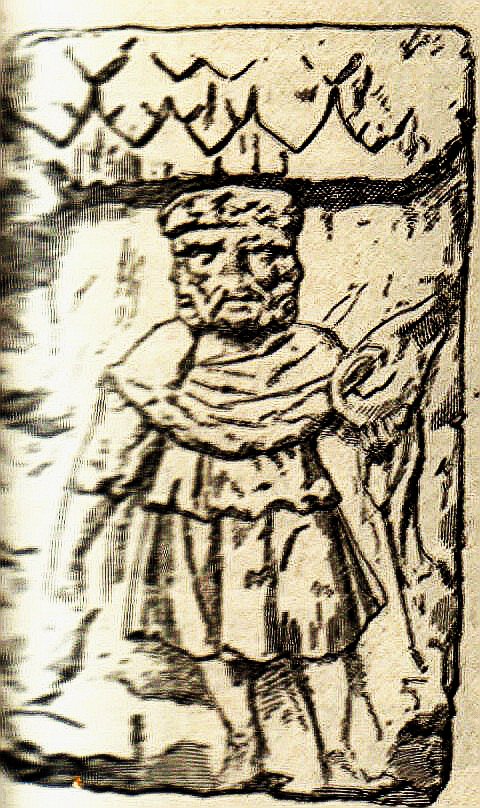 Celts
Celts
[Left: A three-headed image of a Celtic deity, interpreted as Mercury and now believed to represent Lugus]
When they described the gods of Celtic and Germanic tribes, rather than considering them separate deities, the Romans interpreted them as local manifestations or aspects of their own gods, a cultural trait called the interpretatio Romana. Mercury in particular was reported as becoming extremely popular among the nations the Roman Empire conquered; Julius Caesar wrote of Mercury being the most popular god in Britain and Gaul, regarded as the inventor of all the arts. This is probably because in the Roman syncretism, Mercury was equated with the Celtic god Lugus, and in this aspect was commonly accompanied by the Celtic goddess Rosmerta. Although Lugus may originally have been a deity of light or the sun (though this is disputed), similar to the Roman Apollo, his importance as a god of trade and commerce made him more comparable to Mercury, and Apollo was instead equated with the Celtic deity Belenus.
Romans associated Mercury with the Germanic god Wotan, by interpretatio Romana; 1st-century Roman writer Tacitus identifies the two as being the same, and describes him as the chief god of the Germanic peoples. Julius Caesar, in a section of his "Gallic Wars" describing the customs of the German tribes, wrote "The Germans most worship Mercury," apparently identifiyng Wotan with Mercury.
In Celtic areas, Mercury was sometimes portrayed with three heads or faces, and at Tongeren, Belgium, a statuette of Mercury with three phalli was found, with the extra two protruding from his head and replacing his nose; this was probably because the number 3 was considered magical, making such statues good luck and fertility charms. The Romans also made widespread use of small statues of Mercury, probably drawing from the ancient Greek tradition of hermae markers.
Lugus was a deity apparently worshipped widely in antiquity in the Celtic-speaking world. His name is rarely directly attested in inscriptions, but his importance can be inferred from placenames and ethnonyms, and his nature and attributes are deduced from the distinctive iconography of Gallo-Roman inscriptions to Mercury, who is widely believed to have been identified with Lugus, and from the quasi-mythological narratives involving his linguistic descendants, Irish Lugh and Welsh Lleu Llaw Gyffes.
"Gaulish Mercury"
Julius Caesar in his De Bello Gallico identified six gods worshipped in Gaul, by the usual conventions of interpretatio Romana giving the names of their nearest Roman equivalents rather than their Gaulish names. He said that "Mercury" was the god most revered in Gaul, describing him as patron of trade and commerce, protector of travellers, and the inventor of all the arts. The Irish god Lug bore the epithet samildánach (skilled in all arts), which has led to the widespread identification of Caesar's Mercury as Lugus. Mercury's importance is supported by the more than 400 inscriptions into him in Roman Gaul and Britain. Such a blanket identification is optimistic – Jan de Vries[8] demonstrates the unreliability of any one-to-one concordance in the interpretatio Romana – but the available parallels are worth considering.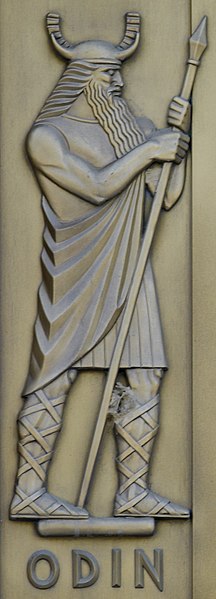
Ancient Germanic Peoples
Odin is considered the chief god in Norse paganism and the ruler of Asgard. Homologous with the Anglo-Saxon Wōden and the Old High German Wotan, it is descended from Proto-Germanic *Wōđinaz or *Wōđanaz. The name Odin is generally accepted as the modern translation; although, in some cases, older translations of his name may be used or preferred. His name is related to ōðr, meaning "fury, excitation", besides "mind", or "poetry". His role, like many of the Norse gods, is complex. He is considered a principal member of the Aesir (Norse Pantheon) and is associated with wisdom, war, battle, and death, and also magic, poetry, prophecy, victory, and the hunt.
Parallels between Odin and Celtic Lugus have often been pointed out: both are intellectual gods, commanding magic and poetry. Both have ravens and a spear as their attributes, and both are one-eyed. Julius Caesar (de bello Gallico, 6.17.1) mentions Mercury as the chief god of Celtic religion. A likely context of the diffusion of elements of Celtic ritual into Germanic culture is that of the Chatti, who lived at the Celtic-Germanic boundary in Hesse during the final centuries before the Common Era.
It can be concluded that various mythological figures, from different cultures, were "associated" with a counterpart. This may have been partly due to political maneuvering by Romans and others, to pacify the population. To conjoin different cultures under a unified imperial state, in the same way that early Christians, rather than try to force the abolition of a pagan holiday, just co-opted it until it more-or-less disappeared.

Sunday, September 6, 2009
From Mercury to Wotan


Sunday, August 30, 2009
The Langobards and the Battle of the Teutoborg Forest - Part III

A new book, 'Rome's Greatest Defeat: Massacre in the Teutoburg Forest' (Adrian Murdock; 2009), states in it's product description: "Over four days at the beginning of September AD 9, half of Rome's Western army was ambushed in a German forest and annihilated. Three legions, three cavalry units and six auxiliary regiments—some 25,000 men—were wiped out. It dealt a body blow to the empire's imperial pretensions and was Rome's greatest defeat. No other battle stopped the Roman empire dead in its tracks. From the moment of the Teutoburg Forest disaster, the Rhine, rather than the Elbe as the Romans had hoped, became the limit of the civilized world. Rome's expansion in northern Europe was checked and Rome anxiously patrolled the Rhineland borders, awaiting further uprisings from Germania. Although one of the most significant and dramatic battles in European history, this is also one that has been largely overlooked. Drawing on primary sources and a vast wealth of new archeological evidence, Adrian Murdoch brings to life the battle itself, the historical background, and the effects of the Roman defeat as well as exploring the personalities of those who took part."
I wanted to note here, a quote from the History Channel's computer graphic-animated documentary of the battle. One quote was as follows:
"The Romans feared the forest as a wild and uncivilized place. They believed that the great oak forest of the north marked the edge of the world. A hundred years later, in (regarding) the events that we're discussing, Tacitus, writing his 'Germania', talks about some mythical part human-part animal figures. So there are areas deep in the interior of Germany which are almost perceived as mythical to the Roman elite. For the German tribes, the forest trees often marked sacred places. The Christmas tree we bring into our home each year, is a reminder of those beliefs."
There is a lot to look at and dissect here. The heavy forests of the Rhineland were, in Roman times, almost perceived as what people thought of in more recent history as like the Congo Basin or the Amazon jungle. A wild, uncivilized, unpredictable, rugged, remote, and scary place. A place ripe with mythology. Germany was, in ancient times, how we might think of the landscape of say Washington or British Columbia.
Even though this quote was merely a quick sidetrack in the documentary, it was a glimpse into some important directions. When they mentioned the Christmas tree, they were talking about Wotanism. I was going to put "they were basically talking about Wotanism," but that wouldn't be accurate. It WAS entirely about Wotanism (called Odinism today). Although we grew up with the idea of it being a Christmas tradition, it predates Christianity by many thousands of years. When they said that it was "a reminder of those (Wotanist) beliefs," that's not necessarily true. We have forgotten this part of our history. When I say "we," I mean "the West," "Europeans," "Americans," etc. There are many examples of where Christianity co-opted pagan holidays and traditions with a new Christian one, rather than try to deconstruct it. To overlap it, or drown it out.
Needless to say, as part of the aftermath of this Roman-German war, Germany retained it's language and culture, while France, for example, adopted the Latin language and Roman customs. Had the Romans been successful, they would have fully intended to take over Germany, Scandinavia, Russia, etc. The monuments to this battle, in both Germany and Minnesota, are, ironically built upon what most would say are "Roman columns." I don't think that is quite as ironic as one might think. Those were actually "Etruscan columns" in origin.
One more quote from the documentary cryptically references Wotanism. Regarding the time just after the Teutoburg massacre: "Those taken prisoner were dragged to ponds deep in the forest, where their throats were cut, and their bodies thrown in the water as a sacrifce to the forest gods." "Forest gods?" Those were Wotanist gods.
Saturday, August 29, 2009
The Langobards and the Battle of the Teutoborg Forest - Part II

Edward Peters, the editor of the book 'History of the Lombards', gave his take on this subject in the first footnote of 'Book I, Chapter VII:
"Scoringa, according to Miillenhoff's explanation in which Bluhme concurs, is "Shoreland" (see Schmidt, 43). Bluhme considers it identical with the later Bardengau, on the left bank of the lower Elbe where the town of Bardowick, twenty-four miles southeast of Hamburg, perpetuates the name of the Langobards even down to the present time. Hammerstein (Bardengau, 56) explains Scoringa as Schieringen near Bleckede in the same region. Schmidt (43) believes that the settlement in Scoringa has a historical basis and certainly, if the name indicates the territory in question, it is the place where the Langobards are first found in authentic history. They are mentioned in connection with the campaigns undertaken by Tiberius against various German tribes during' the reign of Augustus in the fifth and sixth year of the Christian era, in the effort to extend the frontiers of the Roman empire from the Rhine to the Elbe (Mommsen, Romische Geschichte, V, 33). The Langobards then dwelt in that region which lies between the Weser and the lower Elbe. They were described by the court historian Velleius Paterculus (II, 106), who accompanied one of the expeditions as prefect of cavalry (Schmidt, 5), as "more fierce than ordinary German savagery,'' and he tells us that their power was broken by the legions of Tiberius.
"It would appear also from the combined testimony of Strabo (A. D. 20) and Tacitus (A, D. 117) that the Langobards dwelt near the mouth of the Elbe shortly after the beginning of the Christian era, and were in frequent and close relations with the Hermunduri and Semnones, two great Suevic tribes dwelling- higher up the stream. Strabo (see Hodgkin, V, 81) evidently means to assert that in his time the Hermunduri and Langobards had been driven from the left to the right bank. Ptolemy who wrote later (100-161) places them upon the left bank. Possibly both authors were right for different periods in their history (Hodgkin, V, 82). The expedition of Tiberius was the high-water mark of Roman invasion on Teutonic soil, and when a Roman fleet, sailing up the Elbe, established communication with a Roman army upon the bank of that river, it might well be thought that the designs of Augustus were upon the point of accomplishment, and that the boundary of the empire was to be traced by connecting the Danube with the Elbe. The dominions of Marobod, king of the Marcomanni, who was then established in Bohemia, would break the continuity of this boundary, so the Romans proceeded to invade his territories. An insurrection, however, suddenly broke out in Illyricum and the presence of the Roman army was required in that region.
"So a hasty peace was concluded with Marobod, leaving him the possessions he already held. It required four successive campaigns and an enormous number of troops (Mommsen, Rom. Gesch., Vol. V, pp. 35-38) to suppress the revolt. While the Roman veterans were engaged in the Illyrian war, great numbers of Germans led by Arminius, or Hermann, of the Cheruscan tribe rose in rebellion. In the ninth year of our era, Varus marched against them at the head of a force composed largely of new recruits. He was surprised and surrounded in the pathless recesses of the Teutoburg forest and his army of some twenty thousand men was annihilated (id., pp. 38-44). It is not known whether the Langobards were among the confederates who thus arrested the conquest of their country by the Roman army, although they dwelt not far from the scene of this historic battle. They were then considered, however, to belong to the Suevian stock and were subject, not far from this time, to the king of the Marcomanni, a Suevian race (id., p. 34; Tacitus Germania, 38-40; Annals, II, 45), and king Marobod took no part in this war on either side as he had made peace with the Romans. The defeat of Varus was due largely to his own incompetency and it would not appear to have been irretrievable when the immense resources of the Roman empire are considered.
"Still no active offensive operations against the barbarians were undertaken until after the death of Augustus and the succession of Tiberius, A. D. 14, when in three campaigns, the great Germanicus thrice invaded Germany, took captive the wife and child of Arminius, defeated the barbarians in a sanguinary battle, and announced to Rome that in the next campaign the subjugation of Germany would be complete (Mommsen, id., pp. 44-50). But Tiberius permitted no further campaign to be undertaken. The losses suffered by the Romans on the sea as well as on land had been very severe, and whether he was influenced by this fact and by the difficulty of keeping both Gaul and Germany in subjection if the legions were transferred from the Rhine to the Elbe, or whether he was actuated by jealousy of Germanicus, and feared the popularity the latter would acquire by the subjugation of all Germany, cannot now be decided, but he removed that distinguished commander from the scene of his past triumphs and his future hopes, sent him to the East on a new mission, left the army on the Rhine divided and without a general-in-chief, and adopted the policy of keeping that river as the permanent boundary of the empire (id., p. 50-54). Thus the battle in the Teutoburg forest resulted in the maintenance of German independence and ultimately perhaps in the overthrow of the Roman empire itself by German barbarians.
"It marked the beginning of the turn of the tide in Roman conquest and Roman dominion, for although the empire afterwards grew in other directions yet behind the dike here erected, the forces gradually collected which were finally to overwhelm it when it became corrupted with decay. When the legions of Varus were destroyed, the head of the Roman commander was sent to Marobod and his cooperation solicited. He refused however to join the confederated German tribes, he sent the head to Rome for funeral honors, and continued to maintain between the empire and the barbarians, the neutrality he had observed in former wars. This refusal to unite in the national aspirations for German independence, cost him his throne. " Not only the Cheruscans and their confederates " says Tacitus (Ann. II, 45) "who had been the ancient soldiery of Arminius, took arms, but the Semnones and Langobards, both Suevian nations, revolted to him from the sovereignty of Marobod . . . . The armies (Ch. 46) . . . . were stimulated by reasons of their own, the Cheruscans and the Langobards fought for their ancient honor or their newly acquired independence, and the others for increasing their dominion." This occurred in the seventeenth year of our era. Marobod was finally overthrown, and took refuge in exile with the Romans, and it was not long until Arminius, accused of aspiring to despotic power, was assassinated by a noble of his own race (Mommsen, id. 54-56).
"After his death the internal dissensions among the Cheruscans became so violent that the reigning family was swept away, and in the year 47 they asked the Romans to send them as their king the one surviving member of that family, Italirus, the nephew of Arminius, who was born at Rome where he had been educated as a Roman citizen. Accordingly Italicus, with the approval of the emperor Claudius, assumed the sovereignty of the Cheruscans. At first he was received with joy, but soon the cry was raised that with his advent the old liberties of Germany were departing and Roman power was becoming predominant. A struggle ensued, and he was expelled from the country. Again, the Langobards appear upon the scene, with sufficient power as it seems to control the destiny of the tribe which, thirty-eight years before, had been the leader in the struggle for independence, for they restored him to the sovereignty of which he had been despoiled by his inconstant subjects (Tacitus Annals, XI, 16, 17). These events and other internal disturbances injured the Cheruscans so greatly that they soon disappeared from the field of political activity (Mommsen, id., 132). During the generations that followed there was doubtless many a change in the power, the territories and even the names of the various tribes which inhabited Germania Magna, but for a long time peace was preserved along the frontiers which separated them from the Roman world (id., p. 133). It is somewhat remarkable that none of those events appear in the Langobard tradition as contained in the pages of Paul."
Friday, August 28, 2009
The Langobards and the Battle of the Teutoburg Forest - Part 1
 Did the Langobards participate, as part of a Germanic tribal federation, in the Battle of the Teutoburg forest, which ambushed and annihilated a Roman Legion of 18,000 in one of the most important battles of all time? If they did partake, it would have an element of bizarre, as this battle took place in 9 A.D., 559 years prior to the Langobards successfully invading and conquering most of the Italian peninsula.
The Teutoburg Forest is a range of low, forested mountains in the German states of Lower Saxony and North Rhine-Westphalia. The lands west of the Rhine River were part of the Roman Empire. The lands east of the Rhine, and especially between the Rhine and the Elbe River, were long a big problem area for the Romans in as far as their expansion and imperialism was concerned. It was inhabited by many fierce Germanic tribes. We know that, despite their relatively small numbers, the Langobards where noted by the Romans to be particularly fierce even by the standards of of this region. It's a little difficult to imagine them missing out on a battle for German sovereignty and freedom.
The Battle of the Teutoburg Forest (described as clades Variana by Roman historians) took place in A.D. 9 (probably lasting from September 9 to September 11) when an alliance of Germanic tribes led by Arminius, ("Hermann" in German) the son of Segimer of the Cherusci, ambushed and destroyed three Roman legions led by Publius Quinctilius Varus. The battle began a seven-year war which established the Rhine as the boundary of the Roman Empire for the next four hundred years, until the decline of the Roman influence in the West. The Roman Empire made no further concerted attempts to conquer Germania beyond the Rhine.
Upon hearing of the defeat, the Emperor Augustus, according to the Roman historian Suetonius in his Lives of the Twelve Caesars, showed signs of near-insanity, banging his head against the walls of his palace and repeatedly shouting Quintili Vare, legiones redde! ('Quintilius Varus, give me back my legions!'). The three legion numbers were never used again by the Romans after this defeat, unlike other legions that were restructured — a case unique in Roman history. From the time of the rediscovery of Roman sources in the 15th Century, the Battle of Teutoburg Forest has been seen as a pivotal clash which ended Roman expansion into northern Europe.
Arminius, also known as Armin or Hermann (Possibly Eminjoz in proto Germanic) (18 BC/17 BC in Magna Germania; AD 21 in Germania) was a chieftain of the Cherusci who defeated a Roman army in the Battle of the Teutoburg Forest. His influence held an allied coalition of Germanic tribes together in opposition to the Romans but after after decisive defeats to the Roman general Germanicus, nephew of the Emperor Tiberius, his influence waned and he was assasinated on the orders of rival Germanic chiefs. Although Arminius was ultimately unsuccessful in forging unity among the Germanic tribes, the loss of the Roman legions in the Teutoburg forest had a far-reaching effect on the subsequent history of both the ancient Germanic tribes and on the Roman Empire. Germanicus' campaign was the last major Roman military effort east of the Rhine.
The Hermannsdenkmal (German for Hermann monument) is a monument located in North Rhine Westphalia in Germany in the Southern part of the Teutoburg Forest, which is southwest of Detmold in the district of Lippe. It stands on the densely forested and 386 m tall Teutberg in the ring fortification located there, which is called Grotenburg.
The monument commemorates the Cherusci war chief Hermann or Armin (Latin: Arminius) and the Battle of the Teutoburg Forest in which the Germanic tribes under Arminius recorded a decisive victory in 9 AD over three Roman legions under Varus.
The sword has the following inscription:
Deutsche Einigkeit, meine Stärke - meine Stärke, Deutschlands Macht.
German unity (is) my strength - my strength (is) Germany's might.
It's important to note that the Germanic tribes of this time were fighting the good fight for their lands, their culture, and their freedom against what amounted to a self-appointed global dictatorship in the form of the Roman Empire.
The Hermann Heights Monument is a statue erected in New Ulm, Minnesota. The statue depicts Hermann the Cheruscan, also known by the Latin name Arminius, but locals refer to the statue as Herman the German. The only National Register of Historic Places property of its kind in Minnesota, the monument remains an impressive remembrance of German ancestry for many Minnesotans. Visitors to the statue can climb the spiral staircase to an observation platform at the base of the statue, which commands a view of the town and the Minnesota River Valley below.