Showing posts with label Wotan. Show all posts

Tuesday, August 10, 2010

Children of Godan IV: Life along the Danube


Children of Godan IV: Life along the Danube

After peace is made with the Romans and Avars, the Langobard tribe experiences a brief period peace as they reside along the Danube River.

Danube River
http://en.wikipedia.org/wiki/Danube
The Danube (pronounced DAN-ewb in English) is the longest river in the European Union and Europe's second longest river after the Volga.

The river originates in the Black Forest in Germany as the much smaller Brigach and Breg rivers which join at the German town Donaueschingen, after which it is known as the Danube and flows eastwards for a distance of some 2850 km (1771 miles), passing through four Central and Eastern European capitals, before emptying into the Black Sea via the Danube Delta in Romania and Ukraine.

Known to history as one of the long-standing frontiers of the Roman Empire, the river flows through—or forms a part of the borders of—ten countries: Germany (7.5%), Austria (10.3%), Slovakia (5.8%), Hungary (11.7%), Croatia (4.5%), Serbia (10.3%), Bulgaria (5.2%), Moldova (0.017%), Ukraine (3.8%) and Romania (28.9%).


[Music: 'The Night Visits' by Dutch Ramblers; from 'Folk Spirit' CD which is distributed by Odinic Rite Media:

From the OR website:
http://www.odinic-rite.org/ormedia/2009/10/folk-spirit-a-compilation-of-odinist-music/

Also available from Amazon.com, either the CD or individual songs:
http://www.amazon.com/gp/product/B00373IOJ6/ref=dm_sp_alb?ie=UTF8&qid=1281296501&sr=8-1

Sample music from the CD:
http://www.youtube.com/watch?v=_D9E-db0JAs

Saturday, February 13, 2010

Temple of Godan


Godan: God of the Winnili; God of the Langobards.


[Music: 'Falling In' by Tapping The Vein]

Sunday, September 6, 2009

From Mercury to Wotan

In Paul the Deacon's 'History of the Lombards', Book I - Chapter IX, the last sentence reads: "Wotan indeed, whom by adding a letter they called Godan is he who among the Romans is called Mercury, and he is worshipped by all the peoples of Germany as a god, though he is deemed to have existed, not about these times, but long before, and not in Germany, but in Greece."

Was this true? Did the Romans and Greeks share a major god with the Germanic peoples, and perhaps others? If so, that would be a strong bond linking ancient Europe. It should also be noted that the Celts had an extensive mythology, and also we've begun to learn in recent years of the extensive "Slavic mythology" that existed. Staying with the original question, we might be able to start to answer some questions.


Greeks

Hermes is the Messenger of the gods in Greek mythology. An Olympian god, he is also the patron of boundaries and of the travelers who cross them, of shepherds and cowherds, of thieves and road travelers, of orators and wit, of literature and poets, of athletics, of weights and measures, of invention, of general commerce, and of the cunning of thieves and liars.


Romans


In Roman mythology, Mercury (associated with the Greek deity Hermes) was a messenger, and a god of trade, profit and commerce, the son of Maia Maiestas, also known as Ops, the Roman version of Rhea, and Jupiter.

Also according to Wikipedia: "Mercury did not appear among the numinous di indigetes of early Roman religion. Rather, he subsumed the earlier Dei Lucrii as Roman religion was syncretized with Greek religion during the time of the Roman Republic, starting around the 4th century BC. From the beginning, Mercury had essentially the same aspects as Hermes, wearing winged shoes talaria and a winged petasos, and carrying the caduceus, a herald's staff with two entwined snakes that was Apollo's gift to Hermes."


Etruscans


So, according to the above paragraph, Mercury entered the Roman religion some time after the founding of the Roman Republic. There was a break in time there. To answer that question, we again have to explore the Roman ruination of ancient Etruria. The Etruscans called the Greek god Hermes "Turms" (see chart). Well, isn't that interesting. The Etruscans worshipped this god long before Rome, and is it such a stretch to ponder as to whether or not the early Roman elite deliberately deconstructed an important Etruscan god? I have made the comparison of the Etruscans to the USA nation state, and the Romans to the Globalist American leadership. Both deconstructed much of what had been tradition in favor of internationalism.

Now we do not necessarily know if Hermes appeared in Greek mythology prior to Etruscan mythology, but we would have to assume Greece until proven otherwise. We do know that Etruria was not a colony of Greece, and was a strong nation right along with Greece, and that the "Greece then Rome" concept is largely untrue. By destroying the highly advanced Etruscan architecture, the Romans were indeed able to wipe ancient Etruria out of memory.

Celts

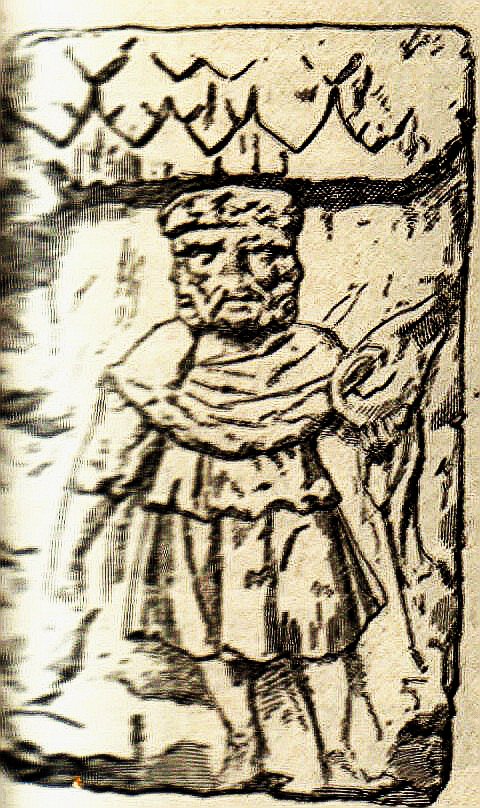
[Left: A three-headed image of a Celtic deity, interpreted as Mercury and now believed to represent Lugus]

When they described the gods of Celtic and Germanic tribes, rather than considering them separate deities, the Romans interpreted them as local manifestations or aspects of their own gods, a cultural trait called the interpretatio Romana. Mercury in particular was reported as becoming extremely popular among the nations the Roman Empire conquered; Julius Caesar wrote of Mercury being the most popular god in Britain and Gaul, regarded as the inventor of all the arts. This is probably because in the Roman syncretism, Mercury was equated with the Celtic god Lugus, and in this aspect was commonly accompanied by the Celtic goddess Rosmerta. Although Lugus may originally have been a deity of light or the sun (though this is disputed), similar to the Roman Apollo, his importance as a god of trade and commerce made him more comparable to Mercury, and Apollo was instead equated with the Celtic deity Belenus.

Romans associated Mercury with the Germanic god Wotan, by interpretatio Romana; 1st-century Roman writer Tacitus identifies the two as being the same, and describes him as the chief god of the Germanic peoples. Julius Caesar, in a section of his "Gallic Wars" describing the customs of the German tribes, wrote "The Germans most worship Mercury," apparently identifiyng Wotan with Mercury.

In Celtic areas, Mercury was sometimes portrayed with three heads or faces, and at Tongeren, Belgium, a statuette of Mercury with three phalli was found, with the extra two protruding from his head and replacing his nose; this was probably because the number 3 was considered magical, making such statues good luck and fertility charms. The Romans also made widespread use of small statues of Mercury, probably drawing from the ancient Greek tradition of hermae markers.

Lugus was a deity apparently worshipped widely in antiquity in the Celtic-speaking world. His name is rarely directly attested in inscriptions, but his importance can be inferred from placenames and ethnonyms, and his nature and attributes are deduced from the distinctive iconography of Gallo-Roman inscriptions to Mercury, who is widely believed to have been identified with Lugus, and from the quasi-mythological narratives involving his linguistic descendants, Irish Lugh and Welsh Lleu Llaw Gyffes.


"Gaulish Mercury"


Julius Caesar in his De Bello Gallico identified six gods worshipped in Gaul, by the usual conventions of interpretatio Romana giving the names of their nearest Roman equivalents rather than their Gaulish names. He said that "Mercury" was the god most revered in Gaul, describing him as patron of trade and commerce, protector of travellers, and the inventor of all the arts. The Irish god Lug bore the epithet samildánach (skilled in all arts), which has led to the widespread identification of Caesar's Mercury as Lugus. Mercury's importance is supported by the more than 400 inscriptions into him in Roman Gaul and Britain. Such a blanket identification is optimistic – Jan de Vries[8] demonstrates the unreliability of any one-to-one concordance in the interpretatio Romana – but the available parallels are worth considering.

Ancient Germanic Peoples


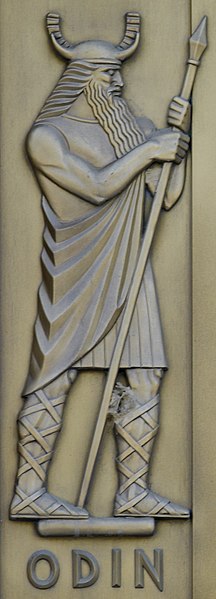
Odin is considered the chief god in Norse paganism and the ruler of Asgard. Homologous with the Anglo-Saxon Wōden and the Old High German Wotan, it is descended from Proto-Germanic *Wōđinaz or *Wōđanaz. The name Odin is generally accepted as the modern translation; although, in some cases, older translations of his name may be used or preferred. His name is related to ōðr, meaning "fury, excitation", besides "mind", or "poetry". His role, like many of the Norse gods, is complex. He is considered a principal member of the Aesir (Norse Pantheon) and is associated with wisdom, war, battle, and death, and also magic, poetry, prophecy, victory, and the hunt.

Parallels between Odin and Celtic Lugus have often been pointed out: both are intellectual gods, commanding magic and poetry. Both have ravens and a spear as their attributes, and both are one-eyed. Julius Caesar (de bello Gallico, 6.17.1) mentions Mercury as the chief god of Celtic religion. A likely context of the diffusion of elements of Celtic ritual into Germanic culture is that of the Chatti, who lived at the Celtic-Germanic boundary in Hesse during the final centuries before the Common Era.

It can be concluded that various mythological figures, from different cultures, were "associated" with a counterpart. This may have been partly due to political maneuvering by Romans and others, to pacify the population. To conjoin different cultures under a unified imperial state, in the same way that early Christians, rather than try to force the abolition of a pagan holiday, just co-opted it until it more-or-less disappeared.

Friday, May 8, 2009

Wotan, Mead, the Irminsul, the Nine Noble Virtues, and other pagan loose ends

There are a few more areas to cover, which I will tie into one entry. I am a believer that a person can view so-called "paganism" as: 1) a religion, 2) a history, 3) a look into the spirituality and soul of a people, and 4) as a set of principles to be adhered to (if they wish). One need not actually "join" a religious and/or spiritual tradition, in order to adhere to it. To make it's values and principles a part of their own conscience.

For example, the 'Nine Noble Virtues'.

Odinic Rite:
1. Courage
2. Truth
3. Honour
4. Fidelity
5. Discipline
6. Hospitality
7. Self Reliance
8. Industriousness
9. Perseverance


Asatru Folk Assembly:

1. Strength is better than weakness
2. Courage is better than cowardice
3. Joy is better than guilt
4. Honour is better than dishonour
5. Freedom is better than slavery
6. Kinship is better than alienation
7. Realism is better than dogmatism
8. Vigor is better than lifelessness
9. Ancestry is better than universalism

Like the 'Ten Commandments' in Christianity, these principles and many other, much deeper, aspects of Odinism (or Asatru) can be admired and studied. I am aware that the Nine Noble Virtues are guidelines and not "thou shalt nots," and they have no concept of "hell," etc., but my real point is that we can look into any faith and adopt some principles from them. I recently viewed an episode on the History Channel program 'Warriors' with Terry Schappert. It was about the Zulu tribe, and they had a special ceremonial tradition after a battle, in which a warrior is purified in order to go back into society. I thought it was in interesting spiritual concept.

The "Viking Era" was a very small part of the history of what we call Odinism or Asatru. Actually, our ancient Lombard ancestors called what was basically the chief god, usually called Odin, the god of war, as Wotan or Wodan. They were Wotanists or Wodanists, and I mean this was many, many centuries ago. The 'Nine Noble Virtues' was taken from one of the Norse Sagas I believe, and the first one, from the Odinic Rite, was the original.


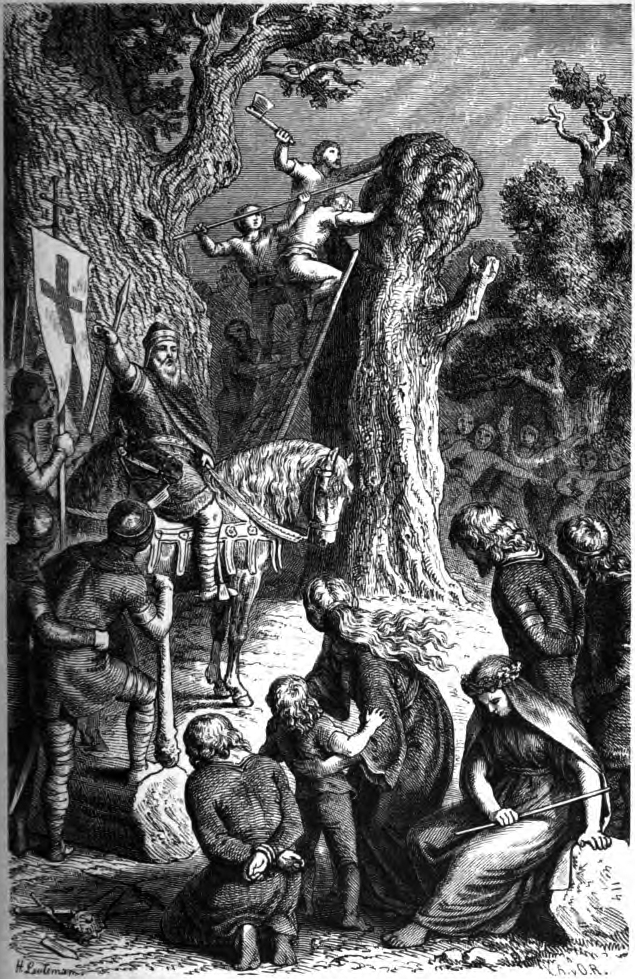
I would also like to at least mention the "Irminsul" (see image to the right), which was a large carved wooden pillar, which was a very important part of this spirituality. I don't think that it was intrinsically worshipped, but may have been a manner to get in touch with all of the gods. Perhaps someone could clue us in there. It appears that the old Germanic tribes often just used a carved tree trunk for this purpose as well. When the Romans, and later powers, finally mobilized themselves to spread Christianity, lets face it, they often did it via force. The following painting was composed by German painter Heinrich Leutemann in 1882, and was entitled 'The destruction of Irminsul through Charlemagne'. It depicts Wotanists literally being forced to accept Christianity as their Irminsul is demolished.


Did you know that names from the days of the week, which we use every day, are from Norse/Germanic spirituality or gods?

Sunday -- "Sun's Day"
Monday -- "Moon's Day"
Tuesday -- "Tiu's Day"
Wednesday -- "Wodan's Day"
Thursday -- "Thor's Day"
Friday -- "Freya's Day"
Saturday -- "Saturn's Day"

Wodan, Wotan, or Woden, may have originally come from the worship of the Greek god Mercury. It's hard sometimes to substantiate some of these things due to various cultures wanting to maintain the purity or originality of their history. I suppose that if this was true, that it was probably due to influence from the Romans, or possibly the Etruscans. I don't really know.

Mead (from description at Wikipedia): "Mead is a typically alcoholic beverage, made from honey and water via fermentation with yeast. Its alcoholic content may range from that of a mild ale to that of a strong wine. It may be still, carbonated, or sparkling. It may be dry, semi-sweet, or sweet.

"Depending on local traditions and specific recipes, it may be brewed with spices, fruits, or grain mash. It may be produced by fermentation of honey with grain mash; mead may also, like beer, be flavored with hops to produce a bitter, beer-like flavor."

What is amazing is that Mead is so hard to find! It was such a part of our ancestors lives, yet it's difficult to find in the market. I don't think that it would be very difficult to make. It can be purchased online pretty easily. Try Yahoo Shopping. Check the Wikipedia link, as there is much more than we have time to research and cover right now. YouTube has videos on how to make Mead as well.

There is an interesting FAQ, from the Wisconsin Vinland Association, called 'An FAQ: Asatru, Wicca, and paganism', which is quite interesting. However, it's pretty apparent that they are a "Universalist" group, meaning that they have a belief that the traditions of their ancestors belong to all other cultures of the earth just as much as it belongs to them. It's probably a split down the middle as far as pagans of European traditions, between those who are Universalist or Folkish. Folkish means that one's heritage is inherently "theirs," and not belonging to every other culture in the world.

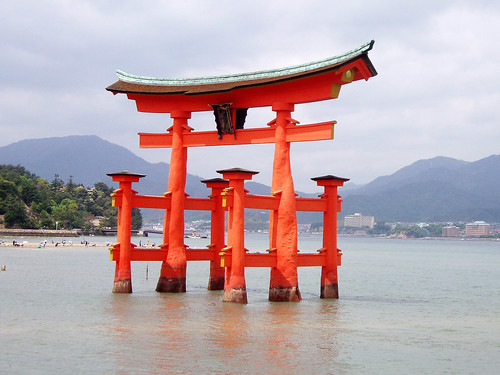
I believe that a European descended person should feel free to study, for example, Shintoism. They may study it, admire it, and even adhere to it; but they can never become a Shintoist because they're not Japanese. It would be extremely disrespectful and dishonorable to try to do this. In the same way, a Japanese person could study and admire Asatru, without trying to co-opt it. Many White Americans flock to Hawaii and force themselves on the native Hawaiian religion, which has caused some of the local Hawaiians to get pretty angry. Again, study, admire, and even adhere to anything, but I believe that it's important for every human being on earth to realize that not everything in the world belongs to YOU. The image above: a Shinto Shrine. Again, don't be afraid to go to YouTube and look up all of these subjects. Many people have downloaded some amazing videos.

I know, this entry has bounced all over the place. I would like to end with an article from the Odinic Rite, entitled 'Images of the Wolf in the Northern Psyche'. It's in PDF, and they don't want it reproduced anywhere without permission, so I will not post the text. It is about the wolf in ancient northern culture and folklore. Actually, much of this folklore survived up to a point in history later than we realize, in some instances. Many ancient Lombard names had a "wulf" ending to them, which comes directly from the reverence of the wolf. I should also mention that this article was written by Heimgest, the director of the Odinic Rite, and I will end this entry with links to four videos of a very interesting interview of him which was conducted.

Interview With a Gothi - Part 1

Interview With a Gothi - Part 2

Interview With a Gothi - Part 3

Interview With a Gothi - Part 4