Showing posts with label Ostrogoths. Show all posts

Saturday, July 18, 2009

Ostrogothic Kingdom: Germanic Conquest


Ostrogothic Kingdom: Germanic Conquest

The Ostrogothic Kingdom established by the Ostrogoths in Italy and neighbouring areas lasted from 493 to 553. In Italy the Ostrogoths replaced Odoacer, the de facto ruler of Italy who had deposed the last emperor of the Western Roman Empire in 476. The Gothic kingdom reached its zenith under the rule of its first king, Theodoric the Great. Most of the social institutions in the late Western Roman Empire were preserved during his rule.

Ostrogothic Kingdom


Theodoric the Great (454 - August 30, 526) was king of the Ostrogoths (471 - 526), ruler of Italy (493 - 526), and regent of the Visigoths (511526). He became a hero of Germanic legend as Þeodric in English legends, Dietrich von Bern in German legends, and as Þjóðrekr and Þiðrekr in Norse mythology.

Theodoric the Great


The Ostrogoths were a branch of the Goths, an East Germanic tribe that played a major role in the political events of the late Roman Empire. The other branch was the Visigoths.

The Ostrogoths established a relatively short-lived successor state of Rome in Italy and the Balkans, even briefly incorporating most of Hispania and southern Gaul. They reached their zenith under their Romanised king Theodoric the Great, who patronised such late Roman figures as Boethius and Cassiodorus, in the first quarter of the sixth century. By mid-century, however, they had been conquered by Rome in the Gothic War (535 - 554), a war with devastating consequences for Italy.

Ostrogoths


Wednesday, August 20, 2008

The Ostrogoths in Italy: Part 2 of 2

Taken from part of "Ostrogothic Kindom" in Wikipedia:

OSTROGOTHIC KINGDOM


The Ostrogothic Kingdom established by the Ostrogoths in Italy and neighbouring areas lasted from 493 to 553. In Italy the Ostrogoths replaced Odoacer, the de facto ruler of Italy who had deposed the last emperor of the Western Roman Empire in 476. The Gothic kingdom reached its zenith under the rule of its first king, Theodoric the Great. Most of the social institutions in the late Western Roman Empire were preserved during his rule.

Starting in 535, the Eastern Roman Empire invaded Italy. The Ostrogothic ruler at that time, Witiges, could not defend successfully and was finally captured when the capital Ravenna fell. The Ostrogoths rallied around a new leader, Totila, and largely managed to reverse the conquest, but were eventually defeated. The last king of the Ostrogothic Kingdom was Teia.

The Ostrogoths

The Ostrogoths were the eastern branch of the Goths. They settled and established a powerful state in Dacia, but during the late 4th century, they came under the dominion of the Huns. After the collapse of the Hunnic empire in 454, large numbers of Ostrogoths were settled by Emperor Marcian in the Roman province of Pannonia as foederati. But in 460, during the reign of Leo I, because the payment of annual sums had ceased, they ravaged Illyricum. Peace was concluded in 461, whereby the young Theodoric Amal, son of Theodemir of the Amals, was sent as a hostage to Constantinople, where he received a Roman education. In previous years, a large number of Goths, first under Aspar and then under Theodoric Strabo, had entered service in the Roman army and were a significant political and military power in the court of Constantinople. The period 477-483 saw a complex three-way struggle among Theodoric the Amal, who had succeeded his father in 474, Theodoric Strabo, and the new Eastern Emperor Zeno. In this conflict, alliances shifted regularly, and large parts of the Balkans were devastated by it. In the end, after Strabo's death in 481, Zeno came to terms with Theodoric. Parts of Moesia and Dacia ripensis were ceded to the Goths, and Theodoric was named magister militum praesentalis and consul for 484. However, barely a year later, Theodoric and Zeno fell out, and again Theodoric's Goths ravaged Thrace. It was then that the thought occurred to Zeno and his advisors to kill two birds with one stone, and direct Theodoric against another troublesome neighbour of the Empire - the Italian kingdom of Odoacer.

Odoacer's kingdom

In 476, Odoacer, a Germanic magister militum, deposed the Western Emperor Romulus Augustulus and declared himself rex Italiae ("King of Italy"), while still nominally remaining under Imperial suzerainty. This fact was recognized by Zeno in 477, when he appointed Odoacer to the rank of patrician. Odoacer retained the Roman administrative system, cooperated actively with the Roman Senate, and his rule was efficient and successful. He evicted the Vandals from Sicily in 477, and in 480 he conquered Dalmatia after the murder of Julius Nepos.

The conquest of Italy by the Goths

An agreement was reached between Zeno and Theodoric, stipulating that Theodoric, if victorious, was to rule in Italy as the emperor's representative. Theodoric with his people set out from Moesia in the autumn of 488, passed through Dalmatia and crossed the Julian Alps into Italy in late August 489. The first confrontation with the army of Odoacer was at the river Isonzo (the battle of Isonzo) on August 28. Odoacer was defeated and withdrew towards Verona, where a month later another battle was fought, resulting in a bloody, but crushing, Gothic victory. Odoacer fled to his capital at Ravenna, while the larger part of his army under Tufa surrendered to the Goths. Theodoric then sent Tufa and his men against Odoacer, but he changed his allegiance again and returned to Odoacer. In 490, Odoacer was thus able to campaign against Theodoric, take Milan and Cremona and besiege the main Gothic base at Ticinum (Pavia). At that point, however, the Visigoths intervened, the siege of Ticinum was lifted, and Odoacer decisively defeated at the river Adda on 11 August 490. Odoacer fled again to Ravenna, while the Senate and many Italian cities declared themselves for Theodoric.

The Goths now turned to besiege Ravenna, but since they lacked a fleet and the city could be resupplied by sea, the siege could be endured almost indefinitely, despite privations. It was not until 492 that Theodoric was able to procure a fleet and capture Ravenna's harbours, thus entirely cutting off communication with the outside world. The effects of this appeared six months later, when, with the mediation of the city's bishop, negotiations started between the two parties. An agreement was reached on 25 February 493, whereby the two should divide Italy between them. A banquet was organised in order to celebrate this treaty. It was at this banquet, on March 15, that Theodoric, after making a toast, killed Odoacer with his own hands. A general massacre of Odoacer's soldiers and supporters followed. Theodoric and his Goths were now masters of Italy.

The reign of Theodoric the Great

"... Theoderic was a man of great distinction and of good-will towards all men, and he ruled for thirty-three years. In his times Italy for thirty years enjoyed such good fortune that his successors also inherited peace. For whatever he did was good. He so governed two races at the same time, Romans and Goths, that although he himself was of the Arian sect, he nevertheless made no assault on the Catholic religion; he gave games in the circus and the amphitheatre, so that even by the Romans he was called a Trajan or a Valentinian, whose times he took as a model; and by the Goths, because of his edict, in which he established justice, he was judged to be in all respects their best king." --Anonymus Valesianus, Excerpta II 59-60

The nature of Theodoric's rule

Like Odoacer, Theodoric was ostensibly a patricius and subject of the emperor in Constantinople, acting as his viceroy for Italy, a position recognized by the new Emperor Anastasius in 497. At the same time, he was the king of his own people, who were not Roman citizens. In reality, he acted as an independent ruler, although unlike Odoacer, he meticulously preserved the outward forms of his subordinate position. The administrative machinery of Odoacer's kingdom, in essence that of the former Empire, was retained and continued to be staffed exclusively by Romans, such as the articulate and literate Cassiodorus. The Senate continued to function normally and was consulted on civil appointments, and the laws of the Empire were still recognized as ruling the Roman population, though Goths were ruled under their own traditional laws. Indeed, as a subordinate ruler, Theodoric did not possess the right to issue his own laws (leges) in the system of Roman law, but merely edicts (edicta), or clarifications on certain details. The continuity in administration is illustrated by the fact that several senior ministers of Odoacer, like Liberius and Cassiodorus the Elder, were retained in the new kingdom's top positions. The close cooperation between Theodoric and the Roman elite began to break down in later years, especially after the healing of the ecclesiastical rift between Rome and Constantinople, as leading senators conspired with the Emperor. This resulted in the arrest and execution of the magister officiorum Boethius and his father-in-law, Symmachus, in 524.

On the other hand, the army and all military offices remained the exclusive preserve of the Goths. The Goths were settled mostly in northern Italy, and kept themselves largely apart from the Roman population, a tendency reinforced by their different faiths: the Goths were mostly Arians, while the people they ruled over were following Chalcedonian Christianity. Nevertheless, and unlike the Visigoths or the Vandals, there was considerable religious tolerance, which was also extended towards Jews. Theodoric's view was clearly expressed in his letters to the Jews of Genoa: "The true mark of civilitas is the observance of law. It is this which makes life in communities possible, and which separates man from the brutes. We therefore gladly accede to your request that all the privileges which the foresight of antiquity conferred upon the Jewish customs shall be renewed to you..." and "We cannot order a religion, because no one can be forced to believe against his will."

Architecture

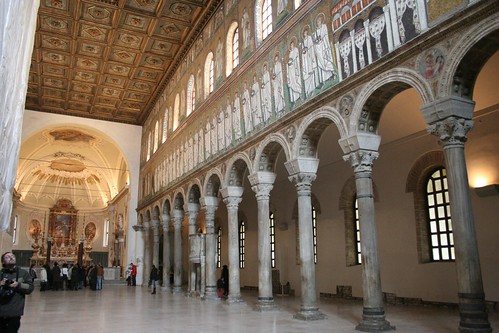
Because of the kingdom's short history, no fusion of the two peoples and their art was achieved. However, under the patronage of Theodoric and Amalasuntha, large-scale restoration of ancient Roman buildings was undertaken, and the tradition of Roman civic architecture continued. In Ravenna, new churches and monumental buildings were erected, several of which survive. The Basilica of Sant'Apollinare Nuovo, its baptistry, and the Archiepiscopal Chapel follow the typical late Roman architectural and decorative motifs, but the Mausoleum of Theodoric displays purely Gothic elements, such as its construction not from the usual brick, but of massive slabs of Istrian limestone, or the 300-ton single-piece roof stone.

Literature

All of the surviving literature written in the Ostrogothic kingdom is in Latin, though some older works were copied in Greek and Gothic (e.g. the Codex Argenteus), and the literature is solidly in the Greco-Roman tradition. Cassiodorus, hailing from a distinguished background, and himself entrusted with high offices (consul and magister officiorum) represents the Roman ruling class. Like many others of his background, he served Theodoric and his heirs loyally and well, something expressed in the writings of the period. In his Chronica, used later by Jordanes in his Getica, as well as in the various panegyrics written by him and other prominent Romans of the time for the Gothic kings, Roman literary and historical tradition is put in the service of their Gothic overlords. His privileged position enabled him to compile the Variae Epistolae, a collection of state correspondence, which gives great insight into the inner workings of the Gothic state. Boethius is another prominent figure of the period. Well-educated and also from a distinguished family, he wrote works on mathematics, music and philosophy. His most famous work, Consolatio philosophiae, was written while imprisoned on charges of treason.

**************************************************

Theodoric the Great

Theodoric is considered to be one of the greatest Germanic kings in history. He was not only a warrior king, but showed great statesmanship and the personality to bring together hostile groups. We don't really have time to go into his life in depth here now, but can get back to him at a future time.

One more time, Theoderic the Great's biography from Wikipedia

**************************************************

The Ostrogothic period was a more complex one than the Lombardic period, mainly because Rome was still strong when the Goths began to flex their muscles in the Balkans. In fact, Byzantine Rome used the Lombards to break up the Gothic power base in Ravenna. In some ways, from our perspective today, the Lombards and the Ostrogoths could be considered under the umbrella of a larger Germanic period in Northern Italian history.

Heritage History Website (info on the Goths and a lot of other subjects)

'The Origin and Deed of the Goths' (by Jordanes)

Jordanes biography (Wikipedia)

Tuesday, August 19, 2008

The Ostrogoths in Italy: Part 1 of 2

THE GOTHS

I believe that the heart and soul of the North Italian cultures stem from the Etruscans and early Italic tribes. The Lombard flag merely symbolizes what was a unified region. The Northern League stresses the Celtic past, pointing out that they had opposed Rome. This is mainly a way of symbolizing the opposition to the modern Roman government. Comunità Odinista stresses our Lombardic past, as the Lombards had practiced Odinism, at least at some point. It's easy to forget that the entire Italian peninsula (the mainland) was part of the Ostrogothic Kingdom, prior to the Lombard invasion.

I wanted to at least give an introduction to the Ostrogoths here, which we can build on later, and I will probably be bouncing all over the place. I have begun reading the book 'The History of the Lombards', and at the beginning, the author Paul the Deacon (a Lombard) points out the tremendous violence of the Germanic nations, and how Italy felt their wrath for centuries. I don't think we should deny that fact, despite what might be a fascination with the barbarians who invaded our ancestral homeland, and partly "became us."

Rather than enter a large amount of text regarding the Goths, who were all over, I will try to use links and look at the bigger picture first, then focus on how they affected Italy. The links will provide further reading, as this history is complex. The Ostrogoths were a branch of the Goths. The Goths were a large Germanic tribe which had settled in Eastern Europe. Like the Lombards, they were Arian Christians by the time they had invaded Italy and the Balkans. Arian Christianity was not Roman Christianity, which is why the early Roman church worked so hard to stamp them out. Centuries later, Queen Theodelinda peacefully brought the region under the Roman church.

The Goths were thought to have originated from "the Gotlanders" in Scandinavia. Gotland Island is a Scandinavian island, which seems to have given rise to a people who later became important on the Scandinavian mainland (Gotlandia, Götaland) and later migrated south. They had a very distinct culture which can be traced throughout their later migrations. Earlier I think I had mentioned that "the Gotts" (Gots, Goti, Guti, Gutar, Gotar, Göta, etc.) were perhaps a branch of the Lombards, but more than likely they were Goths.

Sometime around the 3rd century, the Goths were branching out and making their presence known. They settled near the Danube River, which is were the Lombards settled later, in modern Hungary. The Huns, a large and extremely barbaric central Asian tribe, began to move into the area. They seem to have pushed the Goths southward.

At some point the Goths branched into two main tribes: The Ostrogoths (Eastern Goths) and the Visigoths (Western Goths). The Visigoths migrated southwestward and by 475 had come to dominate almost all of the Iberian peninsula. The Visigoth Kingdom lasted until 711. Along with the Visigothic Kingdom in Spain, the Ostrogoths invaded Italy and the Balkans, where they established their own Kingdom. They ruled the entire area from 488 to 553. Both tribes had partaken in the earlier sacking of Rome.

Wikipedia states that after the two kingdoms were established: "The Goths were briefly reunited under one crown in the early sixth century under Theodoric the Great...." We will go more into Theodoric the Great later.

Backing up a little, it is interesting to me how a small region can affect the world. Gotland Island looks insignificant on a map, yet it was the springboard for a cultural movement that some scholars call the "Gothicismus." Wikipedia states: "Gothicismus, Gothism, or Gothicism (Swedish: Göticism) is the name given to what is considered to have been a cultural movement in Sweden.". Wikipedia goes on to state: During the period ca 600 BC–ca 300 BC the warm and dry climate of southern Scandinavia deteriorated considerably, which not only dramatically changed the flora, but forced people to change their way of living and to leave settlements. The Goths are believed to have crossed the Baltic Sea sometime between the end of this period, ca 300 BC, and 100.

The "Gutasaga" is a Norse saga or history, written in the 13th century, of Gotland and Gothicismus, before it's Christianization. It appears that it was based on the oral tradition or storytelling. It continues with the migration and/or invasions of the Goths southward. The Gutasaga reads "Over a long time, the people descended from these three multiplied so much that the land couldn't support them all. Then they draw lots, and every third person was picked to leave, and they could keep everything they owned and take it with them, except for their land. ... they went up the river Dvina, up through Russia. They went so far that they came to the land of the Greeks. ... they settled there, and live there still, and still have something of our language."

Wikipedia states about the Gutasaga: "That the Goths should have gone "to the land of the Greeks" is consistent with their first appearance in classical sources: Eusebius of Caesarea reported that they devastated "Macedonia, Greece, the Pontus, and Asia" in 263. The emigration would have taken place in the 1st century AD, and loose contact with their homeland would have been maintained for another two centuries, the comment that the emigrant's language "still has something" in common shows awareness of dialectal separation. The events would have needed to be transmitted orally for almost a millennium before the text was written down." "Asia" would have been modern Turkey.

Lastly, Gothic writing and language are other subjects unto itself, which we won't have time to focus on now.


THE OSTROGOTHS

We've already mentioned the Ostrogoths, which was the eastern branch of the Goths. As stated, the Goths had been a single nation until the 3rd century, when they split into two main branches (there were other smaller offshoots). From Wikipedia: "This so-called "split" or, more appropriately, resettlement of western tribes into the Roman province of Dacia was a natural result of population saturation of the area north of the Black Sea. The Goths there established a vast and powerful kingdom, during the 3rd and 4th centuries, between the Danube and the Dniepr in what is now Romania, Moldavia and western Ukraine (see Chernyakhov culture; Gothic runic inscriptions). This was a multi-tribal state ruled by a Gothic elite...." They seem to have migrated from the Roman region of Pannonia (modern Hungary) to the Balkans, where they settled for a good while. They had battled with the Romans, the Huns, and later the Eastern Roman Empire for centuries, off and on between truces and treaties.

Wikipedia briefly sums up the Ostrogoths: "The Ostrogoths (Latin: Ostrogothi or Austrogothi) were a branch of the Goths, an East Germanic tribe that played a major role in the political events of the late Roman Empire. The other branch was the Visigoths. The Ostrogoths established a relatively short-lived successor state of Rome in Italy and the Pannonia, even briefly incorporating most of Hispania and southern Gaul. They reached their zenith under their Romanised king Theodoric the Great, who patronised such late Roman figures as Boethius and Cassiodorus, in the first quarter of the sixth century. By mid-century, however, they had been conquered by Rome in the Gothic War (535–554), a war with devastating consequences for Italy."

Gothic influence was already widespread and remarkable since their rise in Gotland Island centuries before. When the Huns migrated into Europe, it seemed to begin a whole new chapter in Gothic history. I know I'm all over the place here, but this history is hard to look at only in terms of Chronology, as it affected so many other cultures along the way. Another history/fable was written in the 'Hlöðskviða' or otherwise known as 'The Battle of the Goths and Huns.'

The part of specifically Ostrogothic history which affects Italy can follow some chronological order here as follows. From Wikipedia:

"Hunnic invasions

The rise of the Huns around 370 overwhelmed the Gothic kingdoms. Many of the Goths migrated into Roman territory in the Balkans, while others remained north of the Danube under Hunnic rule. They became one of the many Hunnic vassals fighting in Europe, as in the Battle of Chalons in 451. Several uprisings against the Huns were suppressed. The collapse of Hunnic power in the 450s led to further violent upheaval in the lands north of the Danube, during which most of the Goths resident in the area migrated to the Balkans. It was this group that became known as the Ostrogoths.

Gothic was still spoken sporadically in Crimea as late as the 16th century: the Crimean Gothic language.

Post-Hunnic movements

Their recorded history begins with their independence from the remains of the Hunnic Empire following the death of Attila the Hun in 453. Allied with the former vassal and rival, the Gepids and the Ostrogoths led by Theodemir broke the Hunnic power of Attila's sons in the Battle of Nedao in 454.

The Ostrogoths now entered into relations with the Empire, and were settled on lands in Pannonia. During the greater part of the latter half of the 5th century, the East Goths played in south-eastern Europe nearly the same part that the West Goths played in the century before. They were seen going to and fro, in every conceivable relation of friendship and enmity with the Eastern Roman power, until, just as the West Goths had done before them, they passed from the East to the West.

Kingdom in Italy

The greatest of all Ostrogothic rulers, the future Theodoric the Great (whose name means "leader of the people") of Ostrogothic Kingdom, was born to Theodemir in or about 454, soon after the Battle of Nedao. His childhood was spent at Constantinople as a diplomatic hostage, where he was carefully educated. The early part of his life was taken up with various disputes, intrigues and wars within the Byzantine empire, in which he had as his rival Theodoric Strabo, a distant relative of Theodoric the Great and son of Triarius. This older but lesser Theodoric seems to have been the chief, not the king, of that branch of the Ostrogoths which had settled within the Empire at an earlier time. Theodoric the Great, as he is sometimes distinguished, was sometimes the friend, sometimes the enemy, of the Empire. In the former case he was clothed with various Roman titles and offices, as patrician and consul; but in all cases alike he remained the national Ostrogothic king. Theodoric is also known for his attainment of support from the Catholic church, which he gained by appeasing the pope in 520. During his reign, Theodoric, who was Arian, allowed “freedom of religion” which had not been done before. However, he did try to appease the pope and tried to keep his allies with the church strong. He saw the pope as an authority not only in the church but also over Rome.

Theodoric sought to revive Roman culture and government and in doing so, profit the Italian people. It was in both characters together that he set out in 488, by commission from the Byzantine emperor Zeno, to recover Italy from Odoacer. By 493 Ravenna was taken, where Theodoric would set up his capital. It was also at this time that Odoacer was killed by Theodoric's own hand. Ostrogothic power was fully established over Italy, Sicily, Dalmatia and the lands to the north of Italy. In this war the Ostrogoths and Visigoths began again to unite, if we may accept the witness of one writer that Theodoric was helped by Visigothic auxiliaries. The two branches of the nation were soon brought much more closely together; after he was forced to become regent of the Visigothic kingdom of Toulouse, the power of Theodoric was practically extended over a large part of Gaul and over nearly the whole of the Iberian peninsula. Theodoric also attempted to forge an alliance with the Frankish and Burgundian kingdoms by means of a series of diplomatic marriages. This strengthening of power eventually led the Byzantine emperor to fear that Theodoric would become too strong, and motivated his subsequent alliance with the Frankish king, Clovis I, to counter and ultimately overthrow the Ostrogoths.

A time of confusion followed the death of Alaric II, the son-in-law of Theodoric, at the Battle of Vouillé. The Ostrogothic king stepped in as the guardian of his grandson Amalaric, and preserved for him all his Iberian and a fragment of his Gaul dominion. Toulouse passed to the Franks but the Goth kept Narbonne and its district and Septimania, which was the last part of Gaul held by the Goths and kept the name of Gothia for many ages. While Theodoric lived, the Visigothic kingdom was practically united to his own dominion. He seems also to have claimed a kind of protectorate over the Germanic powers generally, and indeed to have practically exercised it, except in the case of the Franks.

The Ostrogothic dominion was now again as great in extent as and far more splendid than it could have been in the time of Hermanaric; however it was now of a wholly different character. The dominion of Theodoric was not a barbarian but a civilized power. His twofold position ran through everything. He was at once national king of the Goths, and successor, though without any imperial titles, of the West Roman emperors. The two nations, differing in manners, language and religion, lived side by side on the soil of Italy; each was ruled according to its own law, by the prince who was, in his two separate characters, the common sovereign of both. It is believed that between 200,000 to 250,000 Ostrogoths settled in Italy but these are guesses and the numbers may have been much lower or higher.

The picture of Theodoric's rule is drawn for us in the state papers drawn up, in his name and in the names of his successors, by his Roman minister Cassiodorus. The Goths seem to have been thick on the ground in northern Italy; in the south they formed little more than garrisons. In Theodoric's theory the Goth was the armed protector of the peaceful Roman; the Gothic king had the toil of government, while the Roman consul had the honour. All the forms of the Roman administration went on, and the Roman policy and culture had great influence on the Goths themselves. The rule of the prince over distinct nations in the same land was necessarily despotic; the old Germanic freedom was necessarily lost. Such a system needed a Theodoric to carry it on. It broke in pieces after his death."

The long war with Rome was a big part of the Ostrogothic Kingdom's history, but too long and complex to go into detail here. The links will provide much further reading. Also, we need to find the books on this kingdom for reference and further study.

Finally, there is some text regarding Ostrogothic culture, but it doesn't go into any read detail in which we can get a good idea of the traditions, architecture, mannerisms, or works of art. Gothic architecture was distinct, and they did create some complex and sightly artwork, which is something else we need to look at in the future. Like the Lombards later, the Ostrogothic culture becomes ours at the end of the day.