Showing posts with label Brennus. Show all posts

Thursday, February 11, 2016

Brennus: Warlord of the Cisalpine Gauls - Part III

Brennus: Hero or plunderer?

Brennus was covered here once before briefly ('Brennus of the 4th century BC'), and the question remains; should Brennus be thought of as our own noble ancestor who stood up against Roman oppressors, or as a foreign invader who only destroyed and plundered? I think the answer is somewhere in the middle.

I recall years ago of reading a Padanian website in English, where Brenno was mentioned as a northern hero. I distinctly remember reading at the end of that particular writing, something like "now Brenno is coming back!" A reference of his Gaulish spirit coming back.

To find the truth, we must recognize two items to begin with. First, Gaul and Cisalpine Gaul were the same culture; and second, the Romans had not invaded the heart of Cisalpine Gaul as of yet. While Brennus was from northern Gaul, there were strong cultural links, For example, part of the northern Gaulish tribe called the Cenomani, apparently migrated to what is now the area of lower Brescia and Verona. These migrations were common, and had occurred over centuries. Therefore, on one hand Brennus was legitimately a powerful figure to the Cisalpine Gauls; while on the other hand the Romans had not invaded the Gauls as of yet. You cannot "strike back" against someone for something they had not done yet; therefore Brennus was more of a plunderer than a resistance fighter.

The simple truth is that the Romans and the Gauls are both part of our heritage. Most the the north were eventually to be culturally "Romanized Gauls." I've always tried to reason that prior to the rise of Rome, there was Gaulish influence in Tuscany and the south ("southern Cisalpina") and Etruscan influence in Lombardy and the north. Had Rome not risen to power, I think that the two cultures (Etruscan-Umbrian and Gaulish-Alpine) would have merged peacefully together. In fact, they already were. In conclusion, in my opinion--as far as this Etrusco-Gaulish ethnic identity concept is concerned--the invading Romans and the later invasion of Germanic tribes were ethno-cultural admixtures.... "secondary influences" as far as ethnicity. Also of interest is that both the Etruscans and the larger Celtic societies, expanded in relative peace. There existed only marginal "pushing" between Etruscans and Gauls; and while local Celtic tribes battled from time to time, it was hardly a clash of civilizations.

In the movie 'Brennus: Enemy of Rome', the Romans were the protagonists. Legitimately defending against an invading barbarian horde. Generally, the Romans are thought of as a civilizing influence amid their ever expanding empire. A cruel system expanding and civilizing an even crueler dark world. The documentary in part one is very interesting with an intentionally ironic title. It showed that the Celtic world (Gaul, British Isles, Spain, south Germany) had a system of roads linking trading centers which traded with other tribes, as well as with Etruscans, Greeks, Phoenicians, etc. They had advanced architecture, including buildings with deep cellars and multiple stories. Their clothing included material, designs, and colors which were very similar to the Scottish clans of much later times. Also, the style of music was similar across this "Celtic world."

It probably wouldn't be entirely truthful to say that Brennus was to the Cisalpine Gauls, what Vercingetorix was to the northern Gauls. There were Cisalpine Gauls among Brennus' army, but Brennus himself was not from Cisalpine Gaul.

************************************************** 

Random fact: I believe that in the movie 'Brennus: Enemy of Rome', Brennus twice made mention of the god "Thor." At one point saying "In the name of Thor!" Thor was a god in the Teutonic pantheon, and not present in Gaulish polytheism. Apparently the filmmakers perceived "the Gauls" as a particular Germanic tribe, instead of an entire culture made up of their own separate tribal groups.

.

Sunday, February 7, 2016

Brennus: Warlord of the Cisalpine Gauls - Part II


Brennus, Enemy of Rome (1963) - Color / 87 mins
 

Vulture Graffix

An English dubbed, Austrian print of Brennus Enemy of Rome (AKA: Brenno der herr des schreckens, AKA: Brenno il nemico di Roma, AKA: Battle of the Valiant). The film was made in 1963 about the sack of Rome in 387 BC. It was written by Adriano Bolzoni, Arpad DeRiso and Nino Scolaro and was directed by Giacomo Gentilomo. It stars Gordon Mitchell, Ursula Davis, Massimo Serato and Tony Kendall.

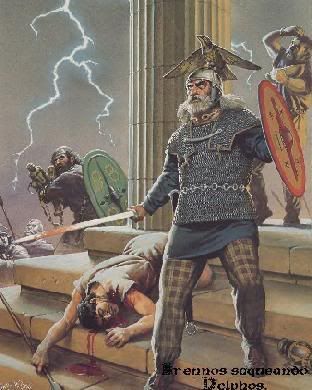
The story takes various elements from Livy's history of the Gauls' attack on Rome, plus Plutarch's biography of Camillus, and cleverly remixes them to fashion a ripping yarn. The banishment of the Roman general Camillus, the controversy over the spoils of Veii, the involvement of the Fabius brothers, the flight of the Vestal virgins from Rome, the barbarian who tugs the beard of a Roman elder, the honking of the sacred geese, and even Brennus's scornful "Woe to the vanquished!" as he heaps his sword onto the scales, are all from the historical record.... and all give tale to a fictional re imagining of the sack of Rome in 387 B.C. by Brennus, leading an army of Gauls.

You can visit our facebook page for further movie mayhem;
https://www.facebook.com/VultureArt


**************************************************


Random fact: "Brennus" in Latin became Brenno in Italian. The city of Breno in northern Brescia possibly may have been named after Brennus, who would have been a hero in the Gaulish Alps. Ironically, the Gaulish sacking of early Rome directly led to the Roman invasion of the Alps centuries later.

.

Saturday, February 6, 2016

Brennus: Warlord of the Cisalpine Gauls - Part I


Barbarians - The Primitive Celts 

docufans1


So you think you know everything about the Romans? They gave us sophisticated road systems, chariots and the modern-day calendar. And of course they had to contend with barbarian hordes who continually threatened the peace, safety and prosperity of their Empire. Didn't they? Terry Jones' Barbarians takes a completely fresh approach to Roman history. Not only does it offer us the chance to see the Romans from a non-Roman perspective, it also reveals that most of the people written off by the Romans as uncivilized, savage and barbaric were in fact organized, motivated and intelligent groups of people, with no intentions of overthrowing Rome and plundering its Empire.


**************************************************

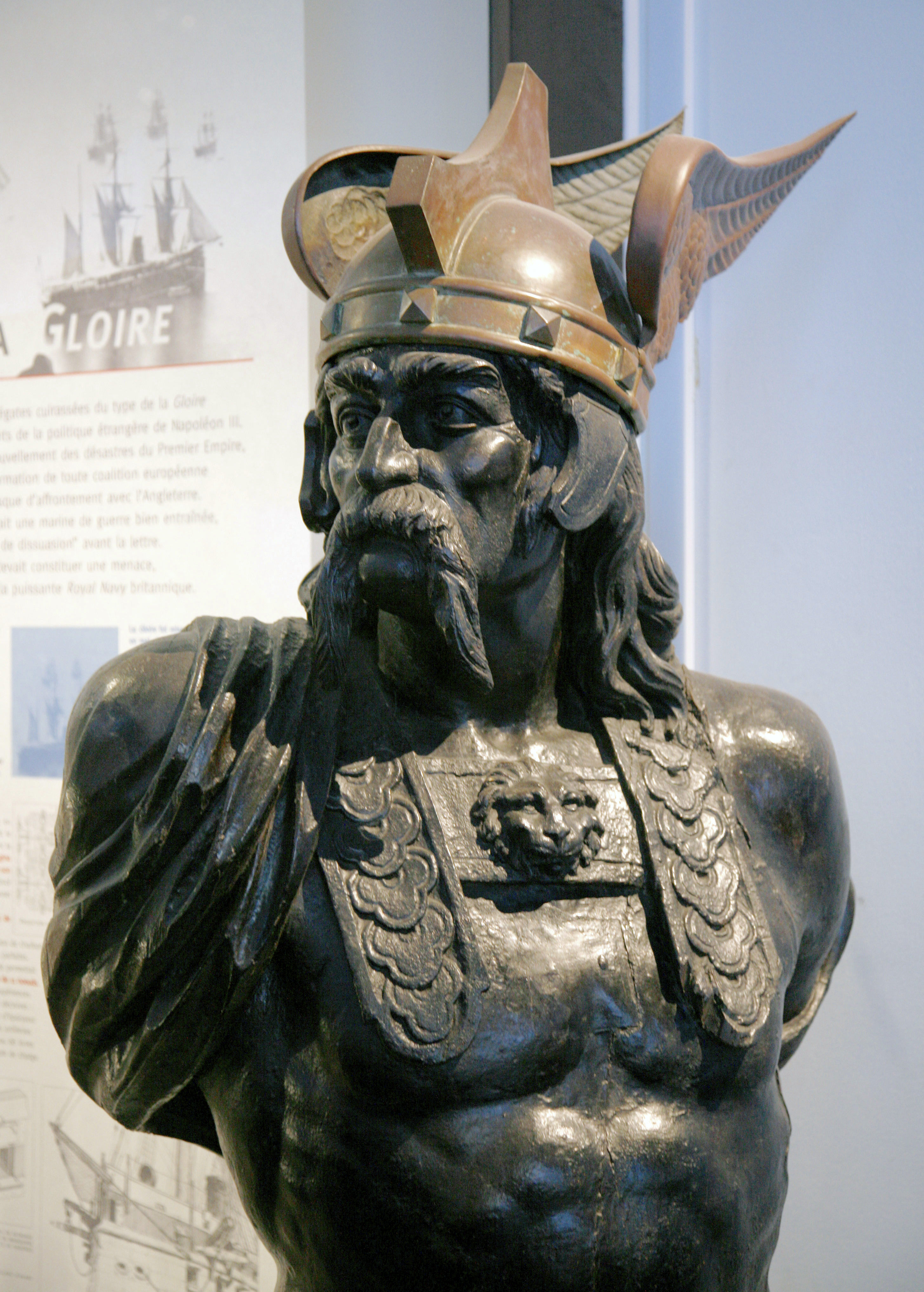
Random fact: Contrary to long held popular perception, the Vikings did not wear horned helmets. However, the Gauls did.


Thursday, September 29, 2011

Brennus of the 4th century BC


Brennus (or Brennos) was a chieftain of the Senones, a Gallic tribe originating from the modern areas of France known as Seine-et-Marne, Loiret, and Yonne, but which had expanded to occupy northern Italy.

More important historically was a branch of the above (called Senones, by Polybius), who about 400 B.C. made their way over the Alps and, having driven out the Umbrians, settled on the east coast of Italy from Ariminum to Ancona, in the so-called ager Gallicus, and founded the town of Sena Gallica (Sinigaglia), which became their capital.

In 391 they invaded Etruria and besieged Clusium. The Clusines appealed to Rome, whose intervention, accompanied by a violation of the law of nations, led to war, the defeat of the Romans at the Allia (18 July 390) and the capture of Rome. In 387 BC he led an army of Cisalpine Gauls in their attack on Rome. It has been theorized that Brennus is actually a title rather than a name. This is because "Brennus" also appears as the name of a Gallic leader 100 years later. It is also possible that Brennus refers to a god, his name taken by the leader before battle in order to invoke the god's favor and powers.

In the Battle of the Allia, Brennus defeated the Romans, and entered the city itself. The Senones captured the entire city of Rome except for the Capitoline Hill, which was successfully held against them. However, seeing their city devastated, the Romans attempted to buy their salvation from Brennus. The Romans agreed to pay one thousand pounds weight of gold. According to Livy, during a dispute over the weights used to measure the gold (the Gauls had brought their own, heavier-than-standard) Brennus threw his sword onto the scales and uttered the famous words "Vae victis!", which translates to "Woe to the vanquished!"

The argument about the weights had so delayed matters that the exiled dictator Marcus Furius Camillus had extra time to muster an army, return to Rome and expel the Gauls, saving both the city and the treasury. Following initial combat through Rome's streets, the Gauls were first ejected from the city, then utterly annihilated in a regular engagement eight miles outside of town on the road to Gabbi. Camillus was hailed by his troops as another Romulus, father of his country 'Pater Patriae' and second founder of Rome.

Some historical accounts say that the Senones besieging the Capitoline Hill were afflicted with an illness and thus were in a weakened state when they took the ransom for Rome. This is plausible as dysentery and other sanitation issues have incapacitated and killed large numbers of combat soldiers up until and including modern times.

It has been theorized that Brennus was working in concert with Dionysius of Syracuse, who sought to control all of Sicily. Rome had strong allegiances with Messana, a small city state in north east Sicily, which Dionysius wanted to control. With Rome's army pinned down by Brennus' efforts Dionysius led a campaign which ultimately failed. Brennus may have been paid twice to sack Rome.

However, the more accepted history (usually citing Livy and Plutarch) finds that Senones marched to Rome to exact retribution for three Roman ambassadors breaking the law of nations (oath of neutrality) in hostilities outside of Clusium. According to this history, the Senones marched to Rome, ignoring the surrounding countryside; once there, they sacked the city for 7 months, and then withdrew. For more information, see the Battle of Allia.

A famous depiction is the academic painting Le Brenn et sa part de butin (1893) by Paul Jamin that shows Brennus viewing his share of spoils (predominantly naked captive women) after the looting of Rome.


In popular culture

Brennus was played by Gordon Mitchell in the 1963 film 'Brennus, Enemy of Rome'.

.