Showing posts with label Northern Italians. Show all posts

Friday, October 17, 2008

More Categories and Endeavors


As stated earlier, we're moving the vast majority of text to this blog. The reason is that it's difficult and time consuming to update web pages, in comparison to just allowing the information and ideas to flow along in a blog. We've now moved another six ideas (for development) here from the main website. I just wanted to enter them, and give a quick description.

Our Patron Saint: This was designated to be Mother Cabrini, the first officially recognized American Saint. She was of Lombardian descent, and seemed to be a logical patron saint. I don't know if this is still a good idea or not, as we have many heros and icons.

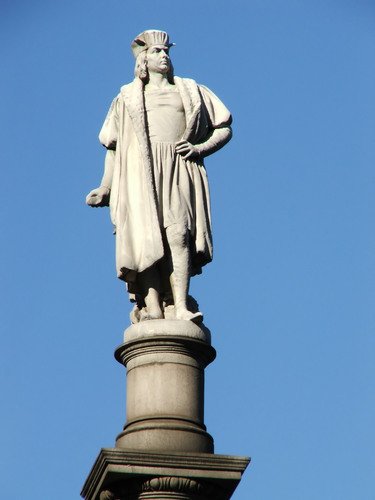
Padanian-American Memorial: In New York City's "Columbus Circle," there is a very impressive statue of Christopher Columbus, which would seem to eliminate the possible need to eventually construct a monument. Again, I don't know now if this is still a good idea. Do we even really need "a memorial?" A cultural center would seem to fill that void. However, sometimes there is a need to have a "special place."

Famous Padanian-Americans: We had attempted to make a list, and this is something that we still need to do. For a relatively small population in America, there are a stunning number of very important individuals. Columbus, Cabot, Verrazzano, Vespucci, Mazzei, Busti, Giannini, Fermi, Cabrini, Beltrami, Vigo, etc., etc. That's just off the top of my head in twenty seconds! Remember the scene from 'The Godfather' were the senate is questioning Michael Corleone? One senator, being the quintessential politician, upon leaving, gives his little speech on "Italian-Americans," and goes on to name many of the great Northern Italians in American history. There's a hidden message in there somewhere, I know it!

Padanian-American Singles: A couple of individuals have suggested this, and it is a very good idea. We just want to merge this as a fuction of the Roundtable that we will form, rather than as just a half-hearted effort on a webpage. This definitely will be accomplished.

Padanian-American Historical Icon: This was another attempt to prop up our own historical figures. Queen Theodelinda was the undisputed queen and ruler of the Lombard Kingdom, and she brought Roman Catholicism to the Lombards, similar to St. Patrick. She could also represent the pagan traditions of the past, in some capacity. In conclusion, for now at least, the appearance of the Lombard queen (Northern Italy) on our logo, and Filippo Mazzei (USA) for our "heritage day," is sufficient.

This brings up a larger complex internal and external issue of Christianity vs. Heathenism. I have come to the conclusion that the Greek communities have this correct. In religion they are Greek Orthodox, but their past pagan icons are always part of their identity. In other words, the issue is ONLY an issue if someone wants to make it an problem. It should be no problem for us. So in conclusion, for us, it shouldn't be "Christianity vs. Heathenism," but "Christianity/Catholicism AND Pagan Identity (Christianity and Heathenism). You can love historical icons, or nature, or whatever, without worshipping it (unless you want to). I think we should follow the "Greek model" on this.

Padanian Females Photo Album: This was a good idea, but I don't want to maintain it, as it is time consuming. There are thousands of images of beautiful women of Tuscan, Lombard, etc., descent. Steve Sailer studies and writes about race, genetic, sociological, and anthropological issues, and when confronted with the question of "who has the most beautiful women?", he had the following to say:

"For European beauty, I'd vote for Northern Italian women."

Saturday, October 4, 2008

Argentine Project


Several months ago, we added a page to the main PAL website entitled "Argentine Project." This was due to what we perceive as the need to connect with our kindred in the "cone of South America." We certainly have not changed our mind about that goal. We just want to move this here to the blog.


***************************************************************************


Buenos Aries, Argentina


***************************************************************************


Argentine Connections

The vast majority of Argentinians are of European descent, primarily Spaniards, Italians (overwhelmingly Northern Italians, especially Lombardians), Germans (Germans, Swiss, Austrians), British Isles-descendants (English, Scottish, Irish), and other Europeans. It is the home of the largest colony of Northern Italians in the world, by far.

Lega Nord has an office in Buenos Aires. We too would like to establish a line of communication between the San Francisco Metro and Buenos Aires and Sao Paulo. As immigration to Northern California was starting to fizzle out, immigration to these areas was just beginning. For a time our ancestors, and theirs, shared the same ships across the Atlantic ocean.

They often came from the same regions and provinces. Up through the 1880s, northwest Italy (mainly Liguria) was the only part of the Italian peninsula which was open for emigration, which was reflected in the makeup of Northern California. This is also why those who migrated to "the Cone" were primarily from the northeast corner of Italy.

Also, as small numbers of Padanian-descendants from the southern "Cone of South America" (Argentina, Chile, Uruguay, Sao Paulo province of Brazil) find their way to California and other states, we want to reach out to them.

We're just using the name "Argentina" as a catch-all term for the entire "Greater Argentina" region. Sao Paulo province has the largest concentration of Italians outside of Italy: Six million people! The city and metro of Sao Paulo has more Italians than any city in the world (yes, more than Rome and Milano!). The population of Sao Paulo Metro is almost 20 million people. The population of the Buenos Aries Metro is over 12 million people. Did you know that Italians MADE Sao Paulo into one of the greatest cities in the world out of absolute abject poverty (before they arrived)?

Also noteworthy is the fact that the climate in this "cone" is not tropical, but very much like the USA or Europe.

***************************************************************************

Oktoberfest 2005 - Cordoba, Argentina


Oktoberfest 2005 from Cordoba, Argentina (image gallery)


***************************************************************************


Northern League office in Argentina (Lega Nord)

Associazione Federale Padani in Europa e nel Mondo
Indirizzo Avenida Centenario 1891 - C,p. B1643CGF
Beccar, Provincia di Buenos Aires, Argentina


***************************************************************************


Sao Paulo, Southern Brazil


Sunday, March 2, 2008

Paesani in Pittsburgh


[Left: Nicholas Ciotola, right has been interviewing Angelo Dozzi, who stands next to him near the hardy kiwi vine in Dozzi's back yard. (Steve Mellon, Post-Gazette)]

This is an article, which appeared in the Pittsburgh Post-Gazette in 1998, entitled 'Paesani in Pittsburgh.' I had a few random thoughts before I place it here. Like the vast majority of articles about Italy in this country, which have a focus on Northern Italy, they mix apples and oranges all over the place. I remember an article by Lou Alfano some years ago, about Filippo Mazzei, which he titled 'Godfather of the American Constitution.' An obvious attempt to play social politics. The title 'Paesani in Pittsburgh' is one that gives me mixed signals. "Paesani" or "Paesans" (countrymen) is very much a "Northeast Italian thing." And yet, a word of that type is needed in some form. Maybe "Polentoni" or "Polentones"? Did that guy D'Andrea really say that Piemonte is the "French-speaking part of Italy" ?? It was a distinct language, with a mild linguistic relation to French, but it's not at all "French." Well, I guess his heart is in the right place. I've made mistakes in my research at times.

This guy Dozzi is really old school. He was from the Tri-Veneto region (northeast Italy). Actually, a significant portion of Western Pennsylvania Italian-Americans are of Northern Italian descent. Also, Northern Michigan. I don't really know why. There's still much research to be done. Even something like Polenta is highly significant, as this simple dish kept people alive during war and hard times in Northern Italy, and elsewhere in Europe as well. Pittsburgh has a "Lucchesi nel Mondo" community, which would give it a connection to the Lucchesi in the Bay Area. South San Francisco is "sister cities" with Lucca in Northern Tuscany. This article also makes mention of "a Little Tuscany in the Mon Valley" (Pennsylvania). We will have to make note of that. Also, to add to the confusion even more, there was (is?) once a significant Italian community in Pittsburg, CA (east of SF; different spelling). I know there was a community, in the 1920's I believe, of people from the Valle Camonica (Northern Brescian mountains), who settled in Monongahela, Pennsylvania and worked in mining mainly. There are people there discovering their roots I have heard, so we need to start to look into all of this. There are links all over the place, separated by time and geography.

When he said his son and family lived right next door, that reminded me of the old sense of community in Italy, or in America. Back when families and relatives actaully lived in the same neighborhood. I remember growing up when the Southern Hills district of Daly City was sort've like 1/3 of an Italian village. There was a sense of community. Where you had a dozen different "fathers" and "mothers" in the neighborhood, who were quick to tell you that you needed to "act right." A kid would say to me, "Lets go to my cousins house" (three blocks away). But in a metropolitan area which has come to resemble the terminal of an airport, where everyone is from somewhere else and either coming or going in a big hurry, how long can something like that last?! Mainly, I think this article is important because he was one of the founders of the Beneficial Society of North Italy (in East Liberty, PA).


Paesani in Pittsburgh

An oral history project documents the lives of Italian Americans in Western Pennsylvania

Tuesday, September 29, 1998

By Patricia Lowry, Post-Gazette Staff Writer

Separated by 60 years and united by a common heritage, two men sit at a table in a yellow and white, 1950s kitchen for one reason: Angelo Dozzi has stories to tell and Nicholas Ciotola wants to hear them. "My name is Angelo Dozzi and I was born Dec. 29, 1911, in Frisanco, in the northern part of Italy. When I was 6, I started school and the war broke out."

As he speaks, Dozzi's words travel into a small microphone clipped to his chest and down a wire that leads to the tape recorder on his table. For more than two hours, he talks about his life in Italy, about coming to America, about his jobs with the beneficial society and the grocery store and the mayor's office.

From time to time, Ciotola glances at his yellow legal pad and offers up another question. It's a gentle grilling that aims to elicit from Dozzi the story of his life.

Hired in the spring as coordinator of Italian American Programs at the Sen. John Heinz Pittsburgh Regional History Center, Ciotola (pronounced chio'-to-la) is spending much of his time collecting oral histories from immigrants and their descendants. Born in New York in 1972 and raised in Lancaster, Ciotola is half Italian: His mother comes from a family that has been in America for generations; his father's parents emigrated from the town of Ateleta in the Abruzzo region in the early 1920s, settling in White Plains, just outside New York City.

But Ciotola never got to know his grandparents, Nicola and Albina Ciotola.

"My dad's dad died when he was 4, and my grandmother died when I was little," Ciotola says. "That's one of the reasons I got into Italian-American history. Going into people's houses and asking about their history allowed me to learn about my own family."

Ciotola was pleased to find a strong sense of ethnicity among the 250,000 Italian Americans in Southwestern Pennsylvania.

"There's a lot of Italian-American organizations in Pittsburgh and a lot of pride," so many that there's even a Coalition of Italian American Organizations.

Ciotola earned his bachelor's degree in history from Penn State, then a master's in history from the University of New Mexico, where he specialized in immigration history and oral history. In 1995 and '96, he was director and principal interviewer for an oral history project documenting the history of Italian immigrants and their descendants in Albuquerque. He later expanded the project into an exhibit of photographs from 1880 to the present.

Ciotola hopes to turn the oral histories here into a similar exhibit.

His salary and projects are funded and directed by the Historical Society of Western Pennsylvania's Italian American Advisory Committee, which has raised more than $500,000 in pledges under the leadership of architect Louis Astorino and honorary Italian consul Joseph D'Andrea.


His goal: A museum

A history museum dedicated to the Italian-American experience in Western Pennsylvania had been D'Andrea's long-held dream, until plans for the History Center got under way. Now D'Andrea and Astorino are working with Ciotola to build the center's artifacts collection and perhaps produce a book or documentary video on Italian-American families and their traditions.

D'Andrea, a former Romance languages teacher who emigrated from Molise in 1948, had what he calls his "awakening" in 1976, during America's Bicentennial. "I was surprised that many Americans knew so little about the countries of their ancestors," he said.

As honorary consul, D'Andrea is the bridge between Italy and America, introducing many to their roots through his research here and in Italy.

While most Italian families in America come from Southern Italy, the first wave of Italian immigrants came in the late 1800s from industrialized Northern Italy, where men already had learned the skills to work in coke ovens and steel mills. Immigrants from Sicily and Tuscany came then, too, to provide the food products and services the industrial workers needed.

In the 1920s there was a mass exodus from the south, and after World War II, from Calabria, one of the more depressed areas. Today's immigrants, D'Andrea says, are the business and professional class - researchers, doctors, engineers and investors who prefer to call themselves "Italians living abroad."

While Pittsburgh has no Little Italy like New York and other cities, it has instead a Little Abruzzo in Bloomfield, a Little Sicily in the Strip, a Little Tuscany in the Mon Valley. Immigrants from certain regions and even certain towns tended to stick together in the new country.

[Right: Angelo Dozzi holds a photograph of himself made in Pittsburgh in 1929. (Steve Mellon, Post-Gazette)]

In Leechburg, D'Andrea says, you can still find people who can speak the dialect of the Piemonte, the French-speaking part of Northwest Italy.

"It's spoken more here than in Italy now."

Morningside Italians tended to come from Calabria, and some of their descendants favored the legal profession. "Most of the Italian-American lawyers and judges are from the Calabresi," D'Andrea said.

In the 1920s, wealthy Sewickley families imported Italian gardeners from Calabria who still have descendants living in Sewickley.

In his oral histories, Ciotola now is focusing his research on the beneficial unions that were established by immigrants, both to help them assimilate and to preserve the traditions of the old country.

One, the Ateleta Beneficial Society in Bloomfield, was founded by immigrants from the same town as Ciotola's father's family. Ciotola's grandmother's sister, Frances Colangelo Sciullo, immigrated in the 1920s to Bloomfield, where her daughter, Michelina Sciullo Mastroiani, still lives. She and her husband, Phil, in fact, are members of the Ateleta Beneficial Society.

Ciotola is interviewing Dozzi because he is one of two surviving founding members of the Beneficial Society of North Italy, established in East Liberty in 1930.

"Ideally you'd like to go back a number of times" and continue the interview, he says. "In the building of that relationship, the person becomes more comfortable and willing to divulge more. I think that's the most important aspect of what we're trying to do here, because it allows people to tell their history in their own words."


'Ate polenta every day'

An isolated village in the foothills of the Italian Alps, Frisanco is on the way to nowhere. There is only one road leading into and out of this picturesque town of stone houses with red canal-tiled roofs, and Dozzi's family - parents, grandparents and four children - lived on the hillside above it, in an ancient four-room house.

The kitchen, warmed by the fireplace used for cooking, also served as the room for family gatherings. The house had no running water or indoor toilets; spring water was carried from the fountain in town.

"We ate polenta every day in Italy, but bread was too expensive to buy," Dozzi says.

"How did you eat the polenta?" Ciotola asks.

What a question, Dozzi's amused look says.

"You grab a piece of polenta and a piece of cheese, then eat one and then the other!" He demonstrates with his hands, pulling imaginary polenta and cheese from the table and popping them into his mouth.

Cornmeal to make the polenta was just about the only thing the family had to buy. In the summer, Dozzi's grandparents lived on their farm, about two miles from town.

"We produced our own milk, our own cheese, butter, eggs and all. We didn't have to buy anything." They grew their own grapes, pears, apples, plums, walnuts, chestnuts, lettuce, escarole, celery, beans.

"Growing up as a child, I had a wonderful life. I loved my grandparents on both sides. They were wonderful people."

But for a year after the Austrian army invaded on Nov. 1, 1917, "we had no food, no provisions of any kind."


The path to America

After the war Dozzi's father, who had worked in America from 1905 to 1910, returned to find work here because there was none at home. During the 1920s he mined coal in eastern Ohio, sending money back to his wife and children.

Dozzi came over in 1928 with his father after one of his visits home. While the elder Dozzi returned to Ohio, Angelo came to stay with his mother's brother, a contractor who lived in East Liberty.

The neighborhood was mostly Italian then, with many men working in the building trades. Within a few weeks, Dozzi was apprenticing as a tile setter and learning English at night at Westinghouse High School.

But with limited construction work available during the Depression, Dozzi had to find other jobs. For two years, he worked at a grocery store on Larimer Avenue for no pay other than three meals a day. Pittsburgh Mayor William McNair hired him as his receptionist in 1935 - mainly, Dozzi says, because he was Italian and the mayor wanted to learn the language. After working for Westinghouse Electric Corp. during World War II, he returned to work at his trade, setting tile.

In 1930, Dozzi was one of about 35 immigrants who formed the Beneficial Society of North Italy, meeting first at the Kingsley House and later in a building next to the grocery store. He was president of the society in 1947, when members erected a new brick-and-stone lodge building with their own hands on Nelson Street, just off Paulson Avenue. It had a dance floor, bar, kitchen and bowling alleys, and a bocce court out back. It was, in many ways, a lot like the small-town clubs in Italy, where members would go to dance and play card games like briscola and scopa.

In the spring, the club donated to the History Society the cornerstone of the building, which closed 11 years ago due to declining membership and is now owned by the lumber company next door.

Dozzi has been back to Italy twice and hopes to go back again next year with his two sons. Victor, the elder, lives next door; the two families share a gently sloping back yard in which the Dozzis have created a kind of little Italy. There are two rows of grapevines; a kiwi arbor, a bountiful pair of chestnut trees and others bearing filberts, hazelnuts, quinces, plums and pawpaws. And a bed of radicchio, the green, leafy kind, which Dozzi puts in salads.

Does he miss the old country?

"In a sort of way, not really. I enjoy the privilege we got over here. It's nice for a visit, but that's it."


'Try to keep a balance'

This is Ciotola's second visit to Dozzi's house; he will go back at least once more, refining his questions to get at the details of a life that is, in many ways, representative of the Italian experience in America.

He has interviewed about an even number of men and women.

"You try to keep a balance between the two," Ciotola says. "Most come from the south, from small towns, agriculturally based. The majority of women didn't work outside the home. They talk about the family and food traditions, and the men go into their working career."

Ciotola has never been to Italy, but, like Dozzi, is planning a trip for next year.

First stop, Ciotola says, is Ateleta.

"That's just as important to me as seeing the Colosseum."

'Paesani in Pittsburgh' article link

Lucchesi nel Mondo - Pittsburgh Chapter

Wednesday, October 17, 2007

The Harmless Ethnic Slur: "Polentone"


The supposed insult, "Polentone" ("Polentoni" in plural), is aimed at people of Northern Italian descent, in an apparent attempt to remind them of their times of struggle. During the hard times of the nineteenth and twentieth centuries, and perhaps at other times, people relied on Polenta to survive.

Hard times such as these affected every nation in Europe, and the world, during this period. Therefore, the "insult" doesn't make a whole lot of sense. The real root of this is from poor Southern Italians, who migrated north after the second world war in the millions, and were denigrated partly due to their extreme poverty. The real reason for this bigotry was that the Italian peninsula was put together in 1860 from numerous nations. This is why Italy has always been such a regional-minded country, at least since the fall of the Roman Empire.

While this term hardly strikes me as an insult, I do recall overhearing some guy in an Italian-American Yahoo chat room, speaking on the microphone, spouting off something about "Polenta, cornmeal, yuck!" This smart alec was probably benignly speaking out of turn, but it sort've ticked me off. This was something that people needed for their very survival. I mean, how high-minded can people be? Hard times seem to be coming back to America. Who knows, maybe he will get a taste of humility.

Polenta is indeed a dish made from boiled cornmeal. I don't think I've ever heard of anyone who didn't like it, except for the joker in the chat room. Although overwhelmingly associated with Northern Italy (not Southern Italy), it is also part of the history of the whole Alpine region (Alpine German, French, and Slavic), and also west to Corsica and as far east as Rumania. I was going to put a recipe here, but it's so easy to find them online. However, I do recommend the book 'The Classic Food of Northern Italy' (Anna Del Conte; 2004).

Many times in history, various people have co-opted negative terms aimed at them. It depends. If the "intent" was so negative, maybe they wouldn't. I don't think there are any Canadians who would take offense at being called a "Canuck." There are a few other examples like this. For whatever it's worth, "Terrone" ("Terroni") refers to a Southern Italian, and "Mezzogiorno" refers to Southern Italy or the former Kingdom of the Two Sicilies. I don't think they're considered negative terms anymore.