Showing posts with label Etruscan mythology. Show all posts

Wednesday, May 22, 2019

Lake Antorno featured now in Windows 10 Spotlight


Lake Antorno

Lago d'Antorno is located in the Dolomites; the province of Belluno in the Veneto.


*************************
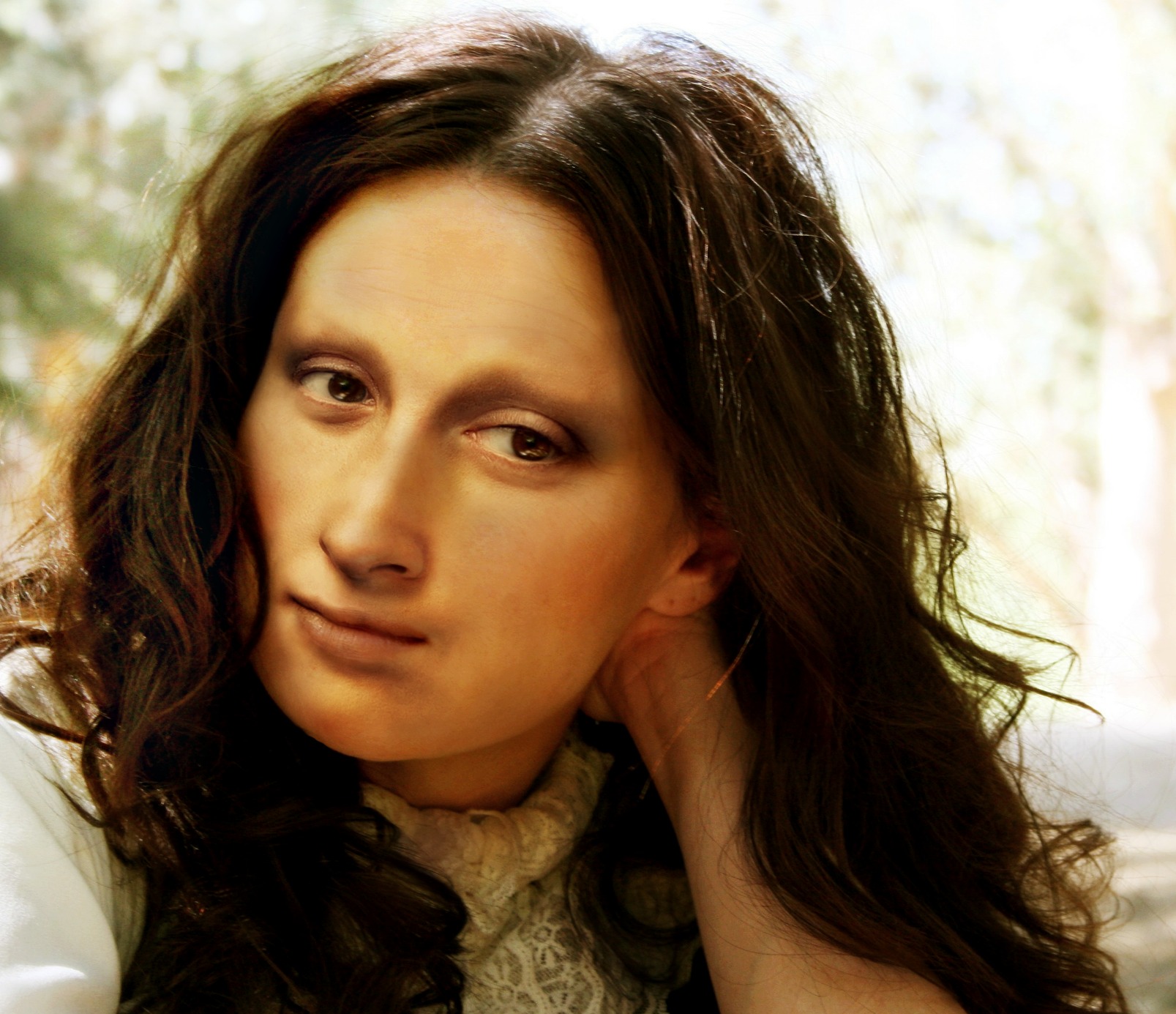


Revisioning drawing of Lisa del Giocondo

Lisa del Giocondo

Lisa del Giocondo (née Gherardini; June 15, 1479 – July 15, 1542) was an Italian noblewoman and member of the Gherardini family of Florence and Tuscany. Her name was given to the Mona Lisa, her portrait commissioned by her husband and painted by Leonardo da Vinci during the Italian Renaissance.

Little is known about Lisa's life. Born in Florence and married in her teens to a cloth and silk merchant who later became a local official, she was a mother to five children and led what is thought to have been a comfortable and ordinary middle-class life. Lisa outlived her husband, who was considerably her senior.

Centuries after Lisa's death, the Mona Lisa became the world's most famous painting and took on a life separate from Lisa, the woman. Speculation by scholars and hobbyists made the work of art a globally recognized icon and an object of commercialization. In 2005, Lisa was definitively identified as the model for the Mona Lisa.


************


'Dark family history behind Mona Lisa's sad smile revealed in new book'

'Leonardo da Vinci never finished the Mona Lisa because he injured his arm while fainting, experts say'


*************************
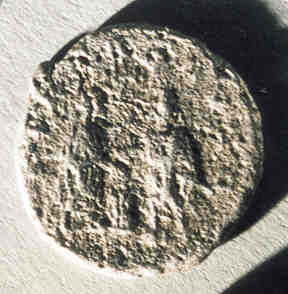


Roman coins from Breathitt County, Kentucky

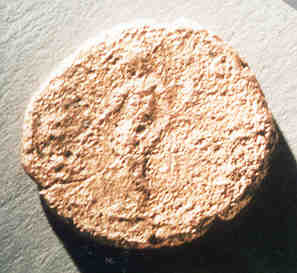
The above three coins were found in a cave shelter in Breathitt County, Kentucky, by Mr. Michael Wayne Griffith of the same county. Mr. Griffith has found another 9 or so similar coins, but the three depicted are the best preserved of the group.

A few years ago the three depicted were examined hands-on by Norman Totten, Professor of History, now Emeritus, at Bentley College. Totten identified the two thinner coins (the top two above) as antoniniani, a type of bronze Roman coin minted between 238 and 305 A.D. The obverses (left photos) depict an unidentifiable emperor wearing the distinctive "solar crown" of the period. The reverse of the top one, in the right photo, depicts two figures standing facing what apparently is a central altar, while that of the middle one depicts a female standing figure facing left with a cornucopia in her right hand.

These would originally have had a silver surface, long since gone. The third coin is thicker, and depicts a bust facing right, wearing a laureate wreath rather than a crown. The reverse, according to Totten, is perhaps a figure of a centaur walking to the right and looking back. Its flan (the metal disk from which coin is made) seems to be of a North African (Egyptian) or Middle Eastern type. This coin probably dates to a similar period to that of the two antoniniani (singular antoninianus). While Totten is confident that the coins are genuine, he warns that such coins are easy to obtain from coin dealers.

In 1963, a small hoard of Roman coins from the same approximate period, and in a much better state of preservation, was found during bridge construction on the north bank of the Ohio River, at the Falls of the Ohio, opposite Louisville, Kentucky.

Breathitt Co., population 16,100 in 2000, is on the upper Kentucky River, in the southeastern portion of the state. The county seat is Jackson, pop. 2,490. Two of the larger towns are named Quicksand and Lost Creek, but the 2000 U.S. Census couldn't find either. The nearest metropolis is Hazard (which may or may not be the inspiration for the "Dukes of Hazzard" TV series), pop. 4,806, and one county to the south.

Mr. Griffith is difficult to contact, but is known to Mr. David Feldman, President of Feldman Lumber Co. in Lancaster, Ky.

The author wishes to thank Prof. Norman Totten, Dr. John Payne, of Berea, Ky., and Mr. David Feldman of Lancaster, Ky., for their invaluable assistance. 


************


Roman Head from Calixtlahuaca, Mexico

Roman coins from the Falls of the Ohio River, Indiana

Roman shipwreck near Rio de Janeiro, Brazil


*************************


Gianfranco Rosi vs Duane Thomas 03-01-1988

Boxing Syko

WBC World Super Welterweight Title Fight

Venue: Palazzo Dello Sport, Genoa, Liguria, Italy


************


Gianfranco Rosi

Gianfranco Rosi (born 5 August 1957) retired Italian boxer who was a two-time world champion in the light-middleweight division.


Professional career

Rosi turned pro in 1979 and won the WBC light-middleweight title in 1987 by decisioning Lupe Aquino. He lost the belt in 1988 when he was dominated by Donald Curry. Rosi was down once in 2nd, 4th and 8th and down twice in 7th, failing to answer the bell starting the 10th round.

In 1989 he won the IBF light-middleweight title by outpointing the undefeated Darrin Van Horn. He went on to successfully defend the title an impressive 11 times. In 1994 he had a technical draw against Vincent Pettway, and in the rematch later that year Pettway KO'd Rosi, ending his long reign.

In 1995 he took on WBO light-middleweight title holder Verno Phillips and won a decision, but Rosi failed a drug test and Phillips was reinstated as champion. The result of the bout was changed to a No Contest. In 1997 he lost a rematch to Phillips and retired.

In 2003 he came out of retirement, and finally retired in 2006 at the age of 49 with a pro record of 62 wins (18 KOs), 6 losses, and 1 draw.


Amateur career

Rosi had a record of 94 wins - 2 losses - 4 draws Highlights:

1976 Italian Light-Welterweight Champion

1977 Italian Welterweight Champion


************


Born in Assisi in the province of Perugia (Umbria), Gianfranco Rosi took a 32-1 record into a European Welterweight Championship bout in 1984 with future world welterweight champion Lloyd Honeyghan from the UK. Rosi lost his first big bout, but won his next nine--including winning the European Junior Middleweight title and defending it twice--and took a 41-2 record into a bout with world champion Luge Aquino of Mexico, a much more dangerous opponent than Honeyghan. Rosi won a unanimous decision to take the belt.

There were so many outstanding boxers worldwide in the 80s, especially between 147 and 160 pounds. Next he defended the belt against another very hard punching boxer, former champion Duane Thomas of Detroit, winning by knockout. Although he lost in his next defense against former welterweight champion Donald Curry, he eventually won the world title back and defended it eleven times before losing.


*************************


The Discovery and Restoration of Leonardo da Vinci's Long-Lost Painting "Salvator Mundi" | Robb Report

Robb Report

Leonardo da Vinci is one of history's greatest artists and thinkers. Only about 15 of his paintings are known to exist and one was thought to be lost forever. Leonard painted that masterpiece, called "Salvator Mundi" (Savior of the World) around 1500. It was owned by no less than three kings and, in 1763, it disappeared. This video tells the story of that incredible painting, how it was rediscovered in 2005, and what happened when it went to auction at Christie's in November 2017.

READ MORE: http://bit.ly/LostDaVinci


Secret Histories of Rare Treasures spotlights the stories behind items that amaze historians, elude collectors, and intrigue audiences. Through original and never-before-seen footage, in-depth archival research, and expert interviews, Robb Report brings these awe-inspiring narratives to life. Developed in coordination with Robb Report’s editors and produced by the brand’s in-house custom-content and video agency Robb Report Studio, the editorial series explores the hidden lives of extremely rare and amazingly valuable items often found in the pages of Robb Report.

Subscribe to Robb Report: https://bit.ly/2rx0Icw


CONNECT WITH ROBB REPORT

Web: http://robbreport.com
Facebook: https://www.facebook.com/robbreport
Twitter: https://www.facebook.com/robbreport
Instagram: https://www.instagram.com/robbreport
Pinterest: https://www.pinterest.com/robbreport


.


*************************


[This portion was originally from the CCNA blog - entitled 'Disciplina Etrusca' by Voltumna - May 31, 2015]

This band named itself after the supreme god of the Etruscan pantheon, "Voltumna" (also called "Veltha"), which I just covered a bit on the other blog ('Etruscan women, mythology, and the god Veltha'). Black Metal music is a lot like the old Heavy Metal music in that some of it is truly good, while most you would probably have to really like the genre to appreciate. This particular song wouldn't be my first choice to promote, but I love the theme! The 'Disciplina Etrusca' was the text of ancient Etruscan polytheism, which was made up of the three "books of fate."

Beyond the larger Black Metal genre, are the sub-genres of "Celtic Black Metal," "Viking Black Metal," etc., etc. One thing this music offers is a clear link to folk-identity, in this case "Etruscan Black Metal." The band's lyrical theme is defined as "Etruscan Paganism, Mythology, Modern Decay"; and it's genre as Black/Death Metal. This additionally suggests a type of Gothic element to it. Dark symbolism can be beautiful, and could be an outlet for people, primarily younger people, who feel alienated by society.

This song is brand new; just released today in fact. The band is from Viterbo, Latium, and has been around since 2009. Viterbo was one of the city-states of the Etruscan civilization. In a Western society which makes a special point to squash identity (individual and collective), I think it's great that people can turn to their ancestors for inspiration and strength. It's not just Black Folk Metal, but there are many other genres which are folk-oriented in this manner. I mean something a little beyond a band merely playing folk music from a certain culture. There's often a rebel-aspect to it. 


If you don't like Black Metal, maybe seek out some of the other types of music within this concept. There's one band from Sardinia called Atrium Animae which is under a genre called "Atmospheric Neoclassical Darkwave," which is hauntingly beautiful.. and is based on what appears to be a Medieval Catholic style. There is Irish Black Metal, Odinic music of many sounds, Slavic, you name it. You might find something you like within one of these folk-spiritual-identity sub-genres.


I like music of just about every texture and harmony, but I don't like "sad music." There are enough things in this life to be sad or depressed about; especially when we lose people. Something inspirational is great, especially when there's that blood-folk connection with a spiritual tie-in. Black Metal is almost like fighting music. Perhaps we need some of that in our lives, because often life is a war. Evolutionary struggle.

Voltumna official website

Voltumna YouTube channel

Metal-Archives.com band profile

Voltumna facebook (official; in Italian mostly)

Voltumna facebook (in English)

.

Saturday, May 30, 2015

Etruscan women, mythology, and the god Veltha


Etruscan Women
 

Tanguy de Thuret
 

Twenty-five hundred years ago, Etruscan women living in the Italian region of what is now called Tuscany were afforded a remarkably equal status with men.
 

An American Art Historian & journalist explains her passion about them & why they are still relevant in contemporary Italian society.

**************************************************

Etruscan mythology

The Etruscan pantheon and its mythology appears to be as mysterious and alluring as any others of the ancient world, yet little is known of it. Part of the reason is that the Romans defeated the Etruscan civilization, destroyed their structures and culture, stole their technology, wiped out any memory of them, and fully replaced them. Only later did they resurrect some of the Etruscan deities under different names. Although apparently goddess-orientated, the supreme god of the Etruscans was a male deity called Voltumna (or Veltha).

The 'Etrusca Disciplina', as they were later referred to by the Romans, were spiritual scriptures made up of three "books of fate." There does seem to be a book of this name in Italian, published in 2006, but it's already out of print... and no English translation. Apparently the original was translated into Latin, yet there is little about it online. I can't even find any evidence that these texts still exist in any form.


Re-imagining and re-imaging the Etruscan pantheon

It's just like anything else, the Etruscan pantheon could be brought back into our imagination if there was the imagery available. For example, the imagery of Odin or Thor, Isis or Thoth, and Zeus or Poseidon, are known the world over. They're probably more known by their images--their dress and props, and the distinct cultural architecture amid the landscap in the background--than they are for even their legends. The Etruscans don't have this in today's world, partly because the Romans stole their thunder.

This would be an interesting challenge for an artist, to do proper research and attempt to recreate this pantheon in art... for example, the god Veltha or the goddess Alpanu. Voltumna, or Veltha as I prefer, is easily the equal of Zeus, Isis, or Odin.

.

Tuesday, June 10, 2014

‘Neverlake’ (2013) – movie review


‘Neverlake’ is a 2013 Italian movie, apparently made for an English-speaking audience. I ordered it via pay-per-view due to its theme, which I found interesting:

On a trip home to visit her father, Jenny is thrown into a world of mystery, horror and legend when she is called upon by 3000 year old spirits of the Neverlake to help return their lost artifacts and save the lives of missing children.

Actually, the film description for the PPV described “Etruscan spirits.” There is surprisingly little information online about his film, outside of a few reviews… of which I haven’t read, as I usually like to try to relay my interpretation firsthand. I wasn’t able to find out which lake it was filmed at, as the lake reminded me of pictures I have seen of Lake Nemi in Tuscany… a location of many legends and folklore. I think most of the filming was around Arezzo in eastern Tuscany. Lake Nemi is in the west, but this lake was mysterious-looking in any case… looking beautifully gloomy and surrounded by heavy woods.

Some background to the story was a little bit unclear. The main protagonist was Jenny.. a sixteen year old girl, of apparently Tuscan birth and heritage, who had been sent to live with an aunt in England at a young age, and was currently going to school in New York City. The movie begins with Jenny on the last leg of her trip to spent the Summer with her father in Arezzo, which is evidently in a rural hilly part of Tuscany, dotted with ancient villages.


This is a difficult movie to review because it was a steady advance of strange experiences, but perhaps none of them standing out in particular. Basically, in one form or another, ancient Etruscan spirits of “the Lake of Idols” seem to be sending her clues regarding.. something. Throughout the film, Jenny’s poetry relay some subtle messages.


Just the theme of Etruscan mythology, combined with the gloomy environment, set an interesting mood. Jenny’s father, apparently a doctor and amateur archeologist, was working on a project regarding ancient Etruscan artifacts. On his wall was a painting of Etruscans engaging in a ritual by that particular lake.. of which they believed had supernatural healing properties. He told Jenny that the painting was just an interpretation by the artist of how they may have held rituals on the lake. I don’t know if there really is such a painting of this theme, or if another painting was used to fit the story. The mysterious terrain of the the land, along with the father and his wife’s unusual actions, results in one strongly getting the impression that there are some secrets being kept. Jenny is told that her mother had passed away.

Soon Jenny meets children from a nearby home for orphaned children suffering from various ailments. This home/facility was fairly large and very old, constructed of stone walls and tiled roofs. It sat alone amidst the natural landscape. Jenny befriends them and reads them stories.. for example, writings of Shakespeare. They begin to trust her, and allow her into their world.

Jenny’s father had removed 2,600 to 3,000 year old statues from the lake, which ties into the main plot. Jenny begins to have supernatural experiences, including strange dreams about the lake. I don’t think I would be giving away too much by saying that the “Souls of the Lake” were unhappy with the removal of their statues (figurines). He had been working on his “project” for twenty years.


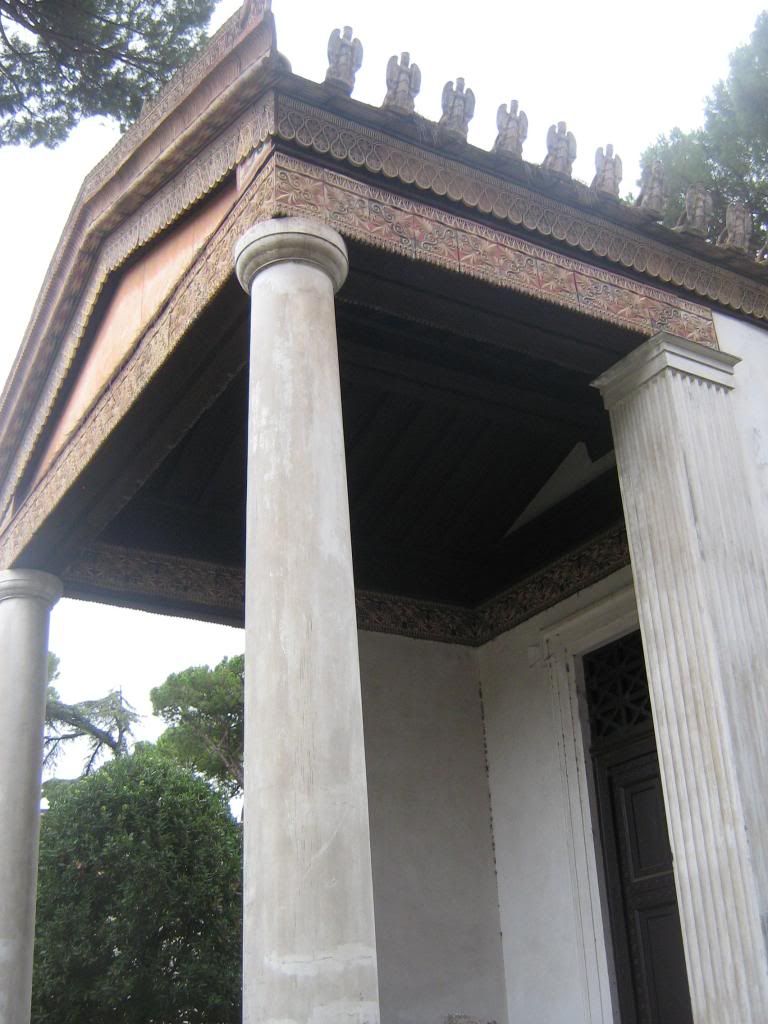
Etruscan temple
I think part of the theme of this film—for me at least—was a folk-pagan concept of reconnecting with one’s ancestors… with a distinction between a true “folk connection,” and one of mere usury. One curious element in the film was one particular character who appeared perhaps dangerous initially, and another who appeared positive initially… well, it turned out to be quite different…

Although this movie moved along with a slow advance—although I found it to be very relaxing and an escape—the ending ties together a large number of loose ends. The film goes from mystery, to horror, to tearjerker at the end. Many things don’t make sense until the dramatic ending scenes. I wouldn’t say that this movie was an absolute “thriller.” It was suspenseful, an escape into the spiritual, and delving into the sensitive theme of child abuse. I guess one could say that it was a common theme of “good vs. evil”… with the adults being the “evil” force… and with the children receiving help from ancestral spirits when they asked for it.
.


Wednesday, May 6, 2009

Etruscan Mythology and Religion: Part 2 of 2


Etruscan Religion (from mysteriousetruscans .com)


Introduction

The basis of Etruscan religion was the fundamental idea that the destiny of man was completely determined by the vagaries of the many deities worshipped by the Etruscans. Every natural phenomenon, such as lightning, the structure of the internal organs of sacrificial animals, or the flight patterns of birds, was therefore an expression of the divine will, and contained a message which could be interpreted by trained priests such as Augurs.

Emerging from this basic concept the Rasenna scrupulously followed a complex code of rituals known by the Romans as the "Disciplina Etrusca." Even up to the fall of the Roman Empire, the Etruscans were regarded by their contemporaries with great respect for their religion and superstitions.

It may have been the fact that Etruscan religious beliefs and practices were so deep-rooted among the Romans that led to the complete destruction of all Etruscan literature as a result of the advent of Christianity. Arnobius, one of the first Christian apologists, living around 300CE, wrote ,"Etruria is the originator and mother of all superstition" .When the Gothic army under Alaric was approaching Rome, the offer made to Pope Innocent I by Etruscan Haruspices was seriously considered by the senate, but finally rejected.

The obvious Eastern Greek influence in Etruscan religion and art from the emergence of the civilisation in the 8th Century BCE, can be interpreted either as evidence of the Etruscan origins in Lydia, or as the influence of subsequent Greek settlement in the prosperous region of Etruria. However it is interpreted, the Etruscan religion was fundamentally unique to the region.

The Etruscan Religion was, like Christianity and Judaism, a revealed religion. An account of the revelation is given by Cicero(On Divination 2.50) . One day, says the legend, in a field near the river Marta in Etruria, a strange event occurred. A divine being rose up from the newly ploughed furrow, a being with the appearance of a child, but with the wisdom of an old man. The startled cry of the ploughman brought lucomones, the priest kings of Etruria hurrying up to the spot. To them, the wise child chanted the sacred doctrine, which they reverently listened to and wrote down, so that this most precious possession could be passed on to their successors. Immediately after the revelation, the miraculous being fell dead and disappeared into the ploughed field. His name was Tages, and he was believed to be the son of Genius and grandson of the highest God, Tinia (or Jupiter as he became known to the Romans). This doctrine was known to the Romans as the Disciplina Etrusca.

From the writings of the Etruscan haruspex Tarquitius around 90 BCE, we also get a glimpse of the prophesy of the nymph Vegoia (Latinised form of the name). This is bound up in the Gramatici veteres, in a corpus of Roman land surveys, We have a passage in which a divinity, the nymph Vergoia, speaks to Arruns Velturnnus:

"You should know that the sea is separated from the earth. When Jupiter claimed the land of Etruria for himself, he decided and commanded the fields to be surveyed and the lands marked out. Knowing the covetousness of man and his worldly greed, he wanted the boundaries of everything to be marked by boundary stones. Those which at any time anyone has placed because of the greed of this eighth - almost the latest - saeculum, arrogating to themselves licence, men with wrongful deceit will violate, touch and move. But if anyone touches or moves a boundary stone, extending his own possessions or diminishing those of someone else, for this crime he will be condemned by the gods. If slaves shall do this, they shall be moved to a lower status by their owner. But if this is done with the knowledge of the master, the household will be immediately uprooted, and the whole of his family will perish. The people responsible will be afflicted by the worst diseases and wounds and their limbs will be weakened. Then even the land will be shaken by storms or whirlwinds and many landslips. The crops will be frequently laid low and cut down by rain and hail, they will perish in the heat of the summer, they will be killed off by blight. There will be civil strife amongst the people. Know that these things happen, when such crimes are committed. Therefore do not be either a deceitful or treacherous. Place restraint in your heart. ..."


The Disciplina Etrusca

The Disciplina Etrusca seems to have comprised three categories of books of fate. The first was that of the Libri Haruspicini, which dealt with divination from the livers of sacrificed animals; the second, the Libri Fulgurates, on the interpretation of thunder and lightning; the third, the Libri Rituales, which covered a variety of matters. They contained, as Festus says, "prescriptions concerning the founding of cities, the consecration of altars and temples, the inviolability of ramparts, the laws relating to city gates, the division into tribes, curiae and centuriae, the constitution and organization of armies, and all other things of this nature concerning war and peace.

Among the Libri Rituales were also three further categories: the Libri Fatales, on the division of time and the life-span of individuals and peoples; the Libri Acherontici, on the world beyond the grave and the rituals for salvation; and finally, the Ostentaria, which gave rules for interpreting signs and portents and laid down the propitiatory and expiatory acts needed to obviate disaster and to placate the gods.


Education

So complex and all-embracing a doctrine naturally required long and laborious study. For this, the Etruscans had special training institutes, among which that at Tarquinii early enjoyed the highest repute. These institutes were much more than priests' seminaries in the modern sense. To judge by their range of studies they were a kind of university with several faculties. For their curricula included not only religious laws and theology, but also the encyclopaedic knowledge required by the priests, which ranged from astronomy and meteorology through zoology, ornithology, and botany to geology and hydraulics. The last subject was the specialty of the aquivices who advised the city-states on all their hydraulic engineering projects. They were expert diviners who knew how to find subterranean water and how to bore wells, how to dig water channels, supply drinking water in the towns, and install irrigation and drainage systems in the fields. In addition they could create artificial reservoirs and they collaborated with other priests who specialized in constructing subterranean corridors and tunneling mountains. In Etruria, as in the ancient East, theological and secular knowledge were not separated. Whatever man set himself to do on earth must be in consonance with the cosmos. Thus all the efforts of the priests were directed upon the heavens when it was necessary to discover the will of the gods in accordance with the sacred doctrine. The orientation and division of space were of crucial importance as much in divination from an animal's liver as in laying the foundation of a temple, in interpreting a shooting star as in surveying land and marking out a garden and field.


Rituals and Planning

Heaven and earth were imagined as being quartered by a great invisible cross consisting of a north-south axis called cardo and an east-west line called decumanus, to use the Latin terms. All ritual and religious observance was based on this division of celestial and terrestrial space. It alone enabled the priests to decipher and understand the signs emanating from the gods. And every sacral and secular undertaking on earth had to be coordinated with it. For the Etruscans believed that auspicious and inauspicious powers were irrevocably and for all eternity located in the four quarters of the sky, in accordance with the cosmic stations of the gods. The east was considered of good augury, because there the highest deities, those favorable to man, had chosen to dwell. The north east was the most auspicious and promised good fortune. In the south the gods of earth and nature ruled. The terrible and merciless gods of the underworld and of fate dwelt, it was believed, in the drear regions of the west, especially in the quarter between north and west, which was the most inauspicious.

The Etruscans even evolved a system of town planning based on these religious concepts, which were likewise reflected in the elaborate ritual prescribed for the foundation of a new city. In Etruria the town laid out in accordance with the sacred rules was considered a minute portion of the cosmos, harmoniously integrated with an all-embracing order governed by the gods.

The priest, after fixing the north-south and east-west lines by the sky, turned to the south and pronounced the words: "This is my front, and this my back, this my left and this my right."

Then wearing his conical hat (which survives today in the form of the Bishop's mitre) and holding his lituus (the Bishop's crook), he solemnly marked out the cross of the cardo and the decumanus.


Belief in Predestination

The Etruscans believed in predestination. Although a postponement is sometimes possible by means of prayer and sacrifice, the end is certain. According to the Libri Fatales as described by Censorinus, Man had allocated to him a cycle of seven times twelve years. Anyone who lived beyond these years, lost the ability to understand the signs of the Gods.

The Etruscans also believed the existence of their people was also limited by a timescale fixed by the gods. According to the doctrine, ten saecula were allotted to the Etruscan name. This proved very accurate, and it is often said that the Etruscan people predicted their own downfall.


Etruscans & Religion (from the University of Pennsylvania Museum of Archaeology and Anthropology)

Etruscans believed theirs to be a revealed religion, communicated to them by the gods of the sky, earth, and the underworld. These forces spoke to mortals through nature and its events: the flight of birds, the sound of thunder, the strikes of lightning bolts, and the entrails of sacrificed animals.

The many modes of learning the gods’ messages brought forth different kinds of prophets. Augurs, for example, read the flight of birds. Haruspices scrutinized the livers of sacrificed sheep for signs of divine disapproval. Etruscans were famous for the way they carried out this rite: unlike their contemporaries, they removed the liver from the slaughtered animal before they examined it. After the divination, the animal’s remains were divided among gods, priests, and people, and consumed.

At Etruscan sanctuaries, grateful worshippers heaped offerings on altars or in special pits. An offering might be a piece of jewelry or other prized possession, but it might also be a special kind of object made for votive use. Bronze or terracotta figurines or models were common: images of gods or goddesses, of suppliants, perhaps of a wished-for baby. Most common of all were terracotta models of the body parts for which healing was sought.

The Etruscans knew many kinds of gods, from spirits of nature and the underworld and invisible sky gods to deities who took on human form. Some of the Etruscan gods who were seen and depicted in human form were shared with Romans and Greeks.


Etruscans: Religion and mythology (from history-world.org)

A History of the Etruscan people including their cities, art, society, rulers and contributions to civilization

By Robert Guisepi 2002

The essential ingredient in Etruscan religion was a belief that human life was but one small meaningful element in a universe controlled by gods who manifested their nature and their will in every facet of the natural world as well as in objects created by humans. This belief permeates the Etruscan representational arts, where one finds rich depictions of land, sea, and air, with man integrated into the ambient. Roman writers give repeated evidence that the Etruscans regarded every bird and every berry as a potential source of knowledge of the gods and that they had developed an elaborate lore and attendant rituals for using this knowledge. Their own myths explained the lore as having been communicated by the gods through a prophet, Tages, a miraculous child with the features of a wise old man who sprang from a plowed furrow in the fields of Tarquinii and sang out the elements of what the Romans called the Etrusca Disciplina.

The literary, epigraphic, and monumental sources provide a glimpse of a cosmology whose image of the sky with its subdivisions is reflected in consecrated areas and even in the viscera of animals. The concept of a sacred space or area reserved for a particular deity or purpose was fundamental, as was the corollary theory that such designated areas could correspond to each other. Heaven reflected Earth, and macrocosm echoed microcosm. The celestial dome was divided into 16 compartments inhabited by the various divinities: major gods to the east, astral and terrestrial divine beings to the south, infernal and inauspicious beings to the west, and the most powerful and mysterious gods of destiny to the north. The deities manifested themselves by means of natural phenomena, principally by lightning. They also revealed themselves in the microcosm of the liver of animals (typical is a bronze model of a sheep's liver found near Piacenza, bearing the incised names of divinities in its 16 outside divisions and in its internal divisions).

These conceptions are linked closely to the art of divination for which the Etruscans were especially famous in the ancient world. Public and private actions of any importance were undertaken only after having interrogated the gods; negative or threatening responses necessitated complex preventive or protective ceremonies. The most important form of divination was haruspicy, or hepatoscopy--the study of the details of the viscera, especially the livers, of sacrificial animals. Second in importance was the observation of lightning and of such other celestial phenomena as the flight of birds (also important in the religion of the Umbri and of the Romans). Finally, there was the interpretation of prodigies--extraordinary and marvelous events observed in the sky or on the earth. These practices, extensively adopted by the Romans, are explicitly attributed by the ancient authors to the religion of the Etruscans.

Etruscans recognized numerous deities (the Piacenza liver lists more than 40), and many are unknown today. Their nature was often vague, and references to them are fraught with ambiguity about number, attributes, and even gender. Some of the leading gods were eventually equated with major deities of the Greeks and Romans, as may be seen especially from the labeled representations on Etruscan mirrors. Tin or Tinia was equivalent to Zeus/Jupiter, Uni to Hera/Juno, Sethlans to Hephaestus/Vulcan, Turms to Hermes/Mercury, Turan to Aphrodite/Venus, and Menrva to Athena/Minerva. But their character and mythology often differed sharply from that of their Greek counterparts. Menrva, for example, an immensely popular deity, was regarded as a sponsor of marriage and childbirth, in contrast to the virgin Athena, who was much more concerned with the affairs of males. Many of the gods had healing powers, and many of them had the authority to hurl a thunderbolt. There were also deities of a fairly orthodox Greco-Roman character, such as Hercle (Heracles) and Apulu (Apollo), who were evidently introduced directly from Greece yet came to have their designated spaces and cults.

Tuesday, May 5, 2009

Etruscan Mythology and Religion: Part 1 of 2

I wanted to make one thing clear to start with. Now that all of the posts from the old Lombardian-American blog have been merged here, as well as many existing posts regarding the history of the ancient Lombards, it could give one the impression of some type of "Lombardophile" concept here. Also, other organizations see Lombard or Celtic heritage as the mainstay of Northern Italian historical identity. While we do utilize symbolic aspects of the Kingdom of the Lombards, we recognize the Etruscans (including the early Italic tribes) as our native stock.

It should be pointed out, again, that the Lombard flag has an Odal Rune in its center, which is actually Etruscan in origin, and it represents the sovereign Northern Italian (Langbard) state. The Romans defeated the Etruscans in war, then absolutely destroyed everything that was Etruscan in the land. It almost reminds me of how Globalists in various nations today, actually attack their own national interests and sovereignty for their personal financial gain. Had this not occurred, history may have ended up being very different than it was. There may have been a permanent Northern Etruria, and the Greeks or Carthaginians may have overtaken the Southern Italian peninsula eventually. In any case, the spirituality of the Etruscans is an area that we do need to take a look at.

Prior to the advance of the Roman Church into the north, there was the Etruscan religion ("
Disciplina Etrusca"?; "Etruscan Trinity"?), Celtic witchcraft (and Celtic Druidism?), and Lombard Odinism (Odin, which they called Wotan or Wodan). However, while I find all of this to be very interesting, it was the Etruscan spirituality which was the one that was homegrown and apparently not shared anywhere else (other than some Greek overlap). When we look at Etruscan gods and mythology, we see that it has all the intrigue of the Greek and Norse gods and mythology. The only difference being that the Romans smothered out the Etruscans from their place in history, and therefore cut it off from it's rightful, inherent, and original Greek-like glory.

There really could have developed a permanent Etruria! Rather than moving towards a Roman-style "empire," they could have developed their own nation and would have been able to defeat any invaders. Again, this seems to me to be directly linked with the Roman devastation of Etruria, which was almost like an internal coup d'etat. Sure, they may have later adopted many of the old Etruscan customs, and perhaps held a certain reverence for them, similar to Americans later holding a reverence of the American Indians, but the world is only now beginning to see the significance of their civilization and place in history. I will state it once again, everything of the Etruscans was especially native to basically Northern Italy. Etruscan civilization extended from around Naples, up to southern Lombardy.


Etruscan mythology (Wikipedia)

The Etruscans were a people of unknown origin living in Northern Italy, who were eventually integrated into Roman culture and politically became part of the Roman Republic. The Etruscans had both a religion and a supporting mythology. Many Etruscan beliefs, customs and divinities became part of Roman culture, including the Roman pantheon. The Etruscans believed that their religion had been revealed to them in early days by seers.


Polytheistic belief system

The Etruscan system of belief was an immanent polytheism; that is, all visible phenomena were considered to be a manifestation of divine power and that power was subsided into deities that acted continually on the world of man and could be dissuaded or persuaded in favor of human affairs. Three layers are evident in the extensive Etruscan art motifs. One appears to be divinities of an indigenous nature: Catha and Usil, the sun, Tivr, the moon, Selvans, a civil god, Turan, the goddess of love, Laran, the god of war, Leinth, the goddess of death, Maris, Thalna, Turms and the ever-popular Fufluns, whose name is related in some unknown way to the city of Populonia and the populus Romanus. Perhaps he was the god of the people.

Ruling over this pantheon of lesser deities were higher ones that seem to reflect the Indo-European system: Tin or Tinia, the sky, Uni his wife (Juno), and Cel, the earth goddess. In addition the Greek gods were taken into the Etruscan system: Aritimi (Artemis), Menrva (Minerva; Latin name for Athena), and Pacha (Bacchus; Latin name for Dionysus) during the Orientalising Period of 850-650 BCE. The heroes taken from Homer also appear extensively in art motifs.


Religious practices

The Etruscans believed in intimate contact with divinity. They did nothing without proper consultation with the gods and signs from them. These practices were taken over in total by the Romans. A god was called an ais (later eis) which in the plural is aisar. Where they were was a fanu or luth, a sacred place, such as a favi, a grave or temple. There one would need to make a fler (plural flerchva) "offering".

Around the mun or muni, the tombs, were the man or mani (Latin Manes), the souls of the ancestors. In iconography after the 5th century BC, the deceased are shown traveling to the underworld. In several instances of Etruscan art, such as in the Francois Tomb, a spirit of the dead is identified by the term hinthial (literally "(one who is) underneath"). A special magistrate, the cechase, looked after the cecha, or rath, sacred things. Every man, however, had his religious responsibilities, which were expressed in an alumnathe or slecaches, a sacred society. No public event was conducted without the netsvis, the haruspex, or his female equivalent, the nethsra. They read the bumps on the liver of a properly sacrificed sheep. We have a model of a liver made of bronze, whose religious significance is still a matter of heated debate, marked into sections which perhaps are meant to explain what the bump in that region should mean. Divination through haruspicy is a tradition originating from the Fertile Crescent.


Beliefs of the hereafter

Like the Egyptians, the Etruscans believed in eternal life, but prosperity there was linked to funeral prosperity here. The tombs in many cases imitated domestic structures and were characterized by spacious chambers, wall paintings and grave furniture. Most Etruscan tombs have been plundered. In the tomb, especially on the sarcophagus, was a representation of the dead person in his or her prime, probably as they wanted to be in the hereafter. Some of the statuary is the finest and most realistic of any. We have no problem visualizing the appearance of the Etruscans. They wanted us to see them smiling and intimate with their kith and kin around them, as we do.


Mythology

The mythology is attested by a number of sources.


Mythological systems

The primary trinity included Tinia, Uni and Menrva.


List of Etruscan mythological figures

The names below were taken mainly from Etruscan "picture bilinguals", which are Etruscan call-outs on art depicting mythological scenes or motifs. Several different media provide names. Variants of the names are given, reflecting differences in language in different localities and times.

Many of the names are Etruscan spellings (and pronunciations) of Greek names. The themes may or may not be entirely Greek. Etruscans frequently added their own themes to Greek myths. The same may be said of native Italic names rendered into Etruscan. Some names are entirely Etruscan. Which is which is often a topic of debate in the international forum of scholarship.


Apulu, Aplu

The Etruscan equivalent of the Greek god, Apollo.


Aritimi, Artumes

Equated with the Greek goddess, Artemis. Infrequently depicted in Etruscan art.


Fufluns

Etruscan god of wine, identified with Dionysus. The name is used in the expressions Fufluns Pacha (Bacchus) and Fufluns Pachie. Puplona (Populonia) was named from Fufluns.


Hercle

With Perseus, the main Etruscan hero, the adopted son of Uni/Juno, who suckled the adult Hercle. His image appears more often than any other on Etruscan carved hardstones. His name appears on the bronze Piacenza Liver, used for divination (hepatoscopy), a major element of Etruscan religious practice. His Etruscan epithet, sometimes substituted for his name, is Calanice, "beautiful victory", derived from Greek Kallinikos


Laran

Etruscan God of war.


Lasa

One of a class of deities, plural Lasas, mainly female, but sometimes male, from which the Roman Lares came. Where the latter were the guardians of the dead, the Etruscan originals formed the court of Turan. Lasa often precedes an epithet referring to a particular deity: Lasa Sitmica, Lasa Achununa, Lasa Racuneta, Lasa Thimrae, Lasa Vecuvia.


Man, Mani

Etruscan class of spirits representing "the dead" and yet not the same as a hinthial, "ghost." From the Mani came the Latin Manes, which are both "the good" and the deified spirits of the dead.


Menerva, Menrva

The Etruscan original to the Roman Minerva, made into Greek Athena.


Nethuns

Italic divinity, probably Umbrian, of springs and water, identified with Greek Poseidon and Roman Neptune, from which the name comes. It occurs in the expression flere Nethuns, "the divinity of Nethuns."


Selvans

God who appears in the expression Selvansl Tularias, "Selvans of the boundaries", which identifies him as a god of boundaries. The name is borrowed from the Roman god, Silvanus.


Tarchon

An Etruscan culture hero who, with his brother, Tyrrhenus, founded the Etruscan Federation of twelve cities.


Tinia, Tina, Tin

Chief Etruscan god, the ruler of the skies, husband of Uni, and father of Hercle, identified with the Greek Zeus and Roman Jupiter well within the Etruscan window of ascendance, as the Etruscan kings built the first temple of Jupiter at Rome. Called apa, "father" in inscriptions (parallel to the -piter in Ju-piter), he has most of the attributes of his Indo-European counterpart, with whom some have postulated a more remote linguistic connection. The name means "day" in Etruscan. He is the god of boundaries and justice. He is depicted as a young, bearded male, seated or standing at the center of the scene, grasping a stock of thunderbolts. According to Latin literature, the bolts are of three types: for warning, good or bad interventions, and drastic catastrophes. Unlike Zeus, Tin needs the permission of the Dii Consentes (consultant gods) and Dii Involuti (hidden gods) to wield the last two categories. A further epithet, Calusna (of Calu), hints at a connection to wolves or dogs and the underworld. In post-classical Tuscan folklore he became an evil spirit, Tigna, who causes lightning strikes, hail, rain, whirlwinds and mildew.


Turan

Etruscan goddess identified with Greek Aphrodite and Roman Venus. She appears in the expression, Turan ati, "Mother Turan", equivalent to Venus Genetrix.[19] Her name is a noun meaning "the act of giving" in Etruscan, based on the verb stem tur- 'to give.'


Turms, Turmś

Etruscan god identified with Greek Hermes and Roman Mercurius. In his capacity as guide to the ghost of Tiresias, who has been summoned by Odysseus, he is Turms Aitas, "Turms Hades."


Uni

Supreme goddess of the Etruscan pantheon, wife of Tinia, mother of Hercle, and patroness of Perugia. With Tinia and Menrva, she was a member of the ruling triad of Etruscan deities. Uni was the equivalent of the Roman Juno (Iuno), whose name Uni may be derived from, and the Greek Hera.


Vanth

Etruscan winged demon of the underworld often depicted in the company of Charun. She could be present at the moment of death, and frequently acted as a guide of the deceased to the underworld.


List of Etruscan mythological figures

Greek deities and their Roman and Etruscan counterparts