Showing posts with label Alps. Show all posts

Wednesday, December 22, 2021

Pragser Wildsee, Südtirol


Pragser Wildsee

Currently on Windows 10 Spotlight

This lake seen here at the base of Seekofel Mountain in the Südtirol. I couldn't find the exact Spotlight image. Seekofel Mountain is part of the Dolomites.

The Pragser Wildsee, or Lake Prags, Lake Braies (Italian: Lago di Braies; German: Pragser Wildsee) is a lake in the Prags Dolomites in South Tyrol, Italy. It belongs to the municipality of Prags which is located in the Prags Valley.

In recent years, the lake earn the nickname of "Pearl of the Alps" due to its increasing popularity among tourists.


Seekofel Mountain, Sudtirol


*************************

Note: I'm backdating this from August 28, 2022. I'm currently living in Sonoma, California. I'll explain in detail later.

.

Sunday, October 31, 2021

Thursday, December 31, 2020

Dragon's Teeth of Vallo Alpino


                            'The Alpine Wall - Italy'


A line of abandoned, alien-like fortresses dot the mountains of North Italy

                                               [AtlasObscura.com]

Similar to the Maginot line of France, the Alpine Wall was built as a defense for Italy in preparation for World War II. There was concern that the natural defense of North Italy’s mountainous terrain was not enough as tensions rose with its neighbors along the top of the “boot”—France, Switzerland, Austria and the former Yugoslavia.

The mountains were enhanced with lookout posts and fortifications all along the passes, stretching over 1,100 miles. The Alpine Wall fortifications varied between three designs: large mountainside forts, rallying points and bunkers, and point-defense fortifications. Many of these can still be seen today.


con't (see images)....


************ 


I saw this subject featured a few days ago on a 2018 episode of 'Mysteries of the Abandoned' (Science Channel) entitled 'Doomsday at Dragon's Teeth'. This elaborate defense system was constructed in 1931, and reflects how Mussolini did not trust Hitler at that point.


************


 Video: The dragon teeth of Pian dei Morti


In the Val Venosta valley, between the borders of Italy and Austria, a weir system was built during WWII, the heart of which was a tank barrier. We will take a closer look at this barrier, as well as the various bunkers which lie 550 meters above Resia. On the way there we enjoy a pleasant, circular hike and inspect the source of the river Adige, the biggest river in South Tyrol.


************


Vallo alpino in Alto Adige


Sbarramento Pian dei Morti


************


Alpenwall - Vallo Alpino - Kreuzbergpass - Mussolinis Festungslinie - Teil 1

Willi seiner

Mussolinis Festungslinie

Der Alpenwall in Südtirol ist der Abschnitt des Vallo Alpino (deutsch Alpenwall), der in den Jahren von 1938 bis 1942


************


Alpenwall in Südtirol


.

Wednesday, May 22, 2019

Lake Antorno featured now in Windows 10 Spotlight


Lake Antorno

Lago d'Antorno is located in the Dolomites; the province of Belluno in the Veneto.


*************************


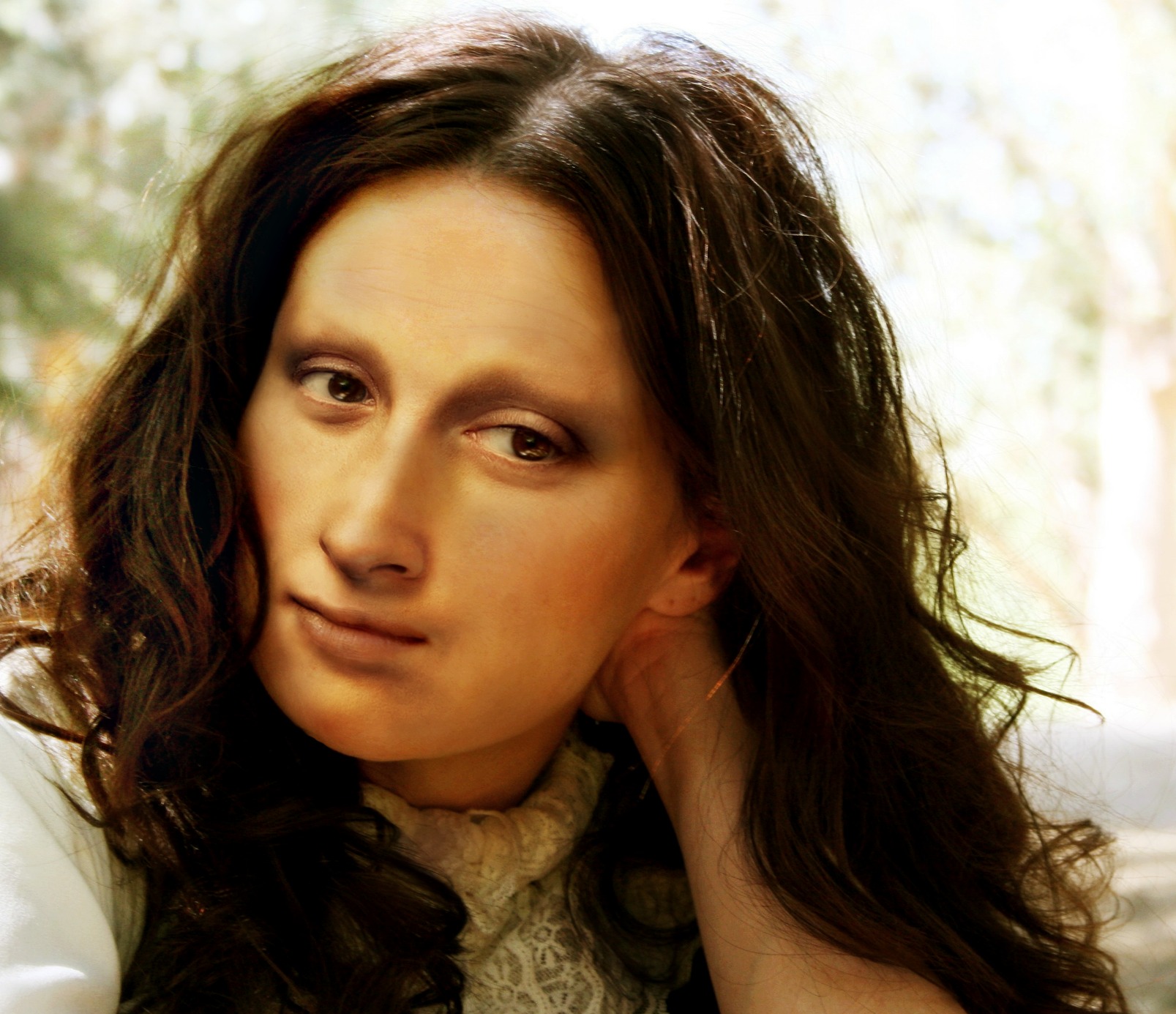
Revisioning drawing of Lisa del Giocondo

Lisa del Giocondo

Lisa del Giocondo (née Gherardini; June 15, 1479 – July 15, 1542) was an Italian noblewoman and member of the Gherardini family of Florence and Tuscany. Her name was given to the Mona Lisa, her portrait commissioned by her husband and painted by Leonardo da Vinci during the Italian Renaissance.

Little is known about Lisa's life. Born in Florence and married in her teens to a cloth and silk merchant who later became a local official, she was a mother to five children and led what is thought to have been a comfortable and ordinary middle-class life. Lisa outlived her husband, who was considerably her senior.

Centuries after Lisa's death, the Mona Lisa became the world's most famous painting and took on a life separate from Lisa, the woman. Speculation by scholars and hobbyists made the work of art a globally recognized icon and an object of commercialization. In 2005, Lisa was definitively identified as the model for the Mona Lisa.


************


'Dark family history behind Mona Lisa's sad smile revealed in new book'

'Leonardo da Vinci never finished the Mona Lisa because he injured his arm while fainting, experts say'


*************************


Roman coins from Breathitt County, Kentucky

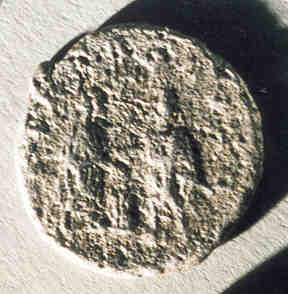
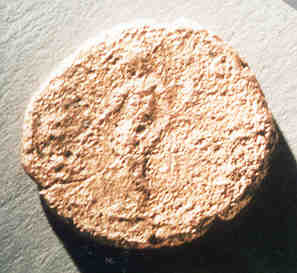
The above three coins were found in a cave shelter in Breathitt County, Kentucky, by Mr. Michael Wayne Griffith of the same county. Mr. Griffith has found another 9 or so similar coins, but the three depicted are the best preserved of the group.

A few years ago the three depicted were examined hands-on by Norman Totten, Professor of History, now Emeritus, at Bentley College. Totten identified the two thinner coins (the top two above) as antoniniani, a type of bronze Roman coin minted between 238 and 305 A.D. The obverses (left photos) depict an unidentifiable emperor wearing the distinctive "solar crown" of the period. The reverse of the top one, in the right photo, depicts two figures standing facing what apparently is a central altar, while that of the middle one depicts a female standing figure facing left with a cornucopia in her right hand.

These would originally have had a silver surface, long since gone. The third coin is thicker, and depicts a bust facing right, wearing a laureate wreath rather than a crown. The reverse, according to Totten, is perhaps a figure of a centaur walking to the right and looking back. Its flan (the metal disk from which coin is made) seems to be of a North African (Egyptian) or Middle Eastern type. This coin probably dates to a similar period to that of the two antoniniani (singular antoninianus). While Totten is confident that the coins are genuine, he warns that such coins are easy to obtain from coin dealers.

In 1963, a small hoard of Roman coins from the same approximate period, and in a much better state of preservation, was found during bridge construction on the north bank of the Ohio River, at the Falls of the Ohio, opposite Louisville, Kentucky.

Breathitt Co., population 16,100 in 2000, is on the upper Kentucky River, in the southeastern portion of the state. The county seat is Jackson, pop. 2,490. Two of the larger towns are named Quicksand and Lost Creek, but the 2000 U.S. Census couldn't find either. The nearest metropolis is Hazard (which may or may not be the inspiration for the "Dukes of Hazzard" TV series), pop. 4,806, and one county to the south.

Mr. Griffith is difficult to contact, but is known to Mr. David Feldman, President of Feldman Lumber Co. in Lancaster, Ky.

The author wishes to thank Prof. Norman Totten, Dr. John Payne, of Berea, Ky., and Mr. David Feldman of Lancaster, Ky., for their invaluable assistance. 


************


Roman Head from Calixtlahuaca, Mexico

Roman coins from the Falls of the Ohio River, Indiana

Roman shipwreck near Rio de Janeiro, Brazil


*************************


Gianfranco Rosi vs Duane Thomas 03-01-1988

Boxing Syko

WBC World Super Welterweight Title Fight

Venue: Palazzo Dello Sport, Genoa, Liguria, Italy


************


Gianfranco Rosi

Gianfranco Rosi (born 5 August 1957) retired Italian boxer who was a two-time world champion in the light-middleweight division.


Professional career

Rosi turned pro in 1979 and won the WBC light-middleweight title in 1987 by decisioning Lupe Aquino. He lost the belt in 1988 when he was dominated by Donald Curry. Rosi was down once in 2nd, 4th and 8th and down twice in 7th, failing to answer the bell starting the 10th round.

In 1989 he won the IBF light-middleweight title by outpointing the undefeated Darrin Van Horn. He went on to successfully defend the title an impressive 11 times. In 1994 he had a technical draw against Vincent Pettway, and in the rematch later that year Pettway KO'd Rosi, ending his long reign.

In 1995 he took on WBO light-middleweight title holder Verno Phillips and won a decision, but Rosi failed a drug test and Phillips was reinstated as champion. The result of the bout was changed to a No Contest. In 1997 he lost a rematch to Phillips and retired.

In 2003 he came out of retirement, and finally retired in 2006 at the age of 49 with a pro record of 62 wins (18 KOs), 6 losses, and 1 draw.


Amateur career

Rosi had a record of 94 wins - 2 losses - 4 draws Highlights:

1976 Italian Light-Welterweight Champion

1977 Italian Welterweight Champion


************


Born in Assisi in the province of Perugia (Umbria), Gianfranco Rosi took a 32-1 record into a European Welterweight Championship bout in 1984 with future world welterweight champion Lloyd Honeyghan from the UK. Rosi lost his first big bout, but won his next nine--including winning the European Junior Middleweight title and defending it twice--and took a 41-2 record into a bout with world champion Luge Aquino of Mexico, a much more dangerous opponent than Honeyghan. Rosi won a unanimous decision to take the belt.

There were so many outstanding boxers worldwide in the 80s, especially between 147 and 160 pounds. Next he defended the belt against another very hard punching boxer, former champion Duane Thomas of Detroit, winning by knockout. Although he lost in his next defense against former welterweight champion Donald Curry, he eventually won the world title back and defended it eleven times before losing.


*************************


The Discovery and Restoration of Leonardo da Vinci's Long-Lost Painting "Salvator Mundi" | Robb Report

Robb Report

Leonardo da Vinci is one of history's greatest artists and thinkers. Only about 15 of his paintings are known to exist and one was thought to be lost forever. Leonard painted that masterpiece, called "Salvator Mundi" (Savior of the World) around 1500. It was owned by no less than three kings and, in 1763, it disappeared. This video tells the story of that incredible painting, how it was rediscovered in 2005, and what happened when it went to auction at Christie's in November 2017.

READ MORE: http://bit.ly/LostDaVinci


Secret Histories of Rare Treasures spotlights the stories behind items that amaze historians, elude collectors, and intrigue audiences. Through original and never-before-seen footage, in-depth archival research, and expert interviews, Robb Report brings these awe-inspiring narratives to life. Developed in coordination with Robb Report’s editors and produced by the brand’s in-house custom-content and video agency Robb Report Studio, the editorial series explores the hidden lives of extremely rare and amazingly valuable items often found in the pages of Robb Report.

Subscribe to Robb Report: https://bit.ly/2rx0Icw


CONNECT WITH ROBB REPORT

Web: http://robbreport.com
Facebook: https://www.facebook.com/robbreport
Twitter: https://www.facebook.com/robbreport
Instagram: https://www.instagram.com/robbreport
Pinterest: https://www.pinterest.com/robbreport


.


*************************


[This portion was originally from the CCNA blog - entitled 'Disciplina Etrusca' by Voltumna - May 31, 2015]

This band named itself after the supreme god of the Etruscan pantheon, "Voltumna" (also called "Veltha"), which I just covered a bit on the other blog ('Etruscan women, mythology, and the god Veltha'). Black Metal music is a lot like the old Heavy Metal music in that some of it is truly good, while most you would probably have to really like the genre to appreciate. This particular song wouldn't be my first choice to promote, but I love the theme! The 'Disciplina Etrusca' was the text of ancient Etruscan polytheism, which was made up of the three "books of fate."

Beyond the larger Black Metal genre, are the sub-genres of "Celtic Black Metal," "Viking Black Metal," etc., etc. One thing this music offers is a clear link to folk-identity, in this case "Etruscan Black Metal." The band's lyrical theme is defined as "Etruscan Paganism, Mythology, Modern Decay"; and it's genre as Black/Death Metal. This additionally suggests a type of Gothic element to it. Dark symbolism can be beautiful, and could be an outlet for people, primarily younger people, who feel alienated by society.

This song is brand new; just released today in fact. The band is from Viterbo, Latium, and has been around since 2009. Viterbo was one of the city-states of the Etruscan civilization. In a Western society which makes a special point to squash identity (individual and collective), I think it's great that people can turn to their ancestors for inspiration and strength. It's not just Black Folk Metal, but there are many other genres which are folk-oriented in this manner. I mean something a little beyond a band merely playing folk music from a certain culture. There's often a rebel-aspect to it. 


If you don't like Black Metal, maybe seek out some of the other types of music within this concept. There's one band from Sardinia called Atrium Animae which is under a genre called "Atmospheric Neoclassical Darkwave," which is hauntingly beautiful.. and is based on what appears to be a Medieval Catholic style. There is Irish Black Metal, Odinic music of many sounds, Slavic, you name it. You might find something you like within one of these folk-spiritual-identity sub-genres.


I like music of just about every texture and harmony, but I don't like "sad music." There are enough things in this life to be sad or depressed about; especially when we lose people. Something inspirational is great, especially when there's that blood-folk connection with a spiritual tie-in. Black Metal is almost like fighting music. Perhaps we need some of that in our lives, because often life is a war. Evolutionary struggle.

Voltumna official website

Voltumna YouTube channel

Metal-Archives.com band profile

Voltumna facebook (official; in Italian mostly)

Voltumna facebook (in English)

.

Monday, June 19, 2017

Saturnia Rising from the Sea - 'Documentary Italy's Mystery Mountains 2014' (Alps, Dolomites, Apennines)


Documentary Italy's Mystery Mountains 2014

documentary HD

Italy's Mystery Mountains explores the fascinating geologic story of Italy, the land known for its fabulous art, fantastic food, opera, the dolce vita, and so much more. What's less known about Italy is the diversity and turbulence of the geology behind all of this abundance: the continuously erupting volcanoes, the violent earthquakes, the clash of mighty tectonic plates, and the rising of the mountains from which Michelangelo sourced his famous marbles.

Italy's Mystery Mountains ties the country's rich artistic culture to its turbulent geologic story, following two international teams of geologists determined to resolve a hotly debated issue: are the Apennines still alive and growing in the north? With the answer to this question the fascinating story of the Italian peninsula will fall into place and geologists may better understand where future earthquakes might strike this highly unstable land.

.

Wednesday, June 22, 2016

La Grande Rogazione di Asiago

" Il Giro del Mondo " La Grande Rogazione di Asiago from Tacconi Luca on Vimeo.


"La Grande Rogazione di Asiago"

"The Great Rogation of Asiago"... apparently a tradition since 1638.

Rogation: In the Christian Church a solemn supplication consisting of the litany of the saints chanted on the three days before Ascension Day.

Asiago is an old Cimbrian town in the Vicenza Province of the Veneto Region.

The town was the site of the Battle of Asiago in 1916 vs. the Austrian army.

Until the middle of the nineteenth century many of the people of Asiago spoke Cimbrian, an ancient German dialect.

Asiago is the birthplace of author Mario Rigoni Stern, and features prominently in his stories. It is also described in Emilio Lussu's 'A Year on the Altopiano'.


The Asiago region is the origin of Asiago cheese.

.

Thursday, March 12, 2015

A Day with Fred Beckey in the Dolomites


A Day with Fred Beckey in the Dolomites 

Patagonia YouTube channel

Prolific climber, Fred Beckey, has a legacy of first ascents greater than that of any other climber. At 89 he had never climbed in the Dolomites, so he headed out to do just that. Narrated by Colin Haley. Check out Fred's book, 100 Favorite North American Climbs: 

http://www.patagonia.com/us/product/100-favorite-climbs-hardcover-book?p=BK570-0-000 

**************************************************

Dolomites 

The Dolomites (Italian: Dolomiti; Ladin: Dolomites; German: Dolomiten; Venetian: Dołomiti: Friulian: Dolomitis) are a mountain range located in northeastern Italy. They form a part of Southern Limestone Alps...

.

Tuesday, August 30, 2011

The Ghost of Cortina d'Ampezzo


The Ghost of Cortina d'Ampezzo

Cortina d'Ampezzo
http://en.wikipedia.org/wiki/Cortina_D%27Ampezzo

Cortina d'Ampezzo (Ladin: Anpëz, German: Hayden) is a town and comune in the southern (Dolomitic) Alps and the province of Belluno, Veneto, northern Italy. Located in the heart of the Dolomites in an alpine valley, it is a popular winter sport resort known for its ski-ranges, scenery, accommodations, shops and après-ski scene. After the scheduled 1944 Olympics had been cancelled because of WWII, it hosted the 1956 Winter Olympics as well as various world cup events and motion pictures. Much of 1963 classic The Pink Panther, the progenitor of the series, was filmed in Cortina. One of the memorable James Bond stunt sequences in 1981's For Your Eyes Only, gunners on spike-wheeled motorcycles chasing Roger Moore on skis, was filmed on its slopes, as were several scenes in the film Cliffhanger.

Celebrity Ghost Stories DVD available September 20, 2011
http://www.amazon.com/Biography-Celebrity-Ghost-Stories-9dvd/dp/B0054YCDQ6/ref=sr_1_2?s=movies-tv&ie=UTF8&qid=1313519644&sr=1-2

.

Sunday, August 21, 2011

The Ladin People: Part 1


Who are the Ladini people who live in the Dolomites?

from DreamOfItaly channel on YouTube

Kathy McCabe of DreamofItaly.com talks to Karen Pizzolini about the Ladini or Ladins of the Dolomites, an ethnic minority who have their own culture and language and have lived in these valleys for thousands of years. Recorded on September 13, 2009 using a Flip Video camcorder.

.

Monday, March 2, 2009

Early Celtic Presence in Northern Italy


[Thanks to Insubria87 for this entry: His original post 'Early Celtic Presence in Northern Italy']


EARLY CELTIC PRESENCE IN NORTHERN ITALY

People of European History

The Celts of the Latène age (475 to 20 BC) are named for the important archaeological finds at La Tène on the lake of Neuchâtel in Switzerland and are counted among the most important people of European history. Their central area of influence stretched from the Marne and Mosel, over southern France, and southern Germany, reaching to southern Poland and the Carpathians. The actual origins of the Celts is unknown. Myths and legends give a very contradictory picture.

Origins and Early History

Fürstengrab Schwarzenbach

Clear references to the history of the Celts are first found in the late Bronze age (the 13th century BC) with the beginning of the Canegrate culture. The name comes from the archaeological excavation at "Canegrate" (http://en.wikipedia.org/wiki/Canegrate) near Legnano north of Milan, where important finds were made. The Canegrate culture was founded by Celts who came from the Northwest alpine region and settled in the area between the Lake of Maggiore and the Lake of Como. They brought a language with them from which "Old-Celtic" continuously developed. They lived in direct proximity to the Golasecca-Celts of the Ticino (their name stems from the important archaeological finds in "Golasecca" at the place where the Ticino river flows out of the Lake of Maggiore) and the Helvetians in the north whose settlements reached far towards southern Germany.

http://www.maasberg.ch/eKelten.html

Cultura di Canegrate
Golasecca culture

The Golasecca culture is a proto-historic pre-Celtic culture in northern Italy of which the type-site is Golasecca in the province of Varese, Lombardy (northern Italy). Sites characteristic of Golasecca culture have been identified in eastern Lombardy, Piedmont, the Canton Ticino and Val Mesolcina, in a territory stretching north of the Po River to sub-alpine zones, between the course of the Serio to the east and the Sesia to the west. The site of Golasecca, where the Ticino exits from Lake Maggiore, was particularly suitable for long-distance exchanges, in which Golaseccans acted as intermediaries between Etruscans and the Halstatt culture of Austria, supported on the all-important trade in salt.

In a broader context, the subalpine Golasecca culture is the very last expression of the Middle European Urnfield culture of the European Bronze Age. The culture's richest flowering was Golasecca II, in the first half of the sixth to early fifth centuries BCE. It lasted until it was overwhelmed by the Celts in the fourth century and was finally incorporated into the hegemony of the Roman Republic.
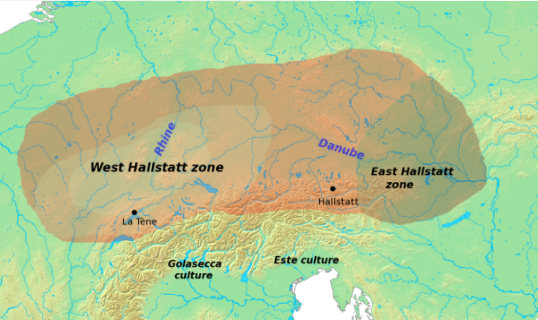

situation of the Golasecca culture to the south of the Hallstatt culture.

Golasecca culture is divided for convenient reference into three parts: the first two cover the period of the ninth to the first half of the fifth century BCE; the third, coinciding with La Tène A-B of the later Iron Age in this region and extending to the end of the fourth century BCE, is marked by increasing Celtic influences, culminating in Celtic hegemony after the conquests of 388 BCE. The very earliest finds are of the Late Bronze Age (ninth century), apparently building upon a local culture.[1]

Cremation near the burial site, followed by ash and bone burials in terracotta jars, in excavated pits set at determined distances one from the other in scattered necropolises, characterize a culture of many small village settlements.

In Golasecca culture some of the first evolved characteristics of historic society may be seen, in the specialized use of materials and the adaptation of the local terrain. The early-period habitations were circular wooden constructions along the edge of the river's floodplain; each was built on a low basement of stone round a central hearth and floored with river pebbles set in clay. Hand-shaped ceramics, made without a potter's wheel, were decorated in gesso. The use of the wheel is known from the carts in the Tomb of the Warrior at the Sesto Calende site. Amber beads from the Baltic sea across the Amber Road and obsidian reveal networks of long-distance trade. From the seventh century onwards some tombs contain burial goods imported from Etruscan areas and Greek objects[2]

The settlements depended on domesticated animals: remains reveal the presence of goats, sheep, pigs, cattle and horses. Some legume and cereal crops were cultivated; nuts and fruits were collected. The dugout boats from Castelletto Ticino and Porto Tolle are conserved at the museum of Isola Bella. Metal, though rare, was in increasing use.

Undeciphered written characters are found incised in ceramics or on stone.

The Golasecca culture is best known by its burial customs, where an apparent ancestor cult imposed respect of the necropoli, a sacred area untouched by agrarian use or deforestation. The early-period burials took place in selected raised positions oriented with respect to the sun. Burial practices were direct inhumation or in lidded cistae. Stone circles and alignments are found. Burial urns were painted with designs, with accessory ceramics, such as cups on tall bases. Bronze objects are usually of wearing apparel: pins and fibulas, armbands, rings, earrings, pendants and necklaces. Bronze vessels are rare. The practice of cremation persists into the second period (early sixth to mid-fourth centuries)

The old sites—Golasecca, Sesto Calende, Castelletto Ticino—maintained their traditional autochthonous character through the sixth century, when outside influences begin to be detectable. At the beginning of the fifth century, pastoral practices resulted in the development of new settlements in the plains.
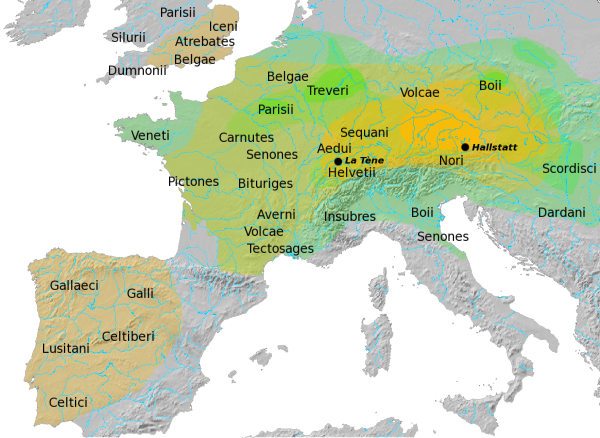
The first finds were discovered at several locations in the comune of Golasecca in 1824, by the antiquarian abate Giovan Battista Giani, who identified the clearly non-Roman burials as remains of the battle between Hannibal and Scipio Africanus[3]. In 1865 Louis Laurent Gabriel de Mortillet, a founder of European archaeology, rightly assigned the same tombs to the early Iron Age. The modern assessment of Golasecca culture is derived from the campaigns of 1965-69 on Monsorino, directed by Mira Bonomi.

Lepontii

The Lepontii were an ancient people occupying portions of Rhaetia (in modern Switzerland and Italy) in the Alps during the time of the Roman conquest of that territory. The Lepontii have been variously described as a Celtic, Ligurian, Raetian, and Germanic tribe. However, most evidence, including recent archeological excavations, and their association with the 'Golasecca culture' of Northern Italy, indicates a Celtic origin although they might actually be an amalgamation of Raetians (who were of Etruscan origin) and Celts.

File:Celts in III century BC.jpg

The chief town of the Lepontii was Oscela, now Domodossola, Italy, and their territory included the southern slopes of the St. Gotthard Pass and Simplon Pass, corresponding roughly to present-day Ossola and Ticino. See also: Lepontic language. This map of Rhaetia [1] shows the location of the Lepontic territory, in the south-western corner of Rhaetia. The area to the South, including what was to become the Insubrian capital Mediolanum (modern Milan), was Etruscan around 600-500 BC, when the Lepontii began writing tombstone inscriptions in their alphabet (one of several Etruscan-derived alphabets in the Rhaetian territory).

Lepontic language

Lepontic is an extinct Celtic language that was spoken in parts of Rhaetia and Cisalpine Gaul (today's Northern Italy) between 700 BC and 400 BC. Sometimes called Cisalpine Celtic, it is considered a dialect of the Gaulish language and thus a Continental Celtic language (Eska 1998).

The language is only known from a few inscriptions discovered that were written in the alphabet of Lugano, one of five main varieties of Northern Italic alphabets, derived from the Etruscan alphabet. These inscriptions were found in an area centered on Lugano, including Lago di Como and Lago Maggiore. Similar scripts were used for writing the Rhaetic and Venetic languages, and the Germanic runic alphabets probably derive from a script belonging to this group.

Lepontic was assimilated first by Gaulish, with the settlement of Gaulish tribes north of the River Po, and then by Latin, after the Roman Republic gained control over Gallia Cisalpina during the late second and first century BC.

The grouping of all of these inscriptions into a single Celtic language is disputed, and some (including specifically all of the older ones) are said to be in a non-Celtic language related to Ligurian (Whatmough 1933, Pisani 1964). Under this view, which was the prevailing view until about 1970, Lepontic is the correct name for the non-Celtic language, while the Celtic language is to be called Cisalpine Gaulish. Following Lejeune (1971), the consensus view became that Lepontic should be classified as a Celtic language, albeit possibly as divergent as Celtiberian, and in any case quite distinct from Cisalpine Gaulish. Only in recent years, there has been a tendency to identify Lepontic and Cisalpine Gaulish as one and the same language.

While the language is named after the tribe of the Lepontii, which occupied portions of ancient Rhaetia, specifically an Alpine area straddling modern Switzerland and Italy and bordering Cisalpine Gaul, the term is currently used by many Celticists to apply to all Celtic dialects of ancient Italy. This usage is disputed by those who continue to view the Lepontii as one of several indigenous pre-Roman tribes of the Alps, quite distinct from the Gauls who invaded the plains of Northern Italy in historical times.

The older Lepontic inscriptions date back to before the 5th century BC, the item from Castelletto Ticino being dated at the 6th century BC and that from Sesto Calende possibly being from the 7th century BC (Prosdocimi, 1991). The people who made these inscriptions are nowadays identified with the Golasecca culture, which has been ascribed a Celtic identity (De Marinis, 1991). The extinction date for Lepontic is only inferred by the absence of later inscriptions.

http://en.wikipedia.org/wiki/Lepontic_language

Ligures

The Ligures (singular Ligus or Ligur; English: Ligurians, Greek: Λίγυες) were an ancient people who gave their name to Liguria, which once stretched from Northern Italy into southern Gaul. According to Plutarch they called themselves Ambrones which means ¨people of the water¨. The Ligures inhabited what now corresponds to Liguria, northern Tuscany, Piedmont, part of Emilia-Romagna, part of Lombardy, and parts of southeastern France.

Classical references and toponomastics suggest that the Ligurian sphere once extended further into central Italy (Taurisci): according to Hesiod's Catalogues (early 6th century BC) they were one of the three main "barbarian" peoples ruling over the Western border of the known world (the others being Aethiopians and Scythians). Avienus, in a translation of a voyage account probably from Marseille (4th century BC) speaks of the Ligurian hegemony extending up to the North Sea, before they were pushed back by the Celts. Ligurian toponyms have been found in Sicily, the Rhône valley, Corsica and Sardinia.

File:Italie -800.JPG I popoli dell'Italia antica:

It is not known for certain whether they were a pre-Indo-European people akin to Iberians; a separate Indo-European branch with Italic and Celtic affinities; or even a branch of the Celts or Italics. Kinship between the Ligures and Lepontii has also been proposed. Another theory traces their origin to Betica (modern Andalusia).

The Ligures were assimilated by the Romans, and before that by the Gauls, producing a Celto-Ligurian culture.

Tribes

Numerous tribes of Ligures are mentioned by ancient historians, among them:

Ligurian language

The Ligurian language was spoken in pre-Roman times and into the Roman era by an ancient people of north-western Italy and south-eastern France known as the Ligures. Very little is known about this language (mainly place names and personal names remain) which is generally believed to have been Indo-European; it appears to have shared many features with other Indo-European languages, primarily Celtic (Gaulish) and Italic (Latin and the Osco-Umbrian languages).

Xavier Delamarre argues that Ligurian was a Celtic language, similar to but not the same as Gaulish. His argument hinges on two points: firstly, the Ligurian place-name Genua (modern Genoa, located near a river mouth) is claimed by Delamarre to derive from PIE *genu-, "chin(bone)". Many Indo-European languages use 'mouth' to mean the part of a river which meets the sea or a lake, but it is only in Celtic that reflexes of PIE *genu- mean 'mouth'. Besides Genua, which is considered Ligurian (Delamarre 2003, p. 177), this is found also in Genava (modern Geneva), which may be Gaulish. However, Genua and Genava may well derive from another PIE root with the form *genu-, which means "knee" (so in Pokorny, IEW [1]).

Delamarre's second point is Plutarch's mention (Marius 10, 5-6) that during the Battle of Aquae Sextiae in 102 BC, the Ambrones (who may have been a Celtic tribe) began to shout "Ambrones!" as their battle-cry; the Ligurian troops fighting for the Romans, on hearing this cry, found that it was identical to an ancient name in their country which the Ligurians often used when speaking of their descent (outôs kata genos onomazousi Ligues), so they returned the shout, "Ambrones!".

Delamarre points out a risk of circular logic - if it is believed that the Ligurians are non-Celtic, and if many place names and tribal names that classical authors state are Ligurian seem to be Celtic, it is incorrect to discard all the Celtic ones when collecting Ligurian words and to use this edited corpus to demonstrate that Ligurian is non-Celtic or non-Indo-European.

Strabo on the other hand states "As for the Alps... Many tribes (éthnê) occupy these mountains, all Celtic (Keltikà) except the Ligurians; but while these Ligurians belong to a different people (hetero-ethneis), still they are similar to the Celts in their modes of life (bíois)."

The Ligurian-Celtic question is also discussed by Barruol (1999).

Herodotus (5.9) wrote that sigunnai meant 'hucksters, peddlers' among the Ligurians who lived above Massilia.

http://en.wikipedia.org/wiki/Ligurian_language