Sunday, August 3, 2014

'Minneapolis Renames Columbus Day As Indigenous People's Day' - Part 2


After viewing many Columbus Day protests, I found it amusing that elsewhere like New York City, the parade goes on seemingly without a hitch. About a minute into this video, you will see the name of an organization called the Columbus Citizens Foundation. The foundation is in full support of anything Columbus, but is based on "Italian heritage" not specifically "Columbus." In other words, from what I can gather, they avoid any "intellectualizing" about all the facets of the Columbus issue (just as the opposing side does), and merely hangs their hat on the "Italian-American" heritage concept.

There's an old saying that I think is mostly true: "Every nation was born in blood." Christopher Columbus was one of many explorers in the New World, starting with Leif Erikson. Erikson was even praised by President Obama... a sometimes-anti-imperialist. Erikson certainly would have set up a permanent colony along the eastern Canadian coast, but it was too far out of the way at that time. Beyond Leif Erikson, all of these early explorers did their part to set up the Americas for colonization.
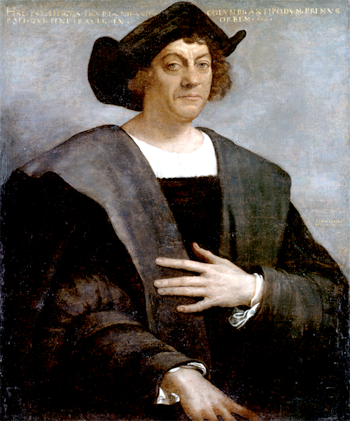
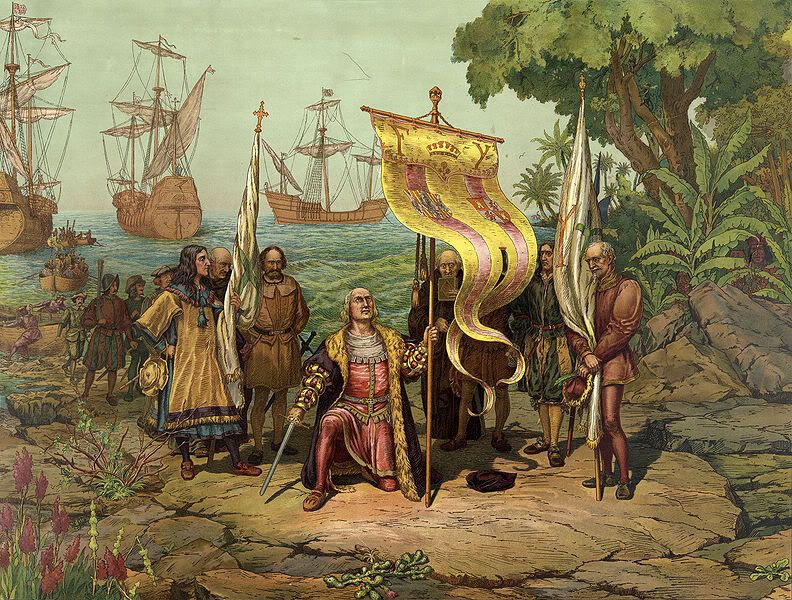
Columbus, to some "the new Hitler"
Personally, I believe that it was actually "Spanish, Portuguese, English, French, and Dutch Imperialism," not "EUROPEAN IMPERIALISM." Again, how many nations participated? There were perhaps fifty European nations in 1492! If someone doesn't like something that China did, they can't blame Tibet, even if they may look similar! If something bad happens in Algeria, you can't blame Pakistan, even if they may look similar! Even the overwhelming colonization of later times right up to the 60s, was the United Kingdom, France, Portugal, and Holland; with the rest being small and sporadic. Even Soviet expansion into Asia, early on, was in huge very depopulated regions.

There's nothing that "the West" did in the New World that Islam did not equal or surpass for 1,500 years on three continents. What did the Berbers, an Indo-European-like people in northwest Africa, endure that the Amerindians didn't endure? They were either driven from their lands or forced to convert to a foreign religion and culture. Islamic colonization took down many peoples and cultures in this manner; just as the Catholic Church did... but some people prefer to ignore all of the facts and just blame Columbus. There was imperialism and slavery all over the world long before Columbus.

Sometimes Mexico is included among the victims of American Imperialism. Really? That's really selling Mexico short, as it adhered to all of the same imperialism, slave trading, and religious supremacy. There aren't too many people in Mexico who don't speak a European language, have a European name, or practice a European-centered religion. Somehow it just seems a little late in the game for Mexican Columbus protesters to suddenly "become Indians" after all the bloody conflicts with Amerindians in Mexico and the Southwest over the centuries. Those protesters want us to "Go back to Europe," when some of their own ancestors were among the very worst Spanish imperialists, slave owners, and Catholic supremacists.

The Cherokees put hundreds of thousands of innocent Africans in chains
If someone wants to blame Columbus, then they must have the entire plate! They cannot ignore the establishment, expansion, and mere existence of the United States, the role of the Vatican in American colonialism (Latin America), the fact that 19 out of 20 captured Africans were sold into slavery in Latin America, and much more. How about the African Chieftains and their henchmen who captured people by literally the millions to sell along the West African coast? Maybe it's time to find out who really owned all those slave ships? Also, there were many Arab slavers working along the West African coast. How many people know that the Cherokee Nation was up to their necks in the slave trade? I think that the Columbus protesters, of all races, should be careful of what they ask for.

Where does it end? There have been hundreds of cases such as demands that a grammar school change its name from "George Washington," or for Andrew Jackson's name to be removed from the $20 bill... because they were "racists." Well, are we going to rehash all the history of all other nations too... the vast majority of which were "born in blood"..? What about the Cherokee Nation... are they going to give an apology for their large role in the slave trade? I don't think there were any Latvians, Hungarians, or Greeks bidding on captured Africans... but there sure were Cherokees bidding. Why is that such a secret? How many people realize that many Irish people were sold into slavery in the Americas? 


.

Thursday, July 31, 2014

The $4.5 Million Lamborghini Veneno driving in California


From the video description (TheStradman):

The $4.5 Million Lamborghini Veneno driving in California

Check me out on Facebook: www.facebook.com/StradmanPhotography

See the other Lamborghini Veneno I've filmed here: https://www.youtube.com/watch?v=Fu-X4...

This $4.5 million dollar Lamborghini Veneno was shown at the Quail Motorsports gathering in Monterey, California. Lamborghini is producing just 4 Venenos; This one will be at the Lamborghini factory in Sant'agata Bolognese, Italy. Two of the remaining three will end up in the United States, one in Miami, Florida and one in Long Island, New York. The third one will end up in the Middle East. The two American bound Lamborghini Venenos have been delivered. The Veneno in Long Island, owned by Antoine Dominic (owner of Lamborghini Long Island) is expected to be displayed at the showroom of Lamborghini Long Island. Dominic is a long time Ferrari owner who had an F40, F50, Enzo and an MC12 prior to switching to Lamborghini. The Miami bound Veneno, owned by Kris Singh, is expected to be driven somewhat regularly. Mr. Singh is managing director of Tequesta Investments. Each of the three customer delivered Venenos is finished in a different colored accent, red, white and green. The Veneno in this video is red. This is noticeable on the front splitter and rear diffuser.

It has been announced that Lamborghini will also introduce a roadster version of the Veneno. Lamborghini will produce 9 Lamborghini Veneno Roadsters.


The Lamborghini Veneno was first unveiled at the Genevea Auto Show in April 2013. The Lamborghini Veneno Roadster was first photographed at a special private viewing in Beverly Hills, California in November 2013. It's official debut was on an Italian air craft carrier in Abu Dhabi. It also was shown at CES 2014, Consumer Electronics Show in Las Vegas, Nevada in conjunction with Monster Audio, who fitted a custom $100,000 sound system in the Veneno Roadster.

The Lamborghini Veneno is a development of the Lamborghini Aventadors 6.5L V12 producing 740 HP. Veneno means venom in Spanish. Lamborghini currently produced the Aventador, the Veneno and is set to begin production of the Gallardo replacement, the Lamborghini Huracan. The Lamborghini Huracan LP610-4 is set to be officially unveiled at the Geneva International Auto Show on March 4, 2014.

The Lamborghini Veneno follows in the footsteps of other extremely limited production Lamborghinis. Prior to the Veneno, Lamborghini built 20 race oriented Lamborghini Sesto Elementos, based off the Gallardo. Prior to the Sesto Elemento, Lamborghini produced the Lamborghini Reventon, of which only 20 coupes and 15 roadsters. The Reventon was sold for $2 million USD.

The Lamborghini Veneno is featured in Forza Motorsport 5 and Need for Speed.


.

Friday, July 25, 2014

'Minneapolis Renames Columbus Day As Indigenous People's Day'

'Minneapolis Renames Columbus Day As Indigenous People's Day'

by Bill Chappell - NPR - April 27, 2014

Minneapolis has designated the second Monday of October, the federal Columbus Day holiday, as Indigenous Peoples Day. The city council adopted the plan after hearing concerns that hailing Columbus as the discoverer of America is inaccurate and ignores the history of indigenous people.

Last week, Indigenous Peoples Day supporter and Lakota activist Bill Means told Minnesota Public Radio that the story that Christopher Columbus discovered America was "one of the first lies we're told in public education."

He expanded on that idea Friday.

"We discovered Columbus, lost on our shores, sick, destitute, and wrapped in rags. We nourished him to health, and the rest is history," Means . "He represents the mascot of American colonialism in the western hemisphere. And so it is time that we change a myth of history."

Similar measures that rename or replace Columbus Day are already in place in other parts of the U.S., from South Dakota to Berkley and other California cities. Several states, such as Alaska, Hawaii, and Oregon, do not observe Columbus Day.

The federal holiday has a long and complex history, including an 1892 proclamation by Benjamin Harrison and its establishment as a federal holiday in 1937. Many came to see Columbus Day "as a way for Italian Americans to be accepted by the mainstream," as NPR's has reported.

Now the holiday is gaining a new identity in Minneapolis, as part of what says is the city's effort "to better reflect the experiences of American Indian people and uplift our country's Indigenous roots, history, and contributions."

According to MPR, the city council gave its unanimous support to the Indigenous Day measure after it was introduced by eight council members, led by Alondra Cano.

"The American Indian Movement emerged in the 1960s from the streets of south Minneapolis, a longtime cultural crossroads for American Indian communities in the Midwest," .

But MPR's Curtis Gilbert adds, "Council President Barbara Johnson noted that some of her Italian-American constituents are 'somewhat offended' by the city's snub of the Genoa-born explorer."


Columbus Day will be designated as Indigenous Peoples Day in Minneapolis, which has become one of several U.S. cities to make the change. Here, a member of the Cowichan Tribes holds her hand up in prayer during a 2011 Native American protest against Columbus Day in Seattle.


Why no mention of the Spanish Empire?

"We discovered Columbus, lost on our shores, sick, destitute, and wrapped in rags. We nourished him to health, and the rest is history," --Bill Means. He said "We," so obviously he sees 100% kinship with the Bahamian natives, or any other natives from Alaska to the tip of South America. Therefore, in order to stay congruent, we need to define the equivalent "Us." So in the expanded picture, the "Us" isn't Cristoforo Columbo nearly as much as it is the Imperial Spanish Empire as the face of European colonial supremacy. Columbus was an agent of the Spanish Monarchy, who were entirely in league with the Vatican and various banking cartels and economic interests.

It's interesting that those who would would attack Columbus don't mention the Spanish Empire or the Catholic Church. As Jesus said "Conquer in my name." How about King Ferdinand? Was he not Columbus' boss? How about Queen Isabella who led the "Spanish Inquisition?" What about Pope Alexander VI? The truth is that they need to revision Columbus as a "European bad guy," while not offending the many people who may feel threatened if they dared attack all the other institutions and individuals who were more important in the imperial effort than Columbus. In other words, Columbus must be projected as "a European"; and not as a Catholic, a Spanish citizen, a capitalist, or even an Italian! He must, in their estimation, stand entirely on his own for examination. This is the worst type of intellectual dishonesty.


Will the "bad guys" please stand?

Every person of European descent is a "white person." But how many are even descended from a nation who had a damn thing to do with all this genocide or slavery of the Americas? My quick count is five. Five countries who seemed to be in parcipitation, with the Vatican as a defacto sixth. Clearly most of it was the result of the Spanish and Portuguese Imperial Empires. I mean, if Japan had committed some type of historical atrocity, you don't blame Cambodia!; Unless someone wanted to somehow--against any logic--blame ALL Asians. Why would it be any different with Europe? So who's to blame? King Ferdinand, or a Polish peasant farmer?

Do you see how crazy this is? For the record, people of North and South America, who are of Amerindian or West African ancestry, are the numerical majority. Just within this "Columbus bashing" effort, how can any person with more than a room temperature IQ ignore all the important people who were behind Columbus' voyages as central figures of Western imperialism and slavery? How about Aaron Lopez? He was one of the leading figures of the Trans-Atlantic slave trade. Arguably at the very top of the list. Like Columbus, he was a very important middle-management figure within the larger scheme of things. Could it be that Columbus makes a much better projected bad guy than Lopez, despite the fact that Lopez administered much more actual harm to people?


.

Tuesday, July 15, 2014

Lionel Messi: One of the all-time soccer greats, an Argentine of Cisalpine ancestry


Lionel Messi (Wikipedia)


Lionel Andrés "Leo" Messi (born 24 June 1987) is an Argentine footballer who plays as a forward for Spanish club FC Barcelona and the Argentina national team. He serves as the captain of his country's national football team.

By the age of 21, Messi had received Ballon d'Or and FIFA World Player of the Year nominations. The following year, in 2009, he won his first Ballon d'Or and FIFA World Player of the Year awards. He followed this up by winning the inaugural FIFA Ballon d'Or in 2010, and then again in 2011 and 2012. He also won the 2010–11 UEFA Best Player in Europe Award. At the age of 24, Messi became Barcelona's all-time top scorer in all official club competitions. At age 25, Messi became the youngest player to score 200 goals in La Liga.

Commonly ranked as the best player in the world and rated by some in the sport as the greatest of all time, Messi is the first football player in history to win four FIFA/Ballons d'Or, all of which he won consecutively, as well as the first to win three European Golden Shoe awards. With Barcelona, Messi has won six La Ligas, two Copas del Rey, six Supercopas de España, three UEFA Champions Leagues, two UEFA Super Cups and two Club World Cups.

Messi is the first and only player to top-score in four consecutive Champions League campaigns, and also holds the record for the most hat-tricks scored in the competition. In March 2012, Messi made Champions League history by becoming the first player to score five goals in one match. He also matched José Altafini's record of 14 goals in a single Champions League season. Messi set the European record for most goals scored in a season during the 2011–12
season, with 73 goals. In the same season, he set the current goalscoring record in a single La Liga season, scoring 50 goals. Also in that season, Messi became the first player ever to score and assist in six different official competitions in one season.

Messi with girlfriend Antonella Roccuzzo and son.
 
On 16 February 2013, Messi scored his 300th Barcelona goal. On 30 March 2013, Messi scored in his 19th consecutive La Liga game, becoming the first footballer in history to net in consecutive matches against every team in a professional football league. He extended his record scoring streak to 21 consecutive league matches, and the run came to a halt only when he sustained a hamstring injury. In March 2014, with a hat-trick against Real Madrid, Messi became the player with the most goals and most hat-tricks in the history of El Clásico.

Messi helped Argentina win the 2005 FIFA U-20 World Cup, finishing as both the best player and the top scorer (with 6 goals). In 2006, he became the youngest Argentine to play and score in the FIFA World Cup, and won a runners-up medal at the Copa América in 2007, in which he was named young player of the tournament. In 2008, he won an Olympic Gold Medal with the Argentina Olympic football team. In 2013, SportsPro rated him the second-most marketable athlete in the world.[8] His playing style and stature have drawn comparisons to compatriot Diego Maradona, who himself declared Messi his "successor". In 2014, Messi led Argentina to the World Cup Final, winning four consecutive Man of the Match awards in the process. He won the Golden Ball award after being adjudged the best player of the tournament.


Don’t Cry for Messi, Argentina. This Germany Team Is One of the Best in Years.

.

Tuesday, June 10, 2014

‘Neverlake’ (2013) – movie review


‘Neverlake’ is a 2013 Italian movie, apparently made for an English-speaking audience. I ordered it via pay-per-view due to its theme, which I found interesting:

On a trip home to visit her father, Jenny is thrown into a world of mystery, horror and legend when she is called upon by 3000 year old spirits of the Neverlake to help return their lost artifacts and save the lives of missing children.

Actually, the film description for the PPV described “Etruscan spirits.” There is surprisingly little information online about his film, outside of a few reviews… of which I haven’t read, as I usually like to try to relay my interpretation firsthand. I wasn’t able to find out which lake it was filmed at, as the lake reminded me of pictures I have seen of Lake Nemi in Tuscany… a location of many legends and folklore. I think most of the filming was around Arezzo in eastern Tuscany. Lake Nemi is in the west, but this lake was mysterious-looking in any case… looking beautifully gloomy and surrounded by heavy woods.

Some background to the story was a little bit unclear. The main protagonist was Jenny.. a sixteen year old girl, of apparently Tuscan birth and heritage, who had been sent to live with an aunt in England at a young age, and was currently going to school in New York City. The movie begins with Jenny on the last leg of her trip to spent the Summer with her father in Arezzo, which is evidently in a rural hilly part of Tuscany, dotted with ancient villages.


This is a difficult movie to review because it was a steady advance of strange experiences, but perhaps none of them standing out in particular. Basically, in one form or another, ancient Etruscan spirits of “the Lake of Idols” seem to be sending her clues regarding.. something. Throughout the film, Jenny’s poetry relay some subtle messages.


Just the theme of Etruscan mythology, combined with the gloomy environment, set an interesting mood. Jenny’s father, apparently a doctor and amateur archeologist, was working on a project regarding ancient Etruscan artifacts. On his wall was a painting of Etruscans engaging in a ritual by that particular lake.. of which they believed had supernatural healing properties. He told Jenny that the painting was just an interpretation by the artist of how they may have held rituals on the lake. I don’t know if there really is such a painting of this theme, or if another painting was used to fit the story. The mysterious terrain of the the land, along with the father and his wife’s unusual actions, results in one strongly getting the impression that there are some secrets being kept. Jenny is told that her mother had passed away.

Soon Jenny meets children from a nearby home for orphaned children suffering from various ailments. This home/facility was fairly large and very old, constructed of stone walls and tiled roofs. It sat alone amidst the natural landscape. Jenny befriends them and reads them stories.. for example, writings of Shakespeare. They begin to trust her, and allow her into their world.

Jenny’s father had removed 2,600 to 3,000 year old statues from the lake, which ties into the main plot. Jenny begins to have supernatural experiences, including strange dreams about the lake. I don’t think I would be giving away too much by saying that the “Souls of the Lake” were unhappy with the removal of their statues (figurines). He had been working on his “project” for twenty years.


Etruscan temple
I think part of the theme of this film—for me at least—was a folk-pagan concept of reconnecting with one’s ancestors… with a distinction between a true “folk connection,” and one of mere usury. One curious element in the film was one particular character who appeared perhaps dangerous initially, and another who appeared positive initially… well, it turned out to be quite different…

Although this movie moved along with a slow advance—although I found it to be very relaxing and an escape—the ending ties together a large number of loose ends. The film goes from mystery, to horror, to tearjerker at the end. Many things don’t make sense until the dramatic ending scenes. I wouldn’t say that this movie was an absolute “thriller.” It was suspenseful, an escape into the spiritual, and delving into the sensitive theme of child abuse. I guess one could say that it was a common theme of “good vs. evil”… with the adults being the “evil” force… and with the children receiving help from ancestral spirits when they asked for it.
.


Thursday, May 15, 2014

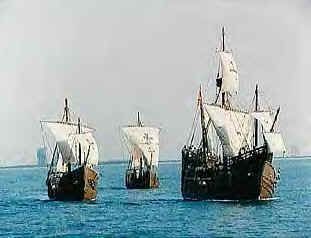
The Santa Maria likely found

Christopher Columbus Ship The Santa Maria May Have Been Found

Bill Chappell - NPR - May 13, 2014

It's been missing for more than 500 years. But now there are reports that the Santa Maria, the largest ship among the trio that made Christopher Columbus' first expedition to North America, may be found. Undersea explorer Barry Clifford says he thinks he has found the ship in waters off of Haiti's coast.

"All the geographical, underwater topography and archaeological evidence strongly suggests that this wreck is Columbus' famous flagship, the Santa Maria," Clifford tells Britain's . "The Haitian government has been extremely helpful — and we now need to continue working with them to carry out a detailed archaeological excavation of the wreck."

Clifford is a well-known wreck hunter, having found the pirate ship and former slave vessel , which sank off the coast of Cape Cod in 1717. That discovery led to a project with .

The Santa Maria sank after hitting reefs off the Haitian coast around Christmas of 1492, months after arriving from Spain. It is believed that Columbus ordered some of the ship's timbers stripped from the wreck in order to build a fort on land near the shore.

According to The Independent, Clifford closed in on the Santa Maria's possible location by combining two separate historical sources. After archaeologists announced new details suggesting the location of Columbus' fort in Haiti in 2003, Clifford used information in the explorer's diary to narrow down a possible location for the Santa Maria's sinking.


It turned out that Clifford's team had already located a wreck in that spot, in 2003. Now they're working to prove its identity as the ship that sailed from Spain along with two smaller ships, the Pinta and the Niña.
But verifying the wreck's identity will be harder now than it would have been in 2003, when Clifford took photos of the site that included a cannon like what the Santa Maria would have carried. When they returned recently, "all the key visible diagnostic objects including the cannon had been looted by illicit raiders," The Independent's archaeology correspondent, David Keys, reports.

Professor Charles Beeker, who directs the Indiana University's Office of Underwater Science and who has visited the wreck with Clifford, tells Keys that there's "some very compelling evidence" that the wreck is the Santa Maria. But he adds that a full excavation must be carried out to be sure.

The Santa Maria was a carrack, a craft that was "the definitive beast of burden of the Age of Exploration," according to the site . "Magellan, for example, had an all-carrack fleet with which he set to circumnavigate the globe in 1519."

One of the ship's advantages was that it was roomy enough for plenty of provisions — a capacity that could also be used to bring treasure back to an expedition's sponsor.

Clifford tells The Independent he'd like the ship to stay in Haiti:

"Ideally, if excavations go well and depending on the state of preservation of any buried timber, it may ultimately be possible to lift any surviving remains of the vessel, fully conserve them and then put them on permanent public exhibition in a museum in Haiti.

"I believe that, treated in this way, the wreck has the potential to play a major role in helping to further develop Haiti's tourism industry in the future."


.

Saturday, May 10, 2014

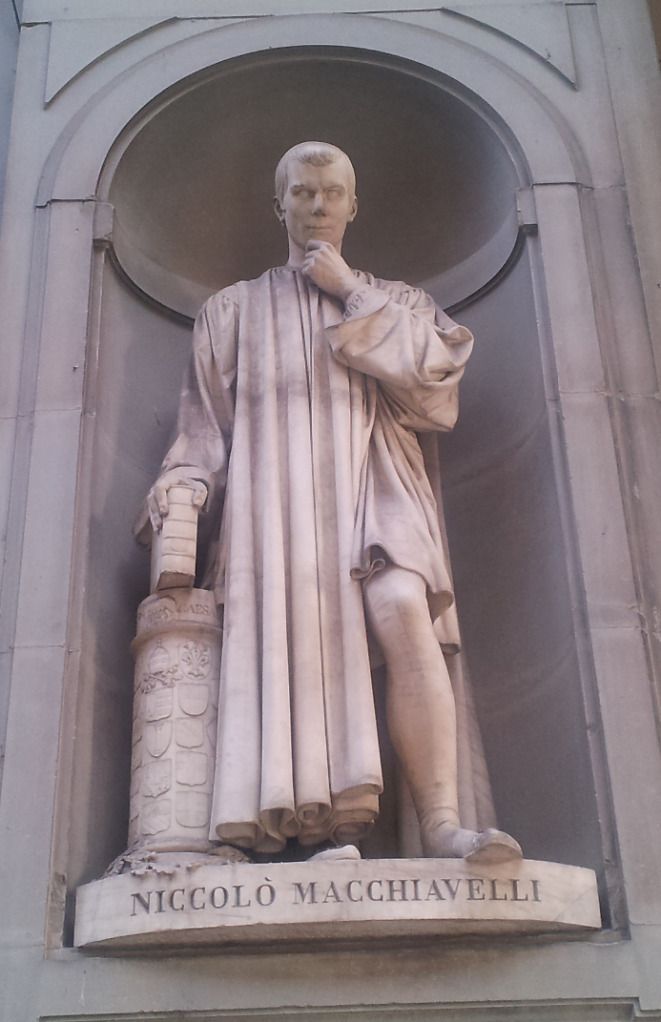
Niccolò Machiavelli


Niccolò Machiavelli (Wikipedia)

Niccolò di Bernardo dei Machiavelli: 3 May 1469 – 21 June 1527) was an Italian historian, politician, diplomat, philosopher, humanist, and writer based in Florence during the Renaissance. He was for many years an official in the Florentine Republic, with responsibilities in diplomatic and military affairs. He
was a founder of modern political science, and more specifically political ethics.

He also wrote comedies, carnival songs, and poetry. His personal correspondence is renowned in the Italian language. He was Secretary to the Second Chancery of the Republic of Florence from 1498 to 1512, when the Medici were out of power. He wrote his masterpiece, The Prince, after the Medici had recovered power and he no longer held a position of responsibility in Florence.

"Machiavellianism" is a widely used negative term to characterize unscrupulous politicians of the sort Machiavelli described in The Prince. The book itself gained enormous notoriety and wide readership because the author seemed to be endorsing behavior often deemed as evil and immoral.


**************************************************

Personally, I think the philosophy of Georg Hegel and Adam Weishaupt have had an infinitely worse affect on the world than Machiavelli, because their methods have become systemic and long-term.

.