 Lunardi's Supermarket
2801 San Bruno Avenue West
San Bruno, CA 94066
San Bruno Only - June Schedule:
* Friday, June 3 - J Winery, 4-7 PM
* Saturday, June 4 - Belle Glos, Mersoleil, 1-4 PM
* Friday, June 10 - Wines of Argentina, 4-7 PM
* Saturday, June 11 - Chateau Ste Michelle, 1-4 PM
* Friday, June 24 - Bear Ridge Wines, 4-7 PM
* Saturday, June 25 - Lou's Selections, 1-4 PM
The Lunardi family of San Francisco and San Mateo County, and proprietors of Lunardi's Markets, are originally from Lucca, Tuscany. This looks like a good combination of local and international wines. Also, the promotion of Argentine wines ties very much into our Cisalpine heritage as well.
.

Tuesday, May 31, 2011
Lunardi's Market: Wine Tastina in San Bruno


Saturday, April 30, 2011
The Etruscan Roots of The Twilight Saga

The Etruscan Roots of The Twilight Saga
Bija Knowles - November 20, 2009
Were there vampires in Volterra? Probably not, but the Etruscans had their own brigade of gods and demons representing night, death and resurrection.
'The Twilight Saga: New Moon' release fuels vampire mania around the world. While teenagers go completely nuts over the film's hunky vampire Edward (Robert Pattinson) – one wrote 'bite me' on her face as she queued with 5,000 others to see him in London last week – other die-hard fans of the Twilight books, written by Stephenie Meyers, are also descending on the small hill-top town of Volterra, in Tuscany, where some of the action of the film is set (even though filming actually took place in Montepulciano, 70 miles away). As a result, hoards of teenagers have been visiting Volterra – a town with Etruscan roots and its own heritage of Etruscan demons, gods and goddesses associated with death, resurrection and the night.
The Twilight Saga isn't the only vampire story to grace our screens lately. The popular US series True Blood – about a young woman in Louisiana who also falls in love with a vampire – based on the The Southern Vampire Mysteries series of novels by Charlaine Harris, also gathered cult status, adding to the growing body of vampire fiction on our bookshelves and on our screens. The nineties saw the likes of Buffy the Vampire Slayer, Interview with a Vampire, Bram Stoker's Dracula as well as From Dusk Till Dawn. The 21st century has seen vampire fever take over with Van Helsing, more Buffy and now Twilight and True Blood.
In fact, Dracula is the most often-portrayed fictional character in film. So what is it about vampires? There must be something about the blood-sucking, garlic-fearing, sun-dodging demons that strikes a chord with modern audiences – and indeed audiences since the early 18th century, when, following a vampire craze in the 1720s and 1730s, a poem called The Vampire, by Heinrich August Ossenfelder, was published in 1748. Vampires soon became a stock part of gothic fiction but they also had a romantic and erotic side to their personae, seducing women at night with their vampire's kiss of death.
To this day vampires are often portrayed as being quite sexy – think Robert Pattinson or True Blood's Stephen Moyer. However, the modern romantic vampire hero has more in common with figures from ancient mythology, rather than the vampire of Eastern European folklore (an altogether more corpse-like and unappetising kind of creature). The Incubus and the Succubus, dating back to the Sumerian kings of Mesopotamia (under the name of Lilu and Lilitu), were demons that appeared at night and seduced dreamers, often into erotic acts against their will.
Other figures from ancient mythology share some of the vampire's traits. In ancient Egypt, Sekhmet, the lion-headed goddess of Upper Egypt, was associated with blood-lust and with drinking blood (mythology has it that she drank a liquid resembling blood to quench her thirst for violence). The ancient Greeks and Romans also had their share of supernatural figures and demi-gods, including Hecate the witch-like figure and her daughter Empusa, who sucked the blood of the men she seduced while they slept. The Lamia was another demon in female form, renowned for sucking the blood of children and young men, while the Strixes were nocturnal bird-like creatures of Greek and Roman mythology, who ate human flesh and blood.
Closely connected with Greek and Roman mythology was the Etruscan pantheon, which also had its dark side. The Etruscans had several gods, goddesses and demons associated with death, the underworld, the night and resurrection. Some of the gods and goddesses included Artume, Vetis, Mania and Tvath. Etruscan demons of death include the Charontes, Tuchulcha (a grotesque demon from the underworld with donkey's ears and snakes for hair and hands) and Vanth (a herald of death with eyes on her wings).
Given the rich Etruscan mythology with many figures associated with death and the underworld, it's fitting that Volterra – an important Etruscan centre, known as Velathri to the Etruscans – is the setting for the new Twilight film. Volterra was a settlement since neolithic times and was then colonised by the Etruscan Velathri during the 8th century BC, while the city wall was built in the fourth century BC. It became one of the 12 important Etruscan city states but in the third century BC came under Roman control. An impressive Augustan-era amphitheatre, some fourth century AD baths as well as an Etruscan acropolis, are some of the important heritage sites in Volterra.
.
Saturday, March 19, 2011
Queen Theodelinda: The Cisalpine St. Patrick, and "most glorious queen"
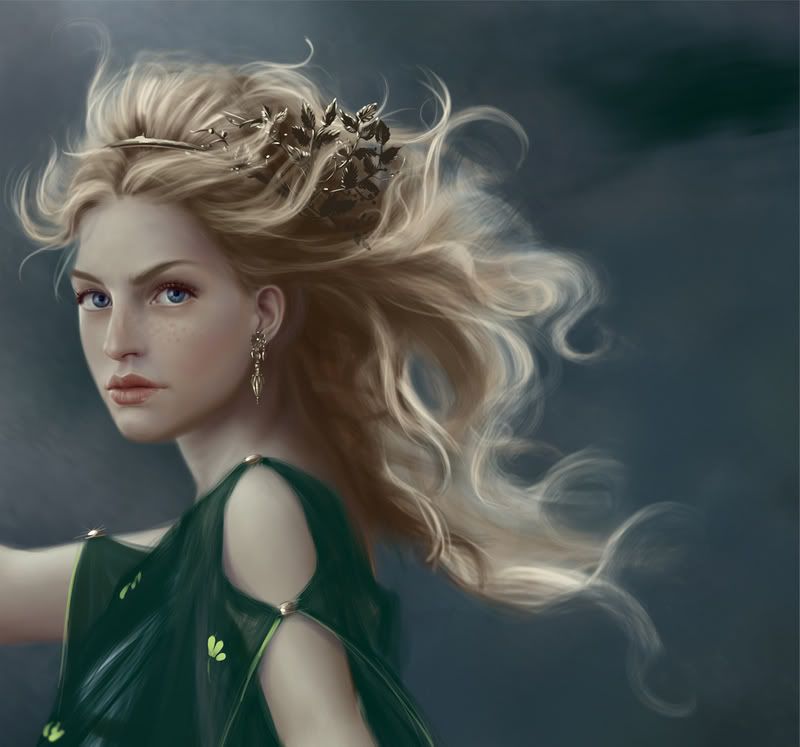 We have covered Queen Theodelinda many times on this blog, and will continue to do so. A simple search will bring up past writings on her, so there is no need to repeat everything. Theodelinda was a Frankish princess from Bavaria, of partly royal Langobard ancestry, who married the Langobard King Authari. The Langobards and Franks had much intermarriage within their ruling classes.
It should be noted that Theodelinda was the granddaughter of the Langobard King Waccho; and that she was the ninth Winilli/Langobard queen (the first being Queen Gambara).
The ruling classes of Germanic society, prior to a millennium ago, are not to be confused with the royals of more recent centuries. For example, the Langobard king used to lead the army in battle, sometimes leading the charge.
Some of the Catholic institutions artistically portrayed her as much less than beautiful despite clear evidence to the contrary. It's a well-known fact that she was very beautiful. King Authari, before agreeing to marry her, sent emissaries to Bavaria to see her. According to Paul the Deacon, simply to see that she was physically adequate. Upon seeing that she was a tall beautiful blonde, they quickly returned to Langbard to inform King Authari. She seems to have worn her hair long prior to becoming queen.
Not to confuse "looks" with deeds, but some of the drab portrayals of her is a type of historical slander. I would like to see some new revisionist artwork on her. Some revisionists believe that she was a vastly underrated historical figure. Like St. Patrick did in Ireland, she brought Catholicism to the Langobards and Cisalpines. She seemingly could very well have been declared a Catholic saint.
The queen had the Cathedral of Monza constructed, which has since housed the famous Iron Crown of Lombardy. The crown is said to have been fashioned with one of the nails used in the crucifixion of Christ. King Authari died after two years of the marriage, and she was loved so much by the people that they wanted her to remain their ruler. I know sometimes we're fed lines like that regarding historical figures, but in this case it seems to be very true from everything that I've read. A year later she chose a new husband, Agilulf. The Wikipedia page on her, not to mention mainstream history itself, has left a lot to be desired!
************************************************** From the Medieval History Journal:
Theodelinda, 'Most Glorious Queen': Gender and Power in Lombard Italy
Ross Balzaretti
School of History and Art History, Nottingham University, Nottingham NG72RD, UK
Abstract
Theodelinda, Queen of the Lombards (590-628), has been known for long to historians through the portrait depicted by Paul the Deacon in his Historia Langobardorum. However, as this was written some 150 years after the queen's death, its evidence needs to be treated with great caution. In this essay, the earliest contemporary evidence of Theodelinda's life is examined and compared to Paul's account. The latter turns out to be a highly-gendered representation, made up largely by Paul. Nevertheless, the early evidence (Gregory the Great's letters and various short historical texts) does show that she was a 'most glorious queen'.
[Right: A depiction of Queen Theodelinda from one of the frescoes in the Theodelinda Chapel in Monza, Lombardy, painted by people who actually saw the queen and knew what she looked like.]
**************************************************
Theodelinda (Wikipedia page):
Theodelinda, queen of the Lombards, (c. 570-628) was the daughter of duke Garibald I of Bavaria.
She was married first in 588 to Authari, king of the Lombards, son of king Cleph. Authari died in 590. Theodelinda was allowed to pick Agilulf as her next husband and Authari's successor in 591. She thereafter exerted much influence in restoring Nicene Christianity (the mainstream, in 1054 split by the East-West Schism in Roman Catholicism and Eastern Orthodoxy) to a position of primacy in Italy against its rival, Arian Christianity.
After the conversion of Agilulf to the Catholic faith, she started building churches in Lombardy and Tuscany, among them the cathedral of Monza and the first Baptistery of Florence. They were all dedicated to Saint John the Baptist.
The famous treasure of Monza contains the Iron Crown of Lombardy and the theca persica, enclosing a text from the Gospel of John, sent by Pope Gregory I (590-604) to her for her son Adaloald. Another of the gifts of this pope to the Lombard queen was a cruciform encolpion (reliquary) containing a portion of the True Cross.
Arts
The history of the queen and her connection with the famous Iron Crown of Lombardy are narrated in the frescoes painted in the Theodelinda Chapel in the Cathedral of Monza, work by Ambrogio and Gregorio Zavattari (1444).
.
Tuesday, March 8, 2011
Grana Padano
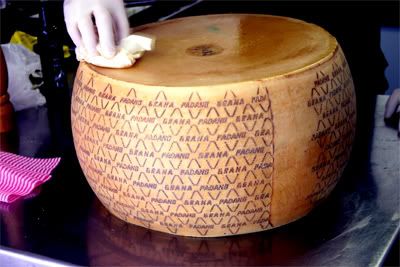 Recently I was shopping at Trader's Joe's and I saw a product called "Grana Padano Parmesan." One of the things that I thought was important is the use of the word "Padano" ("Padanian" or "Padan" in English), which can be loosely translated to "of the Po River Valley." There are those who would even deny that much as far as the legitimacy of the word. On top of that, this cheese product is tied into our culture. It should be noted that the product name "Grana Padano Parmesan" was used to sell a product, and is not really accurate. Grana Padano is a little different than Parmesan cheese (Parmigiano Reggiano), although both are similar.
[Right: A Grana Padano wheel]
From Grana Padano Wikipedia page
Grana Padano is one of the most popular Denominazione di Origine Controllata cheeses of Italy. The name comes from the noun grana (‘grain’), which refers to the distinctively grainy texture of the cheese, and the adjective Padano, which refers to the valley Pianura Padana.
Grana Padano is one of the world's first hard cheeses, created nearly 1,000 years ago by the Cistercian monks of Chiaravalle Abbey, founded in 1135 near Milan, who used ripened cheese as a way of preserving surplus milk. By the year 1477, it was regarded as one of the most famous cheeses of Italy. It can last a long time without spoiling, sometimes aging up to two years. It is made in a similar way to the Parmigiano Reggiano of Emilia-Romagna but over a much wider area and with different regulations and controls. Other Grana cheeses are also made in Lombardy, Piedmont, Trentino, and Veneto.
Like Parmigiano Reggiano, Grana Padano is a semi-fat hard cheese which is cooked and ripened slowly (for at least 9 months, then, if it passes the quality tests, it will be fire-branded with the Grana padano trademark). The cows are milked twice a day, the milk is left to stand, and then partially creamed. Milk produced in the evening is skimmed to remove the surface layer of cream and mixed with fresh milk produced in the morning. The partly skimmed milk is transferred into copper kettles and coagulated; the resulting curd is cut to produce granules with the size of rice grains, which gives the cheese its characteristic texture, and then cooked to 53-56°C. It is produced year-round and the quality can vary seasonally as well as by year. Though similar to Parmiggiano Reggiano cheese, the younger Grana Padano cheeses are less crumbly, milder and less complex in flavor than their more famous longer-aged relative. Grana Padano is widely considered inferior in quality than Parmigiano-Reggiano. Nevertheless many Italians prefer Grana Padano over Parmigiano-Reggiano mainly for the lower price.
A wheel of Grana Padano is cylindrical, with slightly convex or almost straight sides and flat faces. It measures 35 to 45 cm in diameter, and 15 to 18 cm in height. It weighs 24 to 40 kg (53 to 88 lbs) per wheel. The rind, which is thin, is white or straw yellow.
Grana Padano is sold in three different ripening stages:
* "Grana Padano" (9 to 16 months): texture still creamy, only slightly grainy.
* "Grana Padano oltre 16 mesi" (over 16 months): crumblier texture, more pronounced taste.
* "Grana Padano Riserva" (over 20 months): grainy, crumbly and full flavoured.
.
Saturday, February 26, 2011
Ernest Borgnine: Padan descendant
[Above: Ernest Borgnine is honored with the Screen Actors Guild Life Achievement Award on January 30, 2011]
 Borgnine, who is Piedmontese and Emilian descent, has a long biography that we won't post here (see the below link). It's remarkable that he won an Academy Award for best actor in 1955 (for his portrayal of Marty Piletti in the film Marty), and he is still so active today at age 94 (four movies in 2010). It's just by chance that we became aware of his Padan ancestry. Please send any information regarding other famous Cisalpine-descended people in the world.
Ernest Borgnine (from his Wikipedia page):
Ernest Borgnine (born Ermes Effron Borgnino; January 24, 1917) is an American actor of television and film. His career has spanned more than six decades. He was an unconventional lead in many films of the 1950s, including his Academy Award-winning turn in the 1955 film Marty. On television, he played Quinton McHale in the 1962-66 series McHale's Navy and costarred in the mid-1980s action series Airwolf in adition to a wide variety of other roles. Borgnine earned an Emmy nomination at age 92 for his work on the series ER.
.
Friday, February 25, 2011
Galileo Galilei: The Father of Science
Once I overheard an unemotional person of extremely high intelligence--not of Cisalpine descent--state enthusiastically that a genius like Galileo comes around only once a century! That got my attention, and it stuck in my memory.
One frequent mention on this blog has to do with not being able to do some of the subjects justice like they may deserve. In this case, I won't even try! I was perhaps waiting for that, but it won't happen here. To say the least, Galileo was one of the most important figures in world history. In the top ten.
"Galileo, perhaps more than any other single person, was responsible for the birth of modern science." --Stephen Hawking
From the intro of Wikipedia's Galileo Galilei page:
Galileo Galilei (15 February 1564 – 8 January 1642), commonly known as Galileo, was an Italian physicist, mathematician, astronomer and philosopher who played a major role in the Scientific Revolution. His achievements include improvements to the telescope and consequent astronomical observations, and support for Copernicanism. Galileo has been called the "father of modern observational astronomy", the "father of modern physics", the "father of science", and "the Father of Modern Science". Stephen Hawking says, "Galileo, perhaps more than any other single person, was responsible for the birth of modern science."
The motion of uniformly accelerated objects, taught in nearly all high school and introductory college physics courses, was studied by Galileo as the subject of kinematics. His contributions to observational astronomy include the telescopic confirmation of the phases of Venus, the discovery of the four largest satellites of Jupiter (named the Galilean moons in his honour), and the observation and analysis of sunspots. Galileo also worked in applied science and technology, inventing an improved military compass and other instruments.
Galileo's championing of Copernicanism was controversial within his lifetime, when a large majority of philosophers and astronomers still subscribed to the geocentric view that the Earth is at the centre of the universe. After 1610, when he began publicly supporting the heliocentric view, which placed the Sun at the centre of the universe, he met with bitter opposition from some philosophers and clerics, and two of the latter eventually denounced him to the Roman Inquisition early in 1615. In February 1616, although he had been cleared of any offence, the Catholic Church nevertheless condemned heliocentrism as "false and contrary to Scripture", and Galileo was warned to abandon his support for it—which he promised to do. When he later defended his views in his most famous work, Dialogue Concerning the Two Chief World Systems, published in 1632, he was tried by the Inquisition, found "vehemently suspect of heresy", forced to recant, and spent the rest of his life under house arrest.
Thursday, February 24, 2011
The Atmospheres of Padanian Alps
The Atmospheres of Padanian Alps
From YouTube channel Bogoljubskij
_________________________
What is very interesting about this video is the unique architecture of the Padan Alps. It's so unique, and different than Switzerland and the Alpine German regions.
.
Subscribe to:
Posts (Atom)