Showing posts with label Tuscan. Show all posts

Wednesday, November 23, 2022

Five Ways to Celebrate Fibonacci Day on November 23

Fibonacci garden

Fibonacci Day resources on Bing.com

Fibonacci (Leonardo Bonacci, Leonardo of Pisa) has been covered here, and the Fibonacci sequence. If you go to the Fibonacci sequence page and examine those calculations; his ability as a mathematician was stunning. Another in a long list of Tuscans who advanced human knowledge in a dramatic way.


'Five Ways to Celebrate Fibonacci Day on November 23'

November 23 is celebrated as Fibonacci day because when the date is written in the mm/dd format (11/23), the digits in the date form a Fibonacci sequence: 1,1,2,3.

Heather Sheridan - AllTogether.swe.org - November 2, 2021


November 23 is celebrated as Fibonacci day because when the date is written in the mm/dd format (11/23), the digits in the date form a Fibonacci sequence: 1,1,2,3. The Fibonacci sequence begins like this:

1, 1, 2, 3, 5, 8, 13, 21, 34, 55, 89, 144…

The sequence follows a fairly simple pattern: every two numbers, when added together, equal the following number.

While this seems simple, once you begin to see the sequence in things such as the pattern of a pine cone or the petals on a daisy, it starts to seem downright incredible!

Computer data storage and processing uses this number sequence today. The sequence is also useful in the trading of stocks and architecture. Another unexpected place we find the sequence is in nature, for example in hurricanes and DNA patterns. The Fibonacci sequence can be referred to as “nature’s secret code” or “nature’s universal rule.” Here are a few ways to celebrate Fibonacci Day:

1) Plan a Fibonacci feast.

The Fibonacci sequence occurs very frequently in common fruits and vegetables and when prepared together, these foods make for a fun meal! Prepare things like artichokes, pineapple, Romanesco and pomegranate to see how the sequence occurs in nature.

2) Take a Fibonacci-inspired nature walk.


Depending on where you live, you may be able to easily discover Fibonacci sequence in flowers, trees, and much more. Take a nature walk and inspect things like pinecones, ferns, daisies, sunflowers, and snails, since all of these things are made up of Fibonacci numbers.

con't....

.

Saturday, March 17, 2018

Flag and anthem of the Grand Duchy of Tuscany (1840-1860)


Flag and anthem of the Grand Duchy of Tuscany (1840-1860)

TheFlagAndAnthemGuy

ITALIAN: Granducato di Toscana

ANTHEM: "La Leopolda"

Flag from wikipedia: "Flag of the Grand Duchy of Tuscany (1840)" by Flanker. Licensed under CC BY-SA 3.0 via Commons

made using Flag 3D screensaver, available here:
http://www.3planesoft.com/holidays-screensavers/flag-3d-screensaver/

- CONTACTS:
FACEBOOK https://www.facebook.com/TheFlagAnthemGuy-1385863208300909/
TWITTER https://twitter.com/Flag_Anthem
DEVIANTART https://theflagandanthemguy.deviantart.com/


.

Tuesday, February 16, 2016

Food from Tuscany


Food from Tuscany
 

RAI

Tuscany. Home of high quality products appreciated throughout the world: its olive oil, its Chianti wine. And then its Fiorentina T-bone steak from Chianina cattle, one of the most ancient and prized breeds in the world.


See more video at http://www.expo.rai.it/youritaly


.


Wednesday, July 22, 2015

Mona Lisa "Twin" from the same studio

In January 2012 Museo del Prado in Madrid announced that it had discovered and almost fully restored a copy of the painting by a pupil of Leonardo, very possibly painted alongside the master. The copy gives a better indication of what the portrait looked like at the time, as the varnish on the original has become cracked and yellowed with age.

'The Mona Lisa's Twin Painting Discovered'

Speculations about Mona Lisa

.

Sunday, May 24, 2015

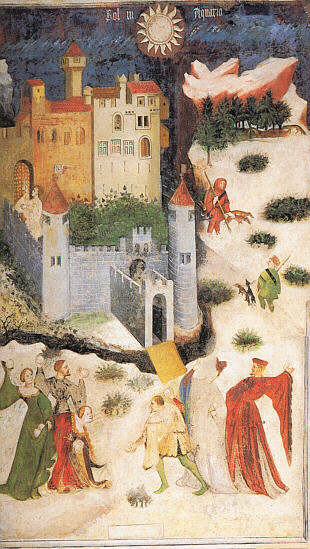
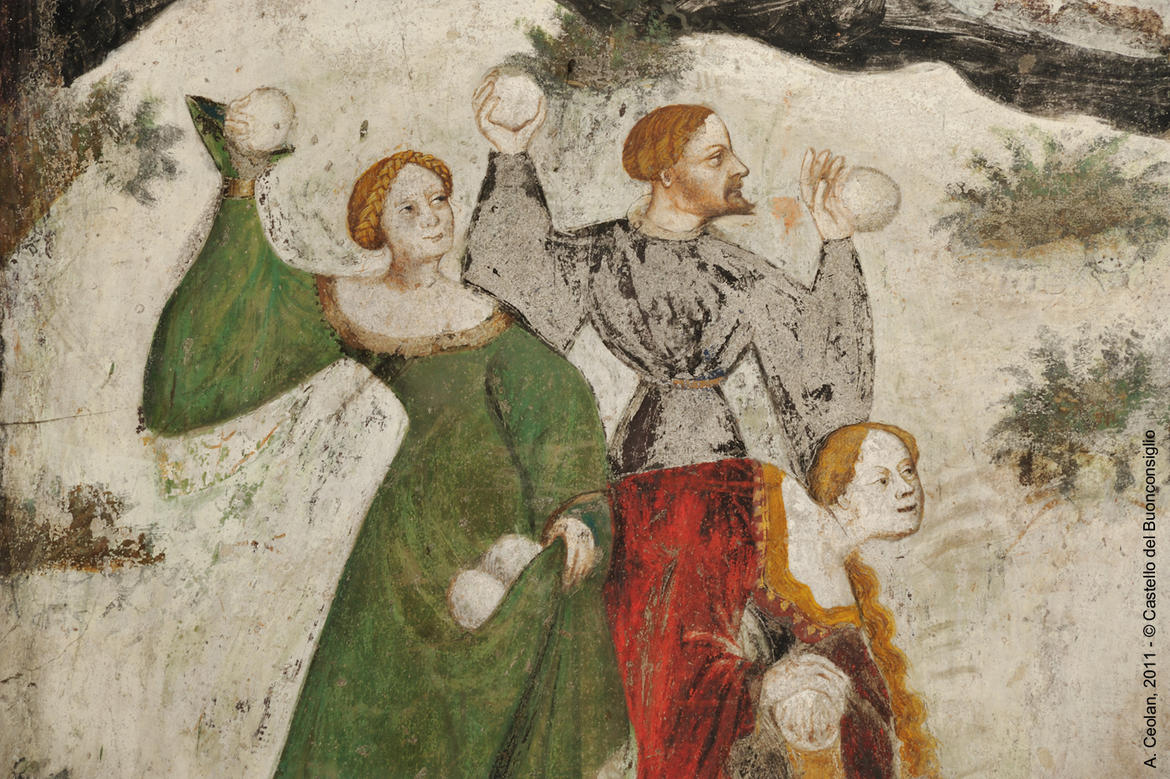
Buonconsiglio Castle in Trento


The Buonconsiglio Castle could be a lot of other castles in the Cisalpine region. It stands out a little due to it's history, size, and artistry. If you click on the above image, right-click, click view image, and click to get the full size; you can see the faces and fine detail on the upper columns. Many centuries old structures further stand out within the picturesque and colorful mountain areas, such as the Trento province.


The castle, which was constructed in the 13th century, was an important state administrative headquarters for the next five hundred years. Invading groups, such as the Austrians, occupied it as a military base.


Decorated by the aristocracy over the centuries, the castle also houses many frescoes and art pieces.


Appearing much as it must have in the 1200s, the castle sits majestically against the Alps at twilight.


**************************************************


The castles of Tuscany

The website CastelliToscani.com has an index of all the major castles in the region.

.

Thursday, October 31, 2013

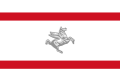
Pegasus - The flag of Tuscany

Flag of Tuscany (Flags of the World)


Description of the Flag

The gonfalon was adopted on the 20th May 1975 and readopted with the coat of arms on the 3rd February 1995. The coat of arms is a sannitic shield, gules a Pegasus argent. The gonfalon is white with two narrow vertical red stripes, and the Pegasus in the middle. The words Regione Toscana appear under in silver. The Pegasus was the symbol of the Toscan National Liberation Committee during the Second World War.
--Pascal Vagnat, 22 September 1998

The white on red stripes are possibly derived from the red-white-red triband (the Austrian colours) adopted by Tuscany in the latter half of the 18th Century and dropped in 1848.
--Christopher Southworth, 14 September 2003

The pegasus image on the flag, gonfanon and arms has been taken from a coin made by the Florentine artist Benvenuto Cellini (the one who made the famous Perseo statue) in 1537. This coin can be seen in the National Museum of Bargello in Florence. White and red have been the traditional colors of Toscana since long time, not only during the Grand-Ducal period. Also note that white and red are the traditional colors of most Tuscan towns, including Firenze, Pistoia, Lucca, Pisa and Grosseto.


Pegasus

Pegasus (Wikipedia)

Pegasus (Ancient Greek: Πήγασος, Pégasos, Latin Pegasus) is one of the best known mythological creatures in Greek mythology. He is a winged divine stallion usually depicted as pure white in colour. He was sired by Poseidon, in his role as horse-god, and foaled by the Gorgon Medusa. He was the brother of Chrysaor, born at a single birthing when his mother was decapitated by Perseus. Greco-Roman poets write about his ascent to heaven after his birth and his obeisance to Zeus, king of the gods, who instructed him to bring lightning and thunder from Olympus. Friend of the Muses, Pegasus is the creator of Hippocrene, the fountain on Mt. Helicon. He was captured by the Greek hero Bellerophon near the fountain Peirene with the help of Athena and Poseidon. Pegasus allows the hero to ride him to defeat a monster, the Chimera, before realizing many other exploits. His rider, however, falls off his back trying to reach Mount Olympus. Zeus transformed him into the constellation Pegasus and placed him up in the sky.

Hypotheses have been proposed regarding its relationship with the Muses, the gods Athena, Poseidon, Zeus, Apollo, and the hero Perseus.

The symbolism of Pegasus varies with time. Symbol of wisdom and especially of fame from the Middle Ages until the Renaissance, he became one symbol of the poetry and the creator of sources in which the poets come to draw inspiration, particularly in the 19th century. Pegasus is the subject of a very rich iconography, especially through the ancient Greek pottery and paintings and sculptures of the Renaissance. Personification of the water, solar myth, or shaman mount, Carl Jung and his followers have seen in Pegasus a profound symbolic esoteric in relation to the spiritual energy that allows to access to the realm of the gods on Mount Olympus.


White horse (mythology) [Wikipedia]

White horses (which are rarer than other colours of horse) have a special significance in the mythologies of cultures around the world. They are often associated with the sun chariot, with warrior-heroes, with fertility (in both mare and stallion manifestations), or with an end-of-time saviour, but other interpretations exist as well. Both truly white horses and the more common grey horses, with completely white hair coats, were identified as "white" by various religious and cultural traditions.

The flag of Tuscany

Mythologies and traditions


European


Celtic

In Celtic mythology, Rhiannon, a mythic figure in the Mabinogion collection of legends, rides a "pale-white" horse. Because of this, she has been linked to the Romano-Celtic fertility horse goddess Epona and other instances of the veneration of horses in early Indo-European culture.

White horses are the most common type of hill figure in England. Though many are modern, the Uffington White Horse at least dates back to the Bronze Age.

In Scottish folklore, the kelpie or each uisge, a deadly supernatural water demon in the shape of a horse, is sometimes described as white, though other stories say it is black.
Greek

In Greek mythology, the white winged horse Pegasus was the son of Poseidon and the gorgon Medusa. Poseidon was also the creator of horses, creating them out of the breaking waves when challenged to make a beautiful land animal.

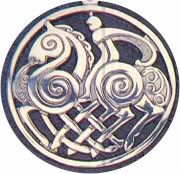
Sleipnir


Norse

In Norse mythology, Odin's eight-legged horse Sleipnir, "the best horse among gods and men", is described as gray. Sleipnir is also the ancestor of another gray horse, Grani, who is owned by the hero Sigurd.


Slavic

In Slavic mythology, the war and fertility deity Svantovit owned an oracular white horse; the historian Saxo Grammaticus, in descriptions similar to those of Tacitus centuries before, says the priests divined the future by leading the white stallion between a series of fences and watching which leg, right or left, stepped first in each row.


Finno-Ugric

The war god in Hungarian mythology was Hadúr, who wears pure copper and is a metalsmith. The ancient Magyars sacrificed white stallions to him before a battle. Additionally, there is a story (mentioned for example in Gesta Hungarorum) that conquering Magyars paid a white horse to Moravian chieftain Svatopluk I (in other forms of the story, it is instead the Bulgarian chieftain Salan) for a part of the land that later became the Kingdom of Hungary.[citation needed] Actual historical background of the story is dubious because Svatopluk I was already dead when the first Hungarian tribes arrived. On the other hand, even Herodotus mentions in his Histories an Eastern custom, where sending a white horse as payment in exchange for land means casus belli. This custom roots in the ancient Eastern belief that stolen land would lose its fertility.


The Pale Horse - Death
Four Horsemen of the Apocalypse (Wikipedia)

The Four Horsemen of the Apocalypse are described in the last book of the New Testament of the Bible, called the Book of Revelation of Jesus Christ to Saint John the Evangelist at 6:1-8. The chapter tells of a "'book', or 'scroll', in God's right hand that is sealed with seven seals". The Lamb of God, or Lion of Judah (Jesus Christ), opens the first four of the seven seals, which summons four beings that ride out on white, red, black, and pale horses. Although some interpretations differ, in most accounts, the four riders are seen as symbolizing Conquest, War, Famine, and Death, respectively. The Christian apocalyptic vision is that the four horsemen are to set a divine apocalypse upon the world as harbingers of the Last Judgment.


White Horse


I watched as the Lamb opened the first of the seven seals. Then I heard one of the four living creatures say in a voice like thunder, "Come and see!" I looked, and there before me was a white horse! Its rider held a bow, and he was given a crown, and he rode out as a conqueror bent on conquest.
--Revelation 6:1-2

Due to the above passage (the most common translation into English), the white rider is referred to as Conquest (not Pestilence, see below). The name could also be construed as "Victory," per the translation found in the Jerusalem Bible (the Greek words are derived from the verb νικάω, to conquer or vanquish). He carries a bow, and wears a victor's crown.


As evil

Artwork which shows the horsemen as a group, such as the famous woodcut by Albrecht Dürer, suggests an interpretation where all four horsemen represent different aspects of the same tribulation.


The first horseman is often associated with military conquest. One interpretation, which was held by evangelist Billy Graham, casts the rider of the white horse as the Antichrist, or a representation of false prophets, citing differences between the white horse in Revelation 6 and Jesus on the white Horse in Revelation 19. In Revelation 19, Jesus has many crowns, but in Revelation 6 the rider has just one.


As righteous

Irenaeus, an influential Christian theologian of the 2nd century, was among the first to interpret this horseman as Christ himself, his white horse representing the successful spread of the gospel. Various scholars have since supported this notion, citing the later appearance, in Revelation 19, of Christ mounted on a white horse, appearing as The Word of God. Furthermore, earlier in the New Testament, the Book of Mark indicates that the advance of the gospel may indeed precede and foretell the apocalypse. The color white also tends to represent righteousness in the Bible, and Christ is in other instances portrayed as a conqueror. However, opposing interpretations argue that the first of the four horsemen is probably not the horseman of Revelation 19. They are described in significantly different ways, and Christ's role as the Lamb who opens the seven seals makes it unlikely that he would also be one of the forces released by the seals.

Besides Christ, the horseman could represent the Holy Spirit. The Holy Spirit was understood to have come upon the Apostles at Pentecost after Jesus' departure from Earth. The appearance of the Lamb in Revelation 5 shows the triumphant arrival of Jesus in Heaven, and the white horseman could represent the sending of the Holy Spirit by Jesus and the advance of the gospel of Jesus Christ.


Globalist/UN Ideology

"We are in charge of God's selection process for planet Earth. He selects, we destroy. We are the riders of the Pale Horse, death. We do this for the sake of the world."
--Barbara Marx-Hubbard 


Barbara Marx-Hubbard couldn't fight her way out've a wet paper bag, but the forces behind words should be taken seriously. However, this is an example of the "White Horse" symbology used within a Biblical meaning.


Other

WHITE HORSE - linked to instinct, purity and the drive of the physical body to release powerful and emotional forces, like rage with ensuing chaos and destruction.

--Excerpt from 'The Subconscious Psychosis of Dreams'

.

Sunday, February 3, 2013

The Tuscan Orient Expeditions: Part 1


[Introducing new contributor 'Etrusco-Umbro-Gallic'. He was trained in the sciences, and well versed in matters concerning the anthropology and history of N/C Italy and the Western World. Any questions or comments can be directed to him, or if you would like to e-mail him directly, please send them to camunlynx@live.com, and they will be forwarded to him. Thank you.]


 The Tuscan Orient Expeditions: Part 1


      Tuscany. No question about it, this is the Western Man’s Kosovo. It’s a microcosm of Western civilization, even surpassing Rome in importance. It is not just the home of Puccini, Of Michelangelo, of Dante, of Galileo, of Bocelli, but also of lesser known characters whose impact on the course of Western civilization was just as monumental. How about Francesco Redi,  Amerigo Vespucci,  Eugenio Barsanti and Felice Matteucci? Tuscany’s influence on the Western World is as immense as it is historically consistent in nearly all important aspects. This essay and its sequels will explore in a chronological manner the encounters, of both individual Tuscans and Tuscany as a whole, with the Orient, that is to say, the Islamic Mediterranean world. Such encounters are a recurring theme in Western history and, in many ways, define who we are as Westerners, as people of European descent.

      After the fall of Rome, Saracen armies went on to conquer the entire Eastern and Southern Mediterranean thanks to their zeal and unorthodox tactics as well as the plagues, political corruption and economic crises which hit the region hard. It was a dark time for Europe, indeed, with Saracen fleets prowling the sea unchecked, plundering settlements (even Rome was almost sacked once), stealing slaves and treasures in the process. According to the insightful, yet obscure and underappreciated historian Henri Pirenne, it were these events, rather than the invasions of the so-called barbarians (who were actually Romanized within century and never really constituted a majority in the former Roman empire anyway) that precipitated the so-called Dark Age.

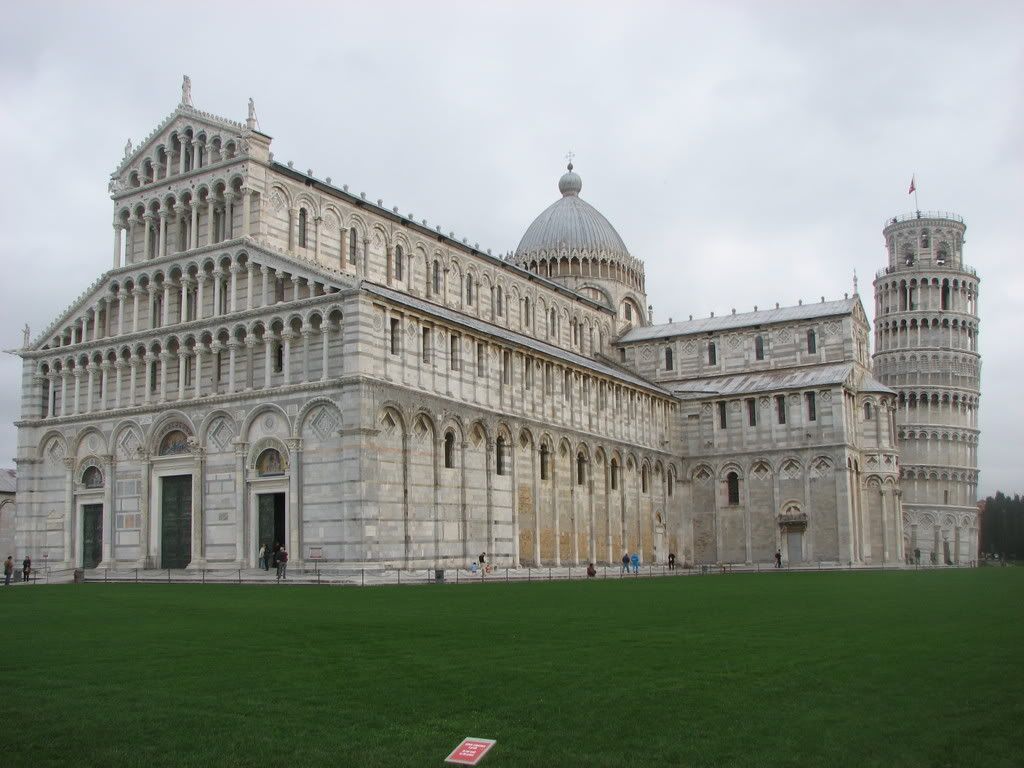
      Situated on the southern shores of Europe, it was only natural that, one way or another, Tuscany, too, was in the crosshairs. The Tuscan coast was repeatedly harassed by the Saracen pirate-marines and long stretches of it were abandoned. Such was not the case with Pisa, a former Roman municipium which was, by that time, the most important city in Tuscany. In the 9th century, spurred by constant Saracen attacks, Pisa began to expand its fleet. In 828, Pisan ships already made headway by taking the fight to the enemy, by assaulting the North African coast. In 871 they took part in the defense of Salerno, then a Lombard-rule principality in Southern Italy, from the Saracens.

      In 970, the Pisans were operating in Calabria, probably making war on its Muslim occupants in order to secure safe passage for their merchants through the Strait of Messina that separated Muslim Sicily from the peninsula. Pisan annals also record a Muslims naval attack on Pisa in 1004 and a Pisan victory over the Muslims off Reggio in 1005. The Muslim assault of 1004  may have originated in Spain, or it may have been a typical pirate raid. The Pisan attack of 1005 was likely a response, and perhaps a serious attempt to put an end to Muslim piracy, for which Reggio served as a perennial base. This victory greatly expanded Pisa’s maritime power.

      In 1011, an expedition from what is today southern Spain went on to wreck havoc on the Tyrrhenian coastline, clipping the Pisa region. The fleet most likely came from the Umayyad port of Denia, then ruled by the emir Mujahid, or Musetto, as he was called in Tuscan. By the time Musetto took power, the Emirate of Denia had established a foothold in the Balearic islands. An ambitious emir, Musetto decided to island-hop to Sardinia. As with most Saracen expeditions, it began with intensive coastal raids and the establishment of tactically important beachheads. The then-acting Pope John VIII was alarmed since Sardinia lay directly across the Tyrrhenian Sea from Rome and urged the Christian lay powers to expel the Saracens from the island. It was no trivial concern since Rome was nearly sacked by Saracen pirates in 846 (St. Peter’s basilica did end up being looted, though, since it was outside the walls). Well, Pisa and Genoa answered that call. Not many details are known, but what is known is that Musetto’s large scale attempt to invade the island in 1015 was thwarted.

      The persistent Musetto returned to Sardinia in 1016, however, intending a more thorough conquest of the island. After defeating the local Judges, as the local Sard rulers were called, Musetto immediately set about building cities using the local Sards for slave labour, which was the economic backbone of early and later Islamic caliphates. It was also that year that Musetto’s pirate-marines raided the Lunigiana, a picturesque area separating Tuscany and Liguria, in an in-your-face fashion. Once again, the wasp had awakened the boar. Once again, the pope called for an expedition and the combined Pisan-Genoese fleet scored---this time for good. With the Saracens expelled from the island, Pisans and Genoese began to bicker over the newly conquered territory, hence initiating their bitter rivalry which was to last unabated for two more centuries.

      Pisa’s fortunes continued to multiply and between 1030 and 1035, Pisa went on to defeat several rival towns in Sicily, conquer Carthage and sack Bona (now Annaba) in North Africa. In 1051–1052 the admiral Jacopo Ciurini conquered Corsica. During this time that Pisa’s rivalry with Genoa continued to grow.

      In 1085 Pope Gregory VII had granted suzerainty over the Balearic islands, off the coast of Iberia, to Pisa. Twenty-eight years later, in the fall of 1113 a Pisan fleet making an expedition to Majorca was put off course by a storm and ended up near the coast of Catalonia, which they initially mistook for the Balearics. The Pisans met with the Count of Barcelona and signed a treaty. Among other things, the treaty called for a military cooperation, the chief goal of which was to suppress Islamic piracy plaguing their coasts and to free Christian slaves. In 1113 Pisa and the Pope Paschal II set up, together with the count of Barcelona and other contingents from Provence and Italy (Genoese excluded), a war to free the Balearic Islands, which were at that time held by the Moors.  To make a long story short, the expedition was a success and the ruler of Majorca was brought in chains to Tuscany. Even though the Almoravids, the dynasty ruling much of Iberia at the time, soon reconquered the island, this was not really a major setback for Pisa. The booty taken helped the Pisans in their magnificent building program, especially its cathedral.  More importantly, Pisa still maintained its dominant military and mercantile role in the Western Mediterranean.

      It was also during this time that Pisa helped pave the way for the First Crusade, a long overdue, yet small-scale effort to roll back some of the conquests and stem the tide of Islamic attacks against the then Christian world. In 1087, prompted by a wave of pirate attacks on the Tyrrhenian coast orchestrated by the Zirid ruler of Mahdia (a city in present day Tunisia), the Pisans, augmented by the Genoese and Amalfitan forces, captured and plundered the city. The Muslim fleet stationed in the harbor was burned during the fighting. As in the Balearic campaign, Mahdia was soon reconquered but, once more, the ever resourceful Pisans used the money gained from plunder to further beautify and enrich their city. By burning the Muslim fleet, the Pisans helped secure the European Western Mediterranean coast which was to become a launchpad for Levant-bound Crusader fleets only 10 years later. Now, the Pisans did not simply initiate the First Crusade. In fact, they actually helped ensure its victorious outcome: the capture of Jerusalem in 1099. Some 120 Pisan ships took part in the First Crusade, no small number for the time.

      Through all of this, several important developments had taken place. By about 1100, thanks largely to the courage of Tuscan marines (along with those from Liguria, Provence, Catalonia, of course), Western Europeans were no longer afraid to go for a boat ride on their own beach. Well, the threat of Saracen piracy was still very much looming and would continue to do so until the French conquest of the Barbary Coast in the 1800s, but the bully’s nose was badly bloodied, so to speak. The pirates were no longer seen as an insurmountable obstacle, but as an inevitable inconvenience. Big difference. Additionally, since Pisa and the other maritime republics/states like Genoa had the ability to field powerful armed fleets, they could now escort their merchant navies safely to the bazaars of the Orient, and to, once again, obtain those now exotic goods, once commodities during the Roman era. Naturally, this wealth trickled down from the Arno Valley to the rest of the European continent over the decades and centuries that followed. 

      The Levant and North Africa were bustling hubs of intellectual activity in the Classical Era. To be fair, yes, a fair amount of that knowledge was preserved under the new Saracen overlords, but few original contributions were made by them to the major disciplines: medicine, philosophy, alchemy, and mathematics. Nevertheless, the region was a treasure trove of old manuscripts pertaining to those subjects and, by way of trade, Pisan travelers and merchants could now bring them back to the Occident. Perhaps the best such example is Leonardo Fibonacci, a forerunner of his fellow Tuscan namesake Leonardo Da Vinci, really. Leonardo was born in 1170 to a Pisan merchant operating in Algiers. As a young man, he was an avid traveler and had perused many mathematical manuscripts during that time. He was exposed to “Arabic” numerals (in quotes because they were actually developed in India and had reached the Mediterranean by way of conquest) and introduced the system to the Western world. He also developed a new notation of expressing fractions, similar to that used today. His name is most strongly associated with what is known as the Fibonacci sequence, where the first two numbers are 0 and 1, and each subsequent number is the sum of the previous two: 0, 1, 1, 2, 3, etc. Leonardo arrived at this sequence from a hypothetical situation involving an immortal rabbit population undergoing reproduction. Interestingly, the ratio of two sequential numbers of the Fibonacci sequence approaches the famous Golden Ratio the further along in the sequence that pair of numbers occurs. The Golden Ratio is commonly associated with art and, yes, has inspired many artists during the renaissance, but it has many applications in the financial market world, too. 


      Fibonacci may have been unique in his intellectual ability, but certainly not in his travels and not in bringing back the most valuable of all commodities, long denied but finally available to all Western Europeans thanks to the courage of his Tuscan countrymen: knowledge. And this knowledge was not destined to simply gather dust and be deemed blasphemic. In Europe, it was elaborated and expanded upon, criticized and corrected. Consequently, new knowledge was generated and systematically recorded and circulated, and this exponential process repeated itself many times over. Nothing like this has ever happened in all of mankind’s history and on no other continent. And here I am writing this on my laptop computer, itself a fruit of this process, much like the nearly microscopic components of its circuitry.

.

Tuesday, November 6, 2012

"Veltha ruin" - Planting our flag


"Veltha ruin" - Planting our flag

Padanian American League flag


Voltumna (Veltha)
http://en.wikipedia.org/wiki/Voltumna

In Etruscan mythology, Voltumna or Veltha was the chthonic (earth) deity, who became the supreme god of the Etruscan pantheon, the deus Etruriae princeps, according to Varro. Voltumna's cult was centered in Volsini (modern-day Orvieto) a polis of the Etruscan Civilization of northwest Italy.

The bond of the twelve Etruscan populi was renewed annually at the sacred grove of Fanum Voltumnae, the sanctuary of Voltumnus sited near Volsinii (present day Bolsena), which was mentioned by Livy. At the Fanum Voltumnae ludi were held, the precise nature of which, whether athletic or artistic, is unknown.


Fanum Voltumnae
http://en.wikipedia.org/wiki/Fanum_Voltumnae

The Fanum Voltumnae, or shrine of Voltumna, was the chief sanctuary of the Etruscans: fanum means a sacred place, a much broader notion than a single temple. Numerous sources refer to a league of the "Twelve Peoples" (lucumonies) of Etruria, formed for religious purposes but evidently having some political functions. The Etruscan league of twelve city-states met annually at the Fanum, located in a place chosen as omphalos (sacred navel), the geographical and spiritual centre of the whole Etruscan nation. Each spring political and religious leaders from the cities would meet to discuss military campaigns and civic affairs and pray to their common gods. Chief amongst these was Voltumna (or Veltha), possibly state god of the Etruria.


Sacred grove
http://en.wikipedia.org/wiki/Sacred_grove

A sacred grove or sacred woods are any grove of trees of special religious importance to a particular culture. Sacred groves were most prominent in the Ancient Near East and prehistoric Europe, but feature in various cultures throughout the world.


[Music: Piano instrumental version of 'Battle Hymn of the Republic' by Allen Dale
http://www.youtube.com/user/allendale1962?feature=watch

Flute instrumental version of 'Brandy' by Blue Train
http://www.youtube.com/user/TwainsBlues?feature=watch

Piano instrumental version of 'Delta Dawn' by Allen Dale]


.

Thursday, March 8, 2012

Renaissance City: Part II


Best New Hotspots in Florence, Italy

From September 2011 By Maria Shollenbarger - 'Travel & Leasure' - September 2011 [Appeared as 'Renaissance City' in T+L Magazine]

Bonan also designed J. K. Place Firenze, the boutique hotel on the Piazza di Santa Maria Novella that, after eight years, continues to evolve. Its cocreator, Ori Kafri, is a sharp 34-year-old entrepreneur with his hands in, among other things, publishing and art galleries. J. K.’s well-connected general manager, Claudio Meli, launched Bravo Concierge service in 2007 so he could finesse clients’ time in Italy beyond their J. K. Place stay. On any given evening one might find a small cross-section of the city’s art, fashion, media, and business worlds commingling in the hotel’s living room and restaurant; on Sundays at lunchtime, the terrace proliferates with friends and families. With its alchemy of ease and style, exclusivity and openness, the hotel has become a Florence institution—one that’s spreading, with an outpost in Capri, a planned opening in Rome in late 2012, and aspirations to launch projects outside of Italy in London, New York City, and Tel Aviv (birthplace of Kafri’s mother and father).

IO Osteria Personale, on the Borgo San Frediano, by contrast, opened just months ago, but it already has the feel of an institution in the making. Owner Matteo Fantini studied and practiced veterinary medicine, but dreamed for years of starting a restaurant. So last December, enlisting 23-year-old chef Nicolò Baretti, he did just that. IO organizes its menu by primary ingredient (meat, fish, vegetables) rather than by course. Fantini, who chats happily with diners for half an hour at a time, draws whimsical art naïf deconstructions of the day’s dishes onto chalkboards above the sparsely elegant table settings. The facile presentation is in winking contrast to the sophistication of the food: whole pigeon embellished with smoked pig’s cheek; delicate warm seafood salad served with minced panzanella and asparagus gelato.

About a mile down the river in San Niccolò there’s a sliver of storefront marked ZEB, outside of which a line forms most days around noon. Inside, Giuseppina and Alberto Navari, mother and son, prepare dishes of simple rustic perfection the way they’ve probably been prepared for a hundred years. It’s the space itself—white, conspicuously designed, equal parts chic diner and fancy urban food emporium—that startles, given that this food is more often paired with scuffed-wood shelving, dusty Chianti flasks, and rickety tables. Instead, customers perch on chrome-and-kidskin stools and point to what they want behind the glass-and-steel counter; and while Alberto pours a nice something from Bolgheri or Montecucco, Giuseppina, with a lambent smile like a benediction, serves up polpettine, lampredotto, and carciofi.

Not that there’s no room in this evolution for tradition of the most established, proto-Florentine sort. Some of the city’s oldest winemaking families—the Frescobaldis and Antinoris, Mazzeis and Ricasolis, Corsinis and Incisa della Rocchettas—collaborated with IMG Artists last year to launch Divino Tuscany, an ultraexclusive annual wine festival. The four-day event saw guests from 17 countries sample prized vintages from 50 of the region’s top producers. There were private concerts, tours, and lavish dinners at family palaces around the city. The weekend culminated in a party hosted by Sting and Trudie Styler at Il Palagio, their estate in Figline Valdarno, 45 minutes outside the city—a hot ticket also attended (and, in a few amusing cases, crashed) by a nice representation of Florentine society.

But if you were to canvass the locals at any of these settings as to the most conspicuously successful manifestation of a putative New Florence, many would point you in the direction of the Fondazione Palazzo Strozzi. Created in 2006, the FPS has in five years hosted a clutch of exhibitions that have earned international praise; last fall’s Bronzino retrospective—the most comprehensive to date of the Mannerist painter’s work—garnered unprecedented attendance and requests from major American and European museums to host it. Here, in the courtyard café of the imposing 15th-century Strozzi family palace that houses the foundation, you’re likely to find James Bradburne, the FSP’s tall, dandy, fiftysomething Anglo-Canadian director, holding an impromptu meeting in a fluent Italian-English mix or simply observing the ebb and flow of visitors though the massive twinned double doors. “This place used to be closed to the public when there wasn’t an exhibition on; there were no plants, no café, no shop,” Bradburne notes. “Now it’s open all the time, and it’s a living building. It gets 25,000 visitors a week. And we aren’t even targeting tourists.”

The FPS is an Italian experiment in institutional management. Its board of directors represents both the public and private sectors; among them are Florence’s museums superintendent Cristina Acidini and hotelier Rocco Forte. “We have a lot more freedom,” Bradburne says. “The board tends to say ‘yes’ rather than ‘no.’ There’s a level of transparency and immediacy that’s”—he smiles—“not typically Italian.” He says he was given two clear mandates. “One: Bring international-caliber exhibitions to Florence. As it happens, we don’t bring them here, we produce them here. Two: Give the palazzo back to the Florentines.”

“It needed someone as bright as James to make it happen,” says Leonardo Ferragamo one morning at Ferragamo headquarters, in the Palazzo Spini-Feroni. Besides holding various executive positions within his family’s company and chairing Lungarno Hotel, Ferragamo is president of the Associazione Partners Palazzo Strozzi, one of the FPS’s founding entities—and, as such, one of Bradburne’s bosses. “This started five years ago because of our frustration with Florence not doing its best in terms of managing its assets,” he said. “It piqued the pride of certain among us, enough so we finally acted.”

The FPS is also home to the Centro di Cultura Contemporanea Strozzina. To run this gallery, Bradburne enlisted Franziska Nori, a former director of Frankfurt’s Museum for Applied Art, who has made CCCS a showcase for topically provocative, intelligent exhibitions that have moved contemporary art from relative obscurity to near the forefront of Florence’s public cultural offerings—significant for a city in a constant struggle to escape from under the shadow of the Renaissance it spawned. “The goal [of FPS] is to be a contemporary institution in a Renaissance city,” Bradburne says. “One doesn’t negate the other. The backdrop is the inspiration.”

It remains a delightfully inescapable backdrop. Across the river, below the brushstroke cypresses surrounding San Miniato, is the 14th-century San Niccolò tower, the southeastern entry to Florence during its golden age. On July 1, after a 40-year closure and a $400,000 restoration effort, it was reopened to the public as part of Mayor Renzi’s improvements program. Stairs lead to its 148-foot summit, where one can gaze over the entire city. The view isn’t terribly dissimilar to the one enjoyed from nearby Piazzale Michelangelo. All the monuments, all the familiar landmarks are spread out below—bathed in the same pellucid sunshine, cradled in the same gentle hills. It’s still the Florence we all know and love, but amazing how a small change of perspective can make it seem just a bit different, somehow new.

Guide to Florence

Stay

Great Value Casa Howard Florence Guest House 18 Via della Scala; 39-06/6992-4555; casahoward.com; doubles from $180.
Il Salviatino 21 Via del Salviatino, Fiesole; 39-055/904-1111; salviatino.com; doubles from $760.
J. K. Place Firenze 7 Piazza di Santa Maria Novella; 39-055/264-5181; jkplace.com; doubles from $490.
Palazzo Vecchietti 4 Via degli Strozzi; 39-055/230-2802, palazzovecchietti.com; doubles from $440.
St. Regis Florence 1 Piazza d’Ognissanti; 877/787-3447 or 39-055/27161; stregisflorence.com; doubles from $1,386.
Villa San Michele This timelessly elegant Fiesole stalwart is more than keeping up with the competition. 4 Via Doccia, Fiesole; 39-055/567-8200; villasanmichele.com; doubles from $1,200.

Eat

Il Santo Bevitore An elevated interpretation of the trattoria, this new two-room restaurant is always packed. 64/66R Via di Santo Spirito; 39-055/211-264; dinner for two $90.
’ino There’s no better place to pop in for an expertly executed panino and a glass of red from a boutique producer. 3R Via dei Georgofili; 39-055/219-208; lunch for two $18.
IO Osteria Personale 167R Borgo San Frediano; 39-055/933-1341; dinner for two $112.
Ora d’Aria On a tiny lane in the shadow of the Uffizi, chef Marco Stabile gathers traditional ingredients and reimagines them in wildly creative ways. 11R Via dei Georgofili; 39-055/200-1699; dinner for two $168.
Zeb 2R Via San Miniato; 39-055/234-2864; lunch for two $53.

Shop

Flair The best spot for Italian design inspiration. 6R Piazza Carlo Goldoni, 39-055/267-0154.
Luisa Via Roma A Florence classic that’s been recently renovated, with Felice Limosani as creative consultant. 19/21R Via Roma; 39-055/906-4116.

See and Do

Cascine Gardens Via delle Cascine; no phone.
Divino Tuscany For more information on next year’s event, to be held in May, visit divinotuscany.com.
Fondazione Palazzo Strozzi/Centro di Cultura Contemporanea Strozzina Piazza degli Strozzi; 39-055/277-6461.
Le Murate Piazza della Madonna della Neve; lemurate.comune.fi.it.
San Niccolò Tower Piazza Giuseppe Poggi.

.

Wednesday, March 7, 2012

Renaissance City: Part 1


From September 2011 By Maria Shollenbarger - 'Travel and Leasure' - September 2011 [Appeared as 'Renaissance City' in T+L Magazine]

Some 500 years after the Medici left their mark here, a new generation of tastemakers and power brokers is breathing fresh life into Florence, Italy’s old soul. T+L reports on the welcome dose of contemporary culture that’s reinvigorating this Tuscan city.

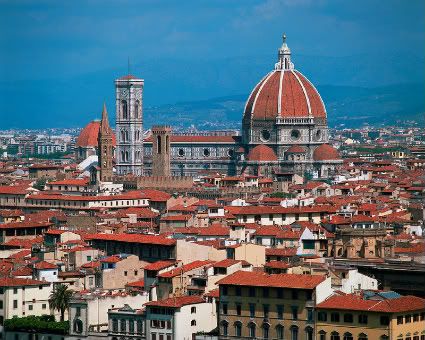
We may as well start by calling this what it is: a sort of love letter. It’s of course not the first penned to Florence, famously one of the world’s more love-letter-inspiring cities. (For rather more accomplished paeans, please see Forster, Stendhal, Lawrence, Shelley. And you might also check D, for Dante.) Florence’s CV is virtually unmatched among destinations: it is the birthplace of modern poetry and merchant banking, the locus of a robust share of the most important architectural and artistic monuments of postmedieval times. In more recent ones, it has been a temporary home to an equally robust share of American college students, who come to immerse themselves in, and perhaps be irrevocably changed by, Italy’s cultural endowments and profligate, heart-constricting beauty. I was one of them; maybe you were, too. But whether you first see it at 18 or at 68, Florence tends to imprint itself on you in a series of visual mnemonics: the sedate, rosy curve of the Duomo; the sylvan fairness of Botticelli’s Primavera; the cypresses like black-ink brushstrokes on the hills near San Miniato—single components which, to paraphrase Walt Whitman (who, sadly for him, never laid eyes on this city), contain numinous multitudes.

Definitely lovable. But is it livable? Or, more precisely: living? Alas, that is a more complex discourse. Milan is virtually defined by its relentlessly contemporary fashion industry. Rome is kept current by maintaining, after two-odd millennia, its status as a political seat. Even gloriously moribund Venice has conspired to focus the attention of the 21st century’s great and good on itself for a few months each year, with twinned Biennales of art and architecture and a film festival.

But with mass tourism generally doing more damage than service to both its resources and reputation, and citizens feeling disenfranchised by a city they perceive to be managed more for visitors’ benefit than their own, Florence has run the risk of becoming a hostage of its own patrimony—a hermetically sealed monument to, well, its many monuments. Città d’arte, yes—and not much else.

Change is in the air here, though. After reaching a collective sense of essere stufi (being fed up), citizens from across the spectrum are waking up to the potential of a Florence that’s more than simply the sum of its beautiful parts. They come from private and public sectors: civil servants, businesspeople, and members of the founding families, along with artists, hoteliers, and curators. All have a stake in moving the city forward along social, civic, commercial, and cultural lines, with an aim of helping Florence recapture the title of contemporary hub, some six centuries after first holding it.

Foremost among these agents of change is Matteo Renzi, Florence’s charismatic 36-year-old mayor, who took office in 2009. It’s hard to think of another European politician who enjoys such uniform approval across such a broad demographic and partisan swath. (The enthusiasm with which he’s name-checked at both working-class bars around Piazza Savonarola and dinner tables presided over by scions with 900-year-old titles recalls the fairy-dusted cachet Obama possessed in his “Yes We Can” days.) “We’ve been a bit asleep to our own potential,” Renzi says when we meet one afternoon in late April in his magnificently frescoed office in the Palazzo Vecchio. “And also to one important imperative: you can’t organize a city like a museum. We have to create every opportunity for citizens to be engaged with and proud of [Florence,]. As for the tourists, you have to give them more, and better, reasons to come back.”

Renzi’s wide-ranging plan for improvements reflects his commitment to both groups. To wit: Via Tornabuoni and the Santo Spirito and Pitti piazzas became pedestrian zones in June, creating veins of calm in some of the city’s most congested sections. Millions of euros are being allocated to the rejuvenation of the Arno riverbanks and, next year, to the Cascine gardens at the western edge of the city. Museum programs and hours are being revised, with some institutions granting free admission on select days to residents and most remaining open until 11 p.m. once a month. This commenced last spring at the Palazzo Vecchio, with the nighttime circumnavigation of its walls, known as the camminamento di ronda, an instant hit (one that, Renzi notes, earned the city almost $17,000 in the three days prior to our meeting alone). And after an almost 20-year delay, the Firenze Card launched in March; it costs $70, is valid for three days, and covers 33 of the city’s most important museums. (By the end of this month, Gucci will add another to the city’s roster when it inaugurates a museum celebrating the history of its illustrious brand, in the Piazza della Signoria.)

Then there is Le Murate, a 15th-century former monastery on the Via Ghibellina, which through public grants has reopened as an arts space comprising galleries, a café, and administrative offices. The brainchild of town alderman for culture Giuliano da Empoli, Le Murate’s public areas go by the acronym SUC, for Spazi Urbani Contemporanei; the idea is for it to serve as a social nexus for emerging artists and those who are interested in them—Italian and international, local and tourist alike.

Away from the Palazzo Vecchio and the official ministrations of civil servants, hoteliers and restaurateurs have tapped into a sense of the city’s elevated potential. Though most have strictly local roots, one notable opening by an American hotel group constitutes a major vote of confidence. The St. Regis Florence made its debut in May on the site of the old Grand Hotel Firenze, in the Piazza d’Ognissanti. Some of its 100 rooms and suites fly (in perfectly tasteful fashion) the Medici-inspired flag of opulent silks and velvets in royal-ecclesiastical shades; others are rendered in a gorgeous muted palette. St. Regis is a hotel brand on a roll, and much strategy goes into the selection of its locations. Its arrival here, now, is a direct result of what St. Regis brass is actually calling Florence’s “second Renaissance.”

At Il Salviatino, just up the hill toward Fiesole, the traditional hospitality model is turned neatly on its head by a staff of Service Ambassadors—driver, butler, waiter, guide, and concierge rolled into a single, nattily-dressed individual. They’ve been met with mixed reviews, as has the hotel’s erratic décor: at times admirably tasteful (as in the beautiful double-height, wood-paneled library), at others less so (hanging old-master reproductions from metal chains, parallel to the ceiling in the restaurant, defies explanation). Thank goodness the terrace, with its white sofas and views of the villa’s gardens, is a delight.

Back in town, just off the Piazza della Repubblica, is a discreet jewel, Palazzo Vecchietti: more residence than hotel, tailor-made for the creative classes seeking low-key live-work space and privacy. There’s no lounge or bar, but all rooms have stocked kitchens and working and sitting areas; and all are prettily modern—the handiwork of local designer Michele Bonan, whose imprimatur of artfully contained flamboyance is instantly recognizable.

.

Friday, February 10, 2012

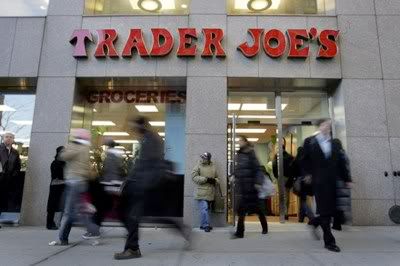
From Trader Joe's Fearless Flyer for February


Trader Joe's always has many products from or of the Cisalpine region, and a number of them were featured in it's "Fearless Flyer" for February.


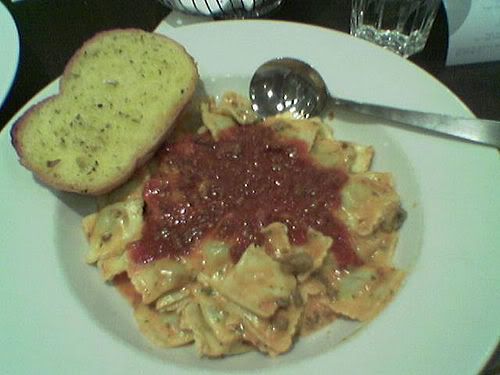
Bolognese Stuffed Ravioli

The Outside On The Inside!

Like most recipes that originate in one country and migrate to the cuisines of other countries, incarnations of Spaghetti Bolognese are as varied as the cooks who make them. We've tasted a good many Bolognese variations over the years, but until now we've never tasted anything quite like Trader Joe's Bolognese Stuffed Ravioli.

Bolognese Stuffed Ravioli take the concept of Bolognese and turn it inside out—or, more accurately, outside in. We've taken fresh, thin, Italian-style ravioli and stuffed them with a hearty meat sauce—tomato, ground beef, onions, carrots, celery, butter, garlic & herbs with Parmesan cheese. The pasta cooks in minutes to a wonderfully al dente finish, and the filling is so rich and satisfying that you really don't even need a sauce—a drizzle of our President's Reserve Extra Virgin Olive Oil and a dusting of freshly grated cheese are an excellent way to accent the pasta without distracting from its stellar flavors.

We're selling each nine ounce package of Bolognese Stuffed Ravioli for a mere $2.99—you'll find them in our refrigerated case.


Arugula Pizza

Arugula Pizza Imported from Italy

Pizza may not have originated in Italy (Greece is the most likely source, though history is still unclear), but the Italians most assuredly get credit for elevating a mere flatbread to an art form. Trader Giotto's Arugula Pizza, the newest in our array of imported Italian pizzas, further elevates this humble pie.

Our Arugula Pizza features a hand-stretched, wood-fired crust, topped with five ferociously flavorful formaggios: mozzarella, grana padano, manchego, provolone and pecorino. Cherry tomatoes and arugula are placed atop the cheeses, making a colorful statement that, when paired with the white of the cheeses, begins to resemble the color scheme of the Italian flag? Coincidence? Hmmmm…

Because the pizza is flash frozen immediately, both the arugula and the tomatoes look and taste fresh when you bake it at home—which takes less than 10 minutes in a pre-heated oven, by the way. We like to rev up the fresh flavors even more by drizzling some of our Fat Free Balsamic Vinaigrette atop the freshly baked pie. Trust us; it’ll make your taste buds tingle. Serve Trader Giotto’s Arugula Pizza with a salad for dinner, or cut it into smaller slices and serve as a memorable appetizer course. Memorable, too, is our price of $4.29 for each 15.3 ounce Pizza. You’ll find it in our freezer case.


Tuscano Marinara Sauce

Tuscano Marinara SauceBig can! Small price!

When it comes time to dress your pasta, you want a sauce that's fresh-tasting, free of preservatives and vibrant in flavor as well as color. You could spend several hours at the stove in pursuit of perfection, or you could buy a can of Trader Giotto's Tuscano Marinara Sauce.

This is a sauce for tomato purists. It begins with perfectly ripe, fresh-from-the-vine, California-grown tomatoes. (We really do mean “fresh-from-the-vine”—these tomatoes are "sauced" within hours of harvest.) The tomatoes are gently peeled using natural steam, then blended with extra virgin olive oil and a savory blend of herbs and spices. Nothing else is added. Unlike many canned sauces, ours has no added citric acid or preservatives, so the overwhelming flavor is exactly what you'd get if you made it from scratch—fresh tomatoes.

Try Tuscano Marinara Sauce on our High Fiber Pastas, on a pizza or in a calzone, in your next lasagna or a on meatball sandwich. We're selling each big, 28 ounce can for a mere $1.79, a price that seems too good to be true for a sauce that is so truly good. You'll find it in our grocery aisle.


Creamy Blue Cambozola

Cambozola is a delicious blend of the assertive flavor of good blue cheese with the creamy richness of triple cream soft ripened cheese. (Think Gorgonzola crossed with Camembert and you'll have a pretty good idea what you’re getting here.) Cambozola is produced by a dairy that's been in the business of making premium quality cheeses for nearly one hundred years. That history and craftsmanship combined make one of the most unique cheeses we've seen.

And though the cheese is unique, its uses are countless. Enjoy Cambozola just as you would a Brie or creamy blue—on a cheese tray, in wedges alongside a green salad or fresh fruit, or melted over a grilled steak. And for a real treat, try Cambozola and sliced Prosciutto on a baguette or sourdough bread. We're selling Cambozola in random weight pieces of about seven ounces for $11.99 per pound, every day—to give you an idea of what a great value this is, we've seen Cambozola selling for nearly twice this amount in other stores.


Asiago Cheese

Asiago CheeseNew World meet Old World. Old World, meet New.

After World War I, much of the cheesemaking infrastructure was destroyed in the Italian mountain town of Asiago. Needing to make a living and seeing vast opportunity, many of the dairy-farming, cheesemaking families of the region uprooted themselves and moved to the upper Midwest of the United States, where they soon established themselves and their distinctive cheeses as a force to be reckoned with. Asiago, the namesake cheese of their hometown, led the way in this Italian-American rivoluzione de formaggio.

Trader Joe's Asiago is made for us in Wisconsin using milk gathered within a 30 mile radius. It's handcrafted and aged for five months to achieve its signature sweet, nutty flavor that's just a touch sharp. This is a great cheese to serve on a platter, and, with ripe pears and a loaf of crusty bread, makes a wonderful Euro-style lunch. It is also an excellent grating cheese and adds a distinctive flavor to pizzas and mac & cheese. We're selling random weight wedges of Trader Joe's Asiago for $5.99 a pound, a terrific price, every day.


Amusant Bubbly Pink Moscato

Amusant Pink Moscato Amusant Bubbly Pink Moscato is currently only available in our stores where wine is sold.*

Is there a special occasion you'd like to celebrate? A special someone you'd like to toast? Or perhaps you're just feeling bubbly? Amusant Bubbly Pink Moscato will fit right in to any of these scenarios. This is a bubbly wine that's made primarily with Moscato grapes, so its aromatic bouquet greets you with every sip. The wine's off-dry balance (meaning sweet, but not too sweet) leads to flavors of apricot, peach, bergamot (think Earl Grey tea), a touch of mint and hints of orange blossom. These flavors get a boost from the fine bubbles, and the wine concludes with a clean and crisp finish.

Serve Amusant Bubbly Pink Moscato with your celebratory meal or save it for dessert. It's a natural with sweets, especially if they're chocolate. We're selling each bottle for $5.99*. Ooh, chocolate, bubbly wine and a great price… we're in love.

*Amusant Bubbly Pink Moscato is $6.49 in KY & GA; $7.99 in OH. Alcohol availability & price may vary due to state laws, taxes, shipment fees & other such stuff. (If we could, we would.)


"Just Sauce" Turkey Bolognese

"Just Sauce" Turkey Bolognese Ever have one of those nights when the last thing you want to do is cook dinner? One of those nights where regardless of your mood, dinner must, in fact, find its way to the table? One of those nights where even putting a pot of water on the stove can feel like a monumental effort? We understand. And we can help.

Trader Joe's "Just Sauce" Turkey Bolognese is about as close to homemade as you can get without standing in front of the stove stirring a hot pot for hours and hours. It's a traditional Bolognese sauce, slow-cooked with tomatoes, dry white wine, celery, onions, and carrots and exactly the right ratio of basil, oregano, thyme & fennel. We've lightened it up a bit by using turkey meat in place of the traditional combo of beef, pork & veal. It's not light on flavor, though. This chunky sauce is positively bursting with fresh, vibrant flavors. It's ready to dress your favorite pasta (we suggest our High Fiber Pastas), it makes a terrific dip for crusty bread, and it's a tasty, protein-rich companion to roasted or grilled vegetables for a quick, simple dinner.

Speaking of quick and simple, Trader Joe's "Just Sauce" Turkey Bolognese is ready to eat in about five minutes (less if you microwave it), and requires quite close to no effort on your part. See? We told you we could help. Even the price is helpful—to your wallet, that is. We're selling each 12 ounce package for $3.29, every day. You'll find it in our freezers.

**************************************************

Ben Gazzara 1930-2012

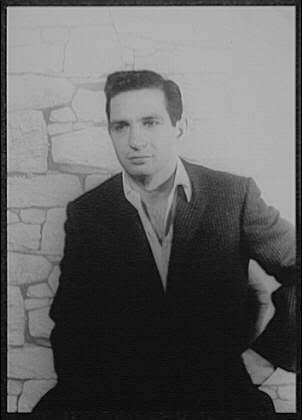
I always thought of Ben Gazzara as a great actor. He had a style all of his own. He wasn't what we would call a "Cisalpine," likely Neapolitan in ancestry, but he was a man who reminds us of men from a different time. So many men today, especially celebrities, act so squirrely. I always admired Ben Gazzara. He actually turned down a lot of roles which ended up being really big ones, so he could have been much more famous than he was, which he later admitted he was "a fool." But sometimes people do what they do, and it's where their mind was at the time. He almost seemed to be a cross between a "brooding tough guy," as he was so often described, and a "personable man." Although I recall him in roles from the 70s, I remember him more for his later roles, like in 'Roadhouse" with Patrick Swayze. That was a good example of a Ben Gazzara character. There are a lot of items about him, and of his particular acting style, on YouTube. "Ben was one of the few actors that you can't take your eyes of whenever they're in a scene. He has some of the most expressive eyes you've ever seen in the movies" (YT user seltaebgirl).

.

Friday, February 25, 2011

Galileo Galilei: The Father of Science


Once I overheard an unemotional person of extremely high intelligence--not of Cisalpine descent--state enthusiastically that a genius like Galileo comes around only once a century! That got my attention, and it stuck in my memory.

One frequent mention on this blog has to do with not being able to do some of the subjects justice like they may deserve. In this case, I won't even try! I was perhaps waiting for that, but it won't happen here. To say the least, Galileo was one of the most important figures in world history. In the top ten.

"Galileo, perhaps more than any other single person, was responsible for the birth of modern science." --Stephen Hawking


From the intro of Wikipedia's Galileo Galilei page:

Galileo Galilei (15 February 1564 – 8 January 1642), commonly known as Galileo, was an Italian physicist, mathematician, astronomer and philosopher who played a major role in the Scientific Revolution. His achievements include improvements to the telescope and consequent astronomical observations, and support for Copernicanism. Galileo has been called the "father of modern observational astronomy", the "father of modern physics", the "father of science", and "the Father of Modern Science". Stephen Hawking says, "Galileo, perhaps more than any other single person, was responsible for the birth of modern science."

The motion of uniformly accelerated objects, taught in nearly all high school and introductory college physics courses, was studied by Galileo as the subject of kinematics. His contributions to observational astronomy include the telescopic confirmation of the phases of Venus, the discovery of the four largest satellites of Jupiter (named the Galilean moons in his honour), and the observation and analysis of sunspots. Galileo also worked in applied science and technology, inventing an improved military compass and other instruments.

Galileo's championing of Copernicanism was controversial within his lifetime, when a large majority of philosophers and astronomers still subscribed to the geocentric view that the Earth is at the centre of the universe. After 1610, when he began publicly supporting the heliocentric view, which placed the Sun at the centre of the universe, he met with bitter opposition from some philosophers and clerics, and two of the latter eventually denounced him to the Roman Inquisition early in 1615. In February 1616, although he had been cleared of any offence, the Catholic Church nevertheless condemned heliocentrism as "false and contrary to Scripture", and Galileo was warned to abandon his support for it—which he promised to do. When he later defended his views in his most famous work, Dialogue Concerning the Two Chief World Systems, published in 1632, he was tried by the Inquisition, found "vehemently suspect of heresy", forced to recant, and spent the rest of his life under house arrest.

.

Monday, October 25, 2010

The Etruscans and Arthur Kemp

This is in response to an entry on the Arthur Kemp blog entitled 'Etruscans: DNA Evidence Proves March of the Titans Correct Once Again'.

The article is based on a 2006 DNA study on native Tuscans. The conclusion was that modern Tuscans are not related to the ancient Etruscans, as had long been thought.

One of the problems with "geographical categorizations" is that racial stocks in certain regions of the world change over time. Therefore a DNA test might show, for example, that a person of Indo-European descent has genetic links to Iran. In reality, it would much more likely be to ancient Persia, and perhaps even thousands of years ago when the demographics were different. The same could be said for many other regions.

When members of the British National Party voluntarily underwent DNA tests, most showed a somewhat significant genetic link to the Middle East. In reality, that link was to the ancient Mediterraneans of that region, long before massive numbers of people of a different racial stock migrated out of the Saudi Peninsula and spread the Islamic faith there. All it meant was that the English and the Middle Easterners shared some common ancestry, despite the fact that those ancestors went in entirely different genetic directions. The ancient Middle Easterners largely became, for all intents and purposes, Saudis. The ancient Mediterranean Britons became basically Germans. Therefore, for someone to state that Englishmen and Iraqis of today, are genetic cousins, would not be intellectually honest.

The article goes on to the hypothesis that the Langobards displaced the mixed-race Roman population. In reality, at least throughout most of the northern half of the Italian peninsula, the population was made up of culturally "Romanized" Gauls as the historical record is absolutely crystal clear on. In Tuscany, Kemp's hypothesis is closer to the truth, and down onto the southern Langobard duchies of Benovento and Spoleto. Still, the wild sweeping generalization seems to show his lack of historical understanding of at least most of the north.

Now, as far the Tuscan DNA study, the article accurately summed up the results:

"DNA testing on Etruscan bones recovered from graves showed that they were completely unrelated to modern Tuscan people.

"DNA testing on the modern Tuscan people showed that their genetic origin was in Anatolia, which is located in modern Turkey, bounded by the Black Sea to the north and the Caucasus to the northeast — smack bang where it should be."

The only problem is that Arthur Kemp wants his cake and eat it too. Up to, and during the Roman period, there was no "Turkey," and there were no "Turks." Using his logic, one could conclude that the Iroquois built New York City, that Aborigines constructed Sydney, or that England was originally settled by immigrants from Iraq.

The region that is now Turkey was the hub of the Eastern Roman Empire. Before that, much of it was part of Greece. A good portion of it was settled early on by Celtic tribes. According to the 'History of Turkey' Wikipedia page:

"The history of Turkey refers to the history of the country now called Turkey. Although the lands have an ancient history, Turkic migration to the country is relatively new. The Turks, a society whose language belongs to the Turkic language family started moving from their original homelands to the modern Turkey in the 11th century. After the Turkic Seljuq Empire defeated forces of the Byzantine Empire at the Battle of Manzikert, the process was accelerated and the country was referred to as 'Turchia' in the Europe as early as the 12th century.[1] The Seljuq dynasty controlled Turkey until the country was invaded by the Mongols following the Battle of Kosedag. During the years when the country was under Mongol rule, some small Turkish states were born. One of these states was the Ottoman beylik which quickly controlled Western Anatolia..." [Source: 'Turkey'; James Bainbridge].

Arthur Kemp can't have it both ways. If Tuscans are really Turks, then Iraqi immigrants were the original settlers of England. In reality, both of those Mediterranean peoples had no genuine link to modern Turks or Iraqis outside of the very "limited shared ancestry" concept, by which entirely different racial stocks could easily have "some common ancestors." It can't be "heads I win, tails you lose." YOU CANNOT HAVE IT BOTH WAYS.

Modern Tuscans, which we consider OUR folk, are not culturally or genetically similar to modern Turks. Although the study showed some strong evidence to support Kemp's politics, his final conclusion was intellectually dishonest. Some years back, someone was poking around a Roman graveyard and found some surnames consistent with Byzantine origins, and Kemp concluded that this meant that the native inhabitants were actually Turks. That was junk science. First of all, the Byzantines were not "Turkish." Even then, how do we know that the graveyard wasn't specifically a Byzantine cemetery? Were other cemeteries from that period studied? How do we know that the twenty seven ancient Etruscans, from which the DNA was obtained, were not atypical individuals; perhaps from elsewhere?

In the British Isles, remains of Roman legionnaires have been discovered. Some of those soldiers had identification documents showing that they were natives of Syria, Carthage, and elsewhere. Although they probably were basically Phoenician or ancient Mediterranean, which would for all intents and purposes would still place them within the range of "Indo-European," one could easily slant the evidence to the contrary. One BNP official, whose DNA was tested, showed 8% historically recent Sub-Saharan African mtDNA markers; likely originating from the importation of West African slaves. Again, someone could very easily slant that evidence. In reality, one would probably need to take a dozen tests to get an accurate reading of various genetic stocks. A single DNA ancestry test will occasionally blow up the admixture of any particular genetic stock, so 2% could read as perhaps 10% of whatever racial stock was being analyzed.

It's probably safe to say that England is probably more purely "Indo-European" than, say, Spain or Sicily. However, when studying data, an intellectually honest researcher can't decide for themselves, depending on their own ideology, that "heads I win, tails you lose." In other words, you can't use one set of rules to come to a conclusion in one area; and an entirely different set of rules to come to a conclusion in another area.

.