
Showing posts with label pagan. Show all posts
Showing posts with label pagan. Show all posts
Thursday, December 6, 2012
The Raven witch and the Autumnal equinox
I missed this seasonally, but this video just sort've came together for me. However, we are still in the Fall. To change the subject, I suppose that I'm not the only one who has fallen in love with certain software programs which slowly become obsolete... and the newer versions of Windows force them out.... aaaand, the newer versions are awful. I loved Corel Photo Paint 8, but it's just no longer compatible, and the newer versions are really, really bad. They're ridiculously confusing and positively limited. There's a big difference between that, and merely getting used to the newer versions of Word, which really just take some time getting used to. I used to really love the older WordPerfect office, more than Word, but I guess it's just a matter of going with what it pragmatic and available.
The Raven witch and the Autumnal equinox
Equinox
http://en.wikipedia.org/wiki/Autumnal_equinox
An equinox occurs twice a year (around 20 March and 22 September), when the tilt of the Earth's axis is inclined neither away from nor towards the Sun, the center of the Sun being in the same plane as the Earth's equator. The term equinox can also be used in a broader sense, meaning the date when such a passage happens. The name "equinox" is derived from the Latin aequus (equal) and nox (night), because around the equinox, night and day are about equal length.
Wheel of the Year
http://en.wikipedia.org/wiki/Wheel_of_the_Year
Autumnal equinox
The holiday of the autumnal equinox, Harvest Home, Mabon, the Feast of the Ingathering, Meán Fómhair or Alban Elfed (in Neo-Druidic traditions), is a Pagan ritual of thanksgiving for the fruits of the earth and a recognition of the need to share them to secure the blessings of the Goddess and the God during the coming winter months. The name Mabon was coined by Aidan Kelly around 1970 as a reference to Mabon ap Modron, a character from Welsh mythology.[27] Among the sabbats, it is the second of the three Pagan harvest festivals, preceded by Lammas / Lughnasadh and followed by Samhain.
[Music: 'Dream Weaver by Michelle Mays; 'Celtic Requiem Chant' by Elliot Simons]
.


Saturday, April 30, 2011
The Etruscan Roots of The Twilight Saga

The Etruscan Roots of The Twilight Saga
Bija Knowles - November 20, 2009
Were there vampires in Volterra? Probably not, but the Etruscans had their own brigade of gods and demons representing night, death and resurrection.
'The Twilight Saga: New Moon' release fuels vampire mania around the world. While teenagers go completely nuts over the film's hunky vampire Edward (Robert Pattinson) – one wrote 'bite me' on her face as she queued with 5,000 others to see him in London last week – other die-hard fans of the Twilight books, written by Stephenie Meyers, are also descending on the small hill-top town of Volterra, in Tuscany, where some of the action of the film is set (even though filming actually took place in Montepulciano, 70 miles away). As a result, hoards of teenagers have been visiting Volterra – a town with Etruscan roots and its own heritage of Etruscan demons, gods and goddesses associated with death, resurrection and the night.
The Twilight Saga isn't the only vampire story to grace our screens lately. The popular US series True Blood – about a young woman in Louisiana who also falls in love with a vampire – based on the The Southern Vampire Mysteries series of novels by Charlaine Harris, also gathered cult status, adding to the growing body of vampire fiction on our bookshelves and on our screens. The nineties saw the likes of Buffy the Vampire Slayer, Interview with a Vampire, Bram Stoker's Dracula as well as From Dusk Till Dawn. The 21st century has seen vampire fever take over with Van Helsing, more Buffy and now Twilight and True Blood.
In fact, Dracula is the most often-portrayed fictional character in film. So what is it about vampires? There must be something about the blood-sucking, garlic-fearing, sun-dodging demons that strikes a chord with modern audiences – and indeed audiences since the early 18th century, when, following a vampire craze in the 1720s and 1730s, a poem called The Vampire, by Heinrich August Ossenfelder, was published in 1748. Vampires soon became a stock part of gothic fiction but they also had a romantic and erotic side to their personae, seducing women at night with their vampire's kiss of death.
To this day vampires are often portrayed as being quite sexy – think Robert Pattinson or True Blood's Stephen Moyer. However, the modern romantic vampire hero has more in common with figures from ancient mythology, rather than the vampire of Eastern European folklore (an altogether more corpse-like and unappetising kind of creature). The Incubus and the Succubus, dating back to the Sumerian kings of Mesopotamia (under the name of Lilu and Lilitu), were demons that appeared at night and seduced dreamers, often into erotic acts against their will.
Other figures from ancient mythology share some of the vampire's traits. In ancient Egypt, Sekhmet, the lion-headed goddess of Upper Egypt, was associated with blood-lust and with drinking blood (mythology has it that she drank a liquid resembling blood to quench her thirst for violence). The ancient Greeks and Romans also had their share of supernatural figures and demi-gods, including Hecate the witch-like figure and her daughter Empusa, who sucked the blood of the men she seduced while they slept. The Lamia was another demon in female form, renowned for sucking the blood of children and young men, while the Strixes were nocturnal bird-like creatures of Greek and Roman mythology, who ate human flesh and blood.
Closely connected with Greek and Roman mythology was the Etruscan pantheon, which also had its dark side. The Etruscans had several gods, goddesses and demons associated with death, the underworld, the night and resurrection. Some of the gods and goddesses included Artume, Vetis, Mania and Tvath. Etruscan demons of death include the Charontes, Tuchulcha (a grotesque demon from the underworld with donkey's ears and snakes for hair and hands) and Vanth (a herald of death with eyes on her wings).
Given the rich Etruscan mythology with many figures associated with death and the underworld, it's fitting that Volterra – an important Etruscan centre, known as Velathri to the Etruscans – is the setting for the new Twilight film. Volterra was a settlement since neolithic times and was then colonised by the Etruscan Velathri during the 8th century BC, while the city wall was built in the fourth century BC. It became one of the 12 important Etruscan city states but in the third century BC came under Roman control. An impressive Augustan-era amphitheatre, some fourth century AD baths as well as an Etruscan acropolis, are some of the important heritage sites in Volterra.
.
Saturday, August 14, 2010
The Twilight Saga and the Benandanti: Part 6

One of the strangest incidences involving werewolves was that of "Benandanti" (a term roughly translated into 'good walkers,' 'those who go well' or 'good-doers') in northern Italy. In this case the werewolves were men who left their bodies and assumed the shape of wolves. After becoming wolves they descended to the underworld to battle witches.
This case was tried in 1692 in Jurgenburg, Livonia, situated in an area east of the Baltic Sea, steeped in werewolf folklore. It involved an 80-year-old man named Thiess.
Thiess confessed to being a werewolf, saying his nose had been broken by a man named Skeistan, a witch who was dead at the time he had struck Thiess. According to Thiess' testimony Skeistan and other witches was preventing the crops of the area from growing. Their purpose for doing this was so they could carry the grain into hell. To help the crop to continue to grow Thiess with a band of other werewolves descended into hell to fight the witches to recover the grain.
The warring of the werewolves and the witches occurred on three nights of the year: Saint Lucia, Pentecost and Saint John (the seasonal changes). If the werewolves were slow in their descent the witches would bar the gates of hell, and the crops, livestock, and even the fish catch would suffer. As weapons the werewolves carried iron bars while the witches used broom handles. Skeistan broke Theiss' nose with a broom handle wrapped in a horse's tail.
The judges were astounded by such testimony, for they had naturally supposed the werewolves were agents of the Devil. But now they were hearing the werewolves were fighting the Devil. When asked what became of the souls of the werewolves, Thiess said they went to heaven. He insisted werewolves were the "hounds of Gods" who helped mankind by preventing the Devil from carrying off the abundance of the earth. If it were not for them all would suffer. He said there were werewolves in Germany and Russia also fighting witches in their own hells.
Thiess was determined in his confession, denying he had ever signed a pact with the Devil. He refused to see the parish priest who was sent for to chastise him, saying that he was a better man than any priest. He claimed he was neither the first nor the last man to become a werewolf in order to fight witches.
Finally the judges, probably out of desperation, sentenced Thiess to ten lashes for acts of idolatry and superstitious beliefs. A.G.H.
In the Friuli region of Italy, Slavic, Germanic, and Italian traditions combined to form the Benandanti cult. Many Benandanti were followers of Diana.
Carlo Ginzburg, in 'Night Battles' wrote:
'The present research now establishes...the positive existence at a relatively late date (from c. 1570) of a fertility cult whose participants, the Benandanti, represented themsleves as defenders of harvests and the fertility of fields...This belief is tied to a larger complex of traditions (connected, in turn, with the myth of nocturnal gatherings over which female deities...presided)...In the span of a century, as we shall see, the Benandanti were transformed into witches and their nocturnal gatherings, intended to induce fertility, became the devil's sabbat, with the resulting storms and destruction.'
Four times a year, on holidays associated with the planting and harvesting of crops, the Benandanti were called to Gatherings. It was at these Gatherings that the major battles with 'Malandanti '(loosely translates to 'evil-doers) or 'Strigoni' were fought. The Benandanti fought with fennel stalks, the Malandanti with sorghum. It was believed that on certain particular nights the soul of the Benandanti gets out of the body to participate in meetings with other Benandanti .
But perhaps the most interesting aspect of the Benandanti was the method by which they were chosen. One did not decide to be Benandanti, the calling was forced on certain people as an accident of birth. Women and men born with a 'caul' (inner fetal membrane still covering the body, especially the head) were believed to have mysterious healing powers and the ability to see witches. Cauls were sometimes saved by these Benandanti and worn about their necks as amulets.
Much like the shamen of other cultures, the Benandanti testified they left their bodies at night, (what we call astral projection) sometimes shape shifting into animal form , sometimes riding animals or household tools. While 'out' they performed work which, we now know from modern research, was typical of shamans around the world. They healed and protected people of the village, they kept the paths of the dead from this world to the next secure, and they fought to protect the village from 'Malandanti'.
The 'doers of good' retained their anti-witchcraft stance until around the year 1610. Shortly afterward, they came under persecution by the Inquisition, and were identified as witches. They maintained that they were an army for Christ in the war against evil. As a result the local beliefs underwent a profound transformation, and by 1640 the Benandanti themselves were acknowledging that they were in fact 'witches'.
.
Friday, August 13, 2010
The Twilight Saga and the Benandanti: Part 5

Night Battles: How the Benandanti Fought Witches During the Sabbath
Daniil Leiderman - deliriumsrealm.com - September 10, 2007
We have learned to dismiss the Inquisition, to view its cases, its hundreds of years of history as a self-fulfilling prophesy gone terribly wrong. People driven by faith or greed or a bit of both, sought witches and found them. Scores and scores of women and men were imprisoned, tortured and in some cases killed, apparently for their own good. History has rejected the Inquisition's legacy, it values and self-validations.
We dismiss the Inquisition's trials and evidence and are quite right to do so-confession obtained under torture is hardly dependable. And yet it is certain that not every case began and ended with torture, and at times even the inquisitors were at odds about a certain potential heretic. Such is the case of the benandanti of the Friuli (north-eastern) region of Italy. Anthropologist Carlo Ginzberg's book Night Battles: Witchcraft & Agrarian Cults in the Sixteenth & Seventeenth Centuries presents the benandanti through the inquisitor's records and trial data, just as the inquisitors met them.
Who are the Benandanti?
The benandanti were of peasant stock, poor and largely illiterate, they spoke almost exclusively the friuli dialect, and at times had trouble communicating with their judges. However several statements reappear throughout the entire length of Ginzberg's study. All benandanti insist they were chosen by being born with a caul.
Superstition ascribed an unusual destiny for children born with a caul, a piece of the amniotic sac on their head. This was true throughout Europe and even the Middle East, however the specifics of the superstition; whether it was a good or bad omen, tended to vary from region to region. For several defendants in Ginzberg's study, the caul was a lifetime protective talisman worn in a pouch around the neck. It was the caul that identified a potential benandante to his or her recruiters.
After the age of approximately twenty each benandanti said another benandanti came to them during the night and led them out, riding cocks or goats beyond the village and into the woods. On the way the benandanti would drink wine from their neighbor's casks, invisible and flying. All benandanti insisted their bodies were left behind on their journeys.
Battles Between Benandanti and Witches
In the woods the spirits of the benandanti would meet the witches in the throes of their Sabbath. The witches would dance, fornicate and defile Christian images. Sometimes the devil lead them, at times a warlock, the witches would serve either. The benandanti would wait, lead by a captain (several separate trials record benandanti from different villages describing the same leader), or a glowing angel, and then they would meet the witches in battle and beat them with flannel stalks.
If the witches won, evil triumphed - crops withered, children and animals died. If the benandanti won, good triumphed for a season - fields were fertile, storms rare, children healthy. Such rites happened four times a year, once before every season.
Each benandanti insisted to his inquisitor that they served Jesus Christ and the Church. One can see the trouble such statements would have given the inquisitor.
The Church's Reactions to Benandanti
The benandanti are by definition acting beyond the Church yet claim to be for the Church, they witness the Devil's Sabbath but do not partake, they know the witches in their region by sight but do not reveal them-they act beyond the paradigm. As such the inquisitors did not immediately reach for the rack and the fire.
Initially the benandanti were released, and the same was true of the next batch of benandanti arrested later in the 16th century. Each new generation of inquisitor seemed to inevitably run up against the benandanti, interrogate, try and give up, handing out, at best, a sentence of mild heresy punishable by paying penance and temporary banishment from the town or region. However, the attention the cult received lead to its decline. The public became aware of the benandanti's claim of their supposed power over the spells of witches.
According to their testimony the benandanti can cajole and threaten witches into reversing their spells or hexes, particularly the ones that cause disease to children. Inevitably some unethical people, who may or may not have been benandanti began to charge the parents of sick children for the lifting of the witches' curse on their child. On the one hand this made the benandanti seem opportunistic and devaluated their "goodness" in the eyes of the populace leading to a more direct association between them and the witches they claimed to oppose. Furthermore, the benandanti's "cure" would more often that not involve the denunciation of the "culprit" usually a family member, as the witch causing the trouble. At times the benandante would name a couple, or even a dozen of local women as witches, and ascribe to them the most vile of acts. The local inquisitors would be forced to investigate if only to stop a lynch mob. Clearly such provocations made the benandanti seem like fanatics bent on disrupting the social order to both the populace and the church hierarchy.
In the end the problem of how to condemn the benandanti as heretics became academic. Changing popular beliefs tainted by two centuries of prosecution, and inquisitors more willing to use torture produced a crop of benandanti whose beliefs had clearly eroded. These benandanti might recall some part of the night battles, but no longer insisted on their separation from the witches, instead admitting under pressure to also cavorting with Satan and spitting on the cross.
Ginzberg traces the decline of the benandanti's beliefs into the 17th century where the cult appears to disappear altogether after several leaders are convicted of misleading the populace and thievery rather than religious reasons. However, the benandanti are not interesting because they challenged the understanding of the inquisitor, but because they challenge ours just as much.
Explanations for the Benandanti's Abilities
Any rational person would be at a loss to explain the sense of community the benandanti convey-for instance benandanti in different villages describe the same meeting place, or even name their leader-and the fact that this community claims to meet in spirit only, given that the Inquisition's own investigation all but rules out actual cult gatherings.
Ginzberg puts forward several theories-epilepsy, hallucinogens, and others, but it is obvious to him and to us that they are insufficient. Indeed who has heard of epileptics who suffer a fit only on certain days of the year, at midnight, with accompanying visions? Or hallucinogens that change your consciousness so as you experience a particular ritual event again and again, to the complete exclusion of your actual sight and hearing? Moreover, even the most outlandish drug cannot account for multiple benandanti who have never met in person claiming that their captain is red-headed, or being able to name the witches in other villages in the region.
One story reveals the gap between the benandanti and our own limits of understanding tells of a benandante woman accused of practicing necromancy. When the inquisitors asks her if it is true that on a certain date she taught a certain local woman how to see the spirits of the dead, the accused tearfully replies that she did not teach the local woman anything, but that the woman came to her looking for help, because she saw ghosts but wanted to stop seeing them. The accused witch told the local woman that she had no choice in the matter, since these things were up to God, and she should simply learn to live with it, as the accused had. We see here the earnest conviction of a peasant woman, who for lack of education, or for fear of the church tells what she believes to be the truth.
Indeed when the benandanti lie, it is fairly obvious-after giving detailed descriptions of the gathering at one interrogation, the accused would suddenly claim to have forgotten, or never heard of the benandanti at the next, one accused simply agreed with anything said by the inquisitors including contradictory statements-he was released when this was noticed. In the necromancer's case the inquisitors decided the woman wasn't a witch, but was guilty of mild heresy and banished her for three years. We would have put both her and the local woman that asked for her help in the mental hospital for schizophrenia. It is arguable which is the better "cure".
But therein lies the significance of Ginzberg's work-we cannot simply discount the rather simple confessions of these people, there is a tradition and a stable set of images, but they are at odds with all rational explanations. Furthermore Ginzberg sites a number of similar European cults, whose believers run the gamut from nearly identical to the benandante, to werewolves that battle the hounds of Satan, and even stranger groups.
Indeed, faced with so many cults we find ourselves in the position of the inquisitors, doing our best to conform these people to our paradigm, to our reason, and find them slipping away into the irrational night.
About the Author
Daniil Leiderman is completing his studies in the fields of art history and comparative literature at New York University. He is a Russian emigre and a practicing pagan.
.
Monday, July 19, 2010
Gallia Cisalpina VI: Gaulish Bread Harvest
 Gallia Cisalpina VI: Gaulish Bread Harvest (click here for link; YouTube did not allow our video to be imbedded due to the fact that the footage is copyrighted)
Lammas is a Neo-Pagan holiday, often called Lughnasadh, celebrating the first harvest and the reaping of grain. It is a cross-quarter holiday halfway between the Summer Solstice (Litha) and the Autumnal Equinox (Mabon). In the northern hemisphere, Lammas takes place around August 1 with the Sun near the midpoint of Leo in the tropical zodiac, while in the southern hemisphere Lammas is celebrated around February 1 with the Sun near the midpoint of Aquarius. On the Wheel of the Year, it is opposite Imbolc, which is celebrated on February 2nd in the northern hemisphere, and late July / early August in the southern hemisphere.
Lammas
http://en.wikipedia.org/wiki/Lammas
Lughnasadh
http://en.wikipedia.org/wiki/Lughnasadh
Harvest Festival
http://en.wikipedia.org/wiki/Harvest_festival
Celtic calendar
http://en.wikipedia.org/wiki/Celtic_calendar
Wheel of the Year
http://en.wikipedia.org/wiki/Wheel_of_the_year
*The footage shown is from the 2006 American remake of 'The Wicker Man' :
Wikipedia
http://en.wikipedia.org/wiki/The_Wicker_Man_(2006_film)
Internet Movie Database
http://www.imdb.com/title/tt0450345/
Amazon.com
http://www.amazon.com/Wicker-Man-Widescreen-Unrated-Rated/dp/B000JYW5DW/ref=sr_1_2?ie=UTF8&s=dvd&qid=1279558795&sr=1-2
[Music: Unknown]
Monday, July 12, 2010
Catholicism and Paganism in Latter Langobard Society
 When one looks at the spirituality of the Winnili/Langobards in a historical sense, it's obvious that they ultimately traveled the full distance from Paganism (Wotanism) to Christianity (Catholicism). However, there were many grey areas in between.
Looking quickly through those fazes, we can probably guess that the Winnili very likely practiced some form of Wotanism. During their stay along the borderland with the Gauls, it's possible that there could have been some Cernic (Cernunnos worship) influence, as there was some crossover between Gaulic spirituality and Teutonic spirituality. By the time the Langobards had become Roman allies along the Danube River, they were possibly roughly half Wotanist and half Arian Christian. Arian Christianity was apparently a crude form of Christianity.
In the Langbard Kingdom, Queen Theodelinda officially turned the Langobards into a Catholic nation sometime during the 590s it appears. The native Romanized Gaulic population had already been Romanized and Catholicized for a long period of time. This appears to have been the first step to actually faze out Wotanism altogether. The Langobard nation, although linking themselves with the early Catholic Church, always seemed to have had a hot-and-cold relationship with the Papal institution. There were times where they seemed to float into the Eastern Orthodox camp.
Just a side note, but it's interesting that the Catholics always portrayed Queen Theodelinda as being "less than attractive," seemingly to de-sexualize her, when in reality, it was widely noted that the Queen was very beautiful. Early pictures of her, especially in the Monza Cathedral, portray her in this manner as well. For better or worse, Queen Theodelinda was the St. Patrick of Cisalpine Gaul/Langbard/northern nations, or whatever name one wants to give the land of our ancestors. From every account, and considering that this was a time of political and religious upheaval, she was a great Langobard leader. Strong, widely loved, a woman to remember. She did what she had to do.
Some of the laws of the Langobards give clues as to where they stood on the religious issue after the establishment of the Langbard Kingdom.
From the Wikipedia page Witch trials in Early Modern Europe and North America, under "Protests" (to witch trials and torture):
"There have been contemporary protesters against witch trials and against use of torture in the examination of those suspected or accused of witchcraft.
"643: The Edictum Rothari, the law code for Lombardy in Italy (‘Let nobody presume to kill a foreign serving maid or female slave as a witch, for it is not possible, nor ought to be believed by Christian minds')"
Obviously, at least under the rule of King Rothari, there was still some sympathy for the pagans. This seemed to vary from one ruler to the next, but ultimately going in the direction of Christianity. Although, the end came when they turned against the Church at a time of great inner turmoil in Langbard, and the Kingdom itself was destroyed by Charlemagne's Catholic Frankish army. Ironically the Langobards had long been strong allies with the Franks, and they shared a similar history, conquering and establishing Kingdoms on the lands of formerly Gallic nations.
From the Wikipedia page Val Camonica witch trials, under "Background" (regarding the Valle Camonica region):
"Christianity is not considered to have been strong in the area, though it was formally christened in the 400s. In 724, King Liutprando of Lombardy feared a rebellion after he had issued a ban against Paganism. In the laws of 1498, stern laws are issued against all "Devilish heresy". In 1499, it was accused of having participated in a "Black mass", and it was reported to be common with such "depravity" in the area."
From the book 'The Lombard Laws' (Fischer Drew; 1973), section III 'The Laws of King Liutprand', "From The Fifteenth Year (A.D. 727)," pages 180-181:
"[Concerning him who seeks the advice of a sorcerer]
"84.I. He who, unmindful of the wrath of God, goes to sorcerers or witches for the purpose of receiving divinations or answers of any kind whatsoever from them, shall pay to the royal fisc as composition half of the price at which he would have been valued if someone had killed him, and in addition, shall do penance according to the established canon. In like manner, he who, like a rustic, prays to a tree as sacred, or adores springs, or who makes any sacrilegious incantation, shall also pay as composition a half of his price to the royal fisc. And he who knows of sorcerers or witches and does not reveal them, or conceals those who go to them and does not reveal it, shall be subjected to the above punishment. Moreover, he who sends his man or woman slave to such sorcerers or witches for the purpose of seeking responses from them, and it is proved, shall pay composition as abovementioned. If indeed the man or woman slave goes to the soothsayer or witch without the consent of is or her lord and so without his authority, likewise for the purpose of seeking responses, then his or her lord ought to sell him or her outside the province. And if his or her lord neglects to do this, he (the lord) shall be subjected to the punishment noted above."
Needless to say, this is a sharp contrast from the earlier attitudes towards paganism. Actually, most of the Lombard Laws were very fair and humane, usually requiring simple fines of varying degrees, depending on the nature of the crime. However here, the fine for breaking a law that could stem from simply praying to a tree, resulted in a fine of half that person's total wealth! Further oppressive was the move to outlaw the act of merely not reporting "acts of paganism" to the authorities.
Therefore, the Langobards went from allowing a large amount of personal freedom, albeit in a caste system, to moving to a system in which victimless crimes in this one area was punishable by rather extreme means. Practically "thought crimes." The very next law of Liutprand was labeled "What is to be done if the judge or other public officials of a place fail to seek out sorcerers or witches." I will not type out this law, which had much text, because I think that the earlier law presented the basic gist of where they were coming from. However, here we see that the law officials were not nearly as powerful as the religious institution. Only the king held power over the major Catholic regional theocrats, the representatives of the Papacy itself.
**************************************************
8-4-10 Addition: From the book 'The Lombard Laws' (Drew; 1973), page 247; footnote 55, we find another interesting clue to this subject. It states: "A belief in witchcraft must, at one time, have been widespread among the Lombards or among the naive population of the Italian peninsula. The Lombard kings approached the subject in an enlightened manner, practically denying the existence of this occult science and providing protection against random accusations of witchcraft or sorcery which might bring death or outlawry to the person accused. Such would seem to be the intent of the present law. On the other hand, there are laws in the code (Liutprand 84, 85) which specifically state that it is the duty of royal officials to seek out sorcerers and such like and apply the penalty of the law--sale outside of the country (Liutprand 85)."
.
Saturday, July 3, 2010
The Twilight Saga and the Benandanti: Part 4
 To tie up a few loose ends here. It's interesting that the Twilight Saga takes place in the state of Washinton, as that state resembles the natural landscape of Germany and the countries to it's east like Rumania, and the greater Alpine region. This is interesting because that is largely where this folklore has it's origins. I wonder of that was intended?
Someone who I know to be very wise, told me one time that if someone with ancestral origins in a particular type of environment feels nothing when they find themselves in a similar natural environment (ex. Alpine region and the Pacific Northwest)... I forget his exact words but the gist of it was that he would be baffled by that, and I agree. This would apply to any individual.
'Waking the Moon' (from Wikipedia)
Waking The Moon is a 1994 novel by Elizabeth Hand. It was the winner of the James Tiptree, Jr. Award and The 1996 Mythopoeic Award for Adult Literature. It is set mainly in The University of Archangel and St. John The Divine, a fictional University inspired by The Catholic University of America, mentioned in a few of Hand's novels. About 100 pages were cut from the US edition.
Plot summary
Sweeney Cassidy starts out as a freshman at University, where she meets the mysterious Angelica and falls in love with the strange and beautiful Oliver. She gets tangled up in sinister, supernatural events involving the awakening of an ancient, malevolent goddess. According to the afterword for the short story The Bacchae, found in the collection Last Summer At Mars Hill, it is another trope on ancient Greek myth that prefigures Waking the Moon. They both involve murderous cults of women. Elizabeth Hand has said that she wanted to show that ancient goddess cultures were not all as peaceful and idyllic as we tend to think.
*************************
This subject ties into what I would call the final period, the Middle Ages, of the stamping out of the pagan traditions of Europe through the various "witch hunts." A lot of people don't tie in the words "infidel" with "heathen," which are one and the same. Even today, every person fits that description in someone's eyes, whether they like it or not.
.
Friday, July 2, 2010
The Twilight Saga and the Benandanti: Part 3
 The second Carlo Ginzburg book on this subject was entitled 'Ecstasies: Deciphering the Witches' Sabbath'. This book seems to delve into the greater issue of "European witchcraft," which is a catch-all term not always accurate.
Ecstasies: Deciphering the Witches' Sabbath (Ginzburg; 1991)
Library Journal (book review)
Emerging from testimonies during witchcraft trials in Europe between the 14th and 17th centuries are consistent descriptions of the Witches' Sabbath: night flying, ritual cannibalism, etc. Most scholars dismiss these descriptions as torture-induced gibberish. Ginzburg (history, Univ. of California at Los Angeles) proves that these descriptions are bastardized accounts of ecstatic experiences practiced by a shamanic culture. In addition, he links the persecution of the witches with that of other social outcasts (lepers, Jews, and Muslims). Europeans thought that these groups conspired against society, which led to their wholesale slaughter. Very interesting and very convincing. For collections serving upper-level undergraduates and graduate students. --Gail Wood, Montgomery College. Library, Germantown, MD
Shamanism In Europe (review by Amazon.com user Zekeriyah)
Yes, Ginzburg actually contends that the so-called "witches" of old Europe were in fact remanents of the old Shamanic cultures of Europe, and he does make an excellent arguement for it. I will admit, I do agree with him on some points. Shamanism is a universal phenomena, and yet (with the notable exception of the Lapps in Scandinavia and a few scattered myths and legends like Orpheus and Odin) Shamanism seems to have all but been absent in Europe, and this has always puzzled me. Certainly, had Shamanism been widespread in Europe, it probably would have survived well into the Christian era, just as it has in other parts of the world. As such, Ginzburg may be right on the money about the witch hunts and such. Regardless of your thoughts on the subject, this remains an excellent book. And if you like it, he has another book, entitled "Night Battles" about a community of Shaman in northern Italy.
A Post-modern analysis of the Witchcraze of the Middle Ages (review by Amazon.com user Tribe)
Ginzburg is one of the first historians who has come forward with a convincing theory that there may well have been pagan sects during the Middle Ages that were the focus of persecutions and regionalized hunts and crazes. This is a fascinating analysis of the legendary Witchs' Sabbath and its mythical foundations, as well as a convincing theory of what led localities to persecute those suspected of being witches.
Missing Link (review by Amazon.com user Aziliz)
It is easy to be acquainted with the mainstream Greek, Roman, Norse and Egyptian mythologies that are so easily acquired from any mythology shelf in library or bookstore but the mainstream doesn't talk about the deities and their mythologies discussed in Carlo Ginzburg's books although his research shows they were obviously widely worshipped just didn't make it into the 'official' pantheons of Rome.
It is also easy to pick up a book on modern paganism/shamanism or on pagan/shamanic religions of exotic cultures--far harder to find anything on European shamanic roots.
Research in many books also too often divorce the mythology from religion; rituals, customs and practices from their adherents and their geographical locations; and don't quote their original sources. Carlo Ginzburg puts this all together and the depth and breadth of the research in this book is fabulous.
The book is a feast for anyone interested in mythology, folklore, old religions, the history of witchcraft, werewolves, history of shamanism or medieval history.
.
Thursday, July 1, 2010
The Twilight Saga and the Benandanti: Part 2
 It should be pointed out that the Benandanti were not part of Stregheria, which is largely of Etruscan/Tuscan origin. Carlo Ginzburg seems to have been the only author to really dig into the history of this group. In 'The Night Battles' and 'Ecstasies', he traced a complex path from certain European witch persecutions to the Benandanti to a wide variety of practices which he describes as evidence of a substrate of shamanic cults in Europe.
'The Night Battles: Witchcraft and Agrarian Cults in the Sixteenth and Seventeenth Centuries' (Ginzburg; 1983)
Ian Myles Slater: on Popular Belief and Official Doctrine (book review)
"Whether or not Carlo Ginzburg actually discovered evidence of shamanism in sixteenth-century Italy, in this or later books, is in part a matter of how one defines shamanism. What he undeniably found, in the seemingly unpromising records of the Inquisition, was evidence of beliefs so remote from those of official European culture as to be flatly unintelligible to the churchmen who first encountered them. Eventually, the Church courts managed to impose something resembling officially acceptable doctrines on the local population, but the process took generations, as Ginzburg is able to show from trial records.
Briefly, Ginzburg found that, in the Friuli district, there was a widespread belief that certain men and women were marked at birth as defenders against witches and demons, these being regarded mainly as the enemies of the people, their livestock, and their crops. The chosen defenders, the "Benandanti," or "good walkers," ventured forth in their dreams to do battle with the forces of evil. Those born with the mark of the Benandanti regarded themselves as good Christians, the allies of the Church. To those outside the local culture, this position was clearly nonsense; unauthorized and unsanctified supernatural power could only be Satanic in origin, and those who claimed to exercise it were, at best, dangerously deluded. In the end, if the court records are to be trusted, they persuaded even the Benandanti themselves that this was the case. At least, the "absurd" and "outrageous" testimony of self-described Benandanti fades from the records, to be replaced with conventional witch-beliefs endorsed by the Holy Office.
The official tendency, Catholic and Protestant, to lump local witch-doctors together with the witches they claimed to counter had long been recognized by historians. Ginzburg, however, discovered, and offered to surprised historians (in the original Italian edition of 1966), a stratum of belief that, when first recorded, seems to have been entirely outside the mainstream of medieval European culture. There is scattered evidence for similar concepts in other parts of Europe, and abundant evidence from other continents, but the connections and age of the beliefs in and about the Benandanti remain subjects for controversy. The demonstration that diverse local beliefs had been rendered uniform by the judicial process, and by intensive indoctrination of the "lower classes," however, remains a landmark.
As described in the "Preface to the English Edition," the Italian version rather quickly received favorable -- and some unfavorable or uncomprehending -- notice from historians of European witchcraft. It was interpreted, or perhaps misunderstoond, by Mircea Eliade, the influential figure in "History of Religions" at the University of Chicago, one of the great authorities on shamanism (and much else). Although sections had been published in English earlier, the whole book became available in English in 1983, in the present translation, from Routledge & Kegan Paul in Britain, and Johns Hopkins University Press in the U.S. I first read it a few years later, and eventually acquired a copy of a Penguin Books re-issue of 1986. (All the English-language editions seem to differ only in cover art, besides the name of the publisher.) I have re-read it from time to time over the years. Although historical views of European witch-beliefs and popular culture have both been in flux, this book remains among the most fascinating in its crowded field."
Ground-breaking work (book review by kaioatey)
"As anthropologists fanned around the world they brought back detailed accounts of shamanic practices of indigenous peoples from Africa, Asia, Siberia & Native America - but not from Europe. European shamanism (including druidism) is thought to have been largely stamped out due to the combined efforts of Enlightenement and the Holy Inquisition. The book opens up the question of the many similarities between Germanic, Latin, Slavic agricultural cults and their relationship to the Dionysian rituals as well as the issue of universality of core beliefs that underly indigenous practices around the world.
The book also pioneers a new understanding of Europeans and their history - one that focuses on the peasant and his relationship with the land (and the Church). The aristocratic elite that controlled the politics and religion of mediaeval Italian city states was just a tiny fraction of the population; Ginzburg therefore opens up a new (and should i say delicious) can of worms.
This book represents a huge step forward in our understanding of European shamanism. Ginzburg burrows deep into the 16th century Inquisition archives from the Friuli region of Northern Italy (where Latin, Slavic and Germanic traditions come together). He returns with a fascinating discovery of an ancient fertility cult, whose participants (the benandanti) represented themselves as defenders of harvest and fertility of the fields. A benandante was someone who four times a year during the Ember days left the body and went "invisibly in spirit" to fight the witches and the devil - "we fight over all the fruits of the earth and for those things won by the benandanti that year there is abundance", said a peasant while questioned by the Inquisition. The benandanti were united by a common element of having been born with the caul (i.e., wrapped in the placenta, which was thought to be an object endowed with magical powers). The departure of the spirit from the body, which was left lifeless, was understood as an actual separation, an event fraught with perils, almost like death. The soul was considered very real and tangible. "We crossed over water like smoke and following combat, everyone returned home as smoke...". The soul was always associated with a spirit animal (usually hare, but also pig, rooster, mouse etc.). This was a world of spells, incantations, evil eye, herbal potions, spirits and communication with the dead.
Ginzburg shows that these beliefs in 16th century peasants were all-pervasive and deeply connected with Earth and its cycles. The Ember Days (i.e., Christmas) festivities had survived from ancient agricultural cults and symbolized the changes of seasons, the passage from the old to the new time of year and a promise of planting, harvest, reaping and autumn vintage. Ginzburg paints a interesting picture of Italian Inquisition - that of a huge centralized organization which was inefficient, swamped with bureaucratic legalisms and in most cases not that interested in prosecuting "ignorant peasants" . The book also champions a rather controversial thesis according to which the Church managed to steer the perception of the benandanti cult from representing fertility rites to that of witchcraft and the devil, almost as if the Church created the very devil that it abhorred. Interesting parallels with modern times, I should say."
Wednesday, June 30, 2010
The Twilight Saga and the Benandanti: Part 1
 Today is the long-anticipated release date for the third installment of the "Twilight Saga" movies, based on the novels of the same name. I don't think that I need to put any links, since the media blitz has probably made the name recognizable to almost everyone already.
The particulars of this saga reminds me of "the Benandanti," a pagan society from the Middle Ages Fruili region. The Benandanti, although a big part of Fruilian folklore, were not a myth. They were a genuine agrarian and fertility pagan religion, who were persecuted out of existence by the church.
Since this movie series is so popular, it seems appropriate to look at some of the folklore from our culture which it is partly based on. Naturally it would fall under the larger category of "European forklore" or "European witchcraft." Perhaps it may stimulate further study into this history.
Benandanti (from Wikipedia)
The Benandanti ("Good Walkers") were an agrarian fertility cult in the Friuli district of Northern Italy in the 16th and 17th centuries. Between 1575 and 1675, the Benandanti were tried as heretics or witches under the Roman Inquisition, and their beliefs assimilated to Satanism. The Benandanti claimed to travel out of their bodies while asleep to struggle against evil witches (streghe) in order to ensure good crops for the season to come. Under pressure by the Inquisition, these nocturnal spirit travels (which often included sleep paralysis) were assimilated to the diabolised stereotype of the witches' Sabbath, leading to the extinction of the Benandanti cult. According to historian Carlo Ginzburg, the Friuli has probably known the same history as the region of Modena: "a slow and progressive transformation, under the unconscious pressure of Inquisitors, of the popular beliefs which finally crystallized themselves in the preexisting model of the diabolic Sabbath."
Members
The Benandanti, who included both males and females, were individuals who believed that they ensured the protection of their community and its crops. They believed themselves to have been marked from birth to join the ranks of the Benandanti, by being born with a caul (the amniotic sac) covering their face. The Benandanti reported leaving their bodies in the shape of mice, cats, rabbits, or butterflies. The men mostly reported flying into the clouds battling against witches to secure fertility for their community; the women more often reported attending great feasts.
Functions
On Thursdays during the Ember days, periods of fasting for the Catholic Church, the Benandanti claimed their spirits would leave their bodies at night in the form of small animals. The spirits of the men would go to the fields to fight evil witches (malandanti). The Benandanti men fought with fennel stalks, while the witches were armed with sorghum stalks (sorghum was used for witches' brooms, and the "brooms' sorghum" was one of the most current type of sorghum). If the men prevailed, the harvest would be plentiful.
The female Benandanti performed other sacred tasks. When they left their bodies they traveled to a great feast, where they danced, ate and drank with a procession of spirits, animals and faeries, and learned who amongst the villagers would die in the next year. In one account, this feast was presided over by a woman, "the abbess", who sat in splendour on the edge of a well. Carlo Ginzburg has compared these spirit assemblies with others reported by similar groups elsewhere in Italy and Sicily, which were also presided over by a goddess-figure who taught magic and divination.
Related traditions
The themes associated with the Benandanti (leaving the body in spirit, possibly in the form of an animal; fighting for the fertility of the land; banqueting with a queen or goddess; drinking from and soiling wine casks in cellars) are found repeated in other testimonies: from the armiers of the Pyrenees, from the followers of Signora Oriente in 14th century Milan and the followers of Richella and 'the wise Sibillia' in 15th century Northern Italy, and much further afield, from Livonian werewolves, Dalmatian kresniki, Hungarian táltos, Romanian căluşari and Ossetian burkudzauta.
Historian Carlo Ginzburg posits a relationship between the Benandanti cult and the shamanism of the Baltic and Slavic cultures, a result of diffusion from a central Eurasian origin, possibly 6,000 years ago. This explains, according to him, the similarities between the Benandanti cult in the Friuli and a distant case in Livonia concerning a benevolent werewolf.
Indeed, in 1692 in Jurgenburg, Livonia, an area near the Baltic Sea, an old man named Theiss was tried for being a werewolf; his defense was that his spirit (and that of others) transformed into werewolves in order to fight demons and prevent them from stealing grain from the village. Historian Carlo Ginzburg has shown that his arguments, and his denial of belonging to a Satanic cult, corresponded to those used by the Benandanti. On 10 October 1692, Theiss was sentenced to ten whip strikes on charges of superstition and idolatry.
Treatment by the church
Between 1575 and 1675 the Benandanti were tried as heretics under the Roman Inquisition. The Inquisitors were perplexed by their stories, and struggled to reconcile them with the witches' Sabbath stereotype. Accused Benandanti tried to draw sharp distinctions between their actions and the actions of the malevolent witches, claiming that they fought "for the faith of Christ," and that only the Benandanti could save the people from the evils that the witches inflicted upon the villagers and their crops. One Inquisition account stated that
"On the one hand, they declared that they were opposed to witches and warlocks, and their evil designs and that they healed the victims of injurious deeds of witches, on the other, like their presumed adversaries, they attended mysterious nocturnal reunions (about which they could not utter a word under pain of being beaten) riding hares, cats, and other animals."
The Benandanti denied using the same practices as witches as well as going to Sabbath. They claimed that they did not use flying ointments, as did witches.
To avoid persecution, the Benandanti even began to accuse other villagers of witchcraft. This proved futile and only served to destroy their reputation in the village.
In the late 16th century, however, the Inquisitors were less concerned with witchcraft, and more concerned with heresy. The actions of the Benandanti were, according to the church, idolatrous, and therefore heretical. Slowly but surely, they were grouped with those targeted by the Inquisition; their opposition to witches notwithstanding, the Benandanti were made to "realize" after serious persuasive work that they themselves were indeed witches. By the 17th century they had almost completely died out. None of the trials ended in execution, however.
Sources
* Carlo Ginzburg. The Night Battles: Witchcraft and Agrarian Cults in the Sixteenth and Seventeenth Centuries. Translated by Anne and John Tedeschi. Baltimore: Johns Hopkins University Press, 1983 (original edition Giulio Einaudi, 1966).
* Carlo Ginzburg. Ecstasies: Deciphering the witches' sabbath. Transl. Raymond Rosenthal. Chicago: University of Chicago Press, 2004.
Benandanti in popular culture
* The Benandanti are a major force in Elizabeth Hand's urban fantasy Waking the Moon.
* "The Amazing Benandanti" was the name of a sideshow escape artist.
* A concept very similar to the Benandanti, and based upon them, appears in Guy Gavriel Kay's historic fantasy Tigana.
* Hector Plasm is a comic book character published occasionally through Image Comics who is a modern portrayal of a benandanti.
* The Benandanti are a secret society of individuals in the old World of Darkness, part of the Wraith: The Oblivion game line, who cross the wall between the lands of the living and the dead while in trances.
* There is a similar 'Hound of God' character in Neil Gaiman's fantasy novel The Graveyard Book.
* The Benandanti are also featured in a haunted attraction in Mesa, Arizona, called Shadowlands.
* The Nightwalkers chapter of the 5th Edition Ars Magica supplement "Hedge Magic Revised Edition" details the benedanti and related traditions as playable magic traditions.
.
Tuesday, February 9, 2010
Gallia Cisalpina V: Celto-Alpine Spirit
Celtic polytheism, sometimes known as Celtic paganism, refers to the religious beliefs and practices of the ancient Celtic peoples of Western Europe prior to Christianization.
Celtic polytheism was animistic, believing in spirits existing in natural objects such as trees and rocks. Religious beliefs and practices of the Celts varied throughout the different Celtic lands, which included Ireland, Britain, Celtiberia, Gaul, areas along the Danube river, and Galatia; however there were commonalities shared by all.
Celtic mythology is the mythology of Celtic polytheism, apparently the religion of the Iron Age Celts. Like other Iron Age Europeans, the early Celts maintained a polytheistic mythology and religious structure.
Among Celts in close contact with Ancient Rome, such as the Gauls and Celtiberians, their mythology did not survive the Roman empire, their subsequent conversion to Christianity, and the loss of their Celtic languages.
[Music: 'Celtic Requiem Chant' by Elliot Simons; different than the 'Celtic Requiem']
Wednesday, January 27, 2010
Winnili Tribe III: Life in Ancient Scandinavia
Prior to the fourth century A.D., the ancestors of the Langobards lived in the harsh Scandinavian landscape.
[Music: 'Beauty of Mother Nature' by Hagalaz Runedance]
Wednesday, November 18, 2009
Gallia Cisalpina IV: Gaulish Harvest Festival of Samonios
Gallia Cisalpina IV: Gaulish Harvest Festival of Samonios
SamhainThe Gaulish calendar appears to have divided the year into two halves: the "dark" half, beginning with the month Samonios (the October/November lunation), and the "light" half, beginning with the month Giamonios (the April/May lunation). The entire year may have been considered as beginning with the "dark" half, so that the beginning of Samonios may be considered the Celtic New Year's day. The celebration of New Year itself may have taken place during the "three nights of Samonios" (Gaulish trinux[tion] samo[nii]), the beginning of the lunar cycle which fell nearest to the midpoint between the autumnal equinox and the winter solstice.
The lunations marking the middle of each half-year may also have been marked by specific festivals. The Coligny calendar marks the mid-summer moon (see Lughnasadh), but omits the mid-winter one (see Imbolc). The seasons are not oriented at the solar year, viz. solstice and equinox, so the mid-summer festival would fall considerably later than summer solstice, around 1 August (Lughnasadh). It appears that the calendar was designed to align the lunations with the agricultural cycle of vegetation, and that the exact astrological position of the Sun at that time was considered less important.
[Music: 'Loreley' by Blackmore's Night]
Tuesday, November 3, 2009
Samhain to Halloween: Part 2
Halloween is an annual holiday celebrated on October 31. It has roots in the Celtic festival of Samhain and the Christian holy day of All Saints, but is today largely a secular celebration.
Halloween activities include trick-or-treating, wearing costumes and attending costume parties, carving jack-o'-lanterns, ghost tours, bonfires, visiting haunted attractions, pranks, telling scary stories, and watching horror films.
HISTORY
Historian Nicholas Rogers, exploring the origins of Halloween, notes that while "some folklorists have detected its origins in the Roman feast of Pomona, the goddess of fruits and seeds, or in the festival of the dead called Parentalia, [it is] more typically linked to the Celtic festival of Samhain or Samuin (pronounced sow-an or sow-in)." The name is derived from Old Irish and means roughly "summer's end". A similar festival was held by the ancient Britons and is known as Calan Gaeaf (pronounced kalan-geyf). Snap-Apple Night by Daniel Maclise showing a Halloween party in Blarney, Ireland, in 1832. The young children on the right bob for apples. A couple in the center play a variant, which involves retrieving an apple hanging from a string. The couples at left play divination games.
The festival of Samhain celebrates the end of the "lighter half" of the year and beginning of the "darker half", and is sometimes regarded as the "Celtic New Year."
The celebration has some elements of a festival of the dead. The ancient Celts believed that the border between this world and the Otherworld became thin on Samhain, allowing spirits (both harmless and harmful) to pass through. The family's ancestors were honoured and invited home whilst harmful spirits were warded off. It is believed that the need to ward off harmful spirits led to the wearing of costumes and masks. Their purpose was to disguise oneself as a harmful spirit and thus avoid harm. In Scotland the spirits were impersonated by young men dressed in white with masked, veiled or blackened faces. Samhain was also a time to take stock of food supplies and slaughter livestock for winter stores. Bonfires played a large part in the festivities. All other fires were doused and each home lit their hearth from the bonfire. The bones of slaughtered livestock were cast into its flames. Sometimes two bonfires would be built side-by-side, and people and their livestock would walk between them as a cleansing ritual.
Another common practise was divination, which often involved the use of food and drink.
The name 'Halloween' and many of its present-day traditions derive from the Old English era.
 ORIGIN OF NAME
The word Halloween is first attested in the 16th century and represents a Scots variant of the fuller All-Hallows-Even, that is, the night before All Hallows Day. Although the phrase All Hallows is found in Old English ("the feast of all saints"), All-Hallows-Even is itself not attested until 1556. Thus there is no evidence of an English term for this day before the Reformation.
SYMBOLS
Development of artifacts and symbols associated with Halloween formed over time encompassing customs of medieval holy days as well as contemporary cultures. The souling practice of commemorating the souls in purgatory with candle lanterns carved from turnips, became adapted into the making of jack-o'-lanterns. In traditional Celtic Halloween festivals, large turnips were hollowed out, carved with faces and placed in windows to ward off evil spirits. The carving of pumpkins is associated with Halloween in North America where pumpkins are both readily available and much larger – making them easier to carve than turnips. Many families that celebrate Halloween carve a pumpkin into a frightening or comical face and place it on their doorstep after dark. The American tradition of carving pumpkins preceded the Great Famine period of Irish immigration and was originally associated with harvest time in general, not becoming specifically associated with Halloween until the mid-to-late 1800s.
The imagery surrounding Halloween is largely a mix of the Halloween season itself, works of Gothic and horror literature, in particular the novels Frankenstein and Dracula, and nearly a century of work from American filmmakers and graphic artists, and British Hammer Horror productions, also a rather commercialized take on the dark and mysterious. Halloween imagery tends to involve death, evil, the occult, magic, or mythical monsters. Traditional characters include the Devil, the Grim Reaper, ghosts, ghouls, demons, witches, goblins, vampires, werewolves, zombies, skeletons, black cats, spiders, bats, and crows.
Particularly in America, symbolism is inspired by classic horror films (which contain fictional figures like Frankenstein's monster and The Mummy). Elements of the autumn season, such as pumpkins, corn husks, and scarecrows, are also prevalent. Homes are often decorated with these types of symbols around Halloween.
The colours black and orange are associated with the celebrations, perhaps because of the darkness of night and the colour of fire, autumn leaves, or pumpkins.
Monday, November 2, 2009
Samhain to Halloween: Part 1
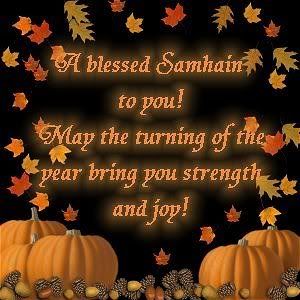 We briefly touched on this last week, but we should know the significance of Samhain. It's pretty easy to see how our Gallic ancestors viewed this time of the year with so much reverence. There's an ominous feeling to "Indian Summer," which we're at the tail end of in the Bay Area with a late Indian Summer, as we know that winter is just around the corner. It's in our genetic memory. Samhain is part of the ancient seasonal "Wheel of the Year." It should be mentioned that the Irish immigrants were the ones who made "Halloween" what it is today, which goes clear back into the ancient world.
SAMHAIN
Samhain — roughly translated as "summer's end" — is a festival held on October 31–November 1 in Gaelic cultures. A harvest festival with ancient roots in Celtic paganism, it was linked to festivals held around the same time in other Celtic cultures, and continued to be celebrated in late medieval times.
Samhain marked the end of the harvest, the end of the "lighter half" of the year and beginning of the "darker half".It was traditionally celebrated over the course of several days. Many scholars believe that it was the beginning of the Celtic year. It has some elements of a festival of the dead. Its relations to a festival of the dead is in the ancient belief that nature was dying during this time. The Gaels believed that the border between this world and the otherworld became thin on Samhain; because nature and plants were dying, it thus allowed the dead to reach back through the veil that seperated them from the living. Bonfires played a large part in the festivities. People and their livestock would often walk between two bonfires as a cleansing ritual, and the bones of slaughtered livestock were cast into its flames.
The Gaelic custom of wearing costumes and masks, was an attempt to copy the spirits or placate them. In Scotland the dead were impersonated by young men with masked, veiled or blackened faces, dressed in white. Samhnag — turnips which were hollowed-out and carved with faces to make lanterns — were also used to ward off harmful spirits.
The Gaelic festival became associated with the Christian All Saints' Day and All Souls' Day, and has hugely influenced the secular customs now connected with Halloween. It continues to be celebrated as a religious festival by some Neopagans.
Samhain and an t-Samhuinn are also the Irish and Scottish Gaelic names of November, respectively.
ETYMOLOGY
The Modern Irish word Samhain is derived from the Old Irish samain, samuin, or samfuin, all referring to 1 November (latha na samna: 'samhain day'), and the festival and royal assembly held on that date in medieval Ireland (oenaig na samna: 'samhain assembly'). Its meaning is glossed as 'summer's end', and the frequent spelling with f suggests analysis by popular etymology as sam ('summer') and fuin ('sunset', 'end'). The Old Irish sam ('summer') is from Proto-Indo-European language (PIE) *semo-; cognates are Welsh haf, Breton hañv, English summer and Old Norse language sumar, all meaning 'summer', and the Sanskrit sáma ("season").
In 1907, Whitley Stokes suggested an etymology from Proto-Celtic *samani ('assembly'), cognate to Sanskrit sámana, and the Gothic samana. J. Vendryes concludes that these words containing *semo- ('summer') are unrelated to samain, remarking that furthermore the Celtic 'end of summer' was in July, not November, as evidenced by Welsh gorffennaf ('July'). We would therefore be dealing with an Insular Celtic word for 'assembly', *samani or *samoni, and a word for 'summer', saminos (derived from *samo-: 'summer') alongside samrad, *samo-roto-. The Irish samain would be etymologically unrelated to 'summer', and derive from 'assembly'. But note that the name of the month is of Proto-Celtic age, cf. Gaulish SAMON[IOS] from the Coligny calendar, and the association with 'summer' by popular etymology may therefore in principle date to even pre-Insular Celtic times.
Confusingly, Gaulish Samonios (October/November lunation) corresponds to GIAMONIOS, the seventh month (the April/May lunation) and the beginning of the summer season. Giamonios, the beginning of the summer season, is clearly related to the word for winter, Proto-Indo-European *g'hei-men- (Latin hiems, Slavic zima, Greek kheimon, Hittite gimmanza), cf. Old Irish gem-adaig ('winter's night'). It appears, therefore, that in Proto-Celtic the first month of the summer season was named 'wintry', and the first month of the winter half-year 'summery', possibly by ellipsis, '[month at the end] of summer/winter', so that samfuin would be a restitution of the original meaning. This interpretation would either invalidate the 'assembly' explanation given above, or push back the time of the re-interpretation by popular etymology to very early times indeed.
Samhain was also called the Féile Moingfhinne (meaning "festival of Mongfhionn"). According to Cormac's Glossary, Mongfhionn was a goddess the pagan Irish worshipped on Samain.
Bealtaine, Lúnasa and Samhain are still today the names of the months of May, August and November in the Irish language. Similarly, an Lùnasdal and an t-Samhuinn are the modern Scottish Gaelic names for August and November.
HISTORY
The Gaulish calendar appears to have divided the year into two halves: the 'dark' half, beginning with the month Samonios (the October/November lunation), and the 'light' half, beginning with the month Giamonios (the April/May lunation). The entire year may have been considered as beginning with the 'dark' half, so that the beginning of Samonios may be considered the Celtic New Year's day. The celebration of New Year itself may have taken place during the 'three nights of Samonios' (Gaulish trinux[tion] samo[nii]), the beginning of the lunar cycle which fell nearest to the midpoint between the autumnal equinox and the winter solstice. The lunations marking the middle of each half-year may also have been marked by specific festivals. The Coligny calendar marks the mid-summer moon (see Lughnasadh), but omits the mid-winter one (see Imbolc). The seasons are not oriented at the solar year, viz. solstice and equinox, so the mid-summer festival would fall considerably later than summer solstice, around 1 August (Lughnasadh). It appears that the calendar was designed to align the lunations with the agricultural cycle of vegetation, and that the exact astrological position of the Sun at that time was considered less important.
In medieval Ireland, Samhain became the principal festival, celebrated with a great assembly at the royal court in Tara, lasting for three days. After being ritually started on the Hill of Tlachtga, a bonfire was set alight on the Hill of Tara, which served as a beacon, signaling to people gathered atop hills all across Ireland to light their ritual bonfires. The custom has survived to some extent, and recent years have seen a resurgence in participation in the festival.
Samhain was identified in Celtic literature as the beginning of the Celtic year and its description as "Celtic New Year" was popularised in 18th century literature. From this usage in the Romanticist Celtic Revival, Samhain is still popularly regarded as the "Celtic New Year" in the contemporary Celtic cultures, both in the Six Celtic Nations and the diaspora. For instance, the contemporary calendars produced by the Celtic League begin and end at Samhain.
NEOPAGANISM
Samhain is observed by various Neopagans in various ways. As forms of Neopaganism can differ widely in both their origins and practices, these representations can vary considerably despite the shared name. Some Neopagans have elaborate rituals to honor the dead, and the deities who are associated with the dead in their particular culture or tradition. Some celebrate in a manner as close as possible to how the Ancient Celts and Living Celtic cultures have maintained the traditions, while others observe the holiday with rituals culled from numerous other unrelated sources, Celtic culture being only one of the sources used.
CELTIC RECONSTRUCTIONISM
Celtic Reconstructionist Pagans tend to celebrate Samhain on the date of first frost, or when the last of the harvest is in and the ground is dry enough to have a bonfire. Like other Reconstructionist traditions, Celtic Reconstructionists place emphasis on historical accuracy, and base their celebrations and rituals on traditional lore from the living Celtic cultures, as well as research into the older beliefs of the polytheistic Celts. At bonfire rituals, some observe the old tradition of building two bonfires, which celebrants and livestock then walk or dance between as a ritual of purification.
According to Celtic lore, Samhain is a time when the boundaries between the world of the living and the world of the dead become thinner, allowing spirits and other supernatural entities to pass between the worlds to socialize with humans. It is the time of the year when ancestors and other departed souls are especially honored. Though Celtic Reconstructionists make offerings to the spirits at all times of the year, Samhain in particular is a time when more elaborate offerings are made to specific ancestors. Often a meal will be prepared of favorite foods of the family's and community's beloved dead, a place set for them at the table, and traditional songs, poetry and dances performed to entertain them. A door or window may be opened to the west and the beloved dead specifically invited to attend. Many leave a candle or other light burning in a western window to guide the dead home. Divination for the coming year is often done, whether in all solemnity or as games for the children. The more mystically inclined may also see this as a time for deeply communing with the deities, especially those whom the lore mentions as being particularly connected with this festival.
WICCA
Samhain is one of the eight annual festivals, often referred to as 'Sabbats', observed as part of the Wiccan Wheel of the Year. It is considered by most Wiccans to be the most important of the four 'greater Sabbats'. It is generally observed on October 31st in the Northern Hemisphere, starting at sundown. Samhain is considered by some Wiccans as a time to celebrate the lives of those who have passed on, and it often involves paying respect to ancestors, family members, elders of the faith, friends, pets and other loved ones who have died. In some rituals the spirits of the departed are invited to attend the festivities. It is seen as a festival of darkness, which is balanced at the opposite point of the wheel by the spring festival of Beltane, which Wiccans celebrate as a festival of light and fertility.
Monday, July 6, 2009
Gallia Cisalpina III: Celto-Ligurian Culture
Gallia Cisalpina III: Celto-Ligurian Culture
All of the tribes of Cisalpine Gaul are sometimes referred to as part of the "Celto-Ligurian" culture. Although some may be "Celto-Venetic" or other regional variations.
The Ligures (singular Ligus or Ligur; English: Ligurians, Greek: Λίγυες) were an ancient people who gave their name to Liguria, which once stretched from Northern Italy into southern Gaul. According to Plutarch they called themselves Ambrones which means ¨people of the water¨. The Ligures inhabited what now corresponds to Liguria, northern Tuscany, Austria (Noricum), Piedmont, part of Emilia-Romagna, part of Lombardy, and parts of southeastern France.
Classical references and toponomastics suggest that the Ligurian sphere once extended further into central Italy (Taurisci): according to Hesiod's Catalogues (early 6th century BC) they were one of the three main "barbarian" peoples ruling over the Western border of the known world (the others being Aethiopians and Scythians). Avienus, in a translation of a voyage account probably from Marseille (4th century BC) speaks of the Ligurian hegemony extending up to the North Sea, before they were pushed back by the Celts. Ligurian toponyms have been found in Sicily, the Rhône valley, Corsica and Sardinia.
It is not known for certain whether they were a pre-Indo-European people akin to Iberians; a separate Indo-European branch with Italic and Celtic affinities; or even a branch of the Celts or Italics. Kinship between the Ligures and Lepontii has also been proposed. Another theory traces their origin to Betica (modern Andalusia) and southern Lusitania (modern Algarve and Alentejo).
The Ligures were assimilated by the Romans, and before that by the Gauls, producing a Celto-Ligurian culture.
Wednesday, July 1, 2009
Gallia Cisalpina II: Pagan Celtic Nation
Gallia Cisalpina II: Pagan Celtic Nation
In memory of the earth-based and gender-equal pagan culture of the Celto-Ligurian tribes in the southern Alpine and Po river valley region called Gallia Cisalpina (Cisalpine Gaul; "Gaul south of the Alps") by the Romans who eventually destroyed their world, took their land, and subjugated them under the Roman Empire.
Monday, June 15, 2009
Gallia Cisalpina: A Celtic Nation
Gallia Cisalpina: A Celtic Nation
Our second video
The Trophy of the Alps or Trophy of Augustus was built by the Roman emperor Augustus to celebrate his definitive victory over the ancient Celto-Ligurian tribes who populated the region and who had harassed merchants along Roman roads. Its remains may be seen in the Commune of La Turbie (Alpes-Maritimes), on the Grande Corniche, 6 km from Monaco.
Friday, May 8, 2009
Wotan, Mead, the Irminsul, the Nine Noble Virtues, and other pagan loose ends
 There are a few more areas to cover, which I will tie into one entry. I am a believer that a person can view so-called "paganism" as: 1) a religion, 2) a history, 3) a look into the spirituality and soul of a people, and 4) as a set of principles to be adhered to (if they wish). One need not actually "join" a religious and/or spiritual tradition, in order to adhere to it. To make it's values and principles a part of their own conscience.
For example, the 'Nine Noble Virtues'.
Odinic Rite:
1. Courage
2. Truth
3. Honour
4. Fidelity
5. Discipline
6. Hospitality
7. Self Reliance
8. Industriousness
9. Perseverance
Asatru Folk Assembly:
1. Strength is better than weakness
2. Courage is better than cowardice
3. Joy is better than guilt
4. Honour is better than dishonour
5. Freedom is better than slavery
6. Kinship is better than alienation
7. Realism is better than dogmatism
8. Vigor is better than lifelessness
9. Ancestry is better than universalism
 Like the 'Ten Commandments' in Christianity, these principles and many other, much deeper, aspects of Odinism (or Asatru) can be admired and studied. I am aware that the Nine Noble Virtues are guidelines and not "thou shalt nots," and they have no concept of "hell," etc., but my real point is that we can look into any faith and adopt some principles from them. I recently viewed an episode on the History Channel program 'Warriors' with Terry Schappert. It was about the Zulu tribe, and they had a special ceremonial tradition after a battle, in which a warrior is purified in order to go back into society. I thought it was in interesting spiritual concept.
The "Viking Era" was a very small part of the history of what we call Odinism or Asatru. Actually, our ancient Lombard ancestors called what was basically the chief god, usually called Odin, the god of war, as Wotan or Wodan. They were Wotanists or Wodanists, and I mean this was many, many centuries ago. The 'Nine Noble Virtues' was taken from one of the Norse Sagas I believe, and the first one, from the Odinic Rite, was the original.
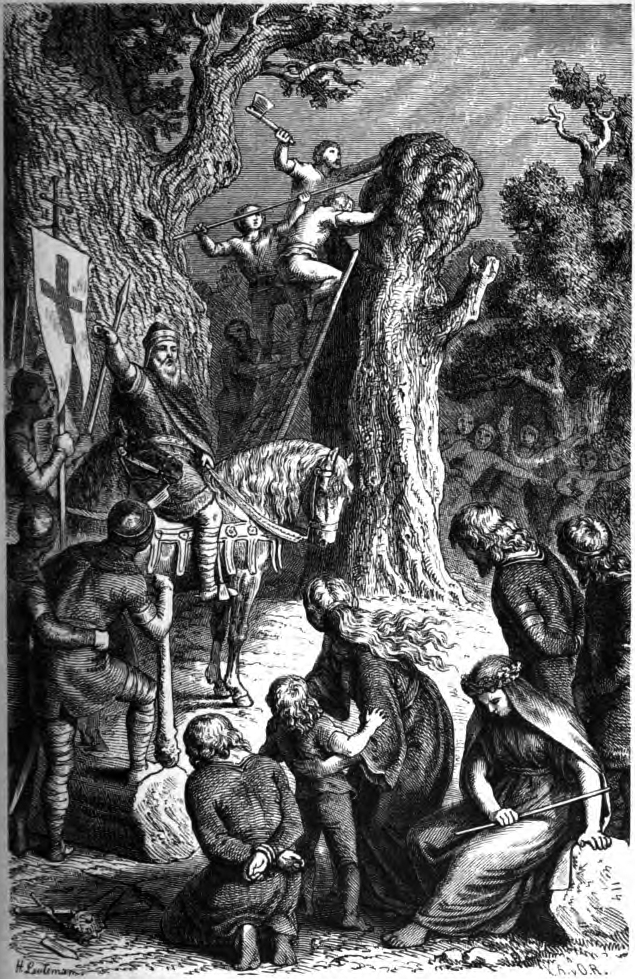
I would also like to at least mention the "Irminsul" (see image to the right), which was a large carved wooden pillar, which was a very important part of this spirituality. I don't think that it was intrinsically worshipped, but may have been a manner to get in touch with all of the gods. Perhaps someone could clue us in there. It appears that the old Germanic tribes often just used a carved tree trunk for this purpose as well. When the Romans, and later powers, finally mobilized themselves to spread Christianity, lets face it, they often did it via force. The following painting was composed by German painter Heinrich Leutemann in 1882, and was entitled 'The destruction of Irminsul through Charlemagne'. It depicts Wotanists literally being forced to accept Christianity as their Irminsul is demolished.
Did you know that names from the days of the week, which we use every day, are from Norse/Germanic spirituality or gods?
Sunday -- "Sun's Day"
Monday -- "Moon's Day"
Tuesday -- "Tiu's Day"
Wednesday -- "Wodan's Day"
Thursday -- "Thor's Day"
Friday -- "Freya's Day"
Saturday -- "Saturn's Day"
Wodan, Wotan, or Woden, may have originally come from the worship of the Greek god Mercury. It's hard sometimes to substantiate some of these things due to various cultures wanting to maintain the purity or originality of their history. I suppose that if this was true, that it was probably due to influence from the Romans, or possibly the Etruscans. I don't really know.
Mead (from description at Wikipedia): "Mead is a typically alcoholic beverage, made from honey and water via fermentation with yeast. Its alcoholic content may range from that of a mild ale to that of a strong wine. It may be still, carbonated, or sparkling. It may be dry, semi-sweet, or sweet.
"Depending on local traditions and specific recipes, it may be brewed with spices, fruits, or grain mash. It may be produced by fermentation of honey with grain mash; mead may also, like beer, be flavored with hops to produce a bitter, beer-like flavor."
What is amazing is that Mead is so hard to find! It was such a part of our ancestors lives, yet it's difficult to find in the market. I don't think that it would be very difficult to make. It can be purchased online pretty easily. Try Yahoo Shopping. Check the Wikipedia link, as there is much more than we have time to research and cover right now. YouTube has videos on how to make Mead as well.
There is an interesting FAQ, from the Wisconsin Vinland Association, called 'An FAQ: Asatru, Wicca, and paganism', which is quite interesting. However, it's pretty apparent that they are a "Universalist" group, meaning that they have a belief that the traditions of their ancestors belong to all other cultures of the earth just as much as it belongs to them. It's probably a split down the middle as far as pagans of European traditions, between those who are Universalist or Folkish. Folkish means that one's heritage is inherently "theirs," and not belonging to every other culture in the world.
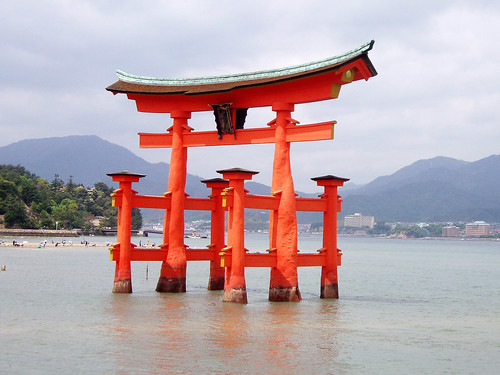 I believe that a European descended person should feel free to study, for example, Shintoism. They may study it, admire it, and even adhere to it; but they can never become a Shintoist because they're not Japanese. It would be extremely disrespectful and dishonorable to try to do this. In the same way, a Japanese person could study and admire Asatru, without trying to co-opt it. Many White Americans flock to Hawaii and force themselves on the native Hawaiian religion, which has caused some of the local Hawaiians to get pretty angry. Again, study, admire, and even adhere to anything, but I believe that it's important for every human being on earth to realize that not everything in the world belongs to YOU. The image above: a Shinto Shrine. Again, don't be afraid to go to YouTube and look up all of these subjects. Many people have downloaded some amazing videos.
 I know, this entry has bounced all over the place. I would like to end with an article from the Odinic Rite, entitled 'Images of the Wolf in the Northern Psyche'. It's in PDF, and they don't want it reproduced anywhere without permission, so I will not post the text. It is about the wolf in ancient northern culture and folklore. Actually, much of this folklore survived up to a point in history later than we realize, in some instances. Many ancient Lombard names had a "wulf" ending to them, which comes directly from the reverence of the wolf. I should also mention that this article was written by Heimgest, the director of the Odinic Rite, and I will end this entry with links to four videos of a very interesting interview of him which was conducted.
Interview With a Gothi - Part 1
Interview With a Gothi - Part 2
Interview With a Gothi - Part 3
Interview With a Gothi - Part 4
Subscribe to:
Posts (Atom)