Showing posts with label military history. Show all posts

Thursday, December 31, 2020

Dragon's Teeth of Vallo Alpino


                            'The Alpine Wall - Italy'


A line of abandoned, alien-like fortresses dot the mountains of North Italy

                                               [AtlasObscura.com]

Similar to the Maginot line of France, the Alpine Wall was built as a defense for Italy in preparation for World War II. There was concern that the natural defense of North Italy’s mountainous terrain was not enough as tensions rose with its neighbors along the top of the “boot”—France, Switzerland, Austria and the former Yugoslavia.

The mountains were enhanced with lookout posts and fortifications all along the passes, stretching over 1,100 miles. The Alpine Wall fortifications varied between three designs: large mountainside forts, rallying points and bunkers, and point-defense fortifications. Many of these can still be seen today.


con't (see images)....


************ 


I saw this subject featured a few days ago on a 2018 episode of 'Mysteries of the Abandoned' (Science Channel) entitled 'Doomsday at Dragon's Teeth'. This elaborate defense system was constructed in 1931, and reflects how Mussolini did not trust Hitler at that point.


************


 Video: The dragon teeth of Pian dei Morti


In the Val Venosta valley, between the borders of Italy and Austria, a weir system was built during WWII, the heart of which was a tank barrier. We will take a closer look at this barrier, as well as the various bunkers which lie 550 meters above Resia. On the way there we enjoy a pleasant, circular hike and inspect the source of the river Adige, the biggest river in South Tyrol.


************


Vallo alpino in Alto Adige


Sbarramento Pian dei Morti


************


Alpenwall - Vallo Alpino - Kreuzbergpass - Mussolinis Festungslinie - Teil 1

Willi seiner

Mussolinis Festungslinie

Der Alpenwall in Südtirol ist der Abschnitt des Vallo Alpino (deutsch Alpenwall), der in den Jahren von 1938 bis 1942


************


Alpenwall in Südtirol


.

Saturday, July 8, 2017

Opening battle scence from 'Gladiator' - A devastating fighting force


Gladiator- Opening Scene.avi

Michael M


*************************


I think this scene gives some glimpse of how effective the Roman army could be. There was the equivalent of howitzers and air strikes. Also, when we think of both thrusting and hacking swords, arrows, oil-fire bomb projectiles, and those big arrows that are fired from a cranked up mechanism... I mean, I'd rather just take a bullet! Lastly, the sheer bravery of all ancient warriors to engage in this type of wicked combat.

.

Saturday, June 13, 2015

Confessions of a bookmark junkie 1

Lucrezia Borgia
For longer than I care to say, like probably a lot of people, I've gone bookmark crazy. It's like on those late evenings, you're feeling tired but still conscious enough to follow some areas of interest. You then just go bookmarking with the intention of "getting back to it later"... which you don't because the subjects are so muddled. Well, maybe it's still possible. I wanted to begin a process of catching up with a series of ideas that will not follow any consistent pattern. Sometimes there should probably be much more to say about them; sometimes not. I may get back to a few of them; maybe not.


Lucrezia Borgia

Lucrezia Borgia (18 April 1480 – 24 June 1519) was the daughter of Pope Alexander VI and Vannozza dei Cattanei. Her brothers included Cesare Borgia, Giovanni Borgia, and Gioffre Borgia.

Lucrezia's family politics became subject matter for The Prince where well implemented ruthlessness represents a practical component of Machiavellian politics.

Her family had arranged several marriages for her which advanced their own political position including Giovanni Sforza (Lord of Pesaro), Alfonso of Aragon (Duke of Bisceglie), and Alfonso I d'Este (Duke of Ferrara).

Tradition has it that Alfonso of Aragon was an illegitimate son of the King of Naples and that her brother Cesare may have had him murdered after his political value waned.

Lucrezia was cast as a femme fatale, a role she has been portrayed as in many artworks, novels, and films.


Not being someone easily taken in by "royalty," which is so often dysgenic, I have nevertheless been intrigued by Lucrezia's image in art. She must have been very beautiful. Somewhat docile, grand in style, prominent hazel eyes, long thick blondish hair. Of course her being young and beautiful, the daughter of a Pope, as well as a member of the House of Borgia... all adds much intrigue to her life. There is a play, an opera, five movies, and a portrayal in three television series; including 'The Borgias' on Showtime. If anyone wants to review 'The Borgias', send an e-mail to camunlynx@live.com. I can recall reading a comic book when I was very young... one of those old mystery comics. Some young woman was possessed by "the spirit of Lucrezia Borgia," took on an evil appearance, and poisoned her boyfriend... something along those lines. Apparently most historians don't believe her to have been a murderer, but it all adds to the legend.


Appearance

She is described as having heavy blonde hair which fell past her knees; a beautiful complexion; hazel eyes which changed color; a full, high bosom; and a natural grace which made her appear to "walk on air." These physical attributes were highly appreciated in Italy during that period. Another description said that "her mouth is rather large, the teeth brilliantly white, her neck is slender and fair, and the bust is admirably proportioned".

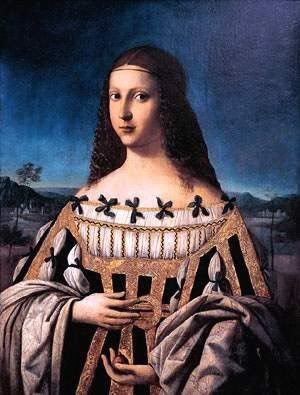
One painting, Portrait of a Youth by Dosso Dossi at the National Gallery of Victoria, was identified as a portrait of Lucrezia in November 2008. This painting may be the only surviving formal portrait of Lucrezia Borgia; however, doubts have been cast on that claim.[10] Several other paintings, such as Veneto's fanciful portrait, have also been said to depict her, but none have been accepted by scholars at present.


Rossi Firearms USA

Rossi Firearms was founded in 1889 by Amadeo Rossi, a Venetian immigrant to Brazil. Frequently, Cisalpines could be described more as "pioneers" more than immigrants... a term which subtly suggests mediocrity. Wherever Cisalpine people go, everything rises up around them. Rossi USA is based in Miami Lakes, Florida.


ROSSI HISTORY AND BACKGROUND INFORMATION

The Rossi revolution of firearm design and manufacture started with the founding of the company in 1889 by Amadeo Rossi.  Over the last 115 years, that tradition has grown along with the company and the Rossi Family.  The Rossi name represents a piece of firearm history and a tradition of excellence.

Over the years, Rossi firearms has led the way in design and engineering.  At the same time, it has always been important to produce an affordable product without sacrificing any quality or accuracy.

In December of 1997 BrazTech International L.C. was created as the exclusive importer of Rossi firearms in North America.

Previously, Rossi firearms were distributed by Interarms of Alexandria, Virginia. Rossi manufactures its classic rifles in a plant in San Leopoldo, Brazil and will continue operations there, selling many firearms outside the United States and North America.

At the same time, Forjas Taurus, S.A. purchased the rights and the equipment to manufacture Rossi handguns.  Taurus manufactures three models of .38 Special revolvers and four models of .357 Magnum revolvers under contract with Rossi.  Revolvers sold by BrazTech with the Rossi name are manufactured in a brand new facility owned by Taurus in SaoLeopoldo, Brazil.  Much of the tooling and many of the machines were acquired from Rossi during negotiations between the companies.

Today's Rossi is still run by the same family and they put the same dedication and innovation into every firearm.  At Rossi, it is more than just building guns...it is a family's history and tradition.


Caffe Trieste

Caffè Trieste is an internationally known chain of four Italian-themed coffeehouses plus one retail store in the San Francisco and Monterey Bay Areas California.

Caffè Trieste was opened in 1956 by Giovanni Giotta (aka "Papa Gianni"), who in 1951 had emigrated to the United States from the small fishing town of Rovigno D'Istria, Italy (now part of Croatia). Missing the espresso houses of Trieste, Italy, Giotta opened his own cafe. Caffè Trieste is said to be the first espresso house on the West Coast.


I remember there used to be families with origins from Trieste in San Francisco.. North Beach.. not very long ago either. It's interesting that the city has also long had Croation and Slovenian communities, two of the cultures which had off-and-on struggled for Trieste over the centuries. San Francisco has about as much continuity as Disneyland now. Recently I heard a lecture where the speaker made mention of the strange behavior of rootless Americans, and he was American.. moving every five years... as he said "living like Gypsies." I think we could at least say that a city shouldn't be as unsettled as an airport. I have been to Caffe Trieste, and it was relaxed enough to play a game of unhurried chess on one of their tables. 


Forst Beer

Although I have never tried it, Forst seems interesting to me just because it's from the culturally-linguistically German South Tyrol region. Partly because as the Cisalpines are more the wine makers; the Transalpines have been more the beer makers, and Forst being founded in 1857. You can order it online at a good price.. except that it will cost about fifty bucks for shipping.

Forst is an Italian brewing company, based in Forst, a frazione (municipal subdivision) of Algund, South Tyrol. The brewery was founded in 1857 by the two entrepreneurs Johann Wallnöfer and Franz Tappeiner from Merano. Later in 1863, the company passed to the entrepreneur Josef Fuchs, who enlarged the plant in Forst.

Forst.it (English) 

Forst Beer Garden (English)

Birra Forst (YouTube)

It can be funny how beer labels come and go. For example, Pabst Blue Ribbon was very popular in the 50s.. all over the country. In California, Primo Beer from Hawaii was rather popular in the 70s, but is difficult to even find now. Still, it can be interesting to try to get your hands on a regionally scarce beer.


National Alpine Association

Years ago, I became aware of this organization by name. There were branches all over the world (Argentina, Australia, South Africa, etc.). In fact, there was a listing in San Francisco. When I inquired about it, I received a postcard in Italian, with some reference to Cesare Battisti. I had thought it might be an association for people of Alpine Italian ancestry; although it seemed odd that a group in San Francisco would send something in Italian when local Italian immigration largely fizzled out in the 30s. 

Actually it appears that it's tied to the Alpini Italian special forces, which recruits out of the mountain regions, mostly the Alps. Contrary to the common perception, they're a very proud military tradition going back to World War I. During the Battle of Stalingrad, they distinguished themselves in the brutal Battle of Nikolayevka. A book about this battle was published, which was entitled 'Sacrifice on the Steppe' (Hamilton; 2011). I think I will save that for another posting. The Alpini traditionally wear those particular Alpine mountain hats that you may have seen before (see above image). Apparently, the Associazione Nazionale Alpini is an association made up of veterans of the Alpini Corps.


Miscellaneous Links

Gaulish Deities - A rundown of the deities of Gaulish polytheism, of which Cisalpine Gaul was a part. Cernunnos was to the Gauls, what Odin was to the Norse.

Walking tours in Northern Italy Good travel site for the northern regions.

Torani coffee and beverage flavoring - Excellent flavoring for coffee. 

Italians in the United Kingdom - Cisalpine migration to northern California, the Great Lakes region, Buenos Aires, Melbourne, or Johannesburg are what I call "GOOD migrations"; while I'm much less enthusiastic about migration to or from other European Nations. However, we should know about any of our people anywhere in the world.

Trentino-Alto Adige/Südtirol wine - Unique and different highland wines.

Italians in France - Our people in the past definitely had an impact on France. Of course, this would go back to Roman times. On a side note, contrary to common perceptions, the South of France was much more impacted long ago by Greek influence than the Cisalpine region. There was a "Magna Graecia" of France at one time.

The Lost Colony of the Templars: Verrazano's Secret Mission to America - The Vatican, the Freemasonic leadership, and other powerful forces definitely knew that the "New World" was here long before 1492.

Historical Reenactment - Taurini Celtic tribe meets Roman Legion at Turin - Interesting photographs of long ago intra-Cisalpine cultural conflict.

St. Bernardino of Siena - St. Bernadino, a Catholic Saint and a Tuscan, is the namesake of the city and large county of San Bernadino, California; as well as the San Bernadino Mountains.

Amerigo: The Man Who Gave His Name to America - The name "America" was named after the Tuscan explorer Amerigo Vespucci. On a side note, to people in north and south America, the name "America" refers to the USA. However to Europeans, the name "America" refers to the entire "New World." I have always thought of North America and South America as two separate continents, with the only common reference as "the Americas".. and the Panama Canal sort've officially separated them anyway. Also, the USA actually uses "America" within it's name, so it's logical to refer only to its citizens as "Americans."

The Pyrgi Tablets Three beautiful golden tablets from BCE; two written in Etruscan, and one in Phoenician.

Savoy - Cisalpine roots? The Savoy region was very much part of the Cisalpine cultural world in 1860. There has long been a separatist movement there. I really don't know as to whether or not they had been speakers of Piedmontese. Perhaps someone can help us out here?

Veronese Easter - Veronese vs. occupying Nepoleonic army - Little-known revolt, similar to the Sicilian Vespers.

Mysteries written in blood - Roman remnants in China - From a Chinese news source, so there must be something to it; because they always promote Chinese historical uniformity.

Antonio Pigafetta explorer - Little-known Venetian explorer who sailed with Magellan.

Ostrogothic Ravenna - The city was the capitol of the Ostrogothic Kingdom. Although this period was short, it might be interesting to look up on the Gothic architecture there.

Matteo Colombo Photography - Colorful sunrise over the Dolomites - Beautiful photography of the Dolomite Mountains.

Top Ten Jesus Movies - Easter came and went so fast, but during Easter many movies from over the years about Jesus were telecast. Some of them you probably remember, and were memorable.

Edward Ross: The Italians - Here are some north-south issues that I had wanted to comment on. Perhaps it's best to just stay with simple issues and data.

Padanian Etruria - Etruscan civilization in Lombardy - The term "Padane" is not new, and there are many centuries old references to it. Also, there were Etruscans in the Alpine stretches; as there were Gauls in Tuscany. Gallo-Etruscan heritage is one that is as legitimate as other ancient cultures which produced modern European nations, such as Britain, France, Germany, etc. There is no real geographical Celt/Gaul-Etruscan/Roman divide in modern times.
 
.

Thursday, May 14, 2015

'Unbroken' (2014) - movie review


'Unbroken' (film)

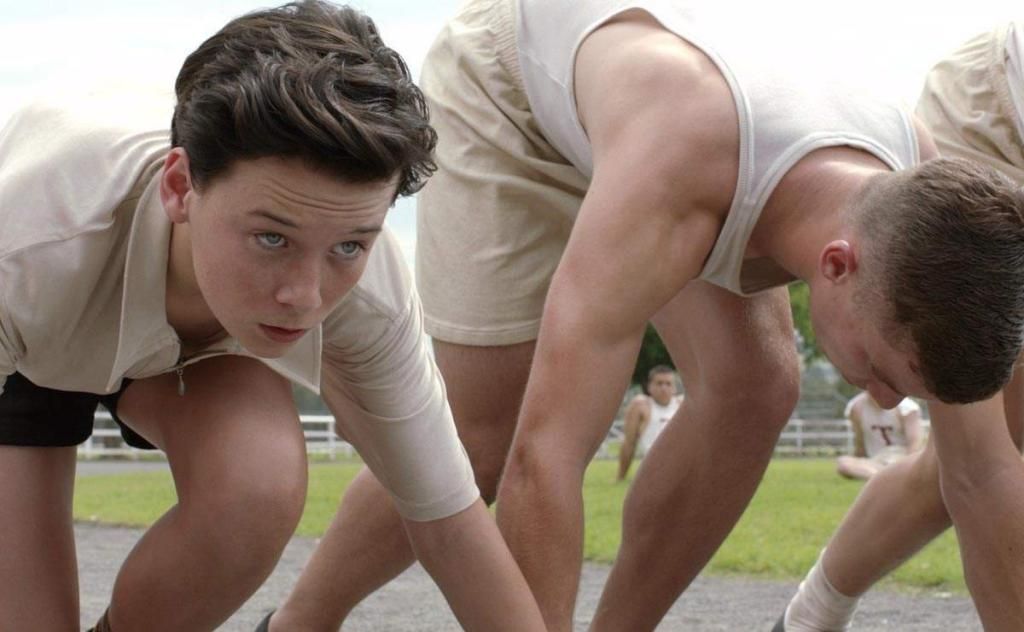
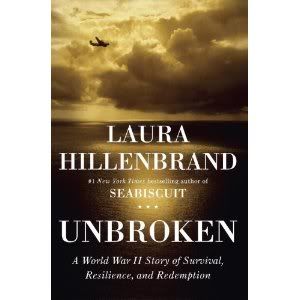
Unbroken is a 2014 American biographical war drama film, produced and directed by Angelina Jolie, and based on the 2010 non-fiction book by Laura Hillenbrand, Unbroken: A World War II Story of Survival, Resilience, and Redemption. The film revolves around the life of USA Olympian and athlete Louis "Louie" Zamperini, portrayed by Jack O'Connell. Zamperini survived in a raft for 47 days after his bomber was downed in World War II, then was sent to a series of prisoner of war camps.

The film begins with a WWII U.S. Army Air Corps fighter plane engaged in combat over the Pacific. The extreme danger of this engagement is quickly and strongly portrayed, with enemy bullets seemingly able to pierce through any portion of the plane at any time, and with dangerously close flybys. Louis Zamperini is a member of this air crew. Then the movies shifts back to Louis' childhood, which would be the less complicated manner to begin reviewing this film; in chronological order, which it does eventually follow midway though.

His parents were immigrants from Verona, in the Veneto region; having settled in a small town in eastern New York state. Growing up during the Great Depression, life was not easy for anyone, and less so for immigrants apparently. His parents were shown as having achieved great respect in the town, but young American-born Louis was always getting into trouble. Encouraged by his brother, he finally finds some focus when he starts to run track in high school. He begins to make a name for himself as one of the best middle distance runners in the country.

Not much of his 1936 Olympic experience in Germany was portrayed. It did show his come-from-behind eighth place showing in the 5000 meters, where he finished with a phenomenal fifty-six second final lap in a twelve and a half lap race. His physical peak probably would have been in the 1940 Olympics, which was cancelled. A couple of years later, before going off to war, he set a national collegiate mile record in the 1600 meters. He set that record despite being severely spiked by other runners during the race. Personally, I think that those fouls were every bit at insane as Mike Tyson biting Evander Holyfield's ear.


Spoiler alert beyond this point...

.

.

.

.

During a rescue mission in 1943 by the air crew, the plane had to be crash landed in the water due to engine problems. Only three men survived, including Louis Zamperini. They were afloat in a life raft for forty seven days! Since you cannot drink the salt water, being stranded in a life raft in the middle of the Pacific is practically a death sentence. At one point, the men were awakened by a shark fin nudging against the raft, which must have been terrifying enough in itself. They later had to beat back sharks with their fists. After catching and eating a raw sea gull, they got sick and threw up. Eventually, in a prey-to-predator scene depicting pure evolutionary struggle, they pulled in and killed a small shark. Rain water further helped sustain them.

After failing to attract an American aircraft with a flare, they got another chance; only this time it turned out to be a Japanese aircraft that proceeded to fire upon the raft. Louis jumped into the water with the sharks. Somehow nobody was hit. Eventually they ran into a Japanese navy vessel, but their struggle was really just beginning. The Japanese military engaged in policies such as beheading prisoners. They somehow survived brutal interrogation before being sent to a detention camp.

After falsely being reported as having been killed in action, the Japanese allowed Louis to send a radio message to his family. This act of seemingly good will was actually only a ploy to later get him to deliver an anti-American message over the radio. He had a choice of either delivering the false message with a chance of living and eating well until the end of the war, or refusing and being sent back to the detention camp with further beatings. He still refused.

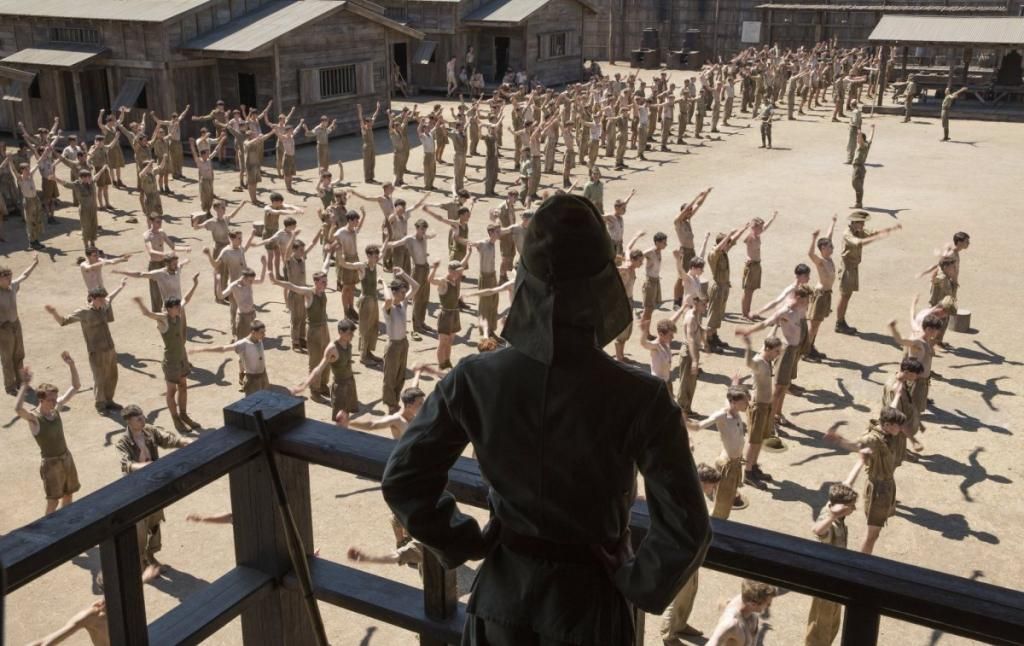
The camp commander was Sergeant Mutsuhiro Watanabe, a sadistic torturous psychopath who had it in for Louis. Watanabe always carried a wooden stick/club, which he used at his every whim. Louis was probably targeted due to his Olympic status, which made him a man whom they wanted to break down in front of the other Allied prisoners. I'm not going to describe all of the physical and psychological torture depicted, some of which would sound almost unbelievable in their brutality. However, in a possible psyop, at one point Watanabe was to have been moving on to a different position due to a promotion. He said to Louis: "Aren't you going to congratulate me?," with no response.

Shortly after, due to emergencies stemming from Japan losing the war, the prisoners were relocated to a work camp. The new commander of this work camp was none-other-than Sergeant Watanabe. This wasn't just hard labor, but they worked prisoners to death. It was apparent policy that if Japan lost the war, all prisoners would be executed, which even took away their hope. This mining camp was dark and desolate, and the poorly fed prisoners were all filthy from the work. Pure misery. Finally, all of the prisoners were ordered into the water of the lake or ocean, fully expecting to finally be executed. Instead, the war was declared over.

The movie ends with his return and some actual photographs and details from his life. Later he is shown at age 81--at the 1998 Nagano, Japan Winter Olympics festivities--carrying the Olympic torch and running well. Sergeant Watanabe went into hiding and was never prosecuted. The film was a financial success, but received mixed reviews. I think that many critics fail to understand that not every movie is made for the intended purpose of them to be "woo'd." It wasn't 'The Shawshank Redemption', but it is a true story. As a movie, it could be called a survival story, depicting one mans plight more than any kind of political message.

.

Wednesday, October 24, 2012

A couple of infamous rifles

I thought I would combine two rather infamous rifles into one entry. If nothing else, they both have a long and interesting history: The Carcano bolt-action rifles and carbines; and the Martini-Henry breech-loading single-shot lever-actuated rifle. Rather then copy a lot of tedious text, filled with gun jargon, I will just give a short summary of each. This is one of those subjects which tie into a lot of other subjects. Perhaps we can look at that vast history more in-depth some other time.


Carcano

This rifle--actually it was a series--is best known as the rifle which some believe was used to assassinate President Kennedy. It's regarded as being of relatively poor quality; but was attractive due to it's affordability. Incredibly, it was the official rifle for the Italian army from 1891 to 1981. To a gun enthusiast, it was "a piece of junk," but that's somewhat of an exaggeration I think. It was viable; a killer.


Wikipedia: Carcano is the frequently used name for a series of Italian bolt-action military rifles and carbines. Introduced in 1891, this rifle was chambered for the rimless 6.5×52mm Mannlicher-Carcano Cartuccia Modello 1895 cartridge. It was developed by the chief technician Salvatore Carcano at the Turin Army Arsenal in 1890 and called the Model 91 (M91). Successively replacing the previous Vetterli-Vitali rifles and carbines in 10.35×47mmR, it was produced from 1892 to 1945. The M91 was used in both rifle and carbine form by most Italian troops during the First World War and by Italian and some German forces during Second World War. The rifle was also used during the Winter War by Finland, and again by regular and irregular forces in Syria, Libya, Tunisia, and Algeria during various postwar conflicts in those countries.

The Type I Carcano rifle was produced by Italy for the Japanese Empire prior to World War II. After the invasion of China, all Arisaka production was required for use of the Imperial Army, so the Imperial Navy contracted with Italy for this weapon in 1937. The Type I is based on the Type 38 rifle and utilizes a Carcano action, but retains the Arisaka/Mauser type 5-round box magazine. The Type I was utilized primarily by Japanese Imperial Naval Forces and was chambered for the Japanese 6.5×50mm Arisaka cartridge. Approximately 60,000 Type I rifles were produced by Italian arsenals for Japan.


Wars fought with Carcano rifles:

Mahdist War,
First Italo-Ethiopian War,
Boxer Rebellion,
Italo-Turkish War,
World War I,
Second Italo-Abyssinian War,
Winter War,
World War II,
Libyan civil war


Users of Carcano rifles:

Albania
Bulgaria Kingdom of Bulgaria
Empire of Japan
Finland
Italy
Italy Kingdom of Italy (1861-1946)
Italian Social Republic
Nazi Germany
Libya National Liberation Army (Libya)


Martini-Henry

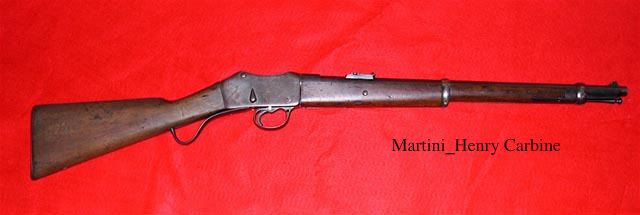
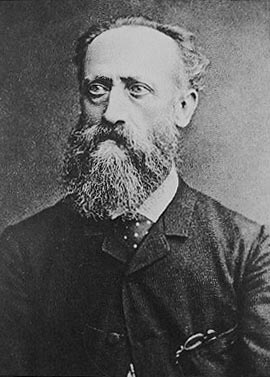
The Martini-Henry rifle is best known for it's use by the British Empire for several decades during their imperial wars. It was a heavy-duty, single-shot rifle, effective at long range, with a bayonet. In other words, truly a "hand-held cannon." Think 'Mutiny on the Bounty' for more of a historical perspective. The Martini-Henry mechanism was invented by American Henry O. Peabody in Boston in 1862, and later perfected by Swiss Friedrich von Martini in 1871, after being "combined with the polygonal barrel rifling designed by Scotsman Alexander Henry." Martini-Henrys have floated around the world long afterwards; and are still being used in some corners of the world over 120 years after the last one was produced.


Wikipedia: The Martini-Henry was a breech-loading single-shot lever-actuated rifle adopted by the British Army, combining the dropping-block action first developed by Henry O. Peabody (in his Peabody rifle) and improved by the Swiss designer Friedrich von Martini, whose work in bringing the cocking and striker mechanism all within the receiver greatly improved the operation of the rifle, which new iteration was combined with the polygonal barrel rifling designed by Scotsman Alexander Henry. It first entered service in 1871, eventually replacing the Snider-Enfield, a muzzle-loader conversion to the cartridge system. Martini-Henry variants were used throughout the British Empire for 30 years. Though the Snider was the first breechloader firing a metallic cartridge in regular British service, the Martini was designed from the outset as a breechloader and was both faster firing and had a longer range.

There are four classes of the Martini-Henry rifle: Mark I (released in June 1871), Mark II, Mark III, and Mark IV. There was also an 1877 carbine version with variations that included a Garrison Artillery Carbine, an Artillery Carbine (Mark I, Mark II, and Mark III), and smaller versions designed as training rifles for military cadets. The Mark IV Martini-Henry rifle ended production in the year 1889, but remained in service throughout the British Empire until the end of the First World War. It was seen in use by some Afghan tribesmen as late as the Soviet invasion. Early in 2010 and 2011, United States Marines recovered at least three from various Taliban weapons caches in Marjah. In April 2011, another Martini-Henry rifle was found near Orgun in Paktika Province by United States Army's 101st Airborne Division (Air Assault).

The Martini-Henry was copied on a large scale by North-West Frontier Province gunsmiths. Their weapons were of a poorer quality than those made by Royal Small Arms Factory, Enfield, but accurate down to the proof markings. The chief manufacturers were the Adam Khel Afridi, who lived around the Khyber Pass. The British called such weapons, "Pass made rifles."


Wars fought with Martini-Henry rifles:

British colonial wars
Second Anglo-Afghan War
Anglo-Zulu War
First Boer War


Users of Martini-Henry rifles:

United Kingdom & Colonies

.