Friday, February 16, 2018
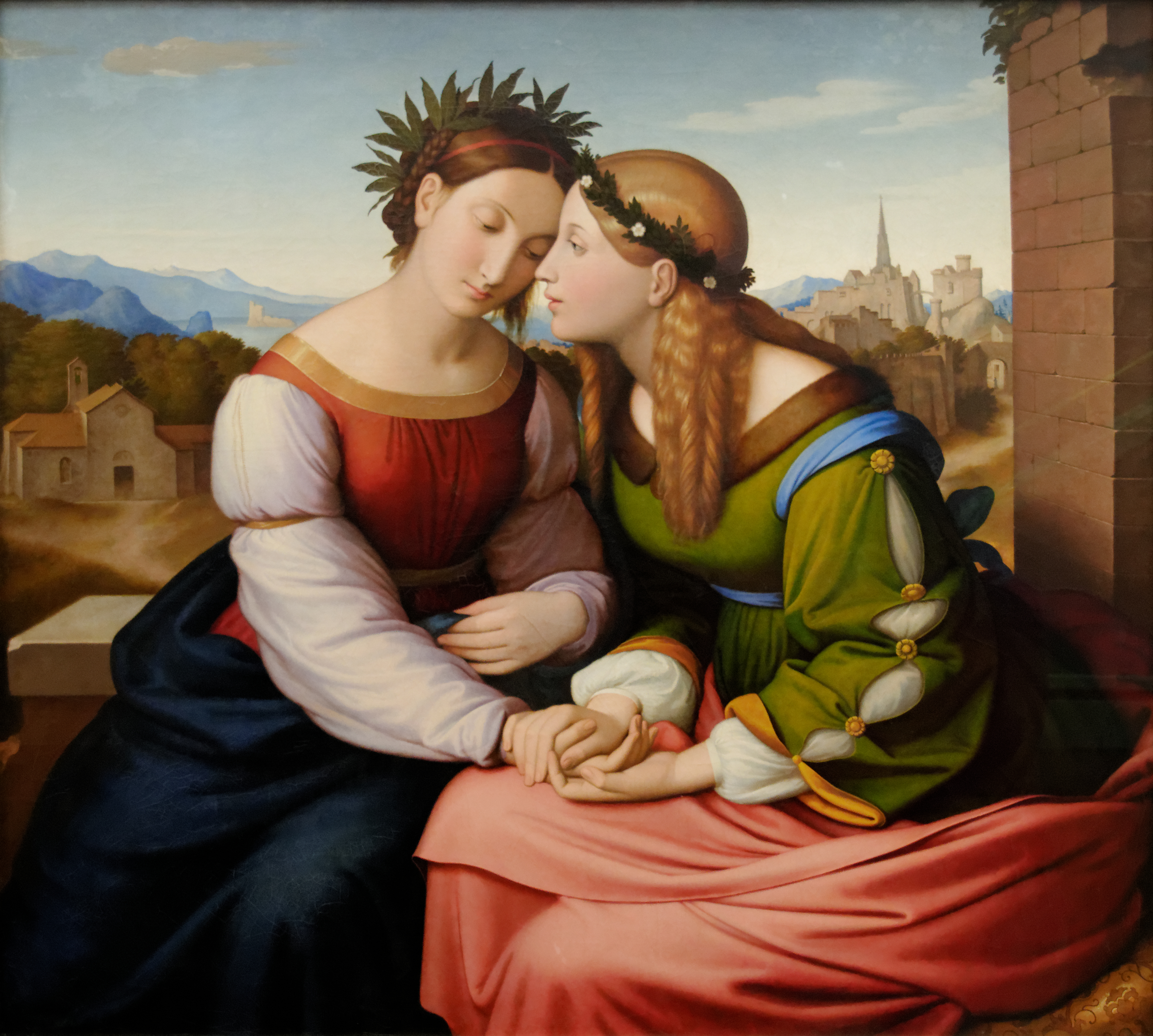
"Italia and Germania" (1828)
Reddit: "Italia and Germania"
Italia und Germania (1828) by Friedrich Overbeck. The two girls are personifications of the countries and symbolise their common heritage and friendship.
Here in Italy there's an adage:
Italians hold Germans in high regard, but don't love them; Germans love Italians but don't hold them in high regard.
Just pointing out the Italian landscape to the left and the German Gothic town to the right.
I love how , when you have pictures of German women in Art, there hair is often braided and Italian women have their hair tied with leaves.
well, the leaves are usually laurel leaves, the plant used in classical antiquity to crown athletes, writers, and so on. It just works as a reminder of our classical past
*************************
I like Germania and Austria more
[Not my comment, but I thought it made for an interesting concept in its own right]
*************************
Is it a coincidence that each one's clothes hint at the other's flag? The green-white-red color scheme was already in use in Italy at the time, not sure about Germany.
Both nations were struggling to create their own state at the time. If anything, it represents nationalism.
Friedrich Overbeck, the painter did want to express both heritage and friendship between these cultural spheres and their common wish for unity.
Italy and Germany have always been very similar (except culturally) in their history (divided politically, then unification, WWII...), and economically (east/west, north/south divide), well at least until not that long ago.
Nah, at that time Italy and Germany weren't countries, but a bunch of small loosely knit duchies, free cities, princedoms, republics, bishoprics and what not. That was also the time that nationalism and a national consciousness was being formed. So this picture, among other things, is supposed to be a fairly nationalistic one. So, if anything, EU is against nationalism and for a more supranational approach to things.
'Italy and Germany: A peaceful meeting of opposites'
Rosemarie Fruehauf - TheEpochTimes.com - December 5, 2010
It is a meeting of dark and bright, yin and yang, of introvert and extrovert. The harmony of this painting is so compelling because it shows a peaceful connection of opposites, a talk between two different realms and approaches toward life.
Leave everything aside—German stereotypes, Italian stereotypes, and the story of the Nazarene movement—and you are looking at a timeless painting about friendship.
.
The Nazarenes
The two ladies, Italia and Germania, in the painting by Johann Friedrich Overbeck, (1789–1869) represent two ideals of art: the art of the early Italian Renaissance as found in the young Raphael, and the German late-Middle Ages paintings like those of Albrecht Dürer. These were the ideals the painter Overbeck venerated and from which he drew his artistic inspiration.
The two girls can also be seen as symbolizing the church and the state. Overbeck and his artist friends of the Nazarene movement postulated that the partners of art should be the church and the state, a view that was regarded as old fashioned and reactionary in a time when art suddenly had to search for reasons to validate its existence.
The industrial revolution was dawning, and both the bourgeoisie and artists were growing ever more independent. In these days at the brink of the 19th century, Overbeck and some fellow students of the Academy of Vienna were dissatisfied with the lack of heart and soul in the prevalent Neoclassicism and with the conventional art education in the academy system.
In the meetings and discussions they held in a loose circle from 1808, they found their Christian ideals manifesting in the earlier European art. Four of them, including Overbeck, left the academy in 1810 and traveled to Rome. In Italy, they hoped to live a life in the way of the old, “true” artists. Making an impact in Rome. They called themselves the “Brotherhood of St. Luke” (St. Luke is the patron saint of painters) and after occupying the abandoned monastery of San Isidoro, conducted a quasi-monastic life, dedicated to praying and painting.
Soon they became known among their detractors as well as supporters by the quizzical nickname “Nazareni” (for their long-haired, biblical appearance) and were joined by other like-minded personalities. The greatest achievement of the group was the reviving of the old fresco technique that had almost been forgotten.
With two major commissions, the wall paintings of Casa Bartholdy and the Casino Massimo in Rome, they could establish an international reputation. By 1830, all the Nazarenes had returned to Germany, where many of them became acclaimed teachers and chairmen of art academies.
Overbeck, as the figurehead of the movement, rejected all offers and stayed in Rome, where he lived his dream until his death in 1869. Though admired by fans and followers, he was ridiculed by his more practical-minded contemporaries.
The Nazarenes were disillusioned over the rationalism of the enlightenment movement that had discredited itself in the terror of the French Revolution.
They preferred a society based on belief. That is why they saw the Middle Ages in a very positive light. With its simplicity and honesty, the Middle Ages became their favorite period of history.
“Italia und Germania” was especially seen as the Nazarenes’ programmatic painting, as it extols the two branches they considered to be the highest ideals of art—the early Italian Renaissance in the spiritual and introverted Madonna-like figure, together with the natural, yet proud German Middle Ages artistry represented by the blond girl.
The Nazarenes were the first art movement in a modern sense—a group of people who met to formulate an ideology of what art should be like and then worked for it. This painting exemplifies and convincingly broadcasts what they sought in art. The painting works perfectly in iconography, technique, and compositional style. Here, their dream and message is given a shape.
The Painting
The painting becomes more meaningful and beautiful the longer one looks at it. Its clear and simple coloring, supported by the stunningly smooth surface, which hardly shows a brush stroke, attracts one’s eyes naturally.
The girls are in the midst of an intimate talk. They seem to be very close, peacefully and lovingly connected. This comes mainly through the composition, as there are a lot of oval forms, which echo each other.
There is the big oval going from their shoulders to their arms and conjoined hands. There are also the ovals of the necklines that Overbeck made the same size, the similarities in the dresses, like the belts and white sleeves of their blouses as well as the floral wreaths corresponding to each other. The pink wrap that drapes the lower part of Germania’s body with its soft pleats frames and emphasizes this big oval dynamic of the setting.
It looks like a religious painting on first glance due to the strong triangular composition in which the two figures are rendered. This is what we have seen in countless saintly images, especially in the Raphael Madonna paintings. The two figures become like saints.
As in Renaissance art, Italia and Germania fill the well-balanced format, and the landscape becomes secondary. With its humble green and blues, it just illustrates a surrounding. Details tell us about the ladies’ identities: Italian architecture and the Mediterranean sea feature the background of Italia; a Gothic city and the Alps decorate Germania’s side.
Sacred Friendship
Their friendship is idealized and made sacred in the way Overbeck depicts the girls because of the harmony, dignity, and quietude of the composition. Their strongly idealized faces cannot count as portraits. Their skin is amazingly white, shimmering like porcelain. Yet this seems to be more than just a conceptual work, as it features a very natural and human conversation.
Although the two are connected, they are independent of each other; their eyes do not meet. They are conjoined by their hands, the compositional triangle shape, and multiple round forms. Each woman has her own personality and emotional quality that goes beyond the idealized portrayal. As a profile portrait, there is almost breezy cuteness in the way the blond Germania stretches her nose in the air. The blooming floral wreath comes across as extroverted and friendly. Its blooms are repeated as golden buttons on her sleeve. She leans toward the dark-haired one and holds both her hands around the others hand. She’s obviously talking to her. Some feel that she’s comforting her friend.
The image of the dark-haired Italia, with its classical three-quarter perspective and the red and blue garments she’s wearing, repeats countless Madonna portrayals. We perceive her to be introverted and almost melancholic as she holds one of her hands in front of her body as if protecting herself. She looks humbly down to the ground while her blond companion curiously looks into the landscape while talking.
The dark lady’s dress is in comparison much simpler; there are no ornaments on it. The laurel wreath she wears is the only thing that gives an idea of her Mediterranean origin and adds a little peculiarity to an otherwise perfect image of Mary.
The two become a symbol for the possible union of opposites and a peaceful dialogue of different temperaments.
.
Saturday, March 5, 2016
Veneto folk group El Canfin - 'I nonni raccontano'
El Canfin - I nonni raccontano (Video Ufficiale)
FONOLADISCHI
I think they have been active since 1986
http://www.elcanfin.it/
.
Tuesday, August 30, 2011
The Ghost of Cortina d'Ampezzo
Cortina d'Ampezzo
http://en.wikipedia.org/wiki/Cortina_D%27Ampezzo
Cortina d'Ampezzo (Ladin: Anpëz, German: Hayden) is a town and comune in the southern (Dolomitic) Alps and the province of Belluno, Veneto, northern Italy. Located in the heart of the Dolomites in an alpine valley, it is a popular winter sport resort known for its ski-ranges, scenery, accommodations, shops and après-ski scene. After the scheduled 1944 Olympics had been cancelled because of WWII, it hosted the 1956 Winter Olympics as well as various world cup events and motion pictures. Much of 1963 classic The Pink Panther, the progenitor of the series, was filmed in Cortina. One of the memorable James Bond stunt sequences in 1981's For Your Eyes Only, gunners on spike-wheeled motorcycles chasing Roger Moore on skis, was filmed on its slopes, as were several scenes in the film Cliffhanger.
Celebrity Ghost Stories DVD available September 20, 2011
http://www.amazon.com/Biography-Celebrity-Ghost-Stories-9dvd/dp/B0054YCDQ6/ref=sr_1_2?s=movies-tv&ie=UTF8&qid=1313519644&sr=1-2
.
Sunday, August 21, 2011
The Ladin People: Part 1
from DreamOfItaly channel on YouTube
Kathy McCabe of DreamofItaly.com talks to Karen Pizzolini about the Ladini or Ladins of the Dolomites, an ethnic minority who have their own culture and language and have lived in these valleys for thousands of years. Recorded on September 13, 2009 using a Flip Video camcorder.
.
Monday, July 19, 2010
Gallia Cisalpina VI: Gaulish Bread Harvest
Gallia Cisalpina VI: Gaulish Bread Harvest (click here for link; YouTube did not allow our video to be imbedded due to the fact that the footage is copyrighted)
Lammas is a Neo-Pagan holiday, often called Lughnasadh, celebrating the first harvest and the reaping of grain. It is a cross-quarter holiday halfway between the Summer Solstice (Litha) and the Autumnal Equinox (Mabon). In the northern hemisphere, Lammas takes place around August 1 with the Sun near the midpoint of Leo in the tropical zodiac, while in the southern hemisphere Lammas is celebrated around February 1 with the Sun near the midpoint of Aquarius. On the Wheel of the Year, it is opposite Imbolc, which is celebrated on February 2nd in the northern hemisphere, and late July / early August in the southern hemisphere.
Lammas
http://en.wikipedia.org/wiki/Lammas
Lughnasadh
http://en.wikipedia.org/wiki/Lughnasadh
Harvest Festival
http://en.wikipedia.org/wiki/Harvest_festival
Celtic calendar
http://en.wikipedia.org/wiki/Celtic_calendar
Wheel of the Year
http://en.wikipedia.org/wiki/Wheel_of_the_year
*The footage shown is from the 2006 American remake of 'The Wicker Man' :
Wikipedia
http://en.wikipedia.org/wiki/The_Wicker_Man_(2006_film)
Internet Movie Database
http://www.imdb.com/title/tt0450345/
Amazon.com
http://www.amazon.com/Wicker-Man-Widescreen-Unrated-Rated/dp/B000JYW5DW/ref=sr_1_2?ie=UTF8&s=dvd&qid=1279558795&sr=1-2
[Music: Unknown]
Tuesday, February 9, 2010
Gallia Cisalpina V: Celto-Alpine Spirit
Celtic polytheism, sometimes known as Celtic paganism, refers to the religious beliefs and practices of the ancient Celtic peoples of Western Europe prior to Christianization.
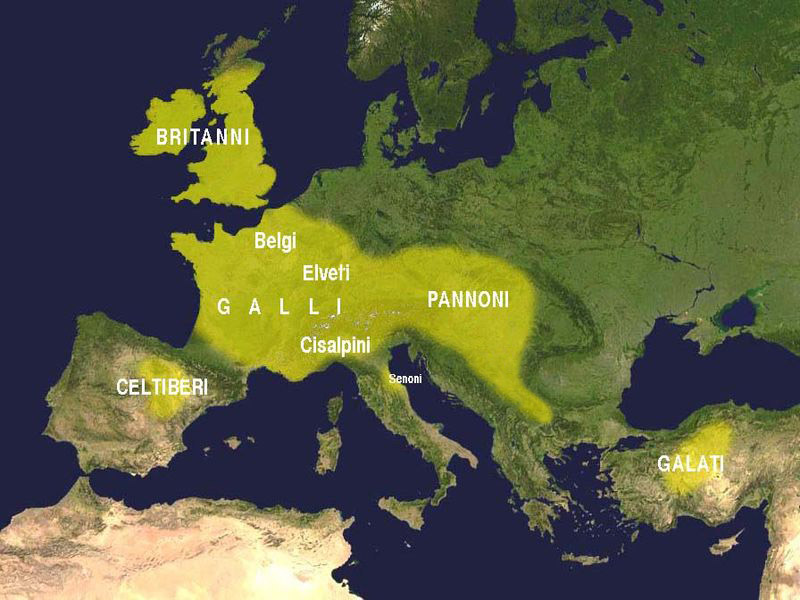
Celtic polytheism was animistic, believing in spirits existing in natural objects such as trees and rocks. Religious beliefs and practices of the Celts varied throughout the different Celtic lands, which included Ireland, Britain, Celtiberia, Gaul, areas along the Danube river, and Galatia; however there were commonalities shared by all.
Celtic mythology is the mythology of Celtic polytheism, apparently the religion of the Iron Age Celts. Like other Iron Age Europeans, the early Celts maintained a polytheistic mythology and religious structure.
Among Celts in close contact with Ancient Rome, such as the Gauls and Celtiberians, their mythology did not survive the Roman empire, their subsequent conversion to Christianity, and the loss of their Celtic languages.
[Music: 'Celtic Requiem Chant' by Elliot Simons; different than the 'Celtic Requiem']
Monday, February 8, 2010
Divine Spirits of Providence
Shall quicken and control.
Living they were the land, and dead,
Their soul shall be her soul.
[Music: 'Moonlight Sonata' by Daniel Pollack]
Wednesday, November 18, 2009
Gallia Cisalpina IV: Gaulish Harvest Festival of Samonios
SamhainThe Gaulish calendar appears to have divided the year into two halves: the "dark" half, beginning with the month Samonios (the October/November lunation), and the "light" half, beginning with the month Giamonios (the April/May lunation). The entire year may have been considered as beginning with the "dark" half, so that the beginning of Samonios may be considered the Celtic New Year's day. The celebration of New Year itself may have taken place during the "three nights of Samonios" (Gaulish trinux[tion] samo[nii]), the beginning of the lunar cycle which fell nearest to the midpoint between the autumnal equinox and the winter solstice.
The lunations marking the middle of each half-year may also have been marked by specific festivals. The Coligny calendar marks the mid-summer moon (see Lughnasadh), but omits the mid-winter one (see Imbolc). The seasons are not oriented at the solar year, viz. solstice and equinox, so the mid-summer festival would fall considerably later than summer solstice, around 1 August (Lughnasadh). It appears that the calendar was designed to align the lunations with the agricultural cycle of vegetation, and that the exact astrological position of the Sun at that time was considered less important.
[Music: 'Loreley' by Blackmore's Night]
Monday, April 6, 2009
Lynx Mythology
The lynx goes back very deeply into our roots. We would like to subtly adopt it as a symbol, as so many other groups use the wolf as a symbol.From Wikipedia webpage "Lynx (mythology):
"The Lynx is an elusive, ghost-like animal that sees without being seen. Often called "the keeper of secrets of the forest", its magical appearance stems from the mystery that such a creature's secrecy can also be its strength. The Lynx teaches us that even the smallest can succeed in life, and that the world can unfold itself to those who stop and listen.
"Roles of the Lynx
"The lynx is not a guardian of secrets so much as the one who knows them, especially when it comes to those secrets that are either obscured by time and space or are completely lost to the world. The lynx is therefore associated with divination and clairvoyance. Those who seek the lynx may find difficulty in getting it to cooperate. Just because the lynx knows secrets does not mean it wishes to share them. Only by respecting the lynx's behavior and listening carefully may one begin to receive an answer.
"This power and ability to remain unseen attracted ancient warriors to adopt the lynx and, thus, they believed, its nature. Cunning, solitary hunters, lynx have large eyes and a keen sense of hearing which enables them to hunt at night.
"Those who have been touched by the lynx's presence may be given a boon and bane. A lynx may guide the listener to a secret, whether it be a lost object or a hidden truth that is somehow relevant at the present time. On the other hand, the lynx may be an omen to warn those who have somehow betrayed the confidentiality of oneself or others.
"The lynx was chosen as the emblem of the Accademia dei Lincei ("Academy of the Lynxes"), one of the world's oldest scientific societies. Its piercing vision was invoked symbolically as characteristic of those dedicated to science.
"Associations and attributes
"The lynx is associated with Dionysus and Lugh. Though lynx are undoubtedly of keen eyesight, this quality of the lynx may have been conflated with the attributes of the near homophonic Lynceus.
"In Medieval Mythology
"In medieval times, the lynx was said to produce a gem. According to many bestiaries, the Lynx would urinate in a hole that it had dug in ground, and then cover it with dirt. The urine would form a gem after so many days. Forcing the Lynx to produce the gem was believed to be a devilish act. Many Medieval naturalists identified the gem as a carbuncle, which is an archaic term for the garnet. The typical feline behavior was interpreted as being somewhat "miserly" according to Medieval observers."
Monday, March 16, 2009
Our Long History with the Wolf

It appears that many people forget that the dog has been with us for thousands of years. Humans and domesticated wolves, in Europe and apparently parts of western Asia and India, teamed up in pre-history in order to help each other survive. Each possessing traits that the other lacked. Even more-so than the horse or cat, the dog is a deep part of our history.
From the Wikipedia entry Canidae: "Canidae is the biological family of the dogs; a member of this family is called a canid. They include wolves, foxes, coyotes, and jackals. The Canidae family is divided into the "true dogs" of the tribe Canini and the "foxes" of the tribe Vulpini. The two species of the basal Caninae are more primitive and do not fit into either tribe.
"Canids and humans
"One canid, the domestic dog, long ago entered into a partnership with humans and today remains one of the most widely kept domestic animals in the world and serves humanity in a great many important ways. Most experts believe the domestic dog is descended from an Asian subspecies of the Gray Wolf.
"Among canids, only the gray wolf has been known to prey on humans. There is at least one record of a coyote killing a toddler, and two of golden jackals killing children. Some canid species have also been trapped and hunted for their fur and, especially the Gray Wolf and the Red Fox, for sport. Some canids are now endangered in the wild due to hunting, habitat loss, and the introduction of diseases from domestic dogs."
From the Wikipedia entry Gray Wolf: "The grey wolf or gray wolf (Canis lupus), also known as the timber wolf or simply wolf, is the largest wild member of the Canidae family. It is an ice age survivor originating during the Late Pleistocene around 300,000 years ago. DNA sequencing and genetic drift studies reaffirm that the gray wolf shares a common ancestry with the domestic dog (Canis lupus familiaris). Although certain aspects of this conclusion have been questioned, including recently, the main body of evidence confirms it. A number of other gray wolf subspecies have been identified, though the actual number of subspecies is still open to discussion. Gray wolves are typically apex predators in the ecosystems they occupy. Though not as adaptable as more generalist canid species, wolves have thrived in temperate forests, deserts, mountains, tundra, taiga, grasslands, and even urban areas.
"Though once abundant over much of Eurasia and North America, the gray wolf inhabits a very small portion of its former range because of widespread destruction of its territory, human encroachment of its habitat, and the resulting human-wolf encounters that sparked broad extirpation. Even so, the gray wolf is regarded as being of least concern for extinction according to the International Union for Conservation of Nature, when the entire gray wolf population is considered as a whole. Today, wolves are protected in some areas, hunted for sport in others, or may be subject to extermination as perceived threats to livestock and pets.
"In areas where human cultures and wolves are sympatric, wolves frequently feature in the folklore and mythology of those cultures, both positively and negatively."
Monday, March 2, 2009
Early Celtic Presence in Northern Italy

[Thanks to Insubria87 for this entry: His original post 'Early Celtic Presence in Northern Italy']
EARLY CELTIC PRESENCE IN NORTHERN ITALY
People of European History
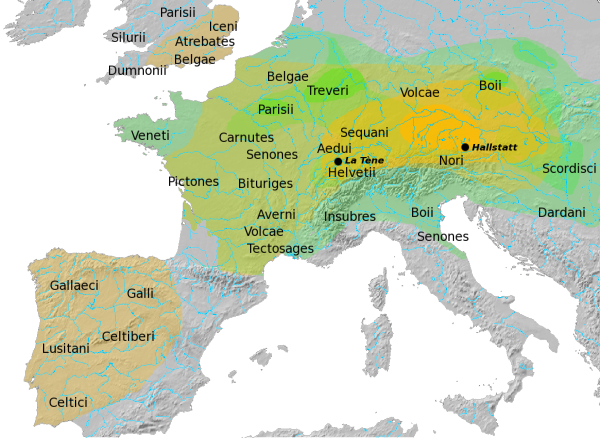
The Celts of the Latène age (475 to 20 BC) are named for the important archaeological finds at La Tène on the lake of Neuchâtel in Switzerland and are counted among the most important people of European history. Their central area of influence stretched from the Marne and Mosel, over southern France, and southern Germany, reaching to southern Poland and the Carpathians. The actual origins of the Celts is unknown. Myths and legends give a very contradictory picture.
Origins and Early History
Clear references to the history of the Celts are first found in the late Bronze age (the 13th century BC) with the beginning of the Canegrate culture. The name comes from the archaeological excavation at "Canegrate" (http://en.wikipedia.org/wiki/Canegrate) near Legnano north of Milan, where important finds were made. The Canegrate culture was founded by Celts who came from the Northwest alpine region and settled in the area between the Lake of Maggiore and the Lake of Como. They brought a language with them from which "Old-Celtic" continuously developed. They lived in direct proximity to the Golasecca-Celts of the Ticino (their name stems from the important archaeological finds in "Golasecca" at the place where the Ticino river flows out of the Lake of Maggiore) and the Helvetians in the north whose settlements reached far towards southern Germany.
The Golasecca culture is a proto-historic pre-Celtic culture in northern Italy of which the type-site is Golasecca in the province of Varese, Lombardy (northern Italy). Sites characteristic of Golasecca culture have been identified in eastern Lombardy, Piedmont, the Canton Ticino and Val Mesolcina, in a territory stretching north of the Po River to sub-alpine zones, between the course of the Serio to the east and the Sesia to the west. The site of Golasecca, where the Ticino exits from Lake Maggiore, was particularly suitable for long-distance exchanges, in which Golaseccans acted as intermediaries between Etruscans and the Halstatt culture of Austria, supported on the all-important trade in salt.
In a broader context, the subalpine Golasecca culture is the very last expression of the Middle European Urnfield culture of the European Bronze Age. The culture's richest flowering was Golasecca II, in the first half of the sixth to early fifth centuries BCE. It lasted until it was overwhelmed by the Celts in the fourth century and was finally incorporated into the hegemony of the Roman Republic.

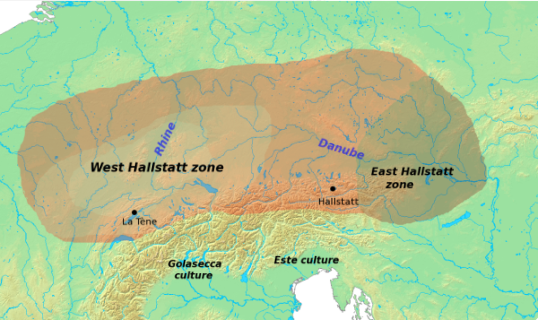
situation of the Golasecca culture to the south of the Hallstatt culture.
Golasecca culture is divided for convenient reference into three parts: the first two cover the period of the ninth to the first half of the fifth century BCE; the third, coinciding with La Tène A-B of the later Iron Age in this region and extending to the end of the fourth century BCE, is marked by increasing Celtic influences, culminating in Celtic hegemony after the conquests of 388 BCE. The very earliest finds are of the Late Bronze Age (ninth century), apparently building upon a local culture.[1]
Cremation near the burial site, followed by ash and bone burials in terracotta jars, in excavated pits set at determined distances one from the other in scattered necropolises, characterize a culture of many small village settlements.
In Golasecca culture some of the first evolved characteristics of historic society may be seen, in the specialized use of materials and the adaptation of the local terrain. The early-period habitations were circular wooden constructions along the edge of the river's floodplain; each was built on a low basement of stone round a central hearth and floored with river pebbles set in clay. Hand-shaped ceramics, made without a potter's wheel, were decorated in gesso. The use of the wheel is known from the carts in the Tomb of the Warrior at the Sesto Calende site. Amber beads from the Baltic sea across the Amber Road and obsidian reveal networks of long-distance trade. From the seventh century onwards some tombs contain burial goods imported from Etruscan areas and Greek objects[2]
The settlements depended on domesticated animals: remains reveal the presence of goats, sheep, pigs, cattle and horses. Some legume and cereal crops were cultivated; nuts and fruits were collected. The dugout boats from Castelletto Ticino and Porto Tolle are conserved at the museum of Isola Bella. Metal, though rare, was in increasing use.
Undeciphered written characters are found incised in ceramics or on stone.
The Golasecca culture is best known by its burial customs, where an apparent ancestor cult imposed respect of the necropoli, a sacred area untouched by agrarian use or deforestation. The early-period burials took place in selected raised positions oriented with respect to the sun. Burial practices were direct inhumation or in lidded cistae. Stone circles and alignments are found. Burial urns were painted with designs, with accessory ceramics, such as cups on tall bases. Bronze objects are usually of wearing apparel: pins and fibulas, armbands, rings, earrings, pendants and necklaces. Bronze vessels are rare. The practice of cremation persists into the second period (early sixth to mid-fourth centuries)
The old sites—Golasecca, Sesto Calende, Castelletto Ticino—maintained their traditional autochthonous character through the sixth century, when outside influences begin to be detectable. At the beginning of the fifth century, pastoral practices resulted in the development of new settlements in the plains.

The first finds were discovered at several locations in the comune of Golasecca in 1824, by the antiquarian abate Giovan Battista Giani, who identified the clearly non-Roman burials as remains of the battle between Hannibal and Scipio Africanus[3]. In 1865 Louis Laurent Gabriel de Mortillet, a founder of European archaeology, rightly assigned the same tombs to the early Iron Age. The modern assessment of Golasecca culture is derived from the campaigns of 1965-69 on Monsorino, directed by Mira Bonomi.
Lepontii
The Lepontii were an ancient people occupying portions of Rhaetia (in modern Switzerland and Italy) in the Alps during the time of the Roman conquest of that territory. The Lepontii have been variously described as a Celtic, Ligurian, Raetian, and Germanic tribe. However, most evidence, including recent archeological excavations, and their association with the 'Golasecca culture' of Northern Italy, indicates a Celtic origin although they might actually be an amalgamation of Raetians (who were of Etruscan origin) and Celts.
The chief town of the Lepontii was Oscela, now Domodossola, Italy, and their territory included the southern slopes of the St. Gotthard Pass and Simplon Pass, corresponding roughly to present-day Ossola and Ticino. See also: Lepontic language. This map of Rhaetia [1] shows the location of the Lepontic territory, in the south-western corner of Rhaetia. The area to the South, including what was to become the Insubrian capital Mediolanum (modern Milan), was Etruscan around 600-500 BC, when the Lepontii began writing tombstone inscriptions in their alphabet (one of several Etruscan-derived alphabets in the Rhaetian territory).
Lepontic is an extinct Celtic language that was spoken in parts of Rhaetia and Cisalpine Gaul (today's Northern Italy) between 700 BC and 400 BC. Sometimes called Cisalpine Celtic, it is considered a dialect of the Gaulish language and thus a Continental Celtic language (Eska 1998).
The language is only known from a few inscriptions discovered that were written in the alphabet of Lugano, one of five main varieties of Northern Italic alphabets, derived from the Etruscan alphabet. These inscriptions were found in an area centered on Lugano, including Lago di Como and Lago Maggiore. Similar scripts were used for writing the Rhaetic and Venetic languages, and the Germanic runic alphabets probably derive from a script belonging to this group.
Lepontic was assimilated first by Gaulish, with the settlement of Gaulish tribes north of the River Po, and then by Latin, after the Roman Republic gained control over Gallia Cisalpina during the late second and first century BC.
The grouping of all of these inscriptions into a single Celtic language is disputed, and some (including specifically all of the older ones) are said to be in a non-Celtic language related to Ligurian (Whatmough 1933, Pisani 1964). Under this view, which was the prevailing view until about 1970, Lepontic is the correct name for the non-Celtic language, while the Celtic language is to be called Cisalpine Gaulish. Following Lejeune (1971), the consensus view became that Lepontic should be classified as a Celtic language, albeit possibly as divergent as Celtiberian, and in any case quite distinct from Cisalpine Gaulish. Only in recent years, there has been a tendency to identify Lepontic and Cisalpine Gaulish as one and the same language.
While the language is named after the tribe of the Lepontii, which occupied portions of ancient Rhaetia, specifically an Alpine area straddling modern Switzerland and Italy and bordering Cisalpine Gaul, the term is currently used by many Celticists to apply to all Celtic dialects of ancient Italy. This usage is disputed by those who continue to view the Lepontii as one of several indigenous pre-Roman tribes of the Alps, quite distinct from the Gauls who invaded the plains of Northern Italy in historical times.

The older Lepontic inscriptions date back to before the 5th century BC, the item from Castelletto Ticino being dated at the 6th century BC and that from Sesto Calende possibly being from the 7th century BC (Prosdocimi, 1991). The people who made these inscriptions are nowadays identified with the Golasecca culture, which has been ascribed a Celtic identity (De Marinis, 1991). The extinction date for Lepontic is only inferred by the absence of later inscriptions.
http://en.wikipedia.org/wiki/Lepontic_language
Ligures
The Ligures (singular Ligus or Ligur; English: Ligurians, Greek: Λίγυες) were an ancient people who gave their name to Liguria, which once stretched from Northern Italy into southern Gaul. According to Plutarch they called themselves Ambrones which means ¨people of the water¨. The Ligures inhabited what now corresponds to Liguria, northern Tuscany, Piedmont, part of Emilia-Romagna, part of Lombardy, and parts of southeastern France.
Classical references and toponomastics suggest that the Ligurian sphere once extended further into central Italy (Taurisci): according to Hesiod's Catalogues (early 6th century BC) they were one of the three main "barbarian" peoples ruling over the Western border of the known world (the others being Aethiopians and Scythians). Avienus, in a translation of a voyage account probably from Marseille (4th century BC) speaks of the Ligurian hegemony extending up to the North Sea, before they were pushed back by the Celts. Ligurian toponyms have been found in Sicily, the Rhône valley, Corsica and Sardinia.
It is not known for certain whether they were a pre-Indo-European people akin to Iberians; a separate Indo-European branch with Italic and Celtic affinities; or even a branch of the Celts or Italics. Kinship between the Ligures and Lepontii has also been proposed. Another theory traces their origin to Betica (modern Andalusia).
The Ligures were assimilated by the Romans, and before that by the Gauls, producing a Celto-Ligurian culture.
Tribes
Numerous tribes of Ligures are mentioned by ancient historians, among them:
The Ligurian language was spoken in pre-Roman times and into the Roman era by an ancient people of north-western Italy and south-eastern France known as the Ligures. Very little is known about this language (mainly place names and personal names remain) which is generally believed to have been Indo-European; it appears to have shared many features with other Indo-European languages, primarily Celtic (Gaulish) and Italic (Latin and the Osco-Umbrian languages).
Xavier Delamarre argues that Ligurian was a Celtic language, similar to but not the same as Gaulish. His argument hinges on two points: firstly, the Ligurian place-name Genua (modern Genoa, located near a river mouth) is claimed by Delamarre to derive from PIE *genu-, "chin(bone)". Many Indo-European languages use 'mouth' to mean the part of a river which meets the sea or a lake, but it is only in Celtic that reflexes of PIE *genu- mean 'mouth'. Besides Genua, which is considered Ligurian (Delamarre 2003, p. 177), this is found also in Genava (modern Geneva), which may be Gaulish. However, Genua and Genava may well derive from another PIE root with the form *genu-, which means "knee" (so in Pokorny, IEW [1]).
Delamarre's second point is Plutarch's mention (Marius 10, 5-6) that during the Battle of Aquae Sextiae in 102 BC, the Ambrones (who may have been a Celtic tribe) began to shout "Ambrones!" as their battle-cry; the Ligurian troops fighting for the Romans, on hearing this cry, found that it was identical to an ancient name in their country which the Ligurians often used when speaking of their descent (outôs kata genos onomazousi Ligues), so they returned the shout, "Ambrones!".
Delamarre points out a risk of circular logic - if it is believed that the Ligurians are non-Celtic, and if many place names and tribal names that classical authors state are Ligurian seem to be Celtic, it is incorrect to discard all the Celtic ones when collecting Ligurian words and to use this edited corpus to demonstrate that Ligurian is non-Celtic or non-Indo-European.
Strabo on the other hand states "As for the Alps... Many tribes (éthnê) occupy these mountains, all Celtic (Keltikà) except the Ligurians; but while these Ligurians belong to a different people (hetero-ethneis), still they are similar to the Celts in their modes of life (bíois)."
The Ligurian-Celtic question is also discussed by Barruol (1999).
Herodotus (5.9) wrote that sigunnai meant 'hucksters, peddlers' among the Ligurians who lived above Massilia.
http://en.wikipedia.org/wiki/Ligurian_language