Etruscan-Celtic Marriage
Reconstruction of a marriage between a Celtic nobleman and an Etruscan princess, in ancient Etruria or Cisalpine Gaul.
.

Etruscan-Celtic Marriage
Reconstruction of a marriage between a Celtic nobleman and an Etruscan princess, in ancient Etruria or Cisalpine Gaul.
.
The Cernic tradition was an ancient religion native to mainly ancient Gaul, Alpine Germany, and Cisalpine Gaul; and which also seemed to exist in Iberia, some parts of Scandinavia, and perhaps elsewhere.
CERNUNNOS
http://en.wikipedia.org/wiki/Cernunnos
Cernunnos (also Cernenus and Cern) is a Celtic god whose representations were widespread in the ancient Celtic lands of western Europe. Cernunnos is associated with horned male animals, especially stags and the ram-horned snake; this and other attributes associate him with produce and fertility.
Everything known about this deity comes from two inscriptions from France and one from Germany.
Evidence
A rock carving of Cernunnos in the National park of Naquane, Italy.[4]
Cernunnos was proposed to have been identified as the illustration on the Snake-witch picture stone, which shows a possibly horned figure holding snakes in his/her hands, from Gotland, Sweden.[citation needed]
Archaeological sources such as inscriptions and depictions from Gaul and Northern Italy (Gallia Cisalpina) have been used to define Cernunnos.
[Music: 'Lacrimae Lugus' by Crystalmoors
"Celtic/Pagan Black Metal band from Cantabria, Spain" (YouTube user BlackDeath)
http://www.myspace.com/crystalmoors
http://www.fotolog.com/crystalmoors ]
 Gallia Cisalpina VI: Gaulish Bread Harvest (click here for link; YouTube did not allow our video to be imbedded due to the fact that the footage is copyrighted)
Lammas is a Neo-Pagan holiday, often called Lughnasadh, celebrating the first harvest and the reaping of grain. It is a cross-quarter holiday halfway between the Summer Solstice (Litha) and the Autumnal Equinox (Mabon). In the northern hemisphere, Lammas takes place around August 1 with the Sun near the midpoint of Leo in the tropical zodiac, while in the southern hemisphere Lammas is celebrated around February 1 with the Sun near the midpoint of Aquarius. On the Wheel of the Year, it is opposite Imbolc, which is celebrated on February 2nd in the northern hemisphere, and late July / early August in the southern hemisphere.
Lammas
http://en.wikipedia.org/wiki/Lammas
Lughnasadh
http://en.wikipedia.org/wiki/Lughnasadh
Harvest Festival
http://en.wikipedia.org/wiki/Harvest_festival
Celtic calendar
http://en.wikipedia.org/wiki/Celtic_calendar
Wheel of the Year
http://en.wikipedia.org/wiki/Wheel_of_the_year
*The footage shown is from the 2006 American remake of 'The Wicker Man' :
Wikipedia
http://en.wikipedia.org/wiki/The_Wicker_Man_(2006_film)
Internet Movie Database
http://www.imdb.com/title/tt0450345/
Amazon.com
http://www.amazon.com/Wicker-Man-Widescreen-Unrated-Rated/dp/B000JYW5DW/ref=sr_1_2?ie=UTF8&s=dvd&qid=1279558795&sr=1-2
[Music: Unknown]
The Celts - Part I
The Celts - Part II
This English documentary does a good job at getting at the real continental roots of the Celts.
Gallia Cisalpina IV: Gaulish Harvest Festival of Samonios
SamhainThe Gaulish calendar appears to have divided the year into two halves: the "dark" half, beginning with the month Samonios (the October/November lunation), and the "light" half, beginning with the month Giamonios (the April/May lunation). The entire year may have been considered as beginning with the "dark" half, so that the beginning of Samonios may be considered the Celtic New Year's day. The celebration of New Year itself may have taken place during the "three nights of Samonios" (Gaulish trinux[tion] samo[nii]), the beginning of the lunar cycle which fell nearest to the midpoint between the autumnal equinox and the winter solstice.
The lunations marking the middle of each half-year may also have been marked by specific festivals. The Coligny calendar marks the mid-summer moon (see Lughnasadh), but omits the mid-winter one (see Imbolc). The seasons are not oriented at the solar year, viz. solstice and equinox, so the mid-summer festival would fall considerably later than summer solstice, around 1 August (Lughnasadh). It appears that the calendar was designed to align the lunations with the agricultural cycle of vegetation, and that the exact astrological position of the Sun at that time was considered less important.
[Music: 'Loreley' by Blackmore's Night]
Halloween is an annual holiday celebrated on October 31. It has roots in the Celtic festival of Samhain and the Christian holy day of All Saints, but is today largely a secular celebration.
Halloween activities include trick-or-treating, wearing costumes and attending costume parties, carving jack-o'-lanterns, ghost tours, bonfires, visiting haunted attractions, pranks, telling scary stories, and watching horror films.
HISTORY
Historian Nicholas Rogers, exploring the origins of Halloween, notes that while "some folklorists have detected its origins in the Roman feast of Pomona, the goddess of fruits and seeds, or in the festival of the dead called Parentalia, [it is] more typically linked to the Celtic festival of Samhain or Samuin (pronounced sow-an or sow-in)." The name is derived from Old Irish and means roughly "summer's end". A similar festival was held by the ancient Britons and is known as Calan Gaeaf (pronounced kalan-geyf). Snap-Apple Night by Daniel Maclise showing a Halloween party in Blarney, Ireland, in 1832. The young children on the right bob for apples. A couple in the center play a variant, which involves retrieving an apple hanging from a string. The couples at left play divination games.
The festival of Samhain celebrates the end of the "lighter half" of the year and beginning of the "darker half", and is sometimes regarded as the "Celtic New Year."
The celebration has some elements of a festival of the dead. The ancient Celts believed that the border between this world and the Otherworld became thin on Samhain, allowing spirits (both harmless and harmful) to pass through. The family's ancestors were honoured and invited home whilst harmful spirits were warded off. It is believed that the need to ward off harmful spirits led to the wearing of costumes and masks. Their purpose was to disguise oneself as a harmful spirit and thus avoid harm. In Scotland the spirits were impersonated by young men dressed in white with masked, veiled or blackened faces. Samhain was also a time to take stock of food supplies and slaughter livestock for winter stores. Bonfires played a large part in the festivities. All other fires were doused and each home lit their hearth from the bonfire. The bones of slaughtered livestock were cast into its flames. Sometimes two bonfires would be built side-by-side, and people and their livestock would walk between them as a cleansing ritual.
Another common practise was divination, which often involved the use of food and drink.
The name 'Halloween' and many of its present-day traditions derive from the Old English era.
 ORIGIN OF NAME
The word Halloween is first attested in the 16th century and represents a Scots variant of the fuller All-Hallows-Even, that is, the night before All Hallows Day. Although the phrase All Hallows is found in Old English ("the feast of all saints"), All-Hallows-Even is itself not attested until 1556. Thus there is no evidence of an English term for this day before the Reformation.
SYMBOLS
Development of artifacts and symbols associated with Halloween formed over time encompassing customs of medieval holy days as well as contemporary cultures. The souling practice of commemorating the souls in purgatory with candle lanterns carved from turnips, became adapted into the making of jack-o'-lanterns. In traditional Celtic Halloween festivals, large turnips were hollowed out, carved with faces and placed in windows to ward off evil spirits. The carving of pumpkins is associated with Halloween in North America where pumpkins are both readily available and much larger – making them easier to carve than turnips. Many families that celebrate Halloween carve a pumpkin into a frightening or comical face and place it on their doorstep after dark. The American tradition of carving pumpkins preceded the Great Famine period of Irish immigration and was originally associated with harvest time in general, not becoming specifically associated with Halloween until the mid-to-late 1800s.
The imagery surrounding Halloween is largely a mix of the Halloween season itself, works of Gothic and horror literature, in particular the novels Frankenstein and Dracula, and nearly a century of work from American filmmakers and graphic artists, and British Hammer Horror productions, also a rather commercialized take on the dark and mysterious. Halloween imagery tends to involve death, evil, the occult, magic, or mythical monsters. Traditional characters include the Devil, the Grim Reaper, ghosts, ghouls, demons, witches, goblins, vampires, werewolves, zombies, skeletons, black cats, spiders, bats, and crows.
Particularly in America, symbolism is inspired by classic horror films (which contain fictional figures like Frankenstein's monster and The Mummy). Elements of the autumn season, such as pumpkins, corn husks, and scarecrows, are also prevalent. Homes are often decorated with these types of symbols around Halloween.
The colours black and orange are associated with the celebrations, perhaps because of the darkness of night and the colour of fire, autumn leaves, or pumpkins.
 We briefly touched on this last week, but we should know the significance of Samhain. It's pretty easy to see how our Gallic ancestors viewed this time of the year with so much reverence. There's an ominous feeling to "Indian Summer," which we're at the tail end of in the Bay Area with a late Indian Summer, as we know that winter is just around the corner. It's in our genetic memory. Samhain is part of the ancient seasonal "Wheel of the Year." It should be mentioned that the Irish immigrants were the ones who made "Halloween" what it is today, which goes clear back into the ancient world.
SAMHAIN
Samhain — roughly translated as "summer's end" — is a festival held on October 31–November 1 in Gaelic cultures. A harvest festival with ancient roots in Celtic paganism, it was linked to festivals held around the same time in other Celtic cultures, and continued to be celebrated in late medieval times.
Samhain marked the end of the harvest, the end of the "lighter half" of the year and beginning of the "darker half".It was traditionally celebrated over the course of several days. Many scholars believe that it was the beginning of the Celtic year. It has some elements of a festival of the dead. Its relations to a festival of the dead is in the ancient belief that nature was dying during this time. The Gaels believed that the border between this world and the otherworld became thin on Samhain; because nature and plants were dying, it thus allowed the dead to reach back through the veil that seperated them from the living. Bonfires played a large part in the festivities. People and their livestock would often walk between two bonfires as a cleansing ritual, and the bones of slaughtered livestock were cast into its flames.
The Gaelic custom of wearing costumes and masks, was an attempt to copy the spirits or placate them. In Scotland the dead were impersonated by young men with masked, veiled or blackened faces, dressed in white. Samhnag — turnips which were hollowed-out and carved with faces to make lanterns — were also used to ward off harmful spirits.
The Gaelic festival became associated with the Christian All Saints' Day and All Souls' Day, and has hugely influenced the secular customs now connected with Halloween. It continues to be celebrated as a religious festival by some Neopagans.
Samhain and an t-Samhuinn are also the Irish and Scottish Gaelic names of November, respectively.
ETYMOLOGY
The Modern Irish word Samhain is derived from the Old Irish samain, samuin, or samfuin, all referring to 1 November (latha na samna: 'samhain day'), and the festival and royal assembly held on that date in medieval Ireland (oenaig na samna: 'samhain assembly'). Its meaning is glossed as 'summer's end', and the frequent spelling with f suggests analysis by popular etymology as sam ('summer') and fuin ('sunset', 'end'). The Old Irish sam ('summer') is from Proto-Indo-European language (PIE) *semo-; cognates are Welsh haf, Breton hañv, English summer and Old Norse language sumar, all meaning 'summer', and the Sanskrit sáma ("season").
In 1907, Whitley Stokes suggested an etymology from Proto-Celtic *samani ('assembly'), cognate to Sanskrit sámana, and the Gothic samana. J. Vendryes concludes that these words containing *semo- ('summer') are unrelated to samain, remarking that furthermore the Celtic 'end of summer' was in July, not November, as evidenced by Welsh gorffennaf ('July'). We would therefore be dealing with an Insular Celtic word for 'assembly', *samani or *samoni, and a word for 'summer', saminos (derived from *samo-: 'summer') alongside samrad, *samo-roto-. The Irish samain would be etymologically unrelated to 'summer', and derive from 'assembly'. But note that the name of the month is of Proto-Celtic age, cf. Gaulish SAMON[IOS] from the Coligny calendar, and the association with 'summer' by popular etymology may therefore in principle date to even pre-Insular Celtic times.
Confusingly, Gaulish Samonios (October/November lunation) corresponds to GIAMONIOS, the seventh month (the April/May lunation) and the beginning of the summer season. Giamonios, the beginning of the summer season, is clearly related to the word for winter, Proto-Indo-European *g'hei-men- (Latin hiems, Slavic zima, Greek kheimon, Hittite gimmanza), cf. Old Irish gem-adaig ('winter's night'). It appears, therefore, that in Proto-Celtic the first month of the summer season was named 'wintry', and the first month of the winter half-year 'summery', possibly by ellipsis, '[month at the end] of summer/winter', so that samfuin would be a restitution of the original meaning. This interpretation would either invalidate the 'assembly' explanation given above, or push back the time of the re-interpretation by popular etymology to very early times indeed.
Samhain was also called the Féile Moingfhinne (meaning "festival of Mongfhionn"). According to Cormac's Glossary, Mongfhionn was a goddess the pagan Irish worshipped on Samain.
Bealtaine, Lúnasa and Samhain are still today the names of the months of May, August and November in the Irish language. Similarly, an Lùnasdal and an t-Samhuinn are the modern Scottish Gaelic names for August and November.
HISTORY
The Gaulish calendar appears to have divided the year into two halves: the 'dark' half, beginning with the month Samonios (the October/November lunation), and the 'light' half, beginning with the month Giamonios (the April/May lunation). The entire year may have been considered as beginning with the 'dark' half, so that the beginning of Samonios may be considered the Celtic New Year's day. The celebration of New Year itself may have taken place during the 'three nights of Samonios' (Gaulish trinux[tion] samo[nii]), the beginning of the lunar cycle which fell nearest to the midpoint between the autumnal equinox and the winter solstice. The lunations marking the middle of each half-year may also have been marked by specific festivals. The Coligny calendar marks the mid-summer moon (see Lughnasadh), but omits the mid-winter one (see Imbolc). The seasons are not oriented at the solar year, viz. solstice and equinox, so the mid-summer festival would fall considerably later than summer solstice, around 1 August (Lughnasadh). It appears that the calendar was designed to align the lunations with the agricultural cycle of vegetation, and that the exact astrological position of the Sun at that time was considered less important.
In medieval Ireland, Samhain became the principal festival, celebrated with a great assembly at the royal court in Tara, lasting for three days. After being ritually started on the Hill of Tlachtga, a bonfire was set alight on the Hill of Tara, which served as a beacon, signaling to people gathered atop hills all across Ireland to light their ritual bonfires. The custom has survived to some extent, and recent years have seen a resurgence in participation in the festival.
Samhain was identified in Celtic literature as the beginning of the Celtic year and its description as "Celtic New Year" was popularised in 18th century literature. From this usage in the Romanticist Celtic Revival, Samhain is still popularly regarded as the "Celtic New Year" in the contemporary Celtic cultures, both in the Six Celtic Nations and the diaspora. For instance, the contemporary calendars produced by the Celtic League begin and end at Samhain.
NEOPAGANISM
Samhain is observed by various Neopagans in various ways. As forms of Neopaganism can differ widely in both their origins and practices, these representations can vary considerably despite the shared name. Some Neopagans have elaborate rituals to honor the dead, and the deities who are associated with the dead in their particular culture or tradition. Some celebrate in a manner as close as possible to how the Ancient Celts and Living Celtic cultures have maintained the traditions, while others observe the holiday with rituals culled from numerous other unrelated sources, Celtic culture being only one of the sources used.
CELTIC RECONSTRUCTIONISM
Celtic Reconstructionist Pagans tend to celebrate Samhain on the date of first frost, or when the last of the harvest is in and the ground is dry enough to have a bonfire. Like other Reconstructionist traditions, Celtic Reconstructionists place emphasis on historical accuracy, and base their celebrations and rituals on traditional lore from the living Celtic cultures, as well as research into the older beliefs of the polytheistic Celts. At bonfire rituals, some observe the old tradition of building two bonfires, which celebrants and livestock then walk or dance between as a ritual of purification.
According to Celtic lore, Samhain is a time when the boundaries between the world of the living and the world of the dead become thinner, allowing spirits and other supernatural entities to pass between the worlds to socialize with humans. It is the time of the year when ancestors and other departed souls are especially honored. Though Celtic Reconstructionists make offerings to the spirits at all times of the year, Samhain in particular is a time when more elaborate offerings are made to specific ancestors. Often a meal will be prepared of favorite foods of the family's and community's beloved dead, a place set for them at the table, and traditional songs, poetry and dances performed to entertain them. A door or window may be opened to the west and the beloved dead specifically invited to attend. Many leave a candle or other light burning in a western window to guide the dead home. Divination for the coming year is often done, whether in all solemnity or as games for the children. The more mystically inclined may also see this as a time for deeply communing with the deities, especially those whom the lore mentions as being particularly connected with this festival.
WICCA
Samhain is one of the eight annual festivals, often referred to as 'Sabbats', observed as part of the Wiccan Wheel of the Year. It is considered by most Wiccans to be the most important of the four 'greater Sabbats'. It is generally observed on October 31st in the Northern Hemisphere, starting at sundown. Samhain is considered by some Wiccans as a time to celebrate the lives of those who have passed on, and it often involves paying respect to ancestors, family members, elders of the faith, friends, pets and other loved ones who have died. In some rituals the spirits of the departed are invited to attend the festivities. It is seen as a festival of darkness, which is balanced at the opposite point of the wheel by the spring festival of Beltane, which Wiccans celebrate as a festival of light and fertility.
 If you're familiar with this blog, then you are familiar with Cernunnos. The worship of the antlered male god of the forest, and the goddess, which was part of Western European culture for probably tens of thousands of years. This practice was part of Cisalpine Gaul more than anywhere else. It was widespread in Gaul, and even into Scandinavia. We don't need to rehash how certain religions have turned "infidels," "heathens," "witches," etc., into dirty words.
As with modern Druidry, it was revived by Freemasons in Britain, and given a universalist spin. The Wiccan Revival in the twentieth century took the worship of Cernunnos and other similar local traditons, and mixed it with other ancient spiritual traditions from the Levant, the Middle East, India, and all over the world, and formed "universalist Wicca." In more recent decades, Wicca has been touted, or at least implied, as the "leftist alternative" to "right-wing Christianity." Perhaps more importantly, as a consequence, the REAL tradition was lost.
Odinism is based on the worship of the chief god in Norse mythology: Odin. Therefore, let me ask, why couldn't the chief god of "Celto-European Witchcraft" (for lack of a better name) -- called Cernunnos, Cernenus, or Cern -- be given a proper traditional name as well? Why couldn't we call this tradition, if even just for reference, "CERNISM?" The main Odinist organization in the world is the Odinic Rite, so why not a "Cernic Rite?" As there are Odinists, why not "Cernists?"
Lets back up for a moment. In modern Greek tradition, all over the world, although they are Greek Orthodox in faith, they honor their folkish-pagan past. They seem to recognize it properly as a history! Why can't we do the same? Instead, we allow people to drag our ancient folk-culture through the mud without apology. No, the worship of Cern was not "Feminist," which makes females into males. It is true that Christianity did destroy Cernism, with disempowering women as part of the strategy of that day. It is also worth mentioning that certain political agendas have used ancient Greek and Roman gods and goddesses for their own purposes in recent decades.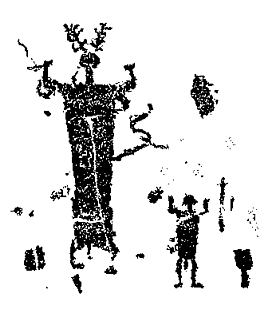 Lets stop using "witchcraft" or "Wicca," and use CERNISM or the CERNIC TRADITION in this Celtic awakening. Lastly, it should be mentioned that the culture of Cisalpine Gaul was "Celto-Ligurian" rather than Celtic. The Alpine tribes were also a big part of the culture.
11-02-09 ADDITION: Someone left a comment and added a link for an image of an ancient drawing of Cernunnos from Val Camonica. There are many drawings like this, from over a span of thousands of years. Sometimes Cernunnos was depicted with an bow.
 One of the challenges which confronted Roman imperialism in Western Europe was defeating the Druidic priesthood. It was a spiritual war rather than a war of weaponry. Over time, the Romans were so successful that they erased the deeply entrenched Druidic system from memory. There is almost no knowledge of their traditions left today.
On the Druid Wikipedia page, you will find a good deal of information of how important and widespread this culture was from the British Isles, France (Gaul), Spain, Cisalpine Gaul, and vicinities; and why the Romans wanted to eliminate it. Also, YouTube has some interesting videos on it, and attempts to revive it. There are Druids today, but they have little to go on. Although largely identified with males, there seem to have been Druidic priestesses. As far as how the Druidry overlapped with the culture of Witchcraft within the Celtic world, we don't know as yet. Unlike the rest of the Celtic world, the worship of Cernunnos, or Witchcraft, seemed to have been just as strong as Druidry in Cisalpine Gaul.
***************************************************************************
The Romans and the Druids (from historylearningsite.co.uk)
The Romans had met the Druids before in conquered Western Europe. While the Romans were happy to make a peaceful settlement with most tribes/groups in England, they had no intention of doing the same with the Druids.
The Druids were priests. The Britons both respected and feared them. It was believed that a Druid could see into the future – they also acted as teachers and judges. They were considered to be very learned people. It could take up to twenty years of learning to become a Druid. However, we do not know a great deal about what they learned as Druids were not allowed to write any of their knowledge down.
In their own way, the Druids were very religious. It was this particular issue that angered the Romans as the Druids sacrificed people to their gods. Caesar, in particular, was horrified by the practice and his writings give us a good idea of what went on in Druid ceremonies -- though from his perspective only. The Romans had once sacrificed people but they now saw it as a barbaric practice that they could not tolerate in one of their colonies. The Romans determined that they would stamp out the Druids.
However, they had to be careful. The Druids traveled freely throughout England as the Britons were too scared to stop them. Therefore, they were not simply in one place where the Romans could attack in force. In AD 54, the Emperor Claudius banned the Druids. In AD 60, the governor of England, Suetonius, decided that the only way to proceed was to attack the known heartland of the Druids--the island of Anglesey in the hope that if the center of the Druids was destroyed, those Druids in outlying areas would die out.
Boats were built for the Roman foot soldiers while the Roman cavalry swam across with their horses. The Druids shouted abuse at the Romans and cursed them but they could not stop the Roman army from landing. Any ceremonial sites on Anglesey used by the Druids were also destroyed but many of them were in secret places and some survived.
*************************************************************************** Two other articles were interesting, but one was a little too long for this entry and the other was written a bit silly and humorous, but still worth reading:
Anglesey: Druid’s island
By Philip Coppens
Anglesey, the island on the far west of Wales, was one of the last vestiges of Celtic religion in Roman times. But whereas it is assumed that the Romans wiped out the druid religion… did it somehow survive? And is nearby Bardsey Island linked with it?
Romans vs. Druids: Best War Ever?
***************************************************************************
Two recent books which apparently have information on the Druids in Cisalpine Gaul:
The Cults of Cisalpine Gaul as Seen in the Inscriptions (2009)
Specifically about Cisalpine Gaul!
The Philosopher and the Druids: A Journey Among the Ancient Celts (2006)
This book also has much about Cisalpine Gaul, according to the reviews, and you can get a used copy for only 95 cents.
The above music video is from a band called La Scelta, and it is entitled 'La Grande Danza' ("the great dancer"). It's a very catchy song. La Scelta plays what is considered Celtic-style music, which is probably based on traditional music from the modern "Celtic nations." It would have to be, because we don't know what kind of music ancient Celts may have composed. La Scelta has their offical website, as well as their YouTube channel.
************************************************************************* Along with the "Sun of the Alps," another Celtic symbol which is tied into the history of mainly the ancient continental Celts, is the "Triple Spiral." A tiny number of Irish people occasionally proclaim to various movements to "stop using OUR symbols" (Celtic symbols). Actually, the Sun of the Alps and the Triple Spiral are not identified with the British Isles at all, and the original Celts were living on the European mainland long before migrating there. It's not clear at all as to what the ancient Celts may have looked like, or what Indo-European sub-stock they may have belonged to. What may be a modern "Irish look(s)," could actually be inherited from Vikings or some other migrating people in that nation's history.
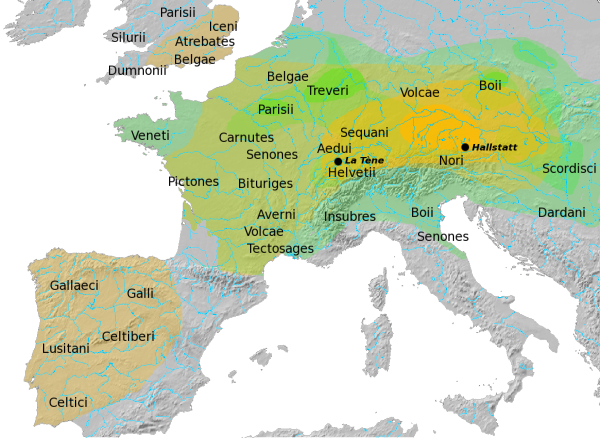
The Celts of the Latène age (475 to 20 BC) are named for the important archaeological finds at La Tène on the lake of Neuchâtel in Switzerland and are counted among the most important people of European history. Their central area of influence stretched from the Marne and Mosel, over southern France, and southern Germany, reaching to southern Poland and the Carpathians. The actual origins of the Celts is unknown. Myths and legends give a very contradictory picture.

Clear references to the history of the Celts are first found in the late Bronze age (the 13th century BC) with the beginning of the Canegrate culture. The name comes from the archaeological excavation at "Canegrate" (http://en.wikipedia.org/wiki/Canegrate) near Legnano north of Milan, where important finds were made. The Canegrate culture was founded by Celts who came from the Northwest alpine region and settled in the area between the Lake of Maggiore and the Lake of Como. They brought a language with them from which "Old-Celtic" continuously developed. They lived in direct proximity to the Golasecca-Celts of the Ticino (their name stems from the important archaeological finds in "Golasecca" at the place where the Ticino river flows out of the Lake of Maggiore) and the Helvetians in the north whose settlements reached far towards southern Germany.
The Golasecca culture is a proto-historic pre-Celtic culture in northern Italy of which the type-site is Golasecca in the province of Varese, Lombardy (northern Italy). Sites characteristic of Golasecca culture have been identified in eastern Lombardy, Piedmont, the Canton Ticino and Val Mesolcina, in a territory stretching north of the Po River to sub-alpine zones, between the course of the Serio to the east and the Sesia to the west. The site of Golasecca, where the Ticino exits from Lake Maggiore, was particularly suitable for long-distance exchanges, in which Golaseccans acted as intermediaries between Etruscans and the Halstatt culture of Austria, supported on the all-important trade in salt.
In a broader context, the subalpine Golasecca culture is the very last expression of the Middle European Urnfield culture of the European Bronze Age. The culture's richest flowering was Golasecca II, in the first half of the sixth to early fifth centuries BCE. It lasted until it was overwhelmed by the Celts in the fourth century and was finally incorporated into the hegemony of the Roman Republic.
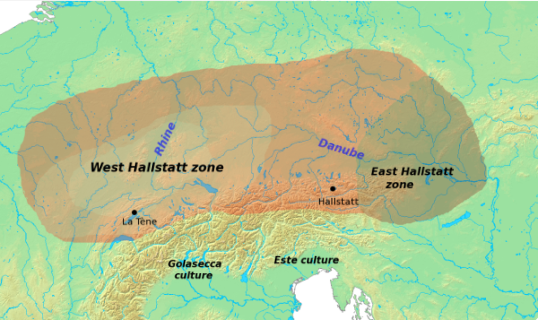
situation of the Golasecca culture to the south of the Hallstatt culture.
Golasecca culture is divided for convenient reference into three parts: the first two cover the period of the ninth to the first half of the fifth century BCE; the third, coinciding with La Tène A-B of the later Iron Age in this region and extending to the end of the fourth century BCE, is marked by increasing Celtic influences, culminating in Celtic hegemony after the conquests of 388 BCE. The very earliest finds are of the Late Bronze Age (ninth century), apparently building upon a local culture.[1]
Cremation near the burial site, followed by ash and bone burials in terracotta jars, in excavated pits set at determined distances one from the other in scattered necropolises, characterize a culture of many small village settlements.
In Golasecca culture some of the first evolved characteristics of historic society may be seen, in the specialized use of materials and the adaptation of the local terrain. The early-period habitations were circular wooden constructions along the edge of the river's floodplain; each was built on a low basement of stone round a central hearth and floored with river pebbles set in clay. Hand-shaped ceramics, made without a potter's wheel, were decorated in gesso. The use of the wheel is known from the carts in the Tomb of the Warrior at the Sesto Calende site. Amber beads from the Baltic sea across the Amber Road and obsidian reveal networks of long-distance trade. From the seventh century onwards some tombs contain burial goods imported from Etruscan areas and Greek objects[2]
The settlements depended on domesticated animals: remains reveal the presence of goats, sheep, pigs, cattle and horses. Some legume and cereal crops were cultivated; nuts and fruits were collected. The dugout boats from Castelletto Ticino and Porto Tolle are conserved at the museum of Isola Bella. Metal, though rare, was in increasing use.
Undeciphered written characters are found incised in ceramics or on stone.
The Golasecca culture is best known by its burial customs, where an apparent ancestor cult imposed respect of the necropoli, a sacred area untouched by agrarian use or deforestation. The early-period burials took place in selected raised positions oriented with respect to the sun. Burial practices were direct inhumation or in lidded cistae. Stone circles and alignments are found. Burial urns were painted with designs, with accessory ceramics, such as cups on tall bases. Bronze objects are usually of wearing apparel: pins and fibulas, armbands, rings, earrings, pendants and necklaces. Bronze vessels are rare. The practice of cremation persists into the second period (early sixth to mid-fourth centuries)
The old sites—Golasecca, Sesto Calende, Castelletto Ticino—maintained their traditional autochthonous character through the sixth century, when outside influences begin to be detectable. At the beginning of the fifth century, pastoral practices resulted in the development of new settlements in the plains.
The first finds were discovered at several locations in the comune of Golasecca in 1824, by the antiquarian abate Giovan Battista Giani, who identified the clearly non-Roman burials as remains of the battle between Hannibal and Scipio Africanus[3]. In 1865 Louis Laurent Gabriel de Mortillet, a founder of European archaeology, rightly assigned the same tombs to the early Iron Age. The modern assessment of Golasecca culture is derived from the campaigns of 1965-69 on Monsorino, directed by Mira Bonomi.
The Lepontii were an ancient people occupying portions of Rhaetia (in modern Switzerland and Italy) in the Alps during the time of the Roman conquest of that territory. The Lepontii have been variously described as a Celtic, Ligurian, Raetian, and Germanic tribe. However, most evidence, including recent archeological excavations, and their association with the 'Golasecca culture' of Northern Italy, indicates a Celtic origin although they might actually be an amalgamation of Raetians (who were of Etruscan origin) and Celts.
The chief town of the Lepontii was Oscela, now Domodossola, Italy, and their territory included the southern slopes of the St. Gotthard Pass and Simplon Pass, corresponding roughly to present-day Ossola and Ticino. See also: Lepontic language. This map of Rhaetia [1] shows the location of the Lepontic territory, in the south-western corner of Rhaetia. The area to the South, including what was to become the Insubrian capital Mediolanum (modern Milan), was Etruscan around 600-500 BC, when the Lepontii began writing tombstone inscriptions in their alphabet (one of several Etruscan-derived alphabets in the Rhaetian territory).
Lepontic is an extinct Celtic language that was spoken in parts of Rhaetia and Cisalpine Gaul (today's Northern Italy) between 700 BC and 400 BC. Sometimes called Cisalpine Celtic, it is considered a dialect of the Gaulish language and thus a Continental Celtic language (Eska 1998).
The language is only known from a few inscriptions discovered that were written in the alphabet of Lugano, one of five main varieties of Northern Italic alphabets, derived from the Etruscan alphabet. These inscriptions were found in an area centered on Lugano, including Lago di Como and Lago Maggiore. Similar scripts were used for writing the Rhaetic and Venetic languages, and the Germanic runic alphabets probably derive from a script belonging to this group.

Lepontic was assimilated first by Gaulish, with the settlement of Gaulish tribes north of the River Po, and then by Latin, after the Roman Republic gained control over Gallia Cisalpina during the late second and first century BC.
The grouping of all of these inscriptions into a single Celtic language is disputed, and some (including specifically all of the older ones) are said to be in a non-Celtic language related to Ligurian (Whatmough 1933, Pisani 1964). Under this view, which was the prevailing view until about 1970, Lepontic is the correct name for the non-Celtic language, while the Celtic language is to be called Cisalpine Gaulish. Following Lejeune (1971), the consensus view became that Lepontic should be classified as a Celtic language, albeit possibly as divergent as Celtiberian, and in any case quite distinct from Cisalpine Gaulish. Only in recent years, there has been a tendency to identify Lepontic and Cisalpine Gaulish as one and the same language.
While the language is named after the tribe of the Lepontii, which occupied portions of ancient Rhaetia, specifically an Alpine area straddling modern Switzerland and Italy and bordering Cisalpine Gaul, the term is currently used by many Celticists to apply to all Celtic dialects of ancient Italy. This usage is disputed by those who continue to view the Lepontii as one of several indigenous pre-Roman tribes of the Alps, quite distinct from the Gauls who invaded the plains of Northern Italy in historical times.

The older Lepontic inscriptions date back to before the 5th century BC, the item from Castelletto Ticino being dated at the 6th century BC and that from Sesto Calende possibly being from the 7th century BC (Prosdocimi, 1991). The people who made these inscriptions are nowadays identified with the Golasecca culture, which has been ascribed a Celtic identity (De Marinis, 1991). The extinction date for Lepontic is only inferred by the absence of later inscriptions.
http://en.wikipedia.org/wiki/Lepontic_language
The Ligures (singular Ligus or Ligur; English: Ligurians, Greek: Λίγυες) were an ancient people who gave their name to Liguria, which once stretched from Northern Italy into southern Gaul. According to Plutarch they called themselves Ambrones which means ¨people of the water¨. The Ligures inhabited what now corresponds to Liguria, northern Tuscany, Piedmont, part of Emilia-Romagna, part of Lombardy, and parts of southeastern France.
Classical references and toponomastics suggest that the Ligurian sphere once extended further into central Italy (Taurisci): according to Hesiod's Catalogues (early 6th century BC) they were one of the three main "barbarian" peoples ruling over the Western border of the known world (the others being Aethiopians and Scythians). Avienus, in a translation of a voyage account probably from Marseille (4th century BC) speaks of the Ligurian hegemony extending up to the North Sea, before they were pushed back by the Celts. Ligurian toponyms have been found in Sicily, the Rhône valley, Corsica and Sardinia.
It is not known for certain whether they were a pre-Indo-European people akin to Iberians; a separate Indo-European branch with Italic and Celtic affinities; or even a branch of the Celts or Italics. Kinship between the Ligures and Lepontii has also been proposed. Another theory traces their origin to Betica (modern Andalusia).
The Ligures were assimilated by the Romans, and before that by the Gauls, producing a Celto-Ligurian culture.
Numerous tribes of Ligures are mentioned by ancient historians, among them:
The Ligurian language was spoken in pre-Roman times and into the Roman era by an ancient people of north-western Italy and south-eastern France known as the Ligures. Very little is known about this language (mainly place names and personal names remain) which is generally believed to have been Indo-European; it appears to have shared many features with other Indo-European languages, primarily Celtic (Gaulish) and Italic (Latin and the Osco-Umbrian languages).
Xavier Delamarre argues that Ligurian was a Celtic language, similar to but not the same as Gaulish. His argument hinges on two points: firstly, the Ligurian place-name Genua (modern Genoa, located near a river mouth) is claimed by Delamarre to derive from PIE *genu-, "chin(bone)". Many Indo-European languages use 'mouth' to mean the part of a river which meets the sea or a lake, but it is only in Celtic that reflexes of PIE *genu- mean 'mouth'. Besides Genua, which is considered Ligurian (Delamarre 2003, p. 177), this is found also in Genava (modern Geneva), which may be Gaulish. However, Genua and Genava may well derive from another PIE root with the form *genu-, which means "knee" (so in Pokorny, IEW [1]).
Delamarre's second point is Plutarch's mention (Marius 10, 5-6) that during the Battle of Aquae Sextiae in 102 BC, the Ambrones (who may have been a Celtic tribe) began to shout "Ambrones!" as their battle-cry; the Ligurian troops fighting for the Romans, on hearing this cry, found that it was identical to an ancient name in their country which the Ligurians often used when speaking of their descent (outôs kata genos onomazousi Ligues), so they returned the shout, "Ambrones!".
Delamarre points out a risk of circular logic - if it is believed that the Ligurians are non-Celtic, and if many place names and tribal names that classical authors state are Ligurian seem to be Celtic, it is incorrect to discard all the Celtic ones when collecting Ligurian words and to use this edited corpus to demonstrate that Ligurian is non-Celtic or non-Indo-European.
Strabo on the other hand states "As for the Alps... Many tribes (éthnê) occupy these mountains, all Celtic (Keltikà) except the Ligurians; but while these Ligurians belong to a different people (hetero-ethneis), still they are similar to the Celts in their modes of life (bíois)."
The Ligurian-Celtic question is also discussed by Barruol (1999).
Herodotus (5.9) wrote that sigunnai meant 'hucksters, peddlers' among the Ligurians who lived above Massilia.
http://en.wikipedia.org/wiki/Ligurian_language


