Romans In Brazil During The Second Third Century?
12-10-03
Ex-marine and underwater explorer, archaeologist, and treasure-hunter Robert Marx states rather flatly:
Amongst my most notable discover[ies] was that of a 2nd century BC Roman shipwreck in the Bay of Guanabara, near Rio de Janeiro. This is a discovery that has received little to no examination, much less validation, from the realm of mainstream archaeology, no doubt in part because Marx is not a Ph.D. archaeologist. Scouring the web for more information about this finding, I did find a reference to the discovery in an article from Dr. Elizabeth Lyding Will, an expert on Roman amphoras (clay vessels used to store and ship goods during the Roman era). Dr. Will apparently has a piece of an amphora recovered from Marx's Brazil discovery. Of it, she says:
The highly publicized amphoras Robert Marx found in the ship are in fact similar in shape to jars produced in kilns at Kouass, on the west coast of Morocco. The Rio jars look to be late versions of those jars, perhaps datable to the third century A.D. I have a large piece of one of the Rio jars, but no labs I have consulted have any clay similar in composition. So the edges of the earth for Rome, beyond India and Scotland and eastern Europe, remain shrouded in mystery. Information about this find is practically non existent. Gary Fretz's synopsis of the "whole story" suggests that the find has been suppressed by the Brazilian government:
At the time the amphorae were confirmed to be "Roman", the large Italian faction in Brazil were extremely excited about this news. The Italian ambassador to Brazil notified the Brazilian government that, since the Romans were the first to "discover" Brazil, then all Italian immigrants should be granted immediate citizenship. There are a large number of Italian immigrants in Brazil and the government has created a tedious and costly citizenship application procedure for Italians that does not apply to Portuguese immigrants.
The Brazilian government would not give in and the Italians in Brazil staged demonstrations. In response, the Brazilian government ordered all civilians off the recovery project and censored further news about the wreck hoping to diffuse the civil unrest. Finally, I've also seen mention of the following written works, which I've yet to dig up: Marx R.F., 1984 , Romans in Rio? [see Santarelli A. Mondo Sommerso 270 1983:252-3. Oceans, 17.4: 18-21.] The Romans in Rio book (?) is not among the works of Robert Marx as listed at Amazon.
 The First Europeans to Reach the New World
By Gary Fretz
Q. With all of the new technology available today, we should be able to know precisely when the first European ships reached the New World. What is the latest news? It was a group of Vikings who made landfall around 900 A.D., right?
A. Wrong! It is now confirmed that a Roman ship reached Brazil around the year 19 B.C.! Here is the whole story …
Two thousand years ago, the most valuable commodity “known to man” was salt. This is because most fresh meats and fish were preserved by packing in salt. In fact, salt was so valuable, it was used in place of coinage. This is where the word “salary” emerged (as well as the expression “he’s not worth his salt”). The Romans had a large salt production facility on Ilha do Sal (Salt Island) in the Cape Verde Islands, which are 350 miles off the coast of West Africa. This location is directly in the path of the hot, dry winds of the Sahara Desert, which can easily blow 60 knots from the east.
It is believed that this Roman merchant vessel was heading for Salt Island to pick up a load of salt and to provision the local army garrison when a fierce Sahara storm started. Roman ships were clumsy by modem standards and would have no choice but to lower their sails and to run with the winds to avoid capsizing. The Sahara winds can blow for many days and the Salt Ship was carried to Guanabara Bay (near Rio de Janeiro) in Brazil.
In the middle of the - Bay is a large submerged rock lying 3’ below the surface called Xareu Rock (named after a local fish that congregates here). The ship appears to have been travelling at a high rate of speed when she struck the rock. She broke into two pieces and settled in 75’ of water near the base of the rock.
In the late 1970’s, a local fisherman using nets around Xareu Rock kept “catching” some large (3’ tall), heavy earthen jars which tore his nets. He mistakenly thought these were “macumba”jars, which are used in local voodoo ceremonies and then thrown into the sea. So, as the jars were hauled up, he smashed them with a hammer and threw the small pieces back into the water in an attempt to prevent tearing his nets in the future.
If he had only known what treasures he was destroying! In recent years, a scuba diver was spear fishing around Xareu Rock and found eight similar jars that he took home.
He sold six jars to tourists before the Brazilian police arrested him with the two remaining jars for illegally selling ancient artifacts. Archaeologists immediately identified these as Roman amphorae of the 1st century B.C These containers were originally used to carry water, grain, salted fish, meat, olives, olive oil and other foods necessary to feed the ship’s crew and to provision Roman outposts.
One of the world’s foremost authorities on Roman shipwrecks, Robert Marx, found more artifacts and confirmed this as an authentic Roman shipwreck. The world’s foremost authority on Roman amphorae analyzed the clay in the jars and confirmed that these were manufactured at Kouass which was a Roman seaport, 2000 years ago, on the coast of modem-day Morocco. The Institute of Archaeology of the University of London performed thermo luminescence testing (which is a more accurate dating process than Carbon 14 dating) and the date of the manufacture was determined to be around 19 B.C. Many more amphorae and some marble objects were recovered, as well as a Roman bronze fibula (a clasp device used to fasten a coat or shirt).
So, why haven't we heard more about this fantastic find? One would think this news would make headlines around the world… The short answer is “politics”. At the time the amphorae were confirmed to be "Roman", the large Italian faction in Brazil were extremely excited about this news.
The Italian ambassador to Brazil notified the Brazilian government that, since the Romans were the first to "discover" Brazil, then all Italian immigrants should be granted immediate citizenship. There are a large number of Italian immigrants in Brazil and the government has created a tedious and costly citizenship application procedure for Italians that does not apply to Portuguese immigrants. The Brazilian government would not give in and the Italians in Brazil staged demonstrations. In response, the Brazilian government ordered all civilians off the recovery project and censored further news about the wreck hoping to diffuse the civil unrest. The Brazilian Navy continues to excavate the wreck in secret.
We only know about it because of what Robert Marx learned before he was dismissed and what the University of London has leaked. This shipwreck may help explain some other intriguing Brazilian finds: - Several hundred ancient Roman silver and bronze coins were unearthed near Recife, Brazil. Did these once belong to the castaways of the Salt Ship?
- A tribe of white, mostly blonde haired, blue-eyed "Indians" has been found in a remote region of the Amazon jungle. Could these be the descendants of the shipwrecked sailors of the Xareu wreck? DNA analysis of these “Indians” will surely bring some interesting facts to light!
Romans In Brazil During The Second Third Century?
 Tiny Roman Bust Shows Pre-Columbian Contact With Mexico
A Report by Andrew Collins
[Two photos are copyright of Romeo H. Hristov]
'Did Roman explorers discover America 1,300 years ahead of Christopher Columbus' was the headline on page 25 of the DAILY MAIL for Thursday, 10 February 2000. On the same day THE EXPRESS ran a story on page 28 under the banner `Oldest Latin in America: Bust may prove Romans got there first'.
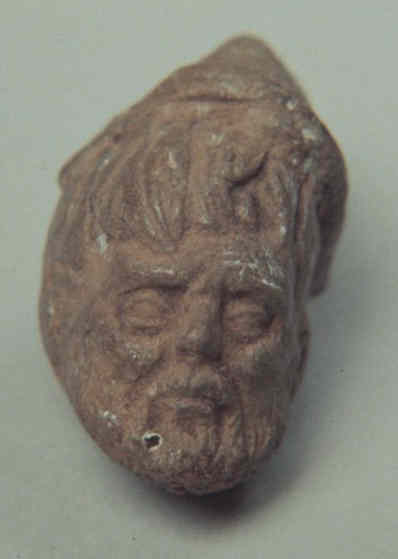
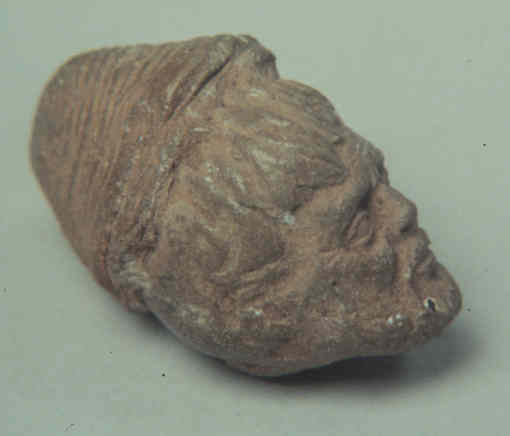
Both stories sought to highlight claims being made in the new issue of the magazine NEW SCIENTIST concerning the recent realisation that a small ceramic head found in 1933 at a site in the Toluca Valley, 72 kilometres west of Mexico City, is in fact Roman in origin.(1) A dating process known as thermoluminescence, which determines the age of ceramics, has found that the tiny bust is approximately 1800 years old. How it might have reached Mexico is the big mystery. The implication, however, is that the head, which shows a full-bearded individual in typical Latin style, was introduced to the New World prior to the age of Columbus.
David Kelley, an archaeologist at Canada's University of Calgary stated that the bust was found 'sealed under three floors. It is as close to archaeological certainty as you can get'.(2)
Such statements led anthropologist Roman Hristow, formerly of the Southern Methodist University, to conclude that the bust is firm evidence of transatlantic contact between the Old and New World as early as AD 200.(3) Having become interested in the Roman piece, he managed to track it down to a museum in Mexico City, where it had remained since its discovery.
It was the Max Planck Institute for Nuclear Physics in Heidelberg, Germany, who conducted the tests which determined the age of the bust. Afterwards art experts were more willing to accept that it was of Roman manufacture. Hristow who then checked original excavation reports and realised that the bust must have been buried at least nine years before the arrival in Mexico of Hernando Cortés in 1519.
Yet this realisation begs the real question of whether or not Roman explorers were making journeys to the Americas around AD 200.Betty Meggers, an anthropologist at the National Museum of Natural History in Washington DC, has stated that: `I see no reason why ancient contact is not possible'.(4) She herself has made an extensive study of the similarities between the prehistoric pottery of the Joman culture of Japan and the Valdivia culture of Ecuador. This she believes is evidence of transpacific contact with the Americas as early as 3000 BC.
In contrast, other archaeologists remain sceptical over the claims being made by scholars such as Hristow and Meggers. Andrew Selkirk, the editor of CURRENT ARCHAEOLOGY, is of the opinion that: `It is a big leap to claim that the Romans reached Mexico City when scientists are not certain whether they even reached the Canary Islands.
'You could imagine a ship being wrecked off Newfoundland and you could argue that it had been blown across the ocean, but to claim that a boat got as far as Mexico sounds a bit over the top'.
Indeed, Selkirk even went so far as to say: `It could have been dropped out of someone's pocket in the 1930s or [was] put there as a spoof. If you had three similar finds in three different places, then maybe that would be more credible'.(5)
On a slightly different tack, David Grove, an archaeologist with the University of Illinois, while accepting that the head is Roman, suggests that it could have been taken from a shipwreck during some later age. If this were so, it would remove any significance the bust might play in re-interpreting the history of Mexico.(6) He also points out that there is no significant evidence of the influence of Old World cultures on the development of Mesoamerican civilisations prior to the age of Columbus.(7)
Speaking in the wake of lingering rumours and stories of Roman wrecks awaiting investigation off the coasts of Central and South America, Simon Keay, a Roman expert at Southampton University, says that although evidence of Roman contact has been found as far east as India, there are no records of trading routes to the Americas.(8)
A Mystery of Two Heads
The idea of transoceanic contact between the ancient world and the Americas is a subject crucial to our understanding of how Plato came to write his account of an Atlantic island called Atlantis in around 350 BC. There is every reason to suppose that in order to construct the story he drew on vague maritime knowledge concerning what lay on the western Atlantic seaboard - information that most probably filtered into the Mediterranean world via Phoenicians from Spain and Carthaginian traders from North Africa.
Indeed, I feature the bust in the chapter of 'GATEWAY TO ATLANTIS' entitled `Shipwrecks and Sailors'. After highlighting the discovery of North African amphorae disgorged from possible Roman wrecks in the so-called Bay of Jars outside of Rio de Janeiro during the 1980s, I introduce the evidence for Roman contact with Mexico. I cite the fired clay bricks used to construct various classical Maya sites in the Yucatán peninsular, in particular the great city of Comalcalco. The walls of its great palace show a remarkable similarity to fired clay structures of the Roman world, while maker's marks have been said to resemble characters from a south-east Asian script. This is territory dealt with in extraordinary detail by British transoceanic expert David Eccott and American archaeologist Neil Steede.
I go on to cite the tiny sculpted Roman head highlighted in the NEW SCIENTIST article and in subsequent national news stories in British papers such as THE DAILY MAIL and THE EXPRESS. The ceramic piece came originally from a site named Calixtlahuaca, located some 72 kilometres west of Mexico City. It was excavated in 1933 by archaeologist José Garcia Payón of Mexico's National Museum. According to the reports, it was found, along with various grave goods, in a truncated pyramid structure dating to the twelfth century and belonging to the Toltec culture which thrived during this era. This would then imply that the Roman bust could have been in Mexico for up to 1,000 years, not simply nine or ten years as has been claimed by anthropologist Roman Hristow. Initially it was thought that this fascinating artefact, which takes the form of a terracotta vessel several centimetres in height, is the one pictured in several books on transoceanic contact with a bushy beard and conical cap, like the Phrygian caps worn by the classical gods Perseus and Mithras.(9)
Yet the Roman bust that appeared originally in the NEW SCIENTIST article, and subsequently in THE EXPRESS, was an entirely different one without a hat and with much sharper features. After some initial confusion it has now been established that this picture had nothing whatsoever to do with the Calixtlahuaca head, and was used simply, and rather sloppily, to illustrate the news story.(10)
 American Odyssey
So how might this priceless Roman artefact have come to be in Mexico in the first place? Austrian orientalist and anthropologist Dr Robert Heine-Geldern, a believer in transpacific contact in pre-Columbian times, was of the opinion in an article published in 1961 that the bust - which he describes as wearing a `Pylos', a knitted cap favoured among sailors from the Greek seaport of Pylos - had come across originally from Indo-China, where Roman artefacts have occasional been found.(11) In his view, it reached India via trade links with the Roman Empire, and then had been traded on to Indo-Chinese cultures in Southeast Asia who were themselves making transoceanic journeys during this age.(12) It was in this way that the head had reached Mexico, and not through direct Roman contact with the Americas.
I have no objection to the view that Roman explorers, or indeed traders, might have made transpacific journeys to Mexico as early as AD 200. However, we must also not ignore the clear evidence for transatlantic contact by Romans during this same epoch. We have the evidence of the amphorae and possible wrecks (yes, wrecks in plural) awaiting investigation off the coast of Brazil. There is another Roman wreck lying off the coast of Honduras in Central America. As early as 1976 it was disgorging amphorae which have been determined to be of Punic, i.e. North African, origin (See 'GATEWAY TO ATLANTIS').
There is also the case of the Roman coin hoard found washed up in a jar on a beach in north-east Venezuela. The age of the coins span an immensely-long period that stretches between the reign of Caesar Augustus (63 BC-AD 14) and a date of around AD 350. Since the hoard includes many duplicates, there seems very little likelihood that it could have been a discarded or buried collection of colonial origin, or that it might have been part of a national treasure trove on its way either to or from the New World. What seems more likely is that it is the wealth of a Roman trader lost overboard when his ship was wrecked sometime around AD 350. Remember, a vessel that follows the North Equatorial Current westwards from the Cape Verdes will be carried directly to the northern coast of Venezuela, almost precisely where the hoard was found. The coins are now in the possession of the Smithsonian Institution.(13)
In addition to this evidence there are numerous examples of Roman amphorae and coins having been found in New England, indicating that Roman vessels were also using the so-called Northwest Passage to reach North America via the Faeroes, Iceland, Greenland, Nova Scotia and Newfoundland.
Lastly, the sheer fact that Dr Heine-Geldern cites the fact that the Calixtlahuaca head sports a cap found among the sailors of Pylos hints at a possible maritime connection between this object and its arrival in Mexico. Pylos, by the way, was a town of Messenia, located on the western coast of the Peloponnesus, opposite the island of Sphacteria in the Ionian Sea.
So when considering the possibility of Roman contact across the Pacific, one should also not forget the Atlantic trade routes that were inherited by the Romans most probably from the Berbers and Taureg peoples of North Africa after the fall of Carthage in 147 BC.
With respect to Simon Keay's statement in the DAILY MAIL to the effect that there is no evidence of trade routes to the Americas I need only to cite the words of Statius Sebosus, a Roman geographer quoted in the works of Caius Solinus and Pliny the Elder. He recorded that the islands of the Hesperides lay 40 days' sail beyond the Gorgades. Since it can be adequately demonstrated that the Gorgades, or the islands of the Gorgons, were the Cape Verde islands, located off the coast of Senegal in West Africa, and the Hesperides were located in the Far West, there is every reason to believe that Sebosus was alluding to a transatlantic journey time between Africa and the West Indies. The Hesperides were certainly taken to be the West Indies by Spanish explorers and chroniclers shortly after the discovery of the New World, and there is every reason to believe that they got it right.
Solinus and Pliny would seem to have preserved a knowledge of transatlantic contact either prior to or contemporary with Sebosus' lifetime (he is thought to have lived in c. 100 BC). If so, then who exactly was making these journeys? Was it the Romans, or could Sebosus have been recalling much earlier journeys made to and from the West Indies by Iberic Phoenicians and Carthaginians?
With respect to the statement made by David Grove of the University of Illinois to the effect that although the Calixtlahuaca bust is Roman it could have come from a Roman shipwreck, I can say only this. If it did come from a shipwreck then it is yet further evidence that Roman vessels reached as far as Mexico. However, I feel it is far more likely that goods for trade were brought to the American mainland by Roman explorers in the time period of its manufacture. I cannot accept that the Roman head was introduced to the site during excavations in the 1930s, or that it is part of some kind of elaborate hoax.
What seems most important is that some scholars are now openly accepting that an item of Roman manufacture has been found through professional excavations at an archaeological site of Mesoamerican origin that predates the time of the conquest. This is an incredible revelation and one which is as significant as the announcement in the 1960s that evidence of Viking occupation had been found at a site named l'Anse aux Meadows in Newfoundland. Previous to this time scholars have always considered that Roman artifacts found in the Americas were either dropped accidentally or planted deliberately in colonial times.
This news also helps strengthen my own theories regarding the manner in which Plato appears to have constructed his Atlantis story from maritime lore reaching the Mediterranean world via Iberic-Phoenician and Carthaginian traders. They, it seems, were making journeys in secret to the West Indies, which were known in Roman times as the Hesperides (after Sebosus and others), as well as the islands left above sea-level following the break up of the Atlantean landmass (after Marcellus and Proclus). I suggest that readers examine 'GATEWAY TO ATLANTIS' for a more detailed account of the evidence for transatlantic journeys to the Americas in ancient times.
Notes and References
1. Knight, Jonathan, `Did Roman sailors shakes hands with ancient Mexicans', New Scientist, 12 February 2000, p. 7, cf. Ancient Mesoamerica, vol. 10, p. 207.
2. Ingham, `Oldest Latin in America', The Express, 10 February 2000, p. 28.
3. Ibid.
4. Ibid.
5. Ibid.
6. Ibid.
7. Ibid.; Derbyshire, `Did Roman explorers discover America 1,300 years ahead of Christopher Columbus?', Daily Mail, 10 February 2000, p. 25.
8. Derbyshire.
9. For instance, it appears in Eccott, 'Before Columbus (the Calixtlahuaca Roman head), Quest for Knowledge, Vol. 1, No. 5, Autumn 1997, pp. 18-9; Gordon, Before Columbus, p. 69, and Thompson, American Discovery, p. 174 (cf. photograph in Carter, George F., Man and the Land; A Cultural Geography, 2nd ed., Holt, Reinhart and Winston, New York, 1968).
10. Visit Huston MacCulloch's site which includes an account of the finding of the Roman Head. This can be found at http://www.econ.ohio-state.edu/jhm/arch/calix.htm.
11. Heine-Geldern, 'Ein Römischer Fund aus dem Vorkolumbischen Mexiko', Anzeiger der Osterreichischen Akademie der Wissenschaften, No. 16, 1961, pp. 117-9. He pointed out that: 'In the years after the war, Louis Malleret investigated, in the coastal plain of the Mekong delta, the remains of a big city [Oceo, south of modern Saigon] of the second to seventh century which was connected to the sea by a canal and was doubtless one of the main trading places of the kingdom of Funan, one of the oldest colonial areas of southeast Asia … Along with numerous Indian, Persian and Chinese objects, a number of Roman imported pieces were found such as sculpted and cut stones and a golden medal with the head of the Roman Emperor Antonius Pius which, according to the inscription, is dated to the fifteenth year of his reign: therefore AD 152. Another gold medal which, although carries no inscription, seems to represent the Emperor Marcus Aurelius.', Eccott, pp. 18-19, quoting Heine-Geldern. Translation by Peter Boakes.
12. Heine-Geldern. David Eccott suggests I point out also that Han dynasty records in the year corresponding to A.D. 166 emissaries of "An-Tun" (obviously Marcus Aurelius Antoninus - who was the Roman Emperor at that time) arrived at Huan Ti. Heine Heine-Geldern states that these emissaries were probably merchant ambassadors and mariners who had struck out across the Indian ocean.
13. Irwin, Fair Gods and Stone Faces, p. 258.
Bibliography
Derbyshire, David, `Did Roman explorers discover America 1,300 years ahead of Christopher Columbus?', Daily Mail, 10 February 2000, p. 25.
Eccott, David, `Before Columbus (the Calixtlahuaca Roman head), Quest for Knowledge, Vol. 1, No. 5, Autumn 1997, pp. 18-9.
Gordon, Cyrus, Before Columbus, 1971, Turnstone, London, 1972.
Thompson, Gunnar, American Discovery, Argonauts Misty-Isles Press, Seattle, Washington, 1994.
Heine-Geldern, Robert, `Ein römischer Fund aus dem vorkolumbischen Mexiko', Anzeiger der Osterreichischen Akademie der Wissenschaften, No. 16, 1961, pp. 117-9
Ingham, John, `Oldest Latin in America', The Express, 10 February 2000, p. 28.
Irwin, Constance, Fair Gods and Stone Faces: Ancient Seafarers and the New World's Most Intriguing Riddle, 1963, W. H. Allen, London, 1964
Knight, Jonathan, `Did Roman sailors shakes hands with ancient Mexicans', New Scientist, 12 February 2000, p. 7, cf. Ancient Mesoamerica, vol. 10, p. 207
Tiny Roman Bust Shows Pre-Columbian Contact With Mexico