
Showing posts with label Mexico. Show all posts
Showing posts with label Mexico. Show all posts
Thursday, July 11, 2019
Stossel: The Southern Poverty Law Center Scam
Stossel: The Southern Poverty Law Center Scam
ReasonTV
There are dangerous hate groups in America. So a group called the Southern Poverty Law Center promises to warn us about them. They release an annual list of hate groups in America.
The media cover it, but John Stossel says they shouldn't. It's a scam.
Subscribe to our YouTube channel: http://youtube.com/reasontv
Like us on Facebook: https://www.facebook.com/Reason.Magazine/
Follow us on Twitter: https://twitter.com/reason
Subscribe to our podcast at iTunes: https://goo.gl/az3a7a
Reason is the planet's leading source of news, politics, and culture from a libertarian perspective. Go to reason.com for a point of view you won't get from legacy media and old left-right opinion magazines.
************
The Southern Poverty Law Center lists Ayaan Hirsi Ali — who grew up Muslim in Somalia and suffered female genital mutilation — as an "anti-Muslim extremist." Just because she now speaks out against radical Islam.
They also list the conservative Family Research Council as a "hate group."
That listing led a man to go to the Council's office to try to gun down their workers. The shooter later told law enforcement that he picked the group because he saw they were on the Southern Poverty Law Center's hate map and he wanted to fight bigots.
Stossel disagrees with the Family Research Council on many issues. But he says they don't deserve to be called haters. The group's Executive Vice President, Jerry Boykin, tells him: "I don't hate gay people, and I know gay people, and I have worked with gay people."
Another group that the Southern Poverty Law Center smears is the Ruth Institute. The group argues that gays shouldn't have the same rights to adopt. But does that make them haters? No, says founder Jennifer Morse: "I have no problem with gay people. That's not the issue."
Other reporters, such as Megyn McArdle at Bloomberg, have also pointed out that the group is an odd fit for a "hate" list.
There are many non-hateful groups on the Southern Poverty Law Center's hate list. But Antifa, which clearly is a hate group, is not on the list.
The Southern Poverty Law Center wouldn't talk to Stossel about their listings. Stossel says screaming "hate!" brings in money.
Morris Dees, the Center's founder, pays himself nearly half a million dollars a year. Although Dees once promised that when the Center's endowment reached $50 million, he'd stop fundraising, he didn't stop. Now the Center has $320 million dollars stashed away -- much of it in the Cayman Islands. It's all in their tax returns.
Stossel notes that they still con people into giving them even more money. Apple gave them $1 million last year.
He says the Southern Poverty Law Center has become a hate group itself. It is now a left-wing, money grabbing, slander machine.
Produced by Maxim Lott. Edited by Joshua Swain.
*************************
The Southern Poverty Law Center---with a half-billion dollars at its disposal---practices ETHNIC INTIMIDATION on whomever it chooses.... often based solely on race and ethnicity! Yes, the SLPC has a distinct RACIAL PROGRAM.
There are numerous far right wing nationalist political parties in Israel, none of which are criticized by the SPLC. La Raza is a Mexican nationalist/Southwest United States irredentist advocacy group, and which is defended by the SPLC despite marches where many held signs such as "Kill Every White Male Over 14." However, the SPLC attacks Forza Nuova, an Italian nationalist political party. So according to the SPLC, Israeli nationalism is GOOD, Mexican nationalism is GOOD, but Italian nationalism is BAD. The former two were originally created by colonial supremacist movements. On the other hand, "Italians didn't steal Italy." Okay, someone could argue that the Roman Empire was the same type of colonial aggressor, however not within Italy; and even if there was some internal question of that sort, or of any other intrinsic sort, it certainly would not be any of their business.
The governments of both Israel and Mexico have stated on record as both being an "Ethnostate," a nation fully dedicated to ONE RACE only! In other words, the SPLC isn't really a civil rights group, but a powerful political lobbying apparatus with a particular agenda. They author demographically-incongruent bills submitted to the U.S. Senate, and have the political and media connections to push them through. There are numerous urban organizations in this country which call for outright violence and terrorism, but whom are ignored by the SLPC. Instead they incessantly watch and collect information on that tiny (using a hypothetical example) entirely non-political Asatru group which meets in the middle of the woods of rural eastern Oregon every week.
The SPLC absolutely will not leave alone certain very small, non-political Neopagan folk groups if they happen to follow ancient spiritual traditions which are European in origin. However ALL others are perfectly okay!.... because THEY said so!! They have a particular hatred for Asatru or Odinism, an ancient Teutonic religion once widespread throughout northern Europe, and some locations in southern and eastern Europe. After years of scrutiny without much "hate," they finally branded some of these groups as "hate groups" using the idea that they're "Volkish." VOOOLKISH!! Volkish simply means folkish, or something which is inherently a part of a particular people.
African-Americans who have discovered their Yoruba traditions, Native American traditions, Sheikhs, Shintoists, etc., are all following "folkish" traditions. I guess the German equivalent "VOLKISH" must make it evil.... because the SPLC says so! It's interesting that the SPLC has apparently not put Forza Nuova, which is present in New Jersey and Arizona, on their infamous "hate map." The ethnicity of the SPLC might feel that attacking Italians may not be good for donations at the present time. Everything they do is planned and calculated.
Some years ago, the SPLC listed a terror group which they called something like the "Algerian Armed Islamic Guerilla Organization" on their hate map. They claimed that this group was present all over the country (NYC, Chicago, Miami, Los Angeles, etc.). Then, all of a sudden, this group just disappeared into thin air! It was no longer listed, and nothing more was mentioned. I suspect that they just made up that group to pad their listings for their prospective donors, then finally realized the danger of listing a fake terror group; a move perhaps too audacious even for them.
.


Friday, August 31, 2012
Eusebio Kino: Missionary and New World Explorer

Eusebio Kino (Wikipedia)
Eusebio Francisco Kino, S.J., (August 1645 – 15 March 1711) was a Jesuit priest from a town which is now a part of northern Italy. For the last 24 years of his life he worked in the region then known as the Pimería Alta, modern day Sonora in Mexico and southern Arizona. He explored the region worked with the indigenous Native American population, including primarily the Sobaipuri and other Upper Piman groups. He proved that Baja California is not an island by leading an overland expedition there. By the time of his death he had established 24 missions and visitas (country chapels or visiting stations).
Born:
Eusebius Franz Kühn (or Chini)
August 1645
Segno, Bishopric of Trent,
Holy Roman Empire
Died:
15 March 1711
Mission Santa Maria Magdalena, Pimería Alta, New Spain,
Spanish Empire
Nationality:
Holy Roman Empire
Occupation:
Priest, missionary, explorer
Eusebio Francisco Kino, S.J., (August 1645 – 15 March 1711) was a Jesuit priest from a town which is now a part of northern Italy. For the last 24 years of his life he worked in the region then known as the Pimería Alta, modern day Sonora in Mexico and southern Arizona. He explored the region worked with the indigenous Native American population, including primarily the Sobaipuri and other Upper Piman groups. He proved that Baja California is not an island by leading an overland expedition there. By the time of his death he had established 24 missions and visitas (country chapels or visiting stations).
Born:
Eusebius Franz Kühn (or Chini)
August 1645
Segno, Bishopric of Trent,
Holy Roman Empire
Died:
15 March 1711
Mission Santa Maria Magdalena, Pimería Alta, New Spain,
Spanish Empire
Nationality:
Holy Roman Empire
Occupation:
Priest, missionary, explorer
Biography
Early life
Kino was born Eusebius Franz Kühn (the name Kino was the version for use in Spanish-speaking domains) in the village of Segno, (now part of the town of Taio), then in the sovereign Prince-bishopric of Trent, a part of the Holy Roman Empire. Other sources cite his name as Eusebio Francesco Chini.
His parents were Franz Kühn (or Francesco Chini) and Margherita Luchi. The exact date of his birth is unknown but he was baptized on 10 August 1645 in the parish church, located in Taio. Kino was educated in Innsbruck, Austria, and after recuperating from a serious illness, he joined the Society of Jesus on 20 November 1665. From 1664-69, he received religious training as a member of the Society at Freiburg, Ingolstadt, and Landsberg, Bavaria. After completing a final stage of training in the Society, during which he taught mathematics in Ingolstadt, he received Holy Orders as a priest on 12 June 1677.
Although Kino wanted to go to the Orient, he was sent to New Spain. Due to travel delays across Europe he missed the ship on which he was to travel and had to wait a year for another ship. While waiting in Cadiz, Spain, he wrote on his observations of a comet, Exposción Astronómica de el Cometa.[1] This publication was later the subject of a sonnet by Sor Juana Inés de la Cruz.
Life in New Spain
Mission in Baja
Kino's first assignment was to lead the Atondo expedition to the Baja California peninsula of the Las Californias Province of New Spain. He established the Misión San Bruno in 1683. After a prolonged drought there in 1685, Kino and the Jesuit missionaries were forced to abandon the mission and return to the viceregal capital of Mexico City.
 |
| Pimeria Alta |
Father Kino began his career in the Pimería Alta on the morning of 14 March 1687, 24 years and one day before his death on 15 March 1711. This was the morning he left Cucurpe, a town once considered the "Rim of Christendom."
Once Father Kino arrived in the Pimería Alta, at the request of the natives, he quickly established the first mission in a river valley in the mountains of Sonora. Subsequently Kino traveled across northern Mexico, and to present day California and Arizona. He followed ancient trading routes established millennia prior by the natives. These trails were later expanded into roads. His many expeditions on horseback covered over 50,000 square miles (130,000 km2), during which he mapped an area 200 miles (320 km) long and 250 miles (400 km) wide. Kino was important in the economic growth of area, working with the already agricultural indigenous native peoples and introducing them to European seed, fruits, herbs and grains. He also taught them to raise cattle, sheep and goats. Kino's initial mission herd of twenty cattle imported to Pimería Alta grew during his period to 70,000. Historian Herbert Bolton referred to Kino as Arizona's first rancher.
Interaction with the Natives
In his travels in the Pimería Alta, Father Kino interacted with 16 different tribes. Some of these had land that bordered on the Pimería Alta, but there are many cases where tribal representatives crossed into the Piman lands to meet Kino. In other cases, Father Kino traveled into their lands to meet with them. The tribes Kino met with are the Cocopa, Eudeve, Hia C-ed O'odham (called Yumans by Kino), Kamia, Kavelchadon, Kiliwa, Maricopa, Mountain Pima, Opata, Quechan, Gila River Pima, Seri, Tohono O'odham, Sobaipuri, Western Apache, Yavapai, and the Yaqui (Yoeme).
Interests
Kino opposed the slavery and compulsory hard labor in the silver mines that the Spaniards forced on the native people. This also caused great controversy among his co-missionaries, many of whom acted according to the laws imposed by Spain on their territory. Kino was also a writer, authoring books on religion, astronomy and cartographys. He built missions extending from the present day states of Mexican Sonora, northeast for 150 miles (240 km), into present-day Arizona, where the San Xavier del Bac mission, near Tucson, a popular National Historic Landmark, is still a functioning Franciscan parish church. Kino constructed nineteen rancherías (villages), which supplied cattle to new settlements.
Kino practiced other crafts and was reportedly an expert astronomer, mathematician and cartographer, who drew the first accurate maps of Pimería Alta, the Gulf of California and Baja California. Father Kino enjoyed making model ships out of wood. His knowledge of maps and ships led him to believe that Mexican Indians could easily access California by sea, a view taken with skepticism by missionaries in Mexico City. When Kino proposed and began making a boat that would be pushed across the Sonoran Desert and to the Mexican west coast, a controversy arose, as many of his co-missionaries began to question Kino's faculties. Kino had an unusual amount of wealth for his vocation, which he used his primarily to fund his missionary activities. His contemporaries reported on his wealth with suspicion.
Death
Kino remained among his missions until his death in 1711. He died from fever on 15 March 1711, aged 65, in what is present-day Magdalena de Kino, Sonora, Mexico. His skeletal remains can be viewed there.
Legacy
Kino has been honored both in Mexico and the United States, with various towns, streets, schools, monuments, and geographic features named after him. In 1965, a statue of Kino was donated to the United States Capitol's National Statuary Hall collection, one of two statues representing Arizona. Another statue of him stands above Kino Parkway, a major thoroughfare in Tucson. Another equestrian statue featuring Kino stands in Wesley Bolin Memorial Plaza across from the Arizona State Capitol in Phoenix. A time capsule is encapsuled in the base. Another equestrian statue also stands next to the Cathedral in the city of Hermosillo, Sonora, México. The towns of Bahía Kino and Magdalena de Kino in Sonora are named in his honor. A park with statue of Kino resides in the city of Nogales, AZ.
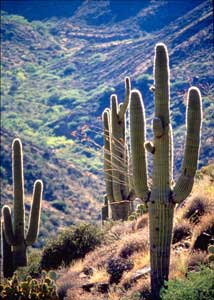 Missions and visitas founded
After the first voyage of Christopher Columbus, the Catholic Church awarded to the Spanish Crown the lands of "New Spain." This grant was with the directive that the Crown would underwrite the efforts to convert the pagan inhabitants to Catholicism. The lands included the Caribbean, Mexico, and portions of what is now the Southwestern United States.
In its new lands, the Spanish Crown employed three major agencies to extend its borders and consolidate its colonial presence: the presidio (royal fort), pueblo (town), and the misión (mission). In addition, there were asistencias (sub-missions or contributing chapels) which were small-scale missions that regularly conducted Divine service on days of obligation, but lacked a resident priest. Visitas (visiting chapels or country chapels) also lacked a resident priest, and were often attended only sporadically. These different types of settlements were established such that each of the installations was no more than a long day's ride by horse or boat (or three days on foot) from one another.
Each type of frontier station needed to be self-supporting, because supply lines (roads) were non-existent. There was no way to maintain a village from outside sources. To sustain a mission settlement, the Fathers needed either Spanish colonists or converted natives to cultivate crops and tend livestock in the volume needed to support a fair-sized Church establishment. Scarcity of imported materials and lack of skilled laborers compelled the Fathers to employ simple building materials and methods.
Although the Spanish hierarchy considered the missions temporary ventures, individual settlement development was not based simply on a priestly whim. The founding of a mission followed long-standing rules and procedures. The paperwork involved required months, sometimes years of correspondence, and demanded the attention of virtually every level of the Spanish bureaucracy.
Once empowered to erect a mission in a given area, the men assigned to it chose a specific site that featured a good water supply, plenty of wood for fires and building material, and ample fields for grazing herds and raising crops. The Fathers blessed the site, and with the aid of their military escort fashioned temporary shelters out of tree limbs roofed with thatch, reeds, or in Pimería Alta saguaro ribs or ocotillo branches topped with brush and mud. These simple huts would ultimately give way to the stone and adobe buildings that exist today.
The majority of structures, indeed whole villages, were oriented on a roughly east-west axis to take the best advantage of the sun's position for interior illumination; the exact alignment depended on the geographic features of the particular site. Directives from Spain clearly stated that villages were to be sited on the west side of any valley so that the sun would shine in the homes first thing in the morning, discouraging slothful behavior on the part of the inhabitants.
When founding a mission compound, first the spot for the church itself was selected, its position marked and then the remainder of the mission complex would be laid out. Workshops, kitchens, living quarters, storerooms, and other ancillary chambers were usually grouped in a quadrangle, inside which religious celebrations and other festive events could take place.
List of missions
This listing of the sites founded by Kino is not complete. Also, since names have changed over time, there appears to be some duplication. They are:
* Mission San Bruno: founded 1683 (Kino led the Atondo expedition to the Baja California peninsula of the Las Californias Province of New Spain. In 1685, after a prolonged drought there, Kino and the Jesuit missionaries were forced to abandon the mission.
* Mission Nuestra Señora de los Dolores: founded on March 13, 1687. This was the first Pimaria Alta mission founded by Father Kino. By 1744, the mission was abandoned.
* Nuestra Señora de los Remedios was founded in 1687 and was abandoned by 1730. Nothing remains of this mission.
* San Ignacio de Cabórica was founded in 1687 and is located in San Ignacio, Sonora.
* Mission San Pedro y San Pablo del Tubutama was founded in 1687, in Tubutama, Sonora.
* Santa Teresa de Atil was founded in 1687, in the small town of Atil, Sonora.
* Santa Maria Magdalena was founded in 1687, located in Magdalena de Kino, Sonora. Kino's grave is located here.
* San José de Imuris was founded in 1687, in Imuris, Sonora.
* Nuestra Señora del Pilar y Santiago de Cocóspera was founded in 1689. It is located in Cocóspera, Sonora.
* San Antonio Paduano del Oquitoa was founded in 1689. It is located in Oquitoa, Sonora.
* San Diego del Pitiquito was founded in 1689. It is located in Pitiquito, Sonora.
* San Luis Bacoancos was founded in 1691, but was soon abandoned after Apache attacks.
* Mission San Cayetano del Tumacácori was founded in 1691 at a native Sobaipuri settlement. This was southern Arizona's first mission and Arizona's first Jesuit mission. Later a chapel was built. (San Cayetano de Calabasas was established in a different location much later, after Kino's time.) Sometime after the 1751 Pima Revolt the settlement and mission were moved to the opposite side of the river and became San José de Tumacácori.
* Mission San José de Tumacácori, the presently known location that is a National Historic Park. The farming land around the mission was sold at auction in 1834 and the mission was abandoned by 1840. It is now a National Monument in Tumacácori National Historical Park in Southern Arizona.
* La Misión de San Gabriel de Guevavi was founded in 1691. It became a cabecera or head mission in 1701 with the establishment of what Kino described affectionately as a "neat little house and church." Through the years its name changed many times so that now it is known by the generic name referencing many saints: Mission Los Santos Ángeles de Guevavi. The chapel was initially established in a native settlement, but then was destroyed by fire, probably during an indigenous uprising. The church rebuilt in new locations twice, the final and largest one being built in 1751. Its ruins are part of Tumacácori National Historical Park.
* San Lázaro was founded in 1691, but was soon abandoned after Apache attacks.
 |
| Mission San Xavier del Bac |
* Visitas San Cosme y Damián de Tucson: founded 1692
* Visitas Los Santos Reyes de Sonoita/San Ignacio de Sonoitac: a rancheria near Tumacacori, founded 1692.
* La Purísima Concepción de Nuestra Señora de Caborca: founded 1693
* Santa María Suamca: founded 1693
* San Valentín de Busanic/Bisanig: founded 1693
* Nuestra Señora de Loreto y San Marcelo de Sonoyta: founded 1693
* Nuestra Señora de la Ascención de Opodepe: founded 1704
Movie
* Father Kino, Padre on Horseback (or Mission to Glory: A True Story) starring Richard Egan as Kino, was made in 1977. The movie is available in DVD format.
References
* Bolton, Herbert Eugene, Kino's Historical Memoir of Pimeria Alta, vol. 1 (Cleveland, Ohio: Arthur H. Clark, 1919.
* Bolton, H., Rim of Christiandom, New York: The MacMilliam Co, 1936.
* Bolton, H., Padre on Horseback, Loyola Press, 1963.
* Polzer, Charles W., Kino Guide II: a Life of Eusebio Francisco Kino, S.J., Arizona's First Pioneer, and a Guide to His Missions and Monuments, Southwest Mission Research Center, 1982.
* Polzer, C., Kino: His Missions, His Monuments, Jesuit Fathers of Southern Arizona, 1998.
* Polzer, C. & Sheridan, Thomas H., Presidio and Militia on the Northern Frontier of New Spain: A Documentary History, Volume Two, Part One: The Californias and Sinaloa-Sonora, 1700–1765, University of Arizona Press, 1997.
* Seymour, Deni J., 1989 The Dynamics of Sobaipuri Settlement in the Eastern Pimeria Alta. Journal of the Southwest 31(2): 205-22.
* Seymour, D., 1997 Finding History in the Archaeological Record: The Upper Piman Settlement of Guevavi. Kiva 62(3): 245-60.
* Seymour, D., 2003 Sobaipuri-Pima Occupation in the Upper San Pedro Valley: San Pablo de Quiburi. New Mexico Historical Review 78(2): 147-66.
* Seymour, D., 2007 Delicate Diplomacy on a Restless Frontier: Seventeenth-Century Sobaipuri Social And Economic Relations in Northwestern New Spain, Part I. New Mexico Historical Review, Volume 82(4): 469-99.
* Seymour, D. 2007 A Syndetic Approach To Identification Of The Historic Mission Site Of San Cayetano Del Tumacácori. International Journal of Historical Archaeology, Vol. 11(3): 269-96.
* Seymour, D., 2008a Delicate Diplomacy on a Restless Frontier: Seventeenth-Century Sobaipuri Social And Economic Relations in Northwestern New Spain, Part II. New Mexico Historical Review, Volume 83(2): 171–99.
* Seymour, D. 2009 Father Kino’s 'Neat Little House and Church' at Guevavi. Journal of the Southwest 51(2):285-316.
* Seymour, D., 2011 Where the Earth and Sky are Sewn Together: Sobaípuri-O’odham Contexts of Contact and Colonialism. University of Utah Press, Salt Lake City.
* Soule, J.A., 2011. Father Kino's Herbs:Growing and Using Them Today. Tierra del Sol Institute Press, Tucson, AZ.
* Sor Juana Ines de la Cruz, "Soneto. Aplaude la ciencia Astronomica del Padre Eusebio Francisco Kino, de la Compania de Jesus, que escrivio del Cometa....", Inundacion castalida de la unica poetisa, musa decima...; Madrid, 1689. [1]Portions of this biography are courtesy National Statuary Hall.
* Spicer, E. H. Cycles of Conquest. University of Arizona Press, Tucson, Arizona 1962
.
Thursday, June 19, 2008
Romans In Brazil During The Second Third Century?

12-10-03
Ex-marine and underwater explorer, archaeologist, and treasure-hunter Robert Marx states rather flatly:
Amongst my most notable discover[ies] was that of a 2nd century BC Roman shipwreck in the Bay of Guanabara, near Rio de Janeiro. This is a discovery that has received little to no examination, much less validation, from the realm of mainstream archaeology, no doubt in part because Marx is not a Ph.D. archaeologist. Scouring the web for more information about this finding, I did find a reference to the discovery in an article from Dr. Elizabeth Lyding Will, an expert on Roman amphoras (clay vessels used to store and ship goods during the Roman era). Dr. Will apparently has a piece of an amphora recovered from Marx's Brazil discovery. Of it, she says:
The highly publicized amphoras Robert Marx found in the ship are in fact similar in shape to jars produced in kilns at Kouass, on the west coast of Morocco. The Rio jars look to be late versions of those jars, perhaps datable to the third century A.D. I have a large piece of one of the Rio jars, but no labs I have consulted have any clay similar in composition. So the edges of the earth for Rome, beyond India and Scotland and eastern Europe, remain shrouded in mystery. Information about this find is practically non existent. Gary Fretz's synopsis of the "whole story" suggests that the find has been suppressed by the Brazilian government:
At the time the amphorae were confirmed to be "Roman", the large Italian faction in Brazil were extremely excited about this news. The Italian ambassador to Brazil notified the Brazilian government that, since the Romans were the first to "discover" Brazil, then all Italian immigrants should be granted immediate citizenship. There are a large number of Italian immigrants in Brazil and the government has created a tedious and costly citizenship application procedure for Italians that does not apply to Portuguese immigrants.
The Brazilian government would not give in and the Italians in Brazil staged demonstrations. In response, the Brazilian government ordered all civilians off the recovery project and censored further news about the wreck hoping to diffuse the civil unrest. Finally, I've also seen mention of the following written works, which I've yet to dig up: Marx R.F., 1984 , Romans in Rio? [see Santarelli A. Mondo Sommerso 270 1983:252-3. Oceans, 17.4: 18-21.] The Romans in Rio book (?) is not among the works of Robert Marx as listed at Amazon.
By Gary Fretz
Q. With all of the new technology available today, we should be able to know precisely when the first European ships reached the New World. What is the latest news? It was a group of Vikings who made landfall around 900 A.D., right?
A. Wrong! It is now confirmed that a Roman ship reached Brazil around the year 19 B.C.! Here is the whole story …
Two thousand years ago, the most valuable commodity “known to man” was salt. This is because most fresh meats and fish were preserved by packing in salt. In fact, salt was so valuable, it was used in place of coinage. This is where the word “salary” emerged (as well as the expression “he’s not worth his salt”). The Romans had a large salt production facility on Ilha do Sal (Salt Island) in the Cape Verde Islands, which are 350 miles off the coast of West Africa. This location is directly in the path of the hot, dry winds of the Sahara Desert, which can easily blow 60 knots from the east.
It is believed that this Roman merchant vessel was heading for Salt Island to pick up a load of salt and to provision the local army garrison when a fierce Sahara storm started. Roman ships were clumsy by modem standards and would have no choice but to lower their sails and to run with the winds to avoid capsizing. The Sahara winds can blow for many days and the Salt Ship was carried to Guanabara Bay (near Rio de Janeiro) in Brazil.
In the middle of the - Bay is a large submerged rock lying 3’ below the surface called Xareu Rock (named after a local fish that congregates here). The ship appears to have been travelling at a high rate of speed when she struck the rock. She broke into two pieces and settled in 75’ of water near the base of the rock.
In the late 1970’s, a local fisherman using nets around Xareu Rock kept “catching” some large (3’ tall), heavy earthen jars which tore his nets. He mistakenly thought these were “macumba”jars, which are used in local voodoo ceremonies and then thrown into the sea. So, as the jars were hauled up, he smashed them with a hammer and threw the small pieces back into the water in an attempt to prevent tearing his nets in the future.
If he had only known what treasures he was destroying! In recent years, a scuba diver was spear fishing around Xareu Rock and found eight similar jars that he took home.
He sold six jars to tourists before the Brazilian police arrested him with the two remaining jars for illegally selling ancient artifacts. Archaeologists immediately identified these as Roman amphorae of the 1st century B.C These containers were originally used to carry water, grain, salted fish, meat, olives, olive oil and other foods necessary to feed the ship’s crew and to provision Roman outposts.
One of the world’s foremost authorities on Roman shipwrecks, Robert Marx, found more artifacts and confirmed this as an authentic Roman shipwreck. The world’s foremost authority on Roman amphorae analyzed the clay in the jars and confirmed that these were manufactured at Kouass which was a Roman seaport, 2000 years ago, on the coast of modem-day Morocco. The Institute of Archaeology of the University of London performed thermo luminescence testing (which is a more accurate dating process than Carbon 14 dating) and the date of the manufacture was determined to be around 19 B.C. Many more amphorae and some marble objects were recovered, as well as a Roman bronze fibula (a clasp device used to fasten a coat or shirt).
So, why haven't we heard more about this fantastic find? One would think this news would make headlines around the world… The short answer is “politics”. At the time the amphorae were confirmed to be "Roman", the large Italian faction in Brazil were extremely excited about this news.
The Italian ambassador to Brazil notified the Brazilian government that, since the Romans were the first to "discover" Brazil, then all Italian immigrants should be granted immediate citizenship. There are a large number of Italian immigrants in Brazil and the government has created a tedious and costly citizenship application procedure for Italians that does not apply to Portuguese immigrants. The Brazilian government would not give in and the Italians in Brazil staged demonstrations. In response, the Brazilian government ordered all civilians off the recovery project and censored further news about the wreck hoping to diffuse the civil unrest. The Brazilian Navy continues to excavate the wreck in secret.
We only know about it because of what Robert Marx learned before he was dismissed and what the University of London has leaked. This shipwreck may help explain some other intriguing Brazilian finds: - Several hundred ancient Roman silver and bronze coins were unearthed near Recife, Brazil. Did these once belong to the castaways of the Salt Ship?
- A tribe of white, mostly blonde haired, blue-eyed "Indians" has been found in a remote region of the Amazon jungle. Could these be the descendants of the shipwrecked sailors of the Xareu wreck? DNA analysis of these “Indians” will surely bring some interesting facts to light!
Romans In Brazil During The Second Third Century?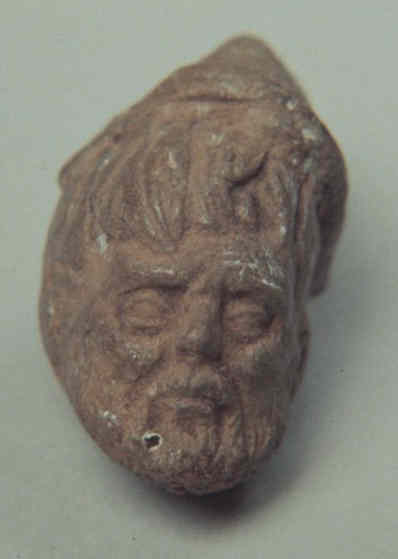
A Report by Andrew Collins
[Two photos are copyright of Romeo H. Hristov]
'Did Roman explorers discover America 1,300 years ahead of Christopher Columbus' was the headline on page 25 of the DAILY MAIL for Thursday, 10 February 2000. On the same day THE EXPRESS ran a story on page 28 under the banner `Oldest Latin in America: Bust may prove Romans got there first'.
Both stories sought to highlight claims being made in the new issue of the magazine NEW SCIENTIST concerning the recent realisation that a small ceramic head found in 1933 at a site in the Toluca Valley, 72 kilometres west of Mexico City, is in fact Roman in origin.(1) A dating process known as thermoluminescence, which determines the age of ceramics, has found that the tiny bust is approximately 1800 years old. How it might have reached Mexico is the big mystery. The implication, however, is that the head, which shows a full-bearded individual in typical Latin style, was introduced to the New World prior to the age of Columbus.
David Kelley, an archaeologist at Canada's University of Calgary stated that the bust was found 'sealed under three floors. It is as close to archaeological certainty as you can get'.(2)
Such statements led anthropologist Roman Hristow, formerly of the Southern Methodist University, to conclude that the bust is firm evidence of transatlantic contact between the Old and New World as early as AD 200.(3) Having become interested in the Roman piece, he managed to track it down to a museum in Mexico City, where it had remained since its discovery.
It was the Max Planck Institute for Nuclear Physics in Heidelberg, Germany, who conducted the tests which determined the age of the bust. Afterwards art experts were more willing to accept that it was of Roman manufacture. Hristow who then checked original excavation reports and realised that the bust must have been buried at least nine years before the arrival in Mexico of Hernando Cortés in 1519.
Yet this realisation begs the real question of whether or not Roman explorers were making journeys to the Americas around AD 200.Betty Meggers, an anthropologist at the National Museum of Natural History in Washington DC, has stated that: `I see no reason why ancient contact is not possible'.(4) She herself has made an extensive study of the similarities between the prehistoric pottery of the Joman culture of Japan and the Valdivia culture of Ecuador. This she believes is evidence of transpacific contact with the Americas as early as 3000 BC.
In contrast, other archaeologists remain sceptical over the claims being made by scholars such as Hristow and Meggers. Andrew Selkirk, the editor of CURRENT ARCHAEOLOGY, is of the opinion that: `It is a big leap to claim that the Romans reached Mexico City when scientists are not certain whether they even reached the Canary Islands.
'You could imagine a ship being wrecked off Newfoundland and you could argue that it had been blown across the ocean, but to claim that a boat got as far as Mexico sounds a bit over the top'.
Indeed, Selkirk even went so far as to say: `It could have been dropped out of someone's pocket in the 1930s or [was] put there as a spoof. If you had three similar finds in three different places, then maybe that would be more credible'.(5)
On a slightly different tack, David Grove, an archaeologist with the University of Illinois, while accepting that the head is Roman, suggests that it could have been taken from a shipwreck during some later age. If this were so, it would remove any significance the bust might play in re-interpreting the history of Mexico.(6) He also points out that there is no significant evidence of the influence of Old World cultures on the development of Mesoamerican civilisations prior to the age of Columbus.(7)
Speaking in the wake of lingering rumours and stories of Roman wrecks awaiting investigation off the coasts of Central and South America, Simon Keay, a Roman expert at Southampton University, says that although evidence of Roman contact has been found as far east as India, there are no records of trading routes to the Americas.(8)
A Mystery of Two Heads
The idea of transoceanic contact between the ancient world and the Americas is a subject crucial to our understanding of how Plato came to write his account of an Atlantic island called Atlantis in around 350 BC. There is every reason to suppose that in order to construct the story he drew on vague maritime knowledge concerning what lay on the western Atlantic seaboard - information that most probably filtered into the Mediterranean world via Phoenicians from Spain and Carthaginian traders from North Africa.
Indeed, I feature the bust in the chapter of 'GATEWAY TO ATLANTIS' entitled `Shipwrecks and Sailors'. After highlighting the discovery of North African amphorae disgorged from possible Roman wrecks in the so-called Bay of Jars outside of Rio de Janeiro during the 1980s, I introduce the evidence for Roman contact with Mexico. I cite the fired clay bricks used to construct various classical Maya sites in the Yucatán peninsular, in particular the great city of Comalcalco. The walls of its great palace show a remarkable similarity to fired clay structures of the Roman world, while maker's marks have been said to resemble characters from a south-east Asian script. This is territory dealt with in extraordinary detail by British transoceanic expert David Eccott and American archaeologist Neil Steede.
I go on to cite the tiny sculpted Roman head highlighted in the NEW SCIENTIST article and in subsequent national news stories in British papers such as THE DAILY MAIL and THE EXPRESS. The ceramic piece came originally from a site named Calixtlahuaca, located some 72 kilometres west of Mexico City. It was excavated in 1933 by archaeologist José Garcia Payón of Mexico's National Museum. According to the reports, it was found, along with various grave goods, in a truncated pyramid structure dating to the twelfth century and belonging to the Toltec culture which thrived during this era. This would then imply that the Roman bust could have been in Mexico for up to 1,000 years, not simply nine or ten years as has been claimed by anthropologist Roman Hristow. Initially it was thought that this fascinating artefact, which takes the form of a terracotta vessel several centimetres in height, is the one pictured in several books on transoceanic contact with a bushy beard and conical cap, like the Phrygian caps worn by the classical gods Perseus and Mithras.(9)
Yet the Roman bust that appeared originally in the NEW SCIENTIST article, and subsequently in THE EXPRESS, was an entirely different one without a hat and with much sharper features. After some initial confusion it has now been established that this picture had nothing whatsoever to do with the Calixtlahuaca head, and was used simply, and rather sloppily, to illustrate the news story.(10)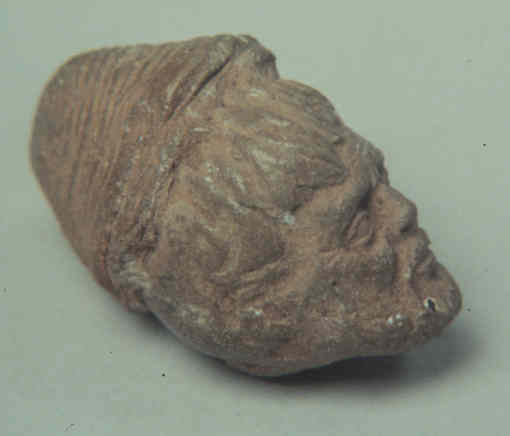
So how might this priceless Roman artefact have come to be in Mexico in the first place? Austrian orientalist and anthropologist Dr Robert Heine-Geldern, a believer in transpacific contact in pre-Columbian times, was of the opinion in an article published in 1961 that the bust - which he describes as wearing a `Pylos', a knitted cap favoured among sailors from the Greek seaport of Pylos - had come across originally from Indo-China, where Roman artefacts have occasional been found.(11) In his view, it reached India via trade links with the Roman Empire, and then had been traded on to Indo-Chinese cultures in Southeast Asia who were themselves making transoceanic journeys during this age.(12) It was in this way that the head had reached Mexico, and not through direct Roman contact with the Americas.
I have no objection to the view that Roman explorers, or indeed traders, might have made transpacific journeys to Mexico as early as AD 200. However, we must also not ignore the clear evidence for transatlantic contact by Romans during this same epoch. We have the evidence of the amphorae and possible wrecks (yes, wrecks in plural) awaiting investigation off the coast of Brazil. There is another Roman wreck lying off the coast of Honduras in Central America. As early as 1976 it was disgorging amphorae which have been determined to be of Punic, i.e. North African, origin (See 'GATEWAY TO ATLANTIS').
There is also the case of the Roman coin hoard found washed up in a jar on a beach in north-east Venezuela. The age of the coins span an immensely-long period that stretches between the reign of Caesar Augustus (63 BC-AD 14) and a date of around AD 350. Since the hoard includes many duplicates, there seems very little likelihood that it could have been a discarded or buried collection of colonial origin, or that it might have been part of a national treasure trove on its way either to or from the New World. What seems more likely is that it is the wealth of a Roman trader lost overboard when his ship was wrecked sometime around AD 350. Remember, a vessel that follows the North Equatorial Current westwards from the Cape Verdes will be carried directly to the northern coast of Venezuela, almost precisely where the hoard was found. The coins are now in the possession of the Smithsonian Institution.(13)
In addition to this evidence there are numerous examples of Roman amphorae and coins having been found in New England, indicating that Roman vessels were also using the so-called Northwest Passage to reach North America via the Faeroes, Iceland, Greenland, Nova Scotia and Newfoundland.
Lastly, the sheer fact that Dr Heine-Geldern cites the fact that the Calixtlahuaca head sports a cap found among the sailors of Pylos hints at a possible maritime connection between this object and its arrival in Mexico. Pylos, by the way, was a town of Messenia, located on the western coast of the Peloponnesus, opposite the island of Sphacteria in the Ionian Sea.
So when considering the possibility of Roman contact across the Pacific, one should also not forget the Atlantic trade routes that were inherited by the Romans most probably from the Berbers and Taureg peoples of North Africa after the fall of Carthage in 147 BC.
With respect to Simon Keay's statement in the DAILY MAIL to the effect that there is no evidence of trade routes to the Americas I need only to cite the words of Statius Sebosus, a Roman geographer quoted in the works of Caius Solinus and Pliny the Elder. He recorded that the islands of the Hesperides lay 40 days' sail beyond the Gorgades. Since it can be adequately demonstrated that the Gorgades, or the islands of the Gorgons, were the Cape Verde islands, located off the coast of Senegal in West Africa, and the Hesperides were located in the Far West, there is every reason to believe that Sebosus was alluding to a transatlantic journey time between Africa and the West Indies. The Hesperides were certainly taken to be the West Indies by Spanish explorers and chroniclers shortly after the discovery of the New World, and there is every reason to believe that they got it right.
Solinus and Pliny would seem to have preserved a knowledge of transatlantic contact either prior to or contemporary with Sebosus' lifetime (he is thought to have lived in c. 100 BC). If so, then who exactly was making these journeys? Was it the Romans, or could Sebosus have been recalling much earlier journeys made to and from the West Indies by Iberic Phoenicians and Carthaginians?
With respect to the statement made by David Grove of the University of Illinois to the effect that although the Calixtlahuaca bust is Roman it could have come from a Roman shipwreck, I can say only this. If it did come from a shipwreck then it is yet further evidence that Roman vessels reached as far as Mexico. However, I feel it is far more likely that goods for trade were brought to the American mainland by Roman explorers in the time period of its manufacture. I cannot accept that the Roman head was introduced to the site during excavations in the 1930s, or that it is part of some kind of elaborate hoax.
What seems most important is that some scholars are now openly accepting that an item of Roman manufacture has been found through professional excavations at an archaeological site of Mesoamerican origin that predates the time of the conquest. This is an incredible revelation and one which is as significant as the announcement in the 1960s that evidence of Viking occupation had been found at a site named l'Anse aux Meadows in Newfoundland. Previous to this time scholars have always considered that Roman artifacts found in the Americas were either dropped accidentally or planted deliberately in colonial times.
This news also helps strengthen my own theories regarding the manner in which Plato appears to have constructed his Atlantis story from maritime lore reaching the Mediterranean world via Iberic-Phoenician and Carthaginian traders. They, it seems, were making journeys in secret to the West Indies, which were known in Roman times as the Hesperides (after Sebosus and others), as well as the islands left above sea-level following the break up of the Atlantean landmass (after Marcellus and Proclus). I suggest that readers examine 'GATEWAY TO ATLANTIS' for a more detailed account of the evidence for transatlantic journeys to the Americas in ancient times.
Notes and References
1. Knight, Jonathan, `Did Roman sailors shakes hands with ancient Mexicans', New Scientist, 12 February 2000, p. 7, cf. Ancient Mesoamerica, vol. 10, p. 207.
2. Ingham, `Oldest Latin in America', The Express, 10 February 2000, p. 28.
3. Ibid.
4. Ibid.
5. Ibid.
6. Ibid.
7. Ibid.; Derbyshire, `Did Roman explorers discover America 1,300 years ahead of Christopher Columbus?', Daily Mail, 10 February 2000, p. 25.
8. Derbyshire.
9. For instance, it appears in Eccott, 'Before Columbus (the Calixtlahuaca Roman head), Quest for Knowledge, Vol. 1, No. 5, Autumn 1997, pp. 18-9; Gordon, Before Columbus, p. 69, and Thompson, American Discovery, p. 174 (cf. photograph in Carter, George F., Man and the Land; A Cultural Geography, 2nd ed., Holt, Reinhart and Winston, New York, 1968).
10. Visit Huston MacCulloch's site which includes an account of the finding of the Roman Head. This can be found at http://www.econ.ohio-state.edu/jhm/arch/calix.htm.
11. Heine-Geldern, 'Ein Römischer Fund aus dem Vorkolumbischen Mexiko', Anzeiger der Osterreichischen Akademie der Wissenschaften, No. 16, 1961, pp. 117-9. He pointed out that: 'In the years after the war, Louis Malleret investigated, in the coastal plain of the Mekong delta, the remains of a big city [Oceo, south of modern Saigon] of the second to seventh century which was connected to the sea by a canal and was doubtless one of the main trading places of the kingdom of Funan, one of the oldest colonial areas of southeast Asia … Along with numerous Indian, Persian and Chinese objects, a number of Roman imported pieces were found such as sculpted and cut stones and a golden medal with the head of the Roman Emperor Antonius Pius which, according to the inscription, is dated to the fifteenth year of his reign: therefore AD 152. Another gold medal which, although carries no inscription, seems to represent the Emperor Marcus Aurelius.', Eccott, pp. 18-19, quoting Heine-Geldern. Translation by Peter Boakes.
12. Heine-Geldern. David Eccott suggests I point out also that Han dynasty records in the year corresponding to A.D. 166 emissaries of "An-Tun" (obviously Marcus Aurelius Antoninus - who was the Roman Emperor at that time) arrived at Huan Ti. Heine Heine-Geldern states that these emissaries were probably merchant ambassadors and mariners who had struck out across the Indian ocean.
13. Irwin, Fair Gods and Stone Faces, p. 258.
Bibliography
Derbyshire, David, `Did Roman explorers discover America 1,300 years ahead of Christopher Columbus?', Daily Mail, 10 February 2000, p. 25.
Eccott, David, `Before Columbus (the Calixtlahuaca Roman head), Quest for Knowledge, Vol. 1, No. 5, Autumn 1997, pp. 18-9.
Gordon, Cyrus, Before Columbus, 1971, Turnstone, London, 1972.
Thompson, Gunnar, American Discovery, Argonauts Misty-Isles Press, Seattle, Washington, 1994.
Heine-Geldern, Robert, `Ein römischer Fund aus dem vorkolumbischen Mexiko', Anzeiger der Osterreichischen Akademie der Wissenschaften, No. 16, 1961, pp. 117-9
Ingham, John, `Oldest Latin in America', The Express, 10 February 2000, p. 28.
Irwin, Constance, Fair Gods and Stone Faces: Ancient Seafarers and the New World's Most Intriguing Riddle, 1963, W. H. Allen, London, 1964
Knight, Jonathan, `Did Roman sailors shakes hands with ancient Mexicans', New Scientist, 12 February 2000, p. 7, cf. Ancient Mesoamerica, vol. 10, p. 207
Subscribe to:
Posts (Atom)