
Showing posts with label Romans. Show all posts
Showing posts with label Romans. Show all posts
Thursday, February 7, 2019
What on Earth Happened to the Old Europeans? Pre-Indo-European History of Europe
What on Earth Happened to the Old Europeans? Pre-Indo-European History of Europe
Masaman
What happened to the Old European? Meaning the original people groups of Europe that inhabited the landmass before the arrival of the Indo-Europeans, a group which would later evolve into the vast majority of European nations we see today, from the Russians, Italians, Irish, Norwegians and Greeks.
Although precious little is known, there are clues left behind in the archaeology, genetics, linguistics and historical texts that have been passed down through the generations, which gives us a somewhat fuzzy picture of pre-historic Europe. Be sure to let me know your thoughts on the pre-Indo-European Europeans and let me know which culture you think is the most interesting. Thanks for watching!
Sources:
https://www.historyfiles.co.uk/KingListsEurope/GreecePelasgians.htm
http://www.sciencemag.org/news/2015/04/how-europeans-evolved-white-skin
http://humanphenotypes.net/PaleoSardinian.html
https://evolutionistx.wordpress.com/2015/10/30/genetic-history-of-the-finno-ugrics/
http://www.elupuu.org/index.php?id=52
https://www.ancient.eu/Etruscan_Civilization/
.


Thursday, April 20, 2017
Sunday, February 28, 2016
Computer simulation of ancient Rome 320 CE
Ancient Rome (higher resolution)
Smarthistory. art, history, conversation.
A project between Khan Academy and Rome Reborn - with Dr. Bernard Frischer
Speakers: Dr. Bernard Frischer and Dr. Steven Zucker
.
Sunday, February 7, 2016
Brennus: Warlord of the Cisalpine Gauls - Part II
Brennus, Enemy of Rome (1963) - Color / 87 mins
Vulture Graffix
An English dubbed, Austrian print of Brennus Enemy of Rome (AKA: Brenno der herr des schreckens, AKA: Brenno il nemico di Roma, AKA: Battle of the Valiant). The film was made in 1963 about the sack of Rome in 387 BC. It was written by Adriano Bolzoni, Arpad DeRiso and Nino Scolaro and was directed by Giacomo Gentilomo. It stars Gordon Mitchell, Ursula Davis, Massimo Serato and Tony Kendall.
The story takes various elements from Livy's history of the Gauls' attack on Rome, plus Plutarch's biography of Camillus, and cleverly remixes them to fashion a ripping yarn. The banishment of the Roman general Camillus, the controversy over the spoils of Veii, the involvement of the Fabius brothers, the flight of the Vestal virgins from Rome, the barbarian who tugs the beard of a Roman elder, the honking of the sacred geese, and even Brennus's scornful "Woe to the vanquished!" as he heaps his sword onto the scales, are all from the historical record.... and all give tale to a fictional re imagining of the sack of Rome in 387 B.C. by Brennus, leading an army of Gauls.
You can visit our facebook page for further movie mayhem;
https://www.facebook.com/VultureArt
**************************************************
Random fact: "Brennus" in Latin became Brenno in Italian. The city of Breno in northern Brescia possibly may have been named after Brennus, who would have been a hero in the Gaulish Alps. Ironically, the Gaulish sacking of early Rome directly led to the Roman invasion of the Alps centuries later.
.
Saturday, February 6, 2016
Brennus: Warlord of the Cisalpine Gauls - Part I
Barbarians - The Primitive Celts
docufans1
So you think you know everything about the Romans? They gave us sophisticated road systems, chariots and the modern-day calendar. And of course they had to contend with barbarian hordes who continually threatened the peace, safety and prosperity of their Empire. Didn't they? Terry Jones' Barbarians takes a completely fresh approach to Roman history. Not only does it offer us the chance to see the Romans from a non-Roman perspective, it also reveals that most of the people written off by the Romans as uncivilized, savage and barbaric were in fact organized, motivated and intelligent groups of people, with no intentions of overthrowing Rome and plundering its Empire.
**************************************************
Random fact: Contrary to long held popular perception, the Vikings did not wear horned helmets. However, the Gauls did.
.
Monday, June 15, 2015
Documentary 'Barbarians' series - 'The Lombards'
The Lombards
georgeweatherby
At the end of the sixth century, he Roman Empire, rocked by relentless waves of violent barbarians -- Goths, Huns, Vandals -- civilization on the Italian penisula teeters on the brink of collapse. As famine, war, plague leave death devastation in their wake, out of north bursts the last of the barbarian hordes. Fiercely pagan, famous for their cruelty, the Lombards strike the final blow to the Roman Empire.
In 488 the Lombards are a small but particularly savage group of warriors on the move, surviving by viciously raiding other tribes Originating in Scandinavia and migrating south, into Roman regions, they eventually inhabit what became modern day Austria and Hungary At the turn of the 6th century only the eastern half of the empire remains, ruled by the Byzantine emperor from Constantinople.
Alboin, king of the Lombards, was celebrated as a man fitted for wars, with noble bearing and courage. The emperor Justinian recruited Alboin and the Vandals to aid in the reconquest of Italy which was controlled by the Goths. The Roman military leaders disgusted by the uncontrolled Lombard warriors, relegated them to a new homeland along the banks of the Danube River. In 568, the Lombards, well familiar with Italy from earlier days as Roman mercenaries, invade Rome, inviting Saxons, Bulgars and other barbarian tribes to join.
Much of our information regarding the Lombards is found in the 8th century chronicler Paul the Deacon's work, HISTORY OF THE LOMBARDS, translated by William Dudley Foulke, LL.D., edited with introduction by Edward Peters, University of Pennsylvania Press, Philadelphia, 1907
This History Channel documentary series, Barbarians 2, tells the fascinating stories of four of the most fabled groups of fighters in history, the Saxons, the Lombards, the Franks, the Vandals, tracing 1,000 years of conquest and adventure through inspired scholarship and some of the most extensive reenactments ever filmed.
.
Friday, May 9, 2014
'What the Ancients Knew: The Romans'
This was an interesting Science Channel documentary from a couple of years back. It's worth watching for the technological innovations alone. I believe that the Etruscans were the rightful founders of Cisalpine civilization; but one cannot deny the influence of the Romans.
.
Thursday, October 25, 2012
Spot where Julius Caesar was stabbed discovered
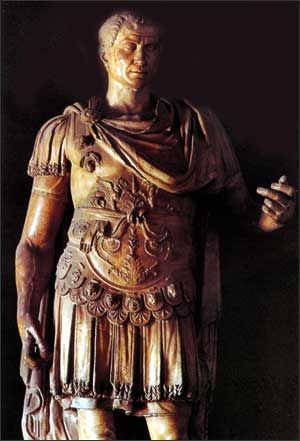
Concrete structure believed to mark location of Roman ruler's killing
By Stephanie Pappas - Senior writer - MSNBC - October 11, 2012
Archaeologists believe they have found the first physical evidence of the spot where Julius Caesar died, according to a new Spanish National Research Council report.
Caesar, the head of the Roman Republic, was stabbed to death by a group of rival Roman senators on March 15, 44 B.C., the Ides of March. The assassination is well-covered in classical texts, but until now, researchers had no archaeological evidence of the place where it happened.
Now, archaeologists have unearthed a concrete structure nearly 10 feet wide and 6.5 feet tall that may have been erected by Augustus, Julius Caesar's successor, to condemn the assassination. The structure is at the base of the Curia, or Theater, of Pompey, the spot where classical writers reported the stabbing took place.
"We always knew that Julius Caesar was killed in the Curia of Pompey on March 15th 44 B.C. because the classical texts pass on so, but so far no material evidence of this fact, so often depicted in historicist painting and cinema, had been recovered," Antonio Monterroso, a researcher at the Spanish National Research Council, said in a statement.
Classical texts also say that years after the assassination, the Curia was closed and turned into a memorial chapel for Caesar. The researchers are studying this building along with another monument in the same complex, the Portico of the Hundred Columns, or Hecatostylon; they are looking for links between the archaeology of the assassination and what has been portrayed in art.
"It is very attractive, in a civic and citizen sense, that thousands of people today take the bus and the tram right next to the place where Julius Caesar was stabbed 2,056 years ago," Monterroso said.
.
Thursday, September 29, 2011
Brennus of the 4th century BC
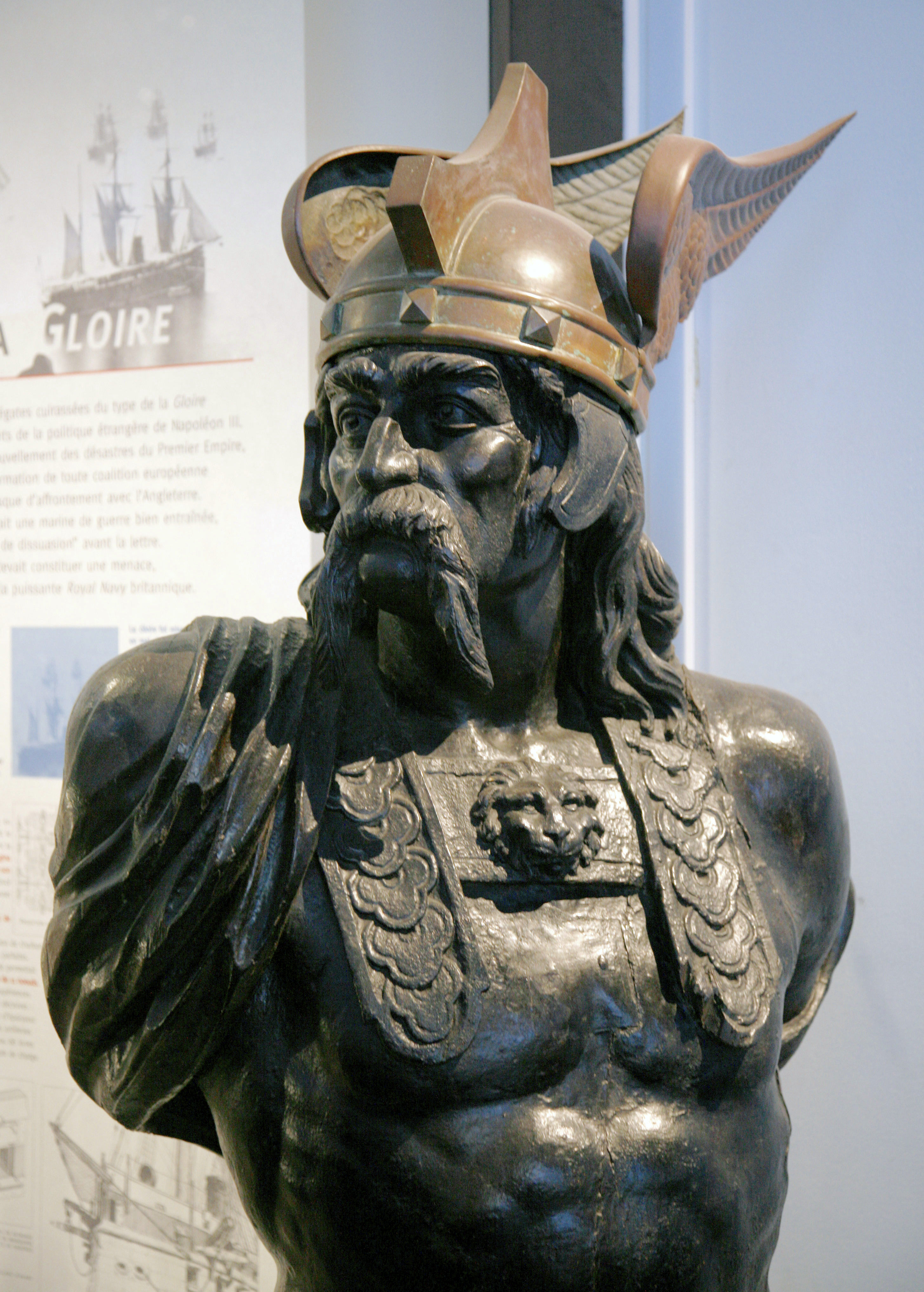
Brennus (or Brennos) was a chieftain of the Senones, a Gallic tribe originating from the modern areas of France known as Seine-et-Marne, Loiret, and Yonne, but which had expanded to occupy northern Italy.
More important historically was a branch of the above (called Senones, by Polybius), who about 400 B.C. made their way over the Alps and, having driven out the Umbrians, settled on the east coast of Italy from Ariminum to Ancona, in the so-called ager Gallicus, and founded the town of Sena Gallica (Sinigaglia), which became their capital.
In 391 they invaded Etruria and besieged Clusium. The Clusines appealed to Rome, whose intervention, accompanied by a violation of the law of nations, led to war, the defeat of the Romans at the Allia (18 July 390) and the capture of Rome. In 387 BC he led an army of Cisalpine Gauls in their attack on Rome. It has been theorized that Brennus is actually a title rather than a name. This is because "Brennus" also appears as the name of a Gallic leader 100 years later. It is also possible that Brennus refers to a god, his name taken by the leader before battle in order to invoke the god's favor and powers.
In the Battle of the Allia, Brennus defeated the Romans, and entered the city itself. The Senones captured the entire city of Rome except for the Capitoline Hill, which was successfully held against them. However, seeing their city devastated, the Romans attempted to buy their salvation from Brennus. The Romans agreed to pay one thousand pounds weight of gold. According to Livy, during a dispute over the weights used to measure the gold (the Gauls had brought their own, heavier-than-standard) Brennus threw his sword onto the scales and uttered the famous words "Vae victis!", which translates to "Woe to the vanquished!"
The argument about the weights had so delayed matters that the exiled dictator Marcus Furius Camillus had extra time to muster an army, return to Rome and expel the Gauls, saving both the city and the treasury. Following initial combat through Rome's streets, the Gauls were first ejected from the city, then utterly annihilated in a regular engagement eight miles outside of town on the road to Gabbi. Camillus was hailed by his troops as another Romulus, father of his country 'Pater Patriae' and second founder of Rome.
Some historical accounts say that the Senones besieging the Capitoline Hill were afflicted with an illness and thus were in a weakened state when they took the ransom for Rome. This is plausible as dysentery and other sanitation issues have incapacitated and killed large numbers of combat soldiers up until and including modern times.
It has been theorized that Brennus was working in concert with Dionysius of Syracuse, who sought to control all of Sicily. Rome had strong allegiances with Messana, a small city state in north east Sicily, which Dionysius wanted to control. With Rome's army pinned down by Brennus' efforts Dionysius led a campaign which ultimately failed. Brennus may have been paid twice to sack Rome.
However, the more accepted history (usually citing Livy and Plutarch) finds that Senones marched to Rome to exact retribution for three Roman ambassadors breaking the law of nations (oath of neutrality) in hostilities outside of Clusium. According to this history, the Senones marched to Rome, ignoring the surrounding countryside; once there, they sacked the city for 7 months, and then withdrew. For more information, see the Battle of Allia.
A famous depiction is the academic painting Le Brenn et sa part de butin (1893) by Paul Jamin that shows Brennus viewing his share of spoils (predominantly naked captive women) after the looting of Rome.
In popular culture
Brennus was played by Gordon Mitchell in the 1963 film 'Brennus, Enemy of Rome'.
Wednesday, November 4, 2009
How did the Cisalpine Romanized Gauls receive the Langobards?

In the forward to the book 'The Lombard Laws' (Katherine Fisher; 1973), on pages XV to XVI, Edward Peters states the following:
"In military and political terms, at least, the Lombards encountered little of that resistance that the Romans had used so successfully against the Visigoths and Ostrogoths. Nor did the Lombards encounter that deeper-rooted social resistance that and organized provincial population, no matter how remote from imperial support, might have offered.
"The devastations of the Gothic wars and the heavy hand of the imperial restoration debilitated even the social fabric of Italy, leaving little in the way of a senatorial or curial class that might have led a resistance movement. With the reduction in imperial taxes that accompanied the Lombard occupation, moreover, even such resistance as might have been generated lost at least the cause of fiscal oppression, and many wealthy Romans fled toward, not away from, the new rulers of northern Italy. Life under the Lombards may well have been preferable to life under the imperial bureaucracy; it was certainly less expensive. Not only were the Lombards fortunate in having little serious military and social resistance, but they encountered little institutional or cultural resistance as well."
It continues on, but that gave the gist of it. Again, by "Romans," Peters is referring to the general population of Romanized Gauls. While other conquered Roman territories were given the respect of having the usage of their ethnic or national label after the Roman era was over, the mere existence of the modern state of Italy was enough to compel historians us use "Roman" here. The main point, however, is that they were not "oppressed" under the Langobards. In fact, it appears that they were actually happy with the change! Germanic and Celtic people were not strangers, historically speaking.
Saturday, October 24, 2009
The Druids of Cisalpine Gaul

On the Druid Wikipedia page, you will find a good deal of information of how important and widespread this culture was from the British Isles, France (Gaul), Spain, Cisalpine Gaul, and vicinities; and why the Romans wanted to eliminate it. Also, YouTube has some interesting videos on it, and attempts to revive it. There are Druids today, but they have little to go on. Although largely identified with males, there seem to have been Druidic priestesses. As far as how the Druidry overlapped with the culture of Witchcraft within the Celtic world, we don't know as yet. Unlike the rest of the Celtic world, the worship of Cernunnos, or Witchcraft, seemed to have been just as strong as Druidry in Cisalpine Gaul.
***************************************************************************
The Romans and the Druids (from historylearningsite.co.uk)
The Romans had met the Druids before in conquered Western Europe. While the Romans were happy to make a peaceful settlement with most tribes/groups in England, they had no intention of doing the same with the Druids.
The Druids were priests. The Britons both respected and feared them. It was believed that a Druid could see into the future – they also acted as teachers and judges. They were considered to be very learned people. It could take up to twenty years of learning to become a Druid. However, we do not know a great deal about what they learned as Druids were not allowed to write any of their knowledge down.
In their own way, the Druids were very religious. It was this particular issue that angered the Romans as the Druids sacrificed people to their gods. Caesar, in particular, was horrified by the practice and his writings give us a good idea of what went on in Druid ceremonies -- though from his perspective only. The Romans had once sacrificed people but they now saw it as a barbaric practice that they could not tolerate in one of their colonies. The Romans determined that they would stamp out the Druids.
However, they had to be careful. The Druids traveled freely throughout England as the Britons were too scared to stop them. Therefore, they were not simply in one place where the Romans could attack in force. In AD 54, the Emperor Claudius banned the Druids. In AD 60, the governor of England, Suetonius, decided that the only way to proceed was to attack the known heartland of the Druids--the island of Anglesey in the hope that if the center of the Druids was destroyed, those Druids in outlying areas would die out.
Boats were built for the Roman foot soldiers while the Roman cavalry swam across with their horses. The Druids shouted abuse at the Romans and cursed them but they could not stop the Roman army from landing. Any ceremonial sites on Anglesey used by the Druids were also destroyed but many of them were in secret places and some survived.
***************************************************************************
Anglesey: Druid’s island
By Philip Coppens
Anglesey, the island on the far west of Wales, was one of the last vestiges of Celtic religion in Roman times. But whereas it is assumed that the Romans wiped out the druid religion… did it somehow survive? And is nearby Bardsey Island linked with it?
Romans vs. Druids: Best War Ever?
***************************************************************************
Two recent books which apparently have information on the Druids in Cisalpine Gaul:
The Cults of Cisalpine Gaul as Seen in the Inscriptions (2009)
Specifically about Cisalpine Gaul!
The Philosopher and the Druids: A Journey Among the Ancient Celts (2006)
This book also has much about Cisalpine Gaul, according to the reviews, and you can get a used copy for only 95 cents.
Sunday, September 6, 2009
From Mercury to Wotan

Was this true? Did the Romans and Greeks share a major god with the Germanic peoples, and perhaps others? If so, that would be a strong bond linking ancient Europe. It should also be noted that the Celts had an extensive mythology, and also we've begun to learn in recent years of the extensive "Slavic mythology" that existed. Staying with the original question, we might be able to start to answer some questions.
Greeks
Hermes is the Messenger of the gods in Greek mythology. An Olympian god, he is also the patron of boundaries and of the travelers who cross them, of shepherds and cowherds, of thieves and road travelers, of orators and wit, of literature and poets, of athletics, of weights and measures, of invention, of general commerce, and of the cunning of thieves and liars.
Romans
In Roman mythology, Mercury (associated with the Greek deity Hermes) was a messenger, and a god of trade, profit and commerce, the son of Maia Maiestas, also known as Ops, the Roman version of Rhea, and Jupiter.
Also according to Wikipedia: "Mercury did not appear among the numinous di indigetes of early Roman religion. Rather, he subsumed the earlier Dei Lucrii as Roman religion was syncretized with Greek religion during the time of the Roman Republic, starting around the 4th century BC. From the beginning, Mercury had essentially the same aspects as Hermes, wearing winged shoes talaria and a winged petasos, and carrying the caduceus, a herald's staff with two entwined snakes that was Apollo's gift to Hermes."
Etruscans
So, according to the above paragraph, Mercury entered the Roman religion some time after the founding of the Roman Republic. There was a break in time there. To answer that question, we again have to explore the Roman ruination of ancient Etruria. The Etruscans called the Greek god Hermes "Turms" (see chart). Well, isn't that interesting. The Etruscans worshipped this god long before Rome, and is it such a stretch to ponder as to whether or not the early Roman elite deliberately deconstructed an important Etruscan god? I have made the comparison of the Etruscans to the USA nation state, and the Romans to the Globalist American leadership. Both deconstructed much of what had been tradition in favor of internationalism.
Now we do not necessarily know if Hermes appeared in Greek mythology prior to Etruscan mythology, but we would have to assume Greece until proven otherwise. We do know that Etruria was not a colony of Greece, and was a strong nation right along with Greece, and that the "Greece then Rome" concept is largely untrue. By destroying the highly advanced Etruscan architecture, the Romans were indeed able to wipe ancient Etruria out of memory.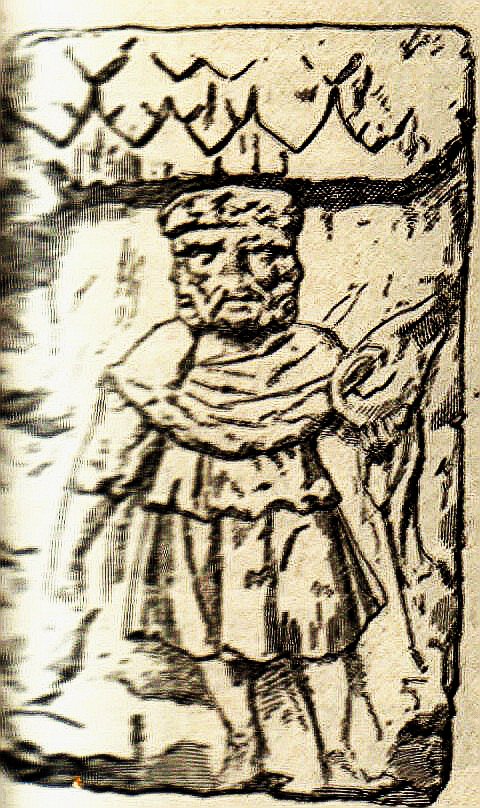
[Left: A three-headed image of a Celtic deity, interpreted as Mercury and now believed to represent Lugus]
When they described the gods of Celtic and Germanic tribes, rather than considering them separate deities, the Romans interpreted them as local manifestations or aspects of their own gods, a cultural trait called the interpretatio Romana. Mercury in particular was reported as becoming extremely popular among the nations the Roman Empire conquered; Julius Caesar wrote of Mercury being the most popular god in Britain and Gaul, regarded as the inventor of all the arts. This is probably because in the Roman syncretism, Mercury was equated with the Celtic god Lugus, and in this aspect was commonly accompanied by the Celtic goddess Rosmerta. Although Lugus may originally have been a deity of light or the sun (though this is disputed), similar to the Roman Apollo, his importance as a god of trade and commerce made him more comparable to Mercury, and Apollo was instead equated with the Celtic deity Belenus.
Romans associated Mercury with the Germanic god Wotan, by interpretatio Romana; 1st-century Roman writer Tacitus identifies the two as being the same, and describes him as the chief god of the Germanic peoples. Julius Caesar, in a section of his "Gallic Wars" describing the customs of the German tribes, wrote "The Germans most worship Mercury," apparently identifiyng Wotan with Mercury.
In Celtic areas, Mercury was sometimes portrayed with three heads or faces, and at Tongeren, Belgium, a statuette of Mercury with three phalli was found, with the extra two protruding from his head and replacing his nose; this was probably because the number 3 was considered magical, making such statues good luck and fertility charms. The Romans also made widespread use of small statues of Mercury, probably drawing from the ancient Greek tradition of hermae markers.
Lugus was a deity apparently worshipped widely in antiquity in the Celtic-speaking world. His name is rarely directly attested in inscriptions, but his importance can be inferred from placenames and ethnonyms, and his nature and attributes are deduced from the distinctive iconography of Gallo-Roman inscriptions to Mercury, who is widely believed to have been identified with Lugus, and from the quasi-mythological narratives involving his linguistic descendants, Irish Lugh and Welsh Lleu Llaw Gyffes.
"Gaulish Mercury"
Julius Caesar in his De Bello Gallico identified six gods worshipped in Gaul, by the usual conventions of interpretatio Romana giving the names of their nearest Roman equivalents rather than their Gaulish names. He said that "Mercury" was the god most revered in Gaul, describing him as patron of trade and commerce, protector of travellers, and the inventor of all the arts. The Irish god Lug bore the epithet samildánach (skilled in all arts), which has led to the widespread identification of Caesar's Mercury as Lugus. Mercury's importance is supported by the more than 400 inscriptions into him in Roman Gaul and Britain. Such a blanket identification is optimistic – Jan de Vries[8] demonstrates the unreliability of any one-to-one concordance in the interpretatio Romana – but the available parallels are worth considering.
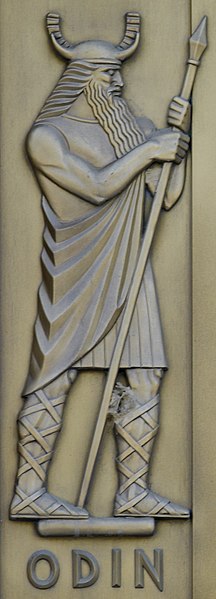
Ancient Germanic Peoples
Odin is considered the chief god in Norse paganism and the ruler of Asgard. Homologous with the Anglo-Saxon Wōden and the Old High German Wotan, it is descended from Proto-Germanic *Wōđinaz or *Wōđanaz. The name Odin is generally accepted as the modern translation; although, in some cases, older translations of his name may be used or preferred. His name is related to ōðr, meaning "fury, excitation", besides "mind", or "poetry". His role, like many of the Norse gods, is complex. He is considered a principal member of the Aesir (Norse Pantheon) and is associated with wisdom, war, battle, and death, and also magic, poetry, prophecy, victory, and the hunt.
Parallels between Odin and Celtic Lugus have often been pointed out: both are intellectual gods, commanding magic and poetry. Both have ravens and a spear as their attributes, and both are one-eyed. Julius Caesar (de bello Gallico, 6.17.1) mentions Mercury as the chief god of Celtic religion. A likely context of the diffusion of elements of Celtic ritual into Germanic culture is that of the Chatti, who lived at the Celtic-Germanic boundary in Hesse during the final centuries before the Common Era.
It can be concluded that various mythological figures, from different cultures, were "associated" with a counterpart. This may have been partly due to political maneuvering by Romans and others, to pacify the population. To conjoin different cultures under a unified imperial state, in the same way that early Christians, rather than try to force the abolition of a pagan holiday, just co-opted it until it more-or-less disappeared.
Sunday, August 30, 2009
The Langobards and the Battle of the Teutoborg Forest - Part III
A new book, 'Rome's Greatest Defeat: Massacre in the Teutoburg Forest' (Adrian Murdock; 2009), states in it's product description: "Over four days at the beginning of September AD 9, half of Rome's Western army was ambushed in a German forest and annihilated. Three legions, three cavalry units and six auxiliary regiments—some 25,000 men—were wiped out. It dealt a body blow to the empire's imperial pretensions and was Rome's greatest defeat. No other battle stopped the Roman empire dead in its tracks. From the moment of the Teutoburg Forest disaster, the Rhine, rather than the Elbe as the Romans had hoped, became the limit of the civilized world. Rome's expansion in northern Europe was checked and Rome anxiously patrolled the Rhineland borders, awaiting further uprisings from Germania. Although one of the most significant and dramatic battles in European history, this is also one that has been largely overlooked. Drawing on primary sources and a vast wealth of new archeological evidence, Adrian Murdoch brings to life the battle itself, the historical background, and the effects of the Roman defeat as well as exploring the personalities of those who took part."
I wanted to note here, a quote from the History Channel's computer graphic-animated documentary of the battle. One quote was as follows:
"The Romans feared the forest as a wild and uncivilized place. They believed that the great oak forest of the north marked the edge of the world. A hundred years later, in (regarding) the events that we're discussing, Tacitus, writing his 'Germania', talks about some mythical part human-part animal figures. So there are areas deep in the interior of Germany which are almost perceived as mythical to the Roman elite. For the German tribes, the forest trees often marked sacred places. The Christmas tree we bring into our home each year, is a reminder of those beliefs."
There is a lot to look at and dissect here. The heavy forests of the Rhineland were, in Roman times, almost perceived as what people thought of in more recent history as like the Congo Basin or the Amazon jungle. A wild, uncivilized, unpredictable, rugged, remote, and scary place. A place ripe with mythology. Germany was, in ancient times, how we might think of the landscape of say Washington or British Columbia.
Even though this quote was merely a quick sidetrack in the documentary, it was a glimpse into some important directions. When they mentioned the Christmas tree, they were talking about Wotanism. I was going to put "they were basically talking about Wotanism," but that wouldn't be accurate. It WAS entirely about Wotanism (called Odinism today). Although we grew up with the idea of it being a Christmas tradition, it predates Christianity by many thousands of years. When they said that it was "a reminder of those (Wotanist) beliefs," that's not necessarily true. We have forgotten this part of our history. When I say "we," I mean "the West," "Europeans," "Americans," etc. There are many examples of where Christianity co-opted pagan holidays and traditions with a new Christian one, rather than try to deconstruct it. To overlap it, or drown it out.
Needless to say, as part of the aftermath of this Roman-German war, Germany retained it's language and culture, while France, for example, adopted the Latin language and Roman customs. Had the Romans been successful, they would have fully intended to take over Germany, Scandinavia, Russia, etc. The monuments to this battle, in both Germany and Minnesota, are, ironically built upon what most would say are "Roman columns." I don't think that is quite as ironic as one might think. Those were actually "Etruscan columns" in origin.

One more quote from the documentary cryptically references Wotanism. Regarding the time just after the Teutoburg massacre: "Those taken prisoner were dragged to ponds deep in the forest, where their throats were cut, and their bodies thrown in the water as a sacrifce to the forest gods." "Forest gods?" Those were Wotanist gods.
Saturday, August 29, 2009
The Langobards and the Battle of the Teutoborg Forest - Part II

Edward Peters, the editor of the book 'History of the Lombards', gave his take on this subject in the first footnote of 'Book I, Chapter VII:
"Scoringa, according to Miillenhoff's explanation in which Bluhme concurs, is "Shoreland" (see Schmidt, 43). Bluhme considers it identical with the later Bardengau, on the left bank of the lower Elbe where the town of Bardowick, twenty-four miles southeast of Hamburg, perpetuates the name of the Langobards even down to the present time. Hammerstein (Bardengau, 56) explains Scoringa as Schieringen near Bleckede in the same region. Schmidt (43) believes that the settlement in Scoringa has a historical basis and certainly, if the name indicates the territory in question, it is the place where the Langobards are first found in authentic history. They are mentioned in connection with the campaigns undertaken by Tiberius against various German tribes during' the reign of Augustus in the fifth and sixth year of the Christian era, in the effort to extend the frontiers of the Roman empire from the Rhine to the Elbe (Mommsen, Romische Geschichte, V, 33). The Langobards then dwelt in that region which lies between the Weser and the lower Elbe. They were described by the court historian Velleius Paterculus (II, 106), who accompanied one of the expeditions as prefect of cavalry (Schmidt, 5), as "more fierce than ordinary German savagery,'' and he tells us that their power was broken by the legions of Tiberius.
"It would appear also from the combined testimony of Strabo (A. D. 20) and Tacitus (A, D. 117) that the Langobards dwelt near the mouth of the Elbe shortly after the beginning of the Christian era, and were in frequent and close relations with the Hermunduri and Semnones, two great Suevic tribes dwelling- higher up the stream. Strabo (see Hodgkin, V, 81) evidently means to assert that in his time the Hermunduri and Langobards had been driven from the left to the right bank. Ptolemy who wrote later (100-161) places them upon the left bank. Possibly both authors were right for different periods in their history (Hodgkin, V, 82). The expedition of Tiberius was the high-water mark of Roman invasion on Teutonic soil, and when a Roman fleet, sailing up the Elbe, established communication with a Roman army upon the bank of that river, it might well be thought that the designs of Augustus were upon the point of accomplishment, and that the boundary of the empire was to be traced by connecting the Danube with the Elbe. The dominions of Marobod, king of the Marcomanni, who was then established in Bohemia, would break the continuity of this boundary, so the Romans proceeded to invade his territories. An insurrection, however, suddenly broke out in Illyricum and the presence of the Roman army was required in that region.
"So a hasty peace was concluded with Marobod, leaving him the possessions he already held. It required four successive campaigns and an enormous number of troops (Mommsen, Rom. Gesch., Vol. V, pp. 35-38) to suppress the revolt. While the Roman veterans were engaged in the Illyrian war, great numbers of Germans led by Arminius, or Hermann, of the Cheruscan tribe rose in rebellion. In the ninth year of our era, Varus marched against them at the head of a force composed largely of new recruits. He was surprised and surrounded in the pathless recesses of the Teutoburg forest and his army of some twenty thousand men was annihilated (id., pp. 38-44). It is not known whether the Langobards were among the confederates who thus arrested the conquest of their country by the Roman army, although they dwelt not far from the scene of this historic battle. They were then considered, however, to belong to the Suevian stock and were subject, not far from this time, to the king of the Marcomanni, a Suevian race (id., p. 34; Tacitus Germania, 38-40; Annals, II, 45), and king Marobod took no part in this war on either side as he had made peace with the Romans. The defeat of Varus was due largely to his own incompetency and it would not appear to have been irretrievable when the immense resources of the Roman empire are considered.
"Still no active offensive operations against the barbarians were undertaken until after the death of Augustus and the succession of Tiberius, A. D. 14, when in three campaigns, the great Germanicus thrice invaded Germany, took captive the wife and child of Arminius, defeated the barbarians in a sanguinary battle, and announced to Rome that in the next campaign the subjugation of Germany would be complete (Mommsen, id., pp. 44-50). But Tiberius permitted no further campaign to be undertaken. The losses suffered by the Romans on the sea as well as on land had been very severe, and whether he was influenced by this fact and by the difficulty of keeping both Gaul and Germany in subjection if the legions were transferred from the Rhine to the Elbe, or whether he was actuated by jealousy of Germanicus, and feared the popularity the latter would acquire by the subjugation of all Germany, cannot now be decided, but he removed that distinguished commander from the scene of his past triumphs and his future hopes, sent him to the East on a new mission, left the army on the Rhine divided and without a general-in-chief, and adopted the policy of keeping that river as the permanent boundary of the empire (id., p. 50-54). Thus the battle in the Teutoburg forest resulted in the maintenance of German independence and ultimately perhaps in the overthrow of the Roman empire itself by German barbarians.
"It marked the beginning of the turn of the tide in Roman conquest and Roman dominion, for although the empire afterwards grew in other directions yet behind the dike here erected, the forces gradually collected which were finally to overwhelm it when it became corrupted with decay. When the legions of Varus were destroyed, the head of the Roman commander was sent to Marobod and his cooperation solicited. He refused however to join the confederated German tribes, he sent the head to Rome for funeral honors, and continued to maintain between the empire and the barbarians, the neutrality he had observed in former wars. This refusal to unite in the national aspirations for German independence, cost him his throne. " Not only the Cheruscans and their confederates " says Tacitus (Ann. II, 45) "who had been the ancient soldiery of Arminius, took arms, but the Semnones and Langobards, both Suevian nations, revolted to him from the sovereignty of Marobod . . . . The armies (Ch. 46) . . . . were stimulated by reasons of their own, the Cheruscans and the Langobards fought for their ancient honor or their newly acquired independence, and the others for increasing their dominion." This occurred in the seventeenth year of our era. Marobod was finally overthrown, and took refuge in exile with the Romans, and it was not long until Arminius, accused of aspiring to despotic power, was assassinated by a noble of his own race (Mommsen, id. 54-56).
"After his death the internal dissensions among the Cheruscans became so violent that the reigning family was swept away, and in the year 47 they asked the Romans to send them as their king the one surviving member of that family, Italirus, the nephew of Arminius, who was born at Rome where he had been educated as a Roman citizen. Accordingly Italicus, with the approval of the emperor Claudius, assumed the sovereignty of the Cheruscans. At first he was received with joy, but soon the cry was raised that with his advent the old liberties of Germany were departing and Roman power was becoming predominant. A struggle ensued, and he was expelled from the country. Again, the Langobards appear upon the scene, with sufficient power as it seems to control the destiny of the tribe which, thirty-eight years before, had been the leader in the struggle for independence, for they restored him to the sovereignty of which he had been despoiled by his inconstant subjects (Tacitus Annals, XI, 16, 17). These events and other internal disturbances injured the Cheruscans so greatly that they soon disappeared from the field of political activity (Mommsen, id., 132). During the generations that followed there was doubtless many a change in the power, the territories and even the names of the various tribes which inhabited Germania Magna, but for a long time peace was preserved along the frontiers which separated them from the Roman world (id., p. 133). It is somewhat remarkable that none of those events appear in the Langobard tradition as contained in the pages of Paul."
Friday, August 28, 2009
The Langobards and the Battle of the Teutoburg Forest - Part 1

The Teutoburg Forest is a range of low, forested mountains in the German states of Lower Saxony and North Rhine-Westphalia. The lands west of the Rhine River were part of the Roman Empire. The lands east of the Rhine, and especially between the Rhine and the Elbe River, were long a big problem area for the Romans in as far as their expansion and imperialism was concerned. It was inhabited by many fierce Germanic tribes. We know that, despite their relatively small numbers, the Langobards where noted by the Romans to be particularly fierce even by the standards of of this region. It's a little difficult to imagine them missing out on a battle for German sovereignty and freedom.
The Battle of the Teutoburg Forest (described as clades Variana by Roman historians) took place in A.D. 9 (probably lasting from September 9 to September 11) when an alliance of Germanic tribes led by Arminius, ("Hermann" in German) the son of Segimer of the Cherusci, ambushed and destroyed three Roman legions led by Publius Quinctilius Varus. The battle began a seven-year war which established the Rhine as the boundary of the Roman Empire for the next four hundred years, until the decline of the Roman influence in the West. The Roman Empire made no further concerted attempts to conquer Germania beyond the Rhine.
Upon hearing of the defeat, the Emperor Augustus, according to the Roman historian Suetonius in his Lives of the Twelve Caesars, showed signs of near-insanity, banging his head against the walls of his palace and repeatedly shouting Quintili Vare, legiones redde! ('Quintilius Varus, give me back my legions!'). The three legion numbers were never used again by the Romans after this defeat, unlike other legions that were restructured — a case unique in Roman history. From the time of the rediscovery of Roman sources in the 15th Century, the Battle of Teutoburg Forest has been seen as a pivotal clash which ended Roman expansion into northern Europe.
Arminius, also known as Armin or Hermann (Possibly Eminjoz in proto Germanic) (18 BC/17 BC in Magna Germania; AD 21 in Germania) was a chieftain of the Cherusci who defeated a Roman army in the Battle of the Teutoburg Forest. His influence held an allied coalition of Germanic tribes together in opposition to the Romans but after after decisive defeats to the Roman general Germanicus, nephew of the Emperor Tiberius, his influence waned and he was assasinated on the orders of rival Germanic chiefs. Although Arminius was ultimately unsuccessful in forging unity among the Germanic tribes, the loss of the Roman legions in the Teutoburg forest had a far-reaching effect on the subsequent history of both the ancient Germanic tribes and on the Roman Empire. Germanicus' campaign was the last major Roman military effort east of the Rhine.
The Hermannsdenkmal (German for Hermann monument) is a monument located in North Rhine Westphalia in Germany in the Southern part of the Teutoburg Forest, which is southwest of Detmold in the district of Lippe. It stands on the densely forested and 386 m tall Teutberg in the ring fortification located there, which is called Grotenburg.
The monument commemorates the Cherusci war chief Hermann or Armin (Latin: Arminius) and the Battle of the Teutoburg Forest in which the Germanic tribes under Arminius recorded a decisive victory in 9 AD over three Roman legions under Varus.
The sword has the following inscription:
Deutsche Einigkeit, meine Stärke - meine Stärke, Deutschlands Macht.
German unity (is) my strength - my strength (is) Germany's might.
It's important to note that the Germanic tribes of this time were fighting the good fight for their lands, their culture, and their freedom against what amounted to a self-appointed global dictatorship in the form of the Roman Empire.
The Hermann Heights Monument is a statue erected in New Ulm, Minnesota. The statue depicts Hermann the Cheruscan, also known by the Latin name Arminius, but locals refer to the statue as Herman the German. The only National Register of Historic Places property of its kind in Minnesota, the monument remains an impressive remembrance of German ancestry for many Minnesotans. Visitors to the statue can climb the spiral staircase to an observation platform at the base of the statue, which commands a view of the town and the Minnesota River Valley below.
Wednesday, July 22, 2009
War for Occupied Cisalpine Gaul: Byzantine Roman Empire versus Langobard Nation
War for Occupied Cisalpine Gaul: Byzantine Roman Empire versus Langobard Nation
Langobard warriors, under warrior King Alboin, defeat the Byzantine Roman Army. The Nation of Langbard is born.
Saturday, July 18, 2009
Ostrogothic Kingdom: Germanic Conquest
Ostrogothic Kingdom: Germanic Conquest
The Ostrogothic Kingdom established by the Ostrogoths in Italy and neighbouring areas lasted from 493 to 553. In Italy the Ostrogoths replaced Odoacer, the de facto ruler of Italy who had deposed the last emperor of the Western Roman Empire in 476. The Gothic kingdom reached its zenith under the rule of its first king, Theodoric the Great. Most of the social institutions in the late Western Roman Empire were preserved during his rule.
Theodoric the Great (454 - August 30, 526) was king of the Ostrogoths (471 - 526), ruler of Italy (493 - 526), and regent of the Visigoths (511526). He became a hero of Germanic legend as Þeodric in English legends, Dietrich von Bern in German legends, and as Þjóðrekr and Þiðrekr in Norse mythology.
The Ostrogoths were a branch of the Goths, an East Germanic tribe that played a major role in the political events of the late Roman Empire. The other branch was the Visigoths.
The Ostrogoths established a relatively short-lived successor state of Rome in Italy and the Balkans, even briefly incorporating most of Hispania and southern Gaul. They reached their zenith under their Romanised king Theodoric the Great, who patronised such late Roman figures as Boethius and Cassiodorus, in the first quarter of the sixth century. By mid-century, however, they had been conquered by Rome in the Gothic War (535 - 554), a war with devastating consequences for Italy.
Tuesday, June 30, 2009
Barbarians II: The Lombards
Barbarians II: The Lombards
[For more great documentaries, visit TheDocumentaryCenter.blogspot.com]
At its peak, the Roman Empire feared nothing in Heaven or on Earth. Perhaps they should have paid closer attention to the pagan rabble. Coming in waves from the dark forests of Europe, the hordes drove the mighty empire to its knees. Relentless, unmerciful and united only in their hatred for Rome, each of these warrior tribes - Vandals, Saxons, Franks and Lombards - had its own violent agenda, dark rites, savage tactics, and secret weapons. Barbarians 2 follows these four fearsome tribes as they cut a swath of destruction through the heart of the Roman world. Barbarians 2 recreates the world of these invaders through breathtaking stunts, large-scale battle reenactments, and a fast-paced, exciting narrative.
THE LOMBARDS: The ferocious tribe partial to severing their foes' heads and stealing their women. Their brutal leader, Alboin, overcame Roman defenses, surrounded The Eternal City, and forced a captured foe's wife to drink from her slain father's skull.
"Estimates of the number range between about fifty thousand and two hundred thousand adult males, so we may be talking about a population of four or five hundred thousand people altogether." --Professor Thomas Noble, Chairperson, Department of History, University of Notre Dame, on the Lombard invasion population numbers in 568 A.D. during verbal interview for the History Channel's 'Barbarians II: The Lombards'
Thursday, June 19, 2008
Romans In Brazil During The Second Third Century?

12-10-03
Ex-marine and underwater explorer, archaeologist, and treasure-hunter Robert Marx states rather flatly:
Amongst my most notable discover[ies] was that of a 2nd century BC Roman shipwreck in the Bay of Guanabara, near Rio de Janeiro. This is a discovery that has received little to no examination, much less validation, from the realm of mainstream archaeology, no doubt in part because Marx is not a Ph.D. archaeologist. Scouring the web for more information about this finding, I did find a reference to the discovery in an article from Dr. Elizabeth Lyding Will, an expert on Roman amphoras (clay vessels used to store and ship goods during the Roman era). Dr. Will apparently has a piece of an amphora recovered from Marx's Brazil discovery. Of it, she says:
The highly publicized amphoras Robert Marx found in the ship are in fact similar in shape to jars produced in kilns at Kouass, on the west coast of Morocco. The Rio jars look to be late versions of those jars, perhaps datable to the third century A.D. I have a large piece of one of the Rio jars, but no labs I have consulted have any clay similar in composition. So the edges of the earth for Rome, beyond India and Scotland and eastern Europe, remain shrouded in mystery. Information about this find is practically non existent. Gary Fretz's synopsis of the "whole story" suggests that the find has been suppressed by the Brazilian government:
At the time the amphorae were confirmed to be "Roman", the large Italian faction in Brazil were extremely excited about this news. The Italian ambassador to Brazil notified the Brazilian government that, since the Romans were the first to "discover" Brazil, then all Italian immigrants should be granted immediate citizenship. There are a large number of Italian immigrants in Brazil and the government has created a tedious and costly citizenship application procedure for Italians that does not apply to Portuguese immigrants.
The Brazilian government would not give in and the Italians in Brazil staged demonstrations. In response, the Brazilian government ordered all civilians off the recovery project and censored further news about the wreck hoping to diffuse the civil unrest. Finally, I've also seen mention of the following written works, which I've yet to dig up: Marx R.F., 1984 , Romans in Rio? [see Santarelli A. Mondo Sommerso 270 1983:252-3. Oceans, 17.4: 18-21.] The Romans in Rio book (?) is not among the works of Robert Marx as listed at Amazon.
By Gary Fretz
Q. With all of the new technology available today, we should be able to know precisely when the first European ships reached the New World. What is the latest news? It was a group of Vikings who made landfall around 900 A.D., right?
A. Wrong! It is now confirmed that a Roman ship reached Brazil around the year 19 B.C.! Here is the whole story …
Two thousand years ago, the most valuable commodity “known to man” was salt. This is because most fresh meats and fish were preserved by packing in salt. In fact, salt was so valuable, it was used in place of coinage. This is where the word “salary” emerged (as well as the expression “he’s not worth his salt”). The Romans had a large salt production facility on Ilha do Sal (Salt Island) in the Cape Verde Islands, which are 350 miles off the coast of West Africa. This location is directly in the path of the hot, dry winds of the Sahara Desert, which can easily blow 60 knots from the east.
It is believed that this Roman merchant vessel was heading for Salt Island to pick up a load of salt and to provision the local army garrison when a fierce Sahara storm started. Roman ships were clumsy by modem standards and would have no choice but to lower their sails and to run with the winds to avoid capsizing. The Sahara winds can blow for many days and the Salt Ship was carried to Guanabara Bay (near Rio de Janeiro) in Brazil.
In the middle of the - Bay is a large submerged rock lying 3’ below the surface called Xareu Rock (named after a local fish that congregates here). The ship appears to have been travelling at a high rate of speed when she struck the rock. She broke into two pieces and settled in 75’ of water near the base of the rock.
In the late 1970’s, a local fisherman using nets around Xareu Rock kept “catching” some large (3’ tall), heavy earthen jars which tore his nets. He mistakenly thought these were “macumba”jars, which are used in local voodoo ceremonies and then thrown into the sea. So, as the jars were hauled up, he smashed them with a hammer and threw the small pieces back into the water in an attempt to prevent tearing his nets in the future.
If he had only known what treasures he was destroying! In recent years, a scuba diver was spear fishing around Xareu Rock and found eight similar jars that he took home.
He sold six jars to tourists before the Brazilian police arrested him with the two remaining jars for illegally selling ancient artifacts. Archaeologists immediately identified these as Roman amphorae of the 1st century B.C These containers were originally used to carry water, grain, salted fish, meat, olives, olive oil and other foods necessary to feed the ship’s crew and to provision Roman outposts.
One of the world’s foremost authorities on Roman shipwrecks, Robert Marx, found more artifacts and confirmed this as an authentic Roman shipwreck. The world’s foremost authority on Roman amphorae analyzed the clay in the jars and confirmed that these were manufactured at Kouass which was a Roman seaport, 2000 years ago, on the coast of modem-day Morocco. The Institute of Archaeology of the University of London performed thermo luminescence testing (which is a more accurate dating process than Carbon 14 dating) and the date of the manufacture was determined to be around 19 B.C. Many more amphorae and some marble objects were recovered, as well as a Roman bronze fibula (a clasp device used to fasten a coat or shirt).
So, why haven't we heard more about this fantastic find? One would think this news would make headlines around the world… The short answer is “politics”. At the time the amphorae were confirmed to be "Roman", the large Italian faction in Brazil were extremely excited about this news.
The Italian ambassador to Brazil notified the Brazilian government that, since the Romans were the first to "discover" Brazil, then all Italian immigrants should be granted immediate citizenship. There are a large number of Italian immigrants in Brazil and the government has created a tedious and costly citizenship application procedure for Italians that does not apply to Portuguese immigrants. The Brazilian government would not give in and the Italians in Brazil staged demonstrations. In response, the Brazilian government ordered all civilians off the recovery project and censored further news about the wreck hoping to diffuse the civil unrest. The Brazilian Navy continues to excavate the wreck in secret.
We only know about it because of what Robert Marx learned before he was dismissed and what the University of London has leaked. This shipwreck may help explain some other intriguing Brazilian finds: - Several hundred ancient Roman silver and bronze coins were unearthed near Recife, Brazil. Did these once belong to the castaways of the Salt Ship?
- A tribe of white, mostly blonde haired, blue-eyed "Indians" has been found in a remote region of the Amazon jungle. Could these be the descendants of the shipwrecked sailors of the Xareu wreck? DNA analysis of these “Indians” will surely bring some interesting facts to light!
Romans In Brazil During The Second Third Century?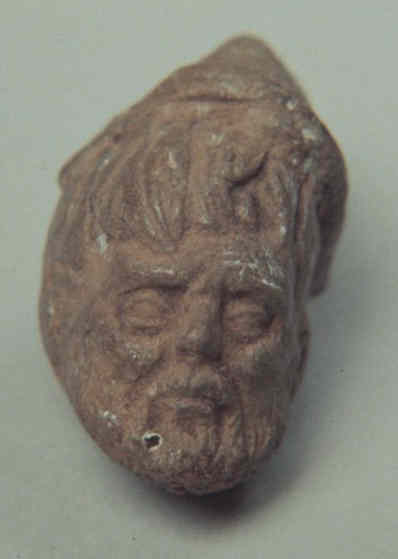
A Report by Andrew Collins
[Two photos are copyright of Romeo H. Hristov]
'Did Roman explorers discover America 1,300 years ahead of Christopher Columbus' was the headline on page 25 of the DAILY MAIL for Thursday, 10 February 2000. On the same day THE EXPRESS ran a story on page 28 under the banner `Oldest Latin in America: Bust may prove Romans got there first'.
Both stories sought to highlight claims being made in the new issue of the magazine NEW SCIENTIST concerning the recent realisation that a small ceramic head found in 1933 at a site in the Toluca Valley, 72 kilometres west of Mexico City, is in fact Roman in origin.(1) A dating process known as thermoluminescence, which determines the age of ceramics, has found that the tiny bust is approximately 1800 years old. How it might have reached Mexico is the big mystery. The implication, however, is that the head, which shows a full-bearded individual in typical Latin style, was introduced to the New World prior to the age of Columbus.
David Kelley, an archaeologist at Canada's University of Calgary stated that the bust was found 'sealed under three floors. It is as close to archaeological certainty as you can get'.(2)
Such statements led anthropologist Roman Hristow, formerly of the Southern Methodist University, to conclude that the bust is firm evidence of transatlantic contact between the Old and New World as early as AD 200.(3) Having become interested in the Roman piece, he managed to track it down to a museum in Mexico City, where it had remained since its discovery.
It was the Max Planck Institute for Nuclear Physics in Heidelberg, Germany, who conducted the tests which determined the age of the bust. Afterwards art experts were more willing to accept that it was of Roman manufacture. Hristow who then checked original excavation reports and realised that the bust must have been buried at least nine years before the arrival in Mexico of Hernando Cortés in 1519.
Yet this realisation begs the real question of whether or not Roman explorers were making journeys to the Americas around AD 200.Betty Meggers, an anthropologist at the National Museum of Natural History in Washington DC, has stated that: `I see no reason why ancient contact is not possible'.(4) She herself has made an extensive study of the similarities between the prehistoric pottery of the Joman culture of Japan and the Valdivia culture of Ecuador. This she believes is evidence of transpacific contact with the Americas as early as 3000 BC.
In contrast, other archaeologists remain sceptical over the claims being made by scholars such as Hristow and Meggers. Andrew Selkirk, the editor of CURRENT ARCHAEOLOGY, is of the opinion that: `It is a big leap to claim that the Romans reached Mexico City when scientists are not certain whether they even reached the Canary Islands.
'You could imagine a ship being wrecked off Newfoundland and you could argue that it had been blown across the ocean, but to claim that a boat got as far as Mexico sounds a bit over the top'.
Indeed, Selkirk even went so far as to say: `It could have been dropped out of someone's pocket in the 1930s or [was] put there as a spoof. If you had three similar finds in three different places, then maybe that would be more credible'.(5)
On a slightly different tack, David Grove, an archaeologist with the University of Illinois, while accepting that the head is Roman, suggests that it could have been taken from a shipwreck during some later age. If this were so, it would remove any significance the bust might play in re-interpreting the history of Mexico.(6) He also points out that there is no significant evidence of the influence of Old World cultures on the development of Mesoamerican civilisations prior to the age of Columbus.(7)
Speaking in the wake of lingering rumours and stories of Roman wrecks awaiting investigation off the coasts of Central and South America, Simon Keay, a Roman expert at Southampton University, says that although evidence of Roman contact has been found as far east as India, there are no records of trading routes to the Americas.(8)
A Mystery of Two Heads
The idea of transoceanic contact between the ancient world and the Americas is a subject crucial to our understanding of how Plato came to write his account of an Atlantic island called Atlantis in around 350 BC. There is every reason to suppose that in order to construct the story he drew on vague maritime knowledge concerning what lay on the western Atlantic seaboard - information that most probably filtered into the Mediterranean world via Phoenicians from Spain and Carthaginian traders from North Africa.
Indeed, I feature the bust in the chapter of 'GATEWAY TO ATLANTIS' entitled `Shipwrecks and Sailors'. After highlighting the discovery of North African amphorae disgorged from possible Roman wrecks in the so-called Bay of Jars outside of Rio de Janeiro during the 1980s, I introduce the evidence for Roman contact with Mexico. I cite the fired clay bricks used to construct various classical Maya sites in the Yucatán peninsular, in particular the great city of Comalcalco. The walls of its great palace show a remarkable similarity to fired clay structures of the Roman world, while maker's marks have been said to resemble characters from a south-east Asian script. This is territory dealt with in extraordinary detail by British transoceanic expert David Eccott and American archaeologist Neil Steede.
I go on to cite the tiny sculpted Roman head highlighted in the NEW SCIENTIST article and in subsequent national news stories in British papers such as THE DAILY MAIL and THE EXPRESS. The ceramic piece came originally from a site named Calixtlahuaca, located some 72 kilometres west of Mexico City. It was excavated in 1933 by archaeologist José Garcia Payón of Mexico's National Museum. According to the reports, it was found, along with various grave goods, in a truncated pyramid structure dating to the twelfth century and belonging to the Toltec culture which thrived during this era. This would then imply that the Roman bust could have been in Mexico for up to 1,000 years, not simply nine or ten years as has been claimed by anthropologist Roman Hristow. Initially it was thought that this fascinating artefact, which takes the form of a terracotta vessel several centimetres in height, is the one pictured in several books on transoceanic contact with a bushy beard and conical cap, like the Phrygian caps worn by the classical gods Perseus and Mithras.(9)
Yet the Roman bust that appeared originally in the NEW SCIENTIST article, and subsequently in THE EXPRESS, was an entirely different one without a hat and with much sharper features. After some initial confusion it has now been established that this picture had nothing whatsoever to do with the Calixtlahuaca head, and was used simply, and rather sloppily, to illustrate the news story.(10)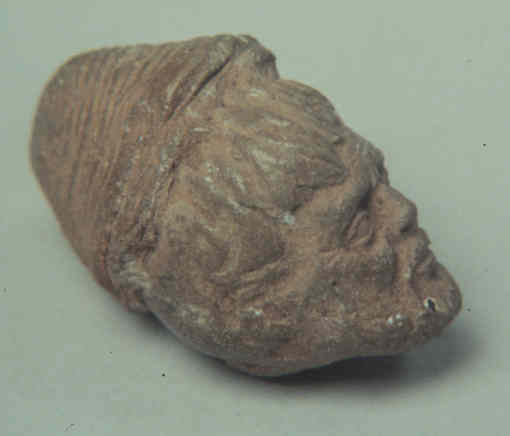
So how might this priceless Roman artefact have come to be in Mexico in the first place? Austrian orientalist and anthropologist Dr Robert Heine-Geldern, a believer in transpacific contact in pre-Columbian times, was of the opinion in an article published in 1961 that the bust - which he describes as wearing a `Pylos', a knitted cap favoured among sailors from the Greek seaport of Pylos - had come across originally from Indo-China, where Roman artefacts have occasional been found.(11) In his view, it reached India via trade links with the Roman Empire, and then had been traded on to Indo-Chinese cultures in Southeast Asia who were themselves making transoceanic journeys during this age.(12) It was in this way that the head had reached Mexico, and not through direct Roman contact with the Americas.
I have no objection to the view that Roman explorers, or indeed traders, might have made transpacific journeys to Mexico as early as AD 200. However, we must also not ignore the clear evidence for transatlantic contact by Romans during this same epoch. We have the evidence of the amphorae and possible wrecks (yes, wrecks in plural) awaiting investigation off the coast of Brazil. There is another Roman wreck lying off the coast of Honduras in Central America. As early as 1976 it was disgorging amphorae which have been determined to be of Punic, i.e. North African, origin (See 'GATEWAY TO ATLANTIS').
There is also the case of the Roman coin hoard found washed up in a jar on a beach in north-east Venezuela. The age of the coins span an immensely-long period that stretches between the reign of Caesar Augustus (63 BC-AD 14) and a date of around AD 350. Since the hoard includes many duplicates, there seems very little likelihood that it could have been a discarded or buried collection of colonial origin, or that it might have been part of a national treasure trove on its way either to or from the New World. What seems more likely is that it is the wealth of a Roman trader lost overboard when his ship was wrecked sometime around AD 350. Remember, a vessel that follows the North Equatorial Current westwards from the Cape Verdes will be carried directly to the northern coast of Venezuela, almost precisely where the hoard was found. The coins are now in the possession of the Smithsonian Institution.(13)
In addition to this evidence there are numerous examples of Roman amphorae and coins having been found in New England, indicating that Roman vessels were also using the so-called Northwest Passage to reach North America via the Faeroes, Iceland, Greenland, Nova Scotia and Newfoundland.
Lastly, the sheer fact that Dr Heine-Geldern cites the fact that the Calixtlahuaca head sports a cap found among the sailors of Pylos hints at a possible maritime connection between this object and its arrival in Mexico. Pylos, by the way, was a town of Messenia, located on the western coast of the Peloponnesus, opposite the island of Sphacteria in the Ionian Sea.
So when considering the possibility of Roman contact across the Pacific, one should also not forget the Atlantic trade routes that were inherited by the Romans most probably from the Berbers and Taureg peoples of North Africa after the fall of Carthage in 147 BC.
With respect to Simon Keay's statement in the DAILY MAIL to the effect that there is no evidence of trade routes to the Americas I need only to cite the words of Statius Sebosus, a Roman geographer quoted in the works of Caius Solinus and Pliny the Elder. He recorded that the islands of the Hesperides lay 40 days' sail beyond the Gorgades. Since it can be adequately demonstrated that the Gorgades, or the islands of the Gorgons, were the Cape Verde islands, located off the coast of Senegal in West Africa, and the Hesperides were located in the Far West, there is every reason to believe that Sebosus was alluding to a transatlantic journey time between Africa and the West Indies. The Hesperides were certainly taken to be the West Indies by Spanish explorers and chroniclers shortly after the discovery of the New World, and there is every reason to believe that they got it right.
Solinus and Pliny would seem to have preserved a knowledge of transatlantic contact either prior to or contemporary with Sebosus' lifetime (he is thought to have lived in c. 100 BC). If so, then who exactly was making these journeys? Was it the Romans, or could Sebosus have been recalling much earlier journeys made to and from the West Indies by Iberic Phoenicians and Carthaginians?
With respect to the statement made by David Grove of the University of Illinois to the effect that although the Calixtlahuaca bust is Roman it could have come from a Roman shipwreck, I can say only this. If it did come from a shipwreck then it is yet further evidence that Roman vessels reached as far as Mexico. However, I feel it is far more likely that goods for trade were brought to the American mainland by Roman explorers in the time period of its manufacture. I cannot accept that the Roman head was introduced to the site during excavations in the 1930s, or that it is part of some kind of elaborate hoax.
What seems most important is that some scholars are now openly accepting that an item of Roman manufacture has been found through professional excavations at an archaeological site of Mesoamerican origin that predates the time of the conquest. This is an incredible revelation and one which is as significant as the announcement in the 1960s that evidence of Viking occupation had been found at a site named l'Anse aux Meadows in Newfoundland. Previous to this time scholars have always considered that Roman artifacts found in the Americas were either dropped accidentally or planted deliberately in colonial times.
This news also helps strengthen my own theories regarding the manner in which Plato appears to have constructed his Atlantis story from maritime lore reaching the Mediterranean world via Iberic-Phoenician and Carthaginian traders. They, it seems, were making journeys in secret to the West Indies, which were known in Roman times as the Hesperides (after Sebosus and others), as well as the islands left above sea-level following the break up of the Atlantean landmass (after Marcellus and Proclus). I suggest that readers examine 'GATEWAY TO ATLANTIS' for a more detailed account of the evidence for transatlantic journeys to the Americas in ancient times.
Notes and References
1. Knight, Jonathan, `Did Roman sailors shakes hands with ancient Mexicans', New Scientist, 12 February 2000, p. 7, cf. Ancient Mesoamerica, vol. 10, p. 207.
2. Ingham, `Oldest Latin in America', The Express, 10 February 2000, p. 28.
3. Ibid.
4. Ibid.
5. Ibid.
6. Ibid.
7. Ibid.; Derbyshire, `Did Roman explorers discover America 1,300 years ahead of Christopher Columbus?', Daily Mail, 10 February 2000, p. 25.
8. Derbyshire.
9. For instance, it appears in Eccott, 'Before Columbus (the Calixtlahuaca Roman head), Quest for Knowledge, Vol. 1, No. 5, Autumn 1997, pp. 18-9; Gordon, Before Columbus, p. 69, and Thompson, American Discovery, p. 174 (cf. photograph in Carter, George F., Man and the Land; A Cultural Geography, 2nd ed., Holt, Reinhart and Winston, New York, 1968).
10. Visit Huston MacCulloch's site which includes an account of the finding of the Roman Head. This can be found at http://www.econ.ohio-state.edu/jhm/arch/calix.htm.
11. Heine-Geldern, 'Ein Römischer Fund aus dem Vorkolumbischen Mexiko', Anzeiger der Osterreichischen Akademie der Wissenschaften, No. 16, 1961, pp. 117-9. He pointed out that: 'In the years after the war, Louis Malleret investigated, in the coastal plain of the Mekong delta, the remains of a big city [Oceo, south of modern Saigon] of the second to seventh century which was connected to the sea by a canal and was doubtless one of the main trading places of the kingdom of Funan, one of the oldest colonial areas of southeast Asia … Along with numerous Indian, Persian and Chinese objects, a number of Roman imported pieces were found such as sculpted and cut stones and a golden medal with the head of the Roman Emperor Antonius Pius which, according to the inscription, is dated to the fifteenth year of his reign: therefore AD 152. Another gold medal which, although carries no inscription, seems to represent the Emperor Marcus Aurelius.', Eccott, pp. 18-19, quoting Heine-Geldern. Translation by Peter Boakes.
12. Heine-Geldern. David Eccott suggests I point out also that Han dynasty records in the year corresponding to A.D. 166 emissaries of "An-Tun" (obviously Marcus Aurelius Antoninus - who was the Roman Emperor at that time) arrived at Huan Ti. Heine Heine-Geldern states that these emissaries were probably merchant ambassadors and mariners who had struck out across the Indian ocean.
13. Irwin, Fair Gods and Stone Faces, p. 258.
Bibliography
Derbyshire, David, `Did Roman explorers discover America 1,300 years ahead of Christopher Columbus?', Daily Mail, 10 February 2000, p. 25.
Eccott, David, `Before Columbus (the Calixtlahuaca Roman head), Quest for Knowledge, Vol. 1, No. 5, Autumn 1997, pp. 18-9.
Gordon, Cyrus, Before Columbus, 1971, Turnstone, London, 1972.
Thompson, Gunnar, American Discovery, Argonauts Misty-Isles Press, Seattle, Washington, 1994.
Heine-Geldern, Robert, `Ein römischer Fund aus dem vorkolumbischen Mexiko', Anzeiger der Osterreichischen Akademie der Wissenschaften, No. 16, 1961, pp. 117-9
Ingham, John, `Oldest Latin in America', The Express, 10 February 2000, p. 28.
Irwin, Constance, Fair Gods and Stone Faces: Ancient Seafarers and the New World's Most Intriguing Riddle, 1963, W. H. Allen, London, 1964
Knight, Jonathan, `Did Roman sailors shakes hands with ancient Mexicans', New Scientist, 12 February 2000, p. 7, cf. Ancient Mesoamerica, vol. 10, p. 207
Subscribe to:
Posts (Atom)