Showing posts with label Roman Catholic. Show all posts

Friday, September 24, 2021

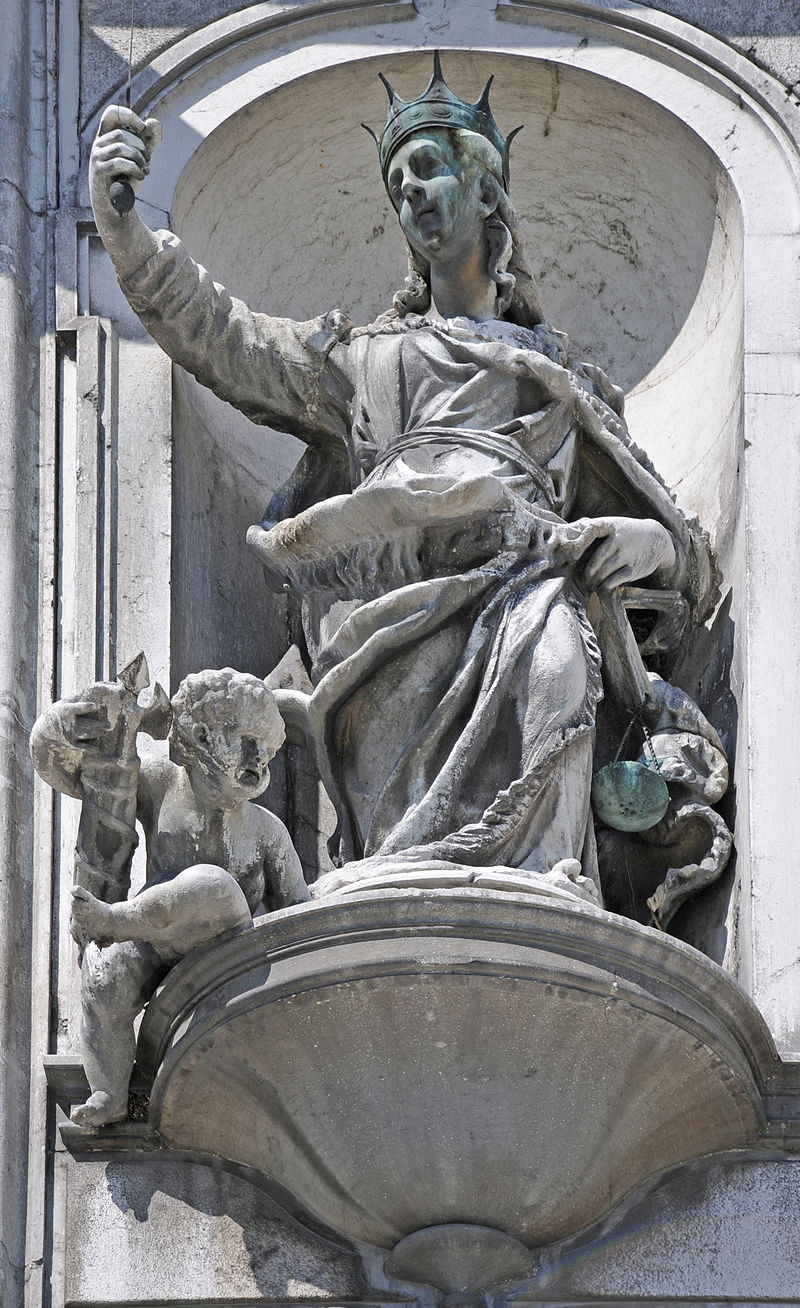
Church of Santa Maria del Rosario (Gesuati) in Venice - 18th century baroque architecture


Church of Santa Maria del Rosario(Gesuati)

The Church of the Gesuati, the largest convent complex in XVIIIth century Venice, was built between 1726 and 1735 for the Dominican Order to replace the smaller church that still stands beside it, which had become too small to hold all the parishioners. The Dominican Order took over from the Jesuates (from whom the church took its name) in 1668, when the order was suppressed. Giorgio Massari was the architect who designed the church and the decorations in the interior, with the help of two great artists of the time: Giambattista Tiepolo and Gian Maria Morlaiter. The three definitively established their fame in the city thanks to the remarkable work they did on the church. There is a beautiful harmony to the interiors, with the striking ceiling frescoes by Giambattista Tiepolo, featuring three splendid frescoes representing “The Virgin Appearing to St. Dominic”, “The Institution of the Rosary” and “The Glory of St. Dominic”, surrounded by a number of monochrome medallions.
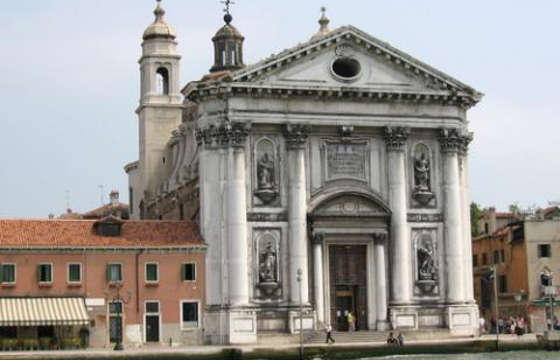
 

Gesuati (Wikipedia)

Santa Maria del Rosario (St. Mary of the Rosary), commonly known as I Gesuati, is an 18th-century Dominican church in the Sestiere of Dorsoduro, on the Giudecca canal in Venice, northern Italy. The classical style building has a well-lit interior and is exceptional in preserving its original layout and Rococo decoration intact. The church and almost all its sculpture and paintings were created within a thirty-year period: construction began in 1725, the church was consecrated in 1743, and the last sculptural decoration was in place by 1755.


Baroque (Wikipedia)

The Baroque is a style of architecture, music, dance, painting, sculpture, and other arts that flourished in Europe from the early 17th century until the 1740s.


baroque (Websters)

Baroque came to English from a French word meaning "irregularly shaped." At first, the word in French was used mostly to refer to pearls. Eventually, it came to describe an extravagant style of art characterized by curving lines, gilt, and gold.


.

Sunday, January 27, 2019

'Notre Dame To Cover Up Christopher Columbus Murals'

'Notre Dame To Cover Up Christopher Columbus Murals'

For Native Americans, the explorer’s impact was “nothing short of a catastrophe,” said John Jenkins, the university’s president.

Hayley Miller - Huffington Post - January 22, 2019

The University of Notre Dame will cover up a series of murals depicting Christopher Columbus amid backlash over the paintings’ stereotypical and inaccurate portrayal of Native Americans and their relationship with white European explorers, the school announced.

The 12 murals, painted by Luigi Gregori in the 1880s, adorn the entrance of the university’s Main Building, a busy throughway that houses administration offices and some classrooms, in South Bend, Indiana.

At the time of their creation, the paintings were intended to empower Catholic immigrants in America, but their message whitewashes the catastrophic impact European explorers had on native peoples, Notre Dame President John Jenkins wrote in a letter to members of the school’s community on Saturday.

con't....


************


Impact of the Spanish Empire still ignored

Christopher Columbus? Who was he? He was an agent of the Spanish Empire. His bosses were King Ferdinand and Queen Isabella. If someone is killed or injured by a defective automobile design, do they sue some foreman overseeing the assembly line?..... or do they sue the owners of the company? This remains the fifty ton pink elephant in the living room that is never spoken about regarding this "issue" by the managed mainstream news. These "issues" are virtually always decided upon by people in high places and/or of great wealth who have organized and financed this Neo-Liberal agenda. Neo-Liberalism has little to do with what was once "the left," as they have embraced some of the most shocking far right wing financial, economic, and military movements for an entire generation now.

In another great irony, from the standpoint of the University of Notre Dame, Columbus was also concurrently a proxy representative of the Vatican. So using their own logic, maybe they should cover up all religious symbols? Why not cover up any Roman symbols or architecture since the Roman Empire invaded and dominated many people? How about just cover up the American flag? The Catholic imperial nations---Spain, Portugal, and France---were in league with the Catholic Church as they invaded the New World and massively partook in the Trans-Atlantic slave trade. What ever happened to the saying "don't throw stones if you live in a glass house"..??

Queen Isabella was no mere figurehead following the lead of the King. She was directly involved in the Spanish Inquisition; you know... "kicking the Muslims and Jews out've Spain." Lets face it, Notre Dame is a representative of the Catholic Church in America, therefore---using their own logic---are culpable for, for example, the rarely-discussed bloody genocide in Croatia in the middle of the last century where tens of thousands of people were outright murdered because "they happened to not be Catholic." Why can't all of us just sit down and take total inventory of all movements of genocidal and forced servitude in human history?; because there wouldn't be enough bags to cover everyone's heads... with the exception of the Tibetans I suppose.

Name virtually any race, ethnicity, religion or culture.. and I'll show you something in their history that is totally indefensible.... even ones who may be labeled as victims by this agenda. Notre Dame wants to erase history, but is stone silent about two thousand years of Catholic imperial aggression. This isn't my issue... they're the ones who've now entered the arena of historical blame, guilt, and punishment! The Bible says that homosexuality is---to say the least---very bad. Okay, using their own logic, maybe it's time to ban the Bible from the Notre Dame campus? It's clearly a homophobic book and obviously must offend many of the students, right?? There certainly must be more homosexuals among the student body than there are Native Americans. Why not cover up the Virgin Mary... as it may offend the Muslim students. The great old American double-standard is alive and well.

P.S. - I have some very serious doubts that Notre Dame President John Jenkins sympathizes with the Catholic immigrants of that time period. I guess him being a Catholic official, gives him the right to discriminate against Irish, Italian, and Slavic Catholics.

What did the guy who lost his job say? He said "I didn't really lose my job. Some other guy has it now."


Notre Dame to cover up murals of Columbus in New World

NoLinkNewsChannel


.

Wednesday, February 11, 2015

'Anthony: Warrior of God' (2006) - full movie with subtitles


From lamisfh YouTube channel

St. Anthony was a great Saint. He was a follower of St. Francis of Assisi. Almost as great as St. Francis of Assisi. His words made people think and follow as example of life. His faith in God was Great.
--Bruna B, //youTube user

.

Thursday, August 14, 2014

'St Matthew Passion'


Hungarian Festival Choir - Hungarian State Symphony Orchestra - conducted by Géza Oberfrank

St Matthew Passion

The St Matthew Passion (also frequently St Matthew's Passion; German: Matthäus-Passion), BWV 244 is a sacred oratorio from the Passions written by Johann Sebastian Bach in 1727 for solo voices, double choir and double orchestra, with libretto by Picander (Christian Friedrich Henrici). It sets chapters 26 and 27 of the Gospel of Matthew (in the German translation of Martin Luther) to music, with interspersed chorales and arias. It is widely regarded as one of the masterpieces of classical sacred music. The original Latin title Passio Domini Nostri J.C. Secundum Evangelistam Matthaeum translates to "The Passion of our Lord Jesus Christ according to the Evangelist Matthew."

Although Bach wrote four (or five) settings of the Passions only two have survived; the other is the St John Passion. The St Matthew Passion was probably first performed on Good Friday (11 April) 1727 in the Thomaskirche in Leipzig, where Bach was the Kantor of the School and Directoris Chori musici of Leipzig. He revised it by 1736, performing it again on 30 March 1736, this time including two organs in the instrumentation. He further revised and performed it again on 23 March 1742. Possibly due to the second organ being under repair, he switched the continuo instrument to harpsichord in Chorus II, reinforced the continuo group in Chorus II with a viola da gamba, and inserted a ripieno soprano in both movements 1 and 29. There is evidence of a further revision in 1743–1746, when the score as it is known originated, but no performance.


.