Showing posts with label cheese. Show all posts

Monday, July 12, 2021

Italian Cheese Board: Four famous northern cheeses

Italian Cheese Board (Safeway)

Last week I purchased an item at the supermarket chain Safeway called 'Italian Cheese Board'. Not that it was particularly fancy, but they were very tasty cheeses; four little stacks of northern cheeses which are well known in America, stacked on top of a hard waxed cardboard backing. There are other cheeses a bit off the beaten path of course, but I thought it significant that these four are so well-known worldwide. Of course Parmesan--originating from Emilia and Lombardia--would be the equivalent to Swiss, feta, gouda, muenster, cheddar, etc. Aged and in slices, it was very adequate in this product. Officially, the name is Parmigiano-Reggiano cheese.

Aged and delicious Asiago cheese has increased much in popularity in recent years, and is similar to Parmesan, but it also seems to be a bit like aged gouda. It originates in Veneto and Trentino, and is very adequate in this product. Provolone cheese should be well-known to any cheese lover, and originates in the Po Basin of Lombardia and Veneto. It's somewhat like white American cheese, but is also a bit like Helvetica cheese from Switzerland. Now "provolone valpadana" is not the same as "provolone del Monaco" originating from the Naples area.

Fontina cheese, which originates in the Aosta Valley, is similar to Swiss cheese. In the Alps or Apennine Mountains, some cheese is traditionally stored for six months or so in a cave for aging. Although well packaged, the damp conditions are perfect. Some of these caves are fancy, but many are just small rural caves where individuals or families can age home made cheese. In Lombardia I saw the name for these caves once from a book I have, but I couldn't locate it; I want to say a "cave grotto," but I think it was another word that starts with a "g." It showed a small cave with a heavy old fashioned door. This method goes back many centuries. In more urban settings, cheese is stored in deep cellars to age, although I think the cave method seems to be more effective for the best results. The dampness is probably the key. There are also special wooden boxes constructed for aging cheese, some very small for a family home.


Fontina cheese aging in a damp Alpine cave

Top 20 Most Popular Italian Cheeses

A Trip to a Cheese Cave, Arona, Piedmont, Italy

Valentine Warner visits the Fontina Cheese Caves, Aosta Valley, Italy

.

Tuesday, March 8, 2011

Grana Padano

Recently I was shopping at Trader's Joe's and I saw a product called "Grana Padano Parmesan." One of the things that I thought was important is the use of the word "Padano" ("Padanian" or "Padan" in English), which can be loosely translated to "of the Po River Valley." There are those who would even deny that much as far as the legitimacy of the word. On top of that, this cheese product is tied into our culture. It should be noted that the product name "Grana Padano Parmesan" was used to sell a product, and is not really accurate. Grana Padano is a little different than Parmesan cheese (Parmigiano Reggiano), although both are similar.

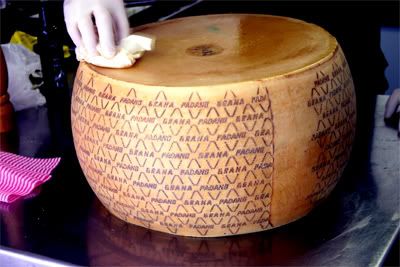
[Right: A Grana Padano wheel]


From Grana Padano Wikipedia page

Grana Padano is one of the most popular Denominazione di Origine Controllata cheeses of Italy. The name comes from the noun grana (‘grain’), which refers to the distinctively grainy texture of the cheese, and the adjective Padano, which refers to the valley Pianura Padana.

Grana Padano is one of the world's first hard cheeses, created nearly 1,000 years ago by the Cistercian monks of Chiaravalle Abbey, founded in 1135 near Milan, who used ripened cheese as a way of preserving surplus milk. By the year 1477, it was regarded as one of the most famous cheeses of Italy. It can last a long time without spoiling, sometimes aging up to two years. It is made in a similar way to the Parmigiano Reggiano of Emilia-Romagna but over a much wider area and with different regulations and controls. Other Grana cheeses are also made in Lombardy, Piedmont, Trentino, and Veneto.

Like Parmigiano Reggiano, Grana Padano is a semi-fat hard cheese which is cooked and ripened slowly (for at least 9 months, then, if it passes the quality tests, it will be fire-branded with the Grana padano trademark). The cows are milked twice a day, the milk is left to stand, and then partially creamed. Milk produced in the evening is skimmed to remove the surface layer of cream and mixed with fresh milk produced in the morning. The partly skimmed milk is transferred into copper kettles and coagulated; the resulting curd is cut to produce granules with the size of rice grains, which gives the cheese its characteristic texture, and then cooked to 53-56°C. It is produced year-round and the quality can vary seasonally as well as by year. Though similar to Parmiggiano Reggiano cheese, the younger Grana Padano cheeses are less crumbly, milder and less complex in flavor than their more famous longer-aged relative. Grana Padano is widely considered inferior in quality than Parmigiano-Reggiano. Nevertheless many Italians prefer Grana Padano over Parmigiano-Reggiano mainly for the lower price.

A wheel of Grana Padano is cylindrical, with slightly convex or almost straight sides and flat faces. It measures 35 to 45 cm in diameter, and 15 to 18 cm in height. It weighs 24 to 40 kg (53 to 88 lbs) per wheel. The rind, which is thin, is white or straw yellow.

Grana Padano is sold in three different ripening stages:

* "Grana Padano" (9 to 16 months): texture still creamy, only slightly grainy.
* "Grana Padano oltre 16 mesi" (over 16 months): crumblier texture, more pronounced taste.
* "Grana Padano Riserva" (over 20 months): grainy, crumbly and full flavoured.
.