Showing posts with label cooking. Show all posts

Monday, July 12, 2021

Italian Cheese Board: Four famous northern cheeses

Italian Cheese Board (Safeway)

Last week I purchased an item at the supermarket chain Safeway called 'Italian Cheese Board'. Not that it was particularly fancy, but they were very tasty cheeses; four little stacks of northern cheeses which are well known in America, stacked on top of a hard waxed cardboard backing. There are other cheeses a bit off the beaten path of course, but I thought it significant that these four are so well-known worldwide. Of course Parmesan--originating from Emilia and Lombardia--would be the equivalent to Swiss, feta, gouda, muenster, cheddar, etc. Aged and in slices, it was very adequate in this product. Officially, the name is Parmigiano-Reggiano cheese.

Aged and delicious Asiago cheese has increased much in popularity in recent years, and is similar to Parmesan, but it also seems to be a bit like aged gouda. It originates in Veneto and Trentino, and is very adequate in this product. Provolone cheese should be well-known to any cheese lover, and originates in the Po Basin of Lombardia and Veneto. It's somewhat like white American cheese, but is also a bit like Helvetica cheese from Switzerland. Now "provolone valpadana" is not the same as "provolone del Monaco" originating from the Naples area.

Fontina cheese, which originates in the Aosta Valley, is similar to Swiss cheese. In the Alps or Apennine Mountains, some cheese is traditionally stored for six months or so in a cave for aging. Although well packaged, the damp conditions are perfect. Some of these caves are fancy, but many are just small rural caves where individuals or families can age home made cheese. In Lombardia I saw the name for these caves once from a book I have, but I couldn't locate it; I want to say a "cave grotto," but I think it was another word that starts with a "g." It showed a small cave with a heavy old fashioned door. This method goes back many centuries. In more urban settings, cheese is stored in deep cellars to age, although I think the cave method seems to be more effective for the best results. The dampness is probably the key. There are also special wooden boxes constructed for aging cheese, some very small for a family home.


Fontina cheese aging in a damp Alpine cave

Top 20 Most Popular Italian Cheeses

A Trip to a Cheese Cave, Arona, Piedmont, Italy

Valentine Warner visits the Fontina Cheese Caves, Aosta Valley, Italy

.

Thursday, June 23, 2016

Cooking Lentil Bolognese


Cooking Lentil Bolognese
 

Wholesome Day
 

Cooking a Lentil Bolognese from the Deliciously Ella book by Ella Woodward.

.

Tuesday, October 18, 2011

Pasta Is Not Originally from Italy

Pasta Is Not Originally from Italy

By Julia - MisconceptionJunction.com - June 3, 2011

Myth: Pasta originally comes from Italy.

Worldwide, pasta has become synonymous with Italian cuisine. Italian immigrants themselves brought pasta everywhere they went. While it is true that the most famous varieties and recipes of cooking pasta really do come from Italy, surprisingly, the actual origin of pasta lies elsewhere!

So how did pasta make its way to Italy? One of the more popular theories was published in the ‘Macaroni Journal’ by the Association of Food Industries. It states that pasta was brought to Italy by Marco Polo via China.  Polo ventured to China in the time of the Yuan Dynasty (1271-1368) and the Chinese had been consuming noodles as early as 3000 B.C. in the Qinghai province. There is even some evidence there of 4,000-year-old noodles made from foxtail and broomcorn millet.

Unfortunately, there are problems with this theory, least of which is that the noodles they were making in China aren’t technically considered pasta.  Polo also described Chinese noodles as being like “lagana”, which implies he was possibly already familiar with a pasta-like food before going to China.  Further, in 1279, there was a Genoese soldier that listed in the inventory of his estate a basket of dried pasta.  Polo didn’t come back from China until 1295.  For those who don’t know, Genoa is a sea port in Italy.  Further, the modern pasta like we know it was first described in 1154 by an Arab geographer, Idrisi, as being common in Sicily. So Marco Polo could not have brought pasta to Italy via China.  It was already in Italy at that time.

So how did it get there?  Most food historians believe that Arabs (specifically from Libya) are to be credited for bringing pasta, along with spinach, eggplant and sugar cane, to the Mediterranean basin. In the Talmud, written in Aramaic in the 5th century AD, there is a reference to pasta being cooked by boiling. It is thought, then, that pasta was introduced to Italy during the Arab conquests of Sicily in the 9th century AD, which had the interesting side effect of drastically influencing the region’s cuisine. It also known that by the 12th century, the Italians had learned from the Arabs methods for drying pasta to preserve it while traveling. Further support for this theory can be found by the fact that, in many old Sicilian pasta recipes, there are Arab gastronomic introductions.

Bonus Factoids:

An alternative theory that has fallen out of favor is that pasta came to Italy via Greece, given that the origins of the name “pasta” seems to be Greek.  The word ‘pasta’ itself comes from the Latin ‘pasta’ meaning ‘dough, pastry cake’ which probably came from the Greek word ‘pastos’ – ‘sprinkled with salt’, ‘salted’. Also, in ancient Greek mythology, there is a tale about the god Vulcan pushing dough through a device that converts it into thin, edible threads.

The first documented case of a ‘macaroni’ machine being brought to the U.S. is believed to have been brought by Thomas Jefferson in 1789 when he came back to the U.S. after serving as an ambassador to France. Later, Jefferson also invented his own pasta machine.

Dried pasta is shaped in a variety of ways to fit various types of sauces. Thin and long pasta suits oily, more liquid sauces, and more complicated shapes are better for thicker, chunkier sauces.

The modern word ‘macaroni’ derives from the Sicilian term for making dough forcefully. At that time, pasta dough was often kneaded with the feet for a significant amount of time.

Italian pasta enthusiasts organized a World Pasta Conference in 1995, they celebrate Word Pasta Day every year in October, since 1998.  There is also an Italian Pasta Association and a Pasta Museum in Rome.

Pasta is a term for foods made from an unleavened dough of wheat or buckwheat flour and water. There are two main groups of pasta – fresh and dried. Dry pasta is typically made from durum wheat flour or durum wheat semolina which has high levels of gluten, which gives it the yellow color and also makes the dough easier to work with.

The first industrial pasta factory in the US was built in Brooklyn in 1848 by a Frenchman.

Sources:

History of pasta

Pasta recipes

National Pasta Association

Did Marco Polo bring pasta from China?

History and Origin of Pasta

.

Wednesday, December 22, 2010

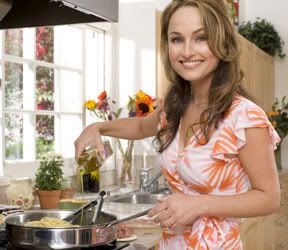
Giada De Laurentiis

From Wikipedia -- Giada Pamela De Laurentiis: Born August 22, 1970) is an Italian American chef, writer, television personality, and the host of the current Food Network program Giada at Home. She also appears regularly as a contributor and guest co-host on NBC's Today. De Laurentiis is the founder of the catering business GDL Foods.

You probably have at least seen Giada De Laurentiis, if you have cable tv, probably on the Food Network. Also on many other media and commericial endeavors. Her biography is very interesting, and you can read the rest of it on the above link. She is the granddaughter of the famous Italian film producer Dino De Laurentiis, and has other famous people in her family tree. Since we consider most of Latium and the South Tyrol as being sort've "honorary Padanians," we would consider her as our folk. Although she has some Neapolitan roots (De Laurentiis). It's also interesting that she was born in Rome and grew up in Southern California.

She cooks and gives instruction on her program, 'Giada at Home', with such enthusiasm that someone created one of those virtue posters for her. It's not a bubbly enthusiasm as much as it's a manifestation of super-positive energy. She has reached a point where she is a "celebrity," close to famous.

.