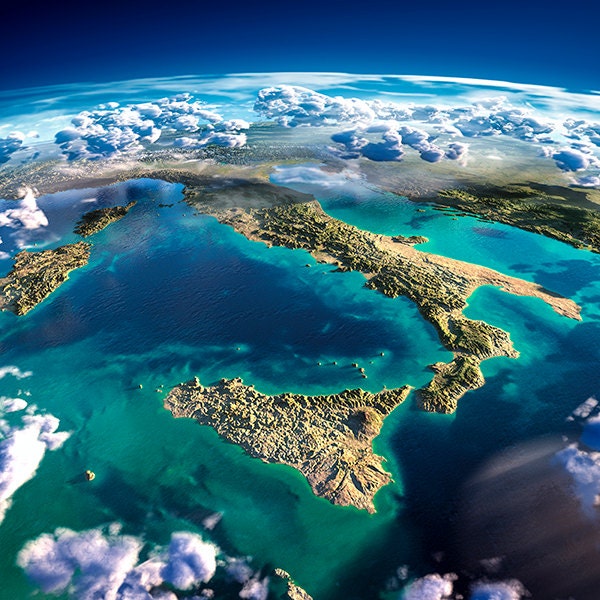
Featuring Sicily in the middle, Malta at the bottom, the boot, Sardinia, Corsica, the cloud covered Alps, and the Balkans. It almost looks as if you could put your hand in the cool pond water, or poke your hand in the grass, or reach out and feel the cold air above the Alps. Also, the larger landmass can be seen under the sea. It also looks like a view from the top of a mountain from a much smaller scale. Amazing photograph. .
Summer Solstice http://en.wikipedia.org/wiki/Summer_solstice The
summer solstice occurs when the tilt of a planet's semi-axis, in either
the northern or the southern hemisphere, is most inclined toward the
star (sun) that it orbits. Earth's maximum axial tilt toward the sun is
23° 26'. This happens twice each year, at which times the sun reaches
its highest position in the sky as seen from the north or the south
pole.
Midsummer http://en.wikipedia.org/wiki/Midsummer Midsummer
is the period of time centered upon the summer solstice, and more
specifically the European celebrations that accompany the actual
solstice or take place on a day between June 21 and June 25 and the
preceding evening. The exact dates vary between different cultures.
Diana (mythology) http://en.wikipedia.org/wiki/Diana_%28mythology%29 In
Roman mythology, Diana (lt. "heavenly" or "divine") was the goddess of
the hunt, the moon and birthing, being associated with wild animals and
woodland, and having the power to talk to and control animals. She was
equated with the Greek goddess Artemis, though she had an independent
origin in Italy. Diana was worshipped in ancient Roman religion and is
revered in Roman Neopaganism and Stregheria. Dianic Wicca, a largely
feminist form of the practice, is named for her. Diana was known to be
the virgin goddess of childbirth and women. She was one of the three
maiden goddesses, Diana, Minerva and Vesta, who swore never to marry. Oak
groves were especially sacred to her. According to mythology, Diana was
born with her twin brother Apollo on the island of Delos, daughter of
Jupiter and Latona. Diana made up a triad with two other Roman deities:
Egeria the water nymph, her servant and assistant midwife; and Virbius,
the woodland god.
Janus http://en.wikipedia.org/wiki/Janus In
ancient Roman religion and myth, Janus (Latin: Ianus) is the god of
beginnings and transitions, thence also of gates, doors, passages,
endings and time. He is usually depicted as having two faces, since he
looks to the future and to the past. The Romans named the month of
January (Ianuarius) in his honor.
Note The stag or horned
solar god, as well as the moon goddess, go clear back into the ancient
world to proto-European peoples. Later manifestations (Etruscan, Greek,
Roman, Norse, Celtic/Gaulish, Slavic, etc.) all merged, co-opted, or
co-existed with this earlier culture.
[Music: Song #1: 'Ready to Fly' by Verman Williams; Song #2: Unknown] .
Celtic polytheism, sometimes known as Celtic paganism, refers to the religious beliefs and practices of the ancient Celtic peoples of Western Europe prior to Christianization.
Celtic polytheism was animistic, believing in spirits existing in natural objects such as trees and rocks. Religious beliefs and practices of the Celts varied throughout the different Celtic lands, which included Ireland, Britain, Celtiberia, Gaul, areas along the Danube river, and Galatia; however there were commonalities shared by all.
Celtic mythology is the mythology of Celtic polytheism, apparently the religion of the Iron Age Celts. Like other Iron Age Europeans, the early Celts maintained a polytheistic mythology and religious structure.
Among Celts in close contact with Ancient Rome, such as the Gauls and Celtiberians, their mythology did not survive the Roman empire, their subsequent conversion to Christianity, and the loss of their Celtic languages.
[Music: 'Celtic Requiem Chant' by Elliot Simons; different than the 'Celtic Requiem']