
Lammas is a Neo-Pagan holiday, often called Lughnasadh, celebrating the first harvest and the reaping of grain. It is a cross-quarter holiday halfway between the Summer Solstice (Litha) and the Autumnal Equinox (Mabon). In the northern hemisphere, Lammas takes place around August 1 with the Sun near the midpoint of Leo in the tropical zodiac, while in the southern hemisphere Lammas is celebrated around February 1 with the Sun near the midpoint of Aquarius. On the Wheel of the Year, it is opposite Imbolc, which is celebrated on February 2nd in the northern hemisphere, and late July / early August in the southern hemisphere.
Lammas
http://en.wikipedia.org/wiki/Lammas
Lughnasadh
http://en.wikipedia.org/wiki/Lughnasadh
Harvest Festival
http://en.wikipedia.org/wiki/Harvest_festival
Celtic calendar
http://en.wikipedia.org/wiki/Celtic_calendar
Wheel of the Year
http://en.wikipedia.org/wiki/Wheel_of_the_year
*The footage shown is from the 2006 American remake of 'The Wicker Man' :
Wikipedia
http://en.wikipedia.org/wiki/The_Wicker_Man_(2006_film)
Internet Movie Database
http://www.imdb.com/title/tt0450345/
Amazon.com
http://www.amazon.com/Wicker-Man-Widescreen-Unrated-Rated/dp/B000JYW5DW/ref=sr_1_2?ie=UTF8&s=dvd&qid=1279558795&sr=1-2
[Music: Unknown]

Monday, July 19, 2010
Gallia Cisalpina VI: Gaulish Bread Harvest


Tuesday, February 9, 2010
Gallia Cisalpina V: Celto-Alpine Spirit
Celtic polytheism, sometimes known as Celtic paganism, refers to the religious beliefs and practices of the ancient Celtic peoples of Western Europe prior to Christianization.
Celtic polytheism was animistic, believing in spirits existing in natural objects such as trees and rocks. Religious beliefs and practices of the Celts varied throughout the different Celtic lands, which included Ireland, Britain, Celtiberia, Gaul, areas along the Danube river, and Galatia; however there were commonalities shared by all.
Celtic mythology is the mythology of Celtic polytheism, apparently the religion of the Iron Age Celts. Like other Iron Age Europeans, the early Celts maintained a polytheistic mythology and religious structure.
Among Celts in close contact with Ancient Rome, such as the Gauls and Celtiberians, their mythology did not survive the Roman empire, their subsequent conversion to Christianity, and the loss of their Celtic languages.
[Music: 'Celtic Requiem Chant' by Elliot Simons; different than the 'Celtic Requiem']
Wednesday, November 18, 2009
Gallia Cisalpina IV: Gaulish Harvest Festival of Samonios
Gallia Cisalpina IV: Gaulish Harvest Festival of Samonios
SamhainThe Gaulish calendar appears to have divided the year into two halves: the "dark" half, beginning with the month Samonios (the October/November lunation), and the "light" half, beginning with the month Giamonios (the April/May lunation). The entire year may have been considered as beginning with the "dark" half, so that the beginning of Samonios may be considered the Celtic New Year's day. The celebration of New Year itself may have taken place during the "three nights of Samonios" (Gaulish trinux[tion] samo[nii]), the beginning of the lunar cycle which fell nearest to the midpoint between the autumnal equinox and the winter solstice.
The lunations marking the middle of each half-year may also have been marked by specific festivals. The Coligny calendar marks the mid-summer moon (see Lughnasadh), but omits the mid-winter one (see Imbolc). The seasons are not oriented at the solar year, viz. solstice and equinox, so the mid-summer festival would fall considerably later than summer solstice, around 1 August (Lughnasadh). It appears that the calendar was designed to align the lunations with the agricultural cycle of vegetation, and that the exact astrological position of the Sun at that time was considered less important.
[Music: 'Loreley' by Blackmore's Night]
Monday, July 6, 2009
Gallia Cisalpina III: Celto-Ligurian Culture
Gallia Cisalpina III: Celto-Ligurian Culture
All of the tribes of Cisalpine Gaul are sometimes referred to as part of the "Celto-Ligurian" culture. Although some may be "Celto-Venetic" or other regional variations.
The Ligures (singular Ligus or Ligur; English: Ligurians, Greek: Λίγυες) were an ancient people who gave their name to Liguria, which once stretched from Northern Italy into southern Gaul. According to Plutarch they called themselves Ambrones which means ¨people of the water¨. The Ligures inhabited what now corresponds to Liguria, northern Tuscany, Austria (Noricum), Piedmont, part of Emilia-Romagna, part of Lombardy, and parts of southeastern France.
Classical references and toponomastics suggest that the Ligurian sphere once extended further into central Italy (Taurisci): according to Hesiod's Catalogues (early 6th century BC) they were one of the three main "barbarian" peoples ruling over the Western border of the known world (the others being Aethiopians and Scythians). Avienus, in a translation of a voyage account probably from Marseille (4th century BC) speaks of the Ligurian hegemony extending up to the North Sea, before they were pushed back by the Celts. Ligurian toponyms have been found in Sicily, the Rhône valley, Corsica and Sardinia.
It is not known for certain whether they were a pre-Indo-European people akin to Iberians; a separate Indo-European branch with Italic and Celtic affinities; or even a branch of the Celts or Italics. Kinship between the Ligures and Lepontii has also been proposed. Another theory traces their origin to Betica (modern Andalusia) and southern Lusitania (modern Algarve and Alentejo).
The Ligures were assimilated by the Romans, and before that by the Gauls, producing a Celto-Ligurian culture.
Wednesday, July 1, 2009
Gallia Cisalpina II: Pagan Celtic Nation
Gallia Cisalpina II: Pagan Celtic Nation
In memory of the earth-based and gender-equal pagan culture of the Celto-Ligurian tribes in the southern Alpine and Po river valley region called Gallia Cisalpina (Cisalpine Gaul; "Gaul south of the Alps") by the Romans who eventually destroyed their world, took their land, and subjugated them under the Roman Empire.
Monday, June 15, 2009
Gallia Cisalpina: A Celtic Nation
Gallia Cisalpina: A Celtic Nation
Our second video
The Trophy of the Alps or Trophy of Augustus was built by the Roman emperor Augustus to celebrate his definitive victory over the ancient Celto-Ligurian tribes who populated the region and who had harassed merchants along Roman roads. Its remains may be seen in the Commune of La Turbie (Alpes-Maritimes), on the Grande Corniche, 6 km from Monaco.
Monday, June 1, 2009
The PAL and the Religious Construct
 To me, this is a non-issue. However, just for the record, the PAL recognizes, within reason and practicality, any faith which is historically linked to the former nations of Northern Italy. This would include Catholic, Waldensian Protestant, Etruscan paganism, Celtic Druidism and Witchcraft, Germanic paganism (Odinism, Asatru, Wotanism), Atheism, Agnostic, etc. They all represent our history going back literally tens of thousands of years. The Padanian-American League is a folk-based association, not a religious or political construct.
The religious construct is rarely a folk-based one, unless it has elements of ancestor worship, like Shintoism and others. One exception is the Greek Orthodox Church, which is basically Greek-only. Apparently it's a sub-branch of Orthodox Christianity, therefore Orthodox Eastern Europeans may attend a Greek Orthodox Church.
Comunità Odinista (Odinist Community) is an Odinist group specifically for those of Northern Italian descent, which traces it's Odinist roots back to the Langobards. The group is active in Northern Italy and Argentina. The PAL has had contact with "CO America" in Argentina. We can cover more about this group later.
 The idea of Padanian-based faiths has crossed my mind, but it would be somewhat divisive at the end of the day. For example, Cattolica Padana (Padanian Catholic), Wotanismo Langobarda (Lombard Wotanism), Disciplina Etrusca (Etruscan Discipline), Wicca Camuna (Camunian Wicca) or Druidismo Celtica (Celtic Druidism), Cristianesimo Valdese (Waldensian Christian), Rito Ambrosiano or Rito Milanese (Ambrosian [Catholic] Rite or Milanese [Catholic] Rite), etc., etc. All of these religious constructs, which were regionalized by historically Northern Italian peoples at one time or another, would be best left up to the individual in the modern world. As far as studies and ceremonies, that is different, and it should be encouraged.
If nothing else, we should honor our history and heritage, even if we may disagree with particular events and movements. For example, the Crusades. I know that there are those would would see the Crusades as a glorious movement, and those who do not. I don't think that we can ignore the fact that most of our folk are Catholic. Have been for centuries. Therefore, it remains, by default, at the top of the list, where it will remain. However, any practitioner of any historically factual religion or faith from any of the former nations of Northern Italy, Catholic, Atheist, or Pagan alike, should be equally welcome in the PAL. In other words, those theologies, traditions, and trains of thought will be the ones which will guide us.
[Retraction: We will no longer use the term "Wicca" in reference to specifically
our own links to the Cernic tradition, and will use the term 'Witchcraft" only in reference as it may pertain to how people may perceive certain traditions. This does not mean that some dialog will not take place to rectify disagreements in certain areas.]
Friday, May 8, 2009
Wotan, Mead, the Irminsul, the Nine Noble Virtues, and other pagan loose ends
 There are a few more areas to cover, which I will tie into one entry. I am a believer that a person can view so-called "paganism" as: 1) a religion, 2) a history, 3) a look into the spirituality and soul of a people, and 4) as a set of principles to be adhered to (if they wish). One need not actually "join" a religious and/or spiritual tradition, in order to adhere to it. To make it's values and principles a part of their own conscience.
For example, the 'Nine Noble Virtues'.
Odinic Rite:
1. Courage
2. Truth
3. Honour
4. Fidelity
5. Discipline
6. Hospitality
7. Self Reliance
8. Industriousness
9. Perseverance
Asatru Folk Assembly:
1. Strength is better than weakness
2. Courage is better than cowardice
3. Joy is better than guilt
4. Honour is better than dishonour
5. Freedom is better than slavery
6. Kinship is better than alienation
7. Realism is better than dogmatism
8. Vigor is better than lifelessness
9. Ancestry is better than universalism
 Like the 'Ten Commandments' in Christianity, these principles and many other, much deeper, aspects of Odinism (or Asatru) can be admired and studied. I am aware that the Nine Noble Virtues are guidelines and not "thou shalt nots," and they have no concept of "hell," etc., but my real point is that we can look into any faith and adopt some principles from them. I recently viewed an episode on the History Channel program 'Warriors' with Terry Schappert. It was about the Zulu tribe, and they had a special ceremonial tradition after a battle, in which a warrior is purified in order to go back into society. I thought it was in interesting spiritual concept.
The "Viking Era" was a very small part of the history of what we call Odinism or Asatru. Actually, our ancient Lombard ancestors called what was basically the chief god, usually called Odin, the god of war, as Wotan or Wodan. They were Wotanists or Wodanists, and I mean this was many, many centuries ago. The 'Nine Noble Virtues' was taken from one of the Norse Sagas I believe, and the first one, from the Odinic Rite, was the original.
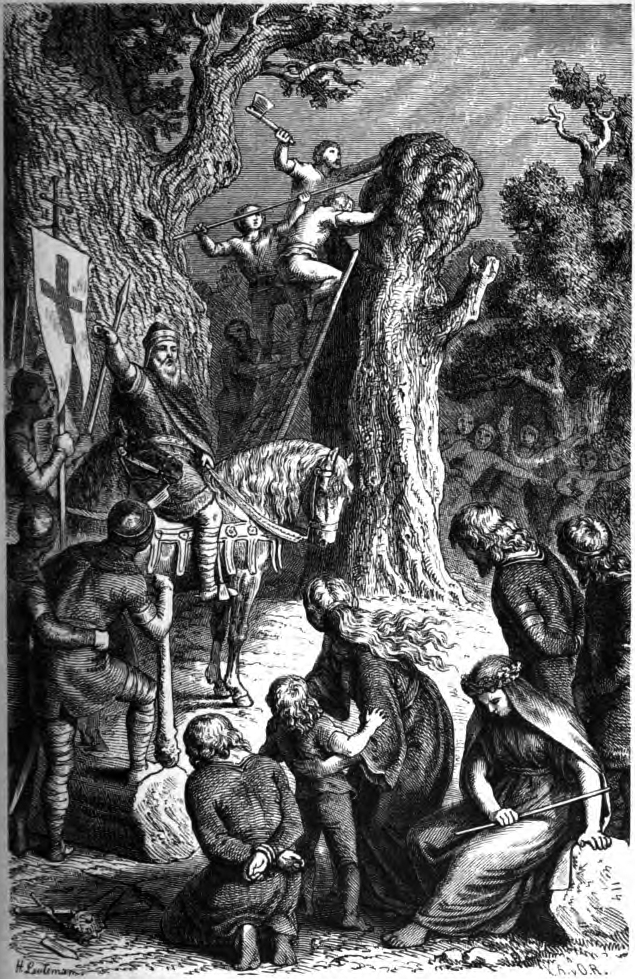
I would also like to at least mention the "Irminsul" (see image to the right), which was a large carved wooden pillar, which was a very important part of this spirituality. I don't think that it was intrinsically worshipped, but may have been a manner to get in touch with all of the gods. Perhaps someone could clue us in there. It appears that the old Germanic tribes often just used a carved tree trunk for this purpose as well. When the Romans, and later powers, finally mobilized themselves to spread Christianity, lets face it, they often did it via force. The following painting was composed by German painter Heinrich Leutemann in 1882, and was entitled 'The destruction of Irminsul through Charlemagne'. It depicts Wotanists literally being forced to accept Christianity as their Irminsul is demolished.
Did you know that names from the days of the week, which we use every day, are from Norse/Germanic spirituality or gods?
Sunday -- "Sun's Day"
Monday -- "Moon's Day"
Tuesday -- "Tiu's Day"
Wednesday -- "Wodan's Day"
Thursday -- "Thor's Day"
Friday -- "Freya's Day"
Saturday -- "Saturn's Day"
Wodan, Wotan, or Woden, may have originally come from the worship of the Greek god Mercury. It's hard sometimes to substantiate some of these things due to various cultures wanting to maintain the purity or originality of their history. I suppose that if this was true, that it was probably due to influence from the Romans, or possibly the Etruscans. I don't really know.
Mead (from description at Wikipedia): "Mead is a typically alcoholic beverage, made from honey and water via fermentation with yeast. Its alcoholic content may range from that of a mild ale to that of a strong wine. It may be still, carbonated, or sparkling. It may be dry, semi-sweet, or sweet.
"Depending on local traditions and specific recipes, it may be brewed with spices, fruits, or grain mash. It may be produced by fermentation of honey with grain mash; mead may also, like beer, be flavored with hops to produce a bitter, beer-like flavor."
What is amazing is that Mead is so hard to find! It was such a part of our ancestors lives, yet it's difficult to find in the market. I don't think that it would be very difficult to make. It can be purchased online pretty easily. Try Yahoo Shopping. Check the Wikipedia link, as there is much more than we have time to research and cover right now. YouTube has videos on how to make Mead as well.
There is an interesting FAQ, from the Wisconsin Vinland Association, called 'An FAQ: Asatru, Wicca, and paganism', which is quite interesting. However, it's pretty apparent that they are a "Universalist" group, meaning that they have a belief that the traditions of their ancestors belong to all other cultures of the earth just as much as it belongs to them. It's probably a split down the middle as far as pagans of European traditions, between those who are Universalist or Folkish. Folkish means that one's heritage is inherently "theirs," and not belonging to every other culture in the world.
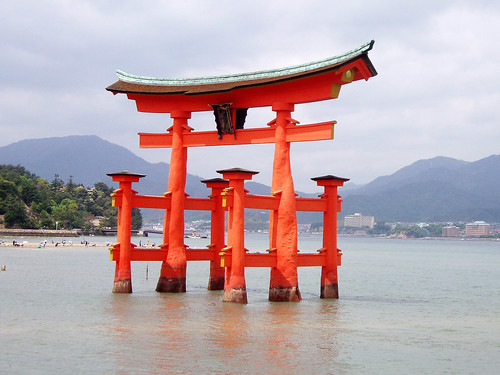 I believe that a European descended person should feel free to study, for example, Shintoism. They may study it, admire it, and even adhere to it; but they can never become a Shintoist because they're not Japanese. It would be extremely disrespectful and dishonorable to try to do this. In the same way, a Japanese person could study and admire Asatru, without trying to co-opt it. Many White Americans flock to Hawaii and force themselves on the native Hawaiian religion, which has caused some of the local Hawaiians to get pretty angry. Again, study, admire, and even adhere to anything, but I believe that it's important for every human being on earth to realize that not everything in the world belongs to YOU. The image above: a Shinto Shrine. Again, don't be afraid to go to YouTube and look up all of these subjects. Many people have downloaded some amazing videos.
 I know, this entry has bounced all over the place. I would like to end with an article from the Odinic Rite, entitled 'Images of the Wolf in the Northern Psyche'. It's in PDF, and they don't want it reproduced anywhere without permission, so I will not post the text. It is about the wolf in ancient northern culture and folklore. Actually, much of this folklore survived up to a point in history later than we realize, in some instances. Many ancient Lombard names had a "wulf" ending to them, which comes directly from the reverence of the wolf. I should also mention that this article was written by Heimgest, the director of the Odinic Rite, and I will end this entry with links to four videos of a very interesting interview of him which was conducted.
Interview With a Gothi - Part 1
Interview With a Gothi - Part 2
Interview With a Gothi - Part 3
Interview With a Gothi - Part 4
Sunday, December 21, 2008
Thoughts on Odinism
One aspect of what could roughly called the world Langbardian/Padanian awakening is the religion of Odinism. Also the similar religion of Ásatrú, and other offshoots. Comunità Odinista (Odinist Community) is a religious organization, based in Northern Italy, which was formed in the early 90s I believe. There has been some revisionist research by university scholars that concludes that the larger percentage of Lombards were pagan rather than Arian Christians. We will post information about that later, not that it's especially important. However, the Lombards were relatively unaffected by Roman civilization. That would mean that they were basically Odinists. Also, likely were many of the Ostrogoths and other Germanic tribes who invaded the region. The Lombards were the only one which stayed permanently however.
In this posting, I will be bouncing all over the place, admittedly, but this subject has many trains of thought. I think that it's important sometimes to dive into a subject, rather than spend a long time to lay it out in a perfect sequence. The Odinic Rite is an organization which has taken Odinism and refined it to a point where it can be defined better and presented in a proactive manner. I think that they have done a good and honorable job, as has Comunità Odinista. Any criticisms that I may bring up has absolutely nothing to do with those two organizations or any of their offshoots.
When one looks at the Odinist/Ásatrú landscape today, there are a lot of problems. Pragmatic problems which are probably unsolvable. First off, any reputable Odinist group will adhere to the idea that Odinism is for anyone of European descent. As we have covered in earlier postings, the runestones were originally Etruscan in origin, passed onto the Germanic tribes via the trade routes. These tribes worshipped Greek and Roman gods, like Mercury. The Greeks, and mainly Romans, had colonized many parts of Northern Europe, and influenced them. Admittedly, the Romans often "conquered" their subject territories in wars of expansion. Not just administratively, but in terms of culture. For example, the deconstruction of the native pagan religions. In relation, the early Romans had destroyed their kindred Etruscan civilization. Almost like a nation eliminating it's own sovereignty to go global, or "empire."
Nordic/Germanic/Teutonic tribes conquered almost every part of Europe at one time or another, so Odinist faiths were practiced far and wide at different times. My point is that there is no real basis at all for Odinism being a Nordic-only faith. It also isn't universalist either. It's a native European religion, whose original origin was in Scandinavia. It's like Celtic heritage. No one culture can make a full claim to it, as the Celts spread far and wide. We still are learning about how they influenced many regions that we would never associate with Celts, like Turkey. Celts were living in Northern Italy and Spain long, long before they migrated to Ireland or Scotland.
Secondly, Odinism is not universalist. It's similar to Shintoism. Shintoism is NOT for non-Japanese. Thirdly, Odinism is NOT a political construct. It's a faith-based and folk-based construct. As the slogan goes: "Faith, Folk, Family." Now looking at this whole landscape, we see a strong breech of all of these innate surface realities. For example, there are many "universalist Odinists," probably coming via the new age movement, attracted by this particular religions' fondness for nature, but who have no respect for it's crystal clear folk-based beliefs. Also, the "opposame" (in this case, two anti-thesis camps) to that group is the "politically-minded Odinists." This group uses Odinism and it's symbology to make strong statements about racial issues, which affects the ability of everyone else to adhere to this faith. These two symbiotic camps are a big detriment to the religion, as both probably should not even be Odinists in the first place. There's even a smaller minority of people who believe that Odinism should only be for Scandinavian or Nordic people, even though some of these people look less so than I do. So in conclusion, even though a firm logic-based consensus has already been clearly established, there are these large problem areas.
Outside of that, most Odinists are great people who merely want to practice their folk-based faith. By no means am I making any statement specifically and intrinsically about Odinism, Ásatrú, or the vast majority of their practitioners. However, we're no outsiders here, as Odinism is part of our lineage. This isn't a "judgement," but just a realistic assessment of the present situation. I realize that I've probably stepped on a few toes here, but my intention was not to be negative. In fact, I have made no mention about any of the finite aspects of the faith.
Hopefully we can cover Odinism and the pagan beliefs of the Etruscans, or any faiths of the other historically Padanian peoples. Here I am, about to throw in another negative, but there are many non-Italian people who have taken what historians and archeologists have learned about Etruscan spirituality, and claimed it as their very own! Now this is OUR culture, so we need to take a good look at that. I'm not talking about the Etruscan Foundation, or any historical or archeological institutions, but only new age universalist interests. "New Age" is a politically-driven movement, and therefore shouldn't be any slander to any pagans out there.
Lastly, I would like to mention that Comunità Odinista has offshoots in Germany, Argentina, Australia, and "Vinland" (North America). The American branch is called "Comunità Odinista - Vinland." I'm not sure if it's currently active. I know that Italy and Argentina are very active. Comunità Odinista follows a type of Germanic idealism, while he Padanian-American League adheres to the idea that we are a greater Etruria; not "Roman" as the Romans demolished the Etruscan culture. The red odal rune on the flag of Langbard is of Etruscan origin, as the runic alphabet was originally from the Etruscans, so there are both Lombard and Etruscan components to the flag. What it boils down to is that the Lombards administratively united the land of Etruscan civilization. Lombard might, and Etruscan genius. I know I'm rambling on, but we should at least honor Odinism in a cultural sense. YouTube has many good Odinist and Ásatrú videos.
***************************************************************************
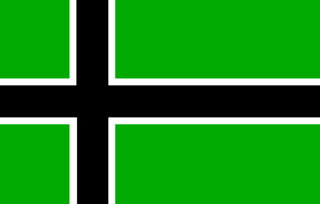 Note: Leif Erikson voyaged to North America centuries before Columbus, and established a Viking colony on the eastern seabord of Canada for a time. The name "Vinland" was coined as a name for this colony, and a Scandinavian-style flag was invented for it. However, the colony was real, and based in fact. There is even a Vinland park in Newfoundland that people can visit. I looked through a library book once, entitled 'The Vikings and America' I recall, which is a good source of information regarding this subject. Below, a statue of Erikson, which presents him as a titanic figure.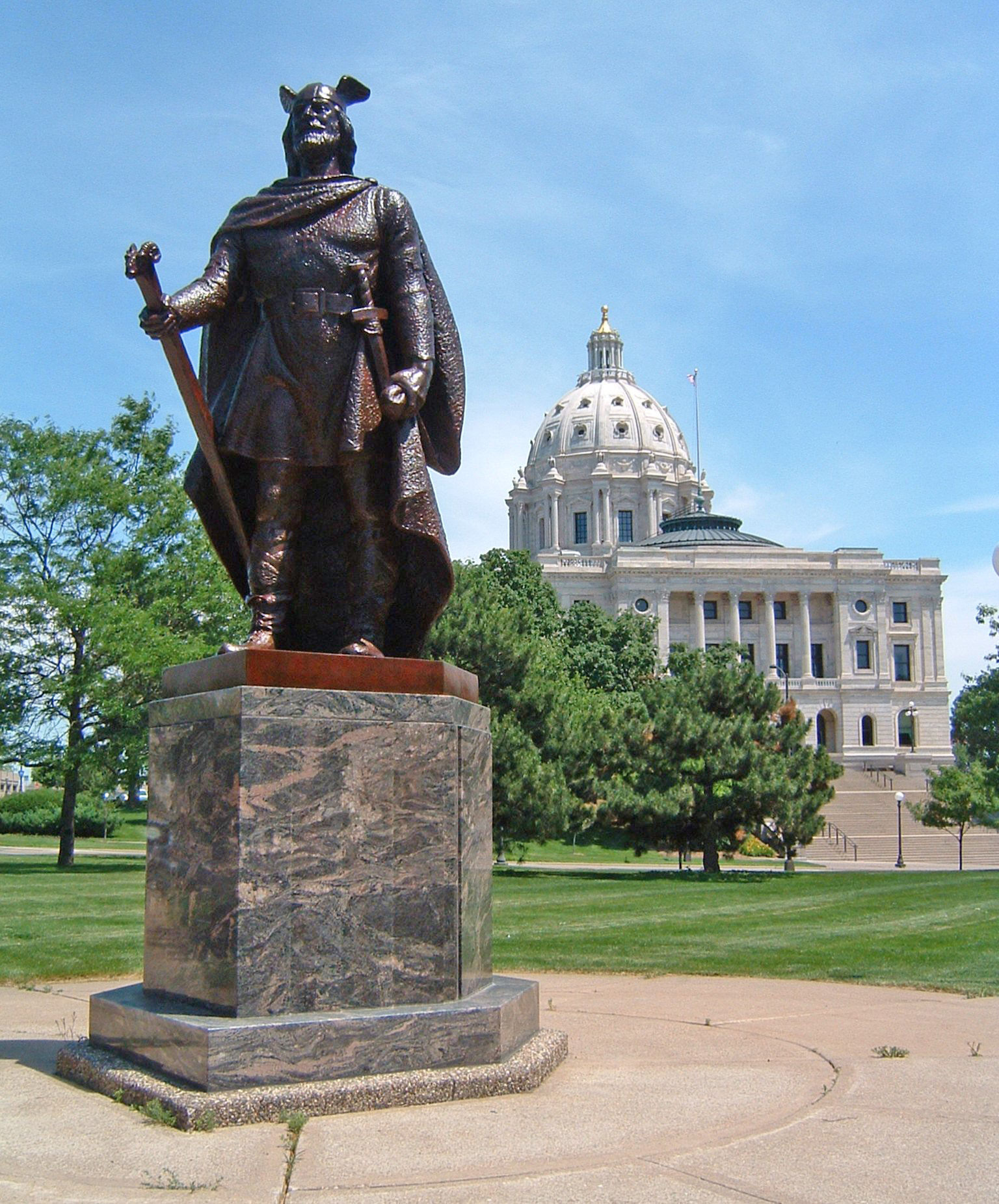
Friday, October 17, 2008
More Categories and Endeavors

 As stated earlier, we're moving the vast majority of text to this blog. The reason is that it's difficult and time consuming to update web pages, in comparison to just allowing the information and ideas to flow along in a blog. We've now moved another six ideas (for development) here from the main website. I just wanted to enter them, and give a quick description.
Our Patron Saint: This was designated to be Mother Cabrini, the first officially recognized American Saint. She was of Lombardian descent, and seemed to be a logical patron saint. I don't know if this is still a good idea or not, as we have many heros and icons.
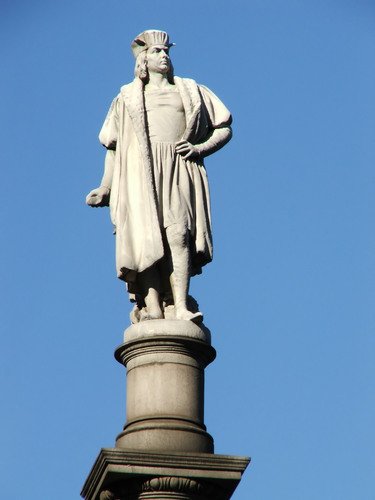
Padanian-American Memorial: In New York City's "Columbus Circle," there is a very impressive statue of Christopher Columbus, which would seem to eliminate the possible need to eventually construct a monument. Again, I don't know now if this is still a good idea. Do we even really need "a memorial?" A cultural center would seem to fill that void. However, sometimes there is a need to have a "special place."
Famous Padanian-Americans: We had attempted to make a list, and this is something that we still need to do. For a relatively small population in America, there are a stunning number of very important individuals. Columbus, Cabot, Verrazzano, Vespucci, Mazzei, Busti, Giannini, Fermi, Cabrini, Beltrami, Vigo, etc., etc. That's just off the top of my head in twenty seconds! Remember the scene from 'The Godfather' were the senate is questioning Michael Corleone? One senator, being the quintessential politician, upon leaving, gives his little speech on "Italian-Americans," and goes on to name many of the great Northern Italians in American history. There's a hidden message in there somewhere, I know it!
Padanian-American Singles: A couple of individuals have suggested this, and it is a very good idea. We just want to merge this as a fuction of the Roundtable that we will form, rather than as just a half-hearted effort on a webpage. This definitely will be accomplished.
Padanian-American Historical Icon: This was another attempt to prop up our own historical figures. Queen Theodelinda was the undisputed queen and ruler of the Lombard Kingdom, and she brought Roman Catholicism to the Lombards, similar to St. Patrick. She could also represent the pagan traditions of the past, in some capacity. In conclusion, for now at least, the appearance of the Lombard queen (Northern Italy) on our logo, and Filippo Mazzei (USA) for our "heritage day," is sufficient.
This brings up a larger complex internal and external issue of Christianity vs. Heathenism. I have come to the conclusion that the Greek communities have this correct. In religion they are Greek Orthodox, but their past pagan icons are always part of their identity. In other words, the issue is ONLY an issue if someone wants to make it an problem. It should be no problem for us. So in conclusion, for us, it shouldn't be "Christianity vs. Heathenism," but "Christianity/Catholicism AND Pagan Identity (Christianity and Heathenism). You can love historical icons, or nature, or whatever, without worshipping it (unless you want to). I think we should follow the "Greek model" on this.
Padanian Females Photo Album: This was a good idea, but I don't want to maintain it, as it is time consuming. There are thousands of images of beautiful women of Tuscan, Lombard, etc., descent. Steve Sailer studies and writes about race, genetic, sociological, and anthropological issues, and when confronted with the question of "who has the most beautiful women?", he had the following to say:
"For European beauty, I'd vote for Northern Italian women."