
Showing posts with label Celts. Show all posts
Showing posts with label Celts. Show all posts
Saturday, February 6, 2016
Brennus: Warlord of the Cisalpine Gauls - Part I
Barbarians - The Primitive Celts
docufans1
So you think you know everything about the Romans? They gave us sophisticated road systems, chariots and the modern-day calendar. And of course they had to contend with barbarian hordes who continually threatened the peace, safety and prosperity of their Empire. Didn't they? Terry Jones' Barbarians takes a completely fresh approach to Roman history. Not only does it offer us the chance to see the Romans from a non-Roman perspective, it also reveals that most of the people written off by the Romans as uncivilized, savage and barbaric were in fact organized, motivated and intelligent groups of people, with no intentions of overthrowing Rome and plundering its Empire.
**************************************************
Random fact: Contrary to long held popular perception, the Vikings did not wear horned helmets. However, the Gauls did.
.


Tuesday, September 27, 2011
Matrimonio Etrusco Celtico
Etruscan-Celtic Marriage
Reconstruction of a marriage between a Celtic nobleman and an Etruscan princess, in ancient Etruria or Cisalpine Gaul.
.
Friday, January 21, 2011
Ancient Celto-Alpine settlers in Tarim Basin (modern China)
DNA evidence has so far placed the Tarim mummies' origin to central Europe, and more specifically to the Alpine region and north, which was prime Celtic territory 4,000 years ago. The overwhelmingly best guess is that they were ancient Hallstatt Celts who had traveled eastward, probably on horses and wagons, all the way into the Tarim Basin (present-day Xinjiang, China). As to why they settled in a mostly deserty region is not clear. It's possible that the region may have been greener at that time. Also, they had traveled so far, and over mountainous terrain, that when they reached this valley, they decided to make a go of it. They seemed to have lived there for about one thousand years.
This was a world in which the population levels weren't nearly as high as today. For a good long time, they may have been the principal racial stock of the region, which was not Chinese or Turkic at that time it appears. A thousand years is a long time, and things changed. Today's root stock population is of Turko-Mongolian origin, of which these Celts were absorbed into. Blue eyes and brown hair seem to be somewhat common, with mostly far eastern features.
Upon arriving there, it's likely that they sent out scouts. They must have figured out northward was the mountainous Asian steppe which was even less hospitable, southward were the Himalayas, eastward were seemingly endless deserts and mountains, and turning back thousands of miles to Europe was not an especially attractive option either.
I think that China deserves some credit, as they are fiercely protective of their history. However, since this region is not ethnic Chinese anyway, I think that it makes little difference. It should be noted that these ancient settlers had knowledge of bronze metalworking, which was not present in China at that time, and it was thought that the Chinese developed bronze on their own. They may well have, as this area was still a long distance from China proper.

part 1 National Geographic Ancient Caucasian Mummies Found In China
part 2 National Geographic Ancient Caucasian Mummies Found In China
part 3 National Geographic Ancient Caucasian Mummies Found In China
part 4 National Geographic Ancient Caucasian Mummies Found In China
part 5 National Geographic Ancient Caucasian Mummies Found In China
part 6 National Geographic Ancient Caucasian Mummies Found In China
The Tocharian culture existed in the same Tarim Basin over a thousand years after "the mummy people" had disappeared, and it's not known if there was a connection. The Tocharian language was a branch of the Indo-European languages, now extinct. After viewing some of the depictions of them, they appear to be much more Nordic-like than Celtic..
Saturday, September 25, 2010
Cernic Rite
The Cernic tradition was an ancient religion native to mainly ancient Gaul, Alpine Germany, and Cisalpine Gaul; and which also seemed to exist in Iberia, some parts of Scandinavia, and perhaps elsewhere.
CERNUNNOS
http://en.wikipedia.org/wiki/Cernunnos
Cernunnos (also Cernenus and Cern) is a Celtic god whose representations were widespread in the ancient Celtic lands of western Europe. Cernunnos is associated with horned male animals, especially stags and the ram-horned snake; this and other attributes associate him with produce and fertility.
Everything known about this deity comes from two inscriptions from France and one from Germany.
Evidence
A rock carving of Cernunnos in the National park of Naquane, Italy.[4]
Cernunnos was proposed to have been identified as the illustration on the Snake-witch picture stone, which shows a possibly horned figure holding snakes in his/her hands, from Gotland, Sweden.[citation needed]
Archaeological sources such as inscriptions and depictions from Gaul and Northern Italy (Gallia Cisalpina) have been used to define Cernunnos.
[Music: 'Lacrimae Lugus' by Crystalmoors
"Celtic/Pagan Black Metal band from Cantabria, Spain" (YouTube user BlackDeath)
http://www.myspace.com/crystalmoors
http://www.fotolog.com/crystalmoors ]
Monday, July 19, 2010
Gallia Cisalpina VI: Gaulish Bread Harvest

Lammas is a Neo-Pagan holiday, often called Lughnasadh, celebrating the first harvest and the reaping of grain. It is a cross-quarter holiday halfway between the Summer Solstice (Litha) and the Autumnal Equinox (Mabon). In the northern hemisphere, Lammas takes place around August 1 with the Sun near the midpoint of Leo in the tropical zodiac, while in the southern hemisphere Lammas is celebrated around February 1 with the Sun near the midpoint of Aquarius. On the Wheel of the Year, it is opposite Imbolc, which is celebrated on February 2nd in the northern hemisphere, and late July / early August in the southern hemisphere.
Lammas
http://en.wikipedia.org/wiki/Lammas
Lughnasadh
http://en.wikipedia.org/wiki/Lughnasadh
Harvest Festival
http://en.wikipedia.org/wiki/Harvest_festival
Celtic calendar
http://en.wikipedia.org/wiki/Celtic_calendar
Wheel of the Year
http://en.wikipedia.org/wiki/Wheel_of_the_year
*The footage shown is from the 2006 American remake of 'The Wicker Man' :
Wikipedia
http://en.wikipedia.org/wiki/The_Wicker_Man_(2006_film)
Internet Movie Database
http://www.imdb.com/title/tt0450345/
Amazon.com
http://www.amazon.com/Wicker-Man-Widescreen-Unrated-Rated/dp/B000JYW5DW/ref=sr_1_2?ie=UTF8&s=dvd&qid=1279558795&sr=1-2
[Music: Unknown]
Sunday, May 23, 2010
Ancient Cisalpine Gaul: More Celtic than we thought
The evidence, as we dig though it, seems to suggest that while they can be traced back to upwards of ten thousand years, they weren't very widespread. It's highly unlikely then that there was every any significant fighting as the Celts migrated and settled in the largely underpopulated region.
The Eugenei who lived outside of what was their later stronghold in the northeast, probably were absorbed into the Celtic tribes. We encounter information all the time which challenges earlier beliefs, so this can and should be considered a historical work in progress. As of now it appears that the Celts were the, numerically-speaking, much more dominant culture. Even the Eugenei tribes who survived as a separate culture, did have at least some clear Celtic influence.
The Eugenei still are a reminder of the very ancient past, and as far as we know, the pure representatives of the human origin of the region. For anyone of "northern nations" descent, unfortunately, getting information in simple English text on these subjects (on both sides of the Atlantic) is like pulling teeth! I refer to the pre-Roman stock as "Celto-Alpine" people, rather than Gaulic or Celtic.
It's still somewhat of a mystery as to exactly where the Celts migrated into the Cisalpine region. They seemed to arrive in successive waves over a long period. The Cenomani tribe has the same name as the Cenomani of Gaul, although there is no definitive proof that they were once the same tribe. However, there is evidence that many or most arrived via Liguria; hence the name "Celto-Ligurian." Gaul's (France) geographic location would seem to validate this.
There is also evidence that some migrated early on from the Halstatt settlements of ancient south Germany. The "iceman," the famous archeological find of a preserved man in high Alpine ice in the 1990s, likely was among the first Celtic pioneers of the Cisalpine region. I recall that he lived between five and six thousand years ago. It should not be forgotten that there was also Celtic settlement in ancient Tuscany. What makes that a little different was that there did seem to be some skirmishing between Celts and Etruscans, although it didn't seem to be very long-lasting.
[1-27-11 ADDITION: It should be noted that Celtic migration into the Cisalpine region began at least by 3,000 years ago, and that in the fifth century there was another wave into the region. The first being pre-Roman, and the latter post-Roman. Also, the latter was also when the Celts first migrated into the British Isles; as well as into Denmark, Spain, and the Balkans. Some of those regions, like Spain, also had pre-Roman Celtic heritage.]
.
Friday, March 5, 2010
The Celts
The Celts - Part I
The Celts - Part II
This English documentary does a good job at getting at the real continental roots of the Celts.
Tuesday, February 9, 2010
Gallia Cisalpina V: Celto-Alpine Spirit
Celtic polytheism, sometimes known as Celtic paganism, refers to the religious beliefs and practices of the ancient Celtic peoples of Western Europe prior to Christianization.
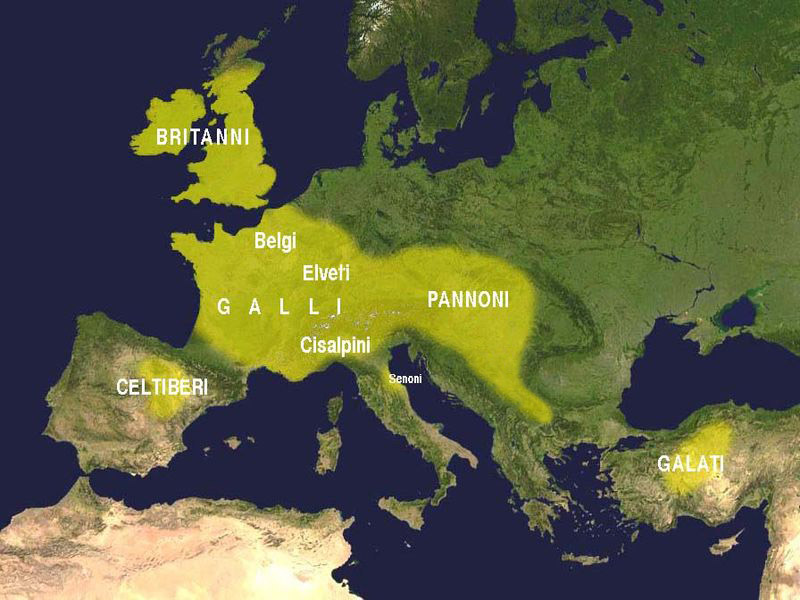
Celtic polytheism was animistic, believing in spirits existing in natural objects such as trees and rocks. Religious beliefs and practices of the Celts varied throughout the different Celtic lands, which included Ireland, Britain, Celtiberia, Gaul, areas along the Danube river, and Galatia; however there were commonalities shared by all.
Celtic mythology is the mythology of Celtic polytheism, apparently the religion of the Iron Age Celts. Like other Iron Age Europeans, the early Celts maintained a polytheistic mythology and religious structure.
Among Celts in close contact with Ancient Rome, such as the Gauls and Celtiberians, their mythology did not survive the Roman empire, their subsequent conversion to Christianity, and the loss of their Celtic languages.
[Music: 'Celtic Requiem Chant' by Elliot Simons; different than the 'Celtic Requiem']
Monday, February 8, 2010
Divine Spirits of Providence
Shall quicken and control.
Living they were the land, and dead,
Their soul shall be her soul.
[Music: 'Moonlight Sonata' by Daniel Pollack]
Wednesday, November 18, 2009
Gallia Cisalpina IV: Gaulish Harvest Festival of Samonios
Gallia Cisalpina IV: Gaulish Harvest Festival of Samonios
SamhainThe Gaulish calendar appears to have divided the year into two halves: the "dark" half, beginning with the month Samonios (the October/November lunation), and the "light" half, beginning with the month Giamonios (the April/May lunation). The entire year may have been considered as beginning with the "dark" half, so that the beginning of Samonios may be considered the Celtic New Year's day. The celebration of New Year itself may have taken place during the "three nights of Samonios" (Gaulish trinux[tion] samo[nii]), the beginning of the lunar cycle which fell nearest to the midpoint between the autumnal equinox and the winter solstice.
The lunations marking the middle of each half-year may also have been marked by specific festivals. The Coligny calendar marks the mid-summer moon (see Lughnasadh), but omits the mid-winter one (see Imbolc). The seasons are not oriented at the solar year, viz. solstice and equinox, so the mid-summer festival would fall considerably later than summer solstice, around 1 August (Lughnasadh). It appears that the calendar was designed to align the lunations with the agricultural cycle of vegetation, and that the exact astrological position of the Sun at that time was considered less important.
[Music: 'Loreley' by Blackmore's Night]
Sunday, September 6, 2009
From Mercury to Wotan

Was this true? Did the Romans and Greeks share a major god with the Germanic peoples, and perhaps others? If so, that would be a strong bond linking ancient Europe. It should also be noted that the Celts had an extensive mythology, and also we've begun to learn in recent years of the extensive "Slavic mythology" that existed. Staying with the original question, we might be able to start to answer some questions.
Greeks
Hermes is the Messenger of the gods in Greek mythology. An Olympian god, he is also the patron of boundaries and of the travelers who cross them, of shepherds and cowherds, of thieves and road travelers, of orators and wit, of literature and poets, of athletics, of weights and measures, of invention, of general commerce, and of the cunning of thieves and liars.
Romans
In Roman mythology, Mercury (associated with the Greek deity Hermes) was a messenger, and a god of trade, profit and commerce, the son of Maia Maiestas, also known as Ops, the Roman version of Rhea, and Jupiter.
Also according to Wikipedia: "Mercury did not appear among the numinous di indigetes of early Roman religion. Rather, he subsumed the earlier Dei Lucrii as Roman religion was syncretized with Greek religion during the time of the Roman Republic, starting around the 4th century BC. From the beginning, Mercury had essentially the same aspects as Hermes, wearing winged shoes talaria and a winged petasos, and carrying the caduceus, a herald's staff with two entwined snakes that was Apollo's gift to Hermes."
Etruscans
So, according to the above paragraph, Mercury entered the Roman religion some time after the founding of the Roman Republic. There was a break in time there. To answer that question, we again have to explore the Roman ruination of ancient Etruria. The Etruscans called the Greek god Hermes "Turms" (see chart). Well, isn't that interesting. The Etruscans worshipped this god long before Rome, and is it such a stretch to ponder as to whether or not the early Roman elite deliberately deconstructed an important Etruscan god? I have made the comparison of the Etruscans to the USA nation state, and the Romans to the Globalist American leadership. Both deconstructed much of what had been tradition in favor of internationalism.
Now we do not necessarily know if Hermes appeared in Greek mythology prior to Etruscan mythology, but we would have to assume Greece until proven otherwise. We do know that Etruria was not a colony of Greece, and was a strong nation right along with Greece, and that the "Greece then Rome" concept is largely untrue. By destroying the highly advanced Etruscan architecture, the Romans were indeed able to wipe ancient Etruria out of memory.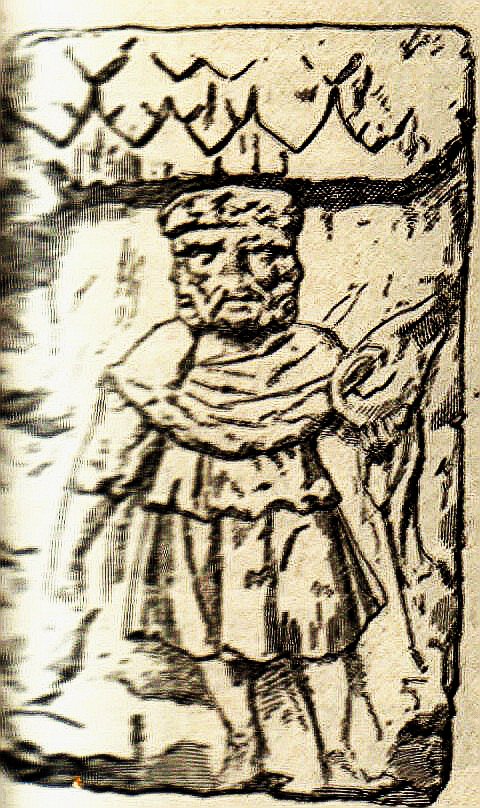
[Left: A three-headed image of a Celtic deity, interpreted as Mercury and now believed to represent Lugus]
When they described the gods of Celtic and Germanic tribes, rather than considering them separate deities, the Romans interpreted them as local manifestations or aspects of their own gods, a cultural trait called the interpretatio Romana. Mercury in particular was reported as becoming extremely popular among the nations the Roman Empire conquered; Julius Caesar wrote of Mercury being the most popular god in Britain and Gaul, regarded as the inventor of all the arts. This is probably because in the Roman syncretism, Mercury was equated with the Celtic god Lugus, and in this aspect was commonly accompanied by the Celtic goddess Rosmerta. Although Lugus may originally have been a deity of light or the sun (though this is disputed), similar to the Roman Apollo, his importance as a god of trade and commerce made him more comparable to Mercury, and Apollo was instead equated with the Celtic deity Belenus.
Romans associated Mercury with the Germanic god Wotan, by interpretatio Romana; 1st-century Roman writer Tacitus identifies the two as being the same, and describes him as the chief god of the Germanic peoples. Julius Caesar, in a section of his "Gallic Wars" describing the customs of the German tribes, wrote "The Germans most worship Mercury," apparently identifiyng Wotan with Mercury.
In Celtic areas, Mercury was sometimes portrayed with three heads or faces, and at Tongeren, Belgium, a statuette of Mercury with three phalli was found, with the extra two protruding from his head and replacing his nose; this was probably because the number 3 was considered magical, making such statues good luck and fertility charms. The Romans also made widespread use of small statues of Mercury, probably drawing from the ancient Greek tradition of hermae markers.
Lugus was a deity apparently worshipped widely in antiquity in the Celtic-speaking world. His name is rarely directly attested in inscriptions, but his importance can be inferred from placenames and ethnonyms, and his nature and attributes are deduced from the distinctive iconography of Gallo-Roman inscriptions to Mercury, who is widely believed to have been identified with Lugus, and from the quasi-mythological narratives involving his linguistic descendants, Irish Lugh and Welsh Lleu Llaw Gyffes.
"Gaulish Mercury"
Julius Caesar in his De Bello Gallico identified six gods worshipped in Gaul, by the usual conventions of interpretatio Romana giving the names of their nearest Roman equivalents rather than their Gaulish names. He said that "Mercury" was the god most revered in Gaul, describing him as patron of trade and commerce, protector of travellers, and the inventor of all the arts. The Irish god Lug bore the epithet samildánach (skilled in all arts), which has led to the widespread identification of Caesar's Mercury as Lugus. Mercury's importance is supported by the more than 400 inscriptions into him in Roman Gaul and Britain. Such a blanket identification is optimistic – Jan de Vries[8] demonstrates the unreliability of any one-to-one concordance in the interpretatio Romana – but the available parallels are worth considering.
Ancient Germanic Peoples
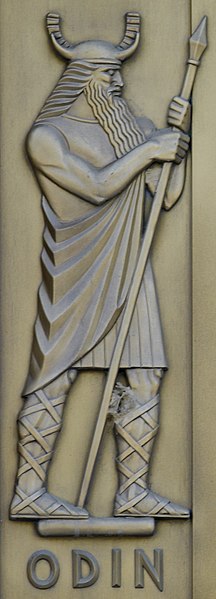
Odin is considered the chief god in Norse paganism and the ruler of Asgard. Homologous with the Anglo-Saxon Wōden and the Old High German Wotan, it is descended from Proto-Germanic *Wōđinaz or *Wōđanaz. The name Odin is generally accepted as the modern translation; although, in some cases, older translations of his name may be used or preferred. His name is related to ōðr, meaning "fury, excitation", besides "mind", or "poetry". His role, like many of the Norse gods, is complex. He is considered a principal member of the Aesir (Norse Pantheon) and is associated with wisdom, war, battle, and death, and also magic, poetry, prophecy, victory, and the hunt.
Parallels between Odin and Celtic Lugus have often been pointed out: both are intellectual gods, commanding magic and poetry. Both have ravens and a spear as their attributes, and both are one-eyed. Julius Caesar (de bello Gallico, 6.17.1) mentions Mercury as the chief god of Celtic religion. A likely context of the diffusion of elements of Celtic ritual into Germanic culture is that of the Chatti, who lived at the Celtic-Germanic boundary in Hesse during the final centuries before the Common Era.
It can be concluded that various mythological figures, from different cultures, were "associated" with a counterpart. This may have been partly due to political maneuvering by Romans and others, to pacify the population. To conjoin different cultures under a unified imperial state, in the same way that early Christians, rather than try to force the abolition of a pagan holiday, just co-opted it until it more-or-less disappeared.
Monday, July 6, 2009
Gallia Cisalpina III: Celto-Ligurian Culture
Gallia Cisalpina III: Celto-Ligurian Culture
All of the tribes of Cisalpine Gaul are sometimes referred to as part of the "Celto-Ligurian" culture. Although some may be "Celto-Venetic" or other regional variations.
The Ligures (singular Ligus or Ligur; English: Ligurians, Greek: Λίγυες) were an ancient people who gave their name to Liguria, which once stretched from Northern Italy into southern Gaul. According to Plutarch they called themselves Ambrones which means ¨people of the water¨. The Ligures inhabited what now corresponds to Liguria, northern Tuscany, Austria (Noricum), Piedmont, part of Emilia-Romagna, part of Lombardy, and parts of southeastern France.
Classical references and toponomastics suggest that the Ligurian sphere once extended further into central Italy (Taurisci): according to Hesiod's Catalogues (early 6th century BC) they were one of the three main "barbarian" peoples ruling over the Western border of the known world (the others being Aethiopians and Scythians). Avienus, in a translation of a voyage account probably from Marseille (4th century BC) speaks of the Ligurian hegemony extending up to the North Sea, before they were pushed back by the Celts. Ligurian toponyms have been found in Sicily, the Rhône valley, Corsica and Sardinia.
It is not known for certain whether they were a pre-Indo-European people akin to Iberians; a separate Indo-European branch with Italic and Celtic affinities; or even a branch of the Celts or Italics. Kinship between the Ligures and Lepontii has also been proposed. Another theory traces their origin to Betica (modern Andalusia) and southern Lusitania (modern Algarve and Alentejo).
The Ligures were assimilated by the Romans, and before that by the Gauls, producing a Celto-Ligurian culture.
Wednesday, July 1, 2009
Gallia Cisalpina II: Pagan Celtic Nation
Gallia Cisalpina II: Pagan Celtic Nation
In memory of the earth-based and gender-equal pagan culture of the Celto-Ligurian tribes in the southern Alpine and Po river valley region called Gallia Cisalpina (Cisalpine Gaul; "Gaul south of the Alps") by the Romans who eventually destroyed their world, took their land, and subjugated them under the Roman Empire.
Monday, June 15, 2009
Gallia Cisalpina: A Celtic Nation
Gallia Cisalpina: A Celtic Nation
Our second video
The Trophy of the Alps or Trophy of Augustus was built by the Roman emperor Augustus to celebrate his definitive victory over the ancient Celto-Ligurian tribes who populated the region and who had harassed merchants along Roman roads. Its remains may be seen in the Commune of La Turbie (Alpes-Maritimes), on the Grande Corniche, 6 km from Monaco.
Monday, March 2, 2009
Early Celtic Presence in Northern Italy

[Thanks to Insubria87 for this entry: His original post 'Early Celtic Presence in Northern Italy']
EARLY CELTIC PRESENCE IN NORTHERN ITALY
People of European History
The Celts of the Latène age (475 to 20 BC) are named for the important archaeological finds at La Tène on the lake of Neuchâtel in Switzerland and are counted among the most important people of European history. Their central area of influence stretched from the Marne and Mosel, over southern France, and southern Germany, reaching to southern Poland and the Carpathians. The actual origins of the Celts is unknown. Myths and legends give a very contradictory picture.
Origins and Early History

Clear references to the history of the Celts are first found in the late Bronze age (the 13th century BC) with the beginning of the Canegrate culture. The name comes from the archaeological excavation at "Canegrate" (http://en.wikipedia.org/wiki/Canegrate) near Legnano north of Milan, where important finds were made. The Canegrate culture was founded by Celts who came from the Northwest alpine region and settled in the area between the Lake of Maggiore and the Lake of Como. They brought a language with them from which "Old-Celtic" continuously developed. They lived in direct proximity to the Golasecca-Celts of the Ticino (their name stems from the important archaeological finds in "Golasecca" at the place where the Ticino river flows out of the Lake of Maggiore) and the Helvetians in the north whose settlements reached far towards southern Germany.
Cultura di Canegrate
Golasecca culture
The Golasecca culture is a proto-historic pre-Celtic culture in northern Italy of which the type-site is Golasecca in the province of Varese, Lombardy (northern Italy). Sites characteristic of Golasecca culture have been identified in eastern Lombardy, Piedmont, the Canton Ticino and Val Mesolcina, in a territory stretching north of the Po River to sub-alpine zones, between the course of the Serio to the east and the Sesia to the west. The site of Golasecca, where the Ticino exits from Lake Maggiore, was particularly suitable for long-distance exchanges, in which Golaseccans acted as intermediaries between Etruscans and the Halstatt culture of Austria, supported on the all-important trade in salt.
In a broader context, the subalpine Golasecca culture is the very last expression of the Middle European Urnfield culture of the European Bronze Age. The culture's richest flowering was Golasecca II, in the first half of the sixth to early fifth centuries BCE. It lasted until it was overwhelmed by the Celts in the fourth century and was finally incorporated into the hegemony of the Roman Republic.

situation of the Golasecca culture to the south of the Hallstatt culture.
Golasecca culture is divided for convenient reference into three parts: the first two cover the period of the ninth to the first half of the fifth century BCE; the third, coinciding with La Tène A-B of the later Iron Age in this region and extending to the end of the fourth century BCE, is marked by increasing Celtic influences, culminating in Celtic hegemony after the conquests of 388 BCE. The very earliest finds are of the Late Bronze Age (ninth century), apparently building upon a local culture.[1]
Cremation near the burial site, followed by ash and bone burials in terracotta jars, in excavated pits set at determined distances one from the other in scattered necropolises, characterize a culture of many small village settlements.
In Golasecca culture some of the first evolved characteristics of historic society may be seen, in the specialized use of materials and the adaptation of the local terrain. The early-period habitations were circular wooden constructions along the edge of the river's floodplain; each was built on a low basement of stone round a central hearth and floored with river pebbles set in clay. Hand-shaped ceramics, made without a potter's wheel, were decorated in gesso. The use of the wheel is known from the carts in the Tomb of the Warrior at the Sesto Calende site. Amber beads from the Baltic sea across the Amber Road and obsidian reveal networks of long-distance trade. From the seventh century onwards some tombs contain burial goods imported from Etruscan areas and Greek objects[2]
The settlements depended on domesticated animals: remains reveal the presence of goats, sheep, pigs, cattle and horses. Some legume and cereal crops were cultivated; nuts and fruits were collected. The dugout boats from Castelletto Ticino and Porto Tolle are conserved at the museum of Isola Bella. Metal, though rare, was in increasing use.
Undeciphered written characters are found incised in ceramics or on stone.
The Golasecca culture is best known by its burial customs, where an apparent ancestor cult imposed respect of the necropoli, a sacred area untouched by agrarian use or deforestation. The early-period burials took place in selected raised positions oriented with respect to the sun. Burial practices were direct inhumation or in lidded cistae. Stone circles and alignments are found. Burial urns were painted with designs, with accessory ceramics, such as cups on tall bases. Bronze objects are usually of wearing apparel: pins and fibulas, armbands, rings, earrings, pendants and necklaces. Bronze vessels are rare. The practice of cremation persists into the second period (early sixth to mid-fourth centuries)
The old sites—Golasecca, Sesto Calende, Castelletto Ticino—maintained their traditional autochthonous character through the sixth century, when outside influences begin to be detectable. At the beginning of the fifth century, pastoral practices resulted in the development of new settlements in the plains.

The first finds were discovered at several locations in the comune of Golasecca in 1824, by the antiquarian abate Giovan Battista Giani, who identified the clearly non-Roman burials as remains of the battle between Hannibal and Scipio Africanus[3]. In 1865 Louis Laurent Gabriel de Mortillet, a founder of European archaeology, rightly assigned the same tombs to the early Iron Age. The modern assessment of Golasecca culture is derived from the campaigns of 1965-69 on Monsorino, directed by Mira Bonomi.
Lepontii
The Lepontii were an ancient people occupying portions of Rhaetia (in modern Switzerland and Italy) in the Alps during the time of the Roman conquest of that territory. The Lepontii have been variously described as a Celtic, Ligurian, Raetian, and Germanic tribe. However, most evidence, including recent archeological excavations, and their association with the 'Golasecca culture' of Northern Italy, indicates a Celtic origin although they might actually be an amalgamation of Raetians (who were of Etruscan origin) and Celts.
The chief town of the Lepontii was Oscela, now Domodossola, Italy, and their territory included the southern slopes of the St. Gotthard Pass and Simplon Pass, corresponding roughly to present-day Ossola and Ticino. See also: Lepontic language. This map of Rhaetia [1] shows the location of the Lepontic territory, in the south-western corner of Rhaetia. The area to the South, including what was to become the Insubrian capital Mediolanum (modern Milan), was Etruscan around 600-500 BC, when the Lepontii began writing tombstone inscriptions in their alphabet (one of several Etruscan-derived alphabets in the Rhaetian territory).
Lepontic language
Lepontic is an extinct Celtic language that was spoken in parts of Rhaetia and Cisalpine Gaul (today's Northern Italy) between 700 BC and 400 BC. Sometimes called Cisalpine Celtic, it is considered a dialect of the Gaulish language and thus a Continental Celtic language (Eska 1998).
The language is only known from a few inscriptions discovered that were written in the alphabet of Lugano, one of five main varieties of Northern Italic alphabets, derived from the Etruscan alphabet. These inscriptions were found in an area centered on Lugano, including Lago di Como and Lago Maggiore. Similar scripts were used for writing the Rhaetic and Venetic languages, and the Germanic runic alphabets probably derive from a script belonging to this group.

Lepontic was assimilated first by Gaulish, with the settlement of Gaulish tribes north of the River Po, and then by Latin, after the Roman Republic gained control over Gallia Cisalpina during the late second and first century BC.
The grouping of all of these inscriptions into a single Celtic language is disputed, and some (including specifically all of the older ones) are said to be in a non-Celtic language related to Ligurian (Whatmough 1933, Pisani 1964). Under this view, which was the prevailing view until about 1970, Lepontic is the correct name for the non-Celtic language, while the Celtic language is to be called Cisalpine Gaulish. Following Lejeune (1971), the consensus view became that Lepontic should be classified as a Celtic language, albeit possibly as divergent as Celtiberian, and in any case quite distinct from Cisalpine Gaulish. Only in recent years, there has been a tendency to identify Lepontic and Cisalpine Gaulish as one and the same language.
While the language is named after the tribe of the Lepontii, which occupied portions of ancient Rhaetia, specifically an Alpine area straddling modern Switzerland and Italy and bordering Cisalpine Gaul, the term is currently used by many Celticists to apply to all Celtic dialects of ancient Italy. This usage is disputed by those who continue to view the Lepontii as one of several indigenous pre-Roman tribes of the Alps, quite distinct from the Gauls who invaded the plains of Northern Italy in historical times.

The older Lepontic inscriptions date back to before the 5th century BC, the item from Castelletto Ticino being dated at the 6th century BC and that from Sesto Calende possibly being from the 7th century BC (Prosdocimi, 1991). The people who made these inscriptions are nowadays identified with the Golasecca culture, which has been ascribed a Celtic identity (De Marinis, 1991). The extinction date for Lepontic is only inferred by the absence of later inscriptions.
http://en.wikipedia.org/wiki/Lepontic_language
Ligures
The Ligures (singular Ligus or Ligur; English: Ligurians, Greek: Λίγυες) were an ancient people who gave their name to Liguria, which once stretched from Northern Italy into southern Gaul. According to Plutarch they called themselves Ambrones which means ¨people of the water¨. The Ligures inhabited what now corresponds to Liguria, northern Tuscany, Piedmont, part of Emilia-Romagna, part of Lombardy, and parts of southeastern France.
Classical references and toponomastics suggest that the Ligurian sphere once extended further into central Italy (Taurisci): according to Hesiod's Catalogues (early 6th century BC) they were one of the three main "barbarian" peoples ruling over the Western border of the known world (the others being Aethiopians and Scythians). Avienus, in a translation of a voyage account probably from Marseille (4th century BC) speaks of the Ligurian hegemony extending up to the North Sea, before they were pushed back by the Celts. Ligurian toponyms have been found in Sicily, the Rhône valley, Corsica and Sardinia.


It is not known for certain whether they were a pre-Indo-European people akin to Iberians; a separate Indo-European branch with Italic and Celtic affinities; or even a branch of the Celts or Italics. Kinship between the Ligures and Lepontii has also been proposed. Another theory traces their origin to Betica (modern Andalusia).
The Ligures were assimilated by the Romans, and before that by the Gauls, producing a Celto-Ligurian culture.
Tribes
Numerous tribes of Ligures are mentioned by ancient historians, among them:
Ligurian language
The Ligurian language was spoken in pre-Roman times and into the Roman era by an ancient people of north-western Italy and south-eastern France known as the Ligures. Very little is known about this language (mainly place names and personal names remain) which is generally believed to have been Indo-European; it appears to have shared many features with other Indo-European languages, primarily Celtic (Gaulish) and Italic (Latin and the Osco-Umbrian languages).
Xavier Delamarre argues that Ligurian was a Celtic language, similar to but not the same as Gaulish. His argument hinges on two points: firstly, the Ligurian place-name Genua (modern Genoa, located near a river mouth) is claimed by Delamarre to derive from PIE *genu-, "chin(bone)". Many Indo-European languages use 'mouth' to mean the part of a river which meets the sea or a lake, but it is only in Celtic that reflexes of PIE *genu- mean 'mouth'. Besides Genua, which is considered Ligurian (Delamarre 2003, p. 177), this is found also in Genava (modern Geneva), which may be Gaulish. However, Genua and Genava may well derive from another PIE root with the form *genu-, which means "knee" (so in Pokorny, IEW [1]).
Delamarre's second point is Plutarch's mention (Marius 10, 5-6) that during the Battle of Aquae Sextiae in 102 BC, the Ambrones (who may have been a Celtic tribe) began to shout "Ambrones!" as their battle-cry; the Ligurian troops fighting for the Romans, on hearing this cry, found that it was identical to an ancient name in their country which the Ligurians often used when speaking of their descent (outôs kata genos onomazousi Ligues), so they returned the shout, "Ambrones!".
Delamarre points out a risk of circular logic - if it is believed that the Ligurians are non-Celtic, and if many place names and tribal names that classical authors state are Ligurian seem to be Celtic, it is incorrect to discard all the Celtic ones when collecting Ligurian words and to use this edited corpus to demonstrate that Ligurian is non-Celtic or non-Indo-European.
Strabo on the other hand states "As for the Alps... Many tribes (éthnê) occupy these mountains, all Celtic (Keltikà) except the Ligurians; but while these Ligurians belong to a different people (hetero-ethneis), still they are similar to the Celts in their modes of life (bíois)."
The Ligurian-Celtic question is also discussed by Barruol (1999).
Herodotus (5.9) wrote that sigunnai meant 'hucksters, peddlers' among the Ligurians who lived above Massilia.
http://en.wikipedia.org/wiki/Ligurian_language
Monday, February 16, 2009
Caesar Augustus' "Conquered Alpine Peoples" - Part 2
 The Celts
We can take a more in-depth look at these various pre-Roman peoples, like the Celts, at a later time. The Celts did indeed invade Northern Italy, like they did so many other regions of Europe, and even beyond Europe, like Turkey. It should be noted that some sources even place them in Northern Italy much earlier (sixth century BC), and even as a place of possible origin. However, it's usually accepted that the first Celtic culture really thrived in the area that is now modern southern Germany and nearby areas of central Europe, although some place the origin in more northern Germany and Holland.
The Celts are sometimes thought of as more of a culture than an ethnic type. However, early Greek and Roman historians describe them as generally being quite tall. The concept of them as being similar to a red haired "Irish" type of people may not be accurate. They may have been more dark haired, but the picture is really not entirely clear, and evidence surfaces from time to time that changes archeologists and anthropologists view of the Celts. With their centuries long wanderings, they may have started out as more of a particular ethnic type, and later morphed into more of a culture, with scattered regional groups.
Celtic Gaul
Pre-Roman Gaul was a Celtic nation in the area that is now France. Although made up of separate tribes, it would still constitute a nation, as they united to defend themselves against the invading Romans. It should also be pointed out that these pre-Roman regions and tribes were also certainly pre-Christian. They had various pagan beliefs. Druidism, for example, is a Celtic-originated tradition. All of these areas are so expansive, but I want to stick with Northern Italian Celts, just prior to their being conquered by the Romans. It is important to know that they did invade Northern Italy from Gaul. It was probably somewhere between the definition of a migration and an invasion. It is known that they pushed the Etruscans south on many occasions.
From Wikipedia webpage for Celts: "Alps and Po Valley
"There was an early Celtic presence in northern Italy since inscriptions dated to the sixth century BC have been found there. In 391 BC Celts "who had their homes beyond the Alps streamed through the passes in great strength and seized the territory that lay between the Appeninne mountains and the Alps" according to Diodorus Siculus. The Po Valley and the rest of northern Italy (known to the Romans as Cisalpine Gaul) was inhabited by Celtic-speakers who founded cities such as Milan. Later the Roman army was routed at the battle of Allia and Rome was sacked in 390 BC by the Senones.
"At the battle of Telemon in 225 BC a large Celtic army was trapped between two Roman forces and crushed.
"The defeat of the combined Samnite, Celtic and Etruscan alliance by the Romans in the Third Samnite War sounded the beginning of the end of the Celtic domination in mainland Europe, but it was not until 192 BC that the Roman armies conquered the last remaining independent Celtic kingdoms in Italy.
"The Celts settled much further south of the Po River than many maps show. Remnants in the town of Doccia, in the province of Emilia-Romagna, showcase Celtic houses in very good condition dating from about the 4th century BC."
The subject of the Celts is so expansive and ambiguous, that I have to hold myself back from really wanting to dive into it and go on and on. It's such a fascinating subject. I want to go more into this in later entries, and keep this to the era just prior to the Roman period (in the Italian Alps). The following link, which shows interactive Celt and Roman maps, shows a Celtic territory that is more expansive than I have been reading in other sources. The first map shown is from about 800 BC., and shows territory in Northern Italy.
From Wikipedia webpage for "Cisalpine Gaul
"Cisalpine Gaul (Latin: Gallia Cisalpina, meaning "Gaul on this side of the Alps") was the Roman name for a geographical area (later a province of the Roman Republic), in the territory of modern-day northern Italy (including Emilia-Romagna, Friuli-Venezia Giulia, Liguria, Lombardy, Piedmont, Trentino-Alto Adige/Südtirol and Veneto), inhabited by the Celts. Sometimes referred to as Gallia Citerior (Hither Gaul), Provincia Ariminum, or Gallia Togata (Toga-wearing Gaul, indicating the region's early Romanization). Gallia Transpadana denoted that part of Cisalpine Gaul between the Padus (now Po) and the Alps, while Gallia Cispadana was the part to the south of the river. The province was governed from Mutina (modern-day Modena), where in 73 BC forces under Spartacus defeated the legion of Gaius Cassius Longinus, the provincial governor.
"The River Rubicon marked its southern boundary with Italia proper, and it was upon crossing this river in 49BC that Julius Caesar, with his battle-hardened legions which resulted from the conquest of Gaul, precipitated a civil war throughout the Roman Republic that led to the eventual establishment of the Roman Empire.
"The province was merged into Italia about 43–42 BC, as part of Octavian's "Italicization" program during the Second Triumvirate. The end of the provincia required a new governing law or lex, though its contemporary title is unknown. The parts of it that are inscribed on a bronze tablet preserved in the museum at Parma are entirely concerned with arranging the judiciary; the lex appoints two viri and four viri juri dicundo. The lex also mentions a Prefect of Mutina. Virgil and Livy were born in Gallia Cisalpina, and were two famous sons of the Province."
It's important to note that the Roman invasion of Cisalpine Gaul (Alpine Italy) was long after the Etruscans were gone. Although called a "southern Gaul" by the Romans, it was actually populated by both ancient Italic tribes and Celtic tribes. The first few names of Caesar Augustus' "conquered Alpine peoples" were Italic Alpine tribes, due to their fearsome resistance. Therefore, it would be false to assume that the Celts were the only ones who bravely resisted. It was both cultural groups. It reads from the Wikipedia "Trophy of Augustus" link: "The Trophy of the Alps or Trophy of Augustus was built by the Roman emperor Augustus to celebrate his definitive victory over the ancient Celto-Ligurian tribes who populated the region and who had harassed merchants along Roman roads." The term "Celto-Ligurian" was just a catch-all word, but, as mentioned in part one, not all the Italic Alpine tribes were Ligures.
From Wikipedia entry for List of Celtic tribes: "Cisalpine Gaul (Northern Italy)
"Cisalpine Gaul, meaning literally "Gaul on this side of the Alps", was the Roman name for a region of Italy inhabited by Gauls, roughly corresponding with modern northern Italy.
"* Salassi - Aosta Valley and Canavese (Northern Piedmont) (Ivrea)
* Graioceles - Northwestern Piedmont in the Graian Alps
* Seguses (or Cotties) - Western Piedmont on Cottian Alps (Susa)
* Taurini - Piedmont (Turin)
* Vertamocorii - Eastern Piedmont (Novara)
* Insubres - Western Lombardy (Milan)
* Orobii or Orumbovii - Central Lombardy (Bergamo)
* Cenomani - Eastern Lombardy (Brixia, Cremona)
* Boii - Central Emilia-Romagna (Bologna)
* Lingones - North-eastern Emilia-Romagna (Ferrara), Po Valley
* Senones - South-eastern Emilia-Romagna (Rimini) and Northern Marche (Senigallia)"
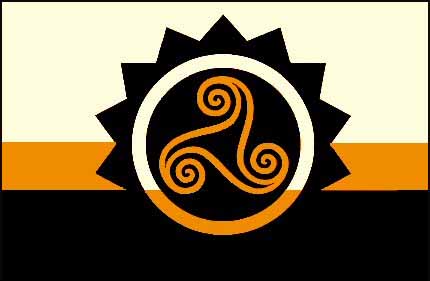
See the Trophy of Augustus link for a list of all the major tribes who were conquered in Cisalpine Gaul (Italics and Celts), and direct links to many of those tribes. Also see the List of Celtic tribes for direct links to many of the various Celtic tribes mentioned above. I would also like to take this time to say that I would like to symbolically designate the above flag, which is fictional, as the flag of the Celto-Ligurian federation which opposed Rome. Not as an anti-Roman sentiment, but as a symbol of what we were at one time, and for the bravery they displayed in standing up to one of the greatest, if not THE greatest army the world has ever known. The historical record shows clearly that they fought them tooth and tail. The symbol is a Celtic one, which was used in Northern Italy, not to be confused with the Celtic Sun of the Alps symbol, which was also used by the Northern Italian Celti. The colors can reflect the ruggedness of the ancient Alps, and it has the sun symbolism on it.
The ancient Alpine region, just prior to Roman invasion, colonization, and Christianization, was more undeveloped and much more heavily forested. The Italic tribes and their Celtic neighbors were living peacefully together. Last fall, I visited a mountainous and heavily forested area. It was later in the day. Houses were very sporadically located in this area, and it was rather dark due to the large trees blocking out the sun. I really feel that this was a visual glimpse of what much of the ancient Alps looked like, at least the more pre-Alpine mountain valleys. Game was much more abundant. Believe it or not, lions once lived in Europe, and maybe in the lower Alpine valleys. They were probably very similar to Asiatic lions, with short manes. There were a lot more bears and wolves in those forests as well. It was rugged and beautiful.
The Romans had to get through the Celto-Ligurians first, before they could conquer other regions. I seriously doubt that the reason for the invasion was the harassment they suffered along Roman roads, but was probably more due to simple imperialism. Those roads also had to be made entirely safe if they wanted to guarantee their supply lines for the invasion of the more northern lands. Also, they wanted to get at that timber, which probably looked unlimited. Centuries later, the Arabs would almost totally deforest Sicily in only two centuries. Natural resources are always a motivation for invasion, much more than the official reason (to stop the harassment on Roman roads). The truth of this history is also a very inconvenient fact against the irresponsible concept of "Italians (Romans) invading Northern Europe (Celtic Gaul)." In reality, they had to conquer the fierce Alpine peoples first.
Subscribe to:
Posts (Atom)