
Showing posts with label heathen. Show all posts
Showing posts with label heathen. Show all posts
Thursday, December 6, 2012
The Raven witch and the Autumnal equinox
I missed this seasonally, but this video just sort've came together for me. However, we are still in the Fall. To change the subject, I suppose that I'm not the only one who has fallen in love with certain software programs which slowly become obsolete... and the newer versions of Windows force them out.... aaaand, the newer versions are awful. I loved Corel Photo Paint 8, but it's just no longer compatible, and the newer versions are really, really bad. They're ridiculously confusing and positively limited. There's a big difference between that, and merely getting used to the newer versions of Word, which really just take some time getting used to. I used to really love the older WordPerfect office, more than Word, but I guess it's just a matter of going with what it pragmatic and available.
The Raven witch and the Autumnal equinox
Equinox
http://en.wikipedia.org/wiki/Autumnal_equinox
An equinox occurs twice a year (around 20 March and 22 September), when the tilt of the Earth's axis is inclined neither away from nor towards the Sun, the center of the Sun being in the same plane as the Earth's equator. The term equinox can also be used in a broader sense, meaning the date when such a passage happens. The name "equinox" is derived from the Latin aequus (equal) and nox (night), because around the equinox, night and day are about equal length.
Wheel of the Year
http://en.wikipedia.org/wiki/Wheel_of_the_Year
Autumnal equinox
The holiday of the autumnal equinox, Harvest Home, Mabon, the Feast of the Ingathering, Meán Fómhair or Alban Elfed (in Neo-Druidic traditions), is a Pagan ritual of thanksgiving for the fruits of the earth and a recognition of the need to share them to secure the blessings of the Goddess and the God during the coming winter months. The name Mabon was coined by Aidan Kelly around 1970 as a reference to Mabon ap Modron, a character from Welsh mythology.[27] Among the sabbats, it is the second of the three Pagan harvest festivals, preceded by Lammas / Lughnasadh and followed by Samhain.
[Music: 'Dream Weaver by Michelle Mays; 'Celtic Requiem Chant' by Elliot Simons]
.


Friday, May 8, 2009
Wotan, Mead, the Irminsul, the Nine Noble Virtues, and other pagan loose ends
 There are a few more areas to cover, which I will tie into one entry. I am a believer that a person can view so-called "paganism" as: 1) a religion, 2) a history, 3) a look into the spirituality and soul of a people, and 4) as a set of principles to be adhered to (if they wish). One need not actually "join" a religious and/or spiritual tradition, in order to adhere to it. To make it's values and principles a part of their own conscience.
For example, the 'Nine Noble Virtues'.
Odinic Rite:
1. Courage
2. Truth
3. Honour
4. Fidelity
5. Discipline
6. Hospitality
7. Self Reliance
8. Industriousness
9. Perseverance
Asatru Folk Assembly:
1. Strength is better than weakness
2. Courage is better than cowardice
3. Joy is better than guilt
4. Honour is better than dishonour
5. Freedom is better than slavery
6. Kinship is better than alienation
7. Realism is better than dogmatism
8. Vigor is better than lifelessness
9. Ancestry is better than universalism
 Like the 'Ten Commandments' in Christianity, these principles and many other, much deeper, aspects of Odinism (or Asatru) can be admired and studied. I am aware that the Nine Noble Virtues are guidelines and not "thou shalt nots," and they have no concept of "hell," etc., but my real point is that we can look into any faith and adopt some principles from them. I recently viewed an episode on the History Channel program 'Warriors' with Terry Schappert. It was about the Zulu tribe, and they had a special ceremonial tradition after a battle, in which a warrior is purified in order to go back into society. I thought it was in interesting spiritual concept.
The "Viking Era" was a very small part of the history of what we call Odinism or Asatru. Actually, our ancient Lombard ancestors called what was basically the chief god, usually called Odin, the god of war, as Wotan or Wodan. They were Wotanists or Wodanists, and I mean this was many, many centuries ago. The 'Nine Noble Virtues' was taken from one of the Norse Sagas I believe, and the first one, from the Odinic Rite, was the original.
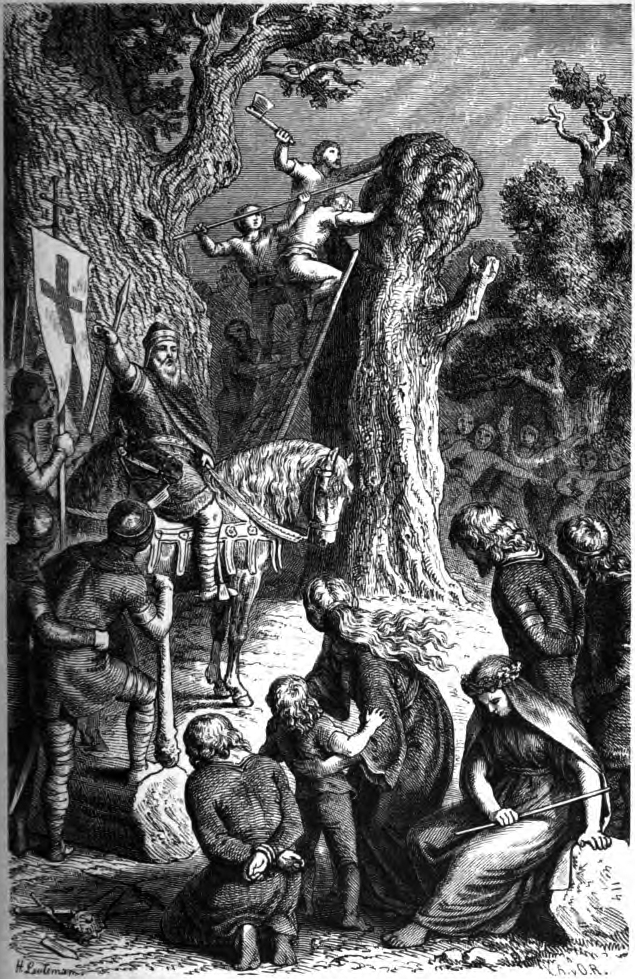
I would also like to at least mention the "Irminsul" (see image to the right), which was a large carved wooden pillar, which was a very important part of this spirituality. I don't think that it was intrinsically worshipped, but may have been a manner to get in touch with all of the gods. Perhaps someone could clue us in there. It appears that the old Germanic tribes often just used a carved tree trunk for this purpose as well. When the Romans, and later powers, finally mobilized themselves to spread Christianity, lets face it, they often did it via force. The following painting was composed by German painter Heinrich Leutemann in 1882, and was entitled 'The destruction of Irminsul through Charlemagne'. It depicts Wotanists literally being forced to accept Christianity as their Irminsul is demolished.
Did you know that names from the days of the week, which we use every day, are from Norse/Germanic spirituality or gods?
Sunday -- "Sun's Day"
Monday -- "Moon's Day"
Tuesday -- "Tiu's Day"
Wednesday -- "Wodan's Day"
Thursday -- "Thor's Day"
Friday -- "Freya's Day"
Saturday -- "Saturn's Day"
Wodan, Wotan, or Woden, may have originally come from the worship of the Greek god Mercury. It's hard sometimes to substantiate some of these things due to various cultures wanting to maintain the purity or originality of their history. I suppose that if this was true, that it was probably due to influence from the Romans, or possibly the Etruscans. I don't really know.
Mead (from description at Wikipedia): "Mead is a typically alcoholic beverage, made from honey and water via fermentation with yeast. Its alcoholic content may range from that of a mild ale to that of a strong wine. It may be still, carbonated, or sparkling. It may be dry, semi-sweet, or sweet.
"Depending on local traditions and specific recipes, it may be brewed with spices, fruits, or grain mash. It may be produced by fermentation of honey with grain mash; mead may also, like beer, be flavored with hops to produce a bitter, beer-like flavor."
What is amazing is that Mead is so hard to find! It was such a part of our ancestors lives, yet it's difficult to find in the market. I don't think that it would be very difficult to make. It can be purchased online pretty easily. Try Yahoo Shopping. Check the Wikipedia link, as there is much more than we have time to research and cover right now. YouTube has videos on how to make Mead as well.
There is an interesting FAQ, from the Wisconsin Vinland Association, called 'An FAQ: Asatru, Wicca, and paganism', which is quite interesting. However, it's pretty apparent that they are a "Universalist" group, meaning that they have a belief that the traditions of their ancestors belong to all other cultures of the earth just as much as it belongs to them. It's probably a split down the middle as far as pagans of European traditions, between those who are Universalist or Folkish. Folkish means that one's heritage is inherently "theirs," and not belonging to every other culture in the world.
 I believe that a European descended person should feel free to study, for example, Shintoism. They may study it, admire it, and even adhere to it; but they can never become a Shintoist because they're not Japanese. It would be extremely disrespectful and dishonorable to try to do this. In the same way, a Japanese person could study and admire Asatru, without trying to co-opt it. Many White Americans flock to Hawaii and force themselves on the native Hawaiian religion, which has caused some of the local Hawaiians to get pretty angry. Again, study, admire, and even adhere to anything, but I believe that it's important for every human being on earth to realize that not everything in the world belongs to YOU. The image above: a Shinto Shrine. Again, don't be afraid to go to YouTube and look up all of these subjects. Many people have downloaded some amazing videos.
 I know, this entry has bounced all over the place. I would like to end with an article from the Odinic Rite, entitled 'Images of the Wolf in the Northern Psyche'. It's in PDF, and they don't want it reproduced anywhere without permission, so I will not post the text. It is about the wolf in ancient northern culture and folklore. Actually, much of this folklore survived up to a point in history later than we realize, in some instances. Many ancient Lombard names had a "wulf" ending to them, which comes directly from the reverence of the wolf. I should also mention that this article was written by Heimgest, the director of the Odinic Rite, and I will end this entry with links to four videos of a very interesting interview of him which was conducted.
Interview With a Gothi - Part 1
Interview With a Gothi - Part 2
Interview With a Gothi - Part 3
Interview With a Gothi - Part 4
Subscribe to:
Posts (Atom)