Love Affair | FIAT 500X and FIAT 124 Spider FIAT USA FIAT has a way of seducing one’s heart from the get go. Whether it’s the performance of the FIAT 124 Spider or the FIAT 500X; prepare to be enchanted. FIAT has been offering customers affordable yet innovative solutions to meet their mobility needs for more than a century. The brand’s mission is to combine the Italian passion for design and originality with efficiency and versatility to simplify everyday life with the joyful usefulness of its products. If you have questions about our products or would like to contact FIAT directly, please use the "Contact Us" option from our website: www.fiatusa.com. SUBSCRIBE TO THE FIAT BRAND YOUTUBE CHANNEL: https://www.youtube.com/user/fiatusa Follow the FIAT brand on social: Facebook: https://www.facebook.com/fiatusa Twitter: https://twitter.com/fiatusa Google+: https://plus.google.com/+FIATUSA/posts Instagram: http://instagram.com/fiatusa Pinterest: http://www.pinterest.com/fiatusa/ Tumblr: http://fiatusa.tumblr.com Blog: http://blog.fiatusa.com/ *************************
. 'Fiat Chrysler’s Income Soars in Latest Quarter' By Chester Dawson - The Wall Street Journal - January 25, 2018 Italian-American auto maker’s profit margins surpass rival Ford Motor DETROIT—Fiat Chrysler Automobiles NV said Thursday it nearly doubled its earnings in the latest quarter, moving the auto maker closer to its ambitious growth targets and surpassing the profitability at rival Ford Motor Co. The strong results are a sign of the company's revival after emerging from bankruptcy almost a decade ago and the merger with Fiat under the Italian auto maker's chief executive, Sergio Marchionne. con't...
*************************
FIAT: Fabbrica Italiana Automobili Torino (Italian Automobile Factory of Turin)
William Paca (October 31, 1740 – October 13, 1799) was a signatory to the United States Declaration of Independence as a representative of Maryland, and later Governor of Maryland and a United States federal judge.
Early life and education Paca was born in Abingdon, in what was then Baltimore County (Abingdon was later included in Harford County when that county was formed from Baltimore County in 1773), in the British colony of Maryland. He was the child of John Paca (c. 1712 – 1785), a wealthy planter in the area, and his wife Elizabeth Smith (?-c. 1766). He was the second son of the family, after his elder brother Aquila, and had five sisters. The brothers entered school at the Philadelphia Academy and Charity School in 1752, and the younger Paca went on to attend the College of Philadelphia (now merged into and known as the University of Pennsylvania), graduating in 1759 with a bachelor of arts degree.[2] He was also to receive a master of arts degree from the college in 1762, though this required no further study, only that Paca request it and be in good standing. After graduating from college, Paca returned to Maryland, reading law in the colonial capital of Annapolis under the tutelage of a local lawyer named Stephen Bordley. By 1761, he was licensed to practice law, and in 1764 was admitted to the provincial bar, having stayed in Annapolis to establish his practice. Professional success was mingled with personal success, as the previous year he had courted Mary Chew, the daughter of a prominent Maryland planter, and they were married on May 26, 1763. They had three children, though only their son John Philemon survived into adulthood.
Career Among the other young lawyers in Annapolis at the time was Samuel Chase, who became a close friend and political colleague of Paca. Paca and Chase led local opposition to the British Stamp Act of 1765 and established the Anne Arundel County chapter of the Sons of Liberty. Paca was elected to the Maryland legislature in 1771 and appointed to the Continental Congress in 1774. He was reelected, serving until 1779, when he became chief justice of the state of Maryland. In 1780, he was elected to serve as a federal judge on the Court of Appeals in Cases of Capture. In 1782 he was elected governor of Maryland. On December 22, 1789, Paca received a recess appointment from President George Washington to a seat on the newly created United States District Court for the District of Maryland, created by 1 Stat. 73. Formally nominated on February 8, 1790, he was confirmed by the United States Senate on February 10, 1790, and received his commission the same day, serving until his death. Paca's career on the federal bench had a significant impact on the admiralty jurisdiction of the Federal courts and what was to become the principal business of the Supreme Court over the subsequent four decades. As the first Federal judge for the District Court of Maryland he rendered an opinion on the case of Betsey that had far reaching consequences when it was overturned by the Supreme Court. In that case Paca argued on solid precedents of international and British law that the District Court did not have jurisdiction over the awarding of prizes brought into American ports by foreign privateers. The Supreme Court asserted otherwise in seriatum opinions and established an exclusive jurisdiction over prize cases vested in the Federal District Courts that took that privilege away from what had been the responsibility of foreign consulates. Paca's opinion was the first District Court opinion to be published, and although ultimately reversed, it provides insight into the extensive legal training of a signer of the Declaration of Independence and an author/compiler of several provisions of what became the Bill of Rights. Paca died in 1799 at his estate of Wye River in Queen Anne's County, Maryland and was buried in the family cemetery there.
William Paca | Declaration of Independence FreedomProject Media Follow the life of William Paca, delegate to the Continental Congress and one of 56 signers, who bravely proclaimed the original thirteen colonies would break away from British rule to form the United States of America. Enjoy this special look at William Paca, signer of the Declaration of Independence. Legacy In Maryland, three elementary schools are named for him: one in Landover, one in Baltimore city (#83) and the other in his home town of Abingdon. A prominent street in Downtown Baltimore bears his name, as does a dormitory on the campus of St. John's College in Annapolis as well as one on the campus of Towson University. Outside of Maryland, a Middle School in Mastic Beach, New York and P.S. 155 in New York City are also named after him. In August 2008 the House was added as a new residence hall in Towson University. His Annapolis home, the House and Garden, was added to the National Register of Historic Places and designated a National Historic Landmark in 1971. The William Paca Club in New Providence, New Jersey is named in his honor. The Club cites the fact that Paca was the only Italian America to sign the Declaration of Independence as the reason for bestowing him this honor.
William Paca House Learn about the life and explore the historic home of 18th-century lawyer and signer of the Declaration of Independence, William Paca. An elegant Georgian mansion and National Historic Landmark, the William Paca House has been carefully restored to look much the same as it would have when it was first built in the 1760s. Learn about the famous owner of the magnificent mansion and find out what life was like for him and his family during the 18th century. con't... Personal life Paca has been described as being of Italian ancestry. According to Stanley South, "The rumor that the name was Italian came from a remark made in 1911 by James Cardinal Gibbons of Baltimore, who commented that he thought a relationship existed between Paca and the Italian family Pecci." In a July 18, 1937, letter to the New York Times, a self-described descendant of Paca claimed: The ancestors of William Paca were of Italian and English origin. The name is said to have originally been spelled Pacci. However, in an interview with Giovanni Schiavo, the letter writer apparently attributed the suggestion that the name was Pecci to Cardinal Gibbons. Schiavo also reported that Paca mentioned Pope Leo XIII (1879–1903), whose surname was Pecci, during the interview. Stiverson and Jacobsen reported that spellings of the surname of William Paca's immigrant ancestor Robert include Peaker, Pecker, Peaca, Peca, and Paka. Neither "Pecci" nor "Pacci" (nor "Pacca") are attested, but that could be attributed to the fact that the Italian spelling of the name would have simply been difficult or unfamiliar to the English-speaking clerks of the time.
Annapolis, Maryland: The William Paca House DonneTempoVideo http://www.donnetempo.com Writer Jacquie Kubin from Donne Tempo magazine visits historical residences of Annapolis, Maryland. This installment visits one of Annapolis' most historic Georgians, The William Paca House museum. Glen Campbell, historian for Historic Annapolis takes us on a tour of one of Annapolis' finest homes with a secret treasure in the back, a formal terraced garden in the grand design. *************************
The surname Pacci is of Tuscan, or possibly Umbrian or Marchese, origin. There certainly were Tuscans, Piedmontese, etc. living in the early American colonies. Also, there were wealthy "Lombard bankers" living in London in the Middle Ages. For example, the actress Teri Polo I'm guessing is of English ancestry; but likely has a Venetian forefather. Sometimes the surname was altered in aristocratic circles, making it sound more in line with an English gentleman.. rather than a somewhat foreign sounding name. Paca House & Garden visit
Between the Fall of Rome and the dawn of the Renaissance, Europe plunged into a dark night of constant war, splintered sovereignties, marauding pagans, rabid crusaders and devastating plague. That anything of value arose from this chaotic muck - much less the Renaissance - is nothing short of miraculous. The History Channel examines the Dark Ages from the fall of the Roman Empire to the First Crusade.
Between the Fall of Rome and the dawn of the Renaissance, Europe plunged into a dark night of constant war, splintered sovereignties, marauding pagans, rabid crusaders and devastating plague. That anything of value arose from this chaotic muck - much less the Renaissance - is nothing short of miraculous. The History Channel examines the Dark Ages from the fall of the Roman Empire to the First Crusade.
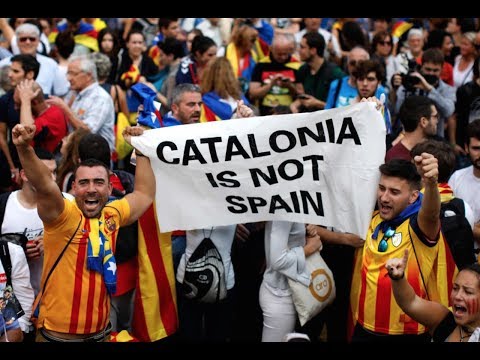
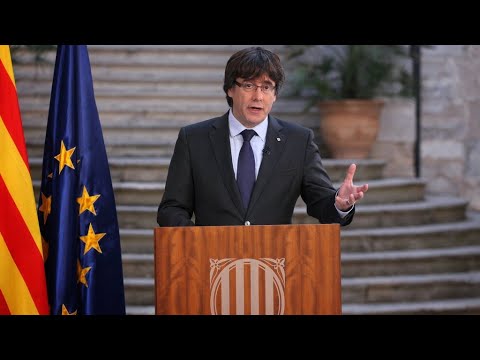
Catalonia’s ousted president has traveled to Brussels and been offered asylum, Spanish authorities said Monday soon after indicating that prosecutors were filing charges against him and other regional leaders related to their declaration of independence last week.
Spanish prosecutors in Madrid said they were asking judges for rebellion, sedition and embezzlement charges against Catalan leader Carles Puigdemont and others who were dismissed by Spain’s central government.
Puigdemont and a majority of Catalonia’s parliament declared independence Friday, but the Spanish government then fired them under a special constitutional provision and called new regional elections Dec. 21.
The attorney general, José Manuel Maza, did not order their immediate arrest, saying he wanted to urgently prosecute the 20 politicians and ordering them to appear in court in Madrid in coming days.
Jaume Alonso-Cuevillas, Puigdemont's attorney, told Antena 3 television that the attorney general’s claim that his client was guilty of rebellion was “real nonsense.”
Puigdemont did not immediately comment. A spokeswoman for his party, Marta Pascal, said she could not confirm whether he would appear in court to face charges. “I’ve talked with him, and he’s fine,” she said at a news conference.
The Madrid government had warned members of the Catalan cabinet that they could remove belongings from their offices Monday but if they tried to perform official duties, they would face charges. con't.... *************************
By Brittany Vonow, Mark Hodge, and Jennifer Awford - 'The Sun' (UK) - October 29, 2017
CATALAN'S deposed leader has seemingly refused to concede he had been sacked as he called for calm in Spain as the country teeters on the brink of its worst political crisis in four decades.
As the Spanish government held its first meeting to discuss their new roles since imposing direct rule over Catalonia, Carles Puigdemont instead promised to continue to build a "free country", and called for "democratic opposition" to Madrid.
In the pre-recorded, televised message, Puigdemont urged people to continue pushing for independence, saying: "We do not deviate: we continue persevering in the only attitude that can make us winners.
"Without violence, without insults, in an inclusive way, respecting people and symbols, opinions, and also respecting the protests of the Catalans who do not agree with what has decided the parliamentary majority."
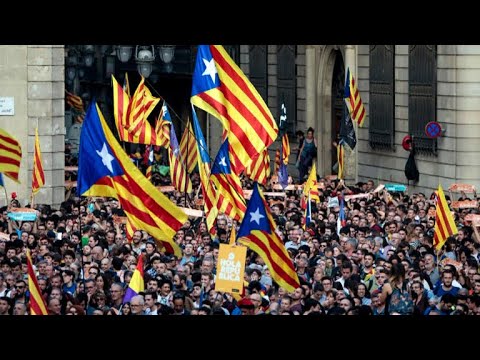
As pro-unity protesters crowds took to the streets on Saturday, screaming "prison for Puigdemont", the leader said "patience, perseverance and perspective" was needed.
It comes after fears that the country could further descend into violence have surfaced after the Prime Minister ordered fresh elections and fired Catalonia's hero police chief who led its response to the Barcelona ISIS terror attack.
Catalonia officials have also been stripped of their powers across civil service, finances and public media, with all eyes on whether independence supporters will carry out their threat of peaceful resistance to Madrid's takeover.
Fights erupted on the streets of Barcelona last night as both sides of the argument took to the streets and further protests were held in Madrid today amid fears local police could resist the national force. con't....
*************************
Obviously the Spanish government does not recognize the Catalonians as any sort of distinct and unique people, language, and culture. After decades of being prepped by Globalist interests, there's no turning back as far as that governmental apparatus... and all of the others for that matter. The Spanish government is really no worse than the Italian government, or Britain, France, Germany, etc. They believe that Catalonia is merely an "administrative zone," and that a Catalonian has no more right to it than a Yemeni migrant. Spain is like Shawshank Prison; the Spanish government is like Warden Norton; Catalonia is like Andy Dufresne. "How dare you leave us and take away all of your energy and talent! We need the wealth that you generate in order to survive!" Pitiful. There is at least some slim degree of mainstream support for Catalonia; from Scotland, Portugal to a smaller extent. .
MILAN (AP) — The presidents of Italy's wealthy northern regions of Veneto and Lombardy on Sunday claimed victory in autonomy referendums that seek to grab additional powers and tax revenue from Rome, riding a global tide of self-determination that has swamped Spain's Catalonia region.
The votes were nonbinding, but the leaders of the neighboring regions hope to leverage strong turnout in talks with Italy's center-left government. As leading members of the anti-migrant, anti-EU Northern League, they want to keep more tax revenue and have autonomy over such policy areas as immigration, security, education and environment.
"This is the big bang of institutional reform," Veneto President Luca Zaia said in Venice. "We are convinced, and I hope Rome understands, that this is not the wish of a political party. These are the wishes of the people."
In Milan, his counterpart in Lombardy, Roberto Maroni, said that with the votes, the two regions "can unify our forces so we can do the battle of the century." The two leaders say they will meet with their regional councils to finalize their requests before going to Rome to meet with Premier Paolo Gentiloni.
Unlike in Catalonia, the referendums do not seek independence and were approved by Italy's constitutional court. Still, the autonomy drive is a powerful threat to Rome's authority. Together, Veneto and Lombardy account for 30 percent of Italy's GDP and nearly one-quarter of the nation's electorate.
Maroni said an overwhelming 95 percent of his region's vote went to "yes," with turnout above 40 percent of Lombardy's 8 million voters. That far exceeded the bar for success that he set at 34 percent, which was the turnout for a national referendum on constitutional reform in 2001.
Independence-minded Veneto easily met a turnout threshold to validate the vote set by Zaia, with some 60 percent of the region's 4 million voters casting ballots. According to early returns, 98 percent voted "yes." con't.... .
While the Catalan crisis dominates the headlines, a similar story is breaking out in Italy – with the country’s northern regions gearing up for a wide autonomy referendum. Can the vote succeed – and how will Rome deal with the results? We ask Matteo Salvini, leader of Italy’s Northern League party.
This month the Lombardy region and the city of Venice will both vote on new powers of autonomy at referendums which are now taking on increasing levels of controversy.
Previously seen as a low-scale vote on local powers, the referendums are now experiencing symbolic overtones following last Sunday’s Catalonian chaos.
Last weekend more than 800 people were injured by police as a referendum on independence for Catalonia was held - against the express wishes of leaders in Madrid and Brussels.
And now Italy is facing similar chaos with two referendums set to be held on October 22, although in these instances the votes are state-approved and will not face violent opposition. con't.... *************************
Globalism (bankers) vs. Nationalism (the cultures of the world) The comments at the end of the two below articles reflect the changing opinion regarding the European Union as well as any. Unfortunately it took Europe being brought to the brink in order to finally comprehend what the EU is really all about. https://www.rt.com/shows/sophieco/406084-catalan-crisis-referendum-italy/
POLICE VIOLENCE IN CATALONIA The Exposer That's why Barcelona and Las Pamas won't be played, security can't be assured. Catalan referendum: 337 injured amid reports of rubber bullets fired by Spanish police. Violence breaks out in Barcelona as riot police attack protests, while Catalans cast independence votes in peaceful defiance of Spanish government. ************ POLICE VIOLENCE IN CATALONIA (Part 2)
************************* The Globalist Spanish government have recruited police, from all other administrative regions of Spain, and dispatched them into Catalonia in a last minute attempt to prevent the referendum. 40% of the total GNP of Spain comes from the little state of Catalonia, which has only 14% of the population! The simple truth is that the Spanish government believes that they preside over mere administrative regions where rootless bankers, Capitalists, Marxists, migrants, and perverts can collect their "entitlements" at the expense of the descent worker and small business person.
This police action is very similar to the manner in which the UK has used it's military in Northern Ireland over the years. The tribal resolve of the collective Catalonian people has ultimately proven to be stronger than separatists from Ireland, Scotland, Padania, Venetia, the Basque Country, and other regions. This is far from over. Catalonia needs to seize full control of their land from an enemy foreign government by forming a provisional army immediately! This almost reminds of the the Five Days of Milan where the people literally defeated the Austrian army.