
Showing posts with label Roman Catholicism. Show all posts
Showing posts with label Roman Catholicism. Show all posts
Friday, November 10, 2017
"The Dark Ages" - documentary
The Dark Ages (Full Documentary)
ajvaughan3 Documentary Films
Between the Fall of Rome and the dawn of the Renaissance, Europe plunged into a dark night of constant war, splintered sovereignties, marauding pagans, rabid crusaders and devastating plague. That anything of value arose from this chaotic muck - much less the Renaissance - is nothing short of miraculous. The History Channel examines the Dark Ages from the fall of the Roman Empire to the First Crusade.
Between the Fall of Rome and the dawn of the Renaissance, Europe plunged into a dark night of constant war, splintered sovereignties, marauding pagans, rabid crusaders and devastating plague. That anything of value arose from this chaotic muck - much less the Renaissance - is nothing short of miraculous. The History Channel examines the Dark Ages from the fall of the Roman Empire to the First Crusade.
.


Sunday, April 9, 2017
'Risen' (2016) - movie review
Risen Official Trailer 1 (2016) - Tom Felton Biblical Movie HD
Movieclips Film Festivals & Indie Films
RESURRECTION tells the epic New Testament story of the first forty days after the Resurrection of Jesus Christ through the eyes of an agnostic Roman Centurion charged by Pontius Pilot to investigate rumors of a risen Jewish Messiah and locate the missing deceased body of Jesus of Nazareth in order to subdue an imminent uprising in Jerusalem.
Risen (2016 film)
Risen is a 2016 American biblical drama film directed by Kevin Reynolds; it was conceived from a screenplay written by Reynolds and Paul Aiello. The film stars Joseph Fiennes, Tom Felton, Peter Firth, and Cliff Curtis, and details a Roman soldier's search for Jesus' body following his Resurrection. Columbia Pictures released the film to theaters nationwide in the United States on February 19, 2016.
*************************
 The film begins with the words "Judean Desert AD 33," and a revolt by Judeans against the Roman army. A rather gutty thing to do, as they were poorly armed. In the bigger picture, the Roman provincial prefect Pontius Pilate wanted things to settle down for a coming visit from the Emperor. In a separate early scene, the Crucifixion of "Yeshua" is shown, and the central character Clavius is introduced. He was a high ranking Roman military tribune; likely a fictional character. Roman and Hebrew leadership were portrayed as conspiring together against Yeshua's potential "Messiah" status after his death, and no doubt were doing so when he was alive as far as this movie's depiction.
Basically, the Hebrews appeared as what we would perceive as like Russian Jews; while the Romans appeared more-or-less accurately as being something of like "Alpine types." There is at least some evidence to suggest that the early Romans were more of a proto-European outfit... rising up against the more Mediterranean Etruscans. Our own Cisalpine culture led the way, in terms of the artistic portrayals of Jesus, centuries later. Needless to say, this movie is very relevant to our culture.
While this film doesn't have a particularly expensive or elaborate setting, it likely shows a more accurate Judea of 2,000 years ago. It shows the characters the way they were to have been, without overstating the point. It's an easy watch; rough without displaying too much overt violence.
*************************
.
.
.
.
.
Spoiler alert beyond this point!
.
.
.
.
.

The movie ends with Yeshua saying a few parting words as he walked towards the rising sun, and finally disappears into it. This at least suggests a connection with Horus, Egyptian mythology, and more ancient sun cult stories... and a symbolic tie-in with "the Sun," "the light of the world," or "our risen savior" (every morning). It's possible that this was a more subtle symbol. My guess is that the filmmakers displayed a clear tie-in with Horus. There was also the fish symbolism, which was not nearly as clear or dramatic as the sun symbology.
.
Wednesday, June 22, 2016
La Grande Rogazione di Asiago
" Il Giro del Mondo " La Grande Rogazione di Asiago from Tacconi Luca on Vimeo.
"La Grande Rogazione di Asiago"
"The Great Rogation of Asiago"... apparently a tradition since 1638.
Rogation: In the Christian Church a solemn supplication consisting of the litany of the saints chanted on the three days before Ascension Day.
Asiago is an old Cimbrian town in the Vicenza Province of the Veneto Region.
The town was the site of the Battle of Asiago in 1916 vs. the Austrian army.
Until the middle of the nineteenth century many of the people of Asiago spoke Cimbrian, an ancient German dialect.
Asiago is the birthplace of author Mario Rigoni Stern, and features prominently in his stories. It is also described in Emilio Lussu's 'A Year on the Altopiano'.
The Asiago region is the origin of Asiago cheese.
.
"La Grande Rogazione di Asiago"
"The Great Rogation of Asiago"... apparently a tradition since 1638.
Rogation: In the Christian Church a solemn supplication consisting of the litany of the saints chanted on the three days before Ascension Day.
Asiago is an old Cimbrian town in the Vicenza Province of the Veneto Region.
The town was the site of the Battle of Asiago in 1916 vs. the Austrian army.
Until the middle of the nineteenth century many of the people of Asiago spoke Cimbrian, an ancient German dialect.
Asiago is the birthplace of author Mario Rigoni Stern, and features prominently in his stories. It is also described in Emilio Lussu's 'A Year on the Altopiano'.
The Asiago region is the origin of Asiago cheese.
.
Thursday, March 3, 2016
'Vergine bella' - Giovanni Pierluigi
Giovanni Pierluigi da Palestrina - Vergine bella - Bronzino
MrThesoundflyer
Palestrina, Vergine bella, from Madrigali spirituali a cinque voci on texts by Francesco Petrarca. Bronzino, paintings. ensemble officium, Wilfried Rombach, conductor.
Giovanni Pierluigi da Palestrina
Giovanni Pierluigi da Palestrina (c. 1525 – 2 February 1594) was an Italian Renaissance composer of sacred music and the best-known 16th-century representative of the Roman School of musical composition. He had a lasting influence on the development of church music, and his work has often been seen as the culmination of Renaissance polyphony.
.
Monday, November 30, 2015
The Wolf of Gubbio
MsCynthiaX
Wolf of Gubbio
The wolf of Gubbio was a wolf that, according to the Fioretti di San Francesco, terrorized the Umbrian city of Gubbio until it was tamed by St. Francis of Assisi acting on behalf of God. The story is one of many in Christian narrative that depict holy persons exerting influence over animals and nature, a motif common to hagiography.
.
Sunday, April 5, 2015
Gregorian Easter chant - 'Victimae Paschali Laudes'
Victimae Paschali Laudes
From bispofr YouTube channel
**************************************************
Description from YouTube user choirmusicrocks
Victimae Paschali Laudes is a sequence prescribed for the Roman Catholic Mass of Easter Sunday. It is usually attributed to the 11th century Wipo of Burgundy, chaplain to the German Emperor Conrad II, but has also been attributed to Notker Balbulus, Robert II of France, and Adam of St. Victor.
Victimae Paschali Laudes is one of only five medieval sequences that were preserved in the Missale Romanum published in 1570 after the Council of Trent (1545-63). The four others were the "Veni Sancte Spiritus" (for the feast of Pentecost), "Lauda Sion" (for Corpus Christi), the "Stabat Mater" (for The Feast Of Our Lady Of Sorrow), and the "Dies Irae" (for the Requiem Mass). *
*Source:Wikipedia and Fr. Fred Klotter
.
Tuesday, February 17, 2015
St. Michael - Patron Saint of the latter Langobards

"St. Michael the Archangel, defend us in battle; be our safeguard against the wickedness and snares of the devil. May God rebuke him, we humbly pray, and do Thou, O Prince of the Heavenly Host, by the power of God, cast into hell, Satan and the other evil spirits who prowl through the world, seeking the ruin of souls. Amen."
When approximately a half million Langobards invaded the Cisalpine region in the sixth century, perhaps slightly over half of them were Odinic Heathens (not the Christian usage of "heathen"), and the rest were Arian Christians (not the same as "Aryan"). Over time, especially under the rule of Queen Theodelinda, they became largely Catholic.
The Prayer to St. Michael (above), to me somehow captured the spirit of the still-very-formidable Langobard army of the post-Cisalpine era. However, it was written by Pope Leo XIII in the nineteenth century.
From PacemInTerris.org:
In a vision, Pope Leo XIII was shown the fearful battle to be waged between Satan and St. Michael over the Church of the future. He composed the following powerful prayer, which you may use as a defense against Satan and all evil spirits. The Church has set aside September 29th to celebrate the holy archangels Michael, Gabriel, and Raphael.

The Archangels
An archangel is an angel of high rank. Beings similar to archangels are found in a number of religious traditions; but the word "archangel" itself is usually associated with the Abrahamic religions.
From PaceInTerris.org:
Archangels are mentioned throughout sacred Scripture in their unique role as God’s messengers to people at critical times in the salvation process.
The Archangels likely predate Abrahamic religions, but that opens up a whole new area of study.
 Archangel Michael
Michael the Archangel
Michael ("who is like God") is an archangel in Jewish, Christian, and Islamic teachings. Roman Catholics, the Eastern Orthodox, Anglicans, and Lutherans refer to him as "Saint Michael the Archangel" and also as "Saint Michael". Orthodox Christians refer to him as the "Taxiarch Archangel Michael" or simply "Archangel Michael."
St. Michael (Catholic)
Saint Michael the Archangel is referred to in the Old Testament and has been part of Christian teachings since the earliest times. In Catholic writings and traditions he acts as the defender of the Church, and chief opponent of Satan; and assists souls at the hour of death.
"Lombards" from the well-admired 1911 Encyclopedia Britannica
 The 1911 Ecyclopedia Britannica is considered by many to be a great source of knowledge. Later encyclopedias were influenced by powerful institutions and lobbying groups who basically sought to "change history." Its description of the Langobards and their history, entitled 'LOMBARDS, or LANGOBARDI', is excellent as a brief source.
If you're like me, and during the evening you don't feel like staring at a screen and concentrating to read a long article, you may want to try FromTextToSpeech.com. Then you can just sit back and listen. I use the "Heather" voice, which I find easy to understand.
.
Wednesday, September 25, 2013
'Libira Me' - Roman Catholic chant
Deliver me, O Lord, from death eternal on that fearful day,
When the heavens and the earth shall be moved,
When thou shalt come to judge the world by fire.
I am made to tremble, and I fear, till the judgment be upon us, and the coming wrath,
When the heavens and the earth shall be moved.
That day, day of wrath, calamity, and misery, day of great and exceeding bitterness,
When thou shalt come to judge the world by fire.
Rest eternal grant unto them, O Lord: and let light perpetual shine upon them.
Libira Me (Wikipedia)
Líbera me ("Deliver me") is a Roman Catholic responsory that is sung in the Office of the Dead and at the absolution of the dead, a service of prayers for the dead said beside the coffin immediately after the Requiem Mass and before burial. The text of Libera Me asks God to have mercy upon the deceased person at the Last Judgment.
.
Tuesday, July 30, 2013
Paul the Deacon
 |
| Monte Cassino |
Paul the Deacon was born in Friûl, in the Langbard state of Austria (Lombardy/Trento/Tri-Veneto), in the Early Middle Ages. Although of Langobard ancestry, he later became a Catholic monk at Monte Cassino. He is famous for authoring a history of the Langobards, entitled 'Historia Langobardorum'. This history covers about four centuries of Langobard history, from their origin in southern Sweden to their duchy at Benevento. He passed away before he could complete it. We are indebted to his work.
Being a dedicated Benedictine, his subtle dismissal of the Heathen spiritual tradition of the earlier Langobards was evident in his works. The book was translated into English in 1907 by William Dudley Foulke, and of course, is available. Remember, the headquarters of the Langbard Kingdom was Lombardy; but more specifically, their capitol was Pavia... very close to Liguria and Genoa.
A 1907 quote from a letter from President Theodore Roosevelt to Willian Dudley Foulke:
The translation of Paul the Deacon has just come, and I have already begun to read it. It is such a pleasure to have friends who do such things as you do! What a delightful old boy the Deacon was; and what an interesting maxture of fact and fable he wrote!
Paul the Deacon (c. 720s – 13 April probably 799), also known as Paulus Diaconus, Warnefred, Barnefridus and Cassinensis (i.e. "of Monte Cassino"), was a Benedictine monk and historian of the Lombards.
Life
An ancestor named Leupichis entered Italy in the train of Alboin and received lands at or near Forum Julii (Cividale del Friuli). During an invasion the Avars swept off the five sons of this warrior into Pannonia, but one, his namesake, returned to Italy and restored the ruined fortunes of his house. The grandson of the younger Leupichis was Warnefrid, who by his wife Theodelinda became the father of Paul.
Born between 720 and 735 in Friuli in Italy to this possibly noble Lombard family, Paul received an exceptionally good education, probably at the court of the Lombard king Ratchis in Pavia, learning from a teacher named Flavian the rudiments of Greek. It is probable that he was secretary to the Lombard king Desiderius, a successor of Ratchis; it is certain that this king's daughter Adelperga was his pupil. After Adelperga had married Arichis II, duke of Benevento, Paul at her request wrote his continuation of Eutropius.
It is certain that he lived at the court of Benevento, possibly taking refuge when Pavia was taken by Charlemagne in 774; but his residence there may be much more probably dated to several years before that event. Soon he entered a monastery on Lake Como, and before 782 he had become a resident at the great Benedictine house of Monte Cassino, where he made the acquaintance of Charlemagne. About 776 his brother Arichis had been carried as a prisoner to Francia, and when five years later the Frankish king visited Rome, Paul successfully wrote to him on behalf of the captive.
His literary achievements attracted the notice of Charlemagne, and Paul became a potent factor in the Carolingian Renaissance. In 787 he returned to Italy and to Monte Cassino, where he died on April 13 in one of the years between 796 and 799. His surname Diaconus, shows that he took orders as a deacon; and some think he was a monk before the fall of the Lombard kingdom.
 Works
WorksThe chief work of Paul is his Historia Langobardorum. This incomplete history in six books was written after 787 and at any rate no later than 795/96, maybe at Montecassino. It covers the story of the Lombards from their legendary origins in the north in 'Scadinavia' and their subsequent migrations, notably to Italy in 568/9 to the death of King Liutprand in 744, and contains much information about the Byzantine empire, the Franks, and others. The story is told from the point of view of a Lombard and is especially valuable for the relations between the Franks and the Lombards. It begins:
The region of the north, in proportion as it is removed from the heat of the sun and is chilled with snow and frost, is so much the more healthful to the bodies of men and fitted for the propagation of nations, just as, on the other hand, every southern region, the nearer it is to the heat of the sun, the more it abounds in diseases and is less fitted for the bringing up of the human race.
Among his sources, Paul used the document called the Origo gentis Langobardorum, the Liber pontificalis, the lost history of Secundus of Trent, and the lost annals of Benevento; he made a free use of Bede, Gregory of Tours and Isidore of Seville.
Cognate with this work is Paul's Historia Romana, a continuation of the Breviarium of Eutropius. This was compiled between 766 and 771, at Benevento. The story runs that Paul advised Adelperga to read Eutropius. She did so, but complained that this Pagan writer said nothing about ecclesiastical affairs and stopped with the accession of the emperor Valens in 364; consequently Paul interwove extracts from the Scriptures, from the ecclesiastical historians and from other sources with Eutropius, and added six books, thus bringing the history down to 553. This work has value for its early historical presentation of the end of the Roman Empire in the West, although it was very popular during the Middle Ages. It has been edited by H Droysen and published in the Monumenta Germaniae Historica. Auctores antiquissimi, Band ii. (1879) as well as by A. Crivellucci, in Fonti per la storia d' Italia, n. 51 (1914).
Paul wrote at the request of Angilram, bishop of Metz (d. 791), a history of the bishops of Metz to 766, the first work of its kind north of the Alps. This Liber de episcopis Mettensibus has been recently edited and translated into English by Damien Kempf (Leuven, 2013). He also wrote many letters, verses and epitaphs, including those of Duke/Prince Arichis II of Benevento and of many members of the Carolingian family. Some of the letters are published with the Historia Langobardorum in the Monumenta; the poems and epitaphs edited by Ernst Dümmler will be found in the Poetae latini aevi carolini, Band i. (Berlin, 188f). Fresh material having come to light, a new edition of the poems (Die Gedichte des Paulus Diaconus) has been edited by Karl Neff (Munich, 1908), who denies, however, the attribution to Paul of the most famous poem in the collection, the Ut queant laxis, a hymn to St. John the Baptist, which Guido d'Arezzo fitted to a melody which had previously been used for Horace's Ode 4.11. From the initial syllables of the first verses of the resultant setting he then took the names of the first notes of the musical scale. Paul also wrote an epitome, which has survived, of Sextus Pompeius Festus' De significatu verborum. It was dedicated to Charlemagne.
While in Francia, Paul was requested by Charlemagne to compile a collection of homilies. He executed this after his return to Monte Cassino, and it was largely used in the Frankish churches. A life of Pope Gregory the Great has also been attributed to him, and he is credited with a Latin translation of the Greek Life of Saint Mary the Egyptian.
.
Sunday, June 16, 2013
Francis of Assisi (1961) - complete film
Francis of Assisi (film) [Wikipedia]
Francis of Assisi is a 1961 DeLuxe CinemaScope film directed by Michael Curtiz, based on the novel The Joyful Beggar by Louis de Wohl. It was shot entirely in Italy. The film was not a box-office success. It starred Bradford Dillman in one of his few sympathetic leading film roles (he usually played a villainous character onscreen, despite having originated the role of Jamie in the original stage version of Eugene O'Neill's Long Day's Journey into Night in 1956).
Two years after the release of Francis of Assisi, Dolores Hart, the 24-year-old actress who plays a nun in the film, became a real-life Roman Catholic nun at the Benedictine Abbey of Regina Laudis in Bethlehem, Connecticut.
Plot
Francis Bernadone (Bradford Dillman) is the son of a wealthy cloth merchant in Assisi, who gives up all his worldly goods to dedicate himself to God. Clare (Dolores Hart) is a young aristocratic woman who, according to the film, is so taken with St. Francis that she leaves her family and becomes a nun. By this time (1212 A.D.), St. Francis has a well-established reputation for his vows of poverty. The movie goes on to note miracles (such as the appearance of the stigmata on Francis's hands and feet) and other aspects of his life, up to and including his death on October 3, 1226.
**************************************************
I saw where this was on on the Turner Classic Movies network, and found it on YouTube. I watched it today. If you're a Cisalpine, you should see it. Even with religion aside, it's part of our history.
.
Thursday, March 14, 2013
First non-European Pope is of Cisalpine descent

Pope Francis (Wikipedia)
Pope Francis (Latin: Franciscus Ecclesiastical Latin: [franˈtʃiskus]; born Jorge Mario Bergoglio; 17 December 1936) is the 266th and current pope of the Catholic Church, elected on 13 March 2013. As such, he is both head of the Church and Sovereign of the Vatican City State.
A native of Buenos Aires, Argentina, he was ordained as a priest in 1969. In 1998 he became the Archbishop of Buenos Aires, and in 2001 a cardinal. Following the resignation of his predecessor, Pope Benedict XVI, on 28 February 2013, the conclave elected Bergoglio, who chose the papal name Francis in honour of Saint Francis of Assisi. He is both the first Jesuit pope and the first pope from the Americas. He is also the first pope from outside Europe since Pope Gregory III in the 8th century.
Early life
Jorge Mario Bergoglio was born in Buenos Aires, one of the five children of Mario José Bergoglio, a railway worker born in Portacomaro (Asti) in Italy's Piedmont region, and his wife Regina María Sivori, a housewife born in Buenos Aires to a family of northern Italian (Piedmontese-Genovese) origin. He graduated from a technical secondary school as a chemical technician and then, at the age of 21, decided to become a priest.
.
Friday, August 31, 2012
Eusebio Kino: Missionary and New World Explorer

Eusebio Kino (Wikipedia)
Eusebio Francisco Kino, S.J., (August 1645 – 15 March 1711) was a Jesuit priest from a town which is now a part of northern Italy. For the last 24 years of his life he worked in the region then known as the Pimería Alta, modern day Sonora in Mexico and southern Arizona. He explored the region worked with the indigenous Native American population, including primarily the Sobaipuri and other Upper Piman groups. He proved that Baja California is not an island by leading an overland expedition there. By the time of his death he had established 24 missions and visitas (country chapels or visiting stations).
Born:
Eusebius Franz Kühn (or Chini)
August 1645
Segno, Bishopric of Trent,
Holy Roman Empire
Died:
15 March 1711
Mission Santa Maria Magdalena, Pimería Alta, New Spain,
Spanish Empire
Nationality:
Holy Roman Empire
Occupation:
Priest, missionary, explorer
Eusebio Francisco Kino, S.J., (August 1645 – 15 March 1711) was a Jesuit priest from a town which is now a part of northern Italy. For the last 24 years of his life he worked in the region then known as the Pimería Alta, modern day Sonora in Mexico and southern Arizona. He explored the region worked with the indigenous Native American population, including primarily the Sobaipuri and other Upper Piman groups. He proved that Baja California is not an island by leading an overland expedition there. By the time of his death he had established 24 missions and visitas (country chapels or visiting stations).
Born:
Eusebius Franz Kühn (or Chini)
August 1645
Segno, Bishopric of Trent,
Holy Roman Empire
Died:
15 March 1711
Mission Santa Maria Magdalena, Pimería Alta, New Spain,
Spanish Empire
Nationality:
Holy Roman Empire
Occupation:
Priest, missionary, explorer
Biography
Early life
Kino was born Eusebius Franz Kühn (the name Kino was the version for use in Spanish-speaking domains) in the village of Segno, (now part of the town of Taio), then in the sovereign Prince-bishopric of Trent, a part of the Holy Roman Empire. Other sources cite his name as Eusebio Francesco Chini.
His parents were Franz Kühn (or Francesco Chini) and Margherita Luchi. The exact date of his birth is unknown but he was baptized on 10 August 1645 in the parish church, located in Taio. Kino was educated in Innsbruck, Austria, and after recuperating from a serious illness, he joined the Society of Jesus on 20 November 1665. From 1664-69, he received religious training as a member of the Society at Freiburg, Ingolstadt, and Landsberg, Bavaria. After completing a final stage of training in the Society, during which he taught mathematics in Ingolstadt, he received Holy Orders as a priest on 12 June 1677.
Although Kino wanted to go to the Orient, he was sent to New Spain. Due to travel delays across Europe he missed the ship on which he was to travel and had to wait a year for another ship. While waiting in Cadiz, Spain, he wrote on his observations of a comet, Exposción Astronómica de el Cometa.[1] This publication was later the subject of a sonnet by Sor Juana Inés de la Cruz.
Life in New Spain
Mission in Baja
Kino's first assignment was to lead the Atondo expedition to the Baja California peninsula of the Las Californias Province of New Spain. He established the Misión San Bruno in 1683. After a prolonged drought there in 1685, Kino and the Jesuit missionaries were forced to abandon the mission and return to the viceregal capital of Mexico City.
 |
| Pimeria Alta |
Father Kino began his career in the Pimería Alta on the morning of 14 March 1687, 24 years and one day before his death on 15 March 1711. This was the morning he left Cucurpe, a town once considered the "Rim of Christendom."
Once Father Kino arrived in the Pimería Alta, at the request of the natives, he quickly established the first mission in a river valley in the mountains of Sonora. Subsequently Kino traveled across northern Mexico, and to present day California and Arizona. He followed ancient trading routes established millennia prior by the natives. These trails were later expanded into roads. His many expeditions on horseback covered over 50,000 square miles (130,000 km2), during which he mapped an area 200 miles (320 km) long and 250 miles (400 km) wide. Kino was important in the economic growth of area, working with the already agricultural indigenous native peoples and introducing them to European seed, fruits, herbs and grains. He also taught them to raise cattle, sheep and goats. Kino's initial mission herd of twenty cattle imported to Pimería Alta grew during his period to 70,000. Historian Herbert Bolton referred to Kino as Arizona's first rancher.
Interaction with the Natives
In his travels in the Pimería Alta, Father Kino interacted with 16 different tribes. Some of these had land that bordered on the Pimería Alta, but there are many cases where tribal representatives crossed into the Piman lands to meet Kino. In other cases, Father Kino traveled into their lands to meet with them. The tribes Kino met with are the Cocopa, Eudeve, Hia C-ed O'odham (called Yumans by Kino), Kamia, Kavelchadon, Kiliwa, Maricopa, Mountain Pima, Opata, Quechan, Gila River Pima, Seri, Tohono O'odham, Sobaipuri, Western Apache, Yavapai, and the Yaqui (Yoeme).
Interests
Kino opposed the slavery and compulsory hard labor in the silver mines that the Spaniards forced on the native people. This also caused great controversy among his co-missionaries, many of whom acted according to the laws imposed by Spain on their territory. Kino was also a writer, authoring books on religion, astronomy and cartographys. He built missions extending from the present day states of Mexican Sonora, northeast for 150 miles (240 km), into present-day Arizona, where the San Xavier del Bac mission, near Tucson, a popular National Historic Landmark, is still a functioning Franciscan parish church. Kino constructed nineteen rancherías (villages), which supplied cattle to new settlements.
Kino practiced other crafts and was reportedly an expert astronomer, mathematician and cartographer, who drew the first accurate maps of Pimería Alta, the Gulf of California and Baja California. Father Kino enjoyed making model ships out of wood. His knowledge of maps and ships led him to believe that Mexican Indians could easily access California by sea, a view taken with skepticism by missionaries in Mexico City. When Kino proposed and began making a boat that would be pushed across the Sonoran Desert and to the Mexican west coast, a controversy arose, as many of his co-missionaries began to question Kino's faculties. Kino had an unusual amount of wealth for his vocation, which he used his primarily to fund his missionary activities. His contemporaries reported on his wealth with suspicion.
Death
Kino remained among his missions until his death in 1711. He died from fever on 15 March 1711, aged 65, in what is present-day Magdalena de Kino, Sonora, Mexico. His skeletal remains can be viewed there.
Legacy
Kino has been honored both in Mexico and the United States, with various towns, streets, schools, monuments, and geographic features named after him. In 1965, a statue of Kino was donated to the United States Capitol's National Statuary Hall collection, one of two statues representing Arizona. Another statue of him stands above Kino Parkway, a major thoroughfare in Tucson. Another equestrian statue featuring Kino stands in Wesley Bolin Memorial Plaza across from the Arizona State Capitol in Phoenix. A time capsule is encapsuled in the base. Another equestrian statue also stands next to the Cathedral in the city of Hermosillo, Sonora, México. The towns of Bahía Kino and Magdalena de Kino in Sonora are named in his honor. A park with statue of Kino resides in the city of Nogales, AZ.
 Missions and visitas founded
After the first voyage of Christopher Columbus, the Catholic Church awarded to the Spanish Crown the lands of "New Spain." This grant was with the directive that the Crown would underwrite the efforts to convert the pagan inhabitants to Catholicism. The lands included the Caribbean, Mexico, and portions of what is now the Southwestern United States.
In its new lands, the Spanish Crown employed three major agencies to extend its borders and consolidate its colonial presence: the presidio (royal fort), pueblo (town), and the misión (mission). In addition, there were asistencias (sub-missions or contributing chapels) which were small-scale missions that regularly conducted Divine service on days of obligation, but lacked a resident priest. Visitas (visiting chapels or country chapels) also lacked a resident priest, and were often attended only sporadically. These different types of settlements were established such that each of the installations was no more than a long day's ride by horse or boat (or three days on foot) from one another.
Each type of frontier station needed to be self-supporting, because supply lines (roads) were non-existent. There was no way to maintain a village from outside sources. To sustain a mission settlement, the Fathers needed either Spanish colonists or converted natives to cultivate crops and tend livestock in the volume needed to support a fair-sized Church establishment. Scarcity of imported materials and lack of skilled laborers compelled the Fathers to employ simple building materials and methods.
Although the Spanish hierarchy considered the missions temporary ventures, individual settlement development was not based simply on a priestly whim. The founding of a mission followed long-standing rules and procedures. The paperwork involved required months, sometimes years of correspondence, and demanded the attention of virtually every level of the Spanish bureaucracy.
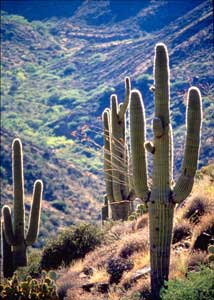
Once empowered to erect a mission in a given area, the men assigned to it chose a specific site that featured a good water supply, plenty of wood for fires and building material, and ample fields for grazing herds and raising crops. The Fathers blessed the site, and with the aid of their military escort fashioned temporary shelters out of tree limbs roofed with thatch, reeds, or in Pimería Alta saguaro ribs or ocotillo branches topped with brush and mud. These simple huts would ultimately give way to the stone and adobe buildings that exist today.
The majority of structures, indeed whole villages, were oriented on a roughly east-west axis to take the best advantage of the sun's position for interior illumination; the exact alignment depended on the geographic features of the particular site. Directives from Spain clearly stated that villages were to be sited on the west side of any valley so that the sun would shine in the homes first thing in the morning, discouraging slothful behavior on the part of the inhabitants.
When founding a mission compound, first the spot for the church itself was selected, its position marked and then the remainder of the mission complex would be laid out. Workshops, kitchens, living quarters, storerooms, and other ancillary chambers were usually grouped in a quadrangle, inside which religious celebrations and other festive events could take place.
List of missions
This listing of the sites founded by Kino is not complete. Also, since names have changed over time, there appears to be some duplication. They are:
* Mission San Bruno: founded 1683 (Kino led the Atondo expedition to the Baja California peninsula of the Las Californias Province of New Spain. In 1685, after a prolonged drought there, Kino and the Jesuit missionaries were forced to abandon the mission.
* Mission Nuestra Señora de los Dolores: founded on March 13, 1687. This was the first Pimaria Alta mission founded by Father Kino. By 1744, the mission was abandoned.
* Nuestra Señora de los Remedios was founded in 1687 and was abandoned by 1730. Nothing remains of this mission.
* San Ignacio de Cabórica was founded in 1687 and is located in San Ignacio, Sonora.
* Mission San Pedro y San Pablo del Tubutama was founded in 1687, in Tubutama, Sonora.
* Santa Teresa de Atil was founded in 1687, in the small town of Atil, Sonora.
* Santa Maria Magdalena was founded in 1687, located in Magdalena de Kino, Sonora. Kino's grave is located here.
* San José de Imuris was founded in 1687, in Imuris, Sonora.
* Nuestra Señora del Pilar y Santiago de Cocóspera was founded in 1689. It is located in Cocóspera, Sonora.
* San Antonio Paduano del Oquitoa was founded in 1689. It is located in Oquitoa, Sonora.
* San Diego del Pitiquito was founded in 1689. It is located in Pitiquito, Sonora.
* San Luis Bacoancos was founded in 1691, but was soon abandoned after Apache attacks.
* Mission San Cayetano del Tumacácori was founded in 1691 at a native Sobaipuri settlement. This was southern Arizona's first mission and Arizona's first Jesuit mission. Later a chapel was built. (San Cayetano de Calabasas was established in a different location much later, after Kino's time.) Sometime after the 1751 Pima Revolt the settlement and mission were moved to the opposite side of the river and became San José de Tumacácori.
* Mission San José de Tumacácori, the presently known location that is a National Historic Park. The farming land around the mission was sold at auction in 1834 and the mission was abandoned by 1840. It is now a National Monument in Tumacácori National Historical Park in Southern Arizona.
* La Misión de San Gabriel de Guevavi was founded in 1691. It became a cabecera or head mission in 1701 with the establishment of what Kino described affectionately as a "neat little house and church." Through the years its name changed many times so that now it is known by the generic name referencing many saints: Mission Los Santos Ángeles de Guevavi. The chapel was initially established in a native settlement, but then was destroyed by fire, probably during an indigenous uprising. The church rebuilt in new locations twice, the final and largest one being built in 1751. Its ruins are part of Tumacácori National Historical Park.
* San Lázaro was founded in 1691, but was soon abandoned after Apache attacks.
 |
| Mission San Xavier del Bac |
* Visitas San Cosme y Damián de Tucson: founded 1692
* Visitas Los Santos Reyes de Sonoita/San Ignacio de Sonoitac: a rancheria near Tumacacori, founded 1692.
* La Purísima Concepción de Nuestra Señora de Caborca: founded 1693
* Santa María Suamca: founded 1693
* San Valentín de Busanic/Bisanig: founded 1693
* Nuestra Señora de Loreto y San Marcelo de Sonoyta: founded 1693
* Nuestra Señora de la Ascención de Opodepe: founded 1704
Movie
* Father Kino, Padre on Horseback (or Mission to Glory: A True Story) starring Richard Egan as Kino, was made in 1977. The movie is available in DVD format.
References
* Bolton, Herbert Eugene, Kino's Historical Memoir of Pimeria Alta, vol. 1 (Cleveland, Ohio: Arthur H. Clark, 1919.
* Bolton, H., Rim of Christiandom, New York: The MacMilliam Co, 1936.
* Bolton, H., Padre on Horseback, Loyola Press, 1963.
* Polzer, Charles W., Kino Guide II: a Life of Eusebio Francisco Kino, S.J., Arizona's First Pioneer, and a Guide to His Missions and Monuments, Southwest Mission Research Center, 1982.
* Polzer, C., Kino: His Missions, His Monuments, Jesuit Fathers of Southern Arizona, 1998.
* Polzer, C. & Sheridan, Thomas H., Presidio and Militia on the Northern Frontier of New Spain: A Documentary History, Volume Two, Part One: The Californias and Sinaloa-Sonora, 1700–1765, University of Arizona Press, 1997.
* Seymour, Deni J., 1989 The Dynamics of Sobaipuri Settlement in the Eastern Pimeria Alta. Journal of the Southwest 31(2): 205-22.
* Seymour, D., 1997 Finding History in the Archaeological Record: The Upper Piman Settlement of Guevavi. Kiva 62(3): 245-60.
* Seymour, D., 2003 Sobaipuri-Pima Occupation in the Upper San Pedro Valley: San Pablo de Quiburi. New Mexico Historical Review 78(2): 147-66.
* Seymour, D., 2007 Delicate Diplomacy on a Restless Frontier: Seventeenth-Century Sobaipuri Social And Economic Relations in Northwestern New Spain, Part I. New Mexico Historical Review, Volume 82(4): 469-99.
* Seymour, D. 2007 A Syndetic Approach To Identification Of The Historic Mission Site Of San Cayetano Del Tumacácori. International Journal of Historical Archaeology, Vol. 11(3): 269-96.
* Seymour, D., 2008a Delicate Diplomacy on a Restless Frontier: Seventeenth-Century Sobaipuri Social And Economic Relations in Northwestern New Spain, Part II. New Mexico Historical Review, Volume 83(2): 171–99.
* Seymour, D. 2009 Father Kino’s 'Neat Little House and Church' at Guevavi. Journal of the Southwest 51(2):285-316.
* Seymour, D., 2011 Where the Earth and Sky are Sewn Together: Sobaípuri-O’odham Contexts of Contact and Colonialism. University of Utah Press, Salt Lake City.
* Soule, J.A., 2011. Father Kino's Herbs:Growing and Using Them Today. Tierra del Sol Institute Press, Tucson, AZ.
* Sor Juana Ines de la Cruz, "Soneto. Aplaude la ciencia Astronomica del Padre Eusebio Francisco Kino, de la Compania de Jesus, que escrivio del Cometa....", Inundacion castalida de la unica poetisa, musa decima...; Madrid, 1689. [1]Portions of this biography are courtesy National Statuary Hall.
* Spicer, E. H. Cycles of Conquest. University of Arizona Press, Tucson, Arizona 1962
.
Subscribe to:
Posts (Atom)