Showing posts with label Emperor Frederick I. Show all posts

Thursday, August 12, 2010

Alberto da Giussano and Barbarossa - Part VIII: Company of Death

This is a part eight of the Barbarossa series from last fall, during the release of the Italian movie 'Barbarossa'. This movie may be available for download at a few pay movie downloading sites, but it would probably be better to just wait probably two more months for the DVD. Let us know if you find a good source in the meantime.


Company of Death (Wikipedia)

The Company of Death is the name used in the historical literature of English language for two related chosen tactical corps, two selected bands of warriors, entrusted to guarantee the cohesiveness and efficiency in battle of both the Milanese and Lombard League's militias through their bound by oath to the defence of the Milanese Carroccio, the wagon on which the standard of the Lombard allies stood.

They fought in the Battle of Legnano (29 May 1176) against the imperial army of Frederick I Barbarossa Emperor of the Holy Roman Empire, in his 5th Italian Campaign, and were determinant in his decisive defeat.

The two corps who formed the Company of Death were the Company of the Carroccio, an infantry unit of 300 men, and the real and effective Company of Death, a cavalry unit of 900 men, commanded according to tradition by Alberto da Giussano.


The Company of the Carroccio

The Company of the Carroccio, was an infantry unit of 300 men, all of them young volunteers (forming a societas) and Milanese, sworn by oath to die in defence of the Milanese Carroccio. They fought as phalanx in a Sheltron formation around their "Sacred wagon", armed with a large shield and a lanzalonga.


The Knights of Death

The Company of Death, also known in some sources till the late 19th century as the Knights of Death, is the name of a temporary military association of medieval knights (a temporary societas), not historically well documented, which according to tradition was organized and equipped by a leader known as Alberto da Giussano. It had a great importance during the Battle of Legnano (29 May 1176) where it defended the Carroccio of the Lombard League against the imperial army of Frederick I Barbarossa.

The company was assembled in haste, depriving the Lombard infantry of the valuable support of enough heavy cavalry, "horse" were recruited by Alberto da Giussano around Brescia, and in other eastern areas of Lombardy that had contributed less in infantry and trails to the League. The knights would not be understood in the medieval and romantic sense, but as mere "mounted on horseback" or also "light cavalry." They were very probably particularly cruel and fierce "professional, or semi-professional, fighters," apt at wreaking havoc in the enemy ranks.

According to Milanese chronicler Galvano Fiamma it was composed of 900 men at arms but other sources and modern scholars reduce that number to 300 or, more probably, 500.

According to tradition they wore a sort of dark suit (black and gray, cut vertically) connected at the sides, to cover the armour, with probably the symbol of the skull on the traditional small pointed wooden shields.

Their motto or battle cry could have been, accordingly to poorly documented but reliable sources, "Ambroeus!" (Which is however in stark contrast with the origin of many of them, allegedly Brescia).

As a demonstation of the Company's rapid formation and specific use and role during the Battle of Legnano, after the battle there is no further information about its continued existence.

.

Friday, October 2, 2009

Alberto da Giussano and Barbarossa - Part VII: The Carroccio

Carroccio

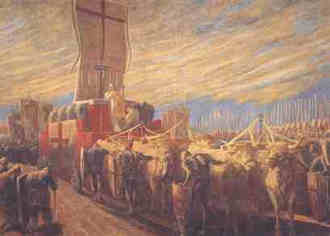
A Carroccio was a war chariot drawn by oxen, used by the medieval republics of Italy. It was a rectangular platform on which the standard of the city and an altar were erected; priests held services on the altar before the battle, and the trumpeters beside them encouraged the fighters to the fray.


In battle the Carroccio was surrounded by the bravest warriors in the army and it served both as a rallying-point and as the palladium of the city's honour; its capture by the enemy was regarded as an irretrievable defeat and humiliation. It was first employed by the Milanese in 1038, and played a great part in the wars of the Lombard League against the emperor Frederick Barbarossa. It was afterwards adopted by other cities, and first appears on a Florentine battlefield in 1228.

The Florentine Carroccio was usually followed by a smaller cart bearing the Martinella, a bell to ring out military signals. When war was regarded as likely the Martinella was attached to the door of the Church of Santa Maria in the Mercato Nuovo in Florence and rung to warn both citizens and enemies. In times of peace the Carroccio was in the keeping of a great family which had distinguished itself by signal services to the republic.

The carro della guerra of Milan was described in detail in 1288 by Bonvesin de la Riva in his book on the "Marvels of Milan". Wrapped in scarlet cloth and drawn by three yoke of oxen that were caparisoned in white with the red cross of Saint George, the city's patron, it carried a crucifix so massive it took four men to step it in place, like a ship's mast.

***************************************************************************

I looked it up again and the opening date, in Italy, for 'Barbarossa' is October 9. Of course, we need to find out when it opens in the United States, and we will just have to make a point to monitor this. It could be a month, or several months.

Thursday, October 1, 2009

Alberto da Giussano and Barbarossa - Part VI: Battle of Legnano


With October now here, and this month being the release date of the upcoming Italian movie 'Barbarossa', here is another segment of our Alberto Giussano and Barbarossa series: The Battle of Legnano. There probably should be an entry just for the "Oath of Pontida," which was the event which united the city-states into the Lombard League, but there wasn't an adequate text in English. It was one of the most brutal wars of the last millennium: The Holy Roman Empire versus The Lombard League.


Battle of Legnano

The Battle of Legnano was fought on May 29, 1176, between the forces of the Holy Roman Empire, led by emperor Frederick Barbarossa, and the Lombard League.


The Lombard League

The Lombard League was formed in 1167, largely out of the Veronese League. It was a Union of Lombard cities promising each other unity, against the Emperor Frederick I Barbarossa. The Lombardy cities swore the oath at Pontida, a small village in Lombardy.

After the disastrous defeat of Pope Alexander III at the Battle of Monte Porzio in May 1167 against Imperial forces, the Lombard League remained as the last legitimate fighting force opposing the Emperor and was therefore heavily backed by the Pope.

Kenneth Pennington wrote: "Alexander’s inability to control Rome and the Papal States was due to his conflict with Frederick. Although he attempted to support the cities of Lombardy, he had neither the power nor the resources to render effective assistance."

[Right: The "Oath of Pontida," painted by Amos Cassioli]


Frederick's 5th Italian Campaign

In September 1174, Frederick embarked on his 5th Italian Campaign, to quench the constant revolts in Lombardy and his quarrels with Pope Alexander III. Frederick led a force of 8,000 knights over the Alps and arrived in Piedmont in late September. His cousin Henry the Lion and his forces, were once again not a part of the Imperial campaign. Frederick wanted to take revenge on Susa, for its "evil" behaviour of 1168, and on the 30 September his forces captured and burned down the town. His next aim was the town of Asti, which he captured after a seven day siege. In October, Frederick finally received the promised Imperial reinforcements from Bohemia. Upon Frederick's rapid and fierce initial success, Margraviate William of Montferrat and the Count of Biandrate, abandoned the Lombard League.


Siege of Alessandria

The siege of Alessandria was an important event in Frederick's 5th Campaign as this was a campaign of revenge, with the aim of the total destruction of the Lombard League and the removal of the Pope Alexander III. Frederick's next goal was therefore the Lombard city of Alessandria. Alessandria was founded by Milanese refugees, who fled after Frederick's forces burned and destroyed the City of Milan in 1162 and named after Pope Alexander III. The siege of the "Straw City", called so because all the roofs were covered with straw, began at the end of October. To Frederick's surprise and anger, his forces were not able to take the city so he had to spend the winter in front of its gates. On Holy Saturday, Fredericks forces managed to enter the city by digging tunnels under its walls, but the attack was repulsed by the Milanese with heavy losses. Alessandria withstood, and that was the first victory of the Lombard League. Frederick had to break off the siege due to an advancing Lombard army and retreated to Pavia.


Treaty of Montebello

On 16 April 1175, Frederick and the Lombard League negotiated peace at the Castle of Montebello but after long talks, negotiations broke with no result. Frederick knew that a battle was imminent and traveled to Chiavenna to meet Henry the Lion. Henry the Lion however refused to help his cousin as he thought that Frederick's defeat would allow him to obtain greater power.


The Battle

After Frederick's setback at Alessandria, the failed agreement of Montebello and the refusal of his cousin Henry the Lion to help him, Frederick finally received some good news and reinforcements from Germany. The German reinforcements crossed Lukmanier Pass into the Lake Como region in April 1176. Frederick I Barbarossa, Philipp I of Heinsberg and Archbishop Wichmann of Magdeburg rode secretly from Pavia along the Ticino River, to meet the reinforcements and to lead them to a joint operation with his main forces. Frederick received 1,000 knights and 1,000 foot soldiers from 16 different German rulers. At Como, Lombard imperialist allies increased the reinforcements to about 3,000 knights and foot soldiers, however, the Imperial army was largely a cavalry force of German knights.

[Left: Lombard knights looking for Fredrick's dead body]

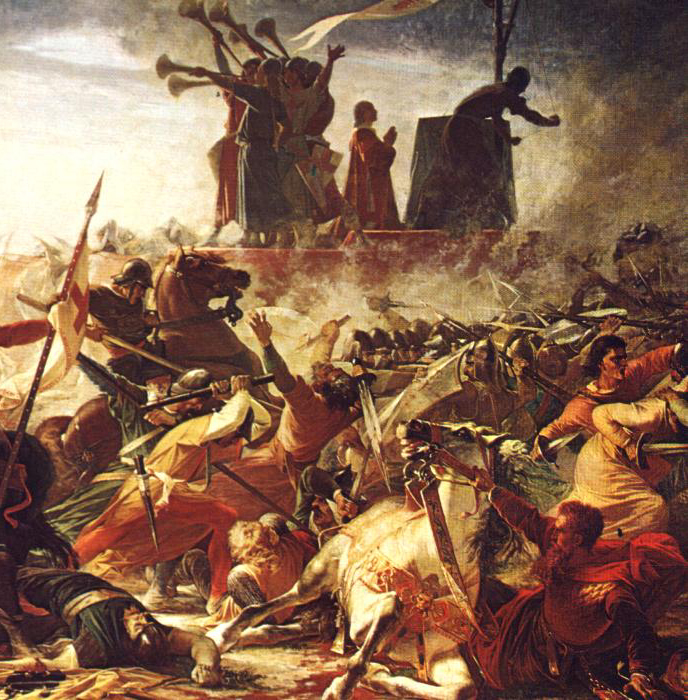
The Milanese were informed about Frederick's plan and prepared for battle. A Carroccio, or a sacred war wagon drawn by oxen, was built and was decorated with the city standard and an altar upon which the cross of Archbishop Aribert of Milan was erected. In 1038, Archbishop Aribert led the victorious defence of Milan against the Holy Roman Emperor Conrad II, and therefore his cross was a symbol of victory against the Empire. According to Sire Raoul, a chronicler from Milan, 900 knights came from Milan and around 550 knights from three other towns, the rest of the League's forces were foot soldiers. The "Company of Death" was a foot soldier unit, that according to Milanese chronicles was led by Alberto da Giussano, and formed the core of the Lombard infantry. While Frederick and his reinforcements were on their way back to Pavia to join the main Imperial force, the Lombard League placed about 3,500 men near the west bank of the Olona. The infantry with the Milanese war cart, the carroccio, stood in a hastily fortified position at Borsano. The Lombards knew that Frederick was about to skirt through their area, however, the Lombards did not know how close Frederick already was. At dawn on the 29 May, the Lombard League sent a reconnaissance unit of 700 horsemen to the Seprio landscape. At the same time, the emperor had crossed the Olona and was marching south from Cairate, five miles northeast of Busto Arsizio. Here, the battle commenced. The Lombard reconnaissance and the 300 Imperial vanguard clashed. The clash was brief and bloody and with Frederick already on the horizon, the Lombard reconnaissance broke off and fled beyond Borsano. Now, Frederick and his Imperial German army launched a rampant and brutal attack on the Lombard League forces near Borsano - Legnano. The Lombard cavalry was largely routed but managed to escape the skirmish, leaving the infantry and carroccio on its own. Frederick advanced to the carroccio, and assaulted the infantry and the Company of Death with his cavalry.

M.B. Synge wrote this about the Company of Death: "Nine hundred desperate patriots forming the Company of Death defended the sacred car. Seeing the Germans were gaining ground, fearful for the safety of their treasure, they suddenly knelt down and renewed their vow to God that they would perish for their country."

The infantry positioned itself in a phalanx-like line. The fight around the carroccio was a long and bloody fight in which the Lombard League infantry brought the Imperial army to a stalemate. Despite the difficulties the Imperial cavalry had against the Lombard infantry, it would have still prevailed in the long run. Finally, the Lombard League forces received help from its regrouped cavalry and from a Brescian cavalry that was called to aid by the fleeing reconnaissance troops. The regrouped reconnaissance troops and the Brescian cavalry jointly attacked Frederick's army from the rear. The decisive assault was made by the Brescians, who managed to break through the lines and attack Frederick directly. In this attack, his guards and standard-bearer were killed, and Frederick was thrown off his horse and believed to be dead. Upon this, the Imperial troops panicked and fled, pursued to the Ticino by the Leagues cavalry. The generals tried to rally the men in vain. The booty and prisoners taken by the League were immense.


Aftermath

After the battle, Frederick's rule over Lombardy was decisively broken. The knights that managed to escape, gathered in Pavia. There, they brought the news of Frederick's presumed death to his wife Beatrice I, Countess of Burgundy. Beatrice and the Empire mourned Frederick's demise but after several days the Emperor appeared at the gates of Pavia.

H. E. Marshall wrote: "Then, greatly to the joy of all, after three days Barbarossa suddenly appeared before the gates of Pavia. Although wounded and bruised and left for dead Frederick had not been killed."

The victory of the Lombard League forced Frederick to travel to Venice. In the Peace of Venice, 1177, Frederick and Pope Alexander III reconciled. The Emperor acknowledged the Pope's sovereignty over the Papal States, and in return Alexander acknowledged the Emperor's overlordship of the Imperial Church. The Peace of Venice were heavily instigated by Archbishop Wichmann of Magdeburg, who was amongst the defeated at Legnano. The cities of Lombardy, however, continued to fight until 1183, when, in the Peace of Constance, Frederick conceded their right to freely elect town magistrates. The Treaty was cast in bronze.

Frederick did not forgive Henry the Lion for refusing to come to his aid in 1176. Taking advantage of the hostility of other German princes to Henry, Frederick had Henry tried in absentia by a court of bishops and princes in 1180, declared that Imperial law overruled traditional German law, and had Henry stripped of his lands and declared an outlaw.

On 27 January 1186, Frederick's son Henry VI married Constance of Sicily in Milan as a sign that peace had really been established.


Actual battlefield

The battle is traditionally tied to the name of Legnano, since the League's forces came from that town. Actually, as local historians have ascertained, the battle was fought a couple miles west of Legnano, where today Villa Cortese and Borsano, frazioni of Busto Arsizio, stand.

***************************************************************************

"Nine hundred desperate patriots forming the Company of Death defended the sacred car. Seeing the Germans were gaining ground, fearful for the safety of their treasure, they suddenly knelt down and renewed their vow to God that they would perish for their country."

That country was not "Italy." I'm not going to argue about whether it should be called Cisalpine Gaul, Etruria, Langbard, Padania, or the Subalpine/Po River Valley; but it was a Nation. "Italy" should be "the Italian peninsula," just as there is "the British Isles," "the Balkins," "the Iberian peninsula," "Scandinavia," etc. So for clarity, it should be Europe, then for reference "northern, southern, Eastern, or southern Europe, and then these "regions."


Friday, September 25, 2009

Alberto da Giussano and Barbarossa - Part V: Lombard League

Lombard League (Wikipedia):

The Lombard League was an alliance formed around 1167, which at its apex included most of the cities of northern Italy (although its membership changed in time), including, among others, Milan, Piacenza, Cremona, Mantua, Crema, Bergamo, Brescia, Bologna, Padua, Treviso, Vicenza, Venice, Verona, Lodi, and Parma, and even some lords, such as the Marquis Malaspina and Ezzelino da Romano. The League was formed to counter the Holy Roman Empire's Frederick I, who was attempting to assert Imperial influence over Italy. Frederick claimed direct Imperial control over Italy at the Diet of Roncaglia (1158). The League had the support of Pope Alexander III, who also wished to see Imperial power in Italy decline. At the Battle of Legnano on May 29, 1176, Frederick I was defeated and, by the Peace of Venice, which took place in 1177, agreed to a six-year truce from August,1178 to 1183, until the Second Treaty of Constance, where the Italian cities agreed to remain loyal to the Empire but retained local jurisdiction over their territories.

The Lombard League was renewed several times and after 1226 regained its former prestige by countering the efforts of Frederick II to gain greater power in Italy. These efforts included the taking of Vicenza and the Battle of Cortenuova which established the reputation of the Emperor as a skillful strategist. He misjudged his strength, rejecting all Milanese peace overtures and insisting on unconditional surrender. It was a moment of grave historic importance when Frederick's hatred coloured his judgment and blocked all possibilities of a peaceful settlement. Milan and five other cities held out, and in October 1238 he had to unsuccessfully raise the siege of Brescia. Once again receiving papal support, the Lombard League effectively countered Frederick's efforts. During the 1249 siege of Parma, the Imperial camp was assaulted and taken, and in the ensuing Battle of Parma the Imperial side was routed. Frederick lost the Imperial treasure and with it any hope of maintaining the impetus of his struggle against the rebellious communes and against the pope. The League was dissolved in 1250 once Frederick died.

**************************************************

The Following paragraph is from a book called 'Modern Italian grammar: a practical guide', and clarifies and simplifies a number of things:

"When, in 1152, Frederick I, known as Redbeard, became King of Germany, he decided to suppress the rebellious City States, He Carred out five raids in Italy; in the first (1154) he suppressed the rebellion in Rome, and had himself crowned emperor; in the second he conquered Milan and with due ceremony reaffirmed the rights of the emperor (1158) in the third he besieged and destroyed Milan (1163) in the fourth he occupied Rome (1168) and in the fifth he was defeated at Legnano by the Lombard League (an alliance between the City States, set up in Pontida in1167, and supported by Pope Alexander III). For this reason he was forced to recognize the freedom of the City States, with the peace treaty of Constance (1183)."

**************************************************


The critics of Padanian identity have gone after trivial facts, to try to underscore the significance of events like the Battle of Legnano. For example, whether or not there was a specific "oath" taken at the formation of the Lombard League in Pontida, Lombardy. That's how the game is played. A people's history needs to be trivialized or absorbed and molded into what is "politically correct." For example, references to "the Italian League," or that it was "for Italian freedom" even though Italy never even existed before. If the history of other groups were to be attacked, it might be answered with calls of "bigotry" or "racism." However, if you're unfortunate enough to be "politically incorrect," then you don't receive this type of protection. You're on your own.

A perfect example of this is if we look at the War of the Sicilian Vespers. Historically, it is referred to as a struggle by the Sicilian people for Sicilian freedom, which it was. However, why is the Battle of Legnano any different? It was a war carried out by Lombardo-Venetian people for Lombardo-Venetian freedom. Why the double standard?

Thursday, September 24, 2009

Alberto da Giussano and Barbarossa - Part IV: Holy Roman Empire

What this all boils down to is that most of the northern subalpine region was conquered and under the subjugation of a powerful German imperial power called the Holy Roman Empire, or what eight centuries later the German National Socialists would refer to as the "First Reich."

Rather than take this sitting down, the city-states of the newly occupied region formed an alliance called the "Lombard League" to oppose the Germanic empire. They were literally fighting for their freedom, just as some of their ancestors had done six centuries earlier when the small Winnili tribe chose to stand and fight the powerful Vandal horde rather than accept being slaves. The odds going into this war were just as long as well.

**************************************************


Holy Roman Empire (from Wikipedia):

The Holy Roman Empire was a union of territories in Central Europe during the Middle Ages and the Early Modern period under a Holy Roman Emperor. The first emperor of the Holy Roman Empire was Otto I, crowned in 962. The last was Francis II, who abdicated and dissolved the Empire in 1806 during the Napoleonic Wars. It was officially known as the Holy Roman Empire of the German Nation by 1450.

The Empire's territorial extent varied over its history, but at its peak it encompassed the Kingdom of Germany, the Kingdom of Italy and the Kingdom of Burgundy; territories embracing present-day Germany (except Southern Schleswig), Austria (except Burgenland), Liechtenstein, Switzerland, Belgium, the Netherlands, Luxembourg, the Czech Republic, Slovenia (except Prekmurje), as well as significant parts of modern France (mainly Artois, Alsace, Franche-Comté, Savoie and Lorraine), Italy (mainly Lombardy, Piedmont, Emilia-Romagna, Tuscany, and South Tyrol), and present-day Poland (mainly Silesia, Pomerania, and Neumark). For much of its history the Empire consisted of hundreds of smaller sub-units, principalities, duchies, counties, Free Imperial Cities, as well as other domains. Despite its name, for much of its history the Empire did not include Rome within its borders.


Holy Roman Emperor (from Wikipedia):

The Holy Roman Emperor is a term used by historians to denote a Middle Ages ruler, who as German King had in addition received the title of "Emperor of the Romans" from the Pope of the Holy Roman Church, and after the 16th century, the elected monarch governing the Holy Roman Empire, a Central European union of territories in existence during the Medieval and the Early Modern period. Charlemagne of the Carolingian Dynasty was the first to receive papal coronation as Emperor of the Romans. Charles V was the last Holy Roman Emperor to be crowned by the Pope. The final Holy Roman Emperor-elect, Francis II, abdicated in 1806 during the Napoleonic Wars that saw the Empire's final dissolution.

The standard designation of the Holy Roman Emperor was "August Emperor of the Romans." When Charlemagne was crowned in 800, his was styled as "most serene Augustus, crowned by God, great and pacific emperor, governing the Roman Empire," thus constituting the elements of "Holy" and "Roman" in the imperial title. The word Holy had never been used as part of that title in official documents. The word Roman was a reflection of the translatio imperii (transfer of rule) principle that regarded the (Germanic) Holy Roman Emperors as the inheritors of the title of Emperor of the Western Roman Empire, a title left unclaimed in the West after the death of Julius Nepos in 480.