Showing posts with label Germany. Show all posts

Tuesday, August 2, 2022

No one would have consented

No one would have consented to having surveillance injected under the skin

Philosophers-stone.info pureblood

Far more sinister than having a chip - injected technology


*************************


So many brilliant women around the world have answered the call on this one--Dr. Sherri Tenpenny, Dr. Carrie Madej, Dr. Dolores Cahill, Dr. Christiane Northrup, Dr. Karen Kingston, Dr. Jane Ruby, etc--and at great personal risk. One could say that a lot of this goes right back to the message put out by Joan Veon, who was of our people, about what these Globalists were up to... and it wasn't heeded. After a very successful career as a financial adviser, Joan was ready to retire early, but had attended some of these Globalist symposiums... which were NOT attended nor covered by the world press, and could see there were some major problems for humanity. She put all of the information, right from their own literature, into a view of the bigger picture that people could understand. These problems should have been taken care of decades ago. Well, now the bill is due! One could stick to the very literature, reports, and words of these people for decades--without speculating one bit--and come to a crystal clear conclusion. However now, it's just right out in the open.


*************************


The World Economic Forum is one of many interfaces between the high-minded "Global Elite" and the world which they seek to subjugate. To the left is Klaus Schwab, who has nothing inherently in his background in particular which stands out, except that he belongs to a German secret society called Fraternitas Saturni. Many of these secret societies change their name and give a different outward look every fifty or one hundred years, but remain a corrosive force in the world. This society was behind the Thule Society, the German General Staff, and a number of other groups which were designed to springboard into National Socialism. That's fact, but I would speculate that this and other movements in history were designed to be altogether temporary arrangements to meet much more long-term goals.

This animal is on record saying to the people of the world for their 2030 goals, "You will own nothing, and be happy." He also openly talks about getting rid of farming, and harvesting insects for people to eat instead. He has taken the basic concepts from what Globalist institutions have been saying for many years, and putting a more extremist spin on them; probably to gauge the world population to see if they resist it or not. As it stands now, as these secret societies massively introduce fetishes from their theology (ex. "the Alchemical Marriage") into every aspect of popular culture... so far people have done little else but embrace them. Subconsciously they seem to absorb what the now corrupted state, media, education, corporatocracy, judicial, entertainment, etc. are advising them to do, and mindlessly doing it... or at least condoning it with their fear and/or silence.

Yuval Noah Harari is an Israeli professor with a number of self-styled titles, but really is another Globalist mouth piece, who was put in that position because of his hidden affiliations. He is, or at least pretending to be, a lapdog for Klaus Schwab. He's on record saying "Humans are now hackable animals. The whole idea that humans have this 'soul' or 'spirit', and nobody knows what's happening inside them, and they have free will-that's over." These quotes are right on video, so they're easy to confirm. Just watch them and listen to their own words! Schwab and Harari have never really innovated anything, nor have they likely ever driven in a nail or screw or sawed a piece of wood. They were put in the positions they are through their hidden affiliations, and hold a deep hatred for humanity. The most dangerous people in the world are not Islamic extremists nor Central American drug cartels, but these Anglo, German, and Jewish death cults. The atrocities which they've committed over just the last several centuries is unfathomable in human history. The British Empire invented the "concentration camp," and they used them. Yet, they never stop, they never go away.

It's important to realize that there have been many others like them, but these are just two of the main figures on the scene today. The late Zbigniew Brzezinski, a political handler for the Global Elite, was the same type of agent. The late Maurice Strong was seemingly an ordinary person, but he was a cloak and dagger member, and suddenly became a billionaire banker with all sorts of "plans for the world." He was established as a front man, not on his own. I could think of dozens of more of them in different fields of human endeavor, corrupting everything they touch. Corrupting science itself! There's always a short or long term, self-serving purpose. It's to the point now that nothing is actually real in the minds of most people, unless this coalition gives its consent to its reality... or they can just make up anything!!


*************************


President Harry S. Truman, throughout his life, carried a fragment of his favorite poem--'Locksley Hall' by Alfred Lord Tennyson--in his wallet. The following is that fragment...


'Locksley Hall'

"For I dipt into the future, far as human eye could see,
Saw the vision of the world, and all the wonder that would be;

Saw the pilots of the purple twilight, dropping down with costly bales;
Heard the heavens fill with with shouting, and there rain’d a ghastly dew
From the nations’ airy navies grappling in the central blue;

Far along the world-wide whisper of the south-wind rushing warm,
Till the war-drum throbb’d no longer, and the battle-flags were fulr’d
In the parliament of man, the federation of the world,

There the common sense of most shall hold a fretful realm in awe,
And the kindly earth shall slumber, lapt in universal law."


Why would any American, especially one who would become an American president, be inspired by a poem about a World Government with a World Law? George H.W. Bush gave a pretty clear answer to that some decades later. One could argue that this is just some poem, and it doesn't really mean anything. I'm not of the belief that members of a cloak and dagger society, and their many aggressions, simply "don't mean anything." However, this curious factoid is just one of hundreds of similar oddities coming from the same basic suspects. A clear pattern of thought and behavior. Then he went on to make the decision to drop atomic bombs on civilian populations in an already defeated country.

"The atom bomb was no 'Great Decision'. It was merely another powerful weapon in the arsenal of righteousness." --Harry S. Truman

Each agent represents a deep rabbit hole that could fill a long study. For example, nobody would think of Cecil Rhodes (above) as anything more than a footnote in history, yet he was a person who transformed the world. He talked a good talk about how the British Empire was going to recapture the United States, yet after he died, his massive fortune was willed to a foreign bank. This was in contrast to everything he ever publicly stated, or that he wrote in his 'Confession of Faith', which all symbolizes the clear pattern of behavior of these people; similar to the "patriotism" in Harry Truman's wallet.

.

Friday, February 16, 2018

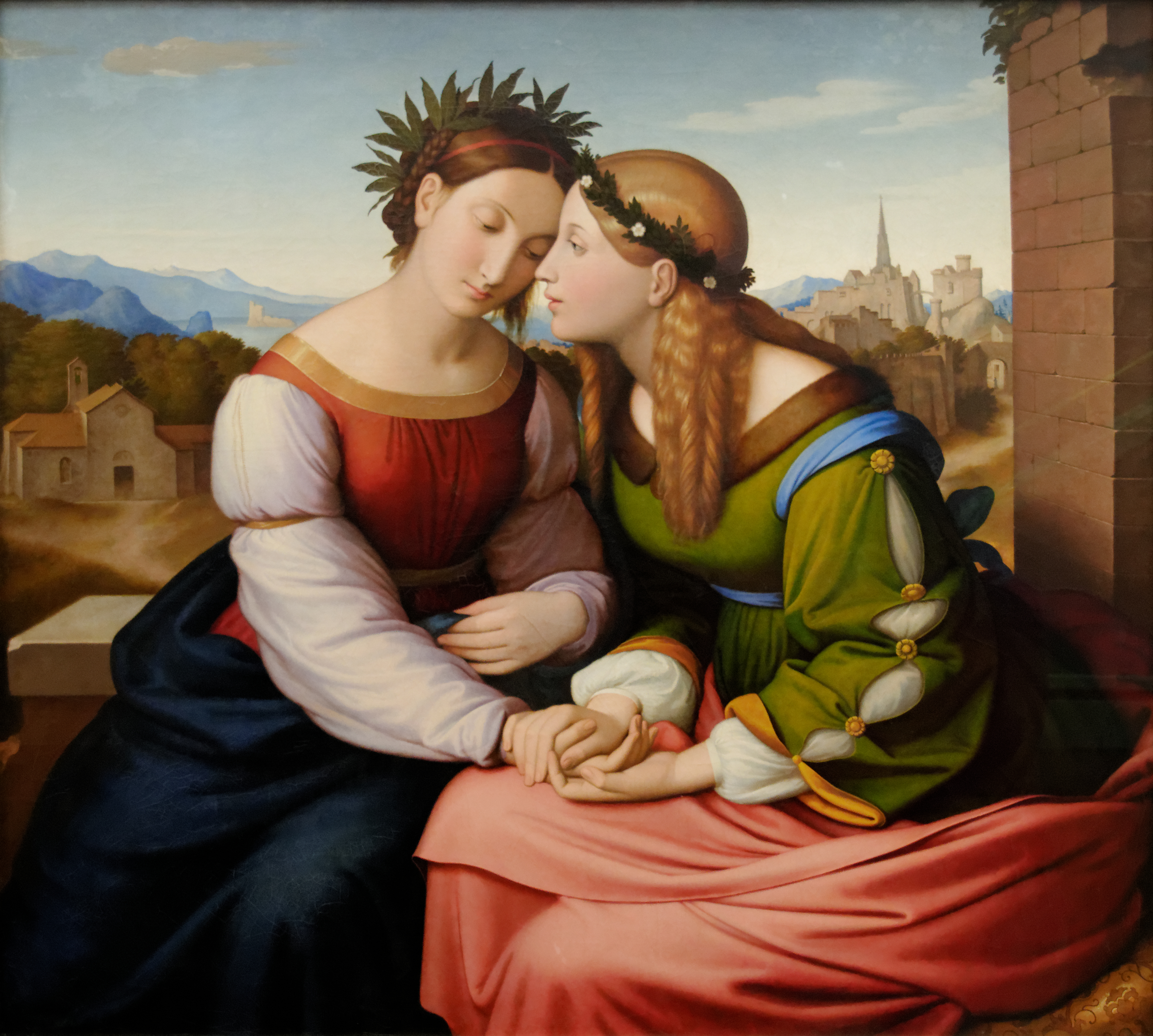
"Italia and Germania" (1828)


Reddit: "Italia and Germania"

Italia und Germania (1828) by Friedrich Overbeck. The two girls are personifications of the countries and symbolise their common heritage and friendship.

Here in Italy there's an adage:
Italians hold Germans in high regard, but don't love them; Germans love Italians but don't hold them in high regard.

Just pointing out the Italian landscape to the left and the German Gothic town to the right.

I love how , when you have pictures of German women in Art, there hair is often braided and Italian women have their hair tied with leaves.

well, the leaves are usually laurel leaves, the plant used in classical antiquity to crown athletes, writers, and so on. It just works as a reminder of our classical past


*************************


I like Germania and Austria more


[Not my comment, but I thought it made for an interesting concept in its own right]


*************************


Is it a coincidence that each one's clothes hint at the other's flag? The green-white-red color scheme was already in use in Italy at the time, not sure about Germany.

Both nations were struggling to create their own state at the time. If anything, it represents nationalism.

Friedrich Overbeck, the painter did want to express both heritage and friendship between these cultural spheres and their common wish for unity.

Italy and Germany have always been very similar (except culturally) in their history (divided politically, then unification, WWII...), and economically (east/west, north/south divide), well at least until not that long ago.

Nah, at that time Italy and Germany weren't countries, but a bunch of small loosely knit duchies, free cities, princedoms, republics, bishoprics and what not. That was also the time that nationalism and a national consciousness was being formed. So this picture, among other things, is supposed to be a fairly nationalistic one. So, if anything, EU is against nationalism and for a more supranational approach to things.


'Italy and Germany: A peaceful meeting of opposites'

Rosemarie Fruehauf - TheEpochTimes.com - December 5, 2010

It is a meeting of dark and bright, yin and yang, of introvert and extrovert. The harmony of this painting is so compelling because it shows a peaceful connection of opposites, a talk between two different realms and approaches toward life.

Leave everything aside—German stereotypes, Italian stereotypes, and the story of the Nazarene movement—and you are looking at a timeless painting about friendship.


.

The Nazarenes

The two ladies, Italia and Germania, in the painting by Johann Friedrich Overbeck, (1789–1869) represent two ideals of art: the art of the early Italian Renaissance as found in the young Raphael, and the German late-Middle Ages paintings like those of Albrecht Dürer. These were the ideals the painter Overbeck venerated and from which he drew his artistic inspiration.

The two girls can also be seen as symbolizing the church and the state. Overbeck and his artist friends of the Nazarene movement postulated that the partners of art should be the church and the state, a view that was regarded as old fashioned and reactionary in a time when art suddenly had to search for reasons to validate its existence.

The industrial revolution was dawning, and both the bourgeoisie and artists were growing ever more independent. In these days at the brink of the 19th century, Overbeck and some fellow students of the Academy of Vienna were dissatisfied with the lack of heart and soul in the prevalent Neoclassicism and with the conventional art education in the academy system.

In the meetings and discussions they held in a loose circle from 1808, they found their Christian ideals manifesting in the earlier European art. Four of them, including Overbeck, left the academy in 1810 and traveled to Rome. In Italy, they hoped to live a life in the way of the old, “true” artists. Making an impact in Rome. They called themselves the “Brotherhood of St. Luke” (St. Luke is the patron saint of painters) and after occupying the abandoned monastery of San Isidoro, conducted a quasi-monastic life, dedicated to praying and painting.

Soon they became known among their detractors as well as supporters by the quizzical nickname “Nazareni” (for their long-haired, biblical appearance) and were joined by other like-minded personalities. The greatest achievement of the group was the reviving of the old fresco technique that had almost been forgotten.

With two major commissions, the wall paintings of Casa Bartholdy and the Casino Massimo in Rome, they could establish an international reputation. By 1830, all the Nazarenes had returned to Germany, where many of them became acclaimed teachers and chairmen of art academies.

Overbeck, as the figurehead of the movement, rejected all offers and stayed in Rome, where he lived his dream until his death in 1869. Though admired by fans and followers, he was ridiculed by his more practical-minded contemporaries.

The Nazarenes were disillusioned over the rationalism of the enlightenment movement that had discredited itself in the terror of the French Revolution.

They preferred a society based on belief. That is why they saw the Middle Ages in a very positive light. With its simplicity and honesty, the Middle Ages became their favorite period of history.

“Italia und Germania” was especially seen as the Nazarenes’ programmatic painting, as it extols the two branches they considered to be the highest ideals of art—the early Italian Renaissance in the spiritual and introverted Madonna-like figure, together with the natural, yet proud German Middle Ages artistry represented by the blond girl.

The Nazarenes were the first art movement in a modern sense—a group of people who met to formulate an ideology of what art should be like and then worked for it. This painting exemplifies and convincingly broadcasts what they sought in art. The painting works perfectly in iconography, technique, and compositional style. Here, their dream and message is given a shape.


The Painting

The painting becomes more meaningful and beautiful the longer one looks at it. Its clear and simple coloring, supported by the stunningly smooth surface, which hardly shows a brush stroke, attracts one’s eyes naturally.

The girls are in the midst of an intimate talk. They seem to be very close, peacefully and lovingly connected. This comes mainly through the composition, as there are a lot of oval forms, which echo each other.

There is the big oval going from their shoulders to their arms and conjoined hands. There are also the ovals of the necklines that Overbeck made the same size, the similarities in the dresses, like the belts and white sleeves of their blouses as well as the floral wreaths corresponding to each other. The pink wrap that drapes the lower part of Germania’s body with its soft pleats frames and emphasizes this big oval dynamic of the setting.

It looks like a religious painting on first glance due to the strong triangular composition in which the two figures are rendered. This is what we have seen in countless saintly images, especially in the Raphael Madonna paintings. The two figures become like saints.


As in Renaissance art, Italia and Germania fill the well-balanced format, and the landscape becomes secondary. With its humble green and blues, it just illustrates a surrounding. Details tell us about the ladies’ identities: Italian architecture and the Mediterranean sea feature the background of Italia; a Gothic city and the Alps decorate Germania’s side.


Sacred Friendship

Their friendship is idealized and made sacred in the way Overbeck depicts the girls because of the harmony, dignity, and quietude of the composition. Their strongly idealized faces cannot count as portraits. Their skin is amazingly white, shimmering like porcelain. Yet this seems to be more than just a conceptual work, as it features a very natural and human conversation.

Although the two are connected, they are independent of each other; their eyes do not meet. They are conjoined by their hands, the compositional triangle shape, and multiple round forms. Each woman has her own personality and emotional quality that goes beyond the idealized portrayal. As a profile portrait, there is almost breezy cuteness in the way the blond Germania stretches her nose in the air. The blooming floral wreath comes across as extroverted and friendly. Its blooms are repeated as golden buttons on her sleeve. She leans toward the dark-haired one and holds both her hands around the others hand. She’s obviously talking to her. Some feel that she’s comforting her friend.

The image of the dark-haired Italia, with its classical three-quarter perspective and the red and blue garments she’s wearing, repeats countless Madonna portrayals. We perceive her to be introverted and almost melancholic as she holds one of her hands in front of her body as if protecting herself. She looks humbly down to the ground while her blond companion curiously looks into the landscape while talking.

The dark lady’s dress is in comparison much simpler; there are no ornaments on it. The laurel wreath she wears is the only thing that gives an idea of her Mediterranean origin and adds a little peculiarity to an otherwise perfect image of Mary.


The two become a symbol for the possible union of opposites and a peaceful dialogue of different temperaments.


.

Tuesday, June 28, 2016

Someone finally says "No" to transnational bankers

In the same manner that there are "labor unions" which seek to unite and ignite an active consensus among workers; there are "unions of billionaires" who use this same basic formula. I say "billionaires" when in fact, three separate international banking cartels each have a net worth in the hundreds of trillions of dollars. Right from the get-go, each country is to have both a central bank.. and a foreign relations group made up of major figures from the main choke points of society: banking, corporations, media, education, advertising, intelligence, military, etc. These two entities are to be linked into the global network in the same manner as perhaps an international labor union might. 

Since they're internationalists, these are the people who have made words like "nationalism, protectionism, and isolationism" into dirty words. Once in awhile they wave a flag when they want something done in a certain area, but their focus is international. Their power is so immense that within a few days of Brexit, we now have contrived mainstream new stories about massive "vote regrets" and millennials being angry at baby boomers (UK).. using manipulated "polls" as they so often do. The simple fact is that a monkey wrench was thrown into the machine of the internationalist dream of these financial and corporate overlords. The UK and Germany was the EU. 

Some years ago when countries were signing up with the European Union, on a couple of occasions the organized facilitators were openly stating that they would just keep putting it to a vote (of politicians) until they got the result that they wanted. Now they want to do the opposite! In their minds.. it's heads they win, tails we lose... every time. These are the people who have for many years, promoted the very worst elements of monopoly Capitalism and social Marxism... as we can so painfully see today. The hard underlying truth is that someone like Obama gets elected, and the very first thing he does is bring in a team of financial advisors from Goldman Sachs.to work like termites behind the scenes for the next eight years. That's the way it works in every country that these transnationalists are allowed to inhabit.


Brexit was one of the most important news events of our lifetime, because these people must operate in a way that loosely follows some type of Democracy. Luckily the populace got a chance to vote, and the scoundrels were thrown out. This should only be the start. There's no way to even begin to describe the damage that these unelected Globalist bureaucrats have done to our world. This whole dynamic reminds me of the movie 'One Flew Over The Cuckoo's Next' when McMurphy finally realized that after all the complaints.. all they really had to do was walk out the door and it would all be over.. just like any abusive relationship. 

However, if there was really any justice, there would be Nuremberg-type trials set up. Bankers who have bled economies dry and funded both sides of wars as has happened so often, and corporations who have organized and armed rebels for coups in third-world countries in order to get at the resources, should be punished. If America is so left-leaning, then why can't we break the unions of these super wealthy transnationals? The British have shown up the Americans and Germans, and punched out their own metaphoric class bully. The bullies can't solve the problem, because they are the problem!

.

Thursday, May 14, 2015

'Unbroken' (2014) - movie review


'Unbroken' (film)

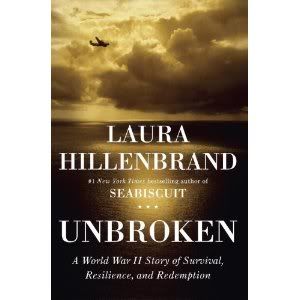
Unbroken is a 2014 American biographical war drama film, produced and directed by Angelina Jolie, and based on the 2010 non-fiction book by Laura Hillenbrand, Unbroken: A World War II Story of Survival, Resilience, and Redemption. The film revolves around the life of USA Olympian and athlete Louis "Louie" Zamperini, portrayed by Jack O'Connell. Zamperini survived in a raft for 47 days after his bomber was downed in World War II, then was sent to a series of prisoner of war camps.

The film begins with a WWII U.S. Army Air Corps fighter plane engaged in combat over the Pacific. The extreme danger of this engagement is quickly and strongly portrayed, with enemy bullets seemingly able to pierce through any portion of the plane at any time, and with dangerously close flybys. Louis Zamperini is a member of this air crew. Then the movies shifts back to Louis' childhood, which would be the less complicated manner to begin reviewing this film; in chronological order, which it does eventually follow midway though.

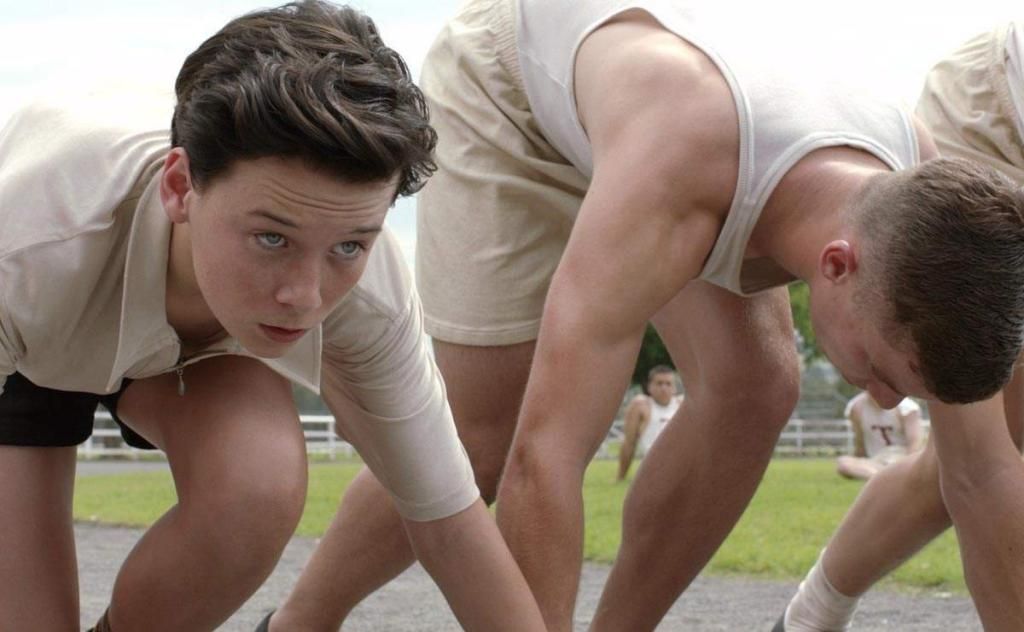
His parents were immigrants from Verona, in the Veneto region; having settled in a small town in eastern New York state. Growing up during the Great Depression, life was not easy for anyone, and less so for immigrants apparently. His parents were shown as having achieved great respect in the town, but young American-born Louis was always getting into trouble. Encouraged by his brother, he finally finds some focus when he starts to run track in high school. He begins to make a name for himself as one of the best middle distance runners in the country.

Not much of his 1936 Olympic experience in Germany was portrayed. It did show his come-from-behind eighth place showing in the 5000 meters, where he finished with a phenomenal fifty-six second final lap in a twelve and a half lap race. His physical peak probably would have been in the 1940 Olympics, which was cancelled. A couple of years later, before going off to war, he set a national collegiate mile record in the 1600 meters. He set that record despite being severely spiked by other runners during the race. Personally, I think that those fouls were every bit at insane as Mike Tyson biting Evander Holyfield's ear.


Spoiler alert beyond this point...

.

.

.

.

During a rescue mission in 1943 by the air crew, the plane had to be crash landed in the water due to engine problems. Only three men survived, including Louis Zamperini. They were afloat in a life raft for forty seven days! Since you cannot drink the salt water, being stranded in a life raft in the middle of the Pacific is practically a death sentence. At one point, the men were awakened by a shark fin nudging against the raft, which must have been terrifying enough in itself. They later had to beat back sharks with their fists. After catching and eating a raw sea gull, they got sick and threw up. Eventually, in a prey-to-predator scene depicting pure evolutionary struggle, they pulled in and killed a small shark. Rain water further helped sustain them.

After failing to attract an American aircraft with a flare, they got another chance; only this time it turned out to be a Japanese aircraft that proceeded to fire upon the raft. Louis jumped into the water with the sharks. Somehow nobody was hit. Eventually they ran into a Japanese navy vessel, but their struggle was really just beginning. The Japanese military engaged in policies such as beheading prisoners. They somehow survived brutal interrogation before being sent to a detention camp.

After falsely being reported as having been killed in action, the Japanese allowed Louis to send a radio message to his family. This act of seemingly good will was actually only a ploy to later get him to deliver an anti-American message over the radio. He had a choice of either delivering the false message with a chance of living and eating well until the end of the war, or refusing and being sent back to the detention camp with further beatings. He still refused.

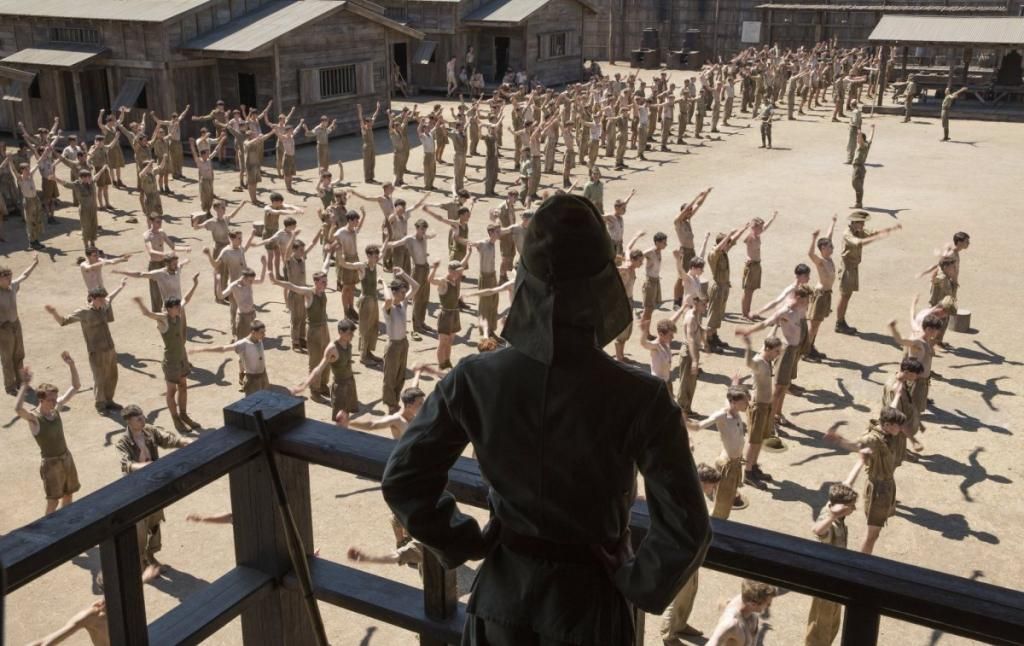
The camp commander was Sergeant Mutsuhiro Watanabe, a sadistic torturous psychopath who had it in for Louis. Watanabe always carried a wooden stick/club, which he used at his every whim. Louis was probably targeted due to his Olympic status, which made him a man whom they wanted to break down in front of the other Allied prisoners. I'm not going to describe all of the physical and psychological torture depicted, some of which would sound almost unbelievable in their brutality. However, in a possible psyop, at one point Watanabe was to have been moving on to a different position due to a promotion. He said to Louis: "Aren't you going to congratulate me?," with no response.

Shortly after, due to emergencies stemming from Japan losing the war, the prisoners were relocated to a work camp. The new commander of this work camp was none-other-than Sergeant Watanabe. This wasn't just hard labor, but they worked prisoners to death. It was apparent policy that if Japan lost the war, all prisoners would be executed, which even took away their hope. This mining camp was dark and desolate, and the poorly fed prisoners were all filthy from the work. Pure misery. Finally, all of the prisoners were ordered into the water of the lake or ocean, fully expecting to finally be executed. Instead, the war was declared over.

The movie ends with his return and some actual photographs and details from his life. Later he is shown at age 81--at the 1998 Nagano, Japan Winter Olympics festivities--carrying the Olympic torch and running well. Sergeant Watanabe went into hiding and was never prosecuted. The film was a financial success, but received mixed reviews. I think that many critics fail to understand that not every movie is made for the intended purpose of them to be "woo'd." It wasn't 'The Shawshank Redemption', but it is a true story. As a movie, it could be called a survival story, depicting one mans plight more than any kind of political message.

.

Tuesday, July 15, 2014

Lionel Messi: One of the all-time soccer greats, an Argentine of Cisalpine ancestry


Lionel Messi (Wikipedia)


Lionel Andrés "Leo" Messi (born 24 June 1987) is an Argentine footballer who plays as a forward for Spanish club FC Barcelona and the Argentina national team. He serves as the captain of his country's national football team.

By the age of 21, Messi had received Ballon d'Or and FIFA World Player of the Year nominations. The following year, in 2009, he won his first Ballon d'Or and FIFA World Player of the Year awards. He followed this up by winning the inaugural FIFA Ballon d'Or in 2010, and then again in 2011 and 2012. He also won the 2010–11 UEFA Best Player in Europe Award. At the age of 24, Messi became Barcelona's all-time top scorer in all official club competitions. At age 25, Messi became the youngest player to score 200 goals in La Liga.

Commonly ranked as the best player in the world and rated by some in the sport as the greatest of all time, Messi is the first football player in history to win four FIFA/Ballons d'Or, all of which he won consecutively, as well as the first to win three European Golden Shoe awards. With Barcelona, Messi has won six La Ligas, two Copas del Rey, six Supercopas de España, three UEFA Champions Leagues, two UEFA Super Cups and two Club World Cups.

Messi is the first and only player to top-score in four consecutive Champions League campaigns, and also holds the record for the most hat-tricks scored in the competition. In March 2012, Messi made Champions League history by becoming the first player to score five goals in one match. He also matched José Altafini's record of 14 goals in a single Champions League season. Messi set the European record for most goals scored in a season during the 2011–12
season, with 73 goals. In the same season, he set the current goalscoring record in a single La Liga season, scoring 50 goals. Also in that season, Messi became the first player ever to score and assist in six different official competitions in one season.

Messi with girlfriend Antonella Roccuzzo and son.
 
On 16 February 2013, Messi scored his 300th Barcelona goal. On 30 March 2013, Messi scored in his 19th consecutive La Liga game, becoming the first footballer in history to net in consecutive matches against every team in a professional football league. He extended his record scoring streak to 21 consecutive league matches, and the run came to a halt only when he sustained a hamstring injury. In March 2014, with a hat-trick against Real Madrid, Messi became the player with the most goals and most hat-tricks in the history of El Clásico.

Messi helped Argentina win the 2005 FIFA U-20 World Cup, finishing as both the best player and the top scorer (with 6 goals). In 2006, he became the youngest Argentine to play and score in the FIFA World Cup, and won a runners-up medal at the Copa América in 2007, in which he was named young player of the tournament. In 2008, he won an Olympic Gold Medal with the Argentina Olympic football team. In 2013, SportsPro rated him the second-most marketable athlete in the world.[8] His playing style and stature have drawn comparisons to compatriot Diego Maradona, who himself declared Messi his "successor". In 2014, Messi led Argentina to the World Cup Final, winning four consecutive Man of the Match awards in the process. He won the Golden Ball award after being adjudged the best player of the tournament.


Don’t Cry for Messi, Argentina. This Germany Team Is One of the Best in Years.

.

Wednesday, January 26, 2011

Ancient Celts in the Tarim Basin (in modern day China)


CELTS
The Celts were a diverse group of tribal societies in Iron Age and Roman-era Europe who spoke Celtic languages.

PROTO-CELTIC LANGUAGE
The Proto-Celtic language, also called Common Celtic, is the reconstructed ancestor language of all the known Celtic languages.

HALLSTADTT CULTURE
The Hallstatt culture was the predominant Central European culture from the 8th to 6th centuries BC (European Early Iron Age), developing out of the Urnfield culture of the 12th century BC (Late Bronze Age) and followed in much of Central Europe by the La Tène culture.

TARIM MUMMIES
The Tarim mummies are a series of mummies discovered in the Tarim Basin in present-day Xinjiang, China, which date from 1800 BCE to 200 CE. Some of the mummies are frequently associated with the presence of the Indo-European Tocharian languages in the Tarim Basin, although the evidence is not totally conclusive.

TARIM BASIN
The Tarim Basin is a large endorheic basin occupying an area of about 906,500 km2 (350,000 sq mi). It is located in the Xinjiang Uyghur Autonomous Region in China's far west.

CELTIC MYTHOLOGY
Celtic mythology is the mythology of Celtic polytheism, apparently the religion of the Iron Age Celts. Like other Iron Age Europeans, the early Celts maintained a polytheistic mythology and religious structure. Among Celts in close contact with Ancient Rome, such as the Gauls and Celtiberians, their mythology did not survive the Roman empire, their subsequent conversion to Christianity, and the loss of their Celtic languages.

BRONZE AGE
The Bronze Age of a culture is the period when the most advanced metalworking (at least in systematic and widespread use) in that culture used bronze. This could either have been based on the local smelting of copper and tin from ores, or trading for bronze from production areas elsewhere.

.

Thursday, August 12, 2010

Alberto da Giussano and Barbarossa - Part VIII: Company of Death

This is a part eight of the Barbarossa series from last fall, during the release of the Italian movie 'Barbarossa'. This movie may be available for download at a few pay movie downloading sites, but it would probably be better to just wait probably two more months for the DVD. Let us know if you find a good source in the meantime.


Company of Death (Wikipedia)

The Company of Death is the name used in the historical literature of English language for two related chosen tactical corps, two selected bands of warriors, entrusted to guarantee the cohesiveness and efficiency in battle of both the Milanese and Lombard League's militias through their bound by oath to the defence of the Milanese Carroccio, the wagon on which the standard of the Lombard allies stood.

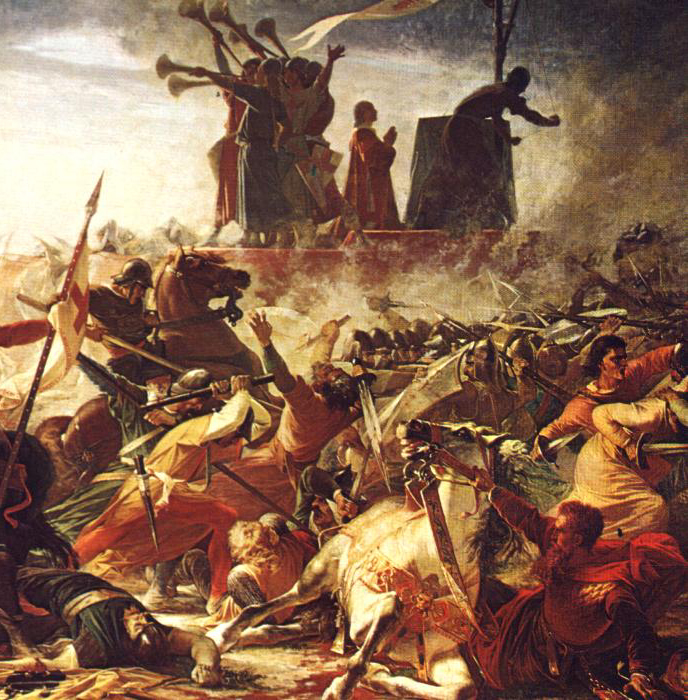
They fought in the Battle of Legnano (29 May 1176) against the imperial army of Frederick I Barbarossa Emperor of the Holy Roman Empire, in his 5th Italian Campaign, and were determinant in his decisive defeat.

The two corps who formed the Company of Death were the Company of the Carroccio, an infantry unit of 300 men, and the real and effective Company of Death, a cavalry unit of 900 men, commanded according to tradition by Alberto da Giussano.


The Company of the Carroccio

The Company of the Carroccio, was an infantry unit of 300 men, all of them young volunteers (forming a societas) and Milanese, sworn by oath to die in defence of the Milanese Carroccio. They fought as phalanx in a Sheltron formation around their "Sacred wagon", armed with a large shield and a lanzalonga.


The Knights of Death

The Company of Death, also known in some sources till the late 19th century as the Knights of Death, is the name of a temporary military association of medieval knights (a temporary societas), not historically well documented, which according to tradition was organized and equipped by a leader known as Alberto da Giussano. It had a great importance during the Battle of Legnano (29 May 1176) where it defended the Carroccio of the Lombard League against the imperial army of Frederick I Barbarossa.

The company was assembled in haste, depriving the Lombard infantry of the valuable support of enough heavy cavalry, "horse" were recruited by Alberto da Giussano around Brescia, and in other eastern areas of Lombardy that had contributed less in infantry and trails to the League. The knights would not be understood in the medieval and romantic sense, but as mere "mounted on horseback" or also "light cavalry." They were very probably particularly cruel and fierce "professional, or semi-professional, fighters," apt at wreaking havoc in the enemy ranks.

According to Milanese chronicler Galvano Fiamma it was composed of 900 men at arms but other sources and modern scholars reduce that number to 300 or, more probably, 500.

According to tradition they wore a sort of dark suit (black and gray, cut vertically) connected at the sides, to cover the armour, with probably the symbol of the skull on the traditional small pointed wooden shields.

Their motto or battle cry could have been, accordingly to poorly documented but reliable sources, "Ambroeus!" (Which is however in stark contrast with the origin of many of them, allegedly Brescia).

As a demonstation of the Company's rapid formation and specific use and role during the Battle of Legnano, after the battle there is no further information about its continued existence.

.

Friday, October 2, 2009

Alberto da Giussano and Barbarossa - Part VII: The Carroccio

Carroccio

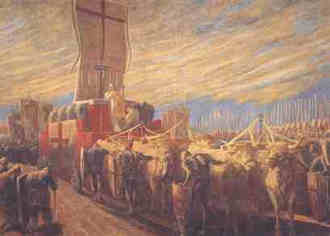
A Carroccio was a war chariot drawn by oxen, used by the medieval republics of Italy. It was a rectangular platform on which the standard of the city and an altar were erected; priests held services on the altar before the battle, and the trumpeters beside them encouraged the fighters to the fray.


In battle the Carroccio was surrounded by the bravest warriors in the army and it served both as a rallying-point and as the palladium of the city's honour; its capture by the enemy was regarded as an irretrievable defeat and humiliation. It was first employed by the Milanese in 1038, and played a great part in the wars of the Lombard League against the emperor Frederick Barbarossa. It was afterwards adopted by other cities, and first appears on a Florentine battlefield in 1228.

The Florentine Carroccio was usually followed by a smaller cart bearing the Martinella, a bell to ring out military signals. When war was regarded as likely the Martinella was attached to the door of the Church of Santa Maria in the Mercato Nuovo in Florence and rung to warn both citizens and enemies. In times of peace the Carroccio was in the keeping of a great family which had distinguished itself by signal services to the republic.

The carro della guerra of Milan was described in detail in 1288 by Bonvesin de la Riva in his book on the "Marvels of Milan". Wrapped in scarlet cloth and drawn by three yoke of oxen that were caparisoned in white with the red cross of Saint George, the city's patron, it carried a crucifix so massive it took four men to step it in place, like a ship's mast.

***************************************************************************

I looked it up again and the opening date, in Italy, for 'Barbarossa' is October 9. Of course, we need to find out when it opens in the United States, and we will just have to make a point to monitor this. It could be a month, or several months.

Thursday, October 1, 2009

Alberto da Giussano and Barbarossa - Part VI: Battle of Legnano


With October now here, and this month being the release date of the upcoming Italian movie 'Barbarossa', here is another segment of our Alberto Giussano and Barbarossa series: The Battle of Legnano. There probably should be an entry just for the "Oath of Pontida," which was the event which united the city-states into the Lombard League, but there wasn't an adequate text in English. It was one of the most brutal wars of the last millennium: The Holy Roman Empire versus The Lombard League.


Battle of Legnano

The Battle of Legnano was fought on May 29, 1176, between the forces of the Holy Roman Empire, led by emperor Frederick Barbarossa, and the Lombard League.


The Lombard League

The Lombard League was formed in 1167, largely out of the Veronese League. It was a Union of Lombard cities promising each other unity, against the Emperor Frederick I Barbarossa. The Lombardy cities swore the oath at Pontida, a small village in Lombardy.

After the disastrous defeat of Pope Alexander III at the Battle of Monte Porzio in May 1167 against Imperial forces, the Lombard League remained as the last legitimate fighting force opposing the Emperor and was therefore heavily backed by the Pope.

Kenneth Pennington wrote: "Alexander’s inability to control Rome and the Papal States was due to his conflict with Frederick. Although he attempted to support the cities of Lombardy, he had neither the power nor the resources to render effective assistance."

[Right: The "Oath of Pontida," painted by Amos Cassioli]


Frederick's 5th Italian Campaign

In September 1174, Frederick embarked on his 5th Italian Campaign, to quench the constant revolts in Lombardy and his quarrels with Pope Alexander III. Frederick led a force of 8,000 knights over the Alps and arrived in Piedmont in late September. His cousin Henry the Lion and his forces, were once again not a part of the Imperial campaign. Frederick wanted to take revenge on Susa, for its "evil" behaviour of 1168, and on the 30 September his forces captured and burned down the town. His next aim was the town of Asti, which he captured after a seven day siege. In October, Frederick finally received the promised Imperial reinforcements from Bohemia. Upon Frederick's rapid and fierce initial success, Margraviate William of Montferrat and the Count of Biandrate, abandoned the Lombard League.


Siege of Alessandria

The siege of Alessandria was an important event in Frederick's 5th Campaign as this was a campaign of revenge, with the aim of the total destruction of the Lombard League and the removal of the Pope Alexander III. Frederick's next goal was therefore the Lombard city of Alessandria. Alessandria was founded by Milanese refugees, who fled after Frederick's forces burned and destroyed the City of Milan in 1162 and named after Pope Alexander III. The siege of the "Straw City", called so because all the roofs were covered with straw, began at the end of October. To Frederick's surprise and anger, his forces were not able to take the city so he had to spend the winter in front of its gates. On Holy Saturday, Fredericks forces managed to enter the city by digging tunnels under its walls, but the attack was repulsed by the Milanese with heavy losses. Alessandria withstood, and that was the first victory of the Lombard League. Frederick had to break off the siege due to an advancing Lombard army and retreated to Pavia.


Treaty of Montebello

On 16 April 1175, Frederick and the Lombard League negotiated peace at the Castle of Montebello but after long talks, negotiations broke with no result. Frederick knew that a battle was imminent and traveled to Chiavenna to meet Henry the Lion. Henry the Lion however refused to help his cousin as he thought that Frederick's defeat would allow him to obtain greater power.


The Battle

After Frederick's setback at Alessandria, the failed agreement of Montebello and the refusal of his cousin Henry the Lion to help him, Frederick finally received some good news and reinforcements from Germany. The German reinforcements crossed Lukmanier Pass into the Lake Como region in April 1176. Frederick I Barbarossa, Philipp I of Heinsberg and Archbishop Wichmann of Magdeburg rode secretly from Pavia along the Ticino River, to meet the reinforcements and to lead them to a joint operation with his main forces. Frederick received 1,000 knights and 1,000 foot soldiers from 16 different German rulers. At Como, Lombard imperialist allies increased the reinforcements to about 3,000 knights and foot soldiers, however, the Imperial army was largely a cavalry force of German knights.

[Left: Lombard knights looking for Fredrick's dead body]

The Milanese were informed about Frederick's plan and prepared for battle. A Carroccio, or a sacred war wagon drawn by oxen, was built and was decorated with the city standard and an altar upon which the cross of Archbishop Aribert of Milan was erected. In 1038, Archbishop Aribert led the victorious defence of Milan against the Holy Roman Emperor Conrad II, and therefore his cross was a symbol of victory against the Empire. According to Sire Raoul, a chronicler from Milan, 900 knights came from Milan and around 550 knights from three other towns, the rest of the League's forces were foot soldiers. The "Company of Death" was a foot soldier unit, that according to Milanese chronicles was led by Alberto da Giussano, and formed the core of the Lombard infantry. While Frederick and his reinforcements were on their way back to Pavia to join the main Imperial force, the Lombard League placed about 3,500 men near the west bank of the Olona. The infantry with the Milanese war cart, the carroccio, stood in a hastily fortified position at Borsano. The Lombards knew that Frederick was about to skirt through their area, however, the Lombards did not know how close Frederick already was. At dawn on the 29 May, the Lombard League sent a reconnaissance unit of 700 horsemen to the Seprio landscape. At the same time, the emperor had crossed the Olona and was marching south from Cairate, five miles northeast of Busto Arsizio. Here, the battle commenced. The Lombard reconnaissance and the 300 Imperial vanguard clashed. The clash was brief and bloody and with Frederick already on the horizon, the Lombard reconnaissance broke off and fled beyond Borsano. Now, Frederick and his Imperial German army launched a rampant and brutal attack on the Lombard League forces near Borsano - Legnano. The Lombard cavalry was largely routed but managed to escape the skirmish, leaving the infantry and carroccio on its own. Frederick advanced to the carroccio, and assaulted the infantry and the Company of Death with his cavalry.

M.B. Synge wrote this about the Company of Death: "Nine hundred desperate patriots forming the Company of Death defended the sacred car. Seeing the Germans were gaining ground, fearful for the safety of their treasure, they suddenly knelt down and renewed their vow to God that they would perish for their country."

The infantry positioned itself in a phalanx-like line. The fight around the carroccio was a long and bloody fight in which the Lombard League infantry brought the Imperial army to a stalemate. Despite the difficulties the Imperial cavalry had against the Lombard infantry, it would have still prevailed in the long run. Finally, the Lombard League forces received help from its regrouped cavalry and from a Brescian cavalry that was called to aid by the fleeing reconnaissance troops. The regrouped reconnaissance troops and the Brescian cavalry jointly attacked Frederick's army from the rear. The decisive assault was made by the Brescians, who managed to break through the lines and attack Frederick directly. In this attack, his guards and standard-bearer were killed, and Frederick was thrown off his horse and believed to be dead. Upon this, the Imperial troops panicked and fled, pursued to the Ticino by the Leagues cavalry. The generals tried to rally the men in vain. The booty and prisoners taken by the League were immense.


Aftermath

After the battle, Frederick's rule over Lombardy was decisively broken. The knights that managed to escape, gathered in Pavia. There, they brought the news of Frederick's presumed death to his wife Beatrice I, Countess of Burgundy. Beatrice and the Empire mourned Frederick's demise but after several days the Emperor appeared at the gates of Pavia.

H. E. Marshall wrote: "Then, greatly to the joy of all, after three days Barbarossa suddenly appeared before the gates of Pavia. Although wounded and bruised and left for dead Frederick had not been killed."

The victory of the Lombard League forced Frederick to travel to Venice. In the Peace of Venice, 1177, Frederick and Pope Alexander III reconciled. The Emperor acknowledged the Pope's sovereignty over the Papal States, and in return Alexander acknowledged the Emperor's overlordship of the Imperial Church. The Peace of Venice were heavily instigated by Archbishop Wichmann of Magdeburg, who was amongst the defeated at Legnano. The cities of Lombardy, however, continued to fight until 1183, when, in the Peace of Constance, Frederick conceded their right to freely elect town magistrates. The Treaty was cast in bronze.

Frederick did not forgive Henry the Lion for refusing to come to his aid in 1176. Taking advantage of the hostility of other German princes to Henry, Frederick had Henry tried in absentia by a court of bishops and princes in 1180, declared that Imperial law overruled traditional German law, and had Henry stripped of his lands and declared an outlaw.

On 27 January 1186, Frederick's son Henry VI married Constance of Sicily in Milan as a sign that peace had really been established.


Actual battlefield

The battle is traditionally tied to the name of Legnano, since the League's forces came from that town. Actually, as local historians have ascertained, the battle was fought a couple miles west of Legnano, where today Villa Cortese and Borsano, frazioni of Busto Arsizio, stand.

***************************************************************************

"Nine hundred desperate patriots forming the Company of Death defended the sacred car. Seeing the Germans were gaining ground, fearful for the safety of their treasure, they suddenly knelt down and renewed their vow to God that they would perish for their country."

That country was not "Italy." I'm not going to argue about whether it should be called Cisalpine Gaul, Etruria, Langbard, Padania, or the Subalpine/Po River Valley; but it was a Nation. "Italy" should be "the Italian peninsula," just as there is "the British Isles," "the Balkins," "the Iberian peninsula," "Scandinavia," etc. So for clarity, it should be Europe, then for reference "northern, southern, Eastern, or southern Europe, and then these "regions."


Friday, September 25, 2009

Alberto da Giussano and Barbarossa - Part V: Lombard League

Lombard League (Wikipedia):

The Lombard League was an alliance formed around 1167, which at its apex included most of the cities of northern Italy (although its membership changed in time), including, among others, Milan, Piacenza, Cremona, Mantua, Crema, Bergamo, Brescia, Bologna, Padua, Treviso, Vicenza, Venice, Verona, Lodi, and Parma, and even some lords, such as the Marquis Malaspina and Ezzelino da Romano. The League was formed to counter the Holy Roman Empire's Frederick I, who was attempting to assert Imperial influence over Italy. Frederick claimed direct Imperial control over Italy at the Diet of Roncaglia (1158). The League had the support of Pope Alexander III, who also wished to see Imperial power in Italy decline. At the Battle of Legnano on May 29, 1176, Frederick I was defeated and, by the Peace of Venice, which took place in 1177, agreed to a six-year truce from August,1178 to 1183, until the Second Treaty of Constance, where the Italian cities agreed to remain loyal to the Empire but retained local jurisdiction over their territories.

The Lombard League was renewed several times and after 1226 regained its former prestige by countering the efforts of Frederick II to gain greater power in Italy. These efforts included the taking of Vicenza and the Battle of Cortenuova which established the reputation of the Emperor as a skillful strategist. He misjudged his strength, rejecting all Milanese peace overtures and insisting on unconditional surrender. It was a moment of grave historic importance when Frederick's hatred coloured his judgment and blocked all possibilities of a peaceful settlement. Milan and five other cities held out, and in October 1238 he had to unsuccessfully raise the siege of Brescia. Once again receiving papal support, the Lombard League effectively countered Frederick's efforts. During the 1249 siege of Parma, the Imperial camp was assaulted and taken, and in the ensuing Battle of Parma the Imperial side was routed. Frederick lost the Imperial treasure and with it any hope of maintaining the impetus of his struggle against the rebellious communes and against the pope. The League was dissolved in 1250 once Frederick died.

**************************************************

The Following paragraph is from a book called 'Modern Italian grammar: a practical guide', and clarifies and simplifies a number of things:

"When, in 1152, Frederick I, known as Redbeard, became King of Germany, he decided to suppress the rebellious City States, He Carred out five raids in Italy; in the first (1154) he suppressed the rebellion in Rome, and had himself crowned emperor; in the second he conquered Milan and with due ceremony reaffirmed the rights of the emperor (1158) in the third he besieged and destroyed Milan (1163) in the fourth he occupied Rome (1168) and in the fifth he was defeated at Legnano by the Lombard League (an alliance between the City States, set up in Pontida in1167, and supported by Pope Alexander III). For this reason he was forced to recognize the freedom of the City States, with the peace treaty of Constance (1183)."

**************************************************


The critics of Padanian identity have gone after trivial facts, to try to underscore the significance of events like the Battle of Legnano. For example, whether or not there was a specific "oath" taken at the formation of the Lombard League in Pontida, Lombardy. That's how the game is played. A people's history needs to be trivialized or absorbed and molded into what is "politically correct." For example, references to "the Italian League," or that it was "for Italian freedom" even though Italy never even existed before. If the history of other groups were to be attacked, it might be answered with calls of "bigotry" or "racism." However, if you're unfortunate enough to be "politically incorrect," then you don't receive this type of protection. You're on your own.

A perfect example of this is if we look at the War of the Sicilian Vespers. Historically, it is referred to as a struggle by the Sicilian people for Sicilian freedom, which it was. However, why is the Battle of Legnano any different? It was a war carried out by Lombardo-Venetian people for Lombardo-Venetian freedom. Why the double standard?

Thursday, September 24, 2009

Alberto da Giussano and Barbarossa - Part IV: Holy Roman Empire

What this all boils down to is that most of the northern subalpine region was conquered and under the subjugation of a powerful German imperial power called the Holy Roman Empire, or what eight centuries later the German National Socialists would refer to as the "First Reich."

Rather than take this sitting down, the city-states of the newly occupied region formed an alliance called the "Lombard League" to oppose the Germanic empire. They were literally fighting for their freedom, just as some of their ancestors had done six centuries earlier when the small Winnili tribe chose to stand and fight the powerful Vandal horde rather than accept being slaves. The odds going into this war were just as long as well.

**************************************************


Holy Roman Empire (from Wikipedia):

The Holy Roman Empire was a union of territories in Central Europe during the Middle Ages and the Early Modern period under a Holy Roman Emperor. The first emperor of the Holy Roman Empire was Otto I, crowned in 962. The last was Francis II, who abdicated and dissolved the Empire in 1806 during the Napoleonic Wars. It was officially known as the Holy Roman Empire of the German Nation by 1450.

The Empire's territorial extent varied over its history, but at its peak it encompassed the Kingdom of Germany, the Kingdom of Italy and the Kingdom of Burgundy; territories embracing present-day Germany (except Southern Schleswig), Austria (except Burgenland), Liechtenstein, Switzerland, Belgium, the Netherlands, Luxembourg, the Czech Republic, Slovenia (except Prekmurje), as well as significant parts of modern France (mainly Artois, Alsace, Franche-Comté, Savoie and Lorraine), Italy (mainly Lombardy, Piedmont, Emilia-Romagna, Tuscany, and South Tyrol), and present-day Poland (mainly Silesia, Pomerania, and Neumark). For much of its history the Empire consisted of hundreds of smaller sub-units, principalities, duchies, counties, Free Imperial Cities, as well as other domains. Despite its name, for much of its history the Empire did not include Rome within its borders.


Holy Roman Emperor (from Wikipedia):

The Holy Roman Emperor is a term used by historians to denote a Middle Ages ruler, who as German King had in addition received the title of "Emperor of the Romans" from the Pope of the Holy Roman Church, and after the 16th century, the elected monarch governing the Holy Roman Empire, a Central European union of territories in existence during the Medieval and the Early Modern period. Charlemagne of the Carolingian Dynasty was the first to receive papal coronation as Emperor of the Romans. Charles V was the last Holy Roman Emperor to be crowned by the Pope. The final Holy Roman Emperor-elect, Francis II, abdicated in 1806 during the Napoleonic Wars that saw the Empire's final dissolution.

The standard designation of the Holy Roman Emperor was "August Emperor of the Romans." When Charlemagne was crowned in 800, his was styled as "most serene Augustus, crowned by God, great and pacific emperor, governing the Roman Empire," thus constituting the elements of "Holy" and "Roman" in the imperial title. The word Holy had never been used as part of that title in official documents. The word Roman was a reflection of the translatio imperii (transfer of rule) principle that regarded the (Germanic) Holy Roman Emperors as the inheritors of the title of Emperor of the Western Roman Empire, a title left unclaimed in the West after the death of Julius Nepos in 480.

Wednesday, September 23, 2009

Alberto da Giussano and Barbarossa - Part III: Emperor Frederick I

Frederick I, Holy Roman Emperor

Excerpts from Wikipedia:

Frederick I Barbarossa (1122 – 10 June 1190) was elected King of Germany at Frankfurt on 4 March 1152 and crowned in Aachen on 9 March, crowned King of Italy in Pavia in 1154, and finally crowned Holy Roman Emperor by Pope Adrian IV on 18 June 1155. He was crowned King of Burgundy at Arles on 30 June 1178. The name Barbarossa came from the northern Italian cities he attempted to rule, and means "red beard."


Rise to power

Eager to restore the Empire to the position it had occupied under Charlemagne and Otto I the Great, the new king saw clearly that the restoration of order in Germany was a necessary preliminary to the enforcement of the imperial rights in Italy. Issuing a general order for peace, he made lavish concessions to the nobles. Abroad, Frederick intervened in the Danish civil war between Svend III and Valdemar I of Denmark and began negotiations with the East Roman emperor, Manuel I Comnenus.

It was probably about this time that the king obtained papal assent for the annulment of his childless marriage with Adelheid of Vohburg, on the grounds of consanguinity (his great-great-grandfather was a brother of Adela's great-great-great-grandmother, making them fourth cousins, once removed). He then made a vain effort to obtain a bride from the court of Constantinople. On his accession Frederick had communicated the news of his election to Pope Eugene III, but had neglected to ask for the papal confirmation. In March 1153, Frederick concluded the treaty of Constance with the Pope whereby, in return for his coronation, he promised to defend the papacy, to make no peace with king Roger II of Sicily or other enemies of the Church without the consent of Eugene and to help Eugene regain control of the city of Rome.


Reign and wars in Italy

Frederick undertook six expeditions into Italy. In the first he was crowned Holy Roman Emperor in Rome by Pope Adrian IV, following the suppression by Imperial forces of the republican city commune led by Arnold of Brescia. During the 1155 campaign in Rome, Frederick quickly allied forces with Pope Adrian IV to regain the city. The major opposition was led by Arnold of Brescia, a student of Abelard. Arnold was captured and hanged for treason and rebellion. Despite his unorthodox teaching concerning theology, Arnold was not charged with heresy. Frederick left Italy in the autumn of 1155 to prepare for a new and more formidable campaign.

In June 1158, Frederick set out upon his second Italian expedition, accompanied by Henry the Lion and his Saxon troops. This expedition resulted in the establishment of imperial officers in the cities of northern Italy, the revolt and capture of Milan, and the beginning of the long struggle with Pope Alexander III. In response to his excommunication by the pope in 1160, Frederick declared his support for Antipope Victor IV. Frederick attempted to convoke a joint council with King Louis of France in 1162 to decide the issue of who should be pope. Louis came near the meeting site but, when he became aware that Frederick had stacked the votes for Alexander, Louis decided not to attend the council. As a result the issue was not resolved at that time.

The political result of the struggle with Pope Alexander was that the Norman state of Sicily and Pope Alexander III formed an alliance against Frederick. Returning to Germany towards the close of 1162, Frederick prevented the escalation of conflicts between Henry the Lion from Saxony and a number of neighbouring princes who were growing weary of Henry's power, influence and territorial gains. He also severely punished the citizens of Mainz for their rebellion against Archbishop Arnold. The next visit to Italy in 1163 saw his plans for the conquest of Sicily ruined by the formation of a powerful league against him, brought together mainly by opposition to imperial taxes.

In 1164 Frederick took what are believed to be the relics of the "Biblical Magi" (the Wise Men or Three Kings) from Milan and gave them as a gift (or as loot) to the Archbishop of Cologne, Rainald of Dassel. The relics had great religious significance and could be counted upon to draw pilgrims from all over Christendom. Today they are kept in the Shrine of the Three Kings in the Cologne cathedral.

Frederick then focused on restoring peace in the Rhineland, where he organized a magnificent celebration of the canonization of Charles the Great (Charlemagne) at Aachen. In October 1166, he went once more on journey to Italy to secure the claim of his Antipope Paschal III, and the coronation of his wife Beatrice as Holy Roman Empress. This time, Henry the Lion refused to join Frederick on his Italian trip, tending instead to his own disputes with neighbors and his continuing expansion into Slavic territories in northeastern Germany. Frederick's forces achieved a great victory over the Romans at the Battle of Monte Porzio, but his campaign was stopped by the sudden outbreak of an epidemic (malaria or the plague), which threatened to destroy the Imperial army and drove the emperor as a fugitive to Germany, where he remained for the ensuing six years.


Later years

In 1174, Frederick made his fifth expedition to Italy but was opposed by the pro-papal Lombard League (now joined by Venice, Sicily and Constantinople) which had previously formed to stand against him. The cities of northern Italy had become exceedingly wealthy through trade, and represented a marked turning point in the transition from medieval feudalism. While continental feudalism had remained strong socially and economically, it was in deep political decline by the time of Frederick Barbarossa. When the northern Italian cities inflicted a defeat on Frederick, the European world was shocked that such a thing could happen. With the refusal of Henry the Lion to bring help to Italy, the campaign was a complete failure.

Frederick was able to march through Northern Italy and occupy Rome with his self-appointed Antipope Paschal III, but the Lombards rose up behind him while a severe fever crippled his army. Frederick suffered a heavy defeat at the Battle of Legnano near Milan, on 29 May 1176, where he was wounded and for some time was believed to be dead. This battle marked the turning point in Frederick's claim to empire. He had no choice other than to begin negotiations for peace with Alexander III and the Lombard League. In the Peace of Anagni in 1176, Frederick recognized Alexander III as Pope and in the Peace of Venice, 1177, Frederick and Alexander III were formally reconciled. The scene was similar to that which had occurred between Pope Gregory VII and Henry IV, Holy Roman Emperor at Canossa a century earlier.

The conflict was the same as that resolved in the Concordat of Worms. Did the Holy Roman Emperor have the power to name the pope and bishops? The Investiture controversy from previous centuries had been brought to a tendentious peace with the Concordat of Worms and affirmed in the First Council of the Lateran. Now it had recurred, in a slightly different form. Frederick had to humble himself before Pope Alexander III at Venice. The Emperor acknowledged the Pope's sovereignty over the Papal States, and in return Alexander acknowledged the Emperor's overlordship of the Imperial Church. Also in the Peace of Venice, a truce was made with the Lombard cities,which took effect in August, 1178. But the grounds for a permanent peace were established only in 1183, when, in the Peace of Constance, Frederick conceded their right to freely elect town magistrates. By this move, Frederick recovered his nominal domination over Italy. This became his chief means of applying pressure on the papacy.


Frederick and the Justinian code

Because of the increase in wealth of the trading cities of northern Italy, there occurred a revival in the study of the Justinian Code. This was a Latin legal system which had become extinct in earlier centuries. Legal scholars renewed its application. It is speculated that Pope Gregory VII personally encouraged the Justinian rule of law, and possessed a copy of it. Corpus Iuris Civilis (Justinian Body of Civil Law) has been described as the greatest code of law ever devised. It envisaged the law of the state as a reflection of natural moral law, the principle of rationality in the universe. By the time Frederick assumed the throne, this legal system was well established on both sides of the Alps. He was the first to utilize the availability of the new professional class of lawyers. The Civil Law allowed Frederick to use these lawyers to administer his kingdom in a logical and consistent manner. It also provided a framework to legitimize his claim to the right to rule both Germany and northern Italy. In the old days of Henry VI and Henry V, the claim of divine right of kings had been severely undermined by the Investiture controversy. The Church had won that argument in the common man's mind. There was no divine right for the German king to also control the church by naming both bishops and popes. The institution of the Justinian code was used, perhaps unscrupulously, by Frederick to lay claim to divine powers.

In Germany, Frederick was a political realist, taking what he could and leaving the rest. In Italy, he tended to be a romantic reactionary, reveling in the antiquarian spirit of the age, exemplified by a revival of classical studies and Roman law. It was through the use of the restored Justinian code that Frederick came to view himself a the new Roman emperor. Roman law gave a rational purpose, for the existence of Frederick and his imperial ambitions. It was a counterweight to the claims of the Church to have authority because of divine revelation. The Church was opposed to Frederick for ideological reasons, not the least of which was the humanist nature found in the revival of the old Roman legal system. When Pepin the Short sought to become king of the Franks, the church needed military protection. Pepin found it convenient to make an ally of the pope. Frederick desired to put the pope aside and claim the crown of old Rome simply because he was in the likeness of the greatest emperors of the pre-Christian era. Pope Adrian IV was naturally opposed to this view and undertook a vigorous propaganda campaign which was designed to diminish Frederick and his ambition. To a large extent, this was successful.


Charismatic leader

Comparison has been made between Henry II of England and Frederick Barbarossa. Both were considered to be the greatest and most charismatic leaders of the age. Each had a rare combination of qualities which made them appear to be superhuman to their contemporaries. They possessed longevity, boundless ambition, extraordinary organizing skill, and greatness on the battlefield. They were handsome and proficient in courtly skills, without appearing effeminate or affected. Both came to the throne in the prime of manhood. Each had an element of learning, without being considered impractical intellectuals, but rather more inclined to practicality. Each found himself in the possession of new legal institutions which were put to creative use in governing. Both Henry and Frederick were viewed to be sufficiently and formally devout to the teachings of the Church, without being moved to the extremes of spirituality seen in the great saints of the twelfth century. In making final decisions, each relied solely upon their own judgment. Both were interested in gathering as much power as they could.

Frederick's charisma led to a fantastic juggling act which over a quarter of a century, restored the imperial authority in the German states. His formidable enemies defeated him on almost every side, yet, in the end, he emerged triumphant. When Frederick came to the throne, the prospects for the revival of German imperial power were extremely thin. The great German princes had increased their power and land holdings. The king had been left with only the traditional family domains and a vestige of power over the bishops and abbeys. The backwash of the Investiture controversy had left the German states in continuous turmoil. Rival states were in perpetual war. These conditions allowed Frederick to be both warrior and occasional peace-maker, both to his advantage.

**************************************************

There is a lot more information about Emperor Frederick I, or as he is more widely known "Barbarossa." He truly affected the northern subalpine nations so much, that his nickname has reigned loudly down through history. The historical record seems to show him not as much a tyrant as he was an aggressive imperialist, and one with a lot of power. Then again, in the preview for the upcoming movie 'Barbarossa', he is shown cutting off a man's ear, so maybe we need to keep this as an open question.

Of further significance to us today, is that there have been four times in history that the closely-related subalpine nations have become "one nation." First, through Etruscan civilization, which at it's peak encompassed the vast majority of the north. Second, through Gallia Cisalpina, as the Roman's called the region of the Celto-Ligurian tribal culture. Third, and the most "administratively proactive" was the Langbard Kingdom. And fourth, through the Lombard League(s).


Sunday, September 20, 2009

Alberto da Giussano and Barbarossa - Part II: Alberto da Giussano

Alberto da Giussano, a native of Lombardy, was a legendary Guelph warrior during the wars of the Lombard League against Frederick Barbarossa in 12th century. Fourteenth century Milanese chroniclers attributed him the deed of forming the "Company of Death" which defended the Carroccio of the League at the Battle of Legnano. Lega Nord uses, as it's emblem, an image inspired by the statue of him erected at Legnano in 1900.

Some anti-Northern League sources claim that some historical aspects involving da Giussano are a myth. This record does have some historical merit, but why this is even relevant anyway is a mystery to me. It's like fighting over whether or not William Wallace tied his left shoe first before the Battle of Sterling, RATHER than acknowledge the significance of the battle itself!

Alberto da Giussano seems to be the main player, along with German Emperor Fredrick I, in the upcoming Italian movie 'Barbarossa.' I think part of the significance of da Giussano, like William Wallace, was the concept of one common man standing up to an extremely powerful imperial dictator, and winning. The old American ideal of loving an underdog is exemplified here I think.

When looking at the excerpts of 'Barbarossa', it gives the appearance of a classic Italian movie. A certain passion and purity comes through it seems. I'm looking forward to it.

[8-12-10 Addition: The following link is for the Alberto da Giussano Wikipedia webpage]


Monday, August 24, 2009

Alberto da Giussano and Barbarossa - Part I: Movie Trailer


Above is an eight minute trailer for the upcoming release of 'Barbarossa', a movie by Renzo Martinelli. "Barbarossa" ("redbeard") was the nickname for the ruthless Holy Roman Emperor Frederick I. Barbarossa invaded and fought numerous wars in the Po River region. One of the heroes of the opposition to him was Alberto da Giussano, a legendary Guelph warrior during the wars of the Lombard League against Barbarossa. His image is utilized by the Northern League party today. He is seen as the image of the warrior raising the sword to the sky, on the party's emblems. This new movie opens sometime in October in Italy, and probably will be released in the United States a month or two after that.