Thursday, February 27, 2020
'Italy... 400 coronavirus cases... the most infected country outside of Asia'
Sinéad Baker - Business Insider - February 26, 2020
[Right: Military officers outside the Duomo cathedral, closed by authorities because of the coronavirus outbreak, in Milan on February 24]
REUTERS/Flavio Lo Scalzo
* Italy is scrambling to stop the spread of the novel coronavirus within its borders as cases of COVID-19 soar.
* Italy has the most cases outside of Asia. As of Wednesday evening, 12 people there had died from the disease.
* The country has put almost a dozen towns under lockdown, canceled major sporting events, and debated closing its borders with neighboring countries.
* The two most infected regions are Lombardy and Veneto in the north of Italy, home to Milan and Venice. New cases are also being reported in southern Italy.
* Visit Business Insider's homepage for more stories.
Italy is scrambling to fight a coronavirus outbreak after a sharp spike in cases and deaths made it the worst-hit country outside of Asia.
As of Wednesday evening, 12 people in Italy had died from the virus. Italian authorities reported at least 400 cases of COVID-19 in the country, according to the BBC.
All the people who have died in Italy were elderly or had other health complications, the Italian newspaper La Repubblica and the Associated Press reported.
The country has put 11 towns on lockdown to contain the virus' spread.
The two most infected regions are Lombardy and Veneto in the north, which contain the major cities of Milan and Venice. But the virus has also spread farther south, with regions including Tuscany and the island of Sicily also reporting cases on Tuesday and Wednesday.
con't....
************
I'll just re-post the following from the previous post:
There are--on average--10,000 germs on a human hand. It would always be a good idea, even aside from this concern, to have liquid hand cleaner handy during the day. Also, halo oral antiseptic spray is a good precaution to use prior to a lot of close contact, such as grocery shopping. Using latex gloves is an option as well. I think a box of 100 goes for about $11 at Lowes. Face masks can be observed occasionally in places like San Francisco. Think gas pumps, shopping cart handles, and door knobs/handles.
.
Thursday, May 23, 2019
Predator or Prey?
The FBI Files: Season 6 - Ep 16 "Radical Resistance"
FilmRise True Crime
Click here to watch great FREE Movies & TV: http://filmrise.com
In the 1970s, a Croatian terrorist group linked to the National Resistance party committed acts against non-supportive Croatians living in the United States. With the help of an informant, the FBI apprehended, arrested and convicted members of the group of crimes ranging from conspiracy and extortion to murder.
THE FBI FILES reveals the crime busting techniques and forensic science used by the FBI to solve the most baffling cases. Former head of the FBI's New York Office James Kallstrom hosts these true stories of crime and detection.
************
Croatian National Resistance
The Croatian National Resistance (Croatian: Hrvatski narodni otpor, HNO), also referred to as Otpor, was an Ustaša organization founded in the aftermath of the Second World War in Spain. The HNO ran a terrorist organisation, Drina, which continued to be active well into the 1970s.
The organization operated between legitimate emigre functions and a thuggish underworld. Its leaders tried to distance the organization from the acts of the so-called renegade elements. It embraced a radical nationalist ideology that differed only marginally from Ustaše ideology.
The HNO had stated, in their constitution, that:
"We regard Yugoslavism and Yugoslavia as the greatest and only evil that has caused the existing calamity... We therefore consider every direct or indirect help to Yugoslavia as treason against the Croatian nation... Yugoslavia must be destroyed—be it with the help of the Russians or the Americans, of Communists, non-Communists or anti-Communists—with the help of anyone willing the destruction of Yugoslavia: destroyed by the dialectic of the word, or by dynamite—but at all costs destroyed."
The organization published its own magazine, Drina. It existed until 1991.
************
Croatian nationalism
Croatia is a distinct ethnicity with it's own genuine history, language, and culture. Of that, there is no question.
The Ustaša
The Croatian Revolutionary Movement, Fascist in ideology.
The Catholic Church and the Ustaša
During World War II, the Catholic Church backed the Ustaša in an effort to form a new Croatian state which would be fully Catholic. This happening---and the many war crimes of the Ustaša, along with knowledge by the church, and participation by Croatian church officials---has overwhelmingly been buried and spun by the financial and political power of the church.
Old Croatian-American communities
There have been Croatian-American communities in many corners of the United States going back a century and beyond. Chicago, Pittsburgh, southeast Louisiana, San Francisco, Sacramento, Los Angeles... the list is long. I have a cousin in a more-or-less rural area in Pennsylvania, and she says there's a strong old Croatian community where she lives. When my family came to this country and settled in Upper Michigan, there was a Croatian community just as old as the Lombardo-Venetian community there. More recent Croatian immigrants have settled in other places like Seattle, Phoenix, locations in Florida and numerous other locales.
Croatian American Association (or here)
During the crisis in Yugoslavia during the late 80s/early 90s, the CAA organized meetings and a structure made up of leaders from all over the U.S. in regards to how to deal with the continuing crisis (at that time). There were a series of YouTube videos about this, but they seem to have disappeared. It certainly showed a tremendous amount of pride, passion, cultural continuity, and social cohesion between older Croatian communities and more recent arrivals.
Croatian National Resistance (Hrvatski narodni otpor) in America
The HNO was much the same as the ETA in the Basque Country, the FLNC in Corsica, the IRA in Ireland, and other separatist groups which resorted to terrorism. On the other hand, many consider the Sons of Liberty to have been basically a terrorist group, which brings up the hypocrisy of the topic. One person's "freedom fighter" is another person's "terrorist." Seldom do people look at the hardships perpetrated on both sides of any conflict.
What made the HNO a bit different is that they wrongly brought terror to the United States, imposing a "revolutionary tax" on successful Croatian-American businessmen. It should be stated that both parties were among the arrivals of recent decades. It probably also perhaps should be stated that the IRA had committed bank robberies in the U.S., for example in Boston, to finance themselves... as well as purchasing arms from Irish-American gangsters.
Parallels between "the Balkans" and "the Italian peninsula"
Although there were inherently more cultural elements which tied the various "nations" of the Italian peninsula together in 1860, there is not all that much difference between it and the Balkans. The peninsula also had different cultures and languages. For example, Lumbardia (pronounced "Loom-bar-DEEE-ah") was essentially a nation, with it's own distinct language. The Lumbard language is NOT a "dialect of Italian"... although it's linguistically related to Roman/Latin. Much of it is made up of words of proto-European and Gaulish origin. In a perfect world, Lumbardia would be a nation in its own right, and possessing a larger area than the current defined region.
The greater Veneto, Tuscany, Calabria, Sicilia, etc., all have their own distinct culture and native tongue... just as the competing nations of the Balkans have. However, they have long been united by a common religion. We can't blame this apathy entirely on circumstance. The Croatians have demonstrated the will and fortitude as a people--even across oceans!--to fight for their ancestral homeland. By being apathetic, even in terms of what might be good for the whole peninsula, we now get a steady diet of this....
Even locally in parts of the Bay Area where there was once quite a prominence of Italian-American culture even just twenty or thirty years ago, a recent "techie" arrival would never know that we were ever here. One would never have the faintest idea of the 100-year link between Genoa and San Francisco. Just yesterday in the late afternoon I was at a successful local business owned by a proud family in Colma with old roots in Liguria. After purchasing something, one of them said a simple phrase to me in Italian as we parted company.
While driving home I thought to myself that I was sorry that I didn't respond to his phrase in a more explicit manner.. in Italian. Here there is a big (gay) "PRIDE" mural right down the street from that establishment, and I can't even say two words in Italian? It's like subconsciously accepting our rapid demise. In the old days, we didn't feel the need to "cut out a slice of society for ourselves," as this was just our home, period. It just belonged to all who lived here.
In nature, in any given circumstance, a creature is either predator or prey. Sadly with super-Capitalism, mass migration, and the new surge in identity, radical, and behavioral politics... human society is now much the same. In the film 'Wall Street', financial predator Gordon Gekko said flatly "You are either INSIDE or you are OUTSIDE." I offer this to our people, south Italians, Croatians, Slavs, and other similar people.... right now we are OUTSIDE. What the Croatian National Resistance did wasn't the right thing to do... however, doing nothing is worse. Even discussing what one "might do" is still better than doing absolutely nothing.
The people who absolutely dominate this country---and are behind that mural... and a thousand other things that disable us with their veiled supremacism---meet every July in Marin County not far from here, and they hate us! We're archaic people who need to be replaced or go away. It's that simple. If you took all responsible, wittingly or unwittingly, for local studio apartment to be as high as $5,000 a month.... and imposed that horrible and unreasonable THING upon the hometowns that they originally came from.... their hometowns would become ghost towns overnight.... and we stand for this??
It's all part of the same thing----whether it's a supernational entity totally disempowering a people like what was happening in Croatia, or gentrifying a people out've existence in favor of others, or taxing a people out've existence, or denigrating their culture in favor of their own, or surveiling them without having to show cause----as the prominent and influential Greek statesman, orator and general of Athens--Pericles--once said: "Just because you do not take an interest in politics doesn't mean politics won't take an interest in you."
The right wing/left wing folly
It's not difficult to see the problems of a nationalist movement taking on the veneer of "Fascism" or "Communism".... which are both moronic expressions to reflect just how "angry they are." Sure, there are plenty of reasons to be very angry, but they harm their cause by making it all about a general politic... instead of about flesh and blood.... about the soul of a people. Sinn Féin didn't help it's cause by attaching itself to Communists and terrorists. Lega Nord doesn't now help it's cause by even accepting the "far right" label... literally accepting the title that the enemy has given you. Native Americans who fought for their land were not "right-wing extremists." There are Russian nationalists, both Fascist and Communist, who hate each other and have even killed each other... even though they seem to support the same cause.
Remember.... Croatia did eventually win its independence.... and did not end up with a Fascist, Communist, or Globalist government, but a government which has maintained security for its people.
.
Tuesday, January 31, 2017
The Mystery of “Flower of Life” & “Sacred Geometry”
[See article link for images]
After the creation of the Seed of Life the same vortex’s motion was continued, creating the next structure known as the Egg of Life.
This structure forms the basis for music, as the distances between the spheres is identical to the distances between the tones and the half tones in music. It is also identical to the cellular structure of the third embryonic division (The first cell divides into two cells, then to four cells then to eight). Thus this same structure as it is further developed, creates the human body and all of the energy systems including the ones used to create the Merkaba. If we continue creating more and more spheres we will end up with the structure called the Flower of Life.
The flower of life holds a secret symbol created by drawing 13 circles out of the Flower of Life. By doing this, one can discover the most important and sacred pattern in the universe. This is the source of all that exists; it’s called the Fruit of Life. It contains 13 informational systems. Each one explains another aspect of reality. Thus these systems are able to give us access to everything ranging from the human body to the galaxies. In the first system, for example, it’s possible to create any molecular structure and any living cellular structure that exists in the universe. In short every living creature.
The “Seed of Life” is formed from seven circles being placed with sixfold symmetry, forming a pattern of circles and lenses, which acts as a basic component of the Flower of Life’s design.
The Temple of Osiris at Abydos, Egypt contains the oldest to date example. it is carved in granite and may possibly represent the Eye of Ra a symbol of the authority of the pharaoh.
Other examples can be found in Phoenician, Assyrian, Indian, Asian, Middle Eastern, and medieval art.
Leonardo da Vinci has studied the Flower of Life’s form and its mathematical properties. He has drawn the Flower of Life itself, as well as components therein, such as the Seed of Life. He has drawn geometric figures representing shapes such as the platonic solids, a sphere, a torus, etc., and has also used the golden ratio of phi in his artwork; all of which may be derived from the Flower of Life design.
The flower of life shape contains a secret shape known as the fruit of life that consists of 13 spheres that hold many mathematical and geometrical laws. These laws represent the whole universe. Giving the flower of life to someone is like giving them the whole universe in one jewel.
People reported physical and psychological changes after wearing this pendant – faster heart beats, prophetic dreams, breaking of illusions, seeing the reality as it is and becoming free from long time fears.
The flower of life is one of the strongest sacred geometric shapes!
~ROSSLYN CHAPEL- THE CEILING~
The Chapel is filled with the Sinclair symbol of the engrailed cross, and the building is said to be based on the ancient temple of Jerusalem. The Chapel is believed by many to be the final hiding place of a much sought after sacred relic, the Holy Grail itself, thought to be part of the Templar treasure smuggled out of France during the attack on the Templars when Phillip the Fair decided to bring down the powerful and influential order. Some of the order fled to Portugal, others, it is said, to Scotland, for the Templars had connections by marriage to the Sinclairs, and the Scots, including Robert the Bruce, were ready to welcome such a renowned group as the Knights Templar to help them in their fight against the English crown. Many believe that the Templar’s brought with them to Europe new knowledge and holy relics found under the Temple Mount itself. Indeed, it was the Templars who sparked the phenomenal new architecture revealed in the building of the gothic cathedrals of Medieval Europe, the first of these being Chartres in France.
“In a single century from 1170 no fewer than eighty cathedrals and almost five hundred abbeys were built in France alone, involving more masonry than was ever cut in ancient Egypt! These buildings were built to a startling new scale never seen before.“- Knight and Lomas. The Hiram Key. The architecture is such that the experience of sound is heightened. It may be that, like the ancient standing stones and long barrows, these ‘new’ sacred sites were similarly built and ‘tuned’ to enhance certain frequencies and energies.
| Preservation of regional cultures should be a Human Right |
************
Eddie
President at WorldTruth.Tv
Eddie L. is the founder and owner of www.WorldTruth.TV. and www.Womansvibe.com. Both website are dedicated to educating and informing people with articles on powerful and concealed information from around the world. I have spent the last 36+ years researching Bible, History, Alternative Health, Secret Societies, Symbolism and many other topics that are not reported by mainstream media.
.
Tuesday, September 13, 2016
"Italian irredentism" and the concept of a "Cisalpine state"
Italian irredentism (Italian: irredentismo italiano) was a nationalist movement during the late 19th and early 20th centuries in Italy with irredentist goals which promoted the unification of geographic areas in which indigenous ethnic Italians and Italian-speaking persons formed a majority, or substantial minority, of the population.
Originally, the movement promoted the annexation to Italy of territories inhabited by an Italian indigenous population but retained by the Austrian Empire after Third Italian War of Independence in 1866.
In 1859, the Italian peninsula was similar to the Balkans; a grouping of separate nations, each with it's own language and culture. However, three aspects of the Italian peninsula made it different. One was the power and reach of the Catholic Church; the second was the centuries-long influence of the "standard Italian language" based on Tuscan, and third was the incessant invasions from foreign powers (France, Austria, Spain, Islam in the south, etc.). These three factors made it possible to form the Italian state.
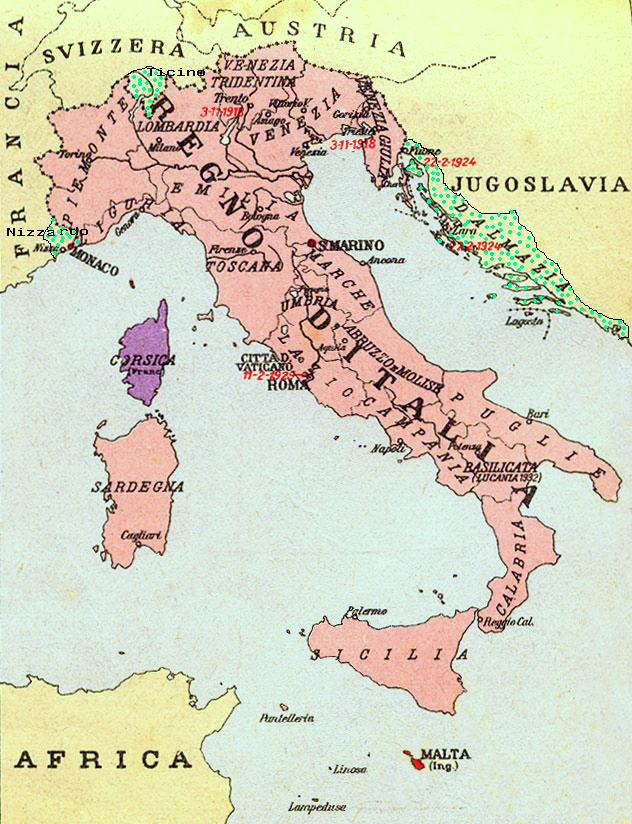
From an Italian irredentist point of view, the concept would seem to include the basic peninsula; the islands of Sicily, Sardinia, and Corsica; the county of Nice in France (Nizza); the country of Monaco; the Swiss canton of Ticino and other Swiss Italian sections to the east; parts of Croatia and the Dalmatian coast in the Balkans, and maybe Savoia (France) in the far north and the island nation of Malta. It was like a 19th century version of the EU, with the promise of security and prosperity; however, not set up along linguistic or cultural lines.
From a Cisalpine/Padanist point of view, the concept would be much simpler, and would include the peninsula north of the Roman state. In my opinion, from an 1859 geopolitical point of view, it would include a politically decentralized Roman state (Latium) and the lands north of it. This would include Monaco, Nice, Savoia, Ticino, and at least Trieste in the east. Of course, far beyond Cisalpine identity, the continuously escalating events during the last twenty years have made a mockery of even European identity itself.
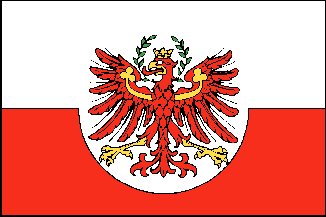
In a general pragmatic way, as far as American-Padanian identity goes, a heritage such as South Tyrolian could be thought of as Cisalpine. I can recall seeing a website once where there was some type of Trentinese-South Tyrolian club somewhere in perhaps New England, in which both Alpini-style hats and traditional Tyrolian dress was worn by some.
Even if Europe is destroyed, we can still continue to exist in the United States, Canada, Argentina, and Australia. We're experiencing the same fundamental problem that has continued over 6,000 years: citizens too afraid to stand up to their own governments or other powerful entities. Even if you simply vote-out the Fabianists/Globalists... the following wrath though their raw deceitful power in government and media is shocking. In the U.S., globalist-treason is centrally organized around the Council on Foreign Relations, a Fabianist billionaire political union with its hands clutched over the main choke-points of society.
.
Tuesday, March 11, 2014
'The New York Times’ List of Potential New Countries..'
The following are a few excerpts from an article entitled 'The New York Times’ List of Potential New Countries, and Others As Well'.
Submitted by Asya Pereltsvaig on September 24, 2013
About a year ago, two New York Times journalists, Frank Jacobs and Parag Khanna, wrote an opinion article listing eleven potential new countries that they expect to emerge in the near future. They write:
“we appear on the brink of yet another nation-state baby boom. This time, the new countries will not be the product of a single political change or conflict, as was the post-Soviet proliferation, nor will they be confined to a specific region. If anything, they are linked by a single, undeniable fact: history chews up borders with the same purposeless determination that geology does, as seaside villas slide off eroding coastal cliffs.”
Here is their list of potential geopolitical changes to look out for. The links below are to numerous GeoCurrents posts about these “potential countries”.
**************************************************
Additional suggestions for potential new countries have also been made elsewhere. ComingAnarchy.com lists the following newly independent states that could splinter off existing countries in Europe: Scotland (currently part of the UK), Normandy, Brittany, and Corsica (France), Basque Republic and Catalonia, the latter with or without the Balearic Islands (Spain), Baden-Württemberg and Bavaria (Germany), Padania and Sardinia (Italy).
An even more radical map of “Potential independent states in Europe” (whose original author I was not able to establish as it has been reposted on multiple websites without proper reference) lists, in addition to the already mentioned candidates: United Ireland, created by joining together the current Republic of Ireland and the Northern Ireland) and Wales in the British Isles; Galicia and Andalusia (Spain); Trentino South-Tyrol in northern Italy; Republica Srpska and Herzeg-Bosnia (which together currently form Bosnia and Herzegovina); Kosovo and Metohia in southern Serbia; Trasdnistria; North Ossetia, Chechnya, and Abkhazia in northern Caucasus region; Nagorno-Karabakh; and Northern Cyprus.
GeoCurrents has written extensively about these problematic regions and nationalist movements (follow links above), but Catalonia in particular is worth mentioning in view of the 250-mile human chain created in support of Catalan independence on 11 September 2013. Approximately 1.6 million people in Spain participated in this event, which became known as The Catalan Way towards Independence, or simply The Catalan Way. It was organized by the Assemblea Nacional Catalana (Catalan National Assembly), an organization that seeks the political independence of Catalonia from Spain through democratic means. Catalan nationalists have chosen public demonstrations and electoral politics over violence, in sharp contrast to hard-core Basque nationalists, who have long embraced militancy, attacking the Spanish state and its institutions with bombs and guns. It appears that the Catalan strategy has been much more successful than that of the Basques. Not just Spaniards at large, but the majority of Basques themselves have been so disgusted with the terrorism of the separatist ETA (Euskadi Ta Askatasuna) that the movement for Basque nationhood has lost its impetus. Catalan nationalism, by contrast, is gaining ground.
One of the reasons behind the Catalan independence movement is the desire to protect the local culture, which revolves around the Catalan language. Like Spanish, Catalan is a Romance language that evolved from Latin after the collapse of the Western Roman Empire in the 5th century CE. But despite being spoken in the Iberian Peninsula, Catalan is more closely related to French and Italian than to Spanish. For example, the Catalan word for ‘summer’ is estiu, derived from the same root as French été and Italian estate but not Spanish verano. Similarly, the verb ‘to want’ in Catalan is voler, closely related to the French vouloir and Italian volere, whereas Spanish querer is clearly different. Both Catalan and Spanish incorporated words from Arabic, but not necessarily the same ones: Catalan borrowed alfàbia meaning ‘large earthware jar’ and rajola meaning ‘tile’, whereas Spanish adopted aceite and aceituna, meaning ‘oil’ and ‘olive’, respectively.
The Catalan language, however, is not limited to Catalonia. It is the national and only official language of the tiny country of Andorra, and a co-official language of the Balearic Islands and Valencia in Spain. It is also spoken, without official recognition, in parts of Aragon and Murcia in Spain, and in the French region of Roussillon. Because Catalan culture extends well beyond Catalonia, many sources explain the surging Catalan independence movement in economic rather than cultural terms. Catalonia is one of the wealthiest parts of Spain, and the taxes collected there subsidize the poorer parts of the country. With Spain’s current economic crisis, many of the region’s residents feel that they can no longer afford to support Extremadura and other poorer parts of the country. Such economic issues have the potential to bind indigenous Catalans with migrants from other parts of Spain who now live in the region.
The Spanish constitution bans outright votes on secession, and it is unclear whether most Catalans want full independence or merely enhanced autonomy. Even so, Catalonia appears to be well on the path “by which the citizens of Catalonia will be able to choose their political future as a people”, as stated in the recently adopted Catalan Sovereignty Declaration.
Finally, another territory that has not been mentioned in those lists of potential independent states is Vojvodina. In late 2009 Serbia granted its northern area of Vojvodina control over its own regional development, agriculture, tourism, transportation, health care, mining, and energy. Vojvodina, population two million, even gained representation in the European Union (although it will be allowed to sign only regional agreements, not international ones). Autonomy rather than independence, however, appears to be what the majority of local residents, 65% of whom are Serbian, want. Vojvodinans evidently favor autonomy largely for economic reasons. But claims for heightened self-rule can lead to further claims; already a local ethnic Hungarian group wants its own autonomous zone within the larger autonomous area of Vojvodina.
*************************
3-17-14 ADDITION: Regarding the deleted posting about available materials from the Italian Government Tourist Board. They no longer offer these types of wide-ranging regional material (free maps, posters, booklets, etc. via snail mail) as they once did. Some good things come to an end, and that posting was made in error. Travel stores would probably have a lot of those types of things.
.
Saturday, August 31, 2013
Current Miss Padania, Serena Bignami, wearing an American t-shirt
Miss Padania 2012 video
Miss Padania Wikipedia page

Miss Padania video site
We also have a "Lodi" in Northern California as well. One of it's famous residents was Robert Mondavi.
.
Wednesday, January 30, 2013
Pan-Padanist ideas and flags
"Pan-Padanism" is something related, but different. It's the concept of acknowledging a diaspora, and getting in touch with manifestations of a root-culture in different parts of the world. Here in northern California, we are at least fifty years removed from even a small degree of immigration from the Cisalpine ancestral homeland... which was chiefly from the northwest region. However, there was a type of chain-migration which existed for about a century. Still, fifty years--and it's really more like seventy years--is a long time. We've collectively lost touch. If we wish to get back in touch, then wouldn't it be best to do it globally?
Regions and flag ideas
Europe
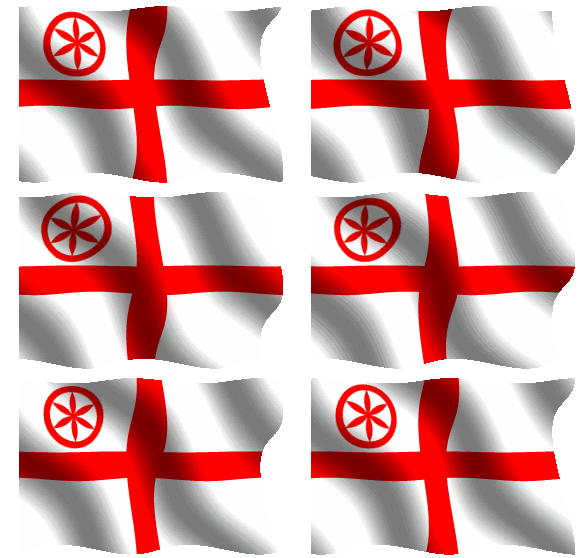
Naturally we would look to the Lega Nord political party for inspiration. The proposed flag (see above) is an ancient green rosette/sun of the alps symbol on white background. They used green as it's a Celtic color; however, sometimes blue or red have been associated with the Celts/Gauls. I think "Gaulish"--or "Celto-Gaulish"--is more the term to describe that part of Cisalpine history. The flag's alternative would be white rosette on green background; as would any Cisalpine flag discussed below.
Argentina is the largest "Cisalpine colony" outside of the ancestral homeland. A significant (one-third?) percentage of the Argentine population is of Cisalpine ancestry. More generally, the "cone of South America" was a region of great settlement of Lombardians, Ligurians, Piedmontese, etc. Argentina clearly stands out, and it's flag is bacially light blue and white. A light blue rosette on white background would seem to be a natural flag for the South American colony in general.
North America
Northern California stands out as the chief area of past settlement of the Cisalpine peoples on this continent. The California flag is mainly red and white. The largest country, Canada, has a red and white flag, Even the old "red ensign" flag of pre-1965 Canada was red. The flag of the United States is largely red and white. Even the Mexican flag is two-thirds "red and white." Yes, some of our people settled in Mexico along with some other non-Hispanic European immigrants.
Even beyond that, red and white seems to be the natural colors in Cisalpine history. The flags of Lombardy and Milano are red cross on white background, and sometimes the opposite, as well as historical Genoese flags. Also the flag of Piedmont is white cross on dark red background; and historical flags of Venice and Tuscany are red. The Lombardian Crusaders painted the red cross on white background on the walls of Jerusalem, and this symbol represents "the religion of our people" (the primary religion, not the only one--or lack thereof).
I would propose the red rosette on white background as the natural flag of the Cisalpines on this continent. The white rosette on red background may tend to look strange to others, but the red on white seems to emit positive energy. In general, the rosette/sun of the Alps symbol is now "the symbol of our people" in the same way that the ancient symbol of Saturn was adopted as the symbol of the Jewish people worldwide.. not just in Israel. Ironically, the Alpine-rosette shares some of the same mathematical dimentions as the Saturnian-hexagram.
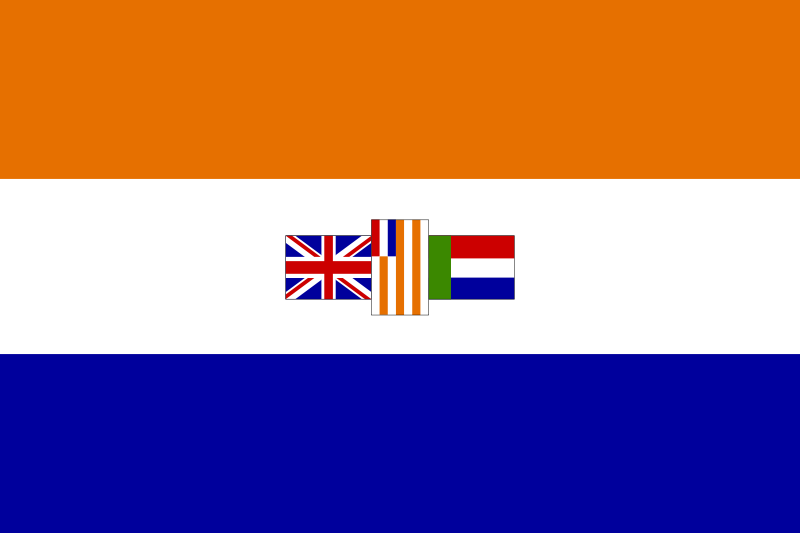
The small Cisalpine population in what was Rhodesia, which included farming communities who fed the nation, has basically been dismantled permanently. Still, in South Africa there are Cisalpine communities, and the Cisalpines have been a part of the country for a long time. The old flag of South Africa was an orange-white-blue, top-to-bottom tricolor. The orange bar on top stood out, and could be used as the Cisalpine flag of the region. Orange rosette on white background--two-thirds of the old Afrikaner flag--but not the blue.... so it's not an "Afrikaner flag," but a mild reminder of the Cisalpine history in the region.
Australia/New Zealand
Both the flag of Australia, and the flag of New Zealand are blue with some white. Therefore, this darker shade of blue on a rosette on white background would seem to clearly be the colors of the Cisalpines of the region.
Alternate symbols
Many concerns adopt "alternate symbols" to use. I think any symbol, arms, or flags which are clearly part of our ancestral history are fair game. However, as sort've a second symbol, the Gothic-style Catholic cross is one which can be seen above-right; and as perhaps a third symbol, the solar cross seen above-right, symbolizing the various ancient spiritual traditions of the Cisalpine hearth which go back deep in our history. However, generally, Roman Catholicism is "the religion of our people."
.
Friday, July 13, 2012
Saturday, February 19, 2011
World Padanian Nation II: World Cisalpine Kindred
World Padanian Nation: World Cisalpine Kindred
Mondo Nazione Padana: Mondo Affine Cisalpina
Mundo Nación Padano: Mundo Parientes Cisalpina
Monde Nation Padanien: Monde Apparenté Cisalpine
Mundo Nação Padano: Mundo Afim Cisalpina
Wereld Padaniaans Natie: Wereld Cisalpine Verwanten
[Music: 'Slow It Down' by Phantom Blue]
.
Thursday, January 27, 2011
Choosing an identifying name
Many times it's hard to find a proper word to use in casually identifying people, places, and things which are "northern nations." "Northern Italian" isn't necessarily all that accurate because that term suggests that there is a definite "Italian." The Italian Peninsula should be a regional term, like the British Isles or the Balkans. Try explaining to someone in Ireland that he's not Irish, but a "British Islander," or to people in the Balkans that they're all the same... "Balkonians!" Yet we are expected to accept the Italian-arrangement without question, despite clear evidence to the contrary. Even the Austrians didn't outlaw our language and culture.
Other terms tended to be too regional or focus on only one aspect of our history. "Subalpine" is a term, while interesting, refers more to a particular climate around the world. "Gallo-Tuscan" is okay, but is still too regionally specific for us. Of course, "Padanian," while in various forms, is a term that goes back centuries, is still identified as a very modern political term. Although we like "northern nations," it would be entirely lost upon people not of our ancestry, and it's not an adjective.
What it really boils down to is that "Padania" or "northern nations" are, to us, fine descriptive terms for a shared ancestry or a federation of former nations which are very similar; but it would still would draw criticism to throw around the Padanian name in everyday language. The best term for that, I believe, is "Cisalpine." The Romans called the land of our Gallic ancestors "Gallia Cisalpina" (Cisalpine Gaul), which meant "Gaul on this side of the Alps." Cisalpine, by itself, literally means "south of the Alps." Also, there were Celts in Tuscany and Umbria.
For our unique heritage--which is different than the much more historically unified cultures of countries like Germany, Spain, France, Poland, etc.--we require acceptable terminology. Therefore "Padania" is a good term for the modern-day Cisalpine Gaul, Etruria, or Langbard Kingdom. It should be a federation of very similar cultures from past nations, and a reference to a common heritage. However for everyday language, a less political and more regional term for description is needed: Cisalpine or Cisalpines.
.
Sunday, December 19, 2010
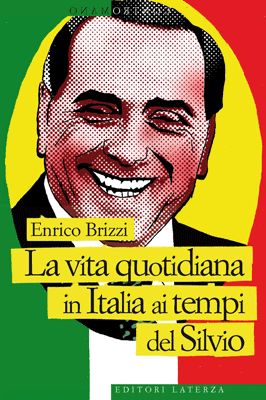
Riots erupt after Berlusconi survives no-confidence vote
Whenever the subject of Italian politics comes up, it's enough to make one want to close their eyes and shake their head. Our only genuine interest is the founding of a Northern Nation. A spiritual pursuit. An Israel for OUR people, no more, no less. Although we're expected to support Berlusconi, what we really need is a nation state, not a right wing party. Left and right politics have been a disaster there for at least a century, and will not provide the outcome that we want. Now with European bankers running the show through the EU, the odds are stacked against us. In other words, behind the scenes bankers like Lord Carrington, or unelected bureaucrats like Javier Solana, can decide the fate of other peoples.
The politic of the day is fabianism, which in short is far far right economics mixed with far far left socialism. In other words, monopoly capitalism and finance (not free market capitalism) married to social marxism. They make a good pair. The plutocrats at the top, and the sheep at the bottom, forming a symbiotic-globalist status quo. We have the exact same thing in the United States, so it would be highly hypocritical for either side to point the finger at the other.
Throwing Berlusconi out on his ear in favor of someone on the left would be the same as going from Bush to Obama. Just two arms of the same globalist monster, all backed by the same money.
Riots erupt after Berlusconi survives no-confidence vote
Italian premier tarnished by gaffes, sex scandals is left with razor-thin majority
MSNBC.com News Services - December 14, 2010
ROME — Premier Silvio Berlusconi won back-to-back confidence votes Tuesday in the Italian parliament, narrowly surviving one of the toughest fights of his political life. But violent protests greeted his victory, as rioters torched cars, smashed windows and clashed with police.
Riot police fired tear gas to try to disperse the crowds in Rome after earlier trying to cordon off the area around parliament. Clouds of white tear gas and orange flares engulfed some streets, shops full of Christmas goods hurriedly closed down and employees at one bank cowered in fear as waves of stone-throwing youths swept by.
Protesters rampaged in the the area around parliament and Berlusconi's residence, which had been cordoned off by heavy police presence. By sundown, almost 100 people, both protesters and police, were reported injured, including about two dozen hospitalized. About 40 were reportedly taken into police custody.
The chaos followed speculation in recent weeks that the end of the Berlusconi era was near.
Weakened by sex scandals and a bitter breakup with his one-time closest ally, Berlusconi seemed destined to be sent packing. The split with Gianfranco Fini had eroded the premier's once comfortable parliamentary majority and left him vulnerable in the lower house.
But Berlusconi battled back, as he has countless times when his political career seemed to be on the ropes. Tuesday's drama confirmed his status as the ultimate political survivor — but he emerges from the battle severely weakened and one top opposition lawmaker called his success a "Pyrrhic victory."
Newsweek: No-confidence vote will cripple Berlusconi
In the most dramatic and closest of the two tests, Berlusconi survived the no-confidence motion in the lower house by just three votes. Scuffles between lawmakers forced a brief suspension in the voting session.
Earlier in the day, Berlusconi had secured a more comfortable victory in a confidence vote at the Senate.
The vote's slim margin means Berlusconi can no longer count on a secure parliamentary majority for passing legislation. Some experts predict he might resign in upcoming weeks, a move that could lead to early elections, which he hopes to win again.
But Berlusconi has repeatedly defied the skeptics, shrugging off a string of gaffes and scandals to win three elections and transform Italy's political landscape since gaining power for the first time in 1994.
The opposition is too splintered and there are no possible challengers among Berlusconi's allies, according to Richard Bellamy, a political-science professor at University College London.
"He survived many times and I doubt that, even if he loses in the lower house, that will be his end," Bellamy said in a telephone interview. "The challenge is whether there is a credible coalition opposition, as Berlusconi has always benefited from the inability of the center left to win."
Berlusconi triumphed in the upper house, where he has a majority, by 162 to 135, Senate Speaker Renato Schifani said.
An intensive campaign of lobbying and persuasion appears to have won over enough deputies to give Berlusconi a chance of survival; many commentators had estimated the government was likely to have just have the numbers to scrape through.
In speeches to parliament Monday, Berlusconi battled back against his critics and outlined why lawmakers should support his government.
'Continuing with change'
"Today what's at stake isn't the future of the prime minister," Berlusconi said, smiling, as opposition members jeered. "Today, what's in play is the choice between continuing with change or restoring old ways."
He offered to negotiate a new legislative agenda that would allow the government to survive until parliamentary elections are held in 2013. He promised to change the membership of his Cabinet to give government positions to those who support him in the votes.
And he argued that his government had successfully protected Italy from becoming engulfed by the eurozone's debt crisis.
"The last thing Italy needs is a political crisis," Berlusconi said, as his close ally Umberto Bossi, leader of the Northern League, sat next to him.
Berlusconi's government has generally won praise for its reaction to the global financial crisis, steadfastly directed by Economy Minister Giulio Tremonti and including a rigorous austerity package.
Italy has a high public debt level, and recently faced renewed economic threats. But it is still widely viewed as low-risk due to the low level of private debt, a relatively sound banking system, and experience in dealing with high public debt levels.
"If your concern over Italy's difficult situation is honest and real, then the only possible way forward is renewing confidence in my government," Berlusconi said. Such a vote, he said, "will be proof of realism and political wisdom."
Berlusconi also defended his friendship with Russia's Prime Minister Vladimir Putin following revelations that the U.S. diplomats were uneasy about the premier's close relationship with Moscow.
He dismissed suggestions that he had personally benefited from business deals between Italian and Russian companies, saying that "not one dollar ... has been put or will ever be put in my pocket."
Reuters and The Associated Press contributed to this report.
.
Thursday, August 12, 2010
Alberto da Giussano and Barbarossa - Part VIII: Company of Death
This is a part eight of the Barbarossa series from last fall, during the release of the Italian movie 'Barbarossa'. This movie may be available for download at a few pay movie downloading sites, but it would probably be better to just wait probably two more months for the DVD. Let us know if you find a good source in the meantime.
The Company of Death is the name used in the historical literature of English language for two related chosen tactical corps, two selected bands of warriors, entrusted to guarantee the cohesiveness and efficiency in battle of both the Milanese and Lombard League's militias through their bound by oath to the defence of the Milanese Carroccio, the wagon on which the standard of the Lombard allies stood.
They fought in the Battle of Legnano (29 May 1176) against the imperial army of Frederick I Barbarossa Emperor of the Holy Roman Empire, in his 5th Italian Campaign, and were determinant in his decisive defeat.
The two corps who formed the Company of Death were the Company of the Carroccio, an infantry unit of 300 men, and the real and effective Company of Death, a cavalry unit of 900 men, commanded according to tradition by Alberto da Giussano.
The Company of the Carroccio
The Company of the Carroccio, was an infantry unit of 300 men, all of them young volunteers (forming a societas) and Milanese, sworn by oath to die in defence of the Milanese Carroccio. They fought as phalanx in a Sheltron formation around their "Sacred wagon", armed with a large shield and a lanzalonga.
The Knights of Death
The Company of Death, also known in some sources till the late 19th century as the Knights of Death, is the name of a temporary military association of medieval knights (a temporary societas), not historically well documented, which according to tradition was organized and equipped by a leader known as Alberto da Giussano. It had a great importance during the Battle of Legnano (29 May 1176) where it defended the Carroccio of the Lombard League against the imperial army of Frederick I Barbarossa.
The company was assembled in haste, depriving the Lombard infantry of the valuable support of enough heavy cavalry, "horse" were recruited by Alberto da Giussano around Brescia, and in other eastern areas of Lombardy that had contributed less in infantry and trails to the League. The knights would not be understood in the medieval and romantic sense, but as mere "mounted on horseback" or also "light cavalry." They were very probably particularly cruel and fierce "professional, or semi-professional, fighters," apt at wreaking havoc in the enemy ranks.
According to Milanese chronicler Galvano Fiamma it was composed of 900 men at arms but other sources and modern scholars reduce that number to 300 or, more probably, 500.
According to tradition they wore a sort of dark suit (black and gray, cut vertically) connected at the sides, to cover the armour, with probably the symbol of the skull on the traditional small pointed wooden shields.
Their motto or battle cry could have been, accordingly to poorly documented but reliable sources, "Ambroeus!" (Which is however in stark contrast with the origin of many of them, allegedly Brescia).
As a demonstation of the Company's rapid formation and specific use and role during the Battle of Legnano, after the battle there is no further information about its continued existence.
.
Sunday, January 24, 2010
World Padanian Nation: Argentina-USA Kindred
To Padanian-Argentinian and Padanian-American kindred and friendship.
Argentina, largely the Buenos Aires province, tended to attract immigrants from the Lombardo-Venetian and Trentino regions; while the United States, largely northern California, tended to attract immigrants from Liguria and Tuscany. Some of our families and clans ended up in both locations, yet we've lost our historical memory of this connection. However, the same ancestry, the same people.
[Music: 'Crimson Tears' by Sindustry]
Friday, October 23, 2009
Pan-Celtism and what it means for us
In the past decade or two, there has been an amazing spread of Celtic identity throughout the world. Celtic festivals are common all over Western Europe, North America, Australia, etc. We now have the Celtic League, the International Celtic Congress, and a major international Celtic festival (which was held in Valle d'Aosta in 2009). The question is: where do we fit into this Pan-Celtic milieu?
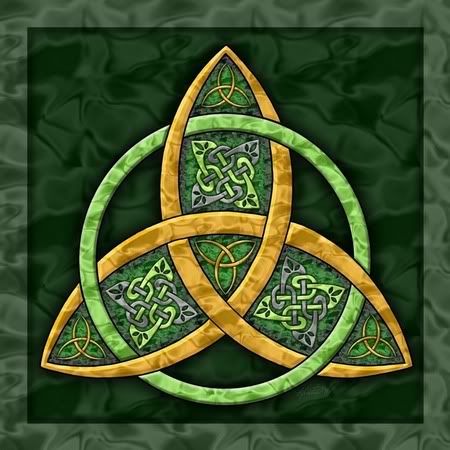
We would have to fit in somewhere, as much of the spirituality and even the Celtic knotwork is tied to Padania. "Cisalpine Gaul," of course, was the name given to Padania by the Romans, which means in Latin: "Gaul south of the Alps." The Trophy of Augustus was the Roman trophy to the conquest of the Celto-Ligurian tribes.
One interesting commonality of the Celtic peoples throughout history is their struggle against encroaching Teutonic and Roman armies. In the movie 'Braveheart', Celtic Scots are depicted defending their homeland against basically Anglo-Saxon/Norman English. The Roman Julius Caesar conquered Celtic Gaul. These are just two of the more well-known examples. Many compare the Roman invasion of Cisalpine Gaul to the invasion of the English against the Scots.
Unlike many other European cultures, Padania doesn't have the definitive "one ancient culture" that it can draw most of it's inspiration from. Lega Nord chose the Celts. The Etruscans were too tied into Roman (Italian) identity, and the Langobards were invaders from somewhere else. At least some of this was based on political reasoning. We do not have the answer to this equation yet.
Actually, Cisalpine Gaul was demographically "Celto-Ligurian," as we have covered before. That is, a mix of both proto-Alpine and Celtic tribes. The Trophy of Augustus lists both Alpine and Celtic tribes.
The Pan-Celtic identity is such a good fit, as we are not really southern or northern European, and not Eastern European. Quite frankly, the region of Padania is/was historically located at the crossroads of Roman/Mediterranean (south), Germanic/Norse (north), Celtic/Gaulic (west) and Slavic (east) worlds. In viewing the greater scope of things, in both ancient and modern concepts, we're more Western European. Like the French, we're basically Romanized Gauls.
Thursday, October 22, 2009
Main Page Link Deposit
We're simplifying the main page, and the following are the links from it for future reference:
PADANIA [WIKIPEDIA]
PADANISM [WIKIPEDIA]
LEGA NORD [WIKIPEDIA]
LEGA NORD [OFFICIAL]
MOVIMENTO GIOVANI PADANI
ASSOCIAZIONI PADANE
ASSOCIAZIONE CULTURALE INTERNET PADANO
PICCOLO ATLANTE DEI POPOLI GALLO ROMANZI CISALPINI
LA LIBERA COMPAGNIA PADANIA
NORTHERN ITALY GENEALOGY DISCUSSION LIST [YAHOO GROUP]
LOMBARDS [WIKIPEDIA]
COMUNITA ODINISTA [INTERNATIONAL]
COMUNITA ODINISTA [MYSPACE]
COMUNITA ODINISTA - VINLAND [USA & CANADA]
COMUNITA ODINISTA AMERICA MYSPACE [SOUTH & CENTRAL AMERICA]
COMUNITA ODINISTA AMERICA BLOGSPOT [SOUTH & CENTRAL AMERICA]
L'ARALDO DI THULE [COMUNITA ODINISTA'S ASATRU GROUP]
LANGBARDLAND
WINNILER
LE RADICI DEL LONGOBARDESE
ETRUSCAN CIVILIZATION [WIKIPEDIA]
THE MYSTERIOUS ETRUSCANS
ETRUSCAN FOUNDATION
ASSOCIAZIONE NAZIONALE ALPINI [ITALY]
ASSOCIAZIONE ALPINI D'ITALIA [USA]
CISALPINE GAUL [WIKIPEDIA]
TRIGALLIA.COM [CELTICA HERITAGE; SEE "LINKS" FOR REGIONAL GROUPS]
CHRIDHE GAIDHLIG CUORE GAELICO [CELTICA HERITAGE; SEE LINKS FOR REGIONAL GROUPS]
CELTICA FESTIVAL INTERNAZIONALE
LA SCELTA [OFFICIAL SITE]
LA SCELTA [YOUTUBE CHANNEL]
QUINLAN ROAD [LOREENA MCKENNITT; WORLD CELTIC HERITAGE MUSIC]
SYMBOL DICTIONARY.NET
Friday, October 2, 2009
Alberto da Giussano and Barbarossa - Part VII: The Carroccio
Carroccio
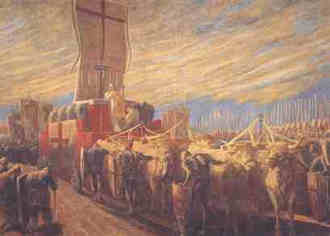
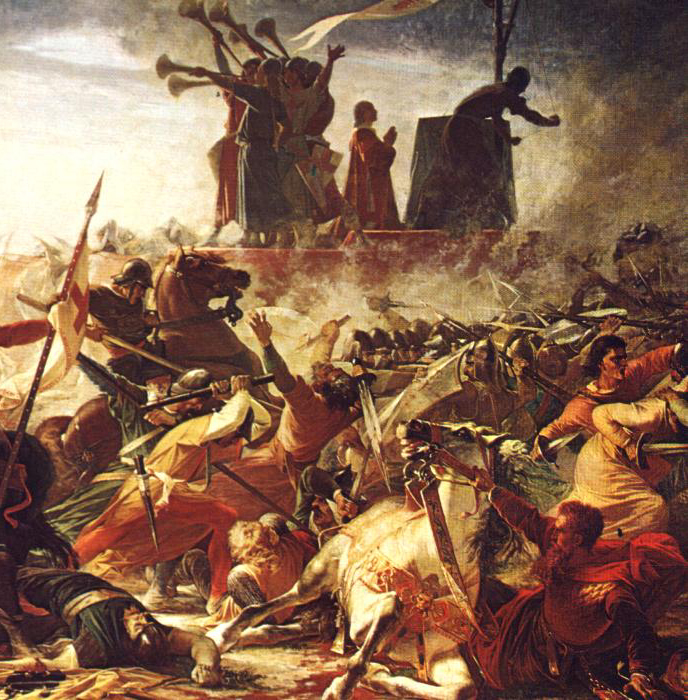
A Carroccio was a war chariot drawn by oxen, used by the medieval republics of Italy. It was a rectangular platform on which the standard of the city and an altar were erected; priests held services on the altar before the battle, and the trumpeters beside them encouraged the fighters to the fray.
In battle the Carroccio was surrounded by the bravest warriors in the army and it served both as a rallying-point and as the palladium of the city's honour; its capture by the enemy was regarded as an irretrievable defeat and humiliation. It was first employed by the Milanese in 1038, and played a great part in the wars of the Lombard League against the emperor Frederick Barbarossa. It was afterwards adopted by other cities, and first appears on a Florentine battlefield in 1228.
The Florentine Carroccio was usually followed by a smaller cart bearing the Martinella, a bell to ring out military signals. When war was regarded as likely the Martinella was attached to the door of the Church of Santa Maria in the Mercato Nuovo in Florence and rung to warn both citizens and enemies. In times of peace the Carroccio was in the keeping of a great family which had distinguished itself by signal services to the republic.
The carro della guerra of Milan was described in detail in 1288 by Bonvesin de la Riva in his book on the "Marvels of Milan". Wrapped in scarlet cloth and drawn by three yoke of oxen that were caparisoned in white with the red cross of Saint George, the city's patron, it carried a crucifix so massive it took four men to step it in place, like a ship's mast.
***************************************************************************
I looked it up again and the opening date, in Italy, for 'Barbarossa' is October 9. Of course, we need to find out when it opens in the United States, and we will just have to make a point to monitor this. It could be a month, or several months.
Thursday, October 1, 2009
Alberto da Giussano and Barbarossa - Part VI: Battle of Legnano
With October now here, and this month being the release date of the upcoming Italian movie 'Barbarossa', here is another segment of our Alberto Giussano and Barbarossa series: The Battle of Legnano. There probably should be an entry just for the "Oath of Pontida," which was the event which united the city-states into the Lombard League, but there wasn't an adequate text in English. It was one of the most brutal wars of the last millennium: The Holy Roman Empire versus The Lombard League.
Battle of Legnano
The Battle of Legnano was fought on May 29, 1176, between the forces of the Holy Roman Empire, led by emperor Frederick Barbarossa, and the Lombard League.
The Lombard League
The Lombard League was formed in 1167, largely out of the Veronese League. It was a Union of Lombard cities promising each other unity, against the Emperor Frederick I Barbarossa. The Lombardy cities swore the oath at Pontida, a small village in Lombardy.
After the disastrous defeat of Pope Alexander III at the Battle of Monte Porzio in May 1167 against Imperial forces, the Lombard League remained as the last legitimate fighting force opposing the Emperor and was therefore heavily backed by the Pope.
Kenneth Pennington wrote: "Alexander’s inability to control Rome and the Papal States was due to his conflict with Frederick. Although he attempted to support the cities of Lombardy, he had neither the power nor the resources to render effective assistance."[Right: The "Oath of Pontida," painted by Amos Cassioli]
Frederick's 5th Italian Campaign
In September 1174, Frederick embarked on his 5th Italian Campaign, to quench the constant revolts in Lombardy and his quarrels with Pope Alexander III. Frederick led a force of 8,000 knights over the Alps and arrived in Piedmont in late September. His cousin Henry the Lion and his forces, were once again not a part of the Imperial campaign. Frederick wanted to take revenge on Susa, for its "evil" behaviour of 1168, and on the 30 September his forces captured and burned down the town. His next aim was the town of Asti, which he captured after a seven day siege. In October, Frederick finally received the promised Imperial reinforcements from Bohemia. Upon Frederick's rapid and fierce initial success, Margraviate William of Montferrat and the Count of Biandrate, abandoned the Lombard League.
Siege of Alessandria
The siege of Alessandria was an important event in Frederick's 5th Campaign as this was a campaign of revenge, with the aim of the total destruction of the Lombard League and the removal of the Pope Alexander III. Frederick's next goal was therefore the Lombard city of Alessandria. Alessandria was founded by Milanese refugees, who fled after Frederick's forces burned and destroyed the City of Milan in 1162 and named after Pope Alexander III. The siege of the "Straw City", called so because all the roofs were covered with straw, began at the end of October. To Frederick's surprise and anger, his forces were not able to take the city so he had to spend the winter in front of its gates. On Holy Saturday, Fredericks forces managed to enter the city by digging tunnels under its walls, but the attack was repulsed by the Milanese with heavy losses. Alessandria withstood, and that was the first victory of the Lombard League. Frederick had to break off the siege due to an advancing Lombard army and retreated to Pavia.
Treaty of Montebello
On 16 April 1175, Frederick and the Lombard League negotiated peace at the Castle of Montebello but after long talks, negotiations broke with no result. Frederick knew that a battle was imminent and traveled to Chiavenna to meet Henry the Lion. Henry the Lion however refused to help his cousin as he thought that Frederick's defeat would allow him to obtain greater power.
The Battle
After Frederick's setback at Alessandria, the failed agreement of Montebello and the refusal of his cousin Henry the Lion to help him, Frederick finally received some good news and reinforcements from Germany. The German reinforcements crossed Lukmanier Pass into the Lake Como region in April 1176. Frederick I Barbarossa, Philipp I of Heinsberg and Archbishop Wichmann of Magdeburg rode secretly from Pavia along the Ticino River, to meet the reinforcements and to lead them to a joint operation with his main forces. Frederick received 1,000 knights and 1,000 foot soldiers from 16 different German rulers. At Como, Lombard imperialist allies increased the reinforcements to about 3,000 knights and foot soldiers, however, the Imperial army was largely a cavalry force of German knights.[Left: Lombard knights looking for Fredrick's dead body]
The Milanese were informed about Frederick's plan and prepared for battle. A Carroccio, or a sacred war wagon drawn by oxen, was built and was decorated with the city standard and an altar upon which the cross of Archbishop Aribert of Milan was erected. In 1038, Archbishop Aribert led the victorious defence of Milan against the Holy Roman Emperor Conrad II, and therefore his cross was a symbol of victory against the Empire. According to Sire Raoul, a chronicler from Milan, 900 knights came from Milan and around 550 knights from three other towns, the rest of the League's forces were foot soldiers. The "Company of Death" was a foot soldier unit, that according to Milanese chronicles was led by Alberto da Giussano, and formed the core of the Lombard infantry. While Frederick and his reinforcements were on their way back to Pavia to join the main Imperial force, the Lombard League placed about 3,500 men near the west bank of the Olona. The infantry with the Milanese war cart, the carroccio, stood in a hastily fortified position at Borsano. The Lombards knew that Frederick was about to skirt through their area, however, the Lombards did not know how close Frederick already was. At dawn on the 29 May, the Lombard League sent a reconnaissance unit of 700 horsemen to the Seprio landscape. At the same time, the emperor had crossed the Olona and was marching south from Cairate, five miles northeast of Busto Arsizio. Here, the battle commenced. The Lombard reconnaissance and the 300 Imperial vanguard clashed. The clash was brief and bloody and with Frederick already on the horizon, the Lombard reconnaissance broke off and fled beyond Borsano. Now, Frederick and his Imperial German army launched a rampant and brutal attack on the Lombard League forces near Borsano - Legnano. The Lombard cavalry was largely routed but managed to escape the skirmish, leaving the infantry and carroccio on its own. Frederick advanced to the carroccio, and assaulted the infantry and the Company of Death with his cavalry.
M.B. Synge wrote this about the Company of Death: "Nine hundred desperate patriots forming the Company of Death defended the sacred car. Seeing the Germans were gaining ground, fearful for the safety of their treasure, they suddenly knelt down and renewed their vow to God that they would perish for their country."
The infantry positioned itself in a phalanx-like line. The fight around the carroccio was a long and bloody fight in which the Lombard League infantry brought the Imperial army to a stalemate. Despite the difficulties the Imperial cavalry had against the Lombard infantry, it would have still prevailed in the long run. Finally, the Lombard League forces received help from its regrouped cavalry and from a Brescian cavalry that was called to aid by the fleeing reconnaissance troops. The regrouped reconnaissance troops and the Brescian cavalry jointly attacked Frederick's army from the rear. The decisive assault was made by the Brescians, who managed to break through the lines and attack Frederick directly. In this attack, his guards and standard-bearer were killed, and Frederick was thrown off his horse and believed to be dead. Upon this, the Imperial troops panicked and fled, pursued to the Ticino by the Leagues cavalry. The generals tried to rally the men in vain. The booty and prisoners taken by the League were immense.
Aftermath
After the battle, Frederick's rule over Lombardy was decisively broken. The knights that managed to escape, gathered in Pavia. There, they brought the news of Frederick's presumed death to his wife Beatrice I, Countess of Burgundy. Beatrice and the Empire mourned Frederick's demise but after several days the Emperor appeared at the gates of Pavia.
H. E. Marshall wrote: "Then, greatly to the joy of all, after three days Barbarossa suddenly appeared before the gates of Pavia. Although wounded and bruised and left for dead Frederick had not been killed."
The victory of the Lombard League forced Frederick to travel to Venice. In the Peace of Venice, 1177, Frederick and Pope Alexander III reconciled. The Emperor acknowledged the Pope's sovereignty over the Papal States, and in return Alexander acknowledged the Emperor's overlordship of the Imperial Church. The Peace of Venice were heavily instigated by Archbishop Wichmann of Magdeburg, who was amongst the defeated at Legnano. The cities of Lombardy, however, continued to fight until 1183, when, in the Peace of Constance, Frederick conceded their right to freely elect town magistrates. The Treaty was cast in bronze.
Frederick did not forgive Henry the Lion for refusing to come to his aid in 1176. Taking advantage of the hostility of other German princes to Henry, Frederick had Henry tried in absentia by a court of bishops and princes in 1180, declared that Imperial law overruled traditional German law, and had Henry stripped of his lands and declared an outlaw.
On 27 January 1186, Frederick's son Henry VI married Constance of Sicily in Milan as a sign that peace had really been established.
Actual battlefield
The battle is traditionally tied to the name of Legnano, since the League's forces came from that town. Actually, as local historians have ascertained, the battle was fought a couple miles west of Legnano, where today Villa Cortese and Borsano, frazioni of Busto Arsizio, stand.
***************************************************************************
"Nine hundred desperate patriots forming the Company of Death defended the sacred car. Seeing the Germans were gaining ground, fearful for the safety of their treasure, they suddenly knelt down and renewed their vow to God that they would perish for their country."
That country was not "Italy." I'm not going to argue about whether it should be called Cisalpine Gaul, Etruria, Langbard, Padania, or the Subalpine/Po River Valley; but it was a Nation. "Italy" should be "the Italian peninsula," just as there is "the British Isles," "the Balkins," "the Iberian peninsula," "Scandinavia," etc. So for clarity, it should be Europe, then for reference "northern, southern, Eastern, or southern Europe, and then these "regions."
Friday, September 25, 2009
Alberto da Giussano and Barbarossa - Part V: Lombard League
Lombard League (Wikipedia):
The Lombard League was an alliance formed around 1167, which at its apex included most of the cities of northern Italy (although its membership changed in time), including, among others, Milan, Piacenza, Cremona, Mantua, Crema, Bergamo, Brescia, Bologna, Padua, Treviso, Vicenza, Venice, Verona, Lodi, and Parma, and even some lords, such as the Marquis Malaspina and Ezzelino da Romano. The League was formed to counter the Holy Roman Empire's Frederick I, who was attempting to assert Imperial influence over Italy. Frederick claimed direct Imperial control over Italy at the Diet of Roncaglia (1158). The League had the support of Pope Alexander III, who also wished to see Imperial power in Italy decline. At the Battle of Legnano on May 29, 1176, Frederick I was defeated and, by the Peace of Venice, which took place in 1177, agreed to a six-year truce from August,1178 to 1183, until the Second Treaty of Constance, where the Italian cities agreed to remain loyal to the Empire but retained local jurisdiction over their territories.
The Lombard League was renewed several times and after 1226 regained its former prestige by countering the efforts of Frederick II to gain greater power in Italy. These efforts included the taking of Vicenza and the Battle of Cortenuova which established the reputation of the Emperor as a skillful strategist. He misjudged his strength, rejecting all Milanese peace overtures and insisting on unconditional surrender. It was a moment of grave historic importance when Frederick's hatred coloured his judgment and blocked all possibilities of a peaceful settlement. Milan and five other cities held out, and in October 1238 he had to unsuccessfully raise the siege of Brescia. Once again receiving papal support, the Lombard League effectively countered Frederick's efforts. During the 1249 siege of Parma, the Imperial camp was assaulted and taken, and in the ensuing Battle of Parma the Imperial side was routed. Frederick lost the Imperial treasure and with it any hope of maintaining the impetus of his struggle against the rebellious communes and against the pope. The League was dissolved in 1250 once Frederick died.
**************************************************
The Following paragraph is from a book called 'Modern Italian grammar: a practical guide', and clarifies and simplifies a number of things:
"When, in 1152, Frederick I, known as Redbeard, became King of Germany, he decided to suppress the rebellious City States, He Carred out five raids in Italy; in the first (1154) he suppressed the rebellion in Rome, and had himself crowned emperor; in the second he conquered Milan and with due ceremony reaffirmed the rights of the emperor (1158) in the third he besieged and destroyed Milan (1163) in the fourth he occupied Rome (1168) and in the fifth he was defeated at Legnano by the Lombard League (an alliance between the City States, set up in Pontida in1167, and supported by Pope Alexander III). For this reason he was forced to recognize the freedom of the City States, with the peace treaty of Constance (1183)."
**************************************************
The critics of Padanian identity have gone after trivial facts, to try to underscore the significance of events like the Battle of Legnano. For example, whether or not there was a specific "oath" taken at the formation of the Lombard League in Pontida, Lombardy. That's how the game is played. A people's history needs to be trivialized or absorbed and molded into what is "politically correct." For example, references to "the Italian League," or that it was "for Italian freedom" even though Italy never even existed before. If the history of other groups were to be attacked, it might be answered with calls of "bigotry" or "racism." However, if you're unfortunate enough to be "politically incorrect," then you don't receive this type of protection. You're on your own.
A perfect example of this is if we look at the War of the Sicilian Vespers. Historically, it is referred to as a struggle by the Sicilian people for Sicilian freedom, which it was. However, why is the Battle of Legnano any different? It was a war carried out by Lombardo-Venetian people for Lombardo-Venetian freedom. Why the double standard?