Showing posts with label Friuli. Show all posts

Sunday, October 31, 2021

Monday, April 6, 2020

The Ladin flag - Colors that symbolize life and the earth


.
Windows 10 is currently featuring the spring image of "green field and blue sky." There aren't as many sights on earth as colorful as this simple and common image. It symbolizes life itself.


.
The distinct Ladin people within the Dolomite region have been covered here. They're a rural mostly farming people with a very particular culture and language, which essentially could remind Americans of the Amish. They seem to have some affinities to the old Cimbrian settlements, but speak a Rhaeto-Romance language related to Swiss Romansh and Friulian. They have a time-honored culture and way of life which is unique in that it inherently promotes environmental sustainability and respect for the earth. Like the Amish, they are known for being great craftspeople. The famous singer-songwriter Giorgio Moroder and world champion and Olympic medalist ice skater Carolina Kostner are probably thought of by many as being Tyrolian, but they're actually Ladin. Ladinia overlaps the South Tyrol a bit, but they don't speak German.

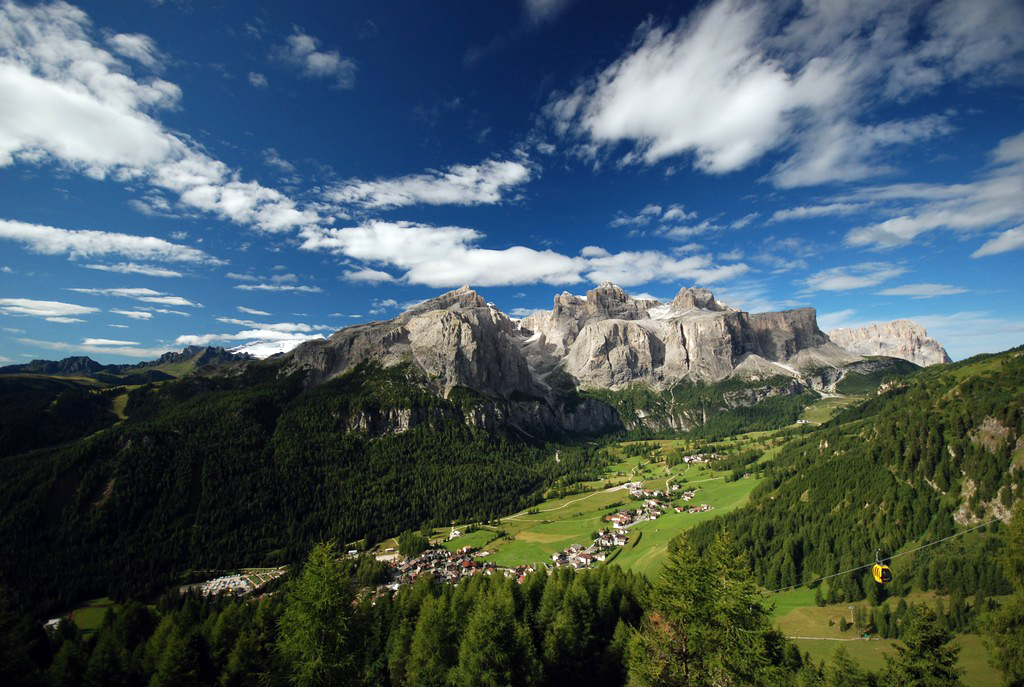
According to the FTOW (Flags Of The World) webpage about the Ladin flag, "The flag symbolizes the landscape: blue for the sky, white for the mountains and green for the meadows." Apparently the flag isn't official, but it still recognized by the Italian government.

Ladin people

Ladin language

Ladinia


.
Above, the Sella mountains and the Ladin village of Calfosch (Corvara). "Blue, white, and green."

.

Thursday, March 12, 2015

A Day with Fred Beckey in the Dolomites


A Day with Fred Beckey in the Dolomites 

Patagonia YouTube channel

Prolific climber, Fred Beckey, has a legacy of first ascents greater than that of any other climber. At 89 he had never climbed in the Dolomites, so he headed out to do just that. Narrated by Colin Haley. Check out Fred's book, 100 Favorite North American Climbs: 

http://www.patagonia.com/us/product/100-favorite-climbs-hardcover-book?p=BK570-0-000 

**************************************************

Dolomites 

The Dolomites (Italian: Dolomiti; Ladin: Dolomites; German: Dolomiten; Venetian: Dołomiti: Friulian: Dolomitis) are a mountain range located in northeastern Italy. They form a part of Southern Limestone Alps...

.

Sunday, September 25, 2011

Friulan Bilingual Signs


Friulan Bilingual Signs
See also: http://www.squidoo.com/padaneis - Some bilingual road signs in Italian & Friulian. Derivatives of images from wikimedia Commons (authors listed in the last frame of the video).

Licence: CC BY-SA 2.5; accordingly, we explicitely state that the authors of the original photos do not necessarily endorse the use we have done of them.

Some images have been driven beyond their natural resolution limits so they are now of low quality; however the primary goal of this video is documentary and educational. No audio.

To get constantly updated info, please subscribe, free of charge, "The Padanian newsletter":
https://groups.google.com/group/the-padanian-newsletter?hl=en

Benrïeda al Chanel Padaneis! (YouTube channel)

Padaneis website

.

Tuesday, February 22, 2011

Friulan language

From Wikipedia's Friulan language page:

Friulan (furlan or affectionately marilenghe in Friulan, friulano in Italian), is a Romance language belonging to the Rhaeto-Romance family, spoken in the Friuli region of northeastern Italy. Friulan has around 800,000 speakers, the vast majority of whom also speak Italian. It is sometimes called Eastern Ladin, since it shares the same roots as Ladin, although over the centuries it has diverged under the influence of surrounding languages, including German, Italian, Venetian, and Slovene. Documents in Friulan are attested from the 11th century, and poetry and literature dating as far back as 1300. By the 20th century, there was a revival of interest in the language, which has continued to this day.

Native speakers refer to anything of Friulan culture, including themselves, as "Friûl." One great way to really get into the spirit of any culture is to find those online translators, like Friulan, and look up various words. In time, you will find aspects of history within those words, even just on your own by seeing similar spelling in other related languages. Friuli is, of course, in the northeast corner of our ancestral homeland, at high Alpine elevation. It was a crossroads between the Cisalpine world, the German world, and the Slavic world. It borders the Tri-Veneto area, Austria, and Slovenia.

When the Romans invaded the region in 181 BC, the natives were called the "Carni" and spoke a Celtic language. Since then many influences have completely altered the language. Roman, Ladin (a similar neighboring people), Langobard, Slavic, Venetian, French, and probably others, have left their linguistic imprint on the Friulan language.

There is so much to say about Friuli, that it's hard to focus only on the native language. The linguistic influences do say a lot about the Friulan people within a historical context. They're a facinating element of the Padan circle of native peoples.

Even within Friuli, there are variants of the language. How is that for confusion? Also, the regionally overlapping Ladin people, with a similar language, adds even more to the confusion. Just to give a few examples of Fruilan words with a clear origin in another historical language:

bussâ, to kiss (German)

zigâ, to shout (old Alpine Slavic)

cudiç devil (Slovene)

sbregâ, to tear (Langobardic)

bragons, trousers (Carnic/Celtic)

canucje, straw (Venetian)

pardabon, really (French)

Do take a look at the above link, as I just can't do this subject justice. This may be the most facinating Padan language of them all. Also, try some of the online translators like Logos; as well as some of the Italian-Friulan translators (you may need to go from English to Italian to Friulan). See also Friulan literature.

.