Showing posts with label symbols. Show all posts

Thursday, July 23, 2020

Symbol banning - "Ordo Ad Chao"

Along with the Capito-Marxist faction more-or-less banning our country, one of the many side effects of that is the the largely inconsistent banning of symbols of all types. The latest victim is, believe or not, the Star of David by Twitter. This particular ban will not last long, but it does reflect the fervor of these minions. The simple truth is that virtually every symbol could be linked to some type of oppression over the course of 6,000 years of human history. Why don't they just ban the American flag? How many things occurred under the Confederate flag that didn't occur under the American flag? Not many. How about the Union Jack, or the flags of Spain, Portugal, Holland, or France since those were all colonial flags and condoned slavery at some point? How about the Mexican flag? The institution of racially-based slavery was condoned under the flag of Mexico. Why not the symbols of Communism, under which over 200 million people were slain during the last century? Also, all of the same types of oppression--including widespread castration of male slaves--occurred under Islamic states for many centuries.

The symbol above is the real flag of the Kingdom of the Lombards or Langbard. I prefer to use the term Langobard as to avoid confusion with the historical region of Lombardia, although there is much crossover between the two. Within the black eagle is the red odal rune or the othala. It means "homeland, homestead, or clan possession." It's a unique symbol in regards to Cisalpine history since it came from old Italian/Alpine script, then later became very popular in much of northern Europe before being brought back into the Cisalpine region by the Langobards. According to the ADL and the SPLC, the othala is a hate symbol. The ethnicity of the ADL/SPLC is getting a little taste of their own medicine by Twitter, although I don't expect this ban to last very long. They may even condone it for a short while within the ancient strategies of "worse is better" and "order out of chaos."

The meaning of both the Star of David and the swastika were entirely different before they were adopted for political, national, religious or ideological purposes. The Star of David is actually a Saturnian hexagram from clear back into the ancient world of the Sumerians, Babylonians, and Phoenicians. The swastika was a solar symbol used in some form all around the world during ancient times. The Twitter banning of the Star of David is part of a smaller trend in which formerly unlikely "suspects"--according to the minions--become targets. This would include statues of Mahatma Gandhi and southwestern Spanish conquistadors. The one strong exception is anything Islamic, despite the obvious hypocrisy. In Canada, one young immigrant Afghan woman was branded as a "NAZI" by a chanting Antifa mob because she was opposed to radical Islam's treatment of women. No thought process goes into anything by them; they merely follow what the current party line is... set forth to them by the very wealthy string-pullers.

.

Monday, April 6, 2020

The Ladin flag - Colors that symbolize life and the earth


.
Windows 10 is currently featuring the spring image of "green field and blue sky." There aren't as many sights on earth as colorful as this simple and common image. It symbolizes life itself.


.
The distinct Ladin people within the Dolomite region have been covered here. They're a rural mostly farming people with a very particular culture and language, which essentially could remind Americans of the Amish. They seem to have some affinities to the old Cimbrian settlements, but speak a Rhaeto-Romance language related to Swiss Romansh and Friulian. They have a time-honored culture and way of life which is unique in that it inherently promotes environmental sustainability and respect for the earth. Like the Amish, they are known for being great craftspeople. The famous singer-songwriter Giorgio Moroder and world champion and Olympic medalist ice skater Carolina Kostner are probably thought of by many as being Tyrolian, but they're actually Ladin. Ladinia overlaps the South Tyrol a bit, but they don't speak German.

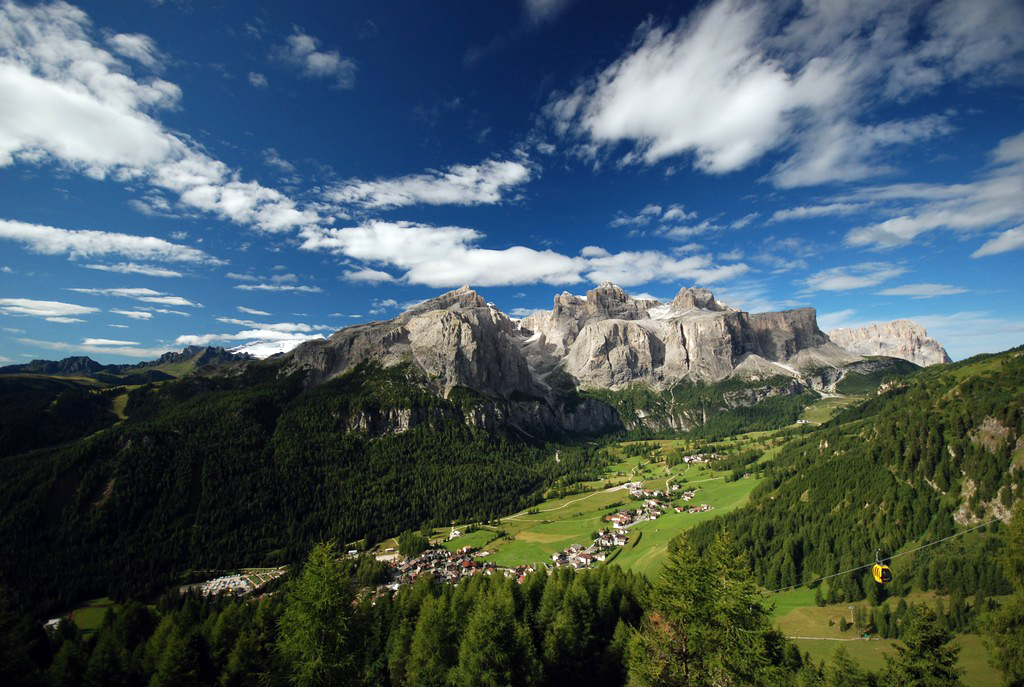
According to the FTOW (Flags Of The World) webpage about the Ladin flag, "The flag symbolizes the landscape: blue for the sky, white for the mountains and green for the meadows." Apparently the flag isn't official, but it still recognized by the Italian government.

Ladin people

Ladin language

Ladinia


.
Above, the Sella mountains and the Ladin village of Calfosch (Corvara). "Blue, white, and green."

.

Tuesday, January 31, 2017

The Mystery of “Flower of Life” & “Sacred Geometry”


The Mystery of “Flower of Life” & “Sacred Geometry”

[See article link for images]


The “Flower of Life” can be found in all major religions of the world. It contains the patterns of creation as they emerged from the “Great Void”. Everything is made from the Creator’s thought.

After the creation of the Seed of Life the same vortex’s motion was continued, creating the next structure known as the Egg of Life.

This structure forms the basis for music, as the distances between the spheres is identical to the distances between the tones and the half tones in music. It is also identical to the cellular structure of the third embryonic division (The first cell divides into two cells, then to four cells then to eight). Thus this same structure as it is further developed, creates the human body and all of the energy systems including the ones used to create the Merkaba. If we continue creating more and more spheres we will end up with the structure called the Flower of Life.

The flower of life holds a secret symbol created by drawing 13 circles out of the Flower of Life. By doing this, one can discover the most important and sacred pattern in the universe. This is the source of all that exists; it’s called the Fruit of Life. It contains 13 informational systems. Each one explains another aspect of reality. Thus these systems are able to give us access to everything ranging from the human body to the galaxies. In the first system, for example, it’s possible to create any molecular structure and any living cellular structure that exists in the universe. In short every living creature.


The most common form of the “Flower of Life” is hexagonal pattern (where the center of each circle is on the circumference of six surrounding circles of the same diameter), made up of 19 complete circles and 36 partial circular arcs, enclosed by a large circle.

The “Seed of Life” is formed from seven circles being placed with sixfold symmetry, forming a pattern of circles and lenses, which acts as a basic component of the Flower of Life’s design.

The Temple of Osiris at Abydos, Egypt contains the oldest to date example. it is carved in granite and may possibly represent the Eye of Ra a symbol of the authority of the pharaoh.

Other examples can be found in Phoenician, Assyrian, Indian, Asian, Middle Eastern, and medieval art.

Leonardo da Vinci has studied the Flower of Life’s form and its mathematical properties. He has drawn the Flower of Life itself, as well as components therein, such as the Seed of Life. He has drawn geometric figures representing shapes such as the platonic solids, a sphere, a torus, etc., and has also used the golden ratio of phi in his artwork; all of which may be derived from the Flower of Life design.

The flower of life shape contains a secret shape known as the fruit of life that consists of 13 spheres that hold many mathematical and geometrical laws. These laws represent the whole universe. Giving the flower of life to someone is like giving them the whole universe in one jewel.


The Flower of Life can be found in all major religions of the world. In Egypt, the source of all the monotheistic religions, the “Flower of Life”, can be found in the ancient Temple of Abydos. In Israel, it can be found in ancient synagogues in the Galilee and in Mesada.

People reported physical and psychological changes after wearing this pendant – faster heart beats, prophetic dreams, breaking of illusions, seeing the reality as it is and becoming free from long time fears.

The flower of life is one of the strongest sacred geometric shapes!


~ROSSLYN CHAPEL- THE CEILING~

The Chapel is filled with the Sinclair symbol of the engrailed cross, and the building is said to be based on the ancient temple of Jerusalem. The Chapel is believed by many to be the final hiding place of a much sought after sacred relic, the Holy Grail itself, thought to be part of the Templar treasure smuggled out of France during the attack on the Templars when Phillip the Fair decided to bring down the powerful and influential order. Some of the order fled to Portugal, others, it is said, to Scotland, for the Templars had connections by marriage to the Sinclairs, and the Scots, including Robert the Bruce, were ready to welcome such a renowned group as the Knights Templar to help them in their fight against the English crown. Many believe that the Templar’s brought with them to Europe new knowledge and holy relics found under the Temple Mount itself. Indeed, it was the Templars who sparked the phenomenal new architecture revealed in the building of the gothic cathedrals of Medieval Europe, the first of these being Chartres in France.

“In a single century from 1170 no fewer than eighty cathedrals and almost five hundred abbeys were built in France alone, involving more masonry than was ever cut in ancient Egypt! These buildings were built to a startling new scale never seen before.“- Knight and Lomas. The Hiram Key. The architecture is such that the experience of sound is heightened. It may be that, like the ancient standing stones and long barrows, these ‘new’ sacred sites were similarly built and ‘tuned’ to enhance certain frequencies and energies.


Preservation of regional cultures should be a Human Right
“What if, in their excavations on the Temple Mount, they had unearthed scrolls, manuscripts, theorems or blueprints relating to Solomon’s Temple itself? What if these discoveries had included the lost architectural secrets of geometry, proportion, balance and harmony that had been known to the builders of the pyramids and other great monuments of antiquity?“– Graham Hancock.The Sign and the Seal.

************

Eddie

President at WorldTruth.Tv

Eddie L. is the founder and owner of www.WorldTruth.TV. and www.Womansvibe.com. Both website are dedicated to educating and informing people with articles on powerful and concealed information from around the world. I have spent the last 36+ years researching Bible, History, Alternative Health, Secret Societies, Symbolism and many other topics that are not reported by mainstream media.


.

Thursday, October 31, 2013

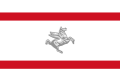
Pegasus - The flag of Tuscany

Flag of Tuscany (Flags of the World)


Description of the Flag

The gonfalon was adopted on the 20th May 1975 and readopted with the coat of arms on the 3rd February 1995. The coat of arms is a sannitic shield, gules a Pegasus argent. The gonfalon is white with two narrow vertical red stripes, and the Pegasus in the middle. The words Regione Toscana appear under in silver. The Pegasus was the symbol of the Toscan National Liberation Committee during the Second World War.
--Pascal Vagnat, 22 September 1998

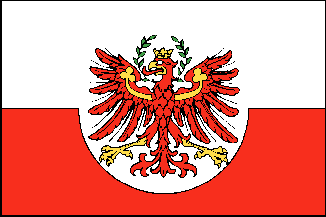
The white on red stripes are possibly derived from the red-white-red triband (the Austrian colours) adopted by Tuscany in the latter half of the 18th Century and dropped in 1848.
--Christopher Southworth, 14 September 2003

The pegasus image on the flag, gonfanon and arms has been taken from a coin made by the Florentine artist Benvenuto Cellini (the one who made the famous Perseo statue) in 1537. This coin can be seen in the National Museum of Bargello in Florence. White and red have been the traditional colors of Toscana since long time, not only during the Grand-Ducal period. Also note that white and red are the traditional colors of most Tuscan towns, including Firenze, Pistoia, Lucca, Pisa and Grosseto.


Pegasus

Pegasus (Wikipedia)

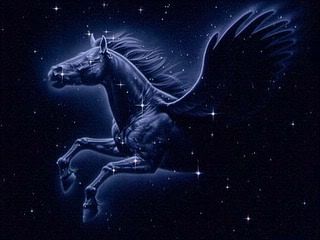
Pegasus (Ancient Greek: Πήγασος, Pégasos, Latin Pegasus) is one of the best known mythological creatures in Greek mythology. He is a winged divine stallion usually depicted as pure white in colour. He was sired by Poseidon, in his role as horse-god, and foaled by the Gorgon Medusa. He was the brother of Chrysaor, born at a single birthing when his mother was decapitated by Perseus. Greco-Roman poets write about his ascent to heaven after his birth and his obeisance to Zeus, king of the gods, who instructed him to bring lightning and thunder from Olympus. Friend of the Muses, Pegasus is the creator of Hippocrene, the fountain on Mt. Helicon. He was captured by the Greek hero Bellerophon near the fountain Peirene with the help of Athena and Poseidon. Pegasus allows the hero to ride him to defeat a monster, the Chimera, before realizing many other exploits. His rider, however, falls off his back trying to reach Mount Olympus. Zeus transformed him into the constellation Pegasus and placed him up in the sky.

Hypotheses have been proposed regarding its relationship with the Muses, the gods Athena, Poseidon, Zeus, Apollo, and the hero Perseus.

The symbolism of Pegasus varies with time. Symbol of wisdom and especially of fame from the Middle Ages until the Renaissance, he became one symbol of the poetry and the creator of sources in which the poets come to draw inspiration, particularly in the 19th century. Pegasus is the subject of a very rich iconography, especially through the ancient Greek pottery and paintings and sculptures of the Renaissance. Personification of the water, solar myth, or shaman mount, Carl Jung and his followers have seen in Pegasus a profound symbolic esoteric in relation to the spiritual energy that allows to access to the realm of the gods on Mount Olympus.


White horse (mythology) [Wikipedia]

White horses (which are rarer than other colours of horse) have a special significance in the mythologies of cultures around the world. They are often associated with the sun chariot, with warrior-heroes, with fertility (in both mare and stallion manifestations), or with an end-of-time saviour, but other interpretations exist as well. Both truly white horses and the more common grey horses, with completely white hair coats, were identified as "white" by various religious and cultural traditions.

The flag of Tuscany

Mythologies and traditions


European


Celtic

In Celtic mythology, Rhiannon, a mythic figure in the Mabinogion collection of legends, rides a "pale-white" horse. Because of this, she has been linked to the Romano-Celtic fertility horse goddess Epona and other instances of the veneration of horses in early Indo-European culture.

White horses are the most common type of hill figure in England. Though many are modern, the Uffington White Horse at least dates back to the Bronze Age.

In Scottish folklore, the kelpie or each uisge, a deadly supernatural water demon in the shape of a horse, is sometimes described as white, though other stories say it is black.
Greek

In Greek mythology, the white winged horse Pegasus was the son of Poseidon and the gorgon Medusa. Poseidon was also the creator of horses, creating them out of the breaking waves when challenged to make a beautiful land animal.

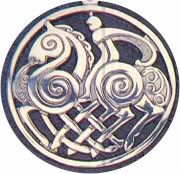
Sleipnir


Norse

In Norse mythology, Odin's eight-legged horse Sleipnir, "the best horse among gods and men", is described as gray. Sleipnir is also the ancestor of another gray horse, Grani, who is owned by the hero Sigurd.


Slavic

In Slavic mythology, the war and fertility deity Svantovit owned an oracular white horse; the historian Saxo Grammaticus, in descriptions similar to those of Tacitus centuries before, says the priests divined the future by leading the white stallion between a series of fences and watching which leg, right or left, stepped first in each row.


Finno-Ugric

The war god in Hungarian mythology was Hadúr, who wears pure copper and is a metalsmith. The ancient Magyars sacrificed white stallions to him before a battle. Additionally, there is a story (mentioned for example in Gesta Hungarorum) that conquering Magyars paid a white horse to Moravian chieftain Svatopluk I (in other forms of the story, it is instead the Bulgarian chieftain Salan) for a part of the land that later became the Kingdom of Hungary.[citation needed] Actual historical background of the story is dubious because Svatopluk I was already dead when the first Hungarian tribes arrived. On the other hand, even Herodotus mentions in his Histories an Eastern custom, where sending a white horse as payment in exchange for land means casus belli. This custom roots in the ancient Eastern belief that stolen land would lose its fertility.


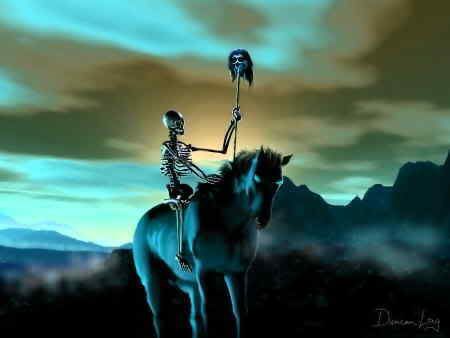
The Pale Horse - Death
Four Horsemen of the Apocalypse (Wikipedia)

The Four Horsemen of the Apocalypse are described in the last book of the New Testament of the Bible, called the Book of Revelation of Jesus Christ to Saint John the Evangelist at 6:1-8. The chapter tells of a "'book', or 'scroll', in God's right hand that is sealed with seven seals". The Lamb of God, or Lion of Judah (Jesus Christ), opens the first four of the seven seals, which summons four beings that ride out on white, red, black, and pale horses. Although some interpretations differ, in most accounts, the four riders are seen as symbolizing Conquest, War, Famine, and Death, respectively. The Christian apocalyptic vision is that the four horsemen are to set a divine apocalypse upon the world as harbingers of the Last Judgment.


White Horse


I watched as the Lamb opened the first of the seven seals. Then I heard one of the four living creatures say in a voice like thunder, "Come and see!" I looked, and there before me was a white horse! Its rider held a bow, and he was given a crown, and he rode out as a conqueror bent on conquest.
--Revelation 6:1-2

Due to the above passage (the most common translation into English), the white rider is referred to as Conquest (not Pestilence, see below). The name could also be construed as "Victory," per the translation found in the Jerusalem Bible (the Greek words are derived from the verb νικάω, to conquer or vanquish). He carries a bow, and wears a victor's crown.


As evil

Artwork which shows the horsemen as a group, such as the famous woodcut by Albrecht Dürer, suggests an interpretation where all four horsemen represent different aspects of the same tribulation.


The first horseman is often associated with military conquest. One interpretation, which was held by evangelist Billy Graham, casts the rider of the white horse as the Antichrist, or a representation of false prophets, citing differences between the white horse in Revelation 6 and Jesus on the white Horse in Revelation 19. In Revelation 19, Jesus has many crowns, but in Revelation 6 the rider has just one.


As righteous

Irenaeus, an influential Christian theologian of the 2nd century, was among the first to interpret this horseman as Christ himself, his white horse representing the successful spread of the gospel. Various scholars have since supported this notion, citing the later appearance, in Revelation 19, of Christ mounted on a white horse, appearing as The Word of God. Furthermore, earlier in the New Testament, the Book of Mark indicates that the advance of the gospel may indeed precede and foretell the apocalypse. The color white also tends to represent righteousness in the Bible, and Christ is in other instances portrayed as a conqueror. However, opposing interpretations argue that the first of the four horsemen is probably not the horseman of Revelation 19. They are described in significantly different ways, and Christ's role as the Lamb who opens the seven seals makes it unlikely that he would also be one of the forces released by the seals.

Besides Christ, the horseman could represent the Holy Spirit. The Holy Spirit was understood to have come upon the Apostles at Pentecost after Jesus' departure from Earth. The appearance of the Lamb in Revelation 5 shows the triumphant arrival of Jesus in Heaven, and the white horseman could represent the sending of the Holy Spirit by Jesus and the advance of the gospel of Jesus Christ.


Globalist/UN Ideology

"We are in charge of God's selection process for planet Earth. He selects, we destroy. We are the riders of the Pale Horse, death. We do this for the sake of the world."
--Barbara Marx-Hubbard 


Barbara Marx-Hubbard couldn't fight her way out've a wet paper bag, but the forces behind words should be taken seriously. However, this is an example of the "White Horse" symbology used within a Biblical meaning.


Other

WHITE HORSE - linked to instinct, purity and the drive of the physical body to release powerful and emotional forces, like rage with ensuing chaos and destruction.

--Excerpt from 'The Subconscious Psychosis of Dreams'

.

Wednesday, April 28, 2010

Triquetra or Sun of the Alps?

One thing that we have needed is a signature symbol for the PAL. That important decision would start with whether or not adopting the flag of the Langbard Kingdom, the flag of Padania (Lega Nord), or some other flag or symbol. Most recently we've used the triquetra symbol. That seemed to make sense, since the triquetra could represent the Holy Trinity or numerous ancient pagan meanings.

What makes this decision even more important is that it will represent a "first impression." A Germanic flag, like the Langbard flag, may tend to send a certain message; not necessarily the correct one. That flag is indeed a powerful image, and we will use it. We could also use a particular Etruscan flag, which was designed years ago, witch is yellow with a black Etruscan lion (chimera). Although we will use those flags, they don't quite send the specific first-impression message that we would like. In particular, our friends in the northern nations would be disappointed with an Etruscan flag as our chief symbol, and we would like that solidarity.

Although we don't see the Etruscans as synonymous with the Romans, there is that tie-in; while the Langobards were invaders. While the triquetra was in usage in many lands, the sun of the Alps symbol was native to the northern nations, as were the progenitors of that symbol, the Celto-Alpine tribes (which were also in Tuscany). While a great idea, the triquetra isn't tied into our heritage like the sun of the Alps, which is practically native to the northern nations. It's worth noting that the Rosa Camuna symbol was native to the Camunian Valley, and not to other areas like the Alpine sun symbol.

The Alpine tribes are probably the true natives of the northern nations region. They go clear back into the ancient world. However the Celts, who arrived in numerous migrations from the Hallstatt area, are often synonymous with the Alpine tribes. There does not appear to be any evidence of any fighing between them, probably because they were so similar. We can't say with absolute certainly that the Alpine sun didn't originate with the pre-Celtic Alpine tribes. Most likely it was Celtic, since it was present in other nearby lands of Celtic settlement.

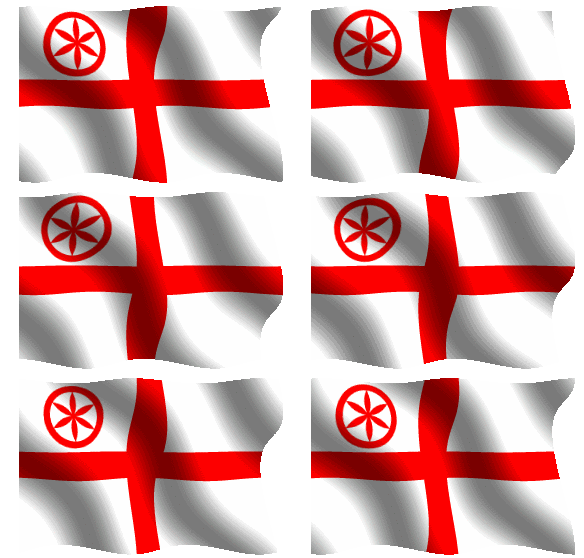
Our proposal is to design a new flag/symbol for the PAL exclusively, which will show both solidarity and uniqueness. That being a modern Padanian flag using the colors of the Langbard flag, red and white. Since the Langbard flag is mainly red, with white as a secondary color, this proposed flag would be red with a sun of the Alps symbol on it. Also, red and white are the colors of the crusader symbol seen on numerous flags in the northern nations. Usually red cross on white background (Genoa, Milan, etc.). Also, this would differ from the Germanic red, white, and black symbolism; or the black eagle.

This proposed flag feels much more "native" than does the triquetra. It seems a perfect fit. We can continue to use other symbols and flags, but this one appears to be closest to sending the right first-impression.

.