
Showing posts with label Titan. Show all posts
Showing posts with label Titan. Show all posts
Sunday, February 1, 2015
Real footage of Cassini-Huygens descent down to the Titan surface
Cassini-Huygens - Ten Years
It has already been ten years since the Cassini-Huygens spacecraft landed upon a moon of Saturn called Titan. The Saturn Mission has been a collaboration of NASA, the European Space Agency (ESA), and the Italian Space Agency (ASI). Initially there were a half dozen or so independent space agencies headquartered in the Cisalpine region, each constructing various parts for the mission, Someone sent me the names of these private agencies, but I misplaced it. I recall with demusement, the radio talk show host Michael Savage proclaiming the he wasn't aware that "Italy" had any space agency... despite the 107 average IQ of root stock Cisalpines, and the continuous scientific contributions to the humankind for centuries.
This video feed, from the initial landing in 2005, almost looks surreal, like a video game, or special effects from a movie. It is, however, very real. Titan has mountains, flat lands, lakes, and rivers. I have heard what almost sounded like claims that it would be about as inhospitable as Antarctica. In other words, a human could almost get by merely dressed as one would in Antarctica, with a breathing apparatus. I say almost, as the surface is about two hundred degrees below zero. Titan has an atmosphere of methane (Earth's atmosphere is partly methane), and the water is mostly methane.. apparently this liquid does not freeze. If the atmosphere could be warmed up, it could be habitable.
A few links:
Italian Space Agency (English language)
What Huygens Saw On Titan - New Image Processing | Video (same as the above, but with commentary)
NASA | Revealing Saturn: Cassini's Tenth Year
Why no Waves in Titan's Ocean's
The Sound of Saturn: The Winds of Titan, from the Huygens Probe
The Eerie Sounds Of Saturn (very strange)
.


Saturday, September 24, 2011
Titan May Have Water Ocean Under The Surface

By Jesse Emspak - International Business Times - May 6, 2011
NASA's Cassini probe, in orbit around Saturn, may have discovered evidence for a liquid ocean under the surface of Titan, Saturn's largest moon.
The data comes from radar observations of the surface that measure Titan's rotation and tell how it is oriented relative to the plane of its orbit - its axial tilt. According to a paper to be published in an upcoming issue of Astronomy and Astrophysics, the new data showed that the many of the planet's surface features were in the wrong place, sometimes off by as much as 30 kilometers (19 miles).
Titan always presents the same face toward Saturn, just like the Moon does to Earth. But in those situations one expects that the moon will be in the "Cassini state," which means that the axial tilt will have a certain value. In Titan's case, the axial tilt was measured at 0.3 degrees. That seemed too high if one assumed Titan was a solid body.
A team at the Royal Observatory of Belgium in Brussels, led by Rose-Marie Baland, proposed that the tilt matches what one would see if Titan had a liquid ocean just under the surface. Given the measured mass of Titan and its density it looks like the ocean is made of water.
The researchers proposed a four-layer model for Titan, involving an icy shell, followed by the ocean, with a mantle of ice underneath that followed by core of rock and ice.
Most small worlds are solid all the way through because they cool fast enough that the insides don't stay molten. Titan is bigger than Mercury but still a good deal smaller than the Earth, which led many to believe it was probably a solid mass of ice and rock on the inside.
The presence of an ocean on Titan has important implications for the search for alien life. As far as anyone on Earth knows, liquid water is essential for life as we know it. If Baland and her team are correct there will be another place to look for it. Currently many scientists see Mars and Europa as two possible abodes for aliens (even if they are only bacteria) because both worlds have had liquid water in the past (Mars) or have it now (Europa, under the surface ice layer).
Baland and her co-authors say that there are some other possibilities besides a liquid ocean. One is the outer layers being denser than the interior. But that seems unlikely because one would ordinarily expect denser material to end up in the core. Another is that Titan was hit by something in the recent past. More observations will be needed to test those hypotheses.
**************************************************
We have followed the Cassini-Huygens Mission for some years now. The mission is now over seven years, and the projected termination date is sometime in 2017. The project is a joint effort of NASA, ESA (European Space Agency), and the ASI (Italian Space Agency). The ASI is a government-led effort, but the allied space agencies are all from the Cisalpine homeland. Most of the components of the spacecraft were constructed at these locations.
.
Friday, September 26, 2008
Cassini–Huygens: Mission to Saturn & Titan
 On our main page, we have long had a page entitled "Cassini–Huygens: Mission to Saturn & Titan," in an attempt to track and monitor the mission. Over the last number of years, Cassini-Huygens has frequently been in the news, and we did republish many articles in our Yahoo Group. The mission is winding down now and we're moving it here.
Much of the technology for this mission came from space agencies in Northern Italy. I can recall a mainstream radio talk show host stating, after an early Cassini-Huygens story, "I didn't even know that Italy had a space program." He may as well said that the French don't know how to make wine, or that Persians don't know how to make rugs. As clearly laid out in the 2003 book 'Human Accomplishment,' Northern Italy (and German-speaking regions) have been at the very TOP of science and technology for the past 600 years. The same host is a big "Sopranos" fan, so it's just another example of just how far this stunning "Italian duality" has gone in this country.
Some of the independent space agencies in Northern Italy (via ASI Agenzia Spaziale Italiana), which are directly involved in Cassini-Huygens, are Alenia Spazio, Galileo Avionica, LABEN, and Carlo Gavazzi Space. Other space agencies are owned by Finmeccanica, a state owned company. Also, there are many other Northern Italian insustries involved in space programs (via ASI or via ESA) like Agusta, Aermacchi, Fiat-Avio, and many others. I had a link to what formerly was Alena Spazio, but it was merged into the whole European corporate conglomerate landscape, which I think is tragic, and just goes along with the diminishing concept of national sovereignty.
 [Right: Amazing photo of Titan, one of Saturn's moons]
FROM WIKIPEDIA:
Cassini–Huygens is a joint NASA/ESA/ASI robotic spacecraft mission currently studying the planet Saturn and its moons. The spacecraft consists of two main elements: the NASA Cassini orbiter, named after the Italian-French astronomer Giovanni Domenico Cassini, and the ESA Huygens probe, named after the Dutch astronomer, mathematician and physicist Christiaan Huygens. It was launched on October 15, 1997 and entered into orbit around Saturn on July 1, 2004. On December 25, 2004 the Huygens probe separated from the orbiter at approximately 02:00 UTC; it reached Saturn's moon Titan on January 14, 2005 where it made an atmospheric descent to the surface and relayed scientific information. On April 18, 2008, NASA announced a two year extension of the mission.[1] Cassini is the first spacecraft to orbit Saturn and the fourth to visit it.
Hundreds of scientists and engineers from 16 European countries and 33 states of the United States make up the team responsible for designing, building, flying and collecting data from the Cassini orbiter and Huygens probe. The mission is managed by NASA’s Jet Propulsion Laboratory, where the orbiter was designed and assembled. Development of the Huygens Titan probe was managed by the European Space Technology and Research Center, whose prime contractor for the probe is Alcatel in France. Equipment and instruments for the probe were supplied from many countries, including the United States. The Italian Space Agency (ASI) provided Cassini's high-gain communication antenna, and a revolutionary compact and light-weight multimode radar (synthetic aperture radar, radar altimeter, radiometer).
***************************************************************************
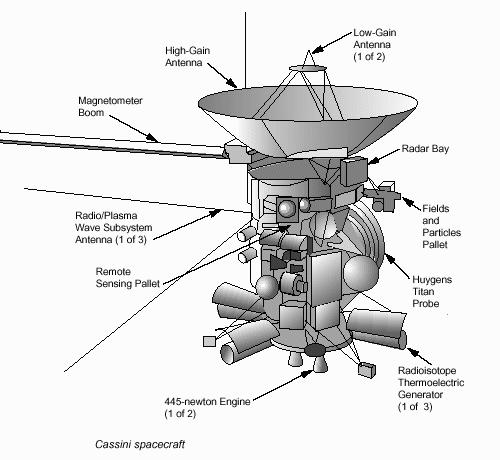 There is much more information and links at the Cassini-Huygens Wikipedia page. Other websites include the Cassini-Huygens home at JPL, the latest Saturn-Titan images at the same JPL site, and a European Cassini-Huygens site with a lot of related images. Also, three recent news items that I happened to see recently include Saturn's rings may be older than thought (Yahoo news), Probe gets close up to Enceladus (BBC), and New Enceladus Closeups Now Arriving (Sky & Telescope). Lastly, let us not forget the Giovanni Domenico Cassini Wikipedia page.
Subscribe to:
Posts (Atom)