Showing posts with label Cisalpine heritage. Show all posts

Tuesday, December 25, 2018

'Riccardo Giacconi, 87, Explorer of the Universe Through X-Rays, Dies'

[Right: The astrophysicist Riccardo Giacconi at a symposium at Stanford University in 1962. His specialty was studying the universe through X-rays.]

'Riccardo Giacconi, 87, Explorer of the Universe Through X-Rays, Dies'

By Dennis Overbye - New /York Times - December 13, 2018

Riccardo Giacconi, an astrophysicist who won the Nobel Prize for pioneering the study of the universe through the X-rays emitted by the most violent actors in the cosmos, including black holes, exploding stars and galumphing clouds of galaxies, died on Sunday in the La Jolla section of San Diego. He was 87.

The National Academy of Sciences, of which he was a member, announced his death.

Dr. Giacconi was one of the great captains of Big Science, leaving lasting imprints on major astronomical institutions like the Space Telescope Science Institute in Baltimore, which runs the Hubble Space Telescope, and the European Southern Observatory in Germany, where he oversaw the building of the largest telescope on Earth. He helped set the pattern for how large scientific projects are run today.

“If you need to do something big, Riccardo was up to the task,” Robert Kirshner, an astronomer at the Gordon and Betty Moore Foundation in Palo Alto, Calif., said by email. Ticking off the observatories Dr. Giacconi directed, Dr. Kirshner called them the “great tools of discovery in the 20th (and 21st) century.”

con't....


.

Sunday, July 24, 2016

'Oakland mourns the looming closure of 90 year old Genova deli'

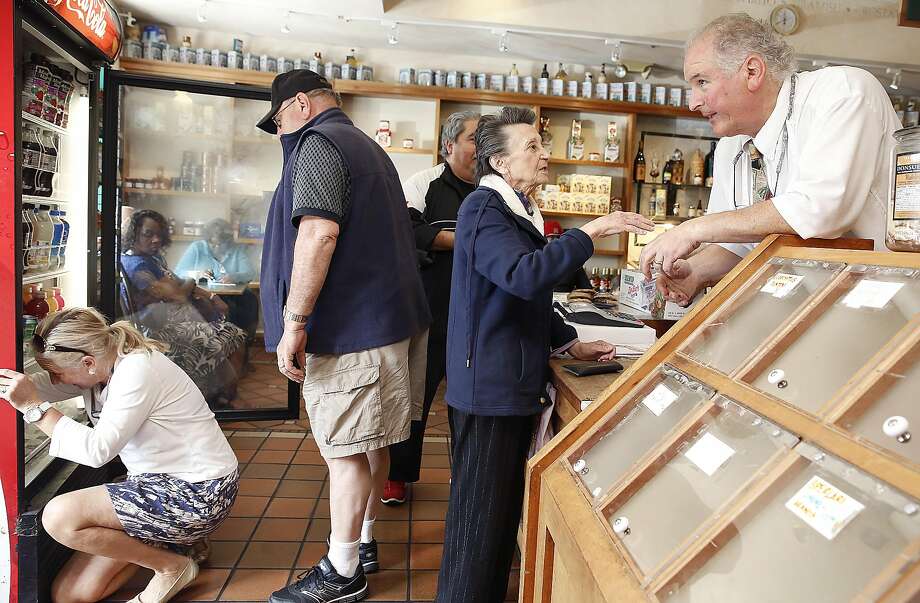
David DeVincenzi (right), son of Genova Deli owner Dominic DeVincenzi, helps customer Mrs. Gasparro, while his wife, Patti, kneels in front of a display case to help Joe Scodella (center), a deli customer since 1956.


'Oakland mourns the looming closure of 90 year old Genova deli'

Ethan Fletcher - San Francisco Chronicle - April 26, 2016

The vibe inside Genova Delicatessen on Monday afternoon had the feel of a living wake, with old friends gathering one last time to celebrate a loved one soon to pass.

In this case, that loved one took the form of overstuffed Italian sandwiches, homemade meat ravioli and softball-size fried artichokes, all of which longtime customers were loading up on one last time before this immensely popular 90-year-old Oakland institution closes for good on Saturday.

While the announcement was officially made late last week, the closure had been threatened — and for many locals, dreaded — since January. That’s when news leaked that owner Dominic DeVincenzi was considering shutting down his family’s flagship Italian deli due in part to a rent dispute with the property owners of Temescal Plaza, where Genova has been located since 1996. (It’s been in Temescal since 1926.)

According to David DeVincenzi, son of Genova Deli owner Dominic DeVincenzi, the family is continuing to work on finding a new location in Oakland.

“We’re working on a couple of places,” DeVincenzi said. Where that might be exactly, however, DeVincenzi was unwilling to divulge.

The Temescal neighborhood’s reputation has soared in recent years as a foodie destination — home to the likes of Pizzaiolo, Burma Superstar and Bakesale Betty — and as a hot spot for house hunters priced out of San Francisco. But the crowd inside Genova, packed with everyone from families to firefighters, felt very old school.


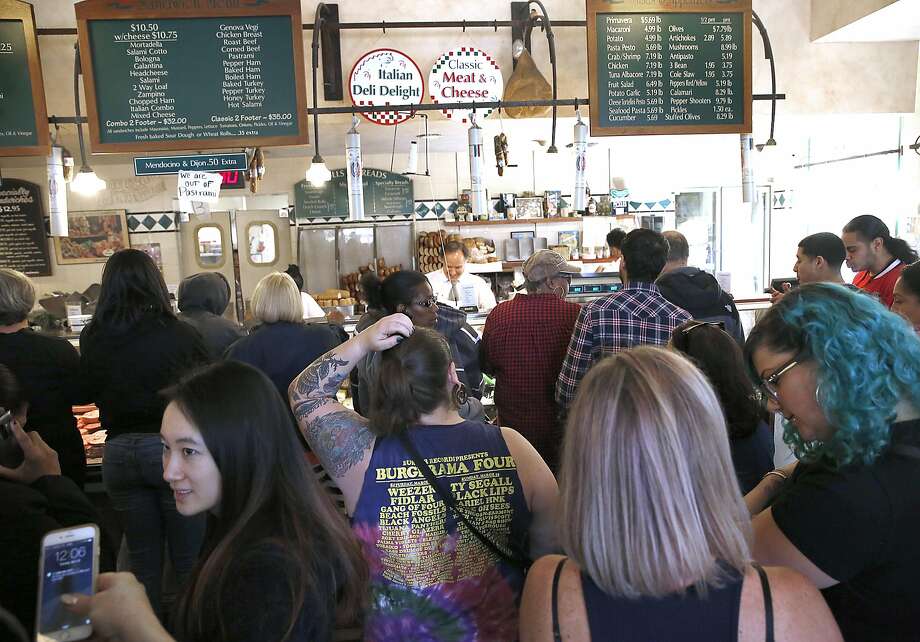
Customers pack Genova Delicatessen for their last orders and to say goodbye before it closes on Saturday after 90 years in Oakland.


Generations of patrons

Terry Barnes, 41, grew up around the corner and said he’d been coming to Genova since he was 4 years old, back in the days when it was located in a tiny Victorian on Telegraph Avenue, and lines would stretch out the door and down the block. He was waiting for his number to be called — which even at 3 in the afternoon was taking upward of an hour — to get one final Italian combo sandwich with extra dry salame and marinated cucumbers. “And a cannoli. Gotta have my cannoli,” Barnes added.

“My family, my mother and my grandmother and all my cousins, we all grew up on this,” he said. “My kids grew up on this, my kids’ friends and their cousins all grew up on this. Every girlfriend I ever had, I would take them here, and now I see all of them coming in with their kids. So it’s sad to see this happen because you would think this place would stick around.”

Genova’s factory and Napa store will remain open, and the property’s landlords have said they’re looking to keep the space as a deli. That seemed small consolation for many customers, nearly all of whom it seemed had been coming for decades and knew each other.

Another customer, Emmy Fearn, ordered three sandwiches — an Italian combo, a coppa and a pastrami. One was for her, one was for her husband getting treatment at a nearby hospital, and the third was for her husband’s doctor, who had promptly put in an order upon hearing the deli was closing. Like many, Fearn expressed shock that Genova was actually closing.

“At first I thought that it was just a play to get some leverage with the landlord,” Fearn said. “But now that it’s really happening, I think it’s horrible. I think it’s a terrible loss to the community.”


‘This is a real loss’

Inside, she ran into an old friend, Marge Gibson Haskell, a former Oakland city councilwoman who had worked with Dominic back in the 1980s to ensure that the deli remained in the neighborhood.

“Back then, there was hardly anything else around here, so you had to really hold on to what you had,” said Haskell while waiting for her Italian combo (light on the peppers). “That was really important for this neighborhood and to a large extent made it possible for everything else that came here afterwards. This is what started it all. … I think not keeping this here is a serious mistake.”

“This city has changed a lot over these last few years, some good, some bad,” said Haskell. “But this. This is a real loss.”

Similar sentiments were echoed by many inside Genova, where there was a palpable sense of unease among longtime locals at the speed with which the rapidly gentrifying city was changing and losing its ties to its past. And while it’s unclear to what extent any rent increase played in the store closing — Genova’s owners have cited the general cost of doing business in Oakland and not wanting to pass that on to the consumer as the main factor — there was plenty of blame to go around that something couldn’t be worked out.

“I understand you want to get fair market value and all that, but you can’t expect people to pay so much, especially in the restaurant industry where the margins are so thin,” said Lex Gopnik, loaded up with a big bag stuffed with Italian provisions. Gopnik said he has been coming to Genova since he moved to the East Bay in 1988. Genova has served as a touchstone for him, his wife and three kids, whether it was grabbing takeout to bring to an A’s game or as an easy dinner for a busy family of five.

“It’s indicative of what’s happening here in the East Bay and the Bay Area in general. I think they would have had to charge like $20 for a sandwich. So it’s sad to see them go, but I respect them for taking a stand and saying, ‘No, I don’t want to do that.’”


‘Things change’

Gopnik is more familiar with the industry than most. He’s been looking for space to open a Montreal-style deli in Oakland, but says news like this makes him reconsider whether he has a future in the city in which rising rents threaten the feasibility of the types of small, independently run businesses that make the place so attractive in the first place.

“I just don’t understand that mentality,” he says. “To me it seems so shortsighted.”

Brian McCabe, an Oakland native waiting for one last turkey sandwich on sourdough, took a more pragmatic view.

“I’ve been coming here for years, and it’s a special place,” he said. “It’s been around for so long, and there’s something comforting about that. But things change.”


Ethan Fletcher is a Bay Area freelance writer. Email: food@sfchronicle.com


*************************


Giovanni Beltramo, who opened a wholesale and
retail wine and spirits business in Menlo Park in
1882, in his vineyard. Photo courtesy Beltramo family.

'Menlo Park: Beltramo's closing after 134 years'

Melanie Wong - Chowhound - May 9, 2016

Whoa. Beltramo's ends 134 years in business this summer.

https://www.beltramos.com/

*************************

It would be worth it to click on the above link just to see the old photos, and there's a short interesting history. When Beltramo's opened, it was the El Camino trail with horses and carriages. The story of Beltramo's, the family originating from Piemonte, is everything our people have been about in northern California. I didn't realize that they were initially in the wine business. It was a truly great store. Why do I miss things most when they're no longer there...

'Beltramo's Wines and Spirits is closing its doors in Menlo Park' (history and old photos)

'Menlo Park's oldest business, Beltramo's, is a family tradition' (history)

.

Wednesday, June 3, 2015

The super-gentrification from San Francisco to the South Bay


This is a difficult subject to delve into because it’s tied to so many other issues—past and present—each with its own legitimate “bottom line.” Many people are simply incapable of compartmentalizing each sub-issue for critical review… after which all of the parts need to be put back together for a final conclusion. The only overwhelming “bottom line” that I can think of is that if we look at our particular local gentrification from 1990 to 2030, literally millions of local residents will have been forced to relocate out of necessity. Some have been referring to this as the issue of “the right to replace.”

We’re not talking about someone taking over a neighborhood or even a city, but of an area of at least 2,000 square miles as the epicenter of a particularly ruthless gentrification. This isn’t “urban renewal,” as it very dramatically affects a large diverse area and every citizen in it. Even the despotic robber barons of history at least allowed their subjects a place to dwell. The newly formed economic-establishment simply want local residents out... period! A portion of the highest socio-economic classes of the old order have even issued complaints for various reasons. We’re living amid a massive social and economic upheaval; and also political, as we witness even San Francisco politicians welcoming the extreme replacement and change over their own long-time constituency.

Like any well-organized colonization, this region has even been renamed… “Silicon Valley”… after what had long been merely a nickname for the technology industry in the South Bay. HBO even produces a series called ‘Silicon Valley’, which I am not familiar with, but what appears to be about IT hipsters; Fabian capitalists in sandals, urban cowboys conquering a new frontier. So, what does that make us? Indians? For every action (mass migration), there’s an opposite re-action (replacement). In many ways, this harsh fact is how humans have interacted for thousands of years; but at least then the aggressors were open about their intentions… such as ‘The Indian Removal Act’. With us, there is neither a name for our ouster or even much complaint from us; just a slow moving push out the door.


The first that I ever really pondered this subject was in the late 90s, when a company which I was working for was closing down the location due to a buyout. One couple, in their late forties, had worked there as well. He worked in the warehouse, while she worked in the office. On the final day, as I spoke to the very down-to-earth couple in the parking lot on that warm late summer evening, they told me that they were moving to Georgia where he had family. San Mateo County had gotten too expensive, and the surrounding area was going the same way. They left, and in some small way, we became metaphorically poorer as a result. I can recall back in the 70s and 80s when the South Bay was booming. New residents migrated in from many places. It was an exciting time then. The growth seemed large, but was not overwhelming. It didn’t hurt the agricultural industry, which has much room to fan out. The new residents were a positive influence.

The only real plus for the locals is if they happen to own a real estate. In the town of Burlingame, for example, a small two-bedroom home is now worth about 200 times what it probably was worth in the 50s… where a barber or a warehouseman could purchase it on one-income. This home equity serves as our only symbolic severance pay for our collective eviction. According to HUD, you should not pay any more than 30% of your net income on rent; which would mean that in order to pay even the bare minimum rent anywhere in San Mateo County and maintain that 30%, a person would need to net about $5,700 a month. Even if a local wished to stay anyway because they can afford it, do you really want to live in a rootless place where you’re the dinosaur? Where are YOU from?

I say this also for people in New York City or any place where a local population has been given their subtle “walking papers” by out-of-towners who want them out… starting yesterday. There’s no comparison between someone simply moving to a new location, and a person with one particular skill set who believes that everything in the world… belongs to them. You can’t resist the whole country when word has gotten out that your backyard is “the place to be!” Nobody can. Of course, they wouldn’t like it if it happened where they're from. It’s like abortion; it’s okay as long as it’s not YOU. I’m not a fan of Spike Lee, but he’s correct about gentrification, such as in regards to a place like Harlem… which is a new hipster paradise. Of course, an entire component to all of this—which is best looked upon as a separate issue—is that many now doing the complaining, sprang from people who got where they are through large-scale demographic change aka “replacement.” Still, that’s a separate issue, and doesn’t make them wrong.


Some individuals of great wealth who have relocated here, then have become “zero-growth” advocates and “open-space" proponents the moment they get here! Before we pat them on the back “at least for that,” many of them are the types who buy up land along the coast or in the many unspoiled areas of the Santa Cruz Mountains, and then block off access to the general public. In other words, under normal conditions, those locations would have largely remained public property in the first place. Still, the great majority are pro-urban sprawl via gentrification. The South Bay will then go into a mode of “ever-expansion outward!”; such as with the Los Angeles Basin. The only reason that the Bay Area has so many open spaces is through the work of a lot of good people over the decades. That is about to change.

Many newcomers of this new-guard will make their buck and then go back “home” again… having forever changed our world. This whole “happening” is the biggest joke… because its foundation rests upon an open secret: They need us out. There’s no way around that fact. Even local retired homeowners, who normally would have remained here, are now given this very lucrative option of selling high and buying low somewhere else. Although this is a great opportunity for them, it further dismantles local roots by breaking down its organic pillars.

What can one say when even upper middle class neighborhoods are being gentrified? San Mateo County was one of the wealthiest counties in the whole country before 1990! Some years ago, a South Bay student who had been away to college, came home to discover the tremendous changes which had taken place in just several years. He produced a documentary about it, of which the name escapes me. However, somehow this all seems so contrived; beyond the typical “change and progress” line that is always fed to society. It’s a feeding frenzy… on our watch. I know of what was once a very beautiful open-space area, amid a nice tree-filled South Bay neighborhood, with wonderful views of the Santa Cruz Mountains. Nothing over three stories high. In the course of about five years, all of it was gone except the official park itself. Skyscrapers now block out the view of the mountains, the once open area along the creek is lost amid a new concrete jungle, and when walking through you always have that feeling of "being watched" with thousands of windows peering down at you. Contrived over-development can sometimes be a downright backward and primitive thing to do. This development is entirely out-of-scale in relation to the surrounding area. Total ruination.


Strangely, local police often favor the newcomers; usually by picking on automobiles which aren’t consistent with the new-guard, and asking “what are you doing down here?”… and followed by “why can’t you do those things up there?”… even if you’re three miles away in the next town over where you live, and you grew up in the area anyway. This is based on the experiences of many individuals, including myself. I was pulled over for no reason on one occasion, and they asked to search my car. Usually they don’t bother asking, so I agreed. This particular officer opened my trunk where I had tools and debris from building a fence for someone. I observed the officer with amusement as he was looking very closely at simple tools, such as a wrench, as though he were examining ancient artifacts. WOW!! If that isn’t a perfect metaphor for what’s been happening, I don’t know what is! Just for the record, as we should acknowledge, police departments vary vastly from city to city. The police are simply a reflection of their superiors. I learned this when a few years ago I went into a building on a local community college campus where there was a police training academy. As I walked in dressed in a coat and tie from a job interview I just had… the cadets walking in the hallway immediately lined up against the walls and saluted me. That… kind’ve says it all.

There are numerous once-major cultural groupings long predating World War II, whom contributed greatly to the local area, which have been massively pushed aside for at least thirty years even before this super-gentrification period. Cisalpines/Italians, Japanese, Irish, Scottish, Croatians, Slovenians, Russians/Ukrainians, Maltese, Portuguese, Germans, Oklahoma-north Texas migratory descendants, etc. This often difficult-to-define umbrella-grouping contributed more overall to local history, culture, free market, self-determinism, and in terms of spirituality--much more-so than those who followed; yet they’re never discussed, spoken of, or referred to in any way in public affairs. They exist only in the abstract: “North Beach” or “Japanese Gardens.” It’s just a perception that there are “Italians in North Beach.” If you don’t officially exist, then any concerns which you may have probably aren’t likely to exist either.

I know so many of you feel the same way, because you’ve told me so time and time again. I’m just defining the entire scope of what you have collectively told me. There are endless examples of where the rootless have defeated local cultures over the years. These socio-economic interests are just the latest in a long line. There was an equally disturbing socio-political migration that was endured for such a long time. Again, these examples are not the same as someone merely moving to a new location. What I’m referring to are people who come in for practically the expressed purpose of taking over, and they need and fully expect us to get out of the way for them. There are many huge corporations which have entire departments dedicated to “finding housing” for incoming employees; including purchasing real estate. Although it sounds almost innocent, this places further stress on the limited opportunities on real estate and housing for locals. They need us out, plain and simple. They know this, we know this, and they know that we know this.


6-10-15 ADDITION:

I wanted to add this thoughtful article from the American Sociological Association, entitled 'Understanding Super-Gentrification in San Francisco' (John Stover - University of San Francisco - April 2014). Actually, I didn't get the term "super-gentrification," from this piece, but maybe I heard of it somewhere.

.

Sunday, February 1, 2015

Real footage of Cassini-Huygens descent down to the Titan surface


Cassini-Huygens - Ten Years

It has already been ten years since the Cassini-Huygens spacecraft landed upon a moon of Saturn called Titan. The Saturn Mission has been a collaboration of NASA, the European Space Agency (ESA), and the Italian Space Agency (ASI). Initially there were a half dozen or so independent space agencies headquartered in the Cisalpine region, each constructing various parts for the mission, Someone sent me the names of these private agencies, but I misplaced it. I recall with demusement, the radio talk show host Michael Savage proclaiming the he wasn't aware that "Italy" had any space agency... despite the 107 average IQ of root stock Cisalpines, and the continuous scientific contributions to the humankind for centuries.

This video feed, from the initial landing in 2005, almost looks surreal, like a video game, or special effects from a movie. It is, however, very real. Titan has mountains, flat lands, lakes, and rivers. I have heard what almost sounded like claims that it would be about as inhospitable as Antarctica. In other words, a human could almost get by merely dressed as one would in Antarctica, with a breathing apparatus. I say almost, as the surface is about two hundred degrees below zero. Titan has an atmosphere of methane (Earth's atmosphere is partly methane), and the water is mostly methane.. apparently this liquid does not freeze. If the atmosphere could be warmed up, it could be habitable.


A few links:

Italian Space Agency (English language)

What Huygens Saw On Titan - New Image Processing | Video (same as the above, but with commentary)

NASA | Revealing Saturn: Cassini's Tenth Year

Why no Waves in Titan's Ocean's

The Sound of Saturn: The Winds of Titan, from the Huygens Probe 

The Eerie Sounds Of Saturn (very strange)

.

Saturday, August 30, 2014

California Wine: Santa Cruz Mountains

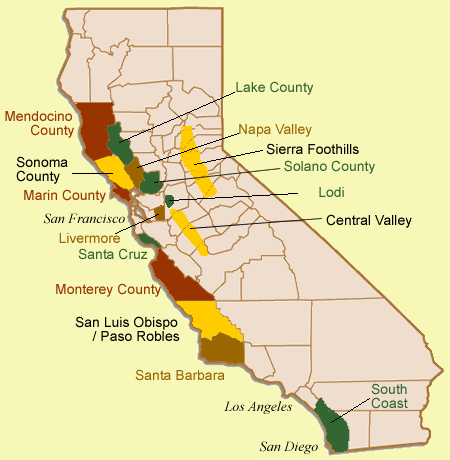
The following article appeared in last Sunday's San Francisco Chronicle in the 'California Wine' special section. Although Napa and Sonoma are the counties that usually are thought of when people think of the local wine industry, Santa Cruz County ranks high as well. Not surprisingly, Cisalpine influence was present from the beginning.


Santa Cruz Mountains blend chill and warmth for Pinot to Cabernet

By Patrick Comiskey - San Francisco Chronicle - August 23, 2014

The San Andreas Fault runs right through the Santa Cruz Mountains appellation, separating parts of the Pacific plate to the west and the North American plate to the east. Between them, geographical chaos ensues. Not surprisingly, it can seem hard to get around by car, with all the winding mountain roads.

There are more than 70 vineyards and wineries in the area, but aside from Ridge and David Bruce, nearly all are tiny and obscured behind mantles of towering redwoods and Douglas firs. The region is largely defined by elevation, and the fog line, so you won’t see many vines planted below 800 feet.

The slopes are so dramatic, and the climatic conditions so variable, that the Santa Cruz Mountains are one of those rare places in the state where it’s possible to farm Pinot Noir, Chardonnay and Cabernet Sauvignon on the same estate.

“We’re definitely on the cool side for Cabernet,” says winemaker Jeffrey Patterson, who grows all three, “and probably a little on the warm side for Pinot Noir.”

Patterson farms and makes wine at Mount Eden Vineyards, one of the mountains’ most historic properties, a hidden enclave that has been continuously farmed for grapes since 1946, when a stockbroker named Martin Ray ventured to the property outside Saratoga, seeking high-elevation slopes upon which to plant Pinot Noir. From his aerie, Ray was one of the era’s most cantankerous but also talented winemakers, a gadfly for everything from proper cellar methods to more transparent varietal labeling.

When you factor in Ray’s tenure, Mount Eden remains the oldest continuous producer of Pinot Noir and Chardonnay in the country.


Total acres: 408,000

Known for: Pinot Noir, Chardonnay, Cabernet Sauvignon.

Defining features: Proximity to the Pacific and its effects result in an appellation with a wildly varying climate. Sedimentary and volcanic soils, depending on which side of the San Andreas Fault you’re on.

Places to visit: Mount Eden Vineyards (tours only by appointment), 22020 Mount Eden Rd., Saratoga. (408) 867-5832. www.mounteden.com.

Ridge Vineyards (weekends, and weekdays by appointment), 17100 Monte Bello Road, Cupertino. (408) 867-3233. www.ridgewine.com.

Thomas Fogarty Winery, 19501 Skyline Drive, Woodside. (650) 851-6777. www.fogartywinery.com.


**************************************************

A few Santa Cruz County wineries, not necessary in the mountains:

http://www.bruzzonevineyards.com/
 

http://www.domenicowinery.com/
 

http://www.lanebbiawinery.com/
 

http://www.larusticanadorsa.com/
 

http://www.muccigrosso.com/
 

http://www.regalewine.com/
 

http://www.traviesowinery.com/
 

http://villadelmontewinery.com/
 

http://www.zayantevineyards.com/
 

http://www.santewinery.com/

http://www.bargetto.com/

**************************************************

Santa Cruz Mountains Winegrowers Association

http://scmwa.com/

.

Monday, August 26, 2013

California Wine 2013

Yesterday, the San Francisco Chronicle published its annual 'California Wine' section. It was subtitled 'Sunny days - Now's the best time in years to enjoy the state's bounty.' In it were numerous articles about regional wines, corresponding foods, fall events, wine tasting, and different grapes. Unfortunately, this group of articles isn't available as a separate section online; but here is the link to their "wine" homepage.

No aspect of regional northern California culture brings out more the long standing local Cisalpine heritage than the wine industry. Not just the older wineries, but newer ones; as well as Cisalpines who came here in later times like Robert Mondavi. One of the wineries featured is the Fanucchi Vineyards in Fresno County.


In one of the articles entitled 'A toast to California wines', it states "California wine is booming as never before. You can see it clearly in the numbers. As we'll relate in the following pages, the state's wine industry remains on a nearly two-decde surge of popularity, accounting for more than $34 billion in sales last year."

In another article from the section entitled 'California wine enjoys a long boom', a sub-section shows the following facts:
*California's wine economy
-$61.5 billion in overall economic impact in the state
-330,000 jobs generated
-$12.3 billion in wages
-$14.7 billion generated in state and federal taxes


I often like to try foreign wines, and it's easy for for locals to forget that we live in very likely the best wine producing region in the world. One interesting development in recent years has been the growth of wine in Sonoma County; although I don't really know if it actually comes close to challenging the famous Napa County wine region in sales. Another interesting aspect of this industry is that there are big growers who don't even have a label of their own, and find it profitable enough in the farming end of the business.

The wine community of Lodi in the Central Valley--a city named after Lodi, Lombardy--had a full page ad to promote their wines, with their website LodiWine.com. If you're near a Chronicle distributor, you could just walk in and purchase the Sunday paper of August 26; especially if you wanted to attend some of the late Summer and Fall events. I find sfgate.com to be hard to search and navigate. Lastly, St. Helena is the heart of the wine industry in North America. It truly is a great place to visit. Our people were predominant in making this industry from it's inception.


.