Showing posts with label boxing. Show all posts

Wednesday, May 22, 2019

Lake Antorno featured now in Windows 10 Spotlight


Lake Antorno

Lago d'Antorno is located in the Dolomites; the province of Belluno in the Veneto.


*************************
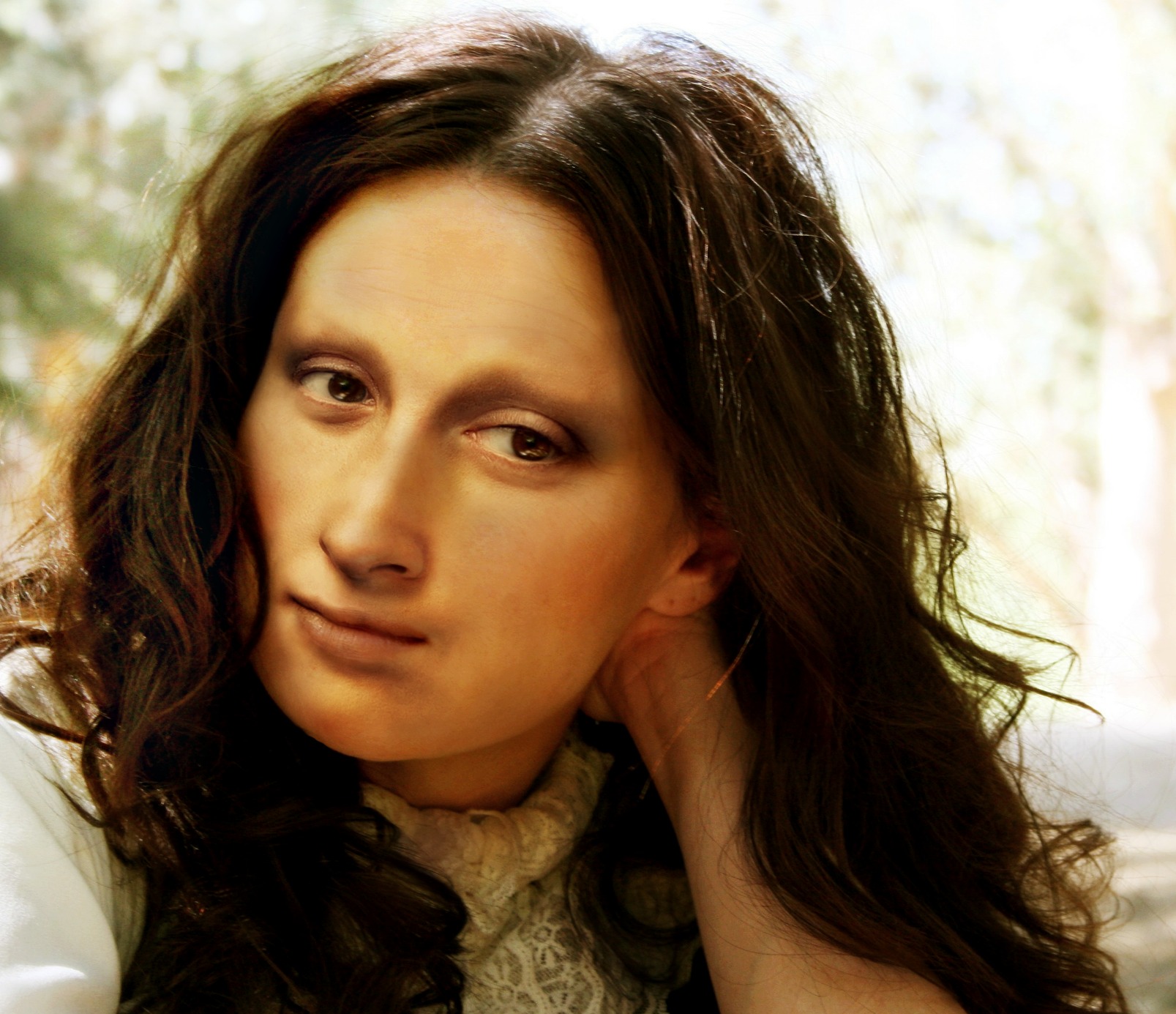


Revisioning drawing of Lisa del Giocondo

Lisa del Giocondo

Lisa del Giocondo (née Gherardini; June 15, 1479 – July 15, 1542) was an Italian noblewoman and member of the Gherardini family of Florence and Tuscany. Her name was given to the Mona Lisa, her portrait commissioned by her husband and painted by Leonardo da Vinci during the Italian Renaissance.

Little is known about Lisa's life. Born in Florence and married in her teens to a cloth and silk merchant who later became a local official, she was a mother to five children and led what is thought to have been a comfortable and ordinary middle-class life. Lisa outlived her husband, who was considerably her senior.

Centuries after Lisa's death, the Mona Lisa became the world's most famous painting and took on a life separate from Lisa, the woman. Speculation by scholars and hobbyists made the work of art a globally recognized icon and an object of commercialization. In 2005, Lisa was definitively identified as the model for the Mona Lisa.


************


'Dark family history behind Mona Lisa's sad smile revealed in new book'

'Leonardo da Vinci never finished the Mona Lisa because he injured his arm while fainting, experts say'


*************************


Roman coins from Breathitt County, Kentucky

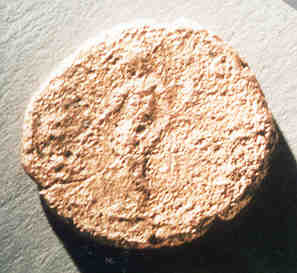
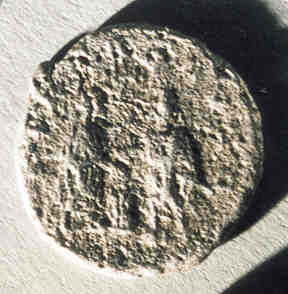
The above three coins were found in a cave shelter in Breathitt County, Kentucky, by Mr. Michael Wayne Griffith of the same county. Mr. Griffith has found another 9 or so similar coins, but the three depicted are the best preserved of the group.

A few years ago the three depicted were examined hands-on by Norman Totten, Professor of History, now Emeritus, at Bentley College. Totten identified the two thinner coins (the top two above) as antoniniani, a type of bronze Roman coin minted between 238 and 305 A.D. The obverses (left photos) depict an unidentifiable emperor wearing the distinctive "solar crown" of the period. The reverse of the top one, in the right photo, depicts two figures standing facing what apparently is a central altar, while that of the middle one depicts a female standing figure facing left with a cornucopia in her right hand.

These would originally have had a silver surface, long since gone. The third coin is thicker, and depicts a bust facing right, wearing a laureate wreath rather than a crown. The reverse, according to Totten, is perhaps a figure of a centaur walking to the right and looking back. Its flan (the metal disk from which coin is made) seems to be of a North African (Egyptian) or Middle Eastern type. This coin probably dates to a similar period to that of the two antoniniani (singular antoninianus). While Totten is confident that the coins are genuine, he warns that such coins are easy to obtain from coin dealers.

In 1963, a small hoard of Roman coins from the same approximate period, and in a much better state of preservation, was found during bridge construction on the north bank of the Ohio River, at the Falls of the Ohio, opposite Louisville, Kentucky.

Breathitt Co., population 16,100 in 2000, is on the upper Kentucky River, in the southeastern portion of the state. The county seat is Jackson, pop. 2,490. Two of the larger towns are named Quicksand and Lost Creek, but the 2000 U.S. Census couldn't find either. The nearest metropolis is Hazard (which may or may not be the inspiration for the "Dukes of Hazzard" TV series), pop. 4,806, and one county to the south.

Mr. Griffith is difficult to contact, but is known to Mr. David Feldman, President of Feldman Lumber Co. in Lancaster, Ky.

The author wishes to thank Prof. Norman Totten, Dr. John Payne, of Berea, Ky., and Mr. David Feldman of Lancaster, Ky., for their invaluable assistance. 


************


Roman Head from Calixtlahuaca, Mexico

Roman coins from the Falls of the Ohio River, Indiana

Roman shipwreck near Rio de Janeiro, Brazil


*************************


Gianfranco Rosi vs Duane Thomas 03-01-1988

Boxing Syko

WBC World Super Welterweight Title Fight

Venue: Palazzo Dello Sport, Genoa, Liguria, Italy


************


Gianfranco Rosi

Gianfranco Rosi (born 5 August 1957) retired Italian boxer who was a two-time world champion in the light-middleweight division.


Professional career

Rosi turned pro in 1979 and won the WBC light-middleweight title in 1987 by decisioning Lupe Aquino. He lost the belt in 1988 when he was dominated by Donald Curry. Rosi was down once in 2nd, 4th and 8th and down twice in 7th, failing to answer the bell starting the 10th round.

In 1989 he won the IBF light-middleweight title by outpointing the undefeated Darrin Van Horn. He went on to successfully defend the title an impressive 11 times. In 1994 he had a technical draw against Vincent Pettway, and in the rematch later that year Pettway KO'd Rosi, ending his long reign.

In 1995 he took on WBO light-middleweight title holder Verno Phillips and won a decision, but Rosi failed a drug test and Phillips was reinstated as champion. The result of the bout was changed to a No Contest. In 1997 he lost a rematch to Phillips and retired.

In 2003 he came out of retirement, and finally retired in 2006 at the age of 49 with a pro record of 62 wins (18 KOs), 6 losses, and 1 draw.


Amateur career

Rosi had a record of 94 wins - 2 losses - 4 draws Highlights:

1976 Italian Light-Welterweight Champion

1977 Italian Welterweight Champion


************


Born in Assisi in the province of Perugia (Umbria), Gianfranco Rosi took a 32-1 record into a European Welterweight Championship bout in 1984 with future world welterweight champion Lloyd Honeyghan from the UK. Rosi lost his first big bout, but won his next nine--including winning the European Junior Middleweight title and defending it twice--and took a 41-2 record into a bout with world champion Luge Aquino of Mexico, a much more dangerous opponent than Honeyghan. Rosi won a unanimous decision to take the belt.

There were so many outstanding boxers worldwide in the 80s, especially between 147 and 160 pounds. Next he defended the belt against another very hard punching boxer, former champion Duane Thomas of Detroit, winning by knockout. Although he lost in his next defense against former welterweight champion Donald Curry, he eventually won the world title back and defended it eleven times before losing.


*************************


The Discovery and Restoration of Leonardo da Vinci's Long-Lost Painting "Salvator Mundi" | Robb Report

Robb Report

Leonardo da Vinci is one of history's greatest artists and thinkers. Only about 15 of his paintings are known to exist and one was thought to be lost forever. Leonard painted that masterpiece, called "Salvator Mundi" (Savior of the World) around 1500. It was owned by no less than three kings and, in 1763, it disappeared. This video tells the story of that incredible painting, how it was rediscovered in 2005, and what happened when it went to auction at Christie's in November 2017.

READ MORE: http://bit.ly/LostDaVinci


Secret Histories of Rare Treasures spotlights the stories behind items that amaze historians, elude collectors, and intrigue audiences. Through original and never-before-seen footage, in-depth archival research, and expert interviews, Robb Report brings these awe-inspiring narratives to life. Developed in coordination with Robb Report’s editors and produced by the brand’s in-house custom-content and video agency Robb Report Studio, the editorial series explores the hidden lives of extremely rare and amazingly valuable items often found in the pages of Robb Report.

Subscribe to Robb Report: https://bit.ly/2rx0Icw


CONNECT WITH ROBB REPORT

Web: http://robbreport.com
Facebook: https://www.facebook.com/robbreport
Twitter: https://www.facebook.com/robbreport
Instagram: https://www.instagram.com/robbreport
Pinterest: https://www.pinterest.com/robbreport


.


*************************


[This portion was originally from the CCNA blog - entitled 'Disciplina Etrusca' by Voltumna - May 31, 2015]

This band named itself after the supreme god of the Etruscan pantheon, "Voltumna" (also called "Veltha"), which I just covered a bit on the other blog ('Etruscan women, mythology, and the god Veltha'). Black Metal music is a lot like the old Heavy Metal music in that some of it is truly good, while most you would probably have to really like the genre to appreciate. This particular song wouldn't be my first choice to promote, but I love the theme! The 'Disciplina Etrusca' was the text of ancient Etruscan polytheism, which was made up of the three "books of fate."

Beyond the larger Black Metal genre, are the sub-genres of "Celtic Black Metal," "Viking Black Metal," etc., etc. One thing this music offers is a clear link to folk-identity, in this case "Etruscan Black Metal." The band's lyrical theme is defined as "Etruscan Paganism, Mythology, Modern Decay"; and it's genre as Black/Death Metal. This additionally suggests a type of Gothic element to it. Dark symbolism can be beautiful, and could be an outlet for people, primarily younger people, who feel alienated by society.

This song is brand new; just released today in fact. The band is from Viterbo, Latium, and has been around since 2009. Viterbo was one of the city-states of the Etruscan civilization. In a Western society which makes a special point to squash identity (individual and collective), I think it's great that people can turn to their ancestors for inspiration and strength. It's not just Black Folk Metal, but there are many other genres which are folk-oriented in this manner. I mean something a little beyond a band merely playing folk music from a certain culture. There's often a rebel-aspect to it. 


If you don't like Black Metal, maybe seek out some of the other types of music within this concept. There's one band from Sardinia called Atrium Animae which is under a genre called "Atmospheric Neoclassical Darkwave," which is hauntingly beautiful.. and is based on what appears to be a Medieval Catholic style. There is Irish Black Metal, Odinic music of many sounds, Slavic, you name it. You might find something you like within one of these folk-spiritual-identity sub-genres.


I like music of just about every texture and harmony, but I don't like "sad music." There are enough things in this life to be sad or depressed about; especially when we lose people. Something inspirational is great, especially when there's that blood-folk connection with a spiritual tie-in. Black Metal is almost like fighting music. Perhaps we need some of that in our lives, because often life is a war. Evolutionary struggle.

Voltumna official website

Voltumna YouTube channel

Metal-Archives.com band profile

Voltumna facebook (official; in Italian mostly)

Voltumna facebook (in English)

.

Saturday, March 6, 2010

Pete Ranzany: The Pride of Sacramento

Pete Ranzany: The Pride of Sacramento

Robert Mladinich - FightBeat.com

In the late seventies, before the Sacramento Kings joined the National Basketball Association, and before television networks like HBO and Showtime were in the business of creating superstars, welterweight Pete Ranzany was that city’s sole sports entity. Campaigning from 1973-83, Ranzany was a perennial contender who fought 57 of his 69 bouts in Sacramento, 55 of them at the Memorial Auditorium. In compiling a record of 59-8-2 (38 KO's), he never embarrassed himself or his hometown, even against the likes of such legendary champions as Sugar Ray Leonard, Wilfred Benitez and Pipino Cuevas. Ranzany was all action all the time, and his local popularity was akin to the esteem in which middleweight John Duddy is held today in his adopted hometown of New York.

"I loved fighting in Sacramento," said Ranzany, now 54 and an 18-year correctional peace officer (prison guard) at the maximum security California State Prison at Sacramento, which was formerly known as Folsom Prison. "It was my town. The fans were really good to me. When I won, the whole city won. When I lost, I felt like I let the whole city down."

Before more than 17,000 fans in September 1978, Ranzany challenged Cuevas for the WBA title in Hughes Stadium. His trainers, Joey Lopes and Herman Carter, had devised an intricate battle plan where the usually offensive-minded Ranzany would take Cuevas into the later rounds before going for the knockout. All went well in the first round, when Ranzany boxed the ears off the square-jawed, murderous-punching Mexican champion.

“Cuevas was a great, great puncher, but he couldn’t box a lick,” explained Ranzany. “I couldn’t do anything wrong in the first round. After I buckled his knees I went back to my corner and told Herman Carter, ‘I’m gonna be champ. I’m gonna punish him the next round.’”

“Boy, do what you trained to,” implored Carter. “And as he was telling me this I’m listening to all these thousands of people screaming ‘Pete, Pete, Pete.’ The next thing I remember is asking what happened. I later learned that he knocked me down twice, and the fight was stopped in the second round.”

Ranzany didn’t lick his wounds for long. He rebounded with five consecutive victories, and even won the NABF title from Clyde Gray of Canada. However, in his first defense of that title, he was stopped by Leonard in the fourth round after getting hit with nearly 30 unanswered punches. Even his career high $75,000 purse did little to offset his disappointment. “Leonard was just awesome,” said Ranzany. “I had already lost a close decision to him in the amateurs, so I thought I knew what to expect. But he had gotten so much better.”

Immediately after the fight, Ranzany was still groggy but remembered how touched he was when one of his previous opponents, Rudy Barro, came to his dressing room cradling his infant son to congratulate him on his knockout victory. When Ranzany attempted to congratulate Leonard, the new champion’s dressing room door was slammed in his face. Minutes later, Ranzany was being hustled to the post-fight press conference when his girlfriend Rose, who is now his wife, halted the procession. “Being the puppy dog that I was, I’m on my way,” recalled Ranzany. “But Rose stepped in and said, ‘Oh, no. No interviews.’”

Rose insisted he be taken to the hospital. While no physical injuries were incurred, Ranzany was emotionally devastated. “Nobody ever stressed me out like Leonard,” explained Ranzany. “He knocked the crap out of me, and he scared the crap out of me.” Leonard later told him that he would have let him last longer if he wasn’t trying so hard to win.

Again the resilient Ranzany rebounded with five wins and a draw, before losing a 10-round decision to Wilfred Benitez in Sacramento. “Benitez was the best pure boxer I ever faced,” said Ranzany. “It was like he had radar. Cuevas was the best puncher by far, and Leonard was the best all-around fighter. He could do it all.”

It is unfair to only remember Ranzany for his high-profile losses to three Hall of Fame champions. He did beat former lightweight champion Sean O’Grady, top contender Randy Shields (with whom he also fought a draw), and previously undefeated prospects Adolfo Viruet and Bruce Finch. The Viruet fight was so exciting, fans threw more than $300 in coins into the ring.

Ranzany, who still lives in Sacramento, grew up poor in some of the city’s toughest neighborhoods. His father, who was of Italian descent, deserted the family early on, forcing his mother Theda, who was of German and Irish stock, to clean houses to support her five children. Ranzany was extremely sensitive and had no propensity for fighting, but was in awe of the attention a local amateur sensation named “Sweet” Pete Peterson was garnering. Four months after he began training at Tommy O’Leary’s Gym, Ranzany engaged in his first bout.

“I fought an [American] Indian kid who threw a lot of wild punches before I knocked him cold,” recalled Ranzany. “All the fighters were sharing the same dressing room, and I saw him crying with his father after the fight. I was devastated, and said this is not for me. I was ready to quit, but then I walked outside and all these people started asking for my autograph. From that moment on, I was hooked.”

Ranzany went on to have a stellar amateur career, and even represented the U.S. Army from 1970-73. He beat future professional champion Carlos Palomino at the 1972 Olympic Trials, but lost to eventual gold medalist Sugar Ray Seales in the finals.

He remembers getting a real education into boxing nuances while competing in the national AAU championships in Boston.

“After I won my first fight, people in Boston made such a big deal about me being Italian,” he recalled. “I was even getting pats on the back from the wagon vendors who were selling calzones on the street. In Sacramento you were white, black or Mexican, so I never thought much of being Italian. But it was sure a big deal there. Then some Italian guys beat up a black guy who came into their neighborhood, and I didn’t feel comfortable separating myself from other people anymore.”

When discharged from the Army, Ranzany debated whether to turn pro in Los Angeles or attend college to study social work in Sacramento. The late Victor Swezey, a reporter for the Sacramento Bee, convinced him to stay at home and do both. While attending college, where he eventually earned an associate’s degree in social science, 10 businessmen used the first three letters of Ranzany’s name and his hometown to form Ransac, a corporation that sponsored his career. “It was like owning a piece of a horse,” jokes Ranzany.

Ranzany never won a world title, but is remembered fondly by all who had the pleasure of attending any of his fights. “I was never much of a boxing fan, but even I got caught up in the excitement and went to many of Pete’s fights,” said Richard Schiveley, a lifelong resident of Sacramento. “Back then we had no professional sports teams in town. He was it. And boy, was he popular. Every one of his fights was a major event.”

While beating O’Grady in October 1982, Ranzany suffered a serious eye injury caused by an accidental thumb. He was wise enough to retire two fights later, after losing a decision in Italy to local hero Nino LaRocca, who was 54-0 at the time. Several years later, Sal Lopez, a onetime opponent and brother of former champion Tony “The Tiger” Lopez, also of Sacramento, convinced Ranzany to become a prison guard. Ranzany had thought about becoming a social worker, but was disturbed by tales of abused and molested children. He also considered the California Highway Patrol, but didn’t like the idea of having to tell people a family member had been killed in a car crash.

When first assigned to Folsom Prison, he guarded Angelo Buono who, along with his cousin Kenny Bianchi, were known as the Hillside Stranglers. Buono used his Italian surname to ingratiate himself with Ranzany, and constantly told him how he was railroaded by the criminal justice system. Ranzany took it all in stride, but was shocked when Buono approached him after seeing him talking, in a professional capacity, to a female medical technician.

“He got this crazy look on his face and started calling women all sorts of names, and telling me you couldn’t trust them,” said Ranzany. “It was a real eye-opener. He couldn’t help but show his true colors. That made things very clear to me.”

Ranzany also ran the prison’s then-lauded boxing program, but soon grew disgruntled by the lethargy of the participants. “Most of them didn’t like the discipline,” he explained. “[When] I made them spar once a week, I went from 50 fighters to 16 overnight. In the movies, inmates are usually really tough. But after working with the team for a year, I bet my sister could have beaten many of the fighters if they didn’t have a knife or a gun.”

Ranzany couldn’t help but recall the words of advice he had once received from a close friend, former Sacramento police chief Jack Hearns. “He said if you work with losers all the time, you’ll start to feel like a loser,” said Ranzany. “He said a prison guard’s job was actually much harder than a cop’s job. Both are dealing with negativity all the time, but cops are not fighting crime every minute. Prison guards are dealing with criminals everyday. And cops get a chance to see positive results once in a while. Prison guards don’t.”

Thankfully, Ranzany never gave into the negativism that is so pervasive in such a challenging vocation. He has immense loyalty to his colleagues, and loves the camaraderie they share because of the inherent dangers of the job. Although Ranzany never became a world champion, the way he sees it he still came out on top.

“I think I always did everything for the right reasons,” he explained. “I never fought for money, I fought to be champ. When I realized that wasn’t going to happen, I quit. For years people tried to lure me out of retirement with all sorts of offers, but I knew what was best for me. I walked away, and have never looked back.”

*********************************************************

The 70s was the last era where there were many boxers who were viable contenders for a considerable period of time, and Pete Ranzany certainly fit that bill. Even after disappointing losses against world class opponents, he was able to bounce back and reestablish himself, which is something rare today. I can recall hearing his name a few times as a kid when we were visiting up near the Sacramento area.

Pete Ranzany - Wikipedia page

.


Monday, November 26, 2007

Benvenuti - Griffith: Forty Years Later


One of the forgotten epics in boxing history was the trilogy of boxing matches between Nino Benvenuti and Emile Griffith. All three being for the undisputed middleweight championship of the world. Benvenuti is considered by many, including noted boxing writer Brian Doogan, to be the greatest boxer ever from Italy.

Although I can't do justice in this short piece as far as Benvenuti's amateur and early pro records in winning the 1960 Olympic welterweight gold medal, as well as numerous Italian and European titles, I will just quickly set the stage for the first Griffith bout. In June 1966, Benvenuti entered the ring to defend his Junior Middleweight (154 lbs.) world championship for the third time against the somewhat lightly regarded South Korean Ki Soo Kim in South Korea. Benvenuti had an amazing 65-0 record, and seemed on his way to much bigger fights. He ended up losing a split decision to Kim.

Perhaps his prior bout against notorious head butter Don Fullmer (whom he did defeat) broke down his confidence (after 26 stitches in the dirty bout), or maybe it was Kim flying very high in his home country (which is so common in sports), or maybe it was a questionable decision, but he did end up losing. Back in those days, the "light middleweight" division was lightly regarded, so losing to an average contender like Kim didn't bode well for Benvenuti's future chances at higher glory, prestige, and money in the great middleweight division. As it turned out, it was probably just an off-night in Seoul.

On April 17th, 1967, after six more wins in the middleweight division, Nino Benvenuti took a 71-1 record into the legendary Madison Square Garden (now closed) in New York City to face middleweight champion Emile Griffith. In a thrilling fight, in which both boxers were down, Benvenuti defeated Griffith by a clear unanimous decision. Ring Magazine named it the "1967 Fight of the Year." The enthusiastic crowd, of largely New York Italian-Americans, adopted the native of the Veneto as their very own. As the legendary trainer (of Griffith) Gil Clancy said, the crowd was virtually 100% in favor of Benvenuti. It was clearly an Italian thing, rather than some kind of overwhelming cheering of a White man over a Black man. Actually, as stated earlier, enthusiastic crowds can have a very favorable effect on the individual or team that is being cheered, like a bolt of electricity on their side.

Five months later, Benvenuti defended his title against Griffith again, and again it was held in New York State (Shea Stadium, Flushing, NY). This time Griffith won a close unanimous decision. After another win, Benvenuti again challenged Griffith in a "rubber match" in Madison Square Garden in 1968. Benvenuti won a close unanimous decision. Benvenuti went on to lose and win the world middleweight championship a couple of more times (5-time world champion in total). Between 1970 and 71, a slightly past his prime Benvenuti was defeated twice (TKO & KO) by Argentinian Carlos Monzon, who is considered today by many to be THE greatest middleweight of all time.

Perhaps someday we can produce a documentary, about Benvenuti and the trilogy with Emile Griffith, worthy of this piece of largely forgotten history. Benvenuti has gone on to do many things since his retirement from boxing, too numerous to name here, including a long friendship with Griffith and Monzon.

Related Links:
Nino Benvenuti Bio - Wikipedia
Emile Griffith Bio - Wikipedia
Nino Benvenuti Record - Boxrec.com
Emile Griffith Record - Boxrec.com
Benvenuti-Griffith I - YouTube