
Showing posts with label art. Show all posts
Showing posts with label art. Show all posts
Wednesday, June 12, 2019
Legionarii - 'Rebirth'
Legionarii - Rebirth (Official video)
ILegionarii
Official Legionarii homepage: http://legionariieurope.wordpress.com
The world is falling deeper into it's own vortex of degeneration, true art and values are facing their final extinction. Let us join together under one goal - we must never let the true European beauty die! We only have one life, one home, and we only have one chance to make a change in this world and earn our right to stand side by side with our ancestors. Let the rebirth of our true spirit begin!
************
Legionarii - We Are The Wolves
.


Wednesday, May 22, 2019
Lake Antorno featured now in Windows 10 Spotlight
.jpg)
Lake Antorno
Lago d'Antorno is located in the Dolomites; the province of Belluno in the Veneto.

*************************
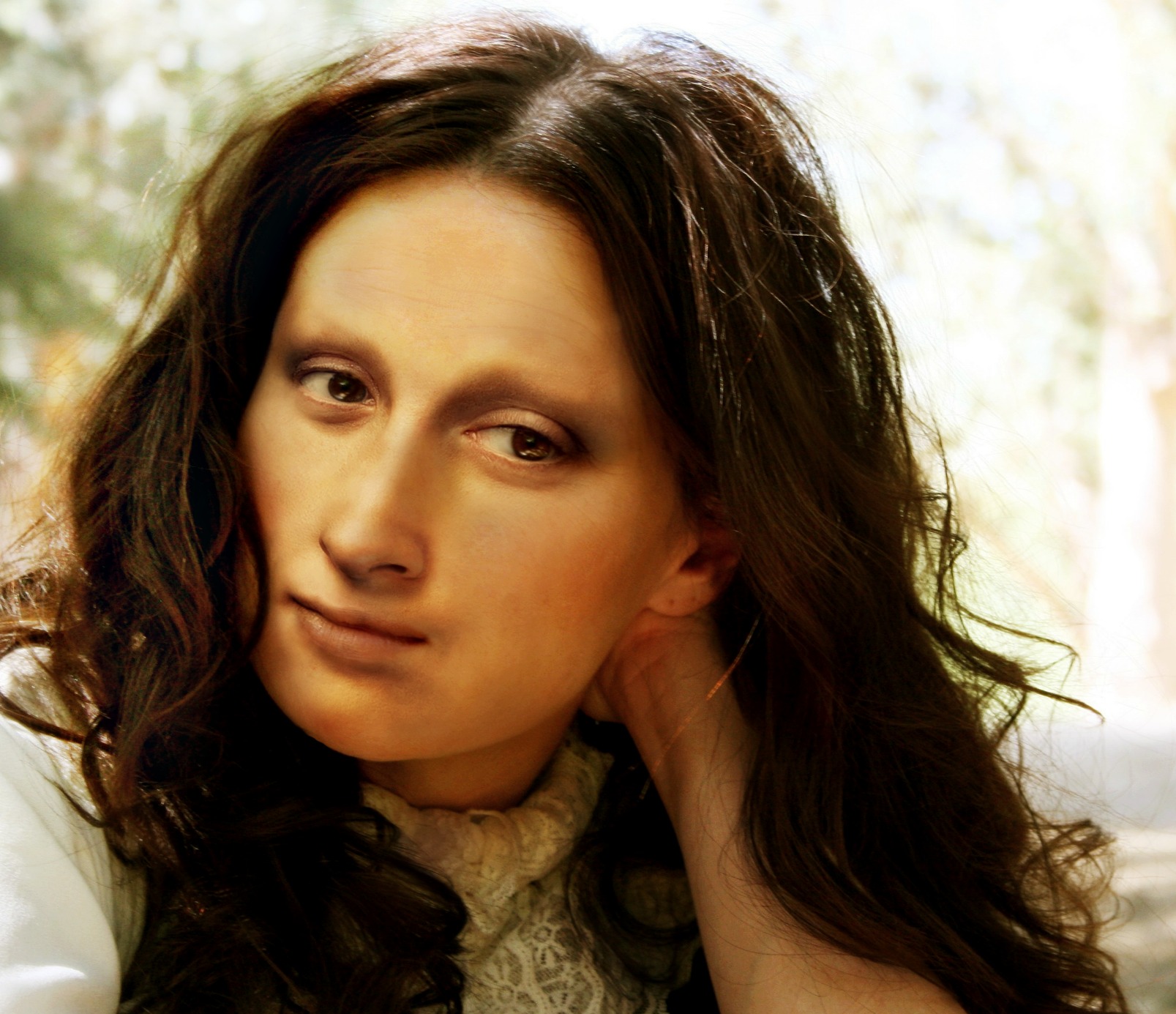 |
| Revisioning drawing of Lisa del Giocondo |
Lisa del Giocondo
Lisa del Giocondo (née Gherardini; June 15, 1479 – July 15, 1542) was an Italian noblewoman and member of the Gherardini family of Florence and Tuscany. Her name was given to the Mona Lisa, her portrait commissioned by her husband and painted by Leonardo da Vinci during the Italian Renaissance.
Little is known about Lisa's life. Born in Florence and married in her teens to a cloth and silk merchant who later became a local official, she was a mother to five children and led what is thought to have been a comfortable and ordinary middle-class life. Lisa outlived her husband, who was considerably her senior.
Centuries after Lisa's death, the Mona Lisa became the world's most famous painting and took on a life separate from Lisa, the woman. Speculation by scholars and hobbyists made the work of art a globally recognized icon and an object of commercialization. In 2005, Lisa was definitively identified as the model for the Mona Lisa.
************
'Dark family history behind Mona Lisa's sad smile revealed in new book'
'Leonardo da Vinci never finished the Mona Lisa because he injured his arm while fainting, experts say'
*************************
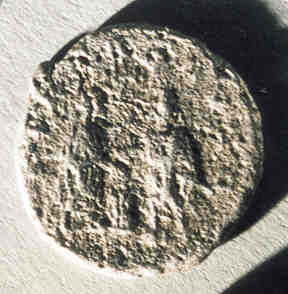
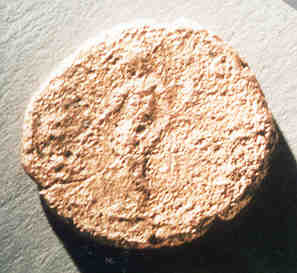
Roman coins from Breathitt County, Kentucky
The above three coins were found in a cave shelter in Breathitt County, Kentucky, by Mr. Michael Wayne Griffith of the same county. Mr. Griffith has found another 9 or so similar coins, but the three depicted are the best preserved of the group.
A few years ago the three depicted were examined hands-on by Norman Totten, Professor of History, now Emeritus, at Bentley College. Totten identified the two thinner coins (the top two above) as antoniniani, a type of bronze Roman coin minted between 238 and 305 A.D. The obverses (left photos) depict an unidentifiable emperor wearing the distinctive "solar crown" of the period. The reverse of the top one, in the right photo, depicts two figures standing facing what apparently is a central altar, while that of the middle one depicts a female standing figure facing left with a cornucopia in her right hand.
These would originally have had a silver surface, long since gone. The third coin is thicker, and depicts a bust facing right, wearing a laureate wreath rather than a crown. The reverse, according to Totten, is perhaps a figure of a centaur walking to the right and looking back. Its flan (the metal disk from which coin is made) seems to be of a North African (Egyptian) or Middle Eastern type. This coin probably dates to a similar period to that of the two antoniniani (singular antoninianus). While Totten is confident that the coins are genuine, he warns that such coins are easy to obtain from coin dealers.
In 1963, a small hoard of Roman coins from the same approximate period, and in a much better state of preservation, was found during bridge construction on the north bank of the Ohio River, at the Falls of the Ohio, opposite Louisville, Kentucky.
Breathitt Co., population 16,100 in 2000, is on the upper Kentucky River, in the southeastern portion of the state. The county seat is Jackson, pop. 2,490. Two of the larger towns are named Quicksand and Lost Creek, but the 2000 U.S. Census couldn't find either. The nearest metropolis is Hazard (which may or may not be the inspiration for the "Dukes of Hazzard" TV series), pop. 4,806, and one county to the south.
Mr. Griffith is difficult to contact, but is known to Mr. David Feldman, President of Feldman Lumber Co. in Lancaster, Ky.
The author wishes to thank Prof. Norman Totten, Dr. John Payne, of Berea, Ky., and Mr. David Feldman of Lancaster, Ky., for their invaluable assistance.
************
Roman Head from Calixtlahuaca, Mexico
Roman coins from the Falls of the Ohio River, Indiana
Roman shipwreck near Rio de Janeiro, Brazil
*************************
Gianfranco Rosi vs Duane Thomas 03-01-1988
Boxing Syko
WBC World Super Welterweight Title Fight
Venue: Palazzo Dello Sport, Genoa, Liguria, Italy
************
Gianfranco Rosi
Gianfranco Rosi (born 5 August 1957) retired Italian boxer who was a two-time world champion in the light-middleweight division.
Professional career
Rosi turned pro in 1979 and won the WBC light-middleweight title in 1987 by decisioning Lupe Aquino. He lost the belt in 1988 when he was dominated by Donald Curry. Rosi was down once in 2nd, 4th and 8th and down twice in 7th, failing to answer the bell starting the 10th round.
In 1989 he won the IBF light-middleweight title by outpointing the undefeated Darrin Van Horn. He went on to successfully defend the title an impressive 11 times. In 1994 he had a technical draw against Vincent Pettway, and in the rematch later that year Pettway KO'd Rosi, ending his long reign.
In 1995 he took on WBO light-middleweight title holder Verno Phillips and won a decision, but Rosi failed a drug test and Phillips was reinstated as champion. The result of the bout was changed to a No Contest. In 1997 he lost a rematch to Phillips and retired.
In 2003 he came out of retirement, and finally retired in 2006 at the age of 49 with a pro record of 62 wins (18 KOs), 6 losses, and 1 draw.
Amateur career
Rosi had a record of 94 wins - 2 losses - 4 draws Highlights:
1976 Italian Light-Welterweight Champion
1977 Italian Welterweight Champion
************
Born in Assisi in the province of Perugia (Umbria), Gianfranco Rosi took a 32-1 record into a European Welterweight Championship bout in 1984 with future world welterweight champion Lloyd Honeyghan from the UK. Rosi lost his first big bout, but won his next nine--including winning the European Junior Middleweight title and defending it twice--and took a 41-2 record into a bout with world champion Luge Aquino of Mexico, a much more dangerous opponent than Honeyghan. Rosi won a unanimous decision to take the belt.
There were so many outstanding boxers worldwide in the 80s, especially between 147 and 160 pounds. Next he defended the belt against another very hard punching boxer, former champion Duane Thomas of Detroit, winning by knockout. Although he lost in his next defense against former welterweight champion Donald Curry, he eventually won the world title back and defended it eleven times before losing.
*************************
The Discovery and Restoration of Leonardo da Vinci's Long-Lost Painting "Salvator Mundi" | Robb Report
Robb Report
Leonardo da Vinci is one of history's greatest artists and thinkers. Only about 15 of his paintings are known to exist and one was thought to be lost forever. Leonard painted that masterpiece, called "Salvator Mundi" (Savior of the World) around 1500. It was owned by no less than three kings and, in 1763, it disappeared. This video tells the story of that incredible painting, how it was rediscovered in 2005, and what happened when it went to auction at Christie's in November 2017.
READ MORE: http://bit.ly/LostDaVinci
Secret Histories of Rare Treasures spotlights the stories behind items that amaze historians, elude collectors, and intrigue audiences. Through original and never-before-seen footage, in-depth archival research, and expert interviews, Robb Report brings these awe-inspiring narratives to life. Developed in coordination with Robb Report’s editors and produced by the brand’s in-house custom-content and video agency Robb Report Studio, the editorial series explores the hidden lives of extremely rare and amazingly valuable items often found in the pages of Robb Report.
Subscribe to Robb Report: https://bit.ly/2rx0Icw
CONNECT WITH ROBB REPORT
Web: http://robbreport.com
Facebook: https://www.facebook.com/robbreport
Twitter: https://www.facebook.com/robbreport
Instagram: https://www.instagram.com/robbreport
Pinterest: https://www.pinterest.com/robbreport
.
*************************
[This portion was originally from the CCNA blog - entitled 'Disciplina Etrusca' by Voltumna - May 31, 2015]
This band named itself after the supreme god of the Etruscan pantheon, "Voltumna" (also called "Veltha"), which I just covered a bit on the other blog ('Etruscan women, mythology, and the god Veltha'). Black Metal music is a lot like the old Heavy Metal music in that some of it is truly good, while most you would probably have to really like the genre to appreciate. This particular song wouldn't be my first choice to promote, but I love the theme! The 'Disciplina Etrusca' was the text of ancient Etruscan polytheism, which was made up of the three "books of fate."
Beyond the larger Black Metal genre, are the sub-genres of "Celtic Black Metal," "Viking Black Metal," etc., etc. One thing this music offers is a clear link to folk-identity, in this case "Etruscan Black Metal." The band's lyrical theme is defined as "Etruscan Paganism, Mythology, Modern Decay"; and it's genre as Black/Death Metal. This additionally suggests a type of Gothic element to it. Dark symbolism can be beautiful, and could be an outlet for people, primarily younger people, who feel alienated by society.
This song is brand new; just released today in fact. The band is from Viterbo, Latium, and has been around since 2009. Viterbo was one of the city-states of the Etruscan civilization. In a Western society which makes a special point to squash identity (individual and collective), I think it's great that people can turn to their ancestors for inspiration and strength. It's not just Black Folk Metal, but there are many other genres which are folk-oriented in this manner. I mean something a little beyond a band merely playing folk music from a certain culture. There's often a rebel-aspect to it.

I like music of just about every texture and harmony, but I don't like "sad music." There are enough things in this life to be sad or depressed about; especially when we lose people. Something inspirational is great, especially when there's that blood-folk connection with a spiritual tie-in. Black Metal is almost like fighting music. Perhaps we need some of that in our lives, because often life is a war. Evolutionary struggle.
Voltumna official website
Voltumna YouTube channel
Metal-Archives.com band profile
Voltumna facebook (official; in Italian mostly)
Voltumna facebook (in English)
.
Saturday, April 27, 2019
What did Leonardo da Vinci's "Last Supper" really look like?
What did Leonardo da Vinci's "Last Supper" really look like? | DW Documentary
Published on Apr 18, 2019
384,688 views
DW Documentary
Leonardo's famous painting "The Last Supper" hides a secret: only 20 percent of the original work is still visible.
In the style of a thriller, the documentary attempts to reconstruct what it originally looked like. Leonardo da Vinci was the epitome of the Renaissance Man. May 2019 marks the 500th anniversary of his death. The artist created world-famous works such as the fresco "The Last Supper" - perhaps the most famous. It is still in its original setting, on the wall of the dining room of the former Dominican convent of Santa Maria delle Grazie in Milan.
The painting, which is 4.60 meters high and 8.80 meters wide, has been undergoing restoration for the last 19 years. But the restorers now know that only 20 percent of the original is visible today. So what did something that is the focus of so many legends originally look like? Our investigation also takes us to the small Belgian abbey of Tongerlo, where a mysterious copy of da Vinci's work has been discovered. It is a painting on canvas that could have been commissioned from da Vinci’s workshop by the French King Louis XII. It has perhaps brought the researchers a step closer to the truth.
.
Friday, February 16, 2018
"Italia and Germania" (1828)
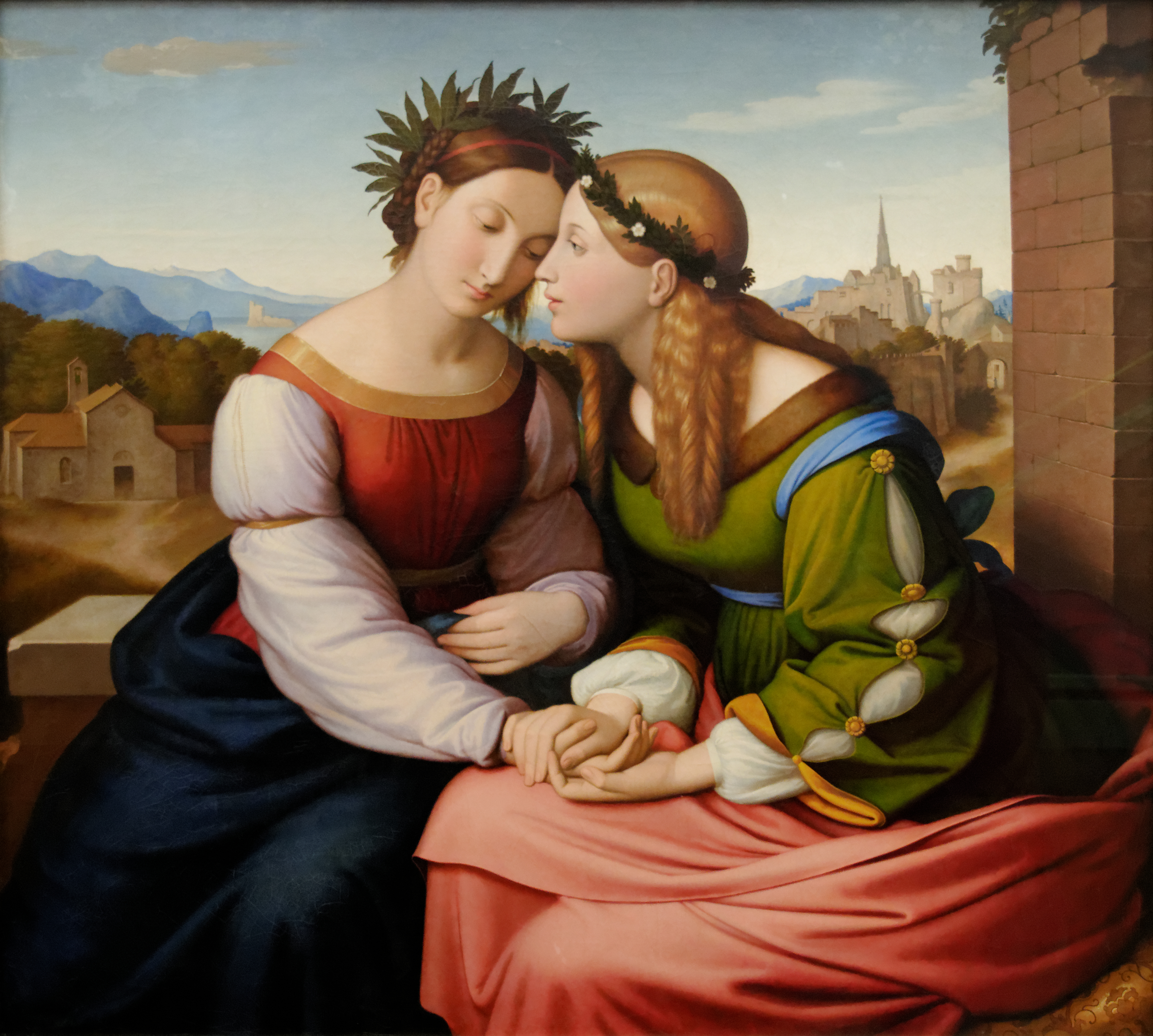
Reddit: "Italia and Germania"
Italia und Germania (1828) by Friedrich Overbeck. The two girls are personifications of the countries and symbolise their common heritage and friendship.
Here in Italy there's an adage:
Italians hold Germans in high regard, but don't love them; Germans love Italians but don't hold them in high regard.
Just pointing out the Italian landscape to the left and the German Gothic town to the right.
I love how , when you have pictures of German women in Art, there hair is often braided and Italian women have their hair tied with leaves.
well, the leaves are usually laurel leaves, the plant used in classical antiquity to crown athletes, writers, and so on. It just works as a reminder of our classical past
*************************
I like Germania and Austria more
[Not my comment, but I thought it made for an interesting concept in its own right]

*************************
Is it a coincidence that each one's clothes hint at the other's flag? The green-white-red color scheme was already in use in Italy at the time, not sure about Germany.
Both nations were struggling to create their own state at the time. If anything, it represents nationalism.
Friedrich Overbeck, the painter did want to express both heritage and friendship between these cultural spheres and their common wish for unity.
Italy and Germany have always been very similar (except culturally) in their history (divided politically, then unification, WWII...), and economically (east/west, north/south divide), well at least until not that long ago.
Nah, at that time Italy and Germany weren't countries, but a bunch of small loosely knit duchies, free cities, princedoms, republics, bishoprics and what not. That was also the time that nationalism and a national consciousness was being formed. So this picture, among other things, is supposed to be a fairly nationalistic one. So, if anything, EU is against nationalism and for a more supranational approach to things.
'Italy and Germany: A peaceful meeting of opposites'
Rosemarie Fruehauf - TheEpochTimes.com - December 5, 2010
It is a meeting of dark and bright, yin and yang, of introvert and extrovert. The harmony of this painting is so compelling because it shows a peaceful connection of opposites, a talk between two different realms and approaches toward life.
Leave everything aside—German stereotypes, Italian stereotypes, and the story of the Nazarene movement—and you are looking at a timeless painting about friendship.
The Nazarenes
The two ladies, Italia and Germania, in the painting by Johann Friedrich Overbeck, (1789–1869) represent two ideals of art: the art of the early Italian Renaissance as found in the young Raphael, and the German late-Middle Ages paintings like those of Albrecht Dürer. These were the ideals the painter Overbeck venerated and from which he drew his artistic inspiration.
The two girls can also be seen as symbolizing the church and the state. Overbeck and his artist friends of the Nazarene movement postulated that the partners of art should be the church and the state, a view that was regarded as old fashioned and reactionary in a time when art suddenly had to search for reasons to validate its existence.
The industrial revolution was dawning, and both the bourgeoisie and artists were growing ever more independent. In these days at the brink of the 19th century, Overbeck and some fellow students of the Academy of Vienna were dissatisfied with the lack of heart and soul in the prevalent Neoclassicism and with the conventional art education in the academy system.
In the meetings and discussions they held in a loose circle from 1808, they found their Christian ideals manifesting in the earlier European art. Four of them, including Overbeck, left the academy in 1810 and traveled to Rome. In Italy, they hoped to live a life in the way of the old, “true” artists. Making an impact in Rome. They called themselves the “Brotherhood of St. Luke” (St. Luke is the patron saint of painters) and after occupying the abandoned monastery of San Isidoro, conducted a quasi-monastic life, dedicated to praying and painting.
Soon they became known among their detractors as well as supporters by the quizzical nickname “Nazareni” (for their long-haired, biblical appearance) and were joined by other like-minded personalities. The greatest achievement of the group was the reviving of the old fresco technique that had almost been forgotten.
With two major commissions, the wall paintings of Casa Bartholdy and the Casino Massimo in Rome, they could establish an international reputation. By 1830, all the Nazarenes had returned to Germany, where many of them became acclaimed teachers and chairmen of art academies.
Overbeck, as the figurehead of the movement, rejected all offers and stayed in Rome, where he lived his dream until his death in 1869. Though admired by fans and followers, he was ridiculed by his more practical-minded contemporaries.
The Nazarenes were disillusioned over the rationalism of the enlightenment movement that had discredited itself in the terror of the French Revolution.
They preferred a society based on belief. That is why they saw the Middle Ages in a very positive light. With its simplicity and honesty, the Middle Ages became their favorite period of history.
“Italia und Germania” was especially seen as the Nazarenes’ programmatic painting, as it extols the two branches they considered to be the highest ideals of art—the early Italian Renaissance in the spiritual and introverted Madonna-like figure, together with the natural, yet proud German Middle Ages artistry represented by the blond girl.
The Nazarenes were the first art movement in a modern sense—a group of people who met to formulate an ideology of what art should be like and then worked for it. This painting exemplifies and convincingly broadcasts what they sought in art. The painting works perfectly in iconography, technique, and compositional style. Here, their dream and message is given a shape.
The Painting
The painting becomes more meaningful and beautiful the longer one looks at it. Its clear and simple coloring, supported by the stunningly smooth surface, which hardly shows a brush stroke, attracts one’s eyes naturally.
The girls are in the midst of an intimate talk. They seem to be very close, peacefully and lovingly connected. This comes mainly through the composition, as there are a lot of oval forms, which echo each other.
There is the big oval going from their shoulders to their arms and conjoined hands. There are also the ovals of the necklines that Overbeck made the same size, the similarities in the dresses, like the belts and white sleeves of their blouses as well as the floral wreaths corresponding to each other. The pink wrap that drapes the lower part of Germania’s body with its soft pleats frames and emphasizes this big oval dynamic of the setting.
It looks like a religious painting on first glance due to the strong triangular composition in which the two figures are rendered. This is what we have seen in countless saintly images, especially in the Raphael Madonna paintings. The two figures become like saints.
As in Renaissance art, Italia and Germania fill the well-balanced format, and the landscape becomes secondary. With its humble green and blues, it just illustrates a surrounding. Details tell us about the ladies’ identities: Italian architecture and the Mediterranean sea feature the background of Italia; a Gothic city and the Alps decorate Germania’s side.
Sacred Friendship
Their friendship is idealized and made sacred in the way Overbeck depicts the girls because of the harmony, dignity, and quietude of the composition. Their strongly idealized faces cannot count as portraits. Their skin is amazingly white, shimmering like porcelain. Yet this seems to be more than just a conceptual work, as it features a very natural and human conversation.
Although the two are connected, they are independent of each other; their eyes do not meet. They are conjoined by their hands, the compositional triangle shape, and multiple round forms. Each woman has her own personality and emotional quality that goes beyond the idealized portrayal. As a profile portrait, there is almost breezy cuteness in the way the blond Germania stretches her nose in the air. The blooming floral wreath comes across as extroverted and friendly. Its blooms are repeated as golden buttons on her sleeve. She leans toward the dark-haired one and holds both her hands around the others hand. She’s obviously talking to her. Some feel that she’s comforting her friend.
The image of the dark-haired Italia, with its classical three-quarter perspective and the red and blue garments she’s wearing, repeats countless Madonna portrayals. We perceive her to be introverted and almost melancholic as she holds one of her hands in front of her body as if protecting herself. She looks humbly down to the ground while her blond companion curiously looks into the landscape while talking.
The dark lady’s dress is in comparison much simpler; there are no ornaments on it. The laurel wreath she wears is the only thing that gives an idea of her Mediterranean origin and adds a little peculiarity to an otherwise perfect image of Mary.
The two become a symbol for the possible union of opposites and a peaceful dialogue of different temperaments.
.
Saturday, March 4, 2017
Artsy.net - Making all the world’s art accessible to anyone

"....our mission to make all the world’s art accessible to anyone. We hope to continue promoting arts education and accessibility with your help.
"The Museo Thyssen-Bournemisza is currently exhibiting "Masterworks from Budapest: From the Renaissance to the Avant-Garde", which features Leonardo Da Vinci. As such, we would like to take the opportunity to now promote his work. Our hope is that the timing of this outreach will effectively support both the Museum and Da Vinci.
"Our Leonardo Da Vinci page provides visitors with Da Vinci's bio, over 15 of his works, exclusive articles, and up-to-date Da Vinci exhibition listings. The page also includes related artists and categories, allowing viewers to discover art beyond our Da Vinci page. We would love to be included as an additional resource for your visitors via a link on your page. We believe that by spreading access we can provide a new, empowering way for approaching art. If you are able to add a link to our Leonardo Da Vinci page, please let me know. Thanks in advance for your consideration!
Thank you,
Alonzo
"Art is never finished, only abandoned"
-- Leonardo Da Vinci
.
Tuesday, November 8, 2016
San Francisco's new Salesforce Tower to be the secend tallest building west of the Mississippi - Part 2

History
Developer Hines, with a proposal by architect César Pelli, was selected as the winner of a global competition in 2007 to entitle and purchase the site. A seven-member jury of development experts assembled by the Transbay Joint Powers Authority (TJPA) selected Hines over proposals from Forest City Enterprises and architect Richard Rogers; and from Rockefeller Development Group Corp. and Skidmore Owings & Merrill. In 2012, Boston Properties acquired a 50% stake in the project and in 2013 acquired most of Hines' remaining interest to become 95% owners of the project.
The site of the tower was in a dilapidated area, formerly used as a ground-level entrance to the San Francisco Transbay Terminal, which was demolished in 2011. The TJPA sold the parcel to Boston Properties and Hines for US$192 million, and ceremonial groundbreaking for the new tower occurred on March 27, 2013. Actual below-grade construction work started in late 2013. The general contractor on the project is a joint venture between Clark Construction and Hathaway Dinwiddie Construction.
 |
| César Pelli - Argentine-American of Cisalpine descent |
The tower is expected to be completed in 2018 and will have 61 floors, with a decorative crown reaching 1,070 ft (326 m). The original proposal called for a 1,200-foot (370 m) tower, but the height was later reduced. It will be the tallest building in San Francisco, surpassing the Transamerica Pyramid by more than 200 feet (61 m). The tower is expected to become the second tallest building in the Western United States. The tower is expected to be completed in 2018 and will have 61 floors, with a decorative crown reaching 1,070 ft (326 m). The original proposal called for a 1,200-foot (370 m) tower, but the height was later reduced. It will be the tallest building in San Francisco, surpassing the Transamerica Pyramid by more than 200 feet (61 m). The tower is expected to become the second tallest building in the Western United States.
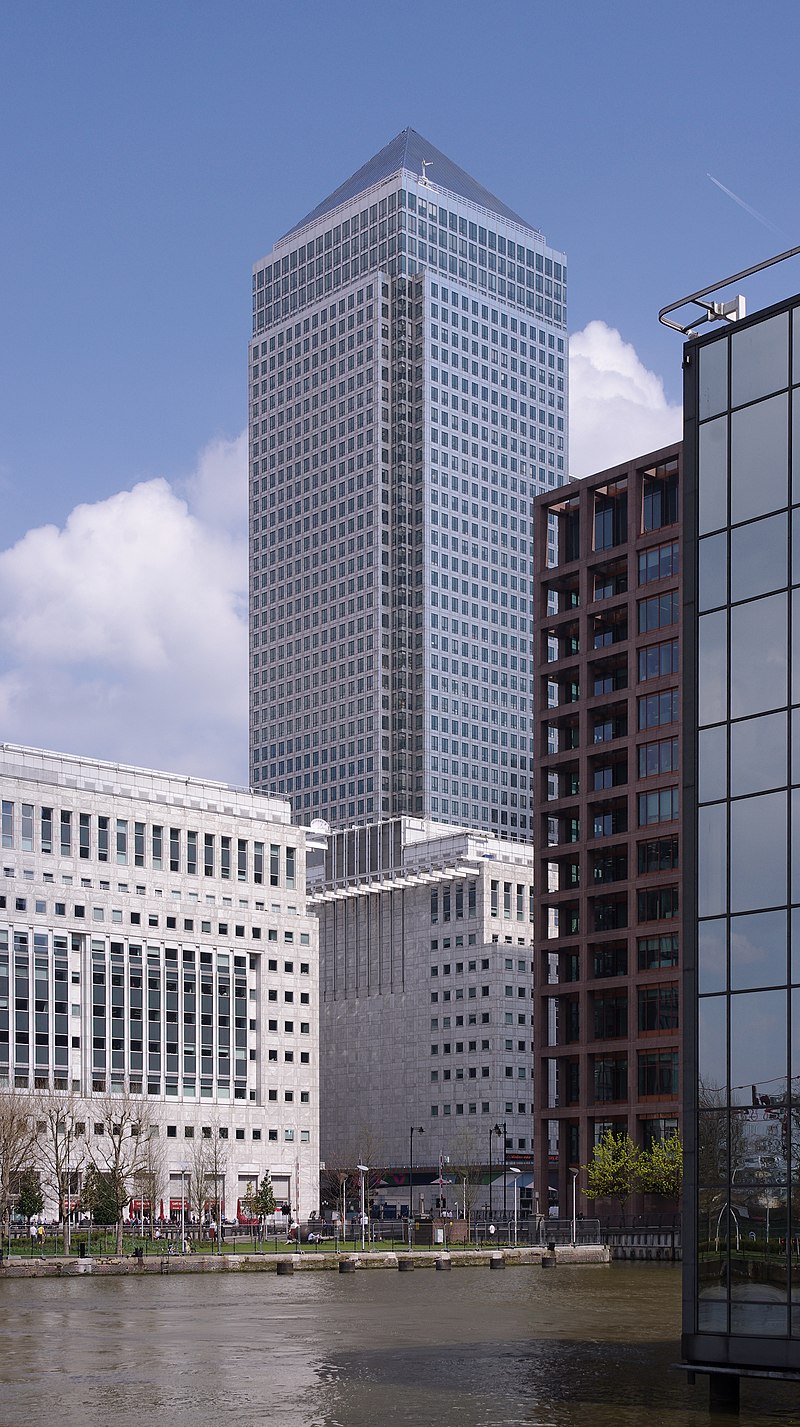 |
| One Canada Square, London |
This list of works by César Pelli categorizes the architect's work. Pelli has established an extremely prolific career in the span of four decades, and has designed some of the tallest buildings in the world. The following are some of his major constructions:
Completed
1966: Worldway Postal Center, Los Angeles International Airport
1967: Kukui Gardens housing, Honolulu, Hawaii
1969: San Bernardino City Hall, San Bernardino, California
1969: Century City Medical Plaza, Century City, Los Angeles, with architect Anthony J. Lumsden.
1972: US Embassy in Tokyo, Japan
1973: Commons Centre and Mall, Columbus, Indiana
1973: Eaton's Department Store, Vancouver, British Columbia, Canada
1975: Pacific Design Center, Los Angeles
1977: Wintergarden Arboretum, Niagara Falls, New York, USA (demolished in 2009)
1981–1987: World Financial Center, New York City, New York, USA
1982–1984: Herring Hall at Rice University, Houston, Texas
1984: Residential Tower atop the Museum of Modern Art (MoMA), New York City
1984–1986: Cleveland Clinic, Cleveland, Ohio, USA
1984: Mattatuck Museum Arts and History Center renovation, Waterbury, Connecticut
1987: Blumenthal Performing Arts Center, Charlotte, North Carolina
1987–1990: Carnegie Hall Tower, New York City, New York, USA
1987-89: Maryland Residence, Bethesda, Maryland, USA
1987–1991: One Canada Square, Canary Wharf, London, England, UK
1988: Wells Fargo Center (formerly Norwest Center), Minneapolis, Minnesota
1989: Gaviidae Common, Minneapolis, Minnesota
1990: Nippon Telegraph and Telephone Headquarters, Tokyo, Japan
1990: Roy Nutt Mathematics, Engineering & Computer Science Center at Trinity College, Hartford, Connecticut
1990: 181 West Madison Street, Chicago
A 50-story skyscraper thought to be inspired by Saarinen's second place entry in Chicago's Tribune Tower competition
1991: Key Tower, Cleveland, Ohio, USA
1991: 777 Tower, Los Angeles, California
1991: Frances Lehman Loeb Art Center at Vassar College, Poughkeepsie, New York
1992: Bank of America Corporate Center, Charlotte, North Carolina
1992: Plaza Tower, Costa Mesa, California
1993: Worrell Professional Center, Wake Forest University School of Law, Winston-Salem, North Carolina
 |
| Cajasol Tower, Spain |
1995: Aronoff Center for Performing Arts, Cincinnati, Ohio
1995: 100 North Main Street (formerly Wachovia Center), Winston-Salem, North Carolina
1996: Edificio República, Buenos Aires, Argentina
1996: Residencial del Bosque, Mexico City, Mexico
1996: Owens Corning World Headquarters, Toledo, Ohio, USA
1997: Expansion of Washington National Airport, Washington, D.C.
1998: Overture Center, Madison, Wisconsin
1998: Petronas Twin Towers, Kuala Lumpur, Malaysia
1998: Schuster Center, Dayton, Ohio, USA
1999: Cheung Kong Center, Hong Kong
1999: Zurich tower office building in The Hague, Netherlands
2000: Kurayoshi Park Square, Kurayoshi, Japan
2000: Boston Bank Building, Buenos Aires, Argentina
2000: KABC-TV, Los Angeles, California
2001: Citigroup Centre, 25 Canada Square, Canary Wharf, London
2001: Bucksbaum Center for the Arts at Grinnell College, Grinnell, Iowa
2001: Athletic and Fitness Center at Grinnell College, Grinnell, Iowa
2001: The Investment Building, Washington, D.C.
2002: JP MorganChase Building, San Francisco
2002: Weber Music Hall at University of Minnesota Duluth, Duluth, Minnesota
2002: Former Enron Headquarters at 1500 Louisiana Street, Houston
2003: Gerald Ratner Athletics Center at University of Chicago, Chicago, Illinois
2003: Two International Finance Centre, Hong Kong
2003: Center for Drama and Film & the Martel Theater at Vassar College, Poughkeepsie, New York
2003: 25 Bank Street, Canary Wharf, Docklands, London
2003: 40 Bank Street, Canary Wharf, Docklands, London
2003: Benjamin & Mariam Schuster Performing Arts Center, Dayton, Ohio
2004: Goldman Sachs Tower, Jersey City, New Jersey
2004 Campus University Siglo 21, Córdoba, Argentina
 |
| Kurajoshi Park Square, Japan |
2005: Malone Engineering Center, Yale University, New Haven, Connecticut
2006: Theodore Roosevelt Federal Building Eastern District Courthouse, Brooklyn, New York
2006: Science and Engineering Research and Classroom Complex at University of Houston, Houston
2006: Minneapolis Public Library's Central branch, Minneapolis
2006: Joe Rosenfield '25 Center, Grinnell College, Grinnell, Iowa
2006: Renée and Henry Segerstrom Concert Hall, Segerstrom Center For The Arts, Orange County Performing Arts Center, Costa Mesa, California
2006: Thomas E. Golden Jr. Center, St. Thomas More Catholic Chapel and Center, Yale University, New Haven, Connecticut
2006: Adrienne Arsht Center for the Performing Arts, Miami
2006: Madison Museum of Contemporary Art, Madison, Wisconsin
2008: BOK Center, Tulsa, Oklahoma
2008: One Park West, Liverpool, England
2008: Torre de Cristal, Madrid, Spain
2008: Repsol-YPF Building, Buenos Aires, Argentina
2008: St. Regis Residences and Hotel, Mexico City, Mexico
2008: Business Instructional Facility, University of Illinois at Urbana–Champaign, Illinois
2009: Cooperative Arts and Humanities High School, New Haven, Connecticut
2009: Connecticut Science Center, Hartford, Connecticut
2009: Aria Resort and Casino, the central feature of CityCenter, Las Vegas
2010: Shanghai IFC, Pudong, sister project of Two International Finance Centre in Hong Kong
2010: Torre Mesoamericana, Tuxtla Gutiérrez, Mexico
2011: New Airport Terminal Building (Phase 1), Winnipeg James Armstrong Richardson International Airport, Winnipeg, Canada
2011: Iberdrola Tower, office building, Bilbao, Spain
2013: The Landmark, Abu Dhabi, United Arab Emirates
2013: The Theatre School, DePaul University, Chicago
2015: Cameron and Edward Lanphier Center, Choate Rosemary Hall, Wallingford, Connecticut
.
Monday, November 7, 2016
San Francisco's new Salesforce Tower to be the secend tallest building west of the Mississippi - Part 1

Salesforce Tower
Salesforce Tower, formerly known as the Transbay Tower, is a 1,070 ft (326 m) supertall office skyscraper under construction in the South of Market district of downtown San Francisco. Located at 415 Mission Street between First and Fremont Streets, next to the Transbay Transit Center site, Salesforce Tower is the centerpiece of the San Francisco Transbay redevelopment plan that contains a mix of office, transportation, retail, and residential uses. When completed, the tower will be the tallest in San Francisco and a defining building in the burgeoning South of Market area. With a top roof height of 970 feet (300 m) and an overall height of 1,070 feet (330 m), it will be the second tallest building west of the Mississippi River after the Wilshire Grand Center in Los Angeles.
 |
| Cira Centre, Philadelphia |
Born: October 12, 1926 (age 90)
San Miguel de Tucumán, Argentina
Nationality: Argentine – United States citizen
Occupation: Architect
Awards: Doctor of Arts, CTBUH Skyscraper Award, The Lynn S. Beedle Lifetime Achievement Award
Practice: Pelli Clarke Pelli
Design: Metallic, art deco-influenced buildings
Buildings
Petronas Towers, Kuala Lumpur
Key Tower, Cleveland
Cira Centre, Philadelphia
30 Hudson Street, Jersey City
1 Canada Square, London
Riverview Plaza, Wuhan
 |
| Pelli in 2010 |
Personal life
After studying architecture at the Universidad Nacional de Tucumán, Pelli completed his studies at the School of Architecture at the University of Illinois at Urbana-Champaign. He started his career in the New Haven offices of architect Eero Saarinen.
He emigrated to the United States in 1952 and became a naturalized U.S. citizen in 1964. He married Diana Balmori, a landscape and urban designer. They have two children: Denis, a neurobiologist and Professor of Psychology and Neural Science at New York University and Rafael Pelli, also well-known architect.
Pelli served as dean of the School of Architecture at Yale University from 1977 to 1984. His firm employs about 100 architects, designers, and support staff in New Haven, Connecticut.
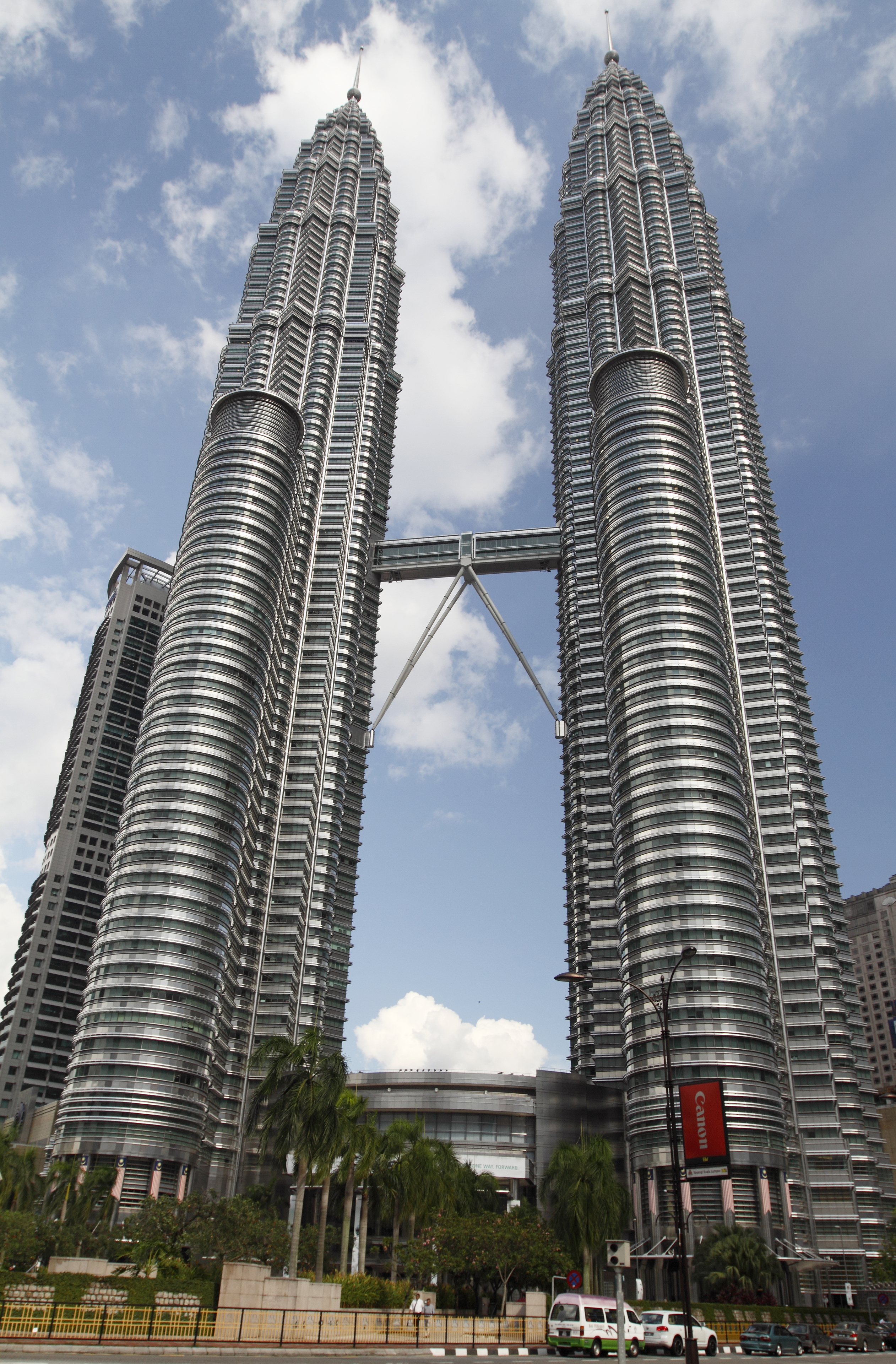 |
| Petronas Towers, Malaysia |
In 2004, his famous work Petronas Towers of Kuala Lumpur received the Aga Khan Award.
On May 15, 2004 the University of Minnesota Duluth awarded Pelli an honorary Doctorate of Humane Letters.
On May 26, 2008, Yale University bestowed an honorary Doctor of Arts degree to Pelli for his work in architecture.
He received the The Lynn S. Beedle Lifetime Achievement Award from the Council on Tall Buildings and Urban Habitat in 2008 to honor his work in the field of tall buildings.
In 2012, Konex Foundation from Argentina, granted him the Diamond Konex Award for Visual Arts as the most important artist in the last decade in his country.
Career
Works
Project Designer, Eero Saarinen
TWA Terminal Building, John F. Kennedy International Airport, New York
City, New York
Morse College & Ezra Stiles College, Yale University
Director of Design at Daniel, Mann, Johnson & Mendenhall, Los Angeles, California
COMSAT Laboratories, in Clarksburg, Maryland, 1967–1968 (with landscape
architect Lester Collins)
Partner, Gruen Associates, Los Angeles, 1968–1976
Cesar Pelli and Associates, 1977, currently known as Pelli, Clarke, Pelli, Architects
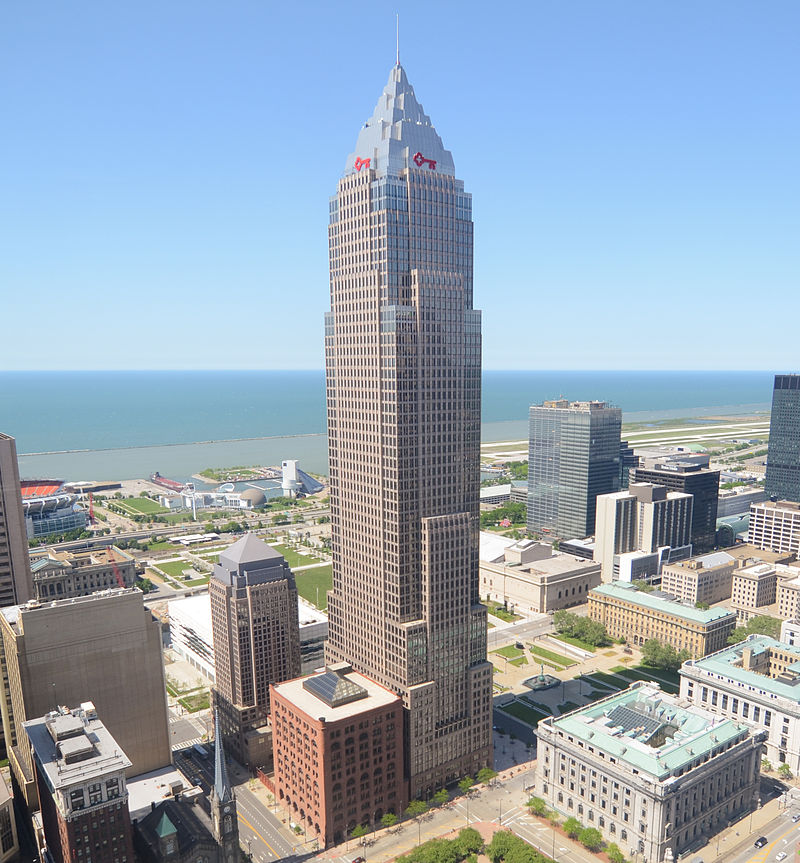 |
| Key Tower, Cleveland |
1982: "Skyscrapers," Perspecta 18, pp. 134–151.
1984: Introduction to The Second Generation by Esther McCoy (Peregrine Smith Books)
1999: Observations for Young Architects (Monacelli Press)
2002: Foreword to Ralph Rapson: Sketches and Drawings from Around the World by Ralph Rapson (Afton Historical Society Press)
External links
Pelli Clarke Pelli Architects
.
Sunday, April 24, 2016
Rosa Feola and Fabio Centanni - American debut at SF's Herbst Theatre on May 6
Rosa Feola - TOSTI Non t'amo più
Rosenblatt Recitals
London 09.01.14 - On this evening Italian soprano Rosa Feola performed songs and arias by Giménez, Bizet, Villa-Lobos, Gounod, Rossini, Tosti, Donizetti, Verdi and Gastaldon, accompanied by Iain Burnside.
************
See Performances.org for details
Rosa Feola - Soprano
Fabio Centanni - Piano
US Recital Debut
Fri May 6 - 7:30 PM
Herbst Theatre
************
Artist Change
Rosa Feola and Fabio Centanni replace Anna Caterina Antonacci and Donald Sulzen who are unable to perform as scheduled.
San Francisco Performances’ Vocal Series is made possible, in part, by a generous grant from The Bernard Osher Foundation.
US Recital Debut
Friday, May 6, 2016
7:30pm
Herbst Theatre
$65/$55/$40
************
“London likes to think it lies at the centre of the musical universe, but many great singers had relatively small careers here and most of today’s up-and-coming stars make their names elsewhere. No one fits that description better than the Italian lyric soprano Rosa Feola…the key to Feola’s artistic personality is not just her vocal prowess: what counts is that she never gives less than a performance. ”
-- Financial Times (Five Star Review)
************
About This Performance
Known for her sparkling soprano and gifts as an actress on both the concert platform and opera stage, she regularly collaborates with conductors such as Riccardo Muti and gives recitals internationally. Her strengths are many, including her natural timbre, flawless technique, and abundance of self-confidence, enough to hold the stage on her own—without a score. Feola’s San Francisco recital program brings together Italian songs that magnify the natural sympathy between music and poetry. In Italy this union has its own particular history, and produced some of the most beautiful—if not always well-known—settings of great Italian poets by composers such as Rossini, Donizetti, Mercadante, Verdi and Tosti. Liszt, the one non-Italian composer in the program is included for his innovative Tre Sonetti del Petrarca, a tribute to one of Italy’s greatest poets and a clear influence on Giuseppe Martucci’s Tre pezzi of 1905–6.
This performance is sponsored in part by a generous gift from Mr. and Mrs. J. Patterson McBaine.
.
Thursday, March 3, 2016
'Vergine bella' - Giovanni Pierluigi
Giovanni Pierluigi da Palestrina - Vergine bella - Bronzino
MrThesoundflyer
Palestrina, Vergine bella, from Madrigali spirituali a cinque voci on texts by Francesco Petrarca. Bronzino, paintings. ensemble officium, Wilfried Rombach, conductor.
Giovanni Pierluigi da Palestrina
Giovanni Pierluigi da Palestrina (c. 1525 – 2 February 1594) was an Italian Renaissance composer of sacred music and the best-known 16th-century representative of the Roman School of musical composition. He had a lasting influence on the development of church music, and his work has often been seen as the culmination of Renaissance polyphony.
.
Tuesday, February 23, 2016
Tribute To European Art and Architecture
Tribute To European Art and Architecture
GermanicGod's channel
Renaissance architecture and art, most of it Catholic and Cisalpine, or inspired. Below, Medieval Catalan music. Catalans are Cisalpine-like people.
trovadores! Si us quer conselh bel'ami'Alamanda...
nachosaen
.
Monday, February 22, 2016
An aerial view of Piedmont
An aerial view of Piedmont
RAI
http://www.expo.rai.it - Piedmont on the fly. From the Sacra di San Michele at the entrance of Val di Susa, up until the magnificent scenes of the Langhe and Roero countryside, which together with Monferrato have been declared World Heritage sites for their enchanting landscapes of vineyards. And then off to Turin, with the Mole Antonelliana, the architecture of the Savoys and the sumptuous royal residences. Do not miss the royal Palace of Venaria. Piedmont’s rice fields stretching as far as the eye are astonishing, as is the beautiful island of Isola Bella in the center of Lake Maggiore, which enchants us with its mysterious beauty.
.
Friday, February 19, 2016
'Conquest of Paradise' by Vangelis
Conquest Of Paradise - Vangelis
New Age Music Corner
From the soundtrack of the 1992 film '!492: Conquest of Paradise'
.
Wednesday, February 17, 2016
An aerial view of Marche
An aerial view of Marche
RAI
http://www.expo.rai.it - The Mole Vanvitelliana and the cathedral of San Ciriaco in Ancona, the ancient port of the East. Towards southwards, the Adriatic coast with the promontory of Monte Conero dropping shear into the sea. The medieval town of Sirolo and the city of Ascoli; the Sferisterio of Macerata, in whose province the Fiastra Abbey is located. Leopardi’s Recanati, the castle of Gradara and the Furlo pass. The beaches of Senigallia and those of Civitanova Marche. Fermo and the sanctuary of Loreto; Offida with its art of lace-making and Urbino, a world heritage city.
.
Wednesday, July 22, 2015
Mona Lisa "Twin" from the same studio

'The Mona Lisa's Twin Painting Discovered'
Speculations about Mona Lisa
.
Sunday, May 24, 2015
Buonconsiglio Castle in Trento

The Buonconsiglio Castle could be a lot of other castles in the Cisalpine region. It stands out a little due to it's history, size, and artistry. If you click on the above image, right-click, click view image, and click to get the full size; you can see the faces and fine detail on the upper columns. Many centuries old structures further stand out within the picturesque and colorful mountain areas, such as the Trento province.
The castle, which was constructed in the 13th century, was an important state administrative headquarters for the next five hundred years. Invading groups, such as the Austrians, occupied it as a military base.


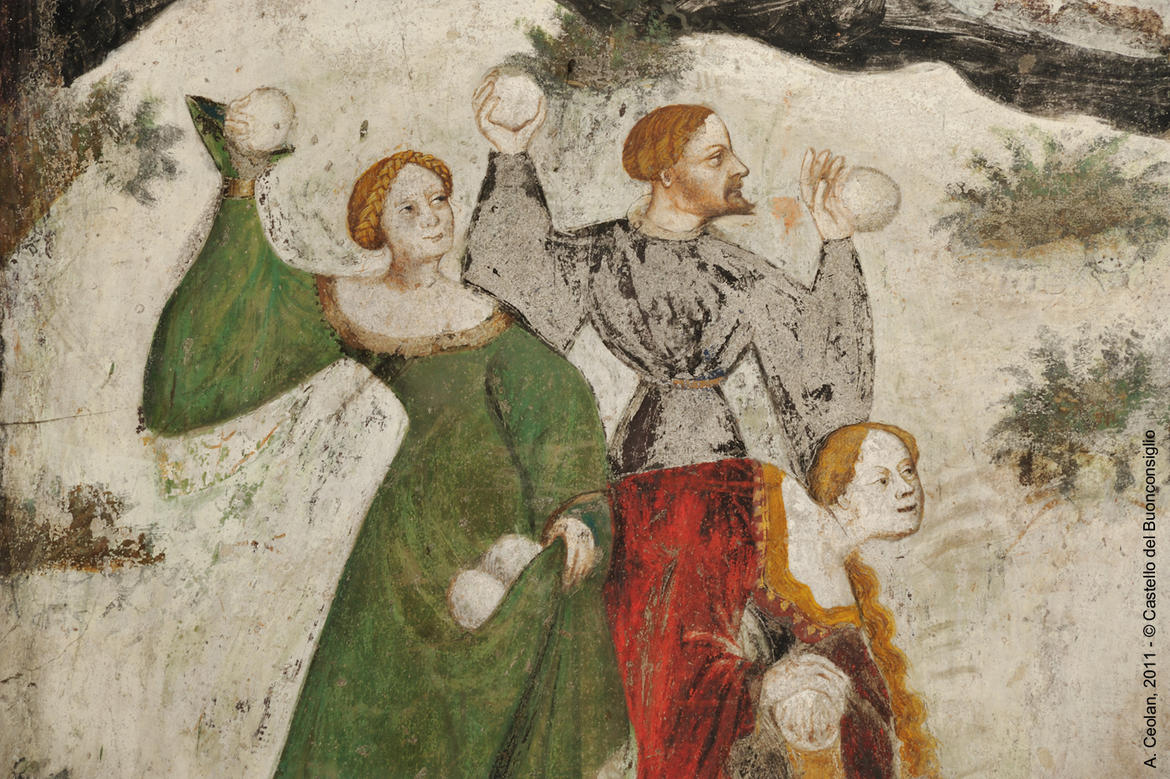
Decorated by the aristocracy over the centuries, the castle also houses many frescoes and art pieces.


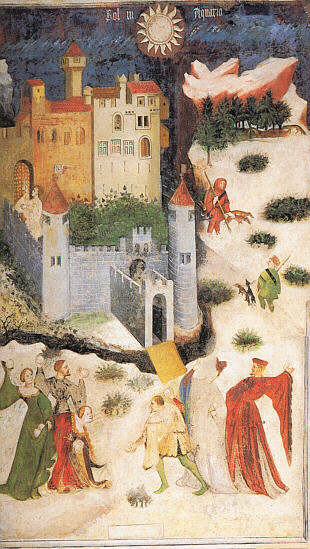


Appearing much as it must have in the 1200s, the castle sits majestically against the Alps at twilight.
**************************************************
The castles of Tuscany
The website CastelliToscani.com has an index of all the major castles in the region.
.
Subscribe to:
Posts (Atom)