Showing posts with label Roman Empire. Show all posts

Wednesday, May 22, 2019

Lake Antorno featured now in Windows 10 Spotlight


Lake Antorno

Lago d'Antorno is located in the Dolomites; the province of Belluno in the Veneto.


*************************
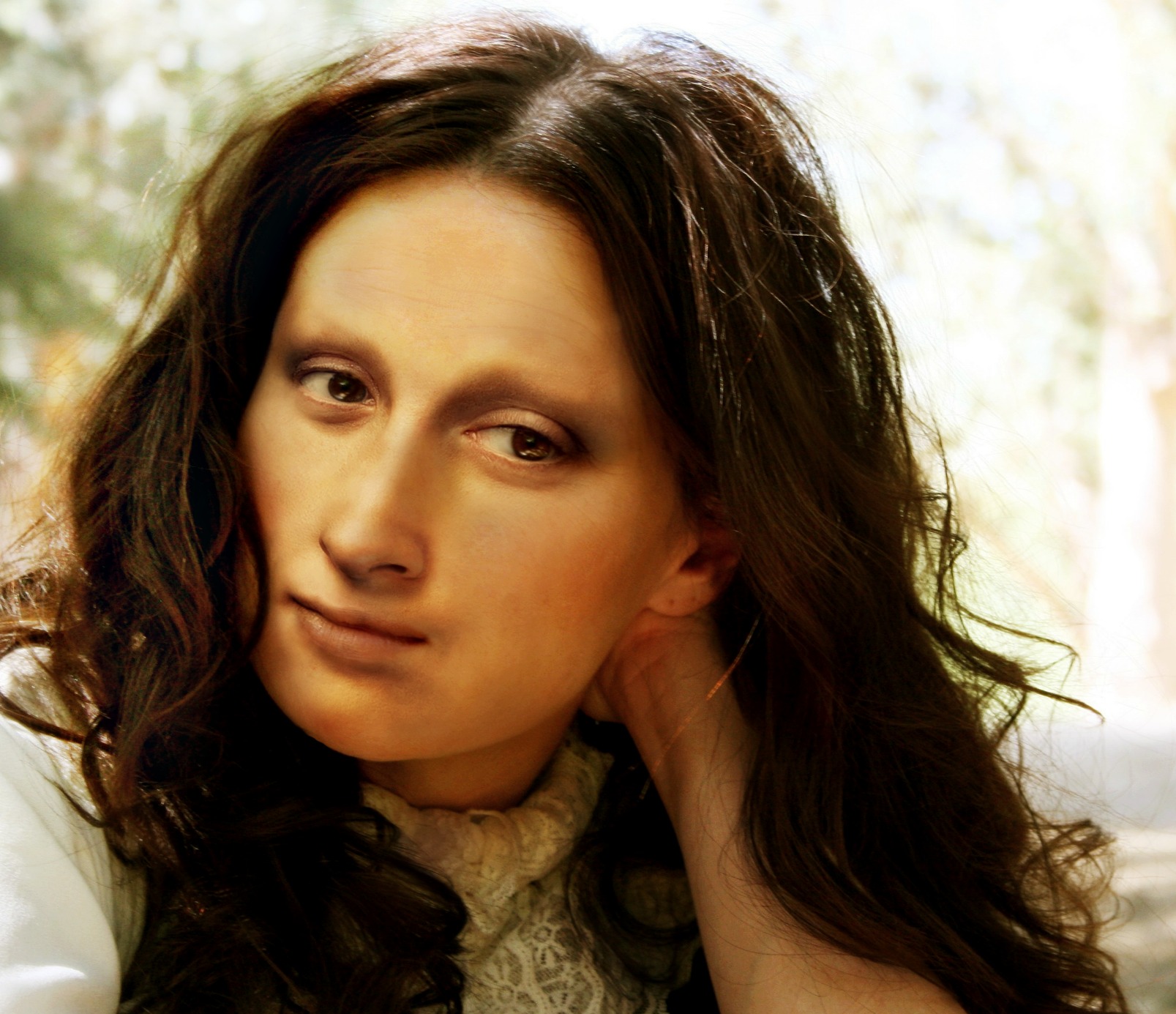


Revisioning drawing of Lisa del Giocondo

Lisa del Giocondo

Lisa del Giocondo (née Gherardini; June 15, 1479 – July 15, 1542) was an Italian noblewoman and member of the Gherardini family of Florence and Tuscany. Her name was given to the Mona Lisa, her portrait commissioned by her husband and painted by Leonardo da Vinci during the Italian Renaissance.

Little is known about Lisa's life. Born in Florence and married in her teens to a cloth and silk merchant who later became a local official, she was a mother to five children and led what is thought to have been a comfortable and ordinary middle-class life. Lisa outlived her husband, who was considerably her senior.

Centuries after Lisa's death, the Mona Lisa became the world's most famous painting and took on a life separate from Lisa, the woman. Speculation by scholars and hobbyists made the work of art a globally recognized icon and an object of commercialization. In 2005, Lisa was definitively identified as the model for the Mona Lisa.


************


'Dark family history behind Mona Lisa's sad smile revealed in new book'

'Leonardo da Vinci never finished the Mona Lisa because he injured his arm while fainting, experts say'


*************************
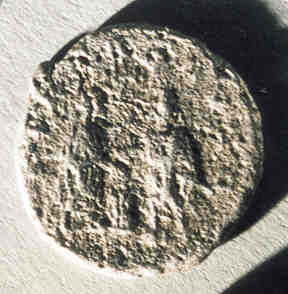


Roman coins from Breathitt County, Kentucky

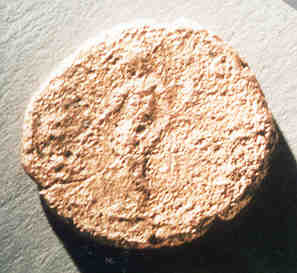
The above three coins were found in a cave shelter in Breathitt County, Kentucky, by Mr. Michael Wayne Griffith of the same county. Mr. Griffith has found another 9 or so similar coins, but the three depicted are the best preserved of the group.

A few years ago the three depicted were examined hands-on by Norman Totten, Professor of History, now Emeritus, at Bentley College. Totten identified the two thinner coins (the top two above) as antoniniani, a type of bronze Roman coin minted between 238 and 305 A.D. The obverses (left photos) depict an unidentifiable emperor wearing the distinctive "solar crown" of the period. The reverse of the top one, in the right photo, depicts two figures standing facing what apparently is a central altar, while that of the middle one depicts a female standing figure facing left with a cornucopia in her right hand.

These would originally have had a silver surface, long since gone. The third coin is thicker, and depicts a bust facing right, wearing a laureate wreath rather than a crown. The reverse, according to Totten, is perhaps a figure of a centaur walking to the right and looking back. Its flan (the metal disk from which coin is made) seems to be of a North African (Egyptian) or Middle Eastern type. This coin probably dates to a similar period to that of the two antoniniani (singular antoninianus). While Totten is confident that the coins are genuine, he warns that such coins are easy to obtain from coin dealers.

In 1963, a small hoard of Roman coins from the same approximate period, and in a much better state of preservation, was found during bridge construction on the north bank of the Ohio River, at the Falls of the Ohio, opposite Louisville, Kentucky.

Breathitt Co., population 16,100 in 2000, is on the upper Kentucky River, in the southeastern portion of the state. The county seat is Jackson, pop. 2,490. Two of the larger towns are named Quicksand and Lost Creek, but the 2000 U.S. Census couldn't find either. The nearest metropolis is Hazard (which may or may not be the inspiration for the "Dukes of Hazzard" TV series), pop. 4,806, and one county to the south.

Mr. Griffith is difficult to contact, but is known to Mr. David Feldman, President of Feldman Lumber Co. in Lancaster, Ky.

The author wishes to thank Prof. Norman Totten, Dr. John Payne, of Berea, Ky., and Mr. David Feldman of Lancaster, Ky., for their invaluable assistance. 


************


Roman Head from Calixtlahuaca, Mexico

Roman coins from the Falls of the Ohio River, Indiana

Roman shipwreck near Rio de Janeiro, Brazil


*************************


Gianfranco Rosi vs Duane Thomas 03-01-1988

Boxing Syko

WBC World Super Welterweight Title Fight

Venue: Palazzo Dello Sport, Genoa, Liguria, Italy


************


Gianfranco Rosi

Gianfranco Rosi (born 5 August 1957) retired Italian boxer who was a two-time world champion in the light-middleweight division.


Professional career

Rosi turned pro in 1979 and won the WBC light-middleweight title in 1987 by decisioning Lupe Aquino. He lost the belt in 1988 when he was dominated by Donald Curry. Rosi was down once in 2nd, 4th and 8th and down twice in 7th, failing to answer the bell starting the 10th round.

In 1989 he won the IBF light-middleweight title by outpointing the undefeated Darrin Van Horn. He went on to successfully defend the title an impressive 11 times. In 1994 he had a technical draw against Vincent Pettway, and in the rematch later that year Pettway KO'd Rosi, ending his long reign.

In 1995 he took on WBO light-middleweight title holder Verno Phillips and won a decision, but Rosi failed a drug test and Phillips was reinstated as champion. The result of the bout was changed to a No Contest. In 1997 he lost a rematch to Phillips and retired.

In 2003 he came out of retirement, and finally retired in 2006 at the age of 49 with a pro record of 62 wins (18 KOs), 6 losses, and 1 draw.


Amateur career

Rosi had a record of 94 wins - 2 losses - 4 draws Highlights:

1976 Italian Light-Welterweight Champion

1977 Italian Welterweight Champion


************


Born in Assisi in the province of Perugia (Umbria), Gianfranco Rosi took a 32-1 record into a European Welterweight Championship bout in 1984 with future world welterweight champion Lloyd Honeyghan from the UK. Rosi lost his first big bout, but won his next nine--including winning the European Junior Middleweight title and defending it twice--and took a 41-2 record into a bout with world champion Luge Aquino of Mexico, a much more dangerous opponent than Honeyghan. Rosi won a unanimous decision to take the belt.

There were so many outstanding boxers worldwide in the 80s, especially between 147 and 160 pounds. Next he defended the belt against another very hard punching boxer, former champion Duane Thomas of Detroit, winning by knockout. Although he lost in his next defense against former welterweight champion Donald Curry, he eventually won the world title back and defended it eleven times before losing.


*************************


The Discovery and Restoration of Leonardo da Vinci's Long-Lost Painting "Salvator Mundi" | Robb Report

Robb Report

Leonardo da Vinci is one of history's greatest artists and thinkers. Only about 15 of his paintings are known to exist and one was thought to be lost forever. Leonard painted that masterpiece, called "Salvator Mundi" (Savior of the World) around 1500. It was owned by no less than three kings and, in 1763, it disappeared. This video tells the story of that incredible painting, how it was rediscovered in 2005, and what happened when it went to auction at Christie's in November 2017.

READ MORE: http://bit.ly/LostDaVinci


Secret Histories of Rare Treasures spotlights the stories behind items that amaze historians, elude collectors, and intrigue audiences. Through original and never-before-seen footage, in-depth archival research, and expert interviews, Robb Report brings these awe-inspiring narratives to life. Developed in coordination with Robb Report’s editors and produced by the brand’s in-house custom-content and video agency Robb Report Studio, the editorial series explores the hidden lives of extremely rare and amazingly valuable items often found in the pages of Robb Report.

Subscribe to Robb Report: https://bit.ly/2rx0Icw


CONNECT WITH ROBB REPORT

Web: http://robbreport.com
Facebook: https://www.facebook.com/robbreport
Twitter: https://www.facebook.com/robbreport
Instagram: https://www.instagram.com/robbreport
Pinterest: https://www.pinterest.com/robbreport


.


*************************


[This portion was originally from the CCNA blog - entitled 'Disciplina Etrusca' by Voltumna - May 31, 2015]

This band named itself after the supreme god of the Etruscan pantheon, "Voltumna" (also called "Veltha"), which I just covered a bit on the other blog ('Etruscan women, mythology, and the god Veltha'). Black Metal music is a lot like the old Heavy Metal music in that some of it is truly good, while most you would probably have to really like the genre to appreciate. This particular song wouldn't be my first choice to promote, but I love the theme! The 'Disciplina Etrusca' was the text of ancient Etruscan polytheism, which was made up of the three "books of fate."

Beyond the larger Black Metal genre, are the sub-genres of "Celtic Black Metal," "Viking Black Metal," etc., etc. One thing this music offers is a clear link to folk-identity, in this case "Etruscan Black Metal." The band's lyrical theme is defined as "Etruscan Paganism, Mythology, Modern Decay"; and it's genre as Black/Death Metal. This additionally suggests a type of Gothic element to it. Dark symbolism can be beautiful, and could be an outlet for people, primarily younger people, who feel alienated by society.

This song is brand new; just released today in fact. The band is from Viterbo, Latium, and has been around since 2009. Viterbo was one of the city-states of the Etruscan civilization. In a Western society which makes a special point to squash identity (individual and collective), I think it's great that people can turn to their ancestors for inspiration and strength. It's not just Black Folk Metal, but there are many other genres which are folk-oriented in this manner. I mean something a little beyond a band merely playing folk music from a certain culture. There's often a rebel-aspect to it. 


If you don't like Black Metal, maybe seek out some of the other types of music within this concept. There's one band from Sardinia called Atrium Animae which is under a genre called "Atmospheric Neoclassical Darkwave," which is hauntingly beautiful.. and is based on what appears to be a Medieval Catholic style. There is Irish Black Metal, Odinic music of many sounds, Slavic, you name it. You might find something you like within one of these folk-spiritual-identity sub-genres.


I like music of just about every texture and harmony, but I don't like "sad music." There are enough things in this life to be sad or depressed about; especially when we lose people. Something inspirational is great, especially when there's that blood-folk connection with a spiritual tie-in. Black Metal is almost like fighting music. Perhaps we need some of that in our lives, because often life is a war. Evolutionary struggle.

Voltumna official website

Voltumna YouTube channel

Metal-Archives.com band profile

Voltumna facebook (official; in Italian mostly)

Voltumna facebook (in English)

.

Monday, September 18, 2017

'The Eagle' - movie review


The Eagle (2011 film)

The Eagle is a 2011 epic historical drama film set in Roman Britain directed by Kevin Macdonald, and starring Channing Tatum, Jamie Bell and Donald Sutherland. Adapted by Jeremy Brock from Rosemary Sutcliff's historical adventure novel The Eagle of the Ninth (1954), the film tells the story of a young Roman officer searching to recover the lost Roman eagle standard of his father's legion in the northern part of Great Britain. The story is based on the Ninth Spanish Legion's supposed disappearance in Britain.

The film was an Anglo-American co-production. It was released in the U.S. and Canada on February 11, 2011, and in the United Kingdom and Ireland on March 25, 2011.

The Eagle is effectively a sequel to the film Centurion, written and directed by Neil Marshall, because Channing Tatum's character in The Eagle is Marcus Flavius Aquila, the son of Titus Flavius Virilus who led the Ninth Legion that was lost in the far north of Britannia, and who was therefore the same person as Dominic West's character Titus Flavius Virilus in Centurion: it continues the story of the disappearance of the Ninth Legion fighting the Picts in what is now northern Scotland, north of Hadrian's Wall by following the leader's son's search to solve the mystery of what happened to his father, and the Legion, and the golden eagle standard that they carried everywhere with them, and to restore his family's honor.

As a historical matter, the purported disappearance of the Ninth Legion in Northern Britain is a subject of debate and dispute (see Legio_IX_Hispana § Theories about the Ninth's disappearance for details.)


*************************


Partial spoiler alert! This review perhaps spoils the first 1/3 of the film....


The premise of the entire movie was the desire of one man, Marcus Flavius Aquila, to put himself at great risk to recapture the lost honor of both the Roman Empire and that of his own family. Since we no longer live in an honor-bound society, this becomes something to really ponder. The symbol of this endeavor was the lost Roman golden eagle standard; a golden Roman eagle which was attached to a pole such as a national flag; a vexillum. Of course, since his own father commanded the 9th Legion, it was both patriotic and personal. The legion contained 5,000 soldiers, a great loss and embarrassment to the empire; similar to the great Roman defeat in the Teutoburg Forest about 130 years earlier.

The 9th Legion was to have disappeared in what was called Caledonia by the Romans, or what is now Scotland. The Picts were not Gaels, but usually thought of as being a Celtic people, although may have been a particular Atlanto-Mediterranean people. The strange sounding language used by the Picts in the film was not the lost and unknown Pictish language, but Scottish Gaelic. In any case, the tribes of Caledonia were so fierce that the Romans constructed a great fortified wall to seal them off, called Hadian's Wall.

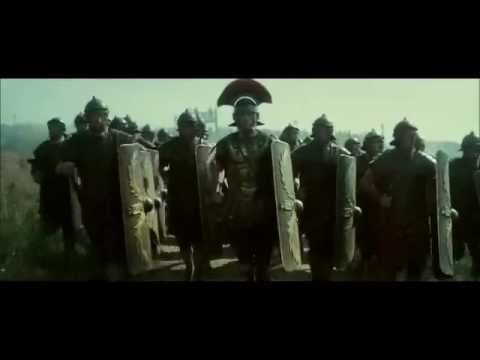
The film opens with a Roman military unit traveling through Briton by boat via a river system with heavy foliage and trees. Suddenly a small herd of large steers splashed across in front of them, showing a certain backwardness to this society; although it was under Roman rule for about a century at that point. The boat carried Marcus who was to be the new commander of a certain Roman fortification and territory in northern Briton. As he arrives, there's a certain ominous feeling. There are still strong unconquered elements about them.

There were a few references to "the gods." Marcus prayed to one of the Roman gods, possibly Mithras, on a couple of occasions. He was a man on a mission. There were rumors of Druids about as well, although the Druids were thought to have been long ago defeated. Apparently, though not militaristic, the Druids had organized resistance to Rome in the past in both Briton and Gaul. Soon after assuming command, on a gloomy night, Marcus awoke with a feeling of danger. He got up and went along the outer walls, and heard a certain noise. They tried to figure out if it was a noise from cattle or not.

Marcus made a decision to waken all of the soldiers. They dressed and manned the walls, and waited. It could have ended up as a somewhat embarrassing error by the new commander. However, an army of Britons did attack, and the attack was repelled. For this, the young Marcus gained respect from all. The next morning, the army of Britons showed themselves beyond the walls again. As they started a ritual execution of two Roman soldiers, Marcus ordered a preemptive attack. Again, a great battle ensued.

As Marcus fought, visions of his father fighting some unknown enemy was shown; hinting at a psycho-spiritual connection with something which had occurred years earlier. Although the Romans were victorious, it came at a greater loss than the night prior. Marcus was seriously injured in the battle, and was soon taken away to a different part of Briton. I assume that he was relocated to a more southern location of which the Romans had a better grip on things. There he meets his uncle, who is in some form of command, and begins his rehabilitation. At this point there is a reference to an old Roman proverb, cited in the book 'The Eagle of the Ninth':

Eagle lost, honor lost;
Honor lost, all lost.

During some type of life-and-death battle "games," a young Briton named Esca is about to be put to death with the apparent approval of the crowd. Marcus rises and objects, successfully. Esca is allowed to live, and is given to Marcus as a slave. At one point Esca pulls a small dagger on Marcus and tells him that he hates him and everything he stands for; however, due to the fact that Marcus saved his life, swears eternal loyalty to him and puts the dagger down.

When Marcus finally heals, he begins his quest to find the golden eagle beyond Hadrian's Wall. This is beyond Roman Briton, dark harsh highlands and weather, populated by savage tribes, the unknown, more dangerous than northern Briton, the top of the world. He sets out on horseback with only his slave Esca; and that's where the film really realizes it's aim.

There's a parallel to the movie 'Braveheart', however the film takes no pro or anti Roman slant. Much of the rest of the film is about redemption of Marcus, Esca, and others. Somewhat ironically, "Roman Briton" at a much later point became a new Roman Empire itself. I reviewed 'Centurion' (2010), of which 'The Eagle' was the sequel to, on the other blog... Centurion (movie review).

In ancient legends, the eagle was the symbol of oppression; perhaps more to the point... of a hording of power and knowledge. The serpent was the symbol of liberation and freedom; more to the point... of an opening up of forbidden knowledge and truth. However, it's also been challenged that the eagle is really the liberator and that it symbolizes safety and the rule of law... while the serpent is an anarchist.

.

Monday, June 15, 2015

Documentary 'Barbarians' series - 'The Lombards'


The Lombards

georgeweatherby

At the end of the sixth century, he Roman Empire, rocked by relentless waves of violent barbarians -- Goths, Huns, Vandals -- civilization on the Italian penisula teeters on the brink of collapse. As famine, war, plague leave death devastation in their wake, out of north bursts the last of the barbarian hordes. Fiercely pagan, famous for their cruelty, the Lombards strike the final blow to the Roman Empire.
In 488 the Lombards are a small but particularly savage group of warriors on the move, surviving by viciously raiding other tribes Originating in Scandinavia and migrating south, into Roman regions, they eventually inhabit what became modern day Austria and Hungary At the turn of the 6th century only the eastern half of the empire remains, ruled by the Byzantine emperor from Constantinople.

Alboin, king of the Lombards, was celebrated as a man fitted for wars, with noble bearing and courage. The emperor Justinian recruited Alboin and the Vandals to aid in the reconquest of Italy which was controlled by the Goths. The Roman military leaders disgusted by the uncontrolled Lombard warriors, relegated them to a new homeland along the banks of the Danube River. In 568, the Lombards, well familiar with Italy from earlier days as Roman mercenaries, invade Rome, inviting Saxons, Bulgars and other barbarian tribes to join.

Much of our information regarding the Lombards is found in the 8th century chronicler Paul the Deacon's work, HISTORY OF THE LOMBARDS, translated by William Dudley Foulke, LL.D., edited with introduction by Edward Peters, University of Pennsylvania Press, Philadelphia, 1907

This History Channel documentary series, Barbarians 2, tells the fascinating stories of four of the most fabled groups of fighters in history, the Saxons, the Lombards, the Franks, the Vandals, tracing 1,000 years of conquest and adventure through inspired scholarship and some of the most extensive reenactments ever filmed.


.

Friday, May 9, 2014

'What the Ancients Knew: The Romans'


This was an interesting Science Channel documentary from a couple of years back. It's worth watching for the technological innovations alone. I believe that the Etruscans were the rightful founders of Cisalpine civilization; but one cannot deny the influence of the Romans.

.

Thursday, October 25, 2012

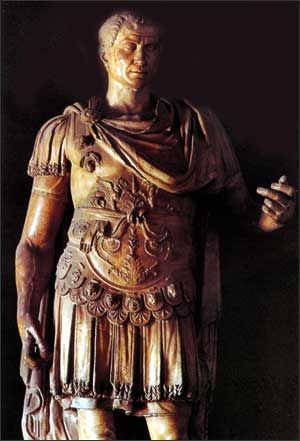
Spot where Julius Caesar was stabbed discovered

Spot where Julius Caesar was stabbed discovered [see image]
 
Concrete structure believed to mark location of Roman ruler's killing


By Stephanie Pappas - Senior writer - MSNBC - October 11, 2012

Archaeologists believe they have found the first physical evidence of the spot where Julius Caesar died, according to a new Spanish National Research Council report.

Caesar, the head of the Roman Republic, was stabbed to death by a group of rival Roman senators on March 15, 44 B.C., the Ides of March. The assassination is well-covered in classical texts, but until now, researchers had no archaeological evidence of the place where it happened.

Now, archaeologists have unearthed a concrete structure nearly 10 feet wide and 6.5 feet tall that may have been erected by Augustus, Julius Caesar's successor, to condemn the assassination. The structure is at the base of the Curia, or Theater, of Pompey, the spot where classical writers reported the stabbing took place.

"We always knew that Julius Caesar was killed in the Curia of Pompey on March 15th 44 B.C. because the classical texts pass on so, but so far no material evidence of this fact, so often depicted in historicist painting and cinema, had been recovered," Antonio Monterroso, a researcher at the Spanish National Research Council, said in a statement.

Classical texts also say that years after the assassination, the Curia was closed and turned into a memorial chapel for Caesar. The researchers are studying this building along with another monument in the same complex, the Portico of the Hundred Columns, or Hecatostylon; they are looking for links between the archaeology of the assassination and what has been portrayed in art.

"It is very attractive, in a civic and citizen sense, that thousands of people today take the bus and the tram right next to the place where Julius Caesar was stabbed 2,056 years ago," Monterroso said.


.

Wednesday, July 22, 2009

War for Occupied Cisalpine Gaul: Byzantine Roman Empire versus Langobard Nation


War for Occupied Cisalpine Gaul: Byzantine Roman Empire versus Langobard Nation

Langobard warriors, under warrior King Alboin, defeat the Byzantine Roman Army. The Nation of Langbard is born.

Kingdom of the Lombards

Lombards

Byzantine Empire

Saturday, July 18, 2009

Ostrogothic Kingdom: Germanic Conquest


Ostrogothic Kingdom: Germanic Conquest

The Ostrogothic Kingdom established by the Ostrogoths in Italy and neighbouring areas lasted from 493 to 553. In Italy the Ostrogoths replaced Odoacer, the de facto ruler of Italy who had deposed the last emperor of the Western Roman Empire in 476. The Gothic kingdom reached its zenith under the rule of its first king, Theodoric the Great. Most of the social institutions in the late Western Roman Empire were preserved during his rule.

Ostrogothic Kingdom


Theodoric the Great (454 - August 30, 526) was king of the Ostrogoths (471 - 526), ruler of Italy (493 - 526), and regent of the Visigoths (511526). He became a hero of Germanic legend as Þeodric in English legends, Dietrich von Bern in German legends, and as Þjóðrekr and Þiðrekr in Norse mythology.

Theodoric the Great


The Ostrogoths were a branch of the Goths, an East Germanic tribe that played a major role in the political events of the late Roman Empire. The other branch was the Visigoths.

The Ostrogoths established a relatively short-lived successor state of Rome in Italy and the Balkans, even briefly incorporating most of Hispania and southern Gaul. They reached their zenith under their Romanised king Theodoric the Great, who patronised such late Roman figures as Boethius and Cassiodorus, in the first quarter of the sixth century. By mid-century, however, they had been conquered by Rome in the Gothic War (535 - 554), a war with devastating consequences for Italy.

Ostrogoths