
Lammas is a Neo-Pagan holiday, often called Lughnasadh, celebrating the first harvest and the reaping of grain. It is a cross-quarter holiday halfway between the Summer Solstice (Litha) and the Autumnal Equinox (Mabon). In the northern hemisphere, Lammas takes place around August 1 with the Sun near the midpoint of Leo in the tropical zodiac, while in the southern hemisphere Lammas is celebrated around February 1 with the Sun near the midpoint of Aquarius. On the Wheel of the Year, it is opposite Imbolc, which is celebrated on February 2nd in the northern hemisphere, and late July / early August in the southern hemisphere.
Lammas
http://en.wikipedia.org/wiki/Lammas
Lughnasadh
http://en.wikipedia.org/wiki/Lughnasadh
Harvest Festival
http://en.wikipedia.org/wiki/Harvest_festival
Celtic calendar
http://en.wikipedia.org/wiki/Celtic_calendar
Wheel of the Year
http://en.wikipedia.org/wiki/Wheel_of_the_year
*The footage shown is from the 2006 American remake of 'The Wicker Man' :
Wikipedia
http://en.wikipedia.org/wiki/The_Wicker_Man_(2006_film)
Internet Movie Database
http://www.imdb.com/title/tt0450345/
Amazon.com
http://www.amazon.com/Wicker-Man-Widescreen-Unrated-Rated/dp/B000JYW5DW/ref=sr_1_2?ie=UTF8&s=dvd&qid=1279558795&sr=1-2
[Music: Unknown]

Monday, July 19, 2010
Gallia Cisalpina VI: Gaulish Bread Harvest


Thursday, May 7, 2009
Celtica Festival 2009
 [from insubria87's post on the PAL Yahoo Group 'Celtica '09'; very interesting, to me at least, is that the Valle d'Aosta location is relatively close to the Trophy of Augustus]
CELTICA '09
THURSDAY 9 JULY 2009
AOSTA
TOWN HALL PORCH
All the day long: Market – Stands
CHANOUX SQUARE
Historical reenactment and craft workshops
15h00 - 19h00: Everyday life situations (EVROPA ANTIQVA, KATERKVA KATTI BROGOS – TEUTA INSUBRIS – LEGIO X)
DES FRANCHISES SQUARE AND PORTE PRETORIANE SQUARE
Musical Animation
15h00 - 15h30: BANDA GAITES LLACIN (Des Franchises Square); KINTYRE SCHOOLS PIPE BAND (Porte Pretoriane Square)
CHANOUX SQUARE > REGIONAL LIBRARY
Musical parade towards the library
15h45 - 16h00: BANDA DE GAITES LLACIN - KINTYRE SCHOOLS PIPE BAND
CONFERENCE HALL REGIONAL LIBRARY
Lecture
16h15 - 17h00: “Aosta and its territory: meeting between indigenous cultures and Rome”
Dott.ssa STELLA BERTARIONE - Archaeologist of the Monuments and Fine Arts Department
PORTE PRETORIANE > REPUBLIC SQUARE
Parade with Music, Dances and Costumes by foot and riding horses
17h00 - 18h00: BANDA DE GAITES LLACIN - KINTYRE SCHOOLS PIPE BAND - DOMINIC GRAHAM SCHOOL IRISH DANCE - EVROPA ANTIQUA - CLAN DELLA GRANDE ORSA - GENS D’YS - GRUPPO STORICO ROMANO PONT-SAINT-MARTIN
ROMAN THEATRE
Concerts
21h00: VINCENZO ZITELLO
22h00: MABON (special guest GENS D’YS)
23h00: BARRAGE


FRIDAY 10 JULY 2009
CHAMONIX MONT-BLANC (F)
PACCARD STREET > BALMAT SQUARE > TRIANGLE DE L'AMITIÉ SQUARE
Parade with Music and Dances
16h30 - 17h15: KINTYRE SCHOOLS PIPE BAND - DOMINIC GRAHAM SCHOOL IRISH DANCE - BANDA DE GAITES LLACIN - GENS D’YS
PLACES Á MUSIQUE!
Music in the Squares
BANDA GAITES LLACIN
Chemin des Alpes Square -17h30
Quai d’Arve - 17h50
Balmat Square - 18h15
KINTYRE SCHOOLS PIPE BAND
Balmat Square - 17h30
Triangle de l’Amitié Square - 17h50
Quai d’Arve - 18h15
DOMINIC GRAHAM SCHOOL IRISH DANCE
Triangle de l’Amitié Square - 17h30
GENS D’YS
Chemin des Alpes Square - 17h50
TRIANGLE DE L'AMITIÉ SQUARE
Music, Celtic Dances and Concerts
21h00: BANDA GAITES LLACIN
21h30: GENS D’YS - SHOW
22h30: INIS FAIL
FRIDAY 10 JULY 2009
VAL VENY – MIAGE LAKE
09h30: PURTUD BRIDGE (PEUTEREY WOOD) Departure towards the Miage lake
11h00: MIAGE LAKE Ceremony for the fairies of Miage VINCENZO ZITELLO
COURMAYEUR
JARDIN DE L’ANGE
Concerts to show the musical groups
17h00: PHAMIE GOW
17h30: MABON
PEUTEREY WOOD
From 9h00: Market – Craft Stands
From 10h00: Workshops and Lectures (see specific page) - Info, timetable and registrations at Infopoint
SMALL STAGE
Open Stage – Concerts and Dances with Italian groups
18h00 - 18h45: RITA PARTINI
19h00 - 19h45: BRUNO LE ROUZIC
19h45 - 20h30: RICATTI ACUSTICI
MAIN STAGE
Concerts
20h30: PHAMIE GOW
21h30: LUSMOR
22h15: THE CHAIR
23h30: MABON
BONFIRE AREA
00h30: Lighting of Druidic Bonfire - CLAN DELLA GRANDE ORSA
PUB AREA
Concerts and Sessions
01.00: “Veilla Celtique”: PHAMIE GOW - THE CHAIR – MABON
SATURDAY 11 JULY 2009
PRÉ-SAINT-DIDIER - VITTORIO EMANUELE II SQUARE
Concert
16.30: PHAMIE GOW
COURMAYEUR
TOWN HALL
Departure “Gran Trail Valdigne” in cooperation with Asd Courmayeur Trailers
09h30: KINTYRE SCHOOLS PIPE BAND - BANDA GAITES LLACIN
ROMA STREET > BROCHEREL SQUARE > JARDIN DE L'ANGE
Music Parade
15h30: KINTYRE SCHOOLS PIPE BAND - DOMINIC GRAHAM SCHOOL IRISH DANCE - BANDA GAITES LLACIN
JARDIN DE L’ANGE
Concerts to show the musical groups
17h00: ADRIANO SANGINETO
17h30: DOMINIC GRAHAM SCHOOL IRISH DANCE
VAL VENY – PEUTEREY WOOD
From 9h00 Market – Craft Stands
From 10h00 Workshops and Lectures (see specific page)
Info, timetable and registrations at Infopoint
SMALL STAGE
Open Stage – Concerts and Dances with Italian groups
18h00 - 18h45: BEATRICE PIGNOLO
19h00 - 19h45: JIG RIG
19h45 - 20h30: RICATTI ACUSTICI
MAIN STAGE
Concerts and Shows
20h30: DOMINIC GRAHAM SCHOOL IRISH DANCE
21h00: KINTYRE SCHOOLS PIPE BAND - BANDA GAITES LLACIN
21h30: THE CHAIR
22h30: SESSION A9
23h30: BARRAGE
00h30: GREENLANDS – Anthem of Celtic Nations with all the musicians of Celtica
PUB AREA
Concerts and Sessions
01h00: “Veilla Celtique”: THE CHAIR – BARRAGE – SESSION A9
SUNDAY 12 JULY 2009
VAL VENY – PEUTEREY WOOD
From 9h00 Market – Craft Stands
From 10h00 Workshops and Lectures (see specific page)
Info, timetable and registrations at Infopoint
CLAN DELLA GRANDE ORSA CAMP
10h00: Celtic Waking up with dark bread and honey from the Aosta Valley
MAIN STAGE
Concerts and Shows
11h30: VINCENZO ZITELLO
12h30: KINTYRE SCHOOLS PIPE BAND
MENHIR AREA
14h00: Ceremony and Goodbye from Celtica 2009 - CLAN DELLA GRANDE ORSA & VINCENZO ZITELLO
SMALL STAGE
14h30: Final recital of the music courses
MAIN STAGE
Concert
15h00: MABON (special guest GENS D’YS)
BARD VILLAGE
BARD VILLAGE - MULTIPURPOSE ROOM TOWN HALL
15h00: Hydromel – Workshop to prepare Gods' nectar
MAURIZIO PUCCI
To attend this workshop you need to have: 1 bottle of 1 L with cork, 300 g honey - the kind you like more -, 2 lemons, a pinch of cinnamon and cloves, a small pot for water, 1 funnel; workshop to be paid by participants, compulsory registrations within 30 June 2009 via e-mail: info@...
BARD VILLAGE - CHURCH PARVIS
Musical Animation
16h00: BANDA GAITES LLACIN
15h30: ADRIANO SANGINETO
BARD VILLAGE - STENDHAL ROOM - TOWN HALL
Lecture
16.30: “Aosta and its territory: meeting between indigenous cultures and Rome”
STELLA BERTARIONE - Archaeologist of the Monuments and Fine Arts Department
BARD VILLAGE - CHURCH PARVIS
Animation – Irish Dances
17h00: KINTYRE SCHOOLS PIPE BAND
17h30: GENS D’YS
BARD FORTRESS – CARLO ALBERTO OPERA SQUARE
Concerts and Shows
20h30: DOMINIC GRAHAM SCHOOL IRISH DANCE
21h00: KINTYRE SCHOOLS PIPE BAND e BANDA GAITES LLACIN
21h15: SESSION A9
22h15: BARRAGE
Downhill with Music towards Bard Village
23h00: KINTYRE SCHOOLS PIPE BAND - BANDA GAITES LLACIN
Lectures, Workshops and Historical Reenactments
Workshops are free (except for different notice). Nevertheless, following the Celtic principle of 'honourable change', it will be nice - if you want to - to give directly an offer to the artists and craftsmen who have shared with us their art.
FROM FRIDAY 10 TO SUNDAY 12 JULY 2009
VAL VENY – Peuterey Wood – Information and registrations at InfoPoint starting from 10h00
Lectures – Druidic Talks nearby the Menhir
“Druids, the Goddess' guardians - The never-ending feminine in the Celtic world” - Silvano Danesi
“Morrigan and the chaos point - From Kalì Yuga to Change” - Silvano Danesi
“Ancient Myths, Treasure for the Soul” - Silvano Danesi
“Harp to heal: the therapeutic use of the Celtic harp from ancient Bards' stories till nowadays” - Rita Partini
“The Holy Flame of Brigit of Ireland: Saint or Goddess?” - Rita Partini
“Theories about the ancient healing: the healing praxis in Druidic art and its employment in the modern holistic therapeutic system” - Elena Fornari, Mari Corrau, Rita Pasdera
“Ogam and trees: the holy natural symbolism” - Federico Gasparotti
“Craftsman reveals himself: history, technique and creativity” - aCraftsmen of CELTICA
Workshops – Music and Dance
Celtic Dances - Gens d’Ys
Traditional Dances for adults and children - La Cerchia
Traditional Percussions (bones & spoons) - Guido Antoniotti
Workshops – Reenactments and Historical Demonstrations
Strength and Agility Games - La Cerchia
To learn to play the Horn - La Cerchia
Weaving with the planks method - Sagitta Barbarica
Approach to Historical Archery - Sagitta Barbarica (adults)
Metal Working - Sagitta Barbarica
Axe Throw - Sagitta Barbarica
The Cassock Net: from history to making - Luca Bertini
Light weaving: technique and equipment of the Celts - Labarum Bagauda Teuta Laevi
Natural Cosmetics: colours of beauty and of war by the Celts - Labarum Bagauda Teuta Laevi
Celtic Fight Strategies and Technique - Labarum Bagauda Teuta Laevi (adults)
Celtic Coins Exhibition – Frenz Vogel
Workshops for children (up to 12 years old)
Approach to Historical Archery - Sagitta Barbarica
Traditional Dances for children - La Cerchia
Games with the Sword for Celtic warriors - La Cerchia
The Enchanted Forest. Tales, Dances and Graphic – Pictorial Activities - Clan Damhmor
Dancing Fairies and Spirits. Expressive Workshop - Clan Damhmor
Training for throwing the spinning top - Moreno Bartolini
Face painting for children - Maurizia Merati
Night Parade looking for Dwarfs - Clan della Grande Orsa
Rides with Ponies and Horses – A.S.D. El Dorado – Jumping Team
Sunday, March 8, 2009
La Scelta and the Triple Spiral
The above music video is from a band called La Scelta, and it is entitled 'La Grande Danza' ("the great dancer"). It's a very catchy song. La Scelta plays what is considered Celtic-style music, which is probably based on traditional music from the modern "Celtic nations." It would have to be, because we don't know what kind of music ancient Celts may have composed. La Scelta has their offical website, as well as their YouTube channel.
************************************************************************* Along with the "Sun of the Alps," another Celtic symbol which is tied into the history of mainly the ancient continental Celts, is the "Triple Spiral." A tiny number of Irish people occasionally proclaim to various movements to "stop using OUR symbols" (Celtic symbols). Actually, the Sun of the Alps and the Triple Spiral are not identified with the British Isles at all, and the original Celts were living on the European mainland long before migrating there. It's not clear at all as to what the ancient Celts may have looked like, or what Indo-European sub-stock they may have belonged to. What may be a modern "Irish look(s)," could actually be inherited from Vikings or some other migrating people in that nation's history.
[6-28-09 UPDATE: I may have been mistaken regarding the knowledge of ancient Celtic music. The evidence seems to show me that there was some knowledge based on the instruments, therefore I retract the statement that "we could not" have known about their music.]
Monday, February 16, 2009
Caesar Augustus' "Conquered Alpine Peoples" - Part 2
 The Celts
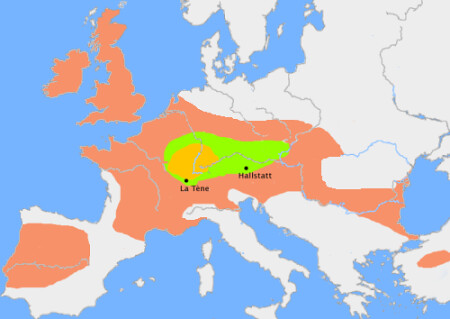
We can take a more in-depth look at these various pre-Roman peoples, like the Celts, at a later time. The Celts did indeed invade Northern Italy, like they did so many other regions of Europe, and even beyond Europe, like Turkey. It should be noted that some sources even place them in Northern Italy much earlier (sixth century BC), and even as a place of possible origin. However, it's usually accepted that the first Celtic culture really thrived in the area that is now modern southern Germany and nearby areas of central Europe, although some place the origin in more northern Germany and Holland.
The Celts are sometimes thought of as more of a culture than an ethnic type. However, early Greek and Roman historians describe them as generally being quite tall. The concept of them as being similar to a red haired "Irish" type of people may not be accurate. They may have been more dark haired, but the picture is really not entirely clear, and evidence surfaces from time to time that changes archeologists and anthropologists view of the Celts. With their centuries long wanderings, they may have started out as more of a particular ethnic type, and later morphed into more of a culture, with scattered regional groups.
Celtic Gaul
Pre-Roman Gaul was a Celtic nation in the area that is now France. Although made up of separate tribes, it would still constitute a nation, as they united to defend themselves against the invading Romans. It should also be pointed out that these pre-Roman regions and tribes were also certainly pre-Christian. They had various pagan beliefs. Druidism, for example, is a Celtic-originated tradition. All of these areas are so expansive, but I want to stick with Northern Italian Celts, just prior to their being conquered by the Romans. It is important to know that they did invade Northern Italy from Gaul. It was probably somewhere between the definition of a migration and an invasion. It is known that they pushed the Etruscans south on many occasions.
From Wikipedia webpage for Celts: "Alps and Po Valley
"There was an early Celtic presence in northern Italy since inscriptions dated to the sixth century BC have been found there. In 391 BC Celts "who had their homes beyond the Alps streamed through the passes in great strength and seized the territory that lay between the Appeninne mountains and the Alps" according to Diodorus Siculus. The Po Valley and the rest of northern Italy (known to the Romans as Cisalpine Gaul) was inhabited by Celtic-speakers who founded cities such as Milan. Later the Roman army was routed at the battle of Allia and Rome was sacked in 390 BC by the Senones.
"At the battle of Telemon in 225 BC a large Celtic army was trapped between two Roman forces and crushed.
"The defeat of the combined Samnite, Celtic and Etruscan alliance by the Romans in the Third Samnite War sounded the beginning of the end of the Celtic domination in mainland Europe, but it was not until 192 BC that the Roman armies conquered the last remaining independent Celtic kingdoms in Italy.
"The Celts settled much further south of the Po River than many maps show. Remnants in the town of Doccia, in the province of Emilia-Romagna, showcase Celtic houses in very good condition dating from about the 4th century BC."
The subject of the Celts is so expansive and ambiguous, that I have to hold myself back from really wanting to dive into it and go on and on. It's such a fascinating subject. I want to go more into this in later entries, and keep this to the era just prior to the Roman period (in the Italian Alps). The following link, which shows interactive Celt and Roman maps, shows a Celtic territory that is more expansive than I have been reading in other sources. The first map shown is from about 800 BC., and shows territory in Northern Italy.
From Wikipedia webpage for "Cisalpine Gaul
"Cisalpine Gaul (Latin: Gallia Cisalpina, meaning "Gaul on this side of the Alps") was the Roman name for a geographical area (later a province of the Roman Republic), in the territory of modern-day northern Italy (including Emilia-Romagna, Friuli-Venezia Giulia, Liguria, Lombardy, Piedmont, Trentino-Alto Adige/Südtirol and Veneto), inhabited by the Celts. Sometimes referred to as Gallia Citerior (Hither Gaul), Provincia Ariminum, or Gallia Togata (Toga-wearing Gaul, indicating the region's early Romanization). Gallia Transpadana denoted that part of Cisalpine Gaul between the Padus (now Po) and the Alps, while Gallia Cispadana was the part to the south of the river. The province was governed from Mutina (modern-day Modena), where in 73 BC forces under Spartacus defeated the legion of Gaius Cassius Longinus, the provincial governor.
"The River Rubicon marked its southern boundary with Italia proper, and it was upon crossing this river in 49BC that Julius Caesar, with his battle-hardened legions which resulted from the conquest of Gaul, precipitated a civil war throughout the Roman Republic that led to the eventual establishment of the Roman Empire.
"The province was merged into Italia about 43–42 BC, as part of Octavian's "Italicization" program during the Second Triumvirate. The end of the provincia required a new governing law or lex, though its contemporary title is unknown. The parts of it that are inscribed on a bronze tablet preserved in the museum at Parma are entirely concerned with arranging the judiciary; the lex appoints two viri and four viri juri dicundo. The lex also mentions a Prefect of Mutina. Virgil and Livy were born in Gallia Cisalpina, and were two famous sons of the Province."
It's important to note that the Roman invasion of Cisalpine Gaul (Alpine Italy) was long after the Etruscans were gone. Although called a "southern Gaul" by the Romans, it was actually populated by both ancient Italic tribes and Celtic tribes. The first few names of Caesar Augustus' "conquered Alpine peoples" were Italic Alpine tribes, due to their fearsome resistance. Therefore, it would be false to assume that the Celts were the only ones who bravely resisted. It was both cultural groups. It reads from the Wikipedia "Trophy of Augustus" link: "The Trophy of the Alps or Trophy of Augustus was built by the Roman emperor Augustus to celebrate his definitive victory over the ancient Celto-Ligurian tribes who populated the region and who had harassed merchants along Roman roads." The term "Celto-Ligurian" was just a catch-all word, but, as mentioned in part one, not all the Italic Alpine tribes were Ligures.
From Wikipedia entry for List of Celtic tribes: "Cisalpine Gaul (Northern Italy)
"Cisalpine Gaul, meaning literally "Gaul on this side of the Alps", was the Roman name for a region of Italy inhabited by Gauls, roughly corresponding with modern northern Italy.
"* Salassi - Aosta Valley and Canavese (Northern Piedmont) (Ivrea)
* Graioceles - Northwestern Piedmont in the Graian Alps
* Seguses (or Cotties) - Western Piedmont on Cottian Alps (Susa)
* Taurini - Piedmont (Turin)
* Vertamocorii - Eastern Piedmont (Novara)
* Insubres - Western Lombardy (Milan)
* Orobii or Orumbovii - Central Lombardy (Bergamo)
* Cenomani - Eastern Lombardy (Brixia, Cremona)
* Boii - Central Emilia-Romagna (Bologna)
* Lingones - North-eastern Emilia-Romagna (Ferrara), Po Valley
* Senones - South-eastern Emilia-Romagna (Rimini) and Northern Marche (Senigallia)"
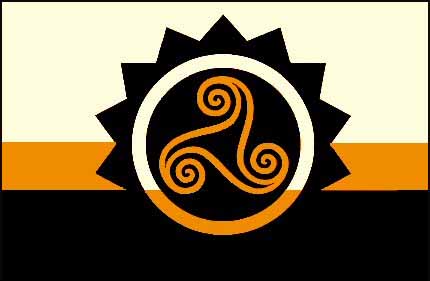
See the Trophy of Augustus link for a list of all the major tribes who were conquered in Cisalpine Gaul (Italics and Celts), and direct links to many of those tribes. Also see the List of Celtic tribes for direct links to many of the various Celtic tribes mentioned above. I would also like to take this time to say that I would like to symbolically designate the above flag, which is fictional, as the flag of the Celto-Ligurian federation which opposed Rome. Not as an anti-Roman sentiment, but as a symbol of what we were at one time, and for the bravery they displayed in standing up to one of the greatest, if not THE greatest army the world has ever known. The historical record shows clearly that they fought them tooth and tail. The symbol is a Celtic one, which was used in Northern Italy, not to be confused with the Celtic Sun of the Alps symbol, which was also used by the Northern Italian Celti. The colors can reflect the ruggedness of the ancient Alps, and it has the sun symbolism on it.
The ancient Alpine region, just prior to Roman invasion, colonization, and Christianization, was more undeveloped and much more heavily forested. The Italic tribes and their Celtic neighbors were living peacefully together. Last fall, I visited a mountainous and heavily forested area. It was later in the day. Houses were very sporadically located in this area, and it was rather dark due to the large trees blocking out the sun. I really feel that this was a visual glimpse of what much of the ancient Alps looked like, at least the more pre-Alpine mountain valleys. Game was much more abundant. Believe it or not, lions once lived in Europe, and maybe in the lower Alpine valleys. They were probably very similar to Asiatic lions, with short manes. There were a lot more bears and wolves in those forests as well. It was rugged and beautiful.
The Romans had to get through the Celto-Ligurians first, before they could conquer other regions. I seriously doubt that the reason for the invasion was the harassment they suffered along Roman roads, but was probably more due to simple imperialism. Those roads also had to be made entirely safe if they wanted to guarantee their supply lines for the invasion of the more northern lands. Also, they wanted to get at that timber, which probably looked unlimited. Centuries later, the Arabs would almost totally deforest Sicily in only two centuries. Natural resources are always a motivation for invasion, much more than the official reason (to stop the harassment on Roman roads). The truth of this history is also a very inconvenient fact against the irresponsible concept of "Italians (Romans) invading Northern Europe (Celtic Gaul)." In reality, they had to conquer the fierce Alpine peoples first.
Friday, February 13, 2009
Caesar Augustus' "Conquered Alpine Peoples" - Part 1
I wanted to expand a little bit on the Italian Alpine region at the end of pre-Roman times.EARLY ITALIC TRIBES
The original inhabitants of the Italian Alps and the lowlands just south of them, that we know of, were early Italic peoples. In the west-central they were known as the Ligures, in the central-east they sometimes are referred to as being of the "Euganei" race, and in the eastern reaches there was the Adriatic Veneti. All of these groups may have been more-or-less similar, but had different language groups and some different cultural characteristics.
From Wikipedia: "Ligures
"The Ligures (singular Ligus or Ligur; English: Ligurians, Greek: Λίγυες) were an ancient people who gave their name to Liguria, which once stretched from Northern Italy into southern Gaul. According to Plutarch they called themselves Ambrones which means ¨people of the water¨. The Ligures inhabited what now corresponds to Liguria, northern Tuscany, Piedmont, part of Emilia-Romagna, part of Lombardy, and parts of southeastern France.
"Classical references and toponomastics suggest that the Ligurian sphere once extended further into central Italy (Taurisci): according to Hesiod's Catalogues (early 6th century BC) they were one of the three main "barbarian" peoples ruling over the Western border of the known world (the others being Aethiopians and Scythians). Avienus, in a translation of a voyage account probably from Marseille (4th century BC) speaks of the Ligurian hegemony extending up to the North Sea, before they were pushed back by the Celts. Ligurian toponyms have been found in Sicily, the Rhône valley, Corsica and Sardinia.
"It is not known for certain whether they were a pre-Indo-European people akin to Iberians; a separate Indo-European branch with Italic and Celtic affinities; or even a branch of the Celts or Italics. Kinship between the Ligures and Lepontii has also been proposed. Another theory traces their origin to Betica (modern Andalusia).
"The Ligures were assimilated by the Romans, and before that by the Gauls, producing a Celto-Ligurian culture.
"Tribes
"Numerous tribes of Ligures are mentioned by ancient historians, among them:
* Apuani
* Bagienni
* Briniates
* Cerdiciates
* Commoni
* Deciates
* Euburiates
* Friniates
* Garuli
* Hercates
* Ilvates
* Ingauni
* Intemellii
* Lapicini
* Laevi
* Marici
* Oxybii
* Statielli
* Sueltri (or Suelteri)
* Taurini (or Taurisci)
* Tiguli
* Vagienni (an alternative name for the Bagienni"
Note: For a description of most of these tribes, see the "Ligures link" in the first paragraph
From Wikipedia: "Euganei
"The Euganei (fr. Lat. Euganei, Euganeorum; cf. Gr. εὐγενής (eugenēs) 'well-born') is a semi-mythical proto-Italic ethnic group that dwelt near present-day Verona. They were according to Titus Livius' The History of Rome defeated by the Adriatic Veneti and the Trojans. Their descendants settled west of the Athesis (Adige) river, around the lakes Sebinus, Edrus, and Benacus, where they occupied 34 towns, which were admitted by Augustus to the rights of Latin cities."
There were numerous regional Euganei tribes, who seem to have predated the others, having a culture that artifacts point to as going back many thousands of years.
From Wikipedia: "Adriatic Veneti
"The Veneti (Enetoi Ενετοί in Greek) were an ancient people who inhabited north-eastern Italy, in an area corresponding to the modern-day region of the Veneto. They spoke Venetic, an independent Indo-European language, which is attested in approximately 300 short inscriptions dating from 6th to 1st centuries BC. Venetic appears to share several similarities with Latin and the Italic languages, but also has some affinities with other IE languages, especially Germanic as well as Celtic.
"Geography
"The north-eastern portion of Italy was also once home to an indigenous group known as the Euganei. They superseded and later mixed with the group that came to be known as the Veneti. In Italy these ancient Veneti are sometimes referred to as Paleoveneti so as to distinguish them from the modern-day Veneti in Italy. The extent of their territory before their incorporation by the Romans is uncertain. It was at first included in Cisalpine Gaul, but later became known as the tenth region of Italy. It was bounded on the west by the Athesis (Adige), or according to others, by the Addua (Adda); on the north by the Alps; on the east by the Timavus (Timavo river in Friuli-Venezia Giulia, known as Timâf) and on the south by the Adriatic Gulf. From the earliest times the Veneti appear to have been a peaceful people, chiefly engaged in commercial pursuits.
"Historical references
"According to Livy, himself one of the Veneti from Patavium, the Veneti were formed by a merging of the indigenous peoples known as the Euganei and a Trojan-Paphlagonian tribe known as the Eneti (or Enetoi in Greek) who had settled in the area between the Alps and the Adriatic sea. Homer and perhaps more significantly, Pliny the Elder points out that with the death of king Pylaemenes of the Paphlagonians, Antenor the Trojan led the Eneti across the Mediterranean towards the coast of north-east Italy near the Brenta river where their descendants, the Veneti lived (Natural History, vi.2.5). Homer (Iliad, ii.852) speaks of the Paphlagonian Eneti as breeders of "wild mules" and their fondness for horses is regarded as proof of their descent from the "horse-taming" Trojans. This is further stipulated by Pliny the Elder who indicates the Veneti ancestry as being Trojan (Natural History, iii.130). Dionysius, tyrant of Syracuse, who assisted the Veneti to repel the attacks of the Liburnian pirates, is said to have kept a stud in their country (Strabo v.1.4).
"Recent studies
"The ancient Veneti traded metals and in particular gold. Many archeological excavations are still underway in the Veneto today with particular focus on the traditional Paleoveneto sites such as Este, Padua, Oderzo, Adria, Vicenza, Verona and Altinum to name but a few. Studies are also being done on the vast influence of the Greeks in the Adriatic and their interaction with the Veneti, particularly focusing on the Euboeans, Phocaeans and Corinthians. Villanovan and more significantly, Etruscan activity in the region and their strong links to the Veneti are also attested to.
"Publications
"Dr. Anna Maria Chieco Bianchi compiled the Italia Omnium Terrarum Alumna (1988) academic reference point for all studies on the Italic peoples which provides a thorough account of the Veneti and the various inscriptions from Este. Chieco Bianchi and Dr. Capuis have established a thorough literary body, predominantly in Italian, of studies on the Veneti. Dr. Capuis, an Associate Professor in Pre-Roman Italian Civilsation at the University of Padua, has contributed along with Doctors De Min, Serafini, Malnati and others under the auspices of the Veneto regional government on a collaborative effort. The Superintendent for the Archaeological Heritage of the Veneto Region has released a recent series of publications with the aforementioned professors on the ancient Veneti and Etruscans as part of a project which commenced in 2003 and was aimed at bringing together all of the foremost archaeological experts on this topic.
"Venetic language
"This work and others on the Venetic languages stems predominantly from the foundations laid by Aldo Prosdocimi and Giovanni Pellegrini with La Lingua Venetica (1967) and Michel Lejeune's Manuel de la langue vénète (1974). Prosdocimi has gone on to publish in 2002 several other articles and catalogues concerning the Venetic script. In particular a study on the alphabet and inscriptions and an article on the names Veneti, Eneti, Euganei, Ateste where specific references are made to inscriptions cross-referenced with archaeological materials at the site of Ateste. Another of the most recent major publications on the ancient Venetic language has been entered in the Cambridge Encyclopedia of the World’s Ancient Languages by Dr. Rex Wallace [6] from the University of Massachusetts Amherst. This was done as a part of several Italic language submissions to the University for inclusion in the 2004 tome along with the Sabellian chapter also by Wallace, Latin by J.P.T. Clarkson and Etruscan by Helmut Rix.Many tribes thought to be Illyrians are actually Veneti.
"Notes
"The ancient Veneti are not to be confused with the later Venetians, who traditionally speak Venetian, a Romance language; both of whom originate from the modern-day Veneto region and are known in Italian as Veneti.
"Peoples of the name Veneti are also historically attested to in Gaul (see Veneti (Gaul)) and other parts of Europe, but it should be emphasized that these were not one and the same people."
To keep things in chronological order, at one point, Etruscan civilization was present in most of the area between modern Naples and southern Lombardy. The Umbri, Volsci, and other peoples who lived south of the Etruscans, all similar in many ways to the Etruscans, lived in a part of the north-central area of the ancient Italian peninsula. The earlier mentioned Italic Alpine tribes lived in the Alpine region. All seemed to co-exist quite well, with the advance of Etruscan civilization being a peaceful one, promoted mainly by trade.
Saturday, January 10, 2009
The Celti and the Trophy of Augustus
 As with the Etruscan civilization, the Roman Empire devoured the Celtic tribes in Northern Italy. I want to make it entirely clear that the Romans deliberately destroyed its parent Etruscan culture. There is very little left of the Etruscans. It was similar to a country literally and purposely eliminating itself in favor of going global.
In the case of the Celti, it was simple imperialism. The tribes constituted a small nation. So how shall we view this conquering of the Etruscans or Celti? I don't have that answer, but I think that we should be open-minded about the Roman Empire. There are two ways to look at it. One, a light in a world of darkness, which it was. And two, an oppressive imperialistic empire, which it was as well.
Had there been no Rome, I believe that the Etruscans, the early Italic tribes in Northern Italy, and the Celti, would have eventually merged into a greater Etruria that would have encompassed all of the North from the old Rome. The Greeks likely would have permanently annexed Southern Italy from Naples (Greek "Neapolis").
***************************************************************************
Trophy of Augustus (Wikipedia; see impressive images)
The Trophy of the Alps or Trophy of Augustus was built by the Roman emperor Augustus to celebrate his definitive victory over the ancient Celto-Ligurian tribes who populated the region and who had harassed merchants along Roman roads. Its remains may be seen in the Commune of La Turbie (Alpes-Maritimes), on the Grande Corniche, 6 km from Monaco, and is the principal tourist attraction for the Commune. There is also a small museum with a scale model of the Trophy.
Construction
The stone used to build the monument was originally extracted from the Roman quarry located about 500 meters away. Visitors to that site can still see the traces of sections of carved columns in the stone.
The monument as partially restored by archaeologists at the beginning of the 20th century, is 35 meters high. When built, according to the architect, the base measured 35 meters in length, the first platform 12 meters in height, and the rotunda of 24 columns with its statue of an enthroned Augustus is 49 meters high.
Inscription
One of the stones of the tower, which Pliny the Elder transcribed, contained the names of the tribes. It reads:
"To the emperor Caesar, son of the deified Caesar, Augustus, Pontifex Maximus, hailed as Imperator for the 14th time, in his 17th year of tribunician power, the Senate and people of Rome [built this], in commemoration that, under his leadership and auspices, all the Alpine peoples, from the upper sea to the lower sea, were submitted to the Roman Empire. Conquered Alpine peoples:
"· The TRUMPILINI
· The CAMUNNI
· The VENOSTES
· The VENNONETES
· The ISARCI
· The BREUNI
· The GENAUNES
· The FOCUNATES
· The four VINDELICUS nations
· The COSUANETES
· The RUCINATES
· The LICATES
· The CATENATES
· The AMBISONTES
· The RUGUSCI
· The SUANETES
· The CALUCONES
· The BRIXENETES
· The LEPONTI
· The UBERI
· The NANTUATES
· The SEDUNI
· The VARAGRI
· The SALASSI
· The ACITAUONES
· The MEDULLI
· The UCENNI
· The CATURIGES
· The BRIGIANI
· The SOGIONTI
· The BRODIONTI
· The NEMALONI
· The EDENATES
· The VESUBIANI
· The VEAMINI
· The GALLITAE
· The TRIULLATI
· The ECDINI
· The VERGUNNI
· The EGUITURI
· The NEMATURI
· The ORATELLI
· The NERUSI
· The VELAUNI
· The SUETRI"
Later life
The monument originally served no military purpose and contained no fortress. Rather, it marked the boundary between Italy and Gallia Narbonensis, later pushed back to the Var. Between the 12th and 15th centuries, however, the Trophy did become a fortress, with locals building houses around its walls. In 1705, when war broke out between Savoy and France during the War of the Spanish Succession, Louis XIV ordered the destruction of all fortresses in the region, including this one. The partially destroyed Trophy then became a quarry and its stones were used, among other things, to build the nearby church of Saint-Michel.
Nearby Roman remains
The area surrounding the Trophy is rich with remnants of the Roman empire such as the famous Roman roads. The Trophy is situated on the Via Julia Augusta, named after the emperor Augustus, which is a continuation of the Via Aurelia which linked Vintimille to Cimiez (Nice). Various fountains within the territory of the communes of Beausoleil and Roquebrune-Cap-Martin are also said to be Roman.
Trophy of the Alps (more images)
***************************************************************************
The following is a quick history lesson the the origin of the Celts. Most identify the Celts with Ireland or Scotland, but they lived on the European mainland long before migrating to the British Isles. We can look more closely into the Celts at a future time. Also, it should be pointed out that not all of the tribes listed on the Trophy of Augustus were Celti. They were as written "conquered Alpine peoples."
***************************************************************************
Celts in Europe 400BC - 800 BC
The Celts also expanded down the Danube river and its tributaries. One of the most influential tribes, the Scordisci, had established their capital at Singidunum in 3rd century BC, which is present-day Belgrade. The concentration of hill-forts and cemeteries shows a density of population in the Tisza valley of modern-day Vojvodina, Hungary and into Ukraine. Expansion into Romania was supposedly limited , according to certain sources, yet syncreticsm of Celtic art is evident in contemporary Romanian folk art
Further south, Celts settled in Thrace (Bulgaria), which they ruled for over a century, and Anatolia, where they settled as the Galatians. Then, having taken advantage of easing of Macedon after civil war, the Celts have destroyed an army of its king Ptolemeus Keravn and have plundered Greece. Despite their geographical isolation from the rest of the Celtic world, the Galatians maintained their Celtic language for at least seven hundred years. One of the largest ports on the Lower Danube in Romania is called Galati and Galata is another Celtic toponym in Turkey.
The Boii tribe gave their name to Bohemia (Czech Republic) and to -see above- Bologna (Italy ) and Celtic artifacts and cemeteries have been discovered further east in both Poland and Slovakia. A celtic coin (Biatec) from Bratislava's mint is displayed on today's Slovak 5 crown coin.
***************************************************************************
2-11-09 NOTE: It should be noted that the Celts from Gaul (France) did invade northern Etruria and pushed the Etruscans out of the regions where the Alps meet the Po River Valley. Some Celti settled in the southernmost Alps, and some in the area immediately south of it. They seemed to more-or-less get along with the equally rugged Italic tribes living in the Alps. Italic Alpine tribes joined with the Celti in opposing Rome. Really, this is almost exactly like the movie 'Braveheart.' Just like in 'Braveheart,' a few Celt tribes betrayed their kin and joined with the Romans against them.