Showing posts with label Roman. Show all posts

Sunday, September 27, 2015

'The Last Days of Pompeii' (1935) - movie review

The Last Days of Pompeii (1935 film)

The Last Days of Pompeii (1935) is an RKO Radio Pictures film starring Preston Foster and directed by Ernest B. Schoedsack and Merian C. Cooper, creators of the original King Kong. Although inspired by the novel of the same name by Edward Bulwer-Lytton, the film has virtually nothing to do with the book.

This film made good use of artificially generated backgrounds, not entirely unlike computer generated graphics used in films today. The opening scene in Pompeii, with this imagery and music which sounded a bit like the fight song of the University of Southern California, was adequately believable. Black and white films, even through the 50s and even 60s, leave just enough shadow that it somehow allows for a little bit to the imagination.

Preston Foster plays the role of Marcus, a poor honest blacksmith who--through a series of events--ends up as a first rate voluntary gladiator. His character is ambiguous throughout the film. He starts out as a noble-minded and hard-working craftsman; but though some tragic events and great loss, takes on the cold attitude that "money is what really counts." Still, he never quite sells out completely, and the good man underneath remains somewhat dormant. He shows a good heart in adopting the son, named Flavius, of a man he has slain in the arena.

After a profitable period as a gladiator, Marcus becomes a slave trader for a short time, then a seaman and adventurer... something like a soldier of fortune. There are a lot of small but important and prophetic items during a time that he travels with Flavius to the Roman colony of Judea that sets the stage for the rest of the film, but are too numerous to mention in this short review. Now as a man of some fame, he meets the Roman prefect of Judea, Pontious Pilate, and they become close friends after Marcus leads what seems to be an off-the-record raid on a band of Pilate's enemies in the countryside. Pontius Pilate is portrayed as a wise man of some conscience, who seems to feel some guilt for having condemned a particular man to crucifixion. That man, although never named in the movie, was Jesus. They split the loot and Marcus returns to Pompeii.

Although the movie was obscure about it, Marcus and Flavius visited an encampment where Jesus was speaking and was active. At at later point, mentioned only later in the film in reference, they observed
Jesus and others being crucified. Both seemed strongly affected by their encounter with Jesus. Marcus denied the experience outwardly, while the young Flavius never forgot it. Basically this fictional film, through the story of the characters, subtly ties together the destruction of Pompeii with the beginnings of Christianity. When the now wealthy and popular Marcus returns to Pompeii, he becomes the important "head of the arena"; I suppose something equivalent to maybe a former football star becoming a director of football operations. During this mid-point in the film, Mt. Vesuvius is depicted ominously smoldering in the background, with one character making reference to it briefly.

.

Spoiler alert beyond this point!

.

.

.

.

.

.


Pompeii ruins with Mt. Vesuvius in the background
After a major slave revolt and escape, the new prefect for the region was compelled to hunt them down. The penalty for this crime was death. Flavius, with this "Christian ideas," was secretly helping to hide these slaves and making arrangements to lead them to a safe island. When they were all captured, Marcus was pleased and began organizing some arena "games" for them as part of their consequence. After being told just before the games that his son was captured along with them, he naturally goes bananas and tries but fails to free him before the prefect discovers what has happened. Finally, Flavius and the others are put into the arena to fight while Marcus dramatically and unsuccessfully scrambles to do something.

During the chaos, Mt. Vesuvius erupts and there's a very powerful earthquake. Pompeii starts to crumble as lava pours down towards the city. Actually in the real event, it was a type of super-hot and toxic smoke vapor that did in Pompeii and its inhabitants; but perhaps this wasn't known in 1935. After initially breaking down emotionally, Marcus quickly recovers--like the Grinch who stole Christmas--and saves a jailer (and the jailer's young son) who earlier would not accept a bribe to release his own son. He then starts loading children onto boats in the harbor ahead of himself. Eventually he saves his son and finally explicitly risks his life standing up to the prefect and his soldiers who wanted to take a boat for themselves away from some children. Marcus is badly wounded by a spear, but his effort allows that last boat to sail to safety.

As this was happening, the city was finally crushed. The final scene shows Marcus dying amid the ruins as he sees the spirit of Jesus come before him... presumably to reward him for his selfless redeeming efforts. Quite an emotional ending for this old film. This film, as well as numerous other works, was inspired by the 1834 novel 'The Last Days of Pomeii', written by the English author Edward Bulwer-Lytton.

.

Saturday, November 29, 2014

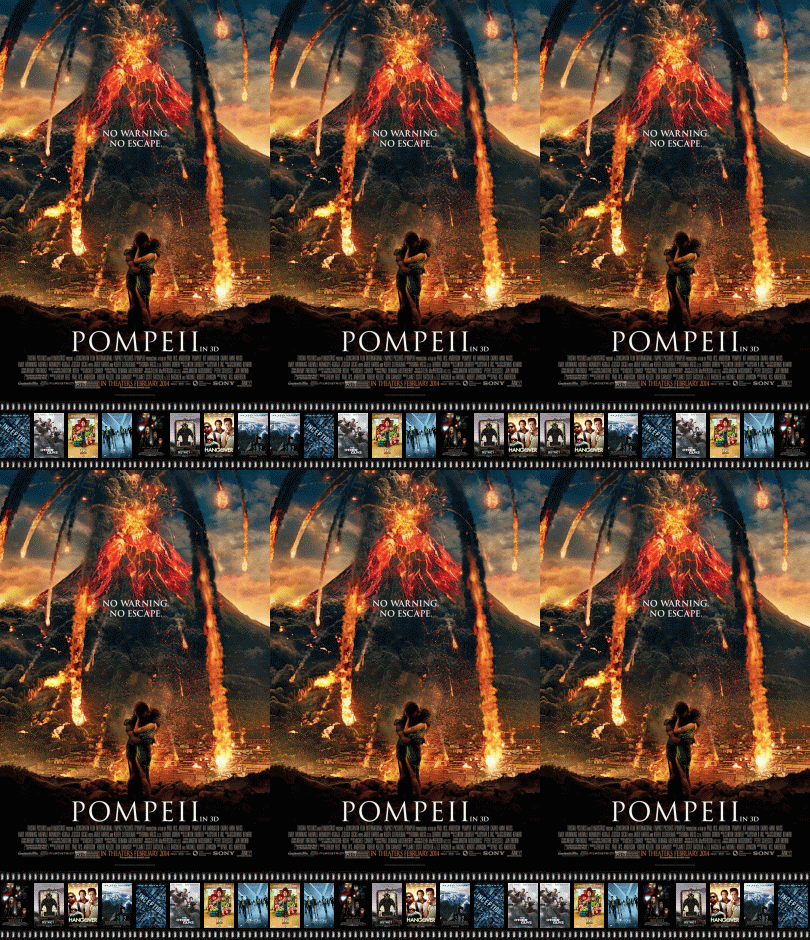
'Pompeii' (film) - movie review

'Pompeii' (film) [Wikipedia]

Pompeii (referred to in marketing as Pompeii in 3D) is a 2014 German-Canadian historical disaster film produced and directed by Paul W. S. Anderson. The film stars Kit Harington, Emily Browning, Carrie-Anne Moss, Adewale Akinnuoye-Agbaje, Jessica Lucas, Jared Harris, and Kiefer Sutherland. It premiered in France, Belgium, and Russia on February 19, 2014 and was released over the course of the next two days in many major territories, including the United States, Canada, India, and Australia.

*************************

'Pompeii' wasn't an "epic" movie, such as 'Spartacus', 'Braveheart', or 'Gladiator'. It was a good movie, and like 'Braveheart', it brought a historical event to life. Apparently, Pompeii was something of a resort city within the Roman Empire... located near modern Naples. It was a major city, and was perhaps more perceived as a "resort town" by Roman authorities.

It would not be giving away the movie to state the obvious... that Pompeii was located right near the foot of Mt. Vesuvius, which was an active volcano which destroyed the city in a horrific manner in 79 AD. Actually it wasn't the lava which destroyed the city and killed its inhabitants, but the real details are too gruesome to go into now. The plot of the movie was fictional.

The film opens with scenes of plaster casts of the victims of Pompeii as quotes on the destruction are made. The opening scene is from the Roman province of Britannia, where Celtic Britons lose in a revolt against the Roman army. The only survivor is a male child named Milo who becomes one of the two chief protagonists. He grows up to be a gladiator in Britannia, and naturally he has a desire for revenge against the Romans in a political and military sense. He is eventually taken to Pompeii to fight in the colosseum arena there, where he meets a princess named Cassia whose father is the city ruler Severus (Jared Harris). Severus' wife, Aurelia, is played by Carrie-Anne Moss. She has such a great character face.


The love affair between Milo (Kit Harington) and Cassia (Emily Browning) is the main plot around which the whole movie revolves. I thought Kiefer Sutherland played the best role, as far as character acting, in the role of Senator Corvus.. a powerful Senator from Rome who was forcing himself on the city's first family while pursuing Cassia for marriage. Naturally Corvus, a classic "bad guy," came into conflict with Milo. This was a very fast-paced film which fits events which would have unfolded over a year or two... into a few days.

The graphics of this movie were very good. Pompeii reminded me of what I perceive Etruscan cities to have looked. The beautiful imagery of the city against the mountains and countryside. During the opening scene in Pompeii.. it was during the "Festival of Vinalia"... a Roman harvest festival held in April and August. Later, the harbor of Pompeii was shown as spectacular and very advanced. Not surprisingly, the special effects of Mt. Vesuvius blowing looked like the end of the world. For the people of Pompeii, it was.

Milo's legitimate issue with Roman authority went along with what was portrayed as a bit of an autonomous feeling by the Pompeiians against Roman dominance over them. The Romans were clearly shown as the antagonists here. One interesting quote from Senator Corvus caught my ear... where he mentions the Roman deities Jupiter and Venus. Jupiter was the god of sky and lightening... symbolized by the eruption of Mt. Vesuvius; while Venus was the goddess of love, beauty, sex, fertility and prosperity... symbolized by Pompeii.

.

Tuesday, August 6, 2013

Ben-Hur (movie review)

Last evening on TCM, I watched 'Ben-Hur' for the first time in a very long time, and I wanted to review it. It is considered one of the epic movies of all time. One aspect of the film which I overlooked when I had watched it as a boy, was the Christian element to it; as it was subtitled 'A Tale of the Christ'. "Ben-Hur" was apparently not based on a real historical figure, but the film was based on an very popular 1880 fictional novel by Govenor/General Lew Wallace of the same title and subtitle.

There had been a 1907 film and a 1925 film based on the novel, and with the same title and subtitle as well. With the upcoming remake, there will be four different film adaptations of the novel, as well as television and many stage adaptations going back over a century. This is one of those movies where a film buff could have a field day researching, including documentaries about it and of how it was made.

The movie opens just as Christ is born. It doesn't actually show it, but it implies it with powerful symbolism, including the Star of Bethlehem moving in the sky and illuminating the spot where he is born. Ben-Hur seems to be the same age as Jesus, and his life runs parallel to his in many ways. Then the film shoots forward twenty-six years as "XXVI" is then shown on the screen with Jerusalem in the background. At this point, the nation of Judea has been conquered by the Roman Empire.

Judah Ben-Hur, played by Charlton Heston, is a wealthy prince and merchant in Jerusalem. At this point his childhood friend Messala, who had joined up with the Romans, has just returned to Judea to rule it as Roman colonial governor. Initially, they are overjoyed to see each other again, and speak of old times... as they are from the same cultural background. However, this soon changes when they begin to speak of Roman colonization. Messala wants to use Ben-Hur to help him crush the rebellions. The heated conversations they have, in my opinion, are the same arguments that people have had from the dawn of mankind to the present day: "Is it okay to betray your people?" Obviously most people have answered "yes" to this question... sometimes even while wrapped up in a flag.

Both have become important young men now. Messala insists that "it's a Roman world now!," while Ben-Hur believes that the Judean nation should go back to being free and sovereign. Messala wants to crush the resistance, while Ben-Hur calls them "patriots." Although it would be much more practical and easy to join up with Messala, Ben-Hur will not give in as he stated that he believes in both the past and future of HIS people.

Eventually Messala finds a reason to lock up Ben-Hur, and he becomes a galley slave, rowing oars on Roman ships. I won't give the movie away, but just as there are parallels with Jesus and Ben-Hur, there is a long battle between Ben-Hur and Messala that takes many dramatic twists and turns. At one point, while being marched across the desert as a slave, the Roman guards will not allow him to drink. While face down on the sand, Jesus gives him water... and he connects with Jesus in a very dramatic way at the end, but I don't want to give it away.

The one scene which the film is best known for is "the chariot race scene," a dramatic sporting competition in Judea, of chariot riders from different Roman colonies; and of which Messala rides for Rome, while Ben-Hur competes for Judea. I wish I could give thoughts about the entire movie, but I won't... but I highly recommend it for anyone who has not seen it yet. Through much suffering, the ending is... to say the least.. special. The movie, espeically the ending, says a lot about love, character, faith, family, culture, and nation.

I thought some of the scenes from Rome, and even some from Jerusalem--especially at night with backgrounds--reminded me of how I perceive what ancient Etruria was like. Even some of the architecture seemed more Etruscan than Greek or Roman. Some of the grand movies of that time, which were based upon the ancient world, were starting to effectively use background imagery.. which I saw some of in 'Ben-Hur.' Also, for the naval battles, believable-looking miniature models were used. A lot of these and other artifacts are available for public viewing.

Ben-Hur is known for its cinematography, which included tremendous Roman pageantry... of which they retained for applicable scenes... without overdoing it. This was a movie with many dramatic ups and downs. There are a lot of dark scenes. The ending scene from Ben-Hur could be metaphorically tied to the scene in the 'Shawshank Redemption' where Andy Dufresne finally emerges from the sanitation pipe... except even better. There was a great cast, as well as many other remarkable aspects to the film, which you can see some of in the below link:


Ben-Hur (1959 film) [Wikipedia]

Ben-Hur is a 1959 American epic historical drama film set in ancient Rome, directed by William Wyler, produced by Sam Zimbalist and starring Charlton Heston, Stephen Boyd, Jack Hawkins, Hugh Griffith and Haya Harareet. It won a record 11 Academy Awards, including Best Picture, an accomplishment that was not equaled until Titanic in 1997 and then again by The Lord of the Rings: The Return of the King in 2003.

A remake of the 1925 silent film with the same name, Ben-Hur was adapted from Lew Wallace's 1880 novel Ben-Hur: A Tale of the Christ. The screenplay is credited to Karl Tunberg but includes contributions from Maxwell Anderson, S. N. Behrman, Gore Vidal, and Christopher Fry. Ben-Hur had the largest budget and the largest sets built for any film produced. The nine-minute chariot race has become one of cinema's most famous sequences. The score composed by Miklós Rózsa was highly influential on cinema for more than 15 years, and is the longest ever composed for a film.


.

Friday, May 31, 2013

Gallo-Italic languages

After the Romans conquered the Gallo-Alpine tribes, the slow process of linguistic Romanization of the languages began. Ancient family and village names were either translated or an Italian suffix was added on to the end (ini, oni, ucci, etti, etc.). In this way, a translated Sicilian name could be the same as a translated Piedmontese name. Still, after the fall of Rome, language shifted back to the natives languages and dialects. What we had in 1860 were the hybrid languages of Roman-Latin and the various Cisalpine dialects. Had cultural and linguistic Romanization not taken place, the Italian peninsula would be just like the Balkans today in terms of constituting entirely different languages and cultures.

If you look at the "linguistic map of Italy," and then look at the nations of 1860 (or any map between the fall of Rome and the Risorgimento, or even the regions today), it always closely matches! There is always the "northern nations," the "Roman state," and the "southern nations." All separated by different languages with local dialects. As Americans, we have a hard time comprehending the way Europe was socio-geographically over the centuries. I could move to Montana, a thousand miles away, tomorrow and instantly become a Montanan. That's what we're used to. I could move From the Bay Area to Maine, and probably fit in better than I do here, even though I have no knowledge of the state. That would be like going from Ireland to Belarus. The cultural-geographical scale, up until very recently, was entirely different.


Within many Italian provinces, there exists even different native dialects (ex. Brescia). Sometimes there are even two different language families, and in parts of the Tri-Veneto area there are three different deep-rooted languages spoken (Italian, Venetian, and Ladin), and it was once four when the German-Cimbrian language was alive. [I would consider the South Tyrol to be a different dynamic since it was wrongly acquired after World War II.]


Gallo-Italic languages (Wikipedia)

The Gallo-Italian or Gallo-Italic languages constitute the majority of northern Italian languages. Among them are are Piedmontese, Lombard, Emiliano-Romagnolo and Ligurian, although there is some doubt about the position of the latter due to its retention of final /o/.

The Gallo-Italian languages have characteristics both of the Gallo-Romance languages to the northwest (including French and Occitan) and the Italo-Romance languages to the south (including standard Italian). Examples of the former are the loss of all final vowels other than -a; the occurrence of lenition; the development of original /kt/ to /jt/ (and often later to /tʃ/); and the development of front-rounded vowels (e.g. the change of /u/ to /y/). Examples of the latter are the use of vowel changes to indicate plurals, in place of /s/; the widespread occurrence of metaphony of stressed vowels, triggered by original final /i/; and the development in some areas of /tʃ/ instead of /ts/ as the result of palatalization of original /k/ before e and i. As a result, there is some debate over the proper grouping of the Gallo-Italian languages. Most commonly, they are grouped with the Gallo-Romance languages, but some Italian linguists prefer to group them with the Italo-Romance languages.


Geographic distribution

Traditionally spoken in Northern Italy, Southern Switzerland, San Marino and Monaco, most Gallo-Italian languages have given way in everyday use to Standardized Italian. The vast majority of current speakers are bilingual with Italian. These languages are still spoken by immigrants in countries with Italian immigrant communities. Ligurian is formalised in Monaco as Monegasque.

The Venetian language is usually considered to belong to a different dialect community, while some publications place it among the Gallo-Italian languages.


.

Thursday, October 25, 2012

Spot where Julius Caesar was stabbed discovered

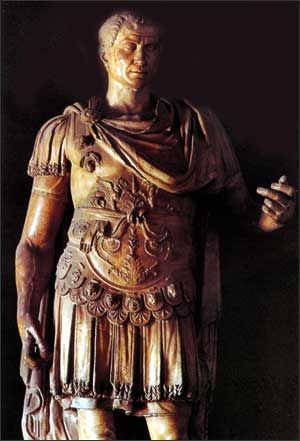
Spot where Julius Caesar was stabbed discovered [see image]
 
Concrete structure believed to mark location of Roman ruler's killing


By Stephanie Pappas - Senior writer - MSNBC - October 11, 2012

Archaeologists believe they have found the first physical evidence of the spot where Julius Caesar died, according to a new Spanish National Research Council report.

Caesar, the head of the Roman Republic, was stabbed to death by a group of rival Roman senators on March 15, 44 B.C., the Ides of March. The assassination is well-covered in classical texts, but until now, researchers had no archaeological evidence of the place where it happened.

Now, archaeologists have unearthed a concrete structure nearly 10 feet wide and 6.5 feet tall that may have been erected by Augustus, Julius Caesar's successor, to condemn the assassination. The structure is at the base of the Curia, or Theater, of Pompey, the spot where classical writers reported the stabbing took place.

"We always knew that Julius Caesar was killed in the Curia of Pompey on March 15th 44 B.C. because the classical texts pass on so, but so far no material evidence of this fact, so often depicted in historicist painting and cinema, had been recovered," Antonio Monterroso, a researcher at the Spanish National Research Council, said in a statement.

Classical texts also say that years after the assassination, the Curia was closed and turned into a memorial chapel for Caesar. The researchers are studying this building along with another monument in the same complex, the Portico of the Hundred Columns, or Hecatostylon; they are looking for links between the archaeology of the assassination and what has been portrayed in art.

"It is very attractive, in a civic and citizen sense, that thousands of people today take the bus and the tram right next to the place where Julius Caesar was stabbed 2,056 years ago," Monterroso said.


.

Saturday, June 30, 2012

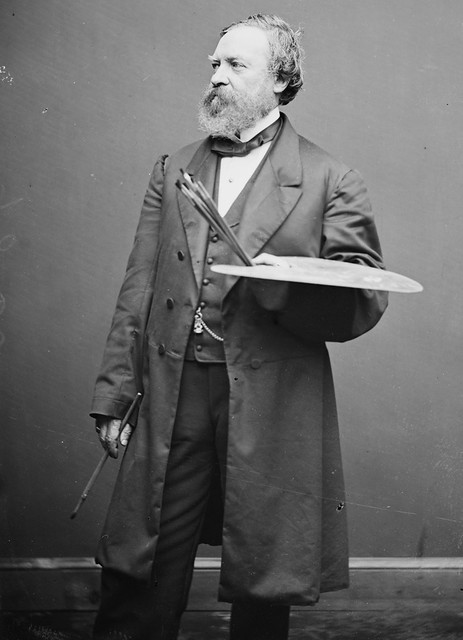
Constantino Brumidi: Artist of the Capitol

Brumidi was half Roman, so we conisder that at least an honorary Cisalpine; and in our opinion, a Padanian-American. Modern Romans are northern in character. It's surprising that there isn't much information out there on him, considering that his craftmanship is still very much featured in the U.S. capitol building. Here is a sample of that artwork. It appears--to put it bluntly--like any situation where someone was contracted to do a job, did it very well, and was forgotten about.

June 10, 2008: Rep. Ackerman manages legislation on the House floor to posthumously award Constantino Brumidi, the Artist of the Capitol, with a Congressional Gold Medal.


Constantino Brumidi (from Wikipedia)

Constantino Brumidi (July 26, 1805 – February 19, 1880) was a Greek/Italian-American historical painter, best known and honored for his fresco work in the Capitol Building in Washington, DC.


Parentage and early life

Brumidi was born in Rome, his father a Greek from Filiatra in the province of Messinia, Greece, and his mother an Italian. He showed his talent for fresco painting at an early age and painted in several Roman palaces, among them being that of Prince Torlonia. Under Gregory XVI he worked for three years in the Vatican.


Emigration and following work

The occupation of Rome by French forces in 1849 apparently persuaded Brumidi to emigrate, having joined the short-lived risorgimental Roman Republic, and he sailed for the United States, where he became a naturalized citizen in 1852. Taking up his residence in New York City, the artist painted a number of portraits. Subsequently he undertook more important works, the principal being a fresco of the Crucifixion in St. Stephen's Church, for which he also executed a Martyrdom of St. Stephen and an Assumption of Mary. He also executed frescoes at Taylor's Chapel, Baltimore, Maryland.

In 1854 Brumidi went to Mexico, where he painted an allegorical representation of the Holy Trinity in the Mexico City cathedral. On his way back to New York he stopped at Washington D.C. and visited the Capitol. Impressed with the opportunity for decoration presented by its vast interior wall spaces, he offered his services for that purpose to Quartermaster General Montgomery C. Meigs. This offer was accepted, and about the same time he was commissioned as a captain of cavalry.

His first art work in the Capitol Building was in the meeting room of the House Committee on Agriculture. At first he received eight dollars a day, which Jefferson Davis, then Secretary of War of the United States, helped increase to ten dollars. His work attracting much favourable attention, he was given further commissions, and gradually settled into the position of a Government painter. His chief work in Washington was done in the rotunda of the Capitol and included the Apotheosis of George Washington in the dome and the Frieze of American History, which contains allegorical scenes from American history. His work in the rotunda was left unfinished at his death, but he had decorated many other sections of the building, most notably hallways in the Senate side of the Capitol now known as the Brumidi Corridors.

In the Cathedral-Basilica of Sts. Peter and Paul in Philadelphia, Pennsylvania, he pictured St. Peter and St. Paul. Brumidi was a capable, if conventional painter, and his black and white modeling in the work at Washington, in imitation of bas-relief, is strikingly effective. He decorated the entrance hall of Saleaudo, located at Frederick, Maryland, and listed on the National Register of Historic Places in 1979.

He died in Washington, DC.

Forgotten for many years, Brumidi's role was rescued from obscurity by Myrtle Cheney Murdock.

.

Wednesday, November 4, 2009

How did the Cisalpine Romanized Gauls receive the Langobards?

In 568, when the Langobards crushed the Byzantine army and became the rulers of the cisalpine region, how did the populace accept the Langobards? According to false perception, they were barbarians who oppressed the "Roman" citizenry of the region. First of all, the populace was not any more ethnically "Roman" than any of the other former Roman provinces in Europe. Like in France, they were basically Romanized Gauls, at least in most of this new conquered territory.

In the forward to the book 'The Lombard Laws' (Katherine Fisher; 1973), on pages XV to XVI, Edward Peters states the following:

"In military and political terms, at least, the Lombards encountered little of that resistance that the Romans had used so successfully against the Visigoths and Ostrogoths. Nor did the Lombards encounter that deeper-rooted social resistance that and organized provincial population, no matter how remote from imperial support, might have offered.

"The devastations of the Gothic wars and the heavy hand of the imperial restoration debilitated even the social fabric of Italy, leaving little in the way of a senatorial or curial class that might have led a resistance movement. With the reduction in imperial taxes that accompanied the Lombard occupation, moreover, even such resistance as might have been generated lost at least the cause of fiscal oppression, and many wealthy Romans fled toward, not away from, the new rulers of northern Italy. Life under the Lombards may well have been preferable to life under the imperial bureaucracy; it was certainly less expensive. Not only were the Lombards fortunate in having little serious military and social resistance, but they encountered little institutional or cultural resistance as well."

It continues on, but that gave the gist of it. Again, by "Romans," Peters is referring to the general population of Romanized Gauls. While other conquered Roman territories were given the respect of having the usage of their ethnic or national label after the Roman era was over, the mere existence of the modern state of Italy was enough to compel historians us use "Roman" here. The main point, however, is that they were not "oppressed" under the Langobards. In fact, it appears that they were actually happy with the change! Germanic and Celtic people were not strangers, historically speaking.

Saturday, January 10, 2009

The Celti and the Trophy of Augustus

As with the Etruscan civilization, the Roman Empire devoured the Celtic tribes in Northern Italy. I want to make it entirely clear that the Romans deliberately destroyed its parent Etruscan culture. There is very little left of the Etruscans. It was similar to a country literally and purposely eliminating itself in favor of going global.

In the case of the Celti, it was simple imperialism. The tribes constituted a small nation. So how shall we view this conquering of the Etruscans or Celti? I don't have that answer, but I think that we should be open-minded about the Roman Empire. There are two ways to look at it. One, a light in a world of darkness, which it was. And two, an oppressive imperialistic empire, which it was as well.

Had there been no Rome, I believe that the Etruscans, the early Italic tribes in Northern Italy, and the Celti, would have eventually merged into a greater Etruria that would have encompassed all of the North from the old Rome. The Greeks likely would have permanently annexed Southern Italy from Naples (Greek "Neapolis").

***************************************************************************

Trophy of Augustus (Wikipedia; see impressive images)

The Trophy of the Alps or Trophy of Augustus was built by the Roman emperor Augustus to celebrate his definitive victory over the ancient Celto-Ligurian tribes who populated the region and who had harassed merchants along Roman roads. Its remains may be seen in the Commune of La Turbie (Alpes-Maritimes), on the Grande Corniche, 6 km from Monaco, and is the principal tourist attraction for the Commune. There is also a small museum with a scale model of the Trophy.

Construction

The stone used to build the monument was originally extracted from the Roman quarry located about 500 meters away. Visitors to that site can still see the traces of sections of carved columns in the stone.

The monument as partially restored by archaeologists at the beginning of the 20th century, is 35 meters high. When built, according to the architect, the base measured 35 meters in length, the first platform 12 meters in height, and the rotunda of 24 columns with its statue of an enthroned Augustus is 49 meters high.

Inscription

One of the stones of the tower, which Pliny the Elder transcribed, contained the names of the tribes. It reads:

"To the emperor Caesar, son of the deified Caesar, Augustus, Pontifex Maximus, hailed as Imperator for the 14th time, in his 17th year of tribunician power, the Senate and people of Rome [built this], in commemoration that, under his leadership and auspices, all the Alpine peoples, from the upper sea to the lower sea, were submitted to the Roman Empire. Conquered Alpine peoples:

"· The TRUMPILINI
· The CAMUNNI
· The VENOSTES
· The VENNONETES
· The ISARCI
· The BREUNI
· The GENAUNES
· The FOCUNATES
· The four VINDELICUS nations
· The COSUANETES
· The RUCINATES
· The LICATES


· The CATENATES
· The AMBISONTES
· The RUGUSCI
· The SUANETES
· The CALUCONES
· The BRIXENETES
· The LEPONTI
· The UBERI
· The NANTUATES
· The SEDUNI
· The VARAGRI
· The SALASSI


· The ACITAUONES
· The MEDULLI
· The UCENNI
· The CATURIGES
· The BRIGIANI
· The SOGIONTI
· The BRODIONTI
· The NEMALONI
· The EDENATES
· The VESUBIANI
· The VEAMINI
· The GALLITAE


· The TRIULLATI
· The ECDINI
· The VERGUNNI
· The EGUITURI
· The NEMATURI
· The ORATELLI
· The NERUSI
· The VELAUNI
· The SUETRI"

Later life

The monument originally served no military purpose and contained no fortress. Rather, it marked the boundary between Italy and Gallia Narbonensis, later pushed back to the Var. Between the 12th and 15th centuries, however, the Trophy did become a fortress, with locals building houses around its walls. In 1705, when war broke out between Savoy and France during the War of the Spanish Succession, Louis XIV ordered the destruction of all fortresses in the region, including this one. The partially destroyed Trophy then became a quarry and its stones were used, among other things, to build the nearby church of Saint-Michel.

Nearby Roman remains

The area surrounding the Trophy is rich with remnants of the Roman empire such as the famous Roman roads. The Trophy is situated on the Via Julia Augusta, named after the emperor Augustus, which is a continuation of the Via Aurelia which linked Vintimille to Cimiez (Nice). Various fountains within the territory of the communes of Beausoleil and Roquebrune-Cap-Martin are also said to be Roman.

Trophy of the Alps (more images)

***************************************************************************

The following is a quick history lesson the the origin of the Celts. Most identify the Celts with Ireland or Scotland, but they lived on the European mainland long before migrating to the British Isles. We can look more closely into the Celts at a future time. Also, it should be pointed out that not all of the tribes listed on the Trophy of Augustus were Celti. They were as written "conquered Alpine peoples."

***************************************************************************

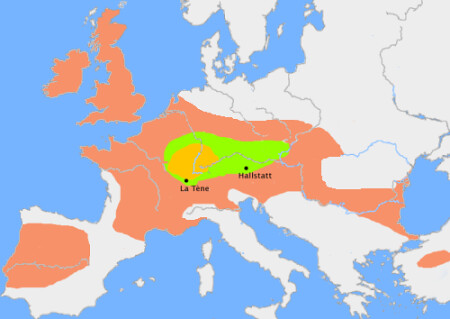
Celts in Europe 400BC - 800 BC

The Celts also expanded down the Danube river and its tributaries. One of the most influential tribes, the Scordisci, had established their capital at Singidunum in 3rd century BC, which is present-day Belgrade. The concentration of hill-forts and cemeteries shows a density of population in the Tisza valley of modern-day Vojvodina, Hungary and into Ukraine. Expansion into Romania was supposedly limited , according to certain sources, yet syncreticsm of Celtic art is evident in contemporary Romanian folk art

Further south, Celts settled in Thrace (Bulgaria), which they ruled for over a century, and Anatolia, where they settled as the Galatians. Then, having taken advantage of easing of Macedon after civil war, the Celts have destroyed an army of its king Ptolemeus Keravn and have plundered Greece. Despite their geographical isolation from the rest of the Celtic world, the Galatians maintained their Celtic language for at least seven hundred years. One of the largest ports on the Lower Danube in Romania is called Galati and Galata is another Celtic toponym in Turkey.

The Boii tribe gave their name to Bohemia (Czech Republic) and to -see above- Bologna (Italy ) and Celtic artifacts and cemeteries have been discovered further east in both Poland and Slovakia. A celtic coin (Biatec) from Bratislava's mint is displayed on today's Slovak 5 crown coin.

***************************************************************************

2-11-09 NOTE: It should be noted that the Celts from Gaul (France) did invade northern Etruria and pushed the Etruscans out of the regions where the Alps meet the Po River Valley. Some Celti settled in the southernmost Alps, and some in the area immediately south of it. They seemed to more-or-less get along with the equally rugged Italic tribes living in the Alps. Italic Alpine tribes joined with the Celti in opposing Rome. Really, this is almost exactly like the movie 'Braveheart.' Just like in 'Braveheart,' a few Celt tribes betrayed their kin and joined with the Romans against them.