Showing posts with label Rome. Show all posts

Monday, August 31, 2020

'Missa Papae Marcelli' by Giovanni Pierluigi da Palestrina


Palestrina, Missa Papae Marcelli. The Tallis Scholars, Peter Phillips

1,590,232 views - January 6, 2014

Mnemósine Amnésica

Giovanni Pierluigi da Palestrina (Palestrina, 1525 - Roma, 1594),

Missa Papae Marcelli

The Tallis Scholars,
Peter Phillips, director
The Palestrina 400 Collection

PALESTRINA - MISSA PAPAE MARCELLI
[00,01→]  Kyrie
[04,44→]  Gloria
[11,00→]  Credo
[20,54→]  Sanctus et Benedictus
[28,33→]  Agnus Dei 1 et 2


Más:

Giovanni Pierluigi da Palestrina:
https://en.wikipedia.org/wiki/Giovanni_Pierluigi_da_Palestrina
https://www.refinandonuestrossentidos.com/giovanni-pierluigi-da-palestrina/
https://www.refinandonuestrossentidos.com/giovanni-pierluigi-da-palestrina/#b

Missa Papae Marcelli:
https://en.wikipedia.org/wiki/Missa_Papae_Marcelli
http://orquestaxis.blogspot.com/2009/11/1562-misa-del-papa-marcelo-de-giovanni.html
https://www.refinandonuestrossentidos.com/giovanni-pierluigi-da-palestrina/

Pinturas:
Michelangelo Merisi da Caravaggio (1571 - 1610)
https://en.wikipedia.org/wiki/Caravaggio

 
Music in this video

"Palestrina: Missa Papae Marcelli - 1: Kyrie"

"Palestrina: Missa Papae Marcelli - 2: Gloria"

"Palestrina: Missa Papae Marcelli - 3: Credo"

"Palestrina: Missa Papae Marcelli - 4: Sanctus and Benedictus"

"Palestrina: Missa Papae Marcelli - 5: Agnus Dei"
 

************
 

"Modern "church music" is mere "campfire songs" by comparison" -- The Drake

"Sometimes I feel down, but music like this reminds me that there's much more good in the world than bad." -- Kyrie

"When I hear Palestrina, I believe in God once again." -- raphael18ify


************ 


Palestrina, Missa Brevis. The Tallis Scholars, Peter Phillips

227,768 views - January 12, 2014

Mnemósine Amnésica

Giovanni Pierluigi da Palestrina (Palestrina, 1525 - Roma, 1594),
Missa Brevis
The Tallis Scholars,
Peter Phillips, director
The Palestrina 400 Collection

[00,01→] 1. Palestrina - Missa Brevis - Kyrie
[02,52→] 2. Palestrina - Missa Brevis - Gloria
[05,58→] 3. Palestrina - Missa Brevis - Credo
[11,23→] 4. Palestrina - Missa Brevis - Sanctus et Benedictus.
[15,56→] 5. Palestrina - Missa Brevis - Agnus Dei


Music in this video

"Palestrina: Missa brevis - 1: Kyrie"

"Palestrina: Missa brevis - 2: Gloria"

"Palestrina: Missa brevis - 3: Credo"

"Palestrina: Missa brevis - 4: Sanctus and Benedictus"

"Palestrina: Missa brevis - 5: Agnus Dei I & II"
 

************
 

Missa brevis

.

Tuesday, May 31, 2016

Giulio Romano - Mannerist Artist


Giulio Romano - Italian Mannerist Painter
 

muziczone1

Giulio Romano -Italian Mannerist Painter
 

circa 1499-1546


Giulio Romano

Giulio Romano (c. 1499 – 1 November 1546) was an Italian painter and architect. A pupil of Raphael, his stylistic deviations from high Renaissance classicism help define the 16th-century style known as Mannerism. Giulio's drawings have long been treasured by collectors; contemporary prints of them engraved by Marcantonio Raimondi were a significant contribution to the spread of 16th-century Italian style throughout Europe.


cont'd


.

Thursday, March 3, 2016

'Vergine bella' - Giovanni Pierluigi


Giovanni Pierluigi da Palestrina - Vergine bella - Bronzino

MrThesoundflyer
Palestrina, Vergine bella, from Madrigali spirituali a cinque voci on texts by Francesco Petrarca. Bronzino, paintings. ensemble officium, Wilfried Rombach, conductor.


Giovanni Pierluigi da Palestrina

Giovanni Pierluigi da Palestrina (c. 1525 – 2 February 1594) was an Italian Renaissance composer of sacred music and the best-known 16th-century representative of the Roman School of musical composition. He had a lasting influence on the development of church music, and his work has often been seen as the culmination of Renaissance polyphony.


.

Sunday, February 28, 2016

Computer simulation of ancient Rome 320 CE


Ancient Rome (higher resolution)
 

Smarthistory. art, history, conversation.
 

A project between Khan Academy and Rome Reborn - with Dr. Bernard Frischer
 

Speakers: Dr. Bernard Frischer and Dr. Steven Zucker

.

Thursday, February 11, 2016

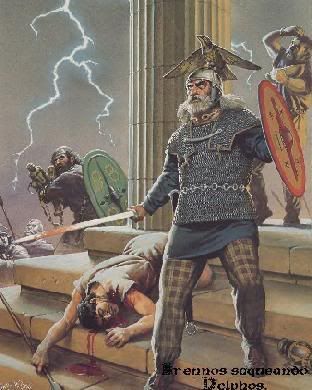
Brennus: Warlord of the Cisalpine Gauls - Part III

Brennus: Hero or plunderer?

Brennus was covered here once before briefly ('Brennus of the 4th century BC'), and the question remains; should Brennus be thought of as our own noble ancestor who stood up against Roman oppressors, or as a foreign invader who only destroyed and plundered? I think the answer is somewhere in the middle.

I recall years ago of reading a Padanian website in English, where Brenno was mentioned as a northern hero. I distinctly remember reading at the end of that particular writing, something like "now Brenno is coming back!" A reference of his Gaulish spirit coming back.

To find the truth, we must recognize two items to begin with. First, Gaul and Cisalpine Gaul were the same culture; and second, the Romans had not invaded the heart of Cisalpine Gaul as of yet. While Brennus was from northern Gaul, there were strong cultural links, For example, part of the northern Gaulish tribe called the Cenomani, apparently migrated to what is now the area of lower Brescia and Verona. These migrations were common, and had occurred over centuries. Therefore, on one hand Brennus was legitimately a powerful figure to the Cisalpine Gauls; while on the other hand the Romans had not invaded the Gauls as of yet. You cannot "strike back" against someone for something they had not done yet; therefore Brennus was more of a plunderer than a resistance fighter.

The simple truth is that the Romans and the Gauls are both part of our heritage. Most the the north were eventually to be culturally "Romanized Gauls." I've always tried to reason that prior to the rise of Rome, there was Gaulish influence in Tuscany and the south ("southern Cisalpina") and Etruscan influence in Lombardy and the north. Had Rome not risen to power, I think that the two cultures (Etruscan-Umbrian and Gaulish-Alpine) would have merged peacefully together. In fact, they already were. In conclusion, in my opinion--as far as this Etrusco-Gaulish ethnic identity concept is concerned--the invading Romans and the later invasion of Germanic tribes were ethno-cultural admixtures.... "secondary influences" as far as ethnicity. Also of interest is that both the Etruscans and the larger Celtic societies, expanded in relative peace. There existed only marginal "pushing" between Etruscans and Gauls; and while local Celtic tribes battled from time to time, it was hardly a clash of civilizations.

In the movie 'Brennus: Enemy of Rome', the Romans were the protagonists. Legitimately defending against an invading barbarian horde. Generally, the Romans are thought of as a civilizing influence amid their ever expanding empire. A cruel system expanding and civilizing an even crueler dark world. The documentary in part one is very interesting with an intentionally ironic title. It showed that the Celtic world (Gaul, British Isles, Spain, south Germany) had a system of roads linking trading centers which traded with other tribes, as well as with Etruscans, Greeks, Phoenicians, etc. They had advanced architecture, including buildings with deep cellars and multiple stories. Their clothing included material, designs, and colors which were very similar to the Scottish clans of much later times. Also, the style of music was similar across this "Celtic world."

It probably wouldn't be entirely truthful to say that Brennus was to the Cisalpine Gauls, what Vercingetorix was to the northern Gauls. There were Cisalpine Gauls among Brennus' army, but Brennus himself was not from Cisalpine Gaul.

************************************************** 

Random fact: I believe that in the movie 'Brennus: Enemy of Rome', Brennus twice made mention of the god "Thor." At one point saying "In the name of Thor!" Thor was a god in the Teutonic pantheon, and not present in Gaulish polytheism. Apparently the filmmakers perceived "the Gauls" as a particular Germanic tribe, instead of an entire culture made up of their own separate tribal groups.

.

Sunday, February 7, 2016

Brennus: Warlord of the Cisalpine Gauls - Part II


Brennus, Enemy of Rome (1963) - Color / 87 mins
 

Vulture Graffix

An English dubbed, Austrian print of Brennus Enemy of Rome (AKA: Brenno der herr des schreckens, AKA: Brenno il nemico di Roma, AKA: Battle of the Valiant). The film was made in 1963 about the sack of Rome in 387 BC. It was written by Adriano Bolzoni, Arpad DeRiso and Nino Scolaro and was directed by Giacomo Gentilomo. It stars Gordon Mitchell, Ursula Davis, Massimo Serato and Tony Kendall.

The story takes various elements from Livy's history of the Gauls' attack on Rome, plus Plutarch's biography of Camillus, and cleverly remixes them to fashion a ripping yarn. The banishment of the Roman general Camillus, the controversy over the spoils of Veii, the involvement of the Fabius brothers, the flight of the Vestal virgins from Rome, the barbarian who tugs the beard of a Roman elder, the honking of the sacred geese, and even Brennus's scornful "Woe to the vanquished!" as he heaps his sword onto the scales, are all from the historical record.... and all give tale to a fictional re imagining of the sack of Rome in 387 B.C. by Brennus, leading an army of Gauls.

You can visit our facebook page for further movie mayhem;
https://www.facebook.com/VultureArt


**************************************************


Random fact: "Brennus" in Latin became Brenno in Italian. The city of Breno in northern Brescia possibly may have been named after Brennus, who would have been a hero in the Gaulish Alps. Ironically, the Gaulish sacking of early Rome directly led to the Roman invasion of the Alps centuries later.

.

Saturday, February 6, 2016

Brennus: Warlord of the Cisalpine Gauls - Part I


Barbarians - The Primitive Celts 

docufans1


So you think you know everything about the Romans? They gave us sophisticated road systems, chariots and the modern-day calendar. And of course they had to contend with barbarian hordes who continually threatened the peace, safety and prosperity of their Empire. Didn't they? Terry Jones' Barbarians takes a completely fresh approach to Roman history. Not only does it offer us the chance to see the Romans from a non-Roman perspective, it also reveals that most of the people written off by the Romans as uncivilized, savage and barbaric were in fact organized, motivated and intelligent groups of people, with no intentions of overthrowing Rome and plundering its Empire.


**************************************************

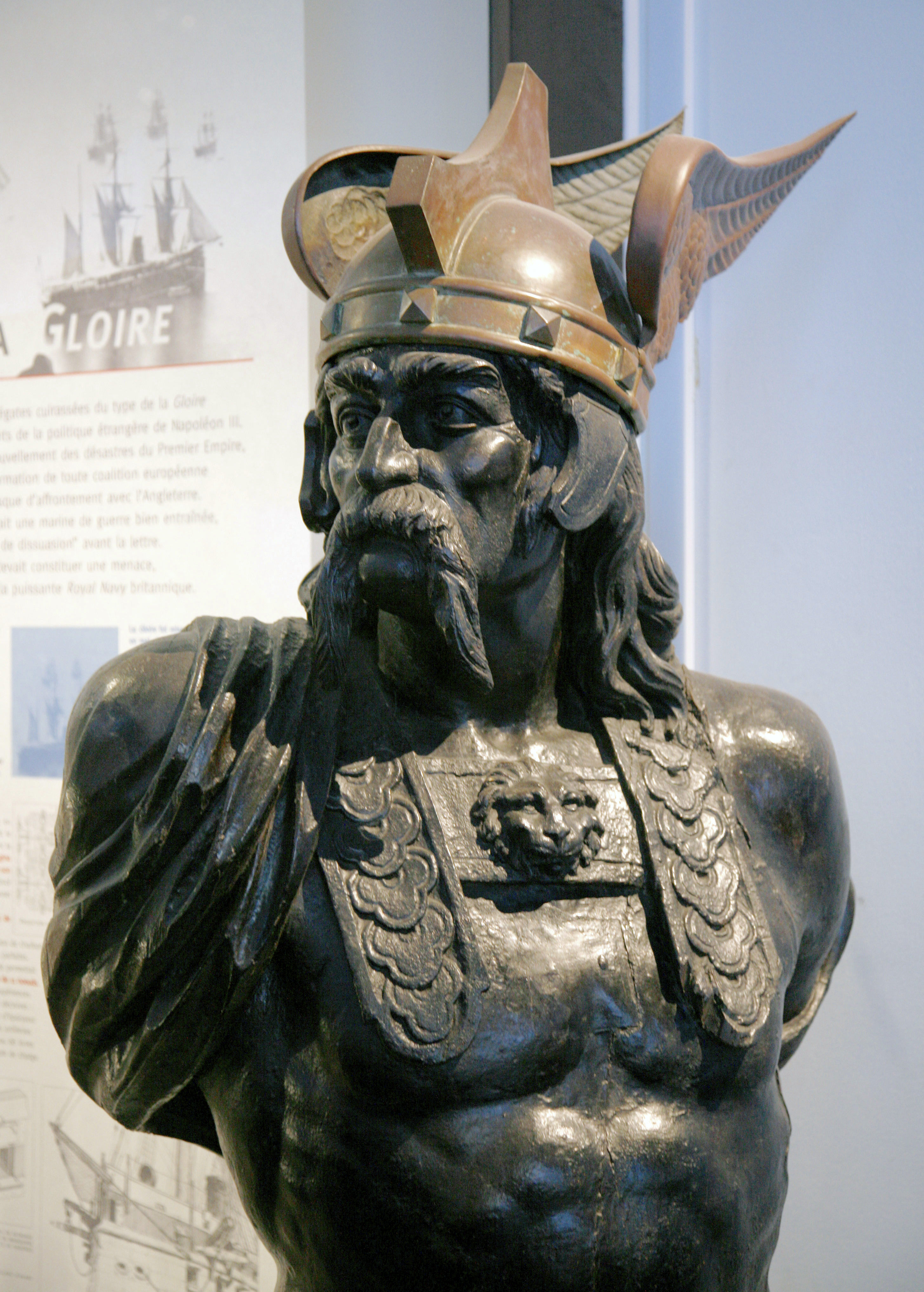
Random fact: Contrary to long held popular perception, the Vikings did not wear horned helmets. However, the Gauls did.


Sunday, September 27, 2015

'The Last Days of Pompeii' (1935) - movie review

The Last Days of Pompeii (1935 film)

The Last Days of Pompeii (1935) is an RKO Radio Pictures film starring Preston Foster and directed by Ernest B. Schoedsack and Merian C. Cooper, creators of the original King Kong. Although inspired by the novel of the same name by Edward Bulwer-Lytton, the film has virtually nothing to do with the book.

This film made good use of artificially generated backgrounds, not entirely unlike computer generated graphics used in films today. The opening scene in Pompeii, with this imagery and music which sounded a bit like the fight song of the University of Southern California, was adequately believable. Black and white films, even through the 50s and even 60s, leave just enough shadow that it somehow allows for a little bit to the imagination.

Preston Foster plays the role of Marcus, a poor honest blacksmith who--through a series of events--ends up as a first rate voluntary gladiator. His character is ambiguous throughout the film. He starts out as a noble-minded and hard-working craftsman; but though some tragic events and great loss, takes on the cold attitude that "money is what really counts." Still, he never quite sells out completely, and the good man underneath remains somewhat dormant. He shows a good heart in adopting the son, named Flavius, of a man he has slain in the arena.

After a profitable period as a gladiator, Marcus becomes a slave trader for a short time, then a seaman and adventurer... something like a soldier of fortune. There are a lot of small but important and prophetic items during a time that he travels with Flavius to the Roman colony of Judea that sets the stage for the rest of the film, but are too numerous to mention in this short review. Now as a man of some fame, he meets the Roman prefect of Judea, Pontious Pilate, and they become close friends after Marcus leads what seems to be an off-the-record raid on a band of Pilate's enemies in the countryside. Pontius Pilate is portrayed as a wise man of some conscience, who seems to feel some guilt for having condemned a particular man to crucifixion. That man, although never named in the movie, was Jesus. They split the loot and Marcus returns to Pompeii.


Although the movie was obscure about it, Marcus and Flavius visited an encampment where Jesus was speaking and was active. At at later point, mentioned only later in the film in reference, they observed
Jesus and others being crucified. Both seemed strongly affected by their encounter with Jesus. Marcus denied the experience outwardly, while the young Flavius never forgot it. Basically this fictional film, through the story of the characters, subtly ties together the destruction of Pompeii with the beginnings of Christianity. When the now wealthy and popular Marcus returns to Pompeii, he becomes the important "head of the arena"; I suppose something equivalent to maybe a former football star becoming a director of football operations. During this mid-point in the film, Mt. Vesuvius is depicted ominously smoldering in the background, with one character making reference to it briefly.

.

Spoiler alert beyond this point!

.

.

.

.

.

.


Pompeii ruins with Mt. Vesuvius in the background
After a major slave revolt and escape, the new prefect for the region was compelled to hunt them down. The penalty for this crime was death. Flavius, with this "Christian ideas," was secretly helping to hide these slaves and making arrangements to lead them to a safe island. When they were all captured, Marcus was pleased and began organizing some arena "games" for them as part of their consequence. After being told just before the games that his son was captured along with them, he naturally goes bananas and tries but fails to free him before the prefect discovers what has happened. Finally, Flavius and the others are put into the arena to fight while Marcus dramatically and unsuccessfully scrambles to do something.

During the chaos, Mt. Vesuvius erupts and there's a very powerful earthquake. Pompeii starts to crumble as lava pours down towards the city. Actually in the real event, it was a type of super-hot and toxic smoke vapor that did in Pompeii and its inhabitants; but perhaps this wasn't known in 1935. After initially breaking down emotionally, Marcus quickly recovers--like the Grinch who stole Christmas--and saves a jailer (and the jailer's young son) who earlier would not accept a bribe to release his own son. He then starts loading children onto boats in the harbor ahead of himself. Eventually he saves his son and finally explicitly risks his life standing up to the prefect and his soldiers who wanted to take a boat for themselves away from some children. Marcus is badly wounded by a spear, but his effort allows that last boat to sail to safety.

As this was happening, the city was finally crushed. The final scene shows Marcus dying amid the ruins as he sees the spirit of Jesus come before him... presumably to reward him for his selfless redeeming efforts. Quite an emotional ending for this old film. This film, as well as numerous other works, was inspired by the 1834 novel 'The Last Days of Pomeii', written by the English author Edward Bulwer-Lytton.

.

Wednesday, June 17, 2015

Federico Fellini on 'Biography'


Biography: Federico Fellini

Pobednik1985


**************************************************

Federico Fellini

Federico Fellini (Italian: January 20, 1920 – October 31, 1993) was an Italian film director and scriptwriter. Known for his distinct style that blends fantasy and baroque images with earthiness, he is considered one of the greatest and most influential filmmakers of the 20th century.

In a career spanning almost fifty years, Fellini won the Palme d'Or for La Dolce Vita, was nominated for twelve Academy Awards, and directed four motion pictures that won Oscars in the category of Best Foreign Language Film. In 1993, he was awarded an honorary Oscar for Lifetime Achievement at the 65th Annual Academy Awards in Los Angeles.


**************************************************

Federico Fellini was of Romagnol ancestry.

.

Tuesday, June 16, 2015

'The World Of Enrico Fermi' - 1970 Documentary


The World Of Enrico Fermi (1970)

AskUsAnyQuestion


"A documentary which portrays the life and work of the nearly contemporary physicist, Enrico Fermi, whose work helped to transform not only physics and the style of doing research, but even the course of history itself.

This movie is part of the collection: Academic Film Archive of North America

Producer: Harvard Project Physics.; Holt, Rinehart, and Winston, inc."
https://archive.org/details/TheWorldOfEnricoFermi


************************************************** 

Enrico Fermi was one of the greatest scientists of all time. Born in Rome to a family originally from Piedmont. There's a big difference, I think, between certain "famous scientists" today who are all talk, and often make surprisingly stupid remarks regarding other issues, and ones like Tesla or Fermi who were real doers!

**************************************************

Enrico Fermi (Wikipedia)

Enrico Fermi; 29 September 1901 – 28 November 1954) was an Italian physicist, best known for his work on Chicago Pile-1 (the first nuclear reactor), and for his contributions to the development of quantum theory, nuclear and particle physics, and statistical mechanics. He is one of the men referred to as the "father of the atomic bomb". Fermi held several patents related to the use of nuclear power, and was awarded the 1938 Nobel Prize in Physics for his work on induced radioactivity by neutron bombardment and the discovery of transuranic elements. He was widely regarded as one of the very few physicists to excel both theoretically and experimentally.

Fermi's first major contribution was to statistical mechanics. After Wolfgang Pauli announced his exclusion principle in 1925, Fermi followed with a paper in which he applied the principle to an ideal gas, employing a statistical formulation now known as Fermi–Dirac statistics. Today, particles that obey the exclusion principle are called "fermions". Later Pauli postulated the existence of an uncharged invisible particle emitted along with an electron during beta decay, to satisfy the law of conservation of energy. Fermi took up this idea, developing a model that incorporated the postulated particle, which he named the "neutrino". His theory, later referred to as Fermi's interaction and still later as weak interaction, described one of the four fundamental forces of nature. Through experiments inducing radioactivity with recently discovered neutrons, Fermi discovered that slow neutrons were more easily captured than fast ones, and developed the Fermi age equation to describe this. After bombarding thorium and uranium with slow neutrons, he concluded that he had created new elements; although he was awarded the Nobel Prize for this discovery, the new elements were subsequently revealed to be fission products.

Fermi left Italy in 1938 to escape new Italian Racial Laws that affected his Jewish wife Laura. He emigrated to the United States where he worked on the Manhattan Project during World War II. Fermi led the team that designed and built Chicago Pile-1, which went critical on 2 December 1942, demonstrating the first artificial self-sustaining nuclear chain reaction. He was on hand when the X-10 Graphite Reactor at Oak Ridge, Tennessee went critical in 1943, and when the B Reactor at the Hanford Site did so the next year. At Los Alamos he headed F Division, part of which worked on Edward Teller's thermonuclear "Super" bomb. He was present at the Trinity test on 16 July 1945, where he used his Fermi method to estimate the bomb's yield.

After the war, Fermi served under J. Robert Oppenheimer on the influential General Advisory Committee, which advised the Atomic Energy Commission on nuclear matters and policy. Following the detonation of the first Soviet fission bomb in August 1949, he strongly opposed the development of a hydrogen bomb on both moral and technical grounds. He was among the scientists who testified on Oppenheimer's behalf at the 1954 hearing that resulted in the denial of the latter's security clearance. Fermi did important work in particle physics, especially related to pions and muons, and he speculated that cosmic rays arose through material being accelerated by magnetic fields in interstellar space. Many awards, concepts, and institutions are named after Fermi, including the Enrico Fermi Award, the Enrico Fermi Institute, the Fermi National Accelerator Laboratory, the Fermi Gamma-ray Space Telescope, the Enrico Fermi Nuclear Generating Station, and the synthetic element fermium.


.

Saturday, November 29, 2014

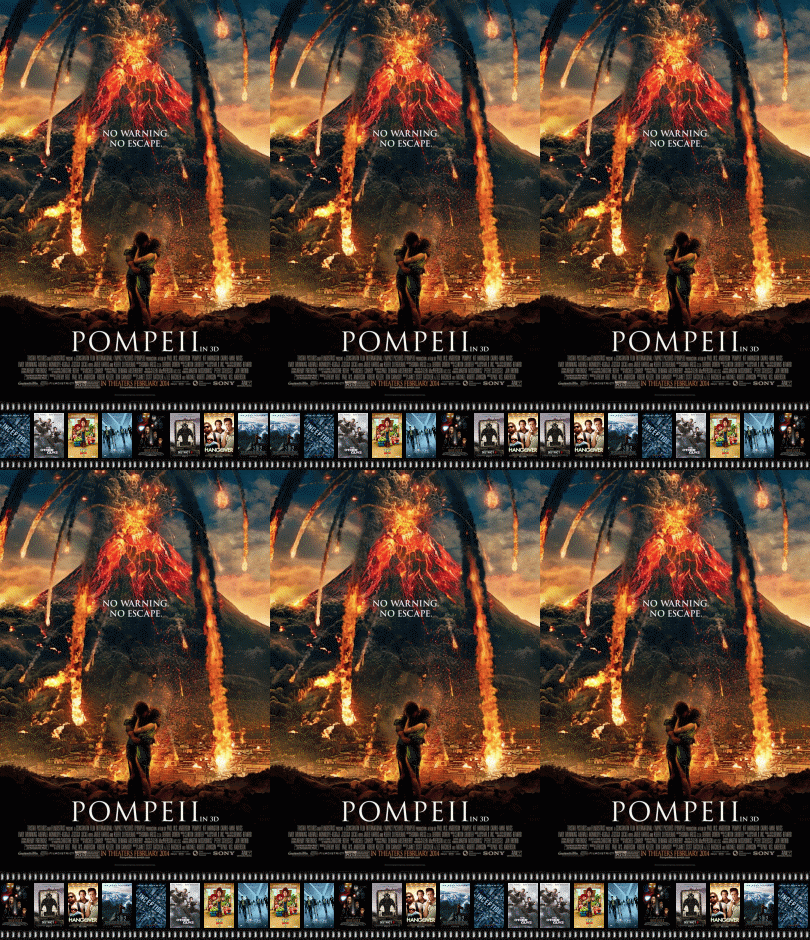
'Pompeii' (film) - movie review

'Pompeii' (film) [Wikipedia]

Pompeii (referred to in marketing as Pompeii in 3D) is a 2014 German-Canadian historical disaster film produced and directed by Paul W. S. Anderson. The film stars Kit Harington, Emily Browning, Carrie-Anne Moss, Adewale Akinnuoye-Agbaje, Jessica Lucas, Jared Harris, and Kiefer Sutherland. It premiered in France, Belgium, and Russia on February 19, 2014 and was released over the course of the next two days in many major territories, including the United States, Canada, India, and Australia.

*************************

'Pompeii' wasn't an "epic" movie, such as 'Spartacus', 'Braveheart', or 'Gladiator'. It was a good movie, and like 'Braveheart', it brought a historical event to life. Apparently, Pompeii was something of a resort city within the Roman Empire... located near modern Naples. It was a major city, and was perhaps more perceived as a "resort town" by Roman authorities.

It would not be giving away the movie to state the obvious... that Pompeii was located right near the foot of Mt. Vesuvius, which was an active volcano which destroyed the city in a horrific manner in 79 AD. Actually it wasn't the lava which destroyed the city and killed its inhabitants, but the real details are too gruesome to go into now. The plot of the movie was fictional.

The film opens with scenes of plaster casts of the victims of Pompeii as quotes on the destruction are made. The opening scene is from the Roman province of Britannia, where Celtic Britons lose in a revolt against the Roman army. The only survivor is a male child named Milo who becomes one of the two chief protagonists. He grows up to be a gladiator in Britannia, and naturally he has a desire for revenge against the Romans in a political and military sense. He is eventually taken to Pompeii to fight in the colosseum arena there, where he meets a princess named Cassia whose father is the city ruler Severus (Jared Harris). Severus' wife, Aurelia, is played by Carrie-Anne Moss. She has such a great character face.


The love affair between Milo (Kit Harington) and Cassia (Emily Browning) is the main plot around which the whole movie revolves. I thought Kiefer Sutherland played the best role, as far as character acting, in the role of Senator Corvus.. a powerful Senator from Rome who was forcing himself on the city's first family while pursuing Cassia for marriage. Naturally Corvus, a classic "bad guy," came into conflict with Milo. This was a very fast-paced film which fits events which would have unfolded over a year or two... into a few days.

The graphics of this movie were very good. Pompeii reminded me of what I perceive Etruscan cities to have looked. The beautiful imagery of the city against the mountains and countryside. During the opening scene in Pompeii.. it was during the "Festival of Vinalia"... a Roman harvest festival held in April and August. Later, the harbor of Pompeii was shown as spectacular and very advanced. Not surprisingly, the special effects of Mt. Vesuvius blowing looked like the end of the world. For the people of Pompeii, it was.

Milo's legitimate issue with Roman authority went along with what was portrayed as a bit of an autonomous feeling by the Pompeiians against Roman dominance over them. The Romans were clearly shown as the antagonists here. One interesting quote from Senator Corvus caught my ear... where he mentions the Roman deities Jupiter and Venus. Jupiter was the god of sky and lightening... symbolized by the eruption of Mt. Vesuvius; while Venus was the goddess of love, beauty, sex, fertility and prosperity... symbolized by Pompeii.

.

Tuesday, August 6, 2013

Ben-Hur (movie review)

Last evening on TCM, I watched 'Ben-Hur' for the first time in a very long time, and I wanted to review it. It is considered one of the epic movies of all time. One aspect of the film which I overlooked when I had watched it as a boy, was the Christian element to it; as it was subtitled 'A Tale of the Christ'. "Ben-Hur" was apparently not based on a real historical figure, but the film was based on an very popular 1880 fictional novel by Govenor/General Lew Wallace of the same title and subtitle.

There had been a 1907 film and a 1925 film based on the novel, and with the same title and subtitle as well. With the upcoming remake, there will be four different film adaptations of the novel, as well as television and many stage adaptations going back over a century. This is one of those movies where a film buff could have a field day researching, including documentaries about it and of how it was made.

The movie opens just as Christ is born. It doesn't actually show it, but it implies it with powerful symbolism, including the Star of Bethlehem moving in the sky and illuminating the spot where he is born. Ben-Hur seems to be the same age as Jesus, and his life runs parallel to his in many ways. Then the film shoots forward twenty-six years as "XXVI" is then shown on the screen with Jerusalem in the background. At this point, the nation of Judea has been conquered by the Roman Empire.

Judah Ben-Hur, played by Charlton Heston, is a wealthy prince and merchant in Jerusalem. At this point his childhood friend Messala, who had joined up with the Romans, has just returned to Judea to rule it as Roman colonial governor. Initially, they are overjoyed to see each other again, and speak of old times... as they are from the same cultural background. However, this soon changes when they begin to speak of Roman colonization. Messala wants to use Ben-Hur to help him crush the rebellions. The heated conversations they have, in my opinion, are the same arguments that people have had from the dawn of mankind to the present day: "Is it okay to betray your people?" Obviously most people have answered "yes" to this question... sometimes even while wrapped up in a flag.

Both have become important young men now. Messala insists that "it's a Roman world now!," while Ben-Hur believes that the Judean nation should go back to being free and sovereign. Messala wants to crush the resistance, while Ben-Hur calls them "patriots." Although it would be much more practical and easy to join up with Messala, Ben-Hur will not give in as he stated that he believes in both the past and future of HIS people.

Eventually Messala finds a reason to lock up Ben-Hur, and he becomes a galley slave, rowing oars on Roman ships. I won't give the movie away, but just as there are parallels with Jesus and Ben-Hur, there is a long battle between Ben-Hur and Messala that takes many dramatic twists and turns. At one point, while being marched across the desert as a slave, the Roman guards will not allow him to drink. While face down on the sand, Jesus gives him water... and he connects with Jesus in a very dramatic way at the end, but I don't want to give it away.

The one scene which the film is best known for is "the chariot race scene," a dramatic sporting competition in Judea, of chariot riders from different Roman colonies; and of which Messala rides for Rome, while Ben-Hur competes for Judea. I wish I could give thoughts about the entire movie, but I won't... but I highly recommend it for anyone who has not seen it yet. Through much suffering, the ending is... to say the least.. special. The movie, espeically the ending, says a lot about love, character, faith, family, culture, and nation.

I thought some of the scenes from Rome, and even some from Jerusalem--especially at night with backgrounds--reminded me of how I perceive what ancient Etruria was like. Even some of the architecture seemed more Etruscan than Greek or Roman. Some of the grand movies of that time, which were based upon the ancient world, were starting to effectively use background imagery.. which I saw some of in 'Ben-Hur.' Also, for the naval battles, believable-looking miniature models were used. A lot of these and other artifacts are available for public viewing.

Ben-Hur is known for its cinematography, which included tremendous Roman pageantry... of which they retained for applicable scenes... without overdoing it. This was a movie with many dramatic ups and downs. There are a lot of dark scenes. The ending scene from Ben-Hur could be metaphorically tied to the scene in the 'Shawshank Redemption' where Andy Dufresne finally emerges from the sanitation pipe... except even better. There was a great cast, as well as many other remarkable aspects to the film, which you can see some of in the below link:


Ben-Hur (1959 film) [Wikipedia]

Ben-Hur is a 1959 American epic historical drama film set in ancient Rome, directed by William Wyler, produced by Sam Zimbalist and starring Charlton Heston, Stephen Boyd, Jack Hawkins, Hugh Griffith and Haya Harareet. It won a record 11 Academy Awards, including Best Picture, an accomplishment that was not equaled until Titanic in 1997 and then again by The Lord of the Rings: The Return of the King in 2003.

A remake of the 1925 silent film with the same name, Ben-Hur was adapted from Lew Wallace's 1880 novel Ben-Hur: A Tale of the Christ. The screenplay is credited to Karl Tunberg but includes contributions from Maxwell Anderson, S. N. Behrman, Gore Vidal, and Christopher Fry. Ben-Hur had the largest budget and the largest sets built for any film produced. The nine-minute chariot race has become one of cinema's most famous sequences. The score composed by Miklós Rózsa was highly influential on cinema for more than 15 years, and is the longest ever composed for a film.


.

Saturday, November 17, 2012

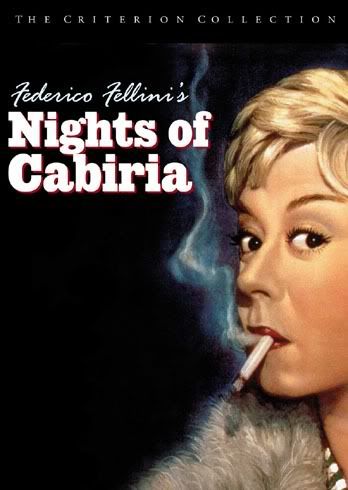
Nights of Cabiria

Nights of Cabiria (Wikipedia)

Nights of Cabiria (Italian: Le notti di Cabiria) is a 1957 Italian romantic drama film directed by Federico Fellini and starring Giulietta Masina, François Périer, and Amedeo Nazzari. Based on a story by Fellini, the film is about a waifish prostitute who wanders the streets of Rome looking for true love but finds only heartbreak. In 1998 the film was rereleased, newly restored and with a crucial scene that censors had cut.

The name Cabiria is borrowed from the 1914 Italian film Cabiria, while the character of Cabiria herself is taken from a brief scene in Fellini's earlier film 'The White Sheik'. It was Masina's performance in that earlier film that inspired Fellini to make this film. But no one in Italy was willing to finance a film which featured prostitutes as heroines. Finally, Dino de Laurentiis agreed to put up the money. Fellini based some of the characters on a real prostitute whom he had met while filming 'Il Bidone'. For authenticity, he had Pier Paolo Pasolini, known for his familiarity with Rome's criminal underworld, help with the dialogue.

The American musical and movie Sweet Charity is based on Fellini's screenplay.


When I started watching this movie, I had no idea as to what to expect. The movie revolves around "Cabiria," who was a prostitute--although this is downplayed in certain ways and just not really presented that way, as she often hung out with normal 20ish people--who lived in a house in a downtrodden district in or on the edge of Rome. She is a very engaging character who always wears her emotions on her sleeve. I can't really describe the character, who was almost like Sandra Dee meets Gwen Stefani with a little Audrey Tautou thrown in... and loud!! Bad things always seemed to happen to her, but she was never down for very long before some experience would make her smile or dance. You don't want anything really bad to happen to her, and you want her to get her life together, but it always does. At the end, something really horrible happens to her where she doesn't want to go on; but then shortly later she is smiling, and the theme seems to be "life is worth living" no matter what happens. The movie always keeps your attention. There's never a dull moment with the bantam Cabiria.

I don't watch a whole lot of movies now, but when I do, I always look it up and cross-reference names, dates, places, etc. This movie was no exception. There are some interesting tie-ins with all of that here. Old movies are like a time capsule. I mean, it's not like this was a hundred years ago... it was from the late fifties; in some ways a long time, and in other ways not very long. However, in this movie they all seem to have passed away. I see more of a deeper meaning in older Italian or European movies, rather than those from Hollywood...which is almost like a political or social engineering machine now. There's a certain innocence to older Italian cinema, generally a certain honesty. There's a movie poster on the above link, and a few images and posters from the movie here.

"Spoiler Alert" beyond this point!


Plot

The film opens with Cabiria happy and laughing, on a river bank with her current boyfriend and live-in lover. He pushes her into the river and steals her purse which is full of money. She cannot swim and very nearly drowns, but is rescued and revived at the last possible moment by helpful ordinary people who live a little further down the river.

The rest of the plot follows Cabiria as she plies her trade, interacts with her best friend and neighbor Wanda, and searches for a chance to better her life. She is frequently mistreated and taken advantage of, but she has some interesting adventures, and manages to keep her basic attitude to life positive.

Eventually, she meets Oscar, an accountant, who seems genuinely kind and who promises her a happy future. At first she is cautious and suspicious, but after several meetings she falls passionately in love with him and they are to be married—after only a few weeks. However, during a walk in a wooded area, on a cliff overlooking a lake Oscar becomes distant and starts acting nervous. Cabiria realizes that—just like her earlier lover—Oscar intends to push her over the cliff and steal her money (she sold her house and possessions and keeps all the money in her purse). She throws her purse at his feet, sobbing in convulsions on the ground as he abandons her.

She later picks herself up and stumbles out of the wood in tears. In the film's famous last sequence, Cabiria walks the long road back to town when she is met by a group of young people riding scooters, playing music, and dancing. They happily form an impromptu parade around her until she begins to smile through her tears.


.

Wednesday, October 5, 2011

The Mussolini/Fascist issue

Our folk have been historically known for political extremism. Fascism, Communism, Anarchism, etc. These concerns have been successful because they are correct on a handful of issues. I usually don't like the term "extremism," because anyone can use the word to belittle anyone they wish; even while supporting types of extremism themselves. However, Fascism was basically a dictatorship in which the state oversaw and largely controlled industry. It is the opposite, or "opposame," of Fabianism in which transnational financial and economic concerns largely control, or at least have undo influence upon, the governmental apparatus of nations; sort've like "International Socialism."

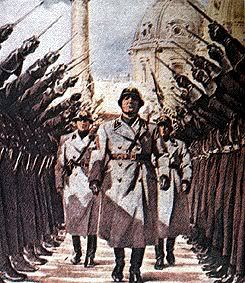
Benito Mussolini was of Emilian descent, which means that he was a member of our folk. However, he was an "Italian nationalist" who cared very little about common people. For example, he, in an apparent attempt to show off his power to the National Socialists, got his country involved in wars of which they were ill-prepared for. This was done in the name of a modern type of "Roman Imperialism." Although the Italian Fascists had limited success, conquering Libya and Ethiopia, the plan was brutal and disastrous even for their own country and people.

The plan was for neo-Rome to conquer the Balkans, North Africa, and other places; and set up a Roman-style imperialist system. In the Balkans, they actually tried to change people's family surnames. For example, a family with the name "Bradovich" would be forced to take a name like "Columbo," even though they didn't not speak Italian at all. They wanted to colonize most of the Mediterranean region with people from Italy, and it was mostly people from the north who colonized North Africa. Italians in general would have some type of high racial status in these colonies. For example, I recall reading once that in colonial Libya, where was a law, with a penalty of eight years in prison, for "touching a white woman." Of course, I don't believe that they should have been in Libya at all. It was almost like Mussolini was showing off for Hitler. At least that's the impression that I always had. Small populations of Jews and Black Africans in Libya were more-or-less forced to go away, and the common Libyans were to be given some type of status as long as they went along with the Fascist dictatorship.

[Left: Libyan resistors being taken to a concentration camp; on the left of the image, two Libyan colonial soldiers, traitors to their people; unfortunately, treason is part of the human character]

Ethnic and linguistic differences, within the Italian peninsula, were even more repressed then before. The Italian Fascists force-migrated people from Southern Italy into the ethnic-German South Tyrol. Also, they were trying to force the Tyroleans to speak standard Italian and change their names. Mussolini, though his own statements, believed that the Langobards were everywhere in the peninsula and that it somehow meant that every Italian was an Aryan-Italian. No regionalism. All were to take the identity of Fascist Lombardo-Romans. From any type of Padanian/Cisalpine folkish way of thinking, Mussolini was a traitor to his own people.

Like the Communists and Fabianists, theirs was a dark world view. Although they defeated the Italian Communists, the results were just as bad as what may have occurred otherwise. Both denied our people freedom, or even a self-identity, as does the Fabianist EU Plutocracy today. We need to finally break away from this right-left Hegelian dialectic, and make our own way. I call this paradigm "the grinder." Throw in a legitimate issue or concern, and out it comes, stripped of all truth or worth. Neatly packaged under a false right or left label; to be put back up on the shelf with all of the other dead issues that the Fabianist power structure doesn't want to trouble itself with.

The fact that we are forced to the right, is a direct consequence of the rise of Fabian Socialist Plutocracy and it's Monopoly Capitalist and Social Marxist minions who today have almost the entire globe in a political straitjacket. I can't see how anyone of our concern could really consider Mussolini or the Fascists as any type of political ideal or icon. The Romans destroyed the Etruscans and Gauls, and the process keeps being recycled over and over again. Remember that bully in the sixth grade? He just absolutely would not stop... until someone literally, physically STOPPED him. We are all still subject to the "law of the jungle."

A very important point to remember. "All wars" were not fought over nationalism or religion; "All wars" were started by bankers, industrialists, and dictators who merely USED nationalism or religion as effective propaganda tools.

[10-25-12 ADDITION

Reader/Contributor Etrusco-Umbro-Gallic pointed out the following:

Speaking of the Rumagnols, you erred once in calling Mussolini an Emilian. He was a Forlivese Rumagnol. Rumagnols are a different folk, culturally and genetically. There are perhaps analogous to Bresans, being more masculine, robust and better built, while Emilians are more like Western Lombards.]

.

Thursday, September 29, 2011

Brennus of the 4th century BC


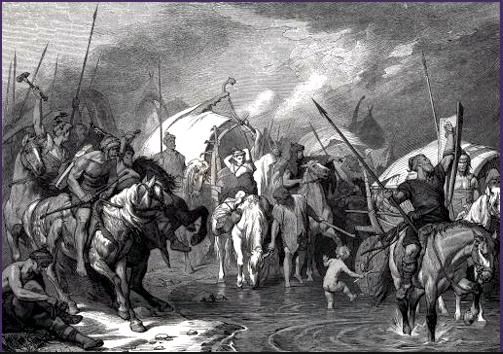
Brennus (or Brennos) was a chieftain of the Senones, a Gallic tribe originating from the modern areas of France known as Seine-et-Marne, Loiret, and Yonne, but which had expanded to occupy northern Italy.

More important historically was a branch of the above (called Senones, by Polybius), who about 400 B.C. made their way over the Alps and, having driven out the Umbrians, settled on the east coast of Italy from Ariminum to Ancona, in the so-called ager Gallicus, and founded the town of Sena Gallica (Sinigaglia), which became their capital.

In 391 they invaded Etruria and besieged Clusium. The Clusines appealed to Rome, whose intervention, accompanied by a violation of the law of nations, led to war, the defeat of the Romans at the Allia (18 July 390) and the capture of Rome. In 387 BC he led an army of Cisalpine Gauls in their attack on Rome. It has been theorized that Brennus is actually a title rather than a name. This is because "Brennus" also appears as the name of a Gallic leader 100 years later. It is also possible that Brennus refers to a god, his name taken by the leader before battle in order to invoke the god's favor and powers.

In the Battle of the Allia, Brennus defeated the Romans, and entered the city itself. The Senones captured the entire city of Rome except for the Capitoline Hill, which was successfully held against them. However, seeing their city devastated, the Romans attempted to buy their salvation from Brennus. The Romans agreed to pay one thousand pounds weight of gold. According to Livy, during a dispute over the weights used to measure the gold (the Gauls had brought their own, heavier-than-standard) Brennus threw his sword onto the scales and uttered the famous words "Vae victis!", which translates to "Woe to the vanquished!"

The argument about the weights had so delayed matters that the exiled dictator Marcus Furius Camillus had extra time to muster an army, return to Rome and expel the Gauls, saving both the city and the treasury. Following initial combat through Rome's streets, the Gauls were first ejected from the city, then utterly annihilated in a regular engagement eight miles outside of town on the road to Gabbi. Camillus was hailed by his troops as another Romulus, father of his country 'Pater Patriae' and second founder of Rome.

Some historical accounts say that the Senones besieging the Capitoline Hill were afflicted with an illness and thus were in a weakened state when they took the ransom for Rome. This is plausible as dysentery and other sanitation issues have incapacitated and killed large numbers of combat soldiers up until and including modern times.

It has been theorized that Brennus was working in concert with Dionysius of Syracuse, who sought to control all of Sicily. Rome had strong allegiances with Messana, a small city state in north east Sicily, which Dionysius wanted to control. With Rome's army pinned down by Brennus' efforts Dionysius led a campaign which ultimately failed. Brennus may have been paid twice to sack Rome.

However, the more accepted history (usually citing Livy and Plutarch) finds that Senones marched to Rome to exact retribution for three Roman ambassadors breaking the law of nations (oath of neutrality) in hostilities outside of Clusium. According to this history, the Senones marched to Rome, ignoring the surrounding countryside; once there, they sacked the city for 7 months, and then withdrew. For more information, see the Battle of Allia.

A famous depiction is the academic painting Le Brenn et sa part de butin (1893) by Paul Jamin that shows Brennus viewing his share of spoils (predominantly naked captive women) after the looting of Rome.


In popular culture

Brennus was played by Gordon Mitchell in the 1963 film 'Brennus, Enemy of Rome'.

.

Saturday, July 18, 2009

Ostrogothic Kingdom: Germanic Conquest


Ostrogothic Kingdom: Germanic Conquest

The Ostrogothic Kingdom established by the Ostrogoths in Italy and neighbouring areas lasted from 493 to 553. In Italy the Ostrogoths replaced Odoacer, the de facto ruler of Italy who had deposed the last emperor of the Western Roman Empire in 476. The Gothic kingdom reached its zenith under the rule of its first king, Theodoric the Great. Most of the social institutions in the late Western Roman Empire were preserved during his rule.

Ostrogothic Kingdom


Theodoric the Great (454 - August 30, 526) was king of the Ostrogoths (471 - 526), ruler of Italy (493 - 526), and regent of the Visigoths (511526). He became a hero of Germanic legend as Þeodric in English legends, Dietrich von Bern in German legends, and as Þjóðrekr and Þiðrekr in Norse mythology.

Theodoric the Great


The Ostrogoths were a branch of the Goths, an East Germanic tribe that played a major role in the political events of the late Roman Empire. The other branch was the Visigoths.

The Ostrogoths established a relatively short-lived successor state of Rome in Italy and the Balkans, even briefly incorporating most of Hispania and southern Gaul. They reached their zenith under their Romanised king Theodoric the Great, who patronised such late Roman figures as Boethius and Cassiodorus, in the first quarter of the sixth century. By mid-century, however, they had been conquered by Rome in the Gothic War (535 - 554), a war with devastating consequences for Italy.

Ostrogoths


Tuesday, June 30, 2009

Barbarians II: The Lombards


Barbarians II: The Lombards

[For more great documentaries, visit TheDocumentaryCenter.blogspot.com]

At its peak, the Roman Empire feared nothing in Heaven or on Earth. Perhaps they should have paid closer attention to the pagan rabble. Coming in waves from the dark forests of Europe, the hordes drove the mighty empire to its knees. Relentless, unmerciful and united only in their hatred for Rome, each of these warrior tribes - Vandals, Saxons, Franks and Lombards - had its own violent agenda, dark rites, savage tactics, and secret weapons. Barbarians 2 follows these four fearsome tribes as they cut a swath of destruction through the heart of the Roman world. Barbarians 2 recreates the world of these invaders through breathtaking stunts, large-scale battle reenactments, and a fast-paced, exciting narrative.

THE LOMBARDS: The ferocious tribe partial to severing their foes' heads and stealing their women. Their brutal leader, Alboin, overcame Roman defenses, surrounded The Eternal City, and forced a captured foe's wife to drink from her slain father's skull.

"Estimates of the number range between about fifty thousand and two hundred thousand adult males, so we may be talking about a population of four or five hundred thousand people altogether." --Professor Thomas Noble, Chairperson, Department of History, University of Notre Dame, on the Lombard invasion population numbers in 568 A.D. during verbal interview for the History Channel's 'Barbarians II: The Lombards'

Saturday, January 10, 2009

The Celti and the Trophy of Augustus

As with the Etruscan civilization, the Roman Empire devoured the Celtic tribes in Northern Italy. I want to make it entirely clear that the Romans deliberately destroyed its parent Etruscan culture. There is very little left of the Etruscans. It was similar to a country literally and purposely eliminating itself in favor of going global.

In the case of the Celti, it was simple imperialism. The tribes constituted a small nation. So how shall we view this conquering of the Etruscans or Celti? I don't have that answer, but I think that we should be open-minded about the Roman Empire. There are two ways to look at it. One, a light in a world of darkness, which it was. And two, an oppressive imperialistic empire, which it was as well.

Had there been no Rome, I believe that the Etruscans, the early Italic tribes in Northern Italy, and the Celti, would have eventually merged into a greater Etruria that would have encompassed all of the North from the old Rome. The Greeks likely would have permanently annexed Southern Italy from Naples (Greek "Neapolis").

***************************************************************************

Trophy of Augustus (Wikipedia; see impressive images)

The Trophy of the Alps or Trophy of Augustus was built by the Roman emperor Augustus to celebrate his definitive victory over the ancient Celto-Ligurian tribes who populated the region and who had harassed merchants along Roman roads. Its remains may be seen in the Commune of La Turbie (Alpes-Maritimes), on the Grande Corniche, 6 km from Monaco, and is the principal tourist attraction for the Commune. There is also a small museum with a scale model of the Trophy.

Construction

The stone used to build the monument was originally extracted from the Roman quarry located about 500 meters away. Visitors to that site can still see the traces of sections of carved columns in the stone.

The monument as partially restored by archaeologists at the beginning of the 20th century, is 35 meters high. When built, according to the architect, the base measured 35 meters in length, the first platform 12 meters in height, and the rotunda of 24 columns with its statue of an enthroned Augustus is 49 meters high.

Inscription

One of the stones of the tower, which Pliny the Elder transcribed, contained the names of the tribes. It reads:

"To the emperor Caesar, son of the deified Caesar, Augustus, Pontifex Maximus, hailed as Imperator for the 14th time, in his 17th year of tribunician power, the Senate and people of Rome [built this], in commemoration that, under his leadership and auspices, all the Alpine peoples, from the upper sea to the lower sea, were submitted to the Roman Empire. Conquered Alpine peoples:

"· The TRUMPILINI
· The CAMUNNI
· The VENOSTES
· The VENNONETES
· The ISARCI
· The BREUNI
· The GENAUNES
· The FOCUNATES
· The four VINDELICUS nations
· The COSUANETES
· The RUCINATES
· The LICATES


· The CATENATES
· The AMBISONTES
· The RUGUSCI
· The SUANETES
· The CALUCONES
· The BRIXENETES
· The LEPONTI
· The UBERI
· The NANTUATES
· The SEDUNI
· The VARAGRI
· The SALASSI


· The ACITAUONES
· The MEDULLI
· The UCENNI
· The CATURIGES
· The BRIGIANI
· The SOGIONTI
· The BRODIONTI
· The NEMALONI
· The EDENATES
· The VESUBIANI
· The VEAMINI
· The GALLITAE


· The TRIULLATI
· The ECDINI
· The VERGUNNI
· The EGUITURI
· The NEMATURI
· The ORATELLI
· The NERUSI
· The VELAUNI
· The SUETRI"

Later life

The monument originally served no military purpose and contained no fortress. Rather, it marked the boundary between Italy and Gallia Narbonensis, later pushed back to the Var. Between the 12th and 15th centuries, however, the Trophy did become a fortress, with locals building houses around its walls. In 1705, when war broke out between Savoy and France during the War of the Spanish Succession, Louis XIV ordered the destruction of all fortresses in the region, including this one. The partially destroyed Trophy then became a quarry and its stones were used, among other things, to build the nearby church of Saint-Michel.

Nearby Roman remains

The area surrounding the Trophy is rich with remnants of the Roman empire such as the famous Roman roads. The Trophy is situated on the Via Julia Augusta, named after the emperor Augustus, which is a continuation of the Via Aurelia which linked Vintimille to Cimiez (Nice). Various fountains within the territory of the communes of Beausoleil and Roquebrune-Cap-Martin are also said to be Roman.

Trophy of the Alps (more images)

***************************************************************************

The following is a quick history lesson the the origin of the Celts. Most identify the Celts with Ireland or Scotland, but they lived on the European mainland long before migrating to the British Isles. We can look more closely into the Celts at a future time. Also, it should be pointed out that not all of the tribes listed on the Trophy of Augustus were Celti. They were as written "conquered Alpine peoples."

***************************************************************************

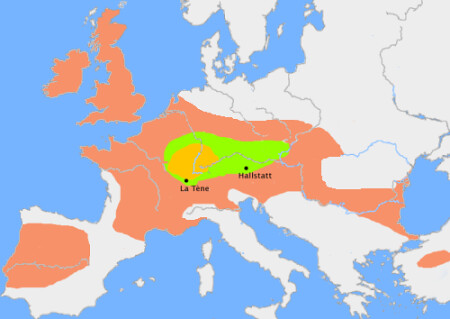
Celts in Europe 400BC - 800 BC

The Celts also expanded down the Danube river and its tributaries. One of the most influential tribes, the Scordisci, had established their capital at Singidunum in 3rd century BC, which is present-day Belgrade. The concentration of hill-forts and cemeteries shows a density of population in the Tisza valley of modern-day Vojvodina, Hungary and into Ukraine. Expansion into Romania was supposedly limited , according to certain sources, yet syncreticsm of Celtic art is evident in contemporary Romanian folk art

Further south, Celts settled in Thrace (Bulgaria), which they ruled for over a century, and Anatolia, where they settled as the Galatians. Then, having taken advantage of easing of Macedon after civil war, the Celts have destroyed an army of its king Ptolemeus Keravn and have plundered Greece. Despite their geographical isolation from the rest of the Celtic world, the Galatians maintained their Celtic language for at least seven hundred years. One of the largest ports on the Lower Danube in Romania is called Galati and Galata is another Celtic toponym in Turkey.

The Boii tribe gave their name to Bohemia (Czech Republic) and to -see above- Bologna (Italy ) and Celtic artifacts and cemeteries have been discovered further east in both Poland and Slovakia. A celtic coin (Biatec) from Bratislava's mint is displayed on today's Slovak 5 crown coin.

***************************************************************************

2-11-09 NOTE: It should be noted that the Celts from Gaul (France) did invade northern Etruria and pushed the Etruscans out of the regions where the Alps meet the Po River Valley. Some Celti settled in the southernmost Alps, and some in the area immediately south of it. They seemed to more-or-less get along with the equally rugged Italic tribes living in the Alps. Italic Alpine tribes joined with the Celti in opposing Rome. Really, this is almost exactly like the movie 'Braveheart.' Just like in 'Braveheart,' a few Celt tribes betrayed their kin and joined with the Romans against them.

Tuesday, August 19, 2008

The Ostrogoths in Italy: Part 1 of 2

THE GOTHS

I believe that the heart and soul of the North Italian cultures stem from the Etruscans and early Italic tribes. The Lombard flag merely symbolizes what was a unified region. The Northern League stresses the Celtic past, pointing out that they had opposed Rome. This is mainly a way of symbolizing the opposition to the modern Roman government. Comunità Odinista stresses our Lombardic past, as the Lombards had practiced Odinism, at least at some point. It's easy to forget that the entire Italian peninsula (the mainland) was part of the Ostrogothic Kingdom, prior to the Lombard invasion.

I wanted to at least give an introduction to the Ostrogoths here, which we can build on later, and I will probably be bouncing all over the place. I have begun reading the book 'The History of the Lombards', and at the beginning, the author Paul the Deacon (a Lombard) points out the tremendous violence of the Germanic nations, and how Italy felt their wrath for centuries. I don't think we should deny that fact, despite what might be a fascination with the barbarians who invaded our ancestral homeland, and partly "became us."

Rather than enter a large amount of text regarding the Goths, who were all over, I will try to use links and look at the bigger picture first, then focus on how they affected Italy. The links will provide further reading, as this history is complex. The Ostrogoths were a branch of the Goths. The Goths were a large Germanic tribe which had settled in Eastern Europe. Like the Lombards, they were Arian Christians by the time they had invaded Italy and the Balkans. Arian Christianity was not Roman Christianity, which is why the early Roman church worked so hard to stamp them out. Centuries later, Queen Theodelinda peacefully brought the region under the Roman church.

The Goths were thought to have originated from "the Gotlanders" in Scandinavia. Gotland Island is a Scandinavian island, which seems to have given rise to a people who later became important on the Scandinavian mainland (Gotlandia, Götaland) and later migrated south. They had a very distinct culture which can be traced throughout their later migrations. Earlier I think I had mentioned that "the Gotts" (Gots, Goti, Guti, Gutar, Gotar, Göta, etc.) were perhaps a branch of the Lombards, but more than likely they were Goths.

Sometime around the 3rd century, the Goths were branching out and making their presence known. They settled near the Danube River, which is were the Lombards settled later, in modern Hungary. The Huns, a large and extremely barbaric central Asian tribe, began to move into the area. They seem to have pushed the Goths southward.

At some point the Goths branched into two main tribes: The Ostrogoths (Eastern Goths) and the Visigoths (Western Goths). The Visigoths migrated southwestward and by 475 had come to dominate almost all of the Iberian peninsula. The Visigoth Kingdom lasted until 711. Along with the Visigothic Kingdom in Spain, the Ostrogoths invaded Italy and the Balkans, where they established their own Kingdom. They ruled the entire area from 488 to 553. Both tribes had partaken in the earlier sacking of Rome.

Wikipedia states that after the two kingdoms were established: "The Goths were briefly reunited under one crown in the early sixth century under Theodoric the Great...." We will go more into Theodoric the Great later.

Backing up a little, it is interesting to me how a small region can affect the world. Gotland Island looks insignificant on a map, yet it was the springboard for a cultural movement that some scholars call the "Gothicismus." Wikipedia states: "Gothicismus, Gothism, or Gothicism (Swedish: Göticism) is the name given to what is considered to have been a cultural movement in Sweden.". Wikipedia goes on to state: During the period ca 600 BC–ca 300 BC the warm and dry climate of southern Scandinavia deteriorated considerably, which not only dramatically changed the flora, but forced people to change their way of living and to leave settlements. The Goths are believed to have crossed the Baltic Sea sometime between the end of this period, ca 300 BC, and 100.

The "Gutasaga" is a Norse saga or history, written in the 13th century, of Gotland and Gothicismus, before it's Christianization. It appears that it was based on the oral tradition or storytelling. It continues with the migration and/or invasions of the Goths southward. The Gutasaga reads "Over a long time, the people descended from these three multiplied so much that the land couldn't support them all. Then they draw lots, and every third person was picked to leave, and they could keep everything they owned and take it with them, except for their land. ... they went up the river Dvina, up through Russia. They went so far that they came to the land of the Greeks. ... they settled there, and live there still, and still have something of our language."

Wikipedia states about the Gutasaga: "That the Goths should have gone "to the land of the Greeks" is consistent with their first appearance in classical sources: Eusebius of Caesarea reported that they devastated "Macedonia, Greece, the Pontus, and Asia" in 263. The emigration would have taken place in the 1st century AD, and loose contact with their homeland would have been maintained for another two centuries, the comment that the emigrant's language "still has something" in common shows awareness of dialectal separation. The events would have needed to be transmitted orally for almost a millennium before the text was written down." "Asia" would have been modern Turkey.

Lastly, Gothic writing and language are other subjects unto itself, which we won't have time to focus on now.


THE OSTROGOTHS

We've already mentioned the Ostrogoths, which was the eastern branch of the Goths. As stated, the Goths had been a single nation until the 3rd century, when they split into two main branches (there were other smaller offshoots). From Wikipedia: "This so-called "split" or, more appropriately, resettlement of western tribes into the Roman province of Dacia was a natural result of population saturation of the area north of the Black Sea. The Goths there established a vast and powerful kingdom, during the 3rd and 4th centuries, between the Danube and the Dniepr in what is now Romania, Moldavia and western Ukraine (see Chernyakhov culture; Gothic runic inscriptions). This was a multi-tribal state ruled by a Gothic elite...." They seem to have migrated from the Roman region of Pannonia (modern Hungary) to the Balkans, where they settled for a good while. They had battled with the Romans, the Huns, and later the Eastern Roman Empire for centuries, off and on between truces and treaties.

Wikipedia briefly sums up the Ostrogoths: "The Ostrogoths (Latin: Ostrogothi or Austrogothi) were a branch of the Goths, an East Germanic tribe that played a major role in the political events of the late Roman Empire. The other branch was the Visigoths. The Ostrogoths established a relatively short-lived successor state of Rome in Italy and the Pannonia, even briefly incorporating most of Hispania and southern Gaul. They reached their zenith under their Romanised king Theodoric the Great, who patronised such late Roman figures as Boethius and Cassiodorus, in the first quarter of the sixth century. By mid-century, however, they had been conquered by Rome in the Gothic War (535–554), a war with devastating consequences for Italy."

Gothic influence was already widespread and remarkable since their rise in Gotland Island centuries before. When the Huns migrated into Europe, it seemed to begin a whole new chapter in Gothic history. I know I'm all over the place here, but this history is hard to look at only in terms of Chronology, as it affected so many other cultures along the way. Another history/fable was written in the 'Hlöðskviða' or otherwise known as 'The Battle of the Goths and Huns.'

The part of specifically Ostrogothic history which affects Italy can follow some chronological order here as follows. From Wikipedia:

"Hunnic invasions

The rise of the Huns around 370 overwhelmed the Gothic kingdoms. Many of the Goths migrated into Roman territory in the Balkans, while others remained north of the Danube under Hunnic rule. They became one of the many Hunnic vassals fighting in Europe, as in the Battle of Chalons in 451. Several uprisings against the Huns were suppressed. The collapse of Hunnic power in the 450s led to further violent upheaval in the lands north of the Danube, during which most of the Goths resident in the area migrated to the Balkans. It was this group that became known as the Ostrogoths.

Gothic was still spoken sporadically in Crimea as late as the 16th century: the Crimean Gothic language.

Post-Hunnic movements

Their recorded history begins with their independence from the remains of the Hunnic Empire following the death of Attila the Hun in 453. Allied with the former vassal and rival, the Gepids and the Ostrogoths led by Theodemir broke the Hunnic power of Attila's sons in the Battle of Nedao in 454.

The Ostrogoths now entered into relations with the Empire, and were settled on lands in Pannonia. During the greater part of the latter half of the 5th century, the East Goths played in south-eastern Europe nearly the same part that the West Goths played in the century before. They were seen going to and fro, in every conceivable relation of friendship and enmity with the Eastern Roman power, until, just as the West Goths had done before them, they passed from the East to the West.

Kingdom in Italy

The greatest of all Ostrogothic rulers, the future Theodoric the Great (whose name means "leader of the people") of Ostrogothic Kingdom, was born to Theodemir in or about 454, soon after the Battle of Nedao. His childhood was spent at Constantinople as a diplomatic hostage, where he was carefully educated. The early part of his life was taken up with various disputes, intrigues and wars within the Byzantine empire, in which he had as his rival Theodoric Strabo, a distant relative of Theodoric the Great and son of Triarius. This older but lesser Theodoric seems to have been the chief, not the king, of that branch of the Ostrogoths which had settled within the Empire at an earlier time. Theodoric the Great, as he is sometimes distinguished, was sometimes the friend, sometimes the enemy, of the Empire. In the former case he was clothed with various Roman titles and offices, as patrician and consul; but in all cases alike he remained the national Ostrogothic king. Theodoric is also known for his attainment of support from the Catholic church, which he gained by appeasing the pope in 520. During his reign, Theodoric, who was Arian, allowed “freedom of religion” which had not been done before. However, he did try to appease the pope and tried to keep his allies with the church strong. He saw the pope as an authority not only in the church but also over Rome.

Theodoric sought to revive Roman culture and government and in doing so, profit the Italian people. It was in both characters together that he set out in 488, by commission from the Byzantine emperor Zeno, to recover Italy from Odoacer. By 493 Ravenna was taken, where Theodoric would set up his capital. It was also at this time that Odoacer was killed by Theodoric's own hand. Ostrogothic power was fully established over Italy, Sicily, Dalmatia and the lands to the north of Italy. In this war the Ostrogoths and Visigoths began again to unite, if we may accept the witness of one writer that Theodoric was helped by Visigothic auxiliaries. The two branches of the nation were soon brought much more closely together; after he was forced to become regent of the Visigothic kingdom of Toulouse, the power of Theodoric was practically extended over a large part of Gaul and over nearly the whole of the Iberian peninsula. Theodoric also attempted to forge an alliance with the Frankish and Burgundian kingdoms by means of a series of diplomatic marriages. This strengthening of power eventually led the Byzantine emperor to fear that Theodoric would become too strong, and motivated his subsequent alliance with the Frankish king, Clovis I, to counter and ultimately overthrow the Ostrogoths.

A time of confusion followed the death of Alaric II, the son-in-law of Theodoric, at the Battle of Vouillé. The Ostrogothic king stepped in as the guardian of his grandson Amalaric, and preserved for him all his Iberian and a fragment of his Gaul dominion. Toulouse passed to the Franks but the Goth kept Narbonne and its district and Septimania, which was the last part of Gaul held by the Goths and kept the name of Gothia for many ages. While Theodoric lived, the Visigothic kingdom was practically united to his own dominion. He seems also to have claimed a kind of protectorate over the Germanic powers generally, and indeed to have practically exercised it, except in the case of the Franks.

The Ostrogothic dominion was now again as great in extent as and far more splendid than it could have been in the time of Hermanaric; however it was now of a wholly different character. The dominion of Theodoric was not a barbarian but a civilized power. His twofold position ran through everything. He was at once national king of the Goths, and successor, though without any imperial titles, of the West Roman emperors. The two nations, differing in manners, language and religion, lived side by side on the soil of Italy; each was ruled according to its own law, by the prince who was, in his two separate characters, the common sovereign of both. It is believed that between 200,000 to 250,000 Ostrogoths settled in Italy but these are guesses and the numbers may have been much lower or higher.

The picture of Theodoric's rule is drawn for us in the state papers drawn up, in his name and in the names of his successors, by his Roman minister Cassiodorus. The Goths seem to have been thick on the ground in northern Italy; in the south they formed little more than garrisons. In Theodoric's theory the Goth was the armed protector of the peaceful Roman; the Gothic king had the toil of government, while the Roman consul had the honour. All the forms of the Roman administration went on, and the Roman policy and culture had great influence on the Goths themselves. The rule of the prince over distinct nations in the same land was necessarily despotic; the old Germanic freedom was necessarily lost. Such a system needed a Theodoric to carry it on. It broke in pieces after his death."

The long war with Rome was a big part of the Ostrogothic Kingdom's history, but too long and complex to go into detail here. The links will provide much further reading. Also, we need to find the books on this kingdom for reference and further study.

Finally, there is some text regarding Ostrogothic culture, but it doesn't go into any read detail in which we can get a good idea of the traditions, architecture, mannerisms, or works of art. Gothic architecture was distinct, and they did create some complex and sightly artwork, which is something else we need to look at in the future. Like the Lombards later, the Ostrogothic culture becomes ours at the end of the day.