Etruscan-Celtic Marriage
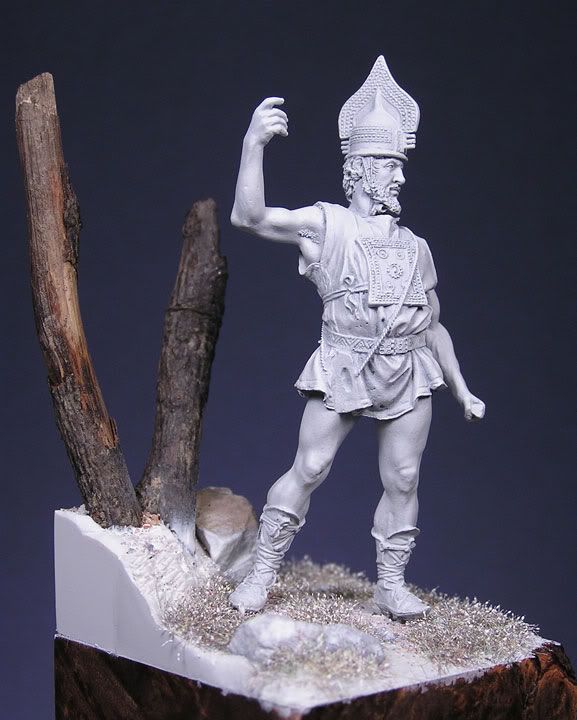
Reconstruction of a marriage between a Celtic nobleman and an Etruscan princess, in ancient Etruria or Cisalpine Gaul.
.

Etruscan-Celtic Marriage
Reconstruction of a marriage between a Celtic nobleman and an Etruscan princess, in ancient Etruria or Cisalpine Gaul.
.
The Etruscan Roots of The Twilight Saga
Bija Knowles - November 20, 2009
Were there vampires in Volterra? Probably not, but the Etruscans had their own brigade of gods and demons representing night, death and resurrection.
'The Twilight Saga: New Moon' release fuels vampire mania around the world. While teenagers go completely nuts over the film's hunky vampire Edward (Robert Pattinson) – one wrote 'bite me' on her face as she queued with 5,000 others to see him in London last week – other die-hard fans of the Twilight books, written by Stephenie Meyers, are also descending on the small hill-top town of Volterra, in Tuscany, where some of the action of the film is set (even though filming actually took place in Montepulciano, 70 miles away). As a result, hoards of teenagers have been visiting Volterra – a town with Etruscan roots and its own heritage of Etruscan demons, gods and goddesses associated with death, resurrection and the night.
The Twilight Saga isn't the only vampire story to grace our screens lately. The popular US series True Blood – about a young woman in Louisiana who also falls in love with a vampire – based on the The Southern Vampire Mysteries series of novels by Charlaine Harris, also gathered cult status, adding to the growing body of vampire fiction on our bookshelves and on our screens. The nineties saw the likes of Buffy the Vampire Slayer, Interview with a Vampire, Bram Stoker's Dracula as well as From Dusk Till Dawn. The 21st century has seen vampire fever take over with Van Helsing, more Buffy and now Twilight and True Blood.
In fact, Dracula is the most often-portrayed fictional character in film. So what is it about vampires? There must be something about the blood-sucking, garlic-fearing, sun-dodging demons that strikes a chord with modern audiences – and indeed audiences since the early 18th century, when, following a vampire craze in the 1720s and 1730s, a poem called The Vampire, by Heinrich August Ossenfelder, was published in 1748. Vampires soon became a stock part of gothic fiction but they also had a romantic and erotic side to their personae, seducing women at night with their vampire's kiss of death.
To this day vampires are often portrayed as being quite sexy – think Robert Pattinson or True Blood's Stephen Moyer. However, the modern romantic vampire hero has more in common with figures from ancient mythology, rather than the vampire of Eastern European folklore (an altogether more corpse-like and unappetising kind of creature). The Incubus and the Succubus, dating back to the Sumerian kings of Mesopotamia (under the name of Lilu and Lilitu), were demons that appeared at night and seduced dreamers, often into erotic acts against their will.
Other figures from ancient mythology share some of the vampire's traits. In ancient Egypt, Sekhmet, the lion-headed goddess of Upper Egypt, was associated with blood-lust and with drinking blood (mythology has it that she drank a liquid resembling blood to quench her thirst for violence). The ancient Greeks and Romans also had their share of supernatural figures and demi-gods, including Hecate the witch-like figure and her daughter Empusa, who sucked the blood of the men she seduced while they slept. The Lamia was another demon in female form, renowned for sucking the blood of children and young men, while the Strixes were nocturnal bird-like creatures of Greek and Roman mythology, who ate human flesh and blood.
Closely connected with Greek and Roman mythology was the Etruscan pantheon, which also had its dark side. The Etruscans had several gods, goddesses and demons associated with death, the underworld, the night and resurrection. Some of the gods and goddesses included Artume, Vetis, Mania and Tvath. Etruscan demons of death include the Charontes, Tuchulcha (a grotesque demon from the underworld with donkey's ears and snakes for hair and hands) and Vanth (a herald of death with eyes on her wings).
Given the rich Etruscan mythology with many figures associated with death and the underworld, it's fitting that Volterra – an important Etruscan centre, known as Velathri to the Etruscans – is the setting for the new Twilight film. Volterra was a settlement since neolithic times and was then colonised by the Etruscan Velathri during the 8th century BC, while the city wall was built in the fourth century BC. It became one of the 12 important Etruscan city states but in the third century BC came under Roman control. An impressive Augustan-era amphitheatre, some fourth century AD baths as well as an Etruscan acropolis, are some of the important heritage sites in Volterra.
.
The article is based on a 2006 DNA study on native Tuscans. The conclusion was that modern Tuscans are not related to the ancient Etruscans, as had long been thought.
One of the problems with "geographical categorizations" is that racial stocks in certain regions of the world change over time. Therefore a DNA test might show, for example, that a person of Indo-European descent has genetic links to Iran. In reality, it would much more likely be to ancient Persia, and perhaps even thousands of years ago when the demographics were different. The same could be said for many other regions.
When members of the British National Party voluntarily underwent DNA tests, most showed a somewhat significant genetic link to the Middle East. In reality, that link was to the ancient Mediterraneans of that region, long before massive numbers of people of a different racial stock migrated out of the Saudi Peninsula and spread the Islamic faith there. All it meant was that the English and the Middle Easterners shared some common ancestry, despite the fact that those ancestors went in entirely different genetic directions. The ancient Middle Easterners largely became, for all intents and purposes, Saudis. The ancient Mediterranean Britons became basically Germans. Therefore, for someone to state that Englishmen and Iraqis of today, are genetic cousins, would not be intellectually honest.
The article goes on to the hypothesis that the Langobards displaced the mixed-race Roman population. In reality, at least throughout most of the northern half of the Italian peninsula, the population was made up of culturally "Romanized" Gauls as the historical record is absolutely crystal clear on. In Tuscany, Kemp's hypothesis is closer to the truth, and down onto the southern Langobard duchies of Benovento and Spoleto. Still, the wild sweeping generalization seems to show his lack of historical understanding of at least most of the north.
Now, as far the Tuscan DNA study, the article accurately summed up the results:
"DNA testing on Etruscan bones recovered from graves showed that they were completely unrelated to modern Tuscan people.
"DNA testing on the modern Tuscan people showed that their genetic origin was in Anatolia, which is located in modern Turkey, bounded by the Black Sea to the north and the Caucasus to the northeast — smack bang where it should be."
The only problem is that Arthur Kemp wants his cake and eat it too. Up to, and during the Roman period, there was no "Turkey," and there were no "Turks." Using his logic, one could conclude that the Iroquois built New York City, that Aborigines constructed Sydney, or that England was originally settled by immigrants from Iraq.
The region that is now Turkey was the hub of the Eastern Roman Empire. Before that, much of it was part of Greece. A good portion of it was settled early on by Celtic tribes. According to the 'History of Turkey' Wikipedia page:
"The history of Turkey refers to the history of the country now called Turkey. Although the lands have an ancient history, Turkic migration to the country is relatively new. The Turks, a society whose language belongs to the Turkic language family started moving from their original homelands to the modern Turkey in the 11th century. After the Turkic Seljuq Empire defeated forces of the Byzantine Empire at the Battle of Manzikert, the process was accelerated and the country was referred to as 'Turchia' in the Europe as early as the 12th century.[1] The Seljuq dynasty controlled Turkey until the country was invaded by the Mongols following the Battle of Kosedag. During the years when the country was under Mongol rule, some small Turkish states were born. One of these states was the Ottoman beylik which quickly controlled Western Anatolia..." [Source: 'Turkey'; James Bainbridge].
Arthur Kemp can't have it both ways. If Tuscans are really Turks, then Iraqi immigrants were the original settlers of England. In reality, both of those Mediterranean peoples had no genuine link to modern Turks or Iraqis outside of the very "limited shared ancestry" concept, by which entirely different racial stocks could easily have "some common ancestors." It can't be "heads I win, tails you lose." YOU CANNOT HAVE IT BOTH WAYS.
Modern Tuscans, which we consider OUR folk, are not culturally or genetically similar to modern Turks. Although the study showed some strong evidence to support Kemp's politics, his final conclusion was intellectually dishonest. Some years back, someone was poking around a Roman graveyard and found some surnames consistent with Byzantine origins, and Kemp concluded that this meant that the native inhabitants were actually Turks. That was junk science. First of all, the Byzantines were not "Turkish." Even then, how do we know that the graveyard wasn't specifically a Byzantine cemetery? Were other cemeteries from that period studied? How do we know that the twenty seven ancient Etruscans, from which the DNA was obtained, were not atypical individuals; perhaps from elsewhere?
In the British Isles, remains of Roman legionnaires have been discovered. Some of those soldiers had identification documents showing that they were natives of Syria, Carthage, and elsewhere. Although they probably were basically Phoenician or ancient Mediterranean, which would for all intents and purposes would still place them within the range of "Indo-European," one could easily slant the evidence to the contrary. One BNP official, whose DNA was tested, showed 8% historically recent Sub-Saharan African mtDNA markers; likely originating from the importation of West African slaves. Again, someone could very easily slant that evidence. In reality, one would probably need to take a dozen tests to get an accurate reading of various genetic stocks. A single DNA ancestry test will occasionally blow up the admixture of any particular genetic stock, so 2% could read as perhaps 10% of whatever racial stock was being analyzed.
It's probably safe to say that England is probably more purely "Indo-European" than, say, Spain or Sicily. However, when studying data, an intellectually honest researcher can't decide for themselves, depending on their own ideology, that "heads I win, tails you lose." In other words, you can't use one set of rules to come to a conclusion in one area; and an entirely different set of rules to come to a conclusion in another area.
.
 New findings from ancient tomb in Italy
Etruscans: Part 1
Etruscans: Part 2
"In the eight century BC, time of westward expansion, Phoenicians going west, Greeks going west, founding colonies. When the Greeks sailed into Italy, they found something they didn't expect. An advanced civilization already there." --Professor Richard E. Prior, Ancient Historian, Furman University, South Carolina, from the documentary 'Rome: Power & Glory'
As has been stated here before, the perception is that Rome more-or-less came from the Greeks. The truth is a lot different. As the above quote reflects, the Etruscans were trendsetters on thier own. That doesn't mean that, in many ways, the Greeks weren't the forerunners of what later became Western civilization. However, in most areas of human endeavor, the Etruscans were the equal to the Greeks. They apparently were not looking to expand, as they already were in a virtual Garden of Eden. They were not sea faring people. They conducted a lot of land trading, with the north mostly, it appears.
After the Romans shattered the Etruscans, as the victors always do, they rewrote the history. Until fairly recently, the Etruscans didn't even exist in the history books. Now we know that the Romans took Etruscan technology and began to form their plan for an empire. They leveled the vast majority of what had been Etruscan.


