
Showing posts with label ancient history. Show all posts
Showing posts with label ancient history. Show all posts
Thursday, April 20, 2017


Sunday, February 28, 2016
Computer simulation of ancient Rome 320 CE
Ancient Rome (higher resolution)
Smarthistory. art, history, conversation.
A project between Khan Academy and Rome Reborn - with Dr. Bernard Frischer
Speakers: Dr. Bernard Frischer and Dr. Steven Zucker
.
Thursday, February 11, 2016
Brennus: Warlord of the Cisalpine Gauls - Part III
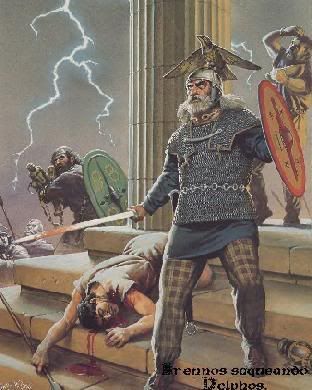
Brennus was covered here once before briefly ('Brennus of the 4th century BC'), and the question remains; should Brennus be thought of as our own noble ancestor who stood up against Roman oppressors, or as a foreign invader who only destroyed and plundered? I think the answer is somewhere in the middle.
I recall years ago of reading a Padanian website in English, where Brenno was mentioned as a northern hero. I distinctly remember reading at the end of that particular writing, something like "now Brenno is coming back!" A reference of his Gaulish spirit coming back.
To find the truth, we must recognize two items to begin with. First, Gaul and Cisalpine Gaul were the same culture; and second, the Romans had not invaded the heart of Cisalpine Gaul as of yet. While Brennus was from northern Gaul, there were strong cultural links, For example, part of the northern Gaulish tribe called the Cenomani, apparently migrated to what is now the area of lower Brescia and Verona. These migrations were common, and had occurred over centuries. Therefore, on one hand Brennus was legitimately a powerful figure to the Cisalpine Gauls; while on the other hand the Romans had not invaded the Gauls as of yet. You cannot "strike back" against someone for something they had not done yet; therefore Brennus was more of a plunderer than a resistance fighter.
The simple truth is that the Romans and the Gauls are both part of our heritage. Most the the north were eventually to be culturally "Romanized Gauls." I've always tried to reason that prior to the rise of Rome, there was Gaulish influence in Tuscany and the south ("southern Cisalpina") and Etruscan influence in Lombardy and the north. Had Rome not risen to power, I think that the two cultures (Etruscan-Umbrian and Gaulish-Alpine) would have merged peacefully together. In fact, they already were. In conclusion, in my opinion--as far as this Etrusco-Gaulish ethnic identity concept is concerned--the invading Romans and the later invasion of Germanic tribes were ethno-cultural admixtures.... "secondary influences" as far as ethnicity. Also of interest is that both the Etruscans and the larger Celtic societies, expanded in relative peace. There existed only marginal "pushing" between Etruscans and Gauls; and while local Celtic tribes battled from time to time, it was hardly a clash of civilizations.

It probably wouldn't be entirely truthful to say that Brennus was to the Cisalpine Gauls, what Vercingetorix was to the northern Gauls. There were Cisalpine Gauls among Brennus' army, but Brennus himself was not from Cisalpine Gaul.
**************************************************
Random fact: I believe that in the movie 'Brennus: Enemy of Rome', Brennus twice made mention of the god "Thor." At one point saying "In the name of Thor!" Thor was a god in the Teutonic pantheon, and not present in Gaulish polytheism. Apparently the filmmakers perceived "the Gauls" as a particular Germanic tribe, instead of an entire culture made up of their own separate tribal groups.
.
Sunday, February 7, 2016
Brennus: Warlord of the Cisalpine Gauls - Part II
Brennus, Enemy of Rome (1963) - Color / 87 mins
Vulture Graffix
An English dubbed, Austrian print of Brennus Enemy of Rome (AKA: Brenno der herr des schreckens, AKA: Brenno il nemico di Roma, AKA: Battle of the Valiant). The film was made in 1963 about the sack of Rome in 387 BC. It was written by Adriano Bolzoni, Arpad DeRiso and Nino Scolaro and was directed by Giacomo Gentilomo. It stars Gordon Mitchell, Ursula Davis, Massimo Serato and Tony Kendall.
The story takes various elements from Livy's history of the Gauls' attack on Rome, plus Plutarch's biography of Camillus, and cleverly remixes them to fashion a ripping yarn. The banishment of the Roman general Camillus, the controversy over the spoils of Veii, the involvement of the Fabius brothers, the flight of the Vestal virgins from Rome, the barbarian who tugs the beard of a Roman elder, the honking of the sacred geese, and even Brennus's scornful "Woe to the vanquished!" as he heaps his sword onto the scales, are all from the historical record.... and all give tale to a fictional re imagining of the sack of Rome in 387 B.C. by Brennus, leading an army of Gauls.
You can visit our facebook page for further movie mayhem;
https://www.facebook.com/VultureArt
**************************************************
Random fact: "Brennus" in Latin became Brenno in Italian. The city of Breno in northern Brescia possibly may have been named after Brennus, who would have been a hero in the Gaulish Alps. Ironically, the Gaulish sacking of early Rome directly led to the Roman invasion of the Alps centuries later.
.
Saturday, February 6, 2016
Brennus: Warlord of the Cisalpine Gauls - Part I
Barbarians - The Primitive Celts
docufans1
So you think you know everything about the Romans? They gave us sophisticated road systems, chariots and the modern-day calendar. And of course they had to contend with barbarian hordes who continually threatened the peace, safety and prosperity of their Empire. Didn't they? Terry Jones' Barbarians takes a completely fresh approach to Roman history. Not only does it offer us the chance to see the Romans from a non-Roman perspective, it also reveals that most of the people written off by the Romans as uncivilized, savage and barbaric were in fact organized, motivated and intelligent groups of people, with no intentions of overthrowing Rome and plundering its Empire.
**************************************************
Random fact: Contrary to long held popular perception, the Vikings did not wear horned helmets. However, the Gauls did.
.
Saturday, May 30, 2015
Etruscan women, mythology, and the god Veltha
Etruscan Women
Tanguy de Thuret
Twenty-five hundred years ago, Etruscan women living in the Italian region of what is now called Tuscany were afforded a remarkably equal status with men.
An American Art Historian & journalist explains her passion about them & why they are still relevant in contemporary Italian society.
**************************************************
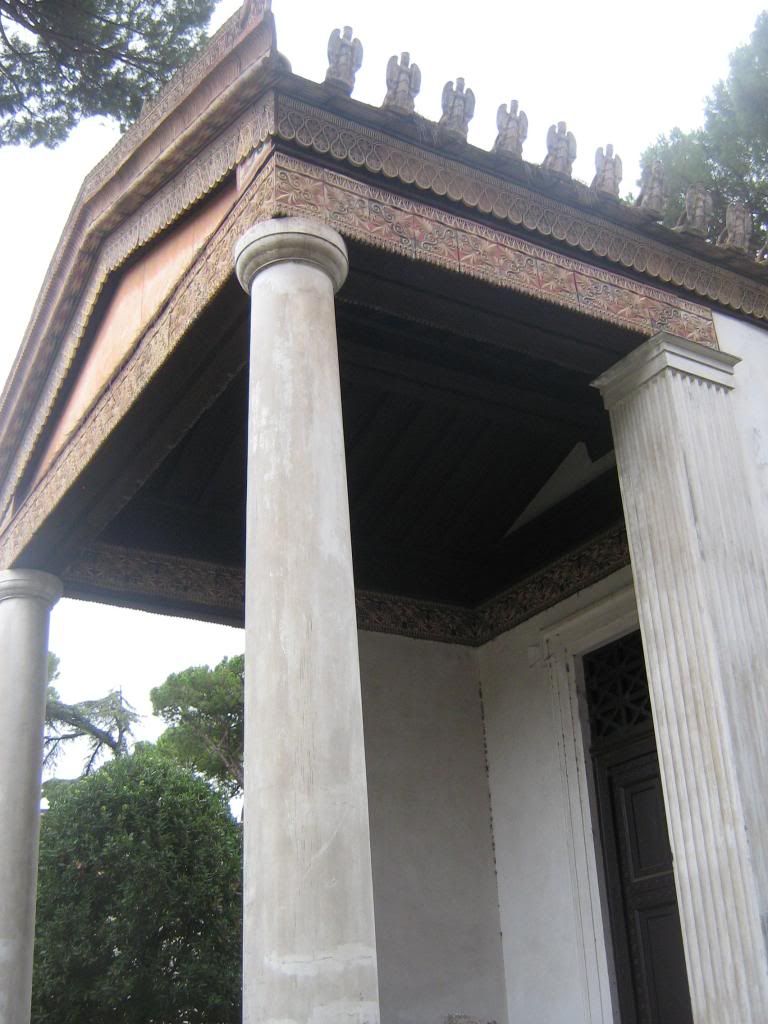
The Etruscan pantheon and its mythology appears to be as mysterious and alluring as any others of the ancient world, yet little is known of it. Part of the reason is that the Romans defeated the Etruscan civilization, destroyed their structures and culture, stole their technology, wiped out any memory of them, and fully replaced them. Only later did they resurrect some of the Etruscan deities under different names. Although apparently goddess-orientated, the supreme god of the Etruscans was a male deity called Voltumna (or Veltha).
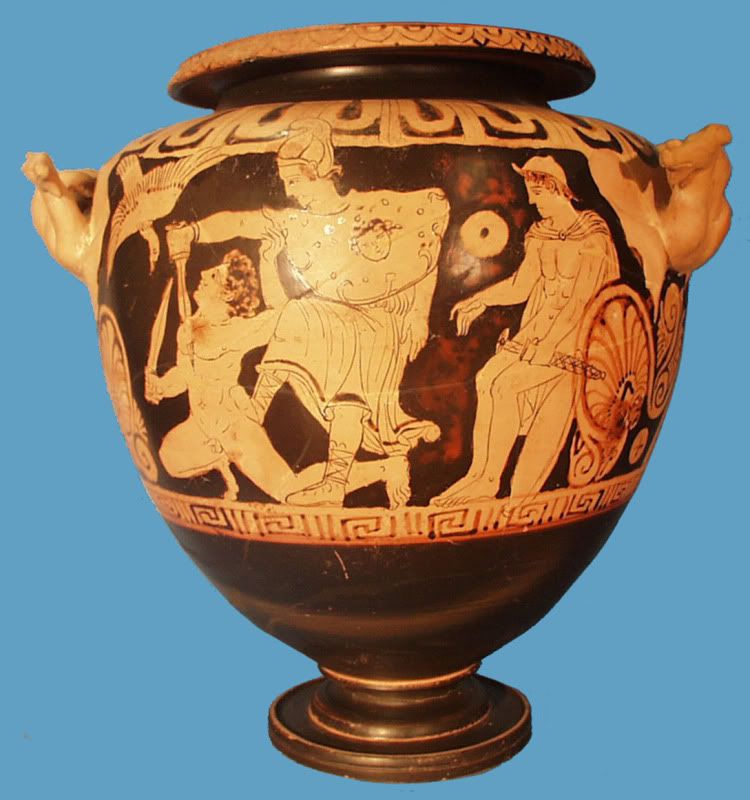
Re-imagining and re-imaging the Etruscan pantheon
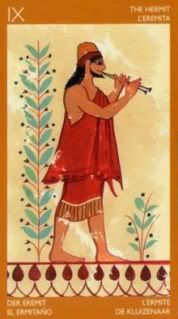
 It's just like anything else, the Etruscan pantheon could be brought back
into our imagination if there was the imagery available. For example, the
imagery of Odin or Thor, Isis or Thoth, and Zeus or Poseidon, are known
the world over. They're probably more known by their images--their
dress and props, and the distinct cultural architecture amid the
landscap in the background--than they are for even their legends. The Etruscans don't have this in today's
world, partly because the Romans stole their thunder.
It's just like anything else, the Etruscan pantheon could be brought back
into our imagination if there was the imagery available. For example, the
imagery of Odin or Thor, Isis or Thoth, and Zeus or Poseidon, are known
the world over. They're probably more known by their images--their
dress and props, and the distinct cultural architecture amid the
landscap in the background--than they are for even their legends. The Etruscans don't have this in today's
world, partly because the Romans stole their thunder.This would be an interesting challenge for an artist, to do proper research and attempt to recreate this pantheon in art... for example, the god Veltha or the goddess Alpanu. Voltumna, or Veltha as I prefer, is easily the equal of Zeus, Isis, or Odin.
.
Friday, January 17, 2014
Giorgio de Santillana
Giorgio de Santillana [Wikipedia]
Giorgio Diaz de Santillana (Rome, 30 May 1902 – Beverly, Massachusetts, 1974) was an Italian-American philosopher of science and historian of science, and professor at MIT. He moved to the United States in 1936 and became a naturalized US citizen in 1945. In 1948, he married. In 1941 he commenced his academic career at the Massachusetts Institute of Technology (MIT), becoming an Assistant Professor the following year. From 1943 to 1945 he served in the United States Army as a war correspondent. Following the war, in 1945 he returned to MIT and was made an Associate Professor in 1948 and a full Professor of the History of Science in the School of Humanities in 1954. In 1969, he published a book entitled: Hamlet's Mill, An Essay on Myth and the Frame of Time with Dr. Hertha von Dechend. This book focussed upon the understanding of the connection between the mythological stories of Pharaonic Egypt, Babylon, Greece, Christianity, etc. and the ancient observations pertaining to the stars, planets and, most notably, the 26,000 year precession of the equinoxes.[1]
Isis, a professional journal of the history of science, included an obituary by friend, Professor Nathan Sivin in Volume 67 (1976), pages 439-443. An excerpt can be found online.
http://platonism347.tripod.com/de_santillana.htm
Bibliography
Development of rationalism and empiricism. With Edgar Zilsel. Chicago: University of Chicago Press, 1941. (International encyclopedia of unified science Foundations of the unity of science ; v2 no.8).
Leonardo Da Vinci (1956)
Crime of Galileo. London: Heinemann, 1958.
The Origins of Scientific Thought: from Anaximander to Proclus, 600 BC to 300 AD. London: Weidenfeld & Nicolson, 1961.
Reflections on Men and Ideas (1968)
Hamlet's Mill. With Hertha von Dechend (1915–2001). Boston: Gambit Inc., 1969.
The Mentor Philosophers: The Age of Adventure: Renaissance Philosophers
Further reading
Payne-Gaposchkin, Cecilia (1972). "Review of Hamlet's Mill, by Giorgio de Santillana and Hertha von Dechend". Journal for the History of Astronomy 3: 206–211. Bibcode:1972JHA.....3..206P.
**************************************************
From the video (YouTube user cfapps7865)
Joe and John Anthony West discuss the theory behind one of my all time favorite books, 'Hamlet's Mill' written by Giorgio de Santillana and Hertha von Dechen. This fascinating,.. but of course highly criticized book brings into question the self-congratulatory assumptions of Western science about the unfolding development and transmission of knowledge. This is a truly seminal and original thesis, a book that should be read by anyone interested in myth and science, and the interactions between the two.
From book: "Mistaking cultural history for a process of gradual evolution, we have deprived ourselves of every reasonable insight into the nature of culture. It goes without saying that the still more modern habit of replacing "culture" by "society" has blocked the last narrow path to understanding history. Our ignorance not only remained vast, but became pretentious as well." (page 71)
From The Joe Rogan Experience, Podcast 226
Full interview:
http://www.youtube.com/watch?v=swEmL2a-h5o
http://en.wikipedia.org/wiki/Hamlet%27s_Mill
http://www.bibliotecapleyades.net/hamlets_mill/hamletmill.htm
http://podcasts.joerogan.net/
**************************************************
From MaverickScience.com
We are not alone in this belief. For several decades now, the words of Giorgio de Santillana and Hertha von Dechend have served as a rallying cry for those of us who believe ancient astronomical conceptions pervade myth:
"The real actors on the stage of the universe are very few, if their adventures are many. The most 'ancient treasure'--in Aristotle's word--that was left to us by our predecessors of the High and Far-Off Times was the idea that the gods are really stars, and that there are no others. The forces reside in the starry heavens, and all the stories, characters and adventures narrated by mythology concentrate on the active powers among the stars, who are the planets."
--'Hamlet's Mill
**************************************************
An emerging pioneer, beyond his lifetime
Giorgio de Santilana was a pioneer into areas of revisionist science which are too numerous to go into detail about now, including the scientific basis for astrology, the electric universe, Saturn as a dwarf star, the Venus-Mars connection, and the reconfiguration of our solar system.
**************************************************
1-19-14 Addition: I couldn't help but add here the irony that Santilana was from Rome, where Saturn was a very big part of Rome's ancient spirituality and culture. In fact, the archaic name for the Roman-Italian peninsula was "Saturnia." The irony being that Saturn is extremely relevant in his theories, which are only gaining momentum now.
.
Tuesday, March 26, 2013
The Etruscans - Legacy of a Lost Civilization

The Etruscans - Legacy of a Lost Civilization (video)
The YouTube channel DeanDigitalVideo didn't allow embedding.
.
Friday, March 15, 2013
Celtic warriors - Italian Bagpipes - Cornamuse Italiane (Arriva la Piva)
The above video, and title, was from YouTube channel fabiovetro. Bagpipes may have been introduced by ancient Phoenician traders, but I have no information about "Italian bagpipes." Apparently there is some evidence of Celtic music having a similar sound in both the British Isles and in continental Europe.
When the ancient Germanic tribes came into Europe, they merged with ancient Alpine natives from Scotland to Asia Minor to produce the "Celtic cultures." The Italic tribes would have been one grouping of the "Alpines," at a time when much of Europe was covered in ice during the last glacial movement. Some of the imagery from this video is based on the Celtic Gaels and Britons, but some of it is based on the continental Celts (Gauls, Celtiberians, Hallstatts, Belgae, Cisalpines, etc.).
.
Saturday, October 27, 2012
Old Roman Catholic Chant - Dixit Dominus Domino meo
Old Roman Catholic Chant - Dixit Dominus Domino meo
Dixit Dominus Domino meo: Sede a dextris meis, donec ponam inimicos tuos scabellum pedum tuorum.
The Lord said unto my Lord: Sit thou on my right hand, until I make thine enemies thy foot-stool.
.
Friday, October 26, 2012
A Journey Through Early Christian Rome
A Journey Through Early Christian Rome
Based on the image album from LiveScience.com entitled 'In Photos: A Journey Through Early Christian Rome' by Owen Jarus (9-30-11). The rise of early Christianity.
http://www.livescience.com/16318-photos-early-christian-rome-catacombs-artifacts.html
[Music: 'Lacrimosa Dies' by Atrium Animae]
.
Thursday, October 25, 2012
Spot where Julius Caesar was stabbed discovered
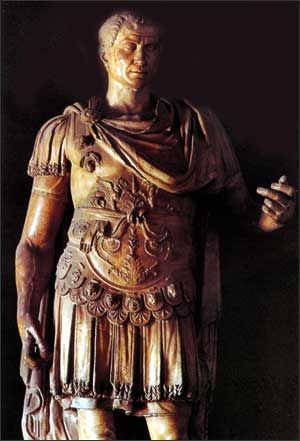
Concrete structure believed to mark location of Roman ruler's killing
By Stephanie Pappas - Senior writer - MSNBC - October 11, 2012
Archaeologists believe they have found the first physical evidence of the spot where Julius Caesar died, according to a new Spanish National Research Council report.
Caesar, the head of the Roman Republic, was stabbed to death by a group of rival Roman senators on March 15, 44 B.C., the Ides of March. The assassination is well-covered in classical texts, but until now, researchers had no archaeological evidence of the place where it happened.
Now, archaeologists have unearthed a concrete structure nearly 10 feet wide and 6.5 feet tall that may have been erected by Augustus, Julius Caesar's successor, to condemn the assassination. The structure is at the base of the Curia, or Theater, of Pompey, the spot where classical writers reported the stabbing took place.
"We always knew that Julius Caesar was killed in the Curia of Pompey on March 15th 44 B.C. because the classical texts pass on so, but so far no material evidence of this fact, so often depicted in historicist painting and cinema, had been recovered," Antonio Monterroso, a researcher at the Spanish National Research Council, said in a statement.
Classical texts also say that years after the assassination, the Curia was closed and turned into a memorial chapel for Caesar. The researchers are studying this building along with another monument in the same complex, the Portico of the Hundred Columns, or Hecatostylon; they are looking for links between the archaeology of the assassination and what has been portrayed in art.
"It is very attractive, in a civic and citizen sense, that thousands of people today take the bus and the tram right next to the place where Julius Caesar was stabbed 2,056 years ago," Monterroso said.
.
Thursday, April 5, 2012
Thursday, December 16, 2010
Was there an Etruscan Book of the Dead?
In the 1998 movie entitled 'The Eighteenth Angel', the fictional plot revolved around something called "The Etruscan Book of the Dead." However, was this based on ancient reality? Certainly we know that there was the Egyptian "Book of the Dead." Google shows 703 results for an exact search for "Etruscan Book of the Dead," but still, the evidence seems to be lacking. We do know that the plot in 'The Eighteenth Angel' was at least partly based on fiction, as it portrayed the book as having something to do with Satan. Satan was a Christian concept, and would not have been present in ancient Etruria.
One possible answer may be hinted at in the book 'Marcus Aurelius: A Life' (McLynn; 2009). According to the book, the former Emperor of Rome enjoyed talking about local wines and the "Etruscan book of the dead" (in lower case). Therefore, this lowercase "book of the dead" possibly could be merely a nickname for the 'Etrusca Disciplina'. To quote Wikipedia's "Etruscan mythology" page: The Etruscan religion was a revealed one. Its scriptures were a corpus of Etruscan texts termed the Etrusca Disciplina.
According to the Romans, who had vanquished the Etruscans long before, "Etruria" was a dead culture. The early Romans had destroyed virtually everything Etruscan, including its spiritual traditions, therefore, the later generations of Romans would have looked back to the pre-Roman period in the region as mysterious. "The dead." Maybe someone out there could give us a little help here, but it appears that this explanation makes sense.
To quote the MysteriousEtruscans.com Etruscan Religion page:
The disciplina etrusca seems to have comprised three categories of books of fate. The first was that of the libri haruspicini, which dealt with divination from the livers of sacrificed animals; the second, the libri fulgurates, on the interpretation of thunder and lightning; the third, the libri rituales, which covered a variety of matters. They contained, as Festus says, "prescriptions concerning the founding of cities, the consecration of altars and temples, the inviolability of ramparts, the laws relating to city gates, the division into tribes, curiae and centuriae, the constitution and organization of armies, and all other things of this nature concerning war and peace.
Among the libri rituales were also three further categories: the libri fatales, on the division of time and the life-span of individuals and peoples; the libri Acherontici, on the world beyond the grave and the rituals for salvation; and finally, the ostentaria, which gave rules for interpreting signs and portents and laid down the propitiatory and expiatory acts needed to obviate disaster and to placate the gods.
The "Etrucan book of the dead" is probably just a nickname for the 'Disciplina Etrusca' and its "books of fate."
.

Monday, October 25, 2010
The Etruscans and Arthur Kemp
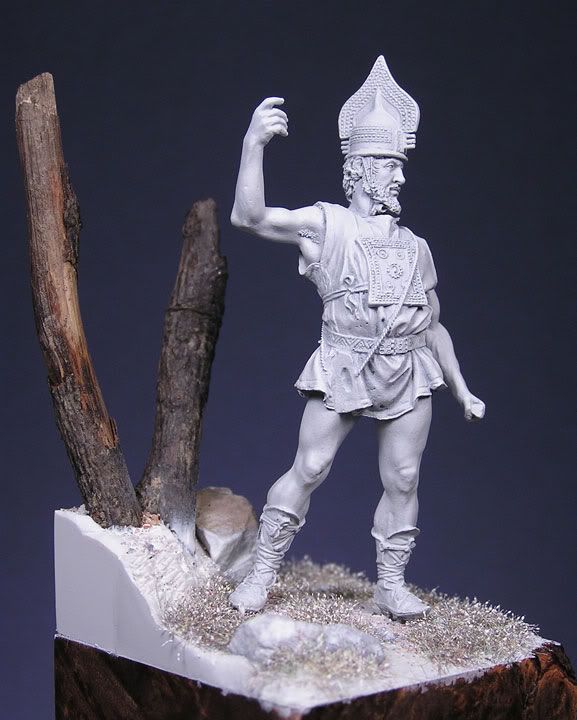
The article is based on a 2006 DNA study on native Tuscans. The conclusion was that modern Tuscans are not related to the ancient Etruscans, as had long been thought.
One of the problems with "geographical categorizations" is that racial stocks in certain regions of the world change over time. Therefore a DNA test might show, for example, that a person of Indo-European descent has genetic links to Iran. In reality, it would much more likely be to ancient Persia, and perhaps even thousands of years ago when the demographics were different. The same could be said for many other regions.
When members of the British National Party voluntarily underwent DNA tests, most showed a somewhat significant genetic link to the Middle East. In reality, that link was to the ancient Mediterraneans of that region, long before massive numbers of people of a different racial stock migrated out of the Saudi Peninsula and spread the Islamic faith there. All it meant was that the English and the Middle Easterners shared some common ancestry, despite the fact that those ancestors went in entirely different genetic directions. The ancient Middle Easterners largely became, for all intents and purposes, Saudis. The ancient Mediterranean Britons became basically Germans. Therefore, for someone to state that Englishmen and Iraqis of today, are genetic cousins, would not be intellectually honest.
The article goes on to the hypothesis that the Langobards displaced the mixed-race Roman population. In reality, at least throughout most of the northern half of the Italian peninsula, the population was made up of culturally "Romanized" Gauls as the historical record is absolutely crystal clear on. In Tuscany, Kemp's hypothesis is closer to the truth, and down onto the southern Langobard duchies of Benovento and Spoleto. Still, the wild sweeping generalization seems to show his lack of historical understanding of at least most of the north.
Now, as far the Tuscan DNA study, the article accurately summed up the results:
"DNA testing on Etruscan bones recovered from graves showed that they were completely unrelated to modern Tuscan people.
"DNA testing on the modern Tuscan people showed that their genetic origin was in Anatolia, which is located in modern Turkey, bounded by the Black Sea to the north and the Caucasus to the northeast — smack bang where it should be."
The only problem is that Arthur Kemp wants his cake and eat it too. Up to, and during the Roman period, there was no "Turkey," and there were no "Turks." Using his logic, one could conclude that the Iroquois built New York City, that Aborigines constructed Sydney, or that England was originally settled by immigrants from Iraq.
The region that is now Turkey was the hub of the Eastern Roman Empire. Before that, much of it was part of Greece. A good portion of it was settled early on by Celtic tribes. According to the 'History of Turkey' Wikipedia page:
"The history of Turkey refers to the history of the country now called Turkey. Although the lands have an ancient history, Turkic migration to the country is relatively new. The Turks, a society whose language belongs to the Turkic language family started moving from their original homelands to the modern Turkey in the 11th century. After the Turkic Seljuq Empire defeated forces of the Byzantine Empire at the Battle of Manzikert, the process was accelerated and the country was referred to as 'Turchia' in the Europe as early as the 12th century.[1] The Seljuq dynasty controlled Turkey until the country was invaded by the Mongols following the Battle of Kosedag. During the years when the country was under Mongol rule, some small Turkish states were born. One of these states was the Ottoman beylik which quickly controlled Western Anatolia..." [Source: 'Turkey'; James Bainbridge].
Arthur Kemp can't have it both ways. If Tuscans are really Turks, then Iraqi immigrants were the original settlers of England. In reality, both of those Mediterranean peoples had no genuine link to modern Turks or Iraqis outside of the very "limited shared ancestry" concept, by which entirely different racial stocks could easily have "some common ancestors." It can't be "heads I win, tails you lose." YOU CANNOT HAVE IT BOTH WAYS.
Modern Tuscans, which we consider OUR folk, are not culturally or genetically similar to modern Turks. Although the study showed some strong evidence to support Kemp's politics, his final conclusion was intellectually dishonest. Some years back, someone was poking around a Roman graveyard and found some surnames consistent with Byzantine origins, and Kemp concluded that this meant that the native inhabitants were actually Turks. That was junk science. First of all, the Byzantines were not "Turkish." Even then, how do we know that the graveyard wasn't specifically a Byzantine cemetery? Were other cemeteries from that period studied? How do we know that the twenty seven ancient Etruscans, from which the DNA was obtained, were not atypical individuals; perhaps from elsewhere?
In the British Isles, remains of Roman legionnaires have been discovered. Some of those soldiers had identification documents showing that they were natives of Syria, Carthage, and elsewhere. Although they probably were basically Phoenician or ancient Mediterranean, which would for all intents and purposes would still place them within the range of "Indo-European," one could easily slant the evidence to the contrary. One BNP official, whose DNA was tested, showed 8% historically recent Sub-Saharan African mtDNA markers; likely originating from the importation of West African slaves. Again, someone could very easily slant that evidence. In reality, one would probably need to take a dozen tests to get an accurate reading of various genetic stocks. A single DNA ancestry test will occasionally blow up the admixture of any particular genetic stock, so 2% could read as perhaps 10% of whatever racial stock was being analyzed.
It's probably safe to say that England is probably more purely "Indo-European" than, say, Spain or Sicily. However, when studying data, an intellectually honest researcher can't decide for themselves, depending on their own ideology, that "heads I win, tails you lose." In other words, you can't use one set of rules to come to a conclusion in one area; and an entirely different set of rules to come to a conclusion in another area.
.
Saturday, September 25, 2010
Cernic Rite
The Cernic tradition was an ancient religion native to mainly ancient Gaul, Alpine Germany, and Cisalpine Gaul; and which also seemed to exist in Iberia, some parts of Scandinavia, and perhaps elsewhere.
CERNUNNOS
http://en.wikipedia.org/wiki/Cernunnos
Cernunnos (also Cernenus and Cern) is a Celtic god whose representations were widespread in the ancient Celtic lands of western Europe. Cernunnos is associated with horned male animals, especially stags and the ram-horned snake; this and other attributes associate him with produce and fertility.
Everything known about this deity comes from two inscriptions from France and one from Germany.
Evidence
A rock carving of Cernunnos in the National park of Naquane, Italy.[4]
Cernunnos was proposed to have been identified as the illustration on the Snake-witch picture stone, which shows a possibly horned figure holding snakes in his/her hands, from Gotland, Sweden.[citation needed]
Archaeological sources such as inscriptions and depictions from Gaul and Northern Italy (Gallia Cisalpina) have been used to define Cernunnos.
[Music: 'Lacrimae Lugus' by Crystalmoors
"Celtic/Pagan Black Metal band from Cantabria, Spain" (YouTube user BlackDeath)
http://www.myspace.com/crystalmoors
http://www.fotolog.com/crystalmoors ]
Tuesday, August 17, 2010
New findings from ancient tomb in Italy
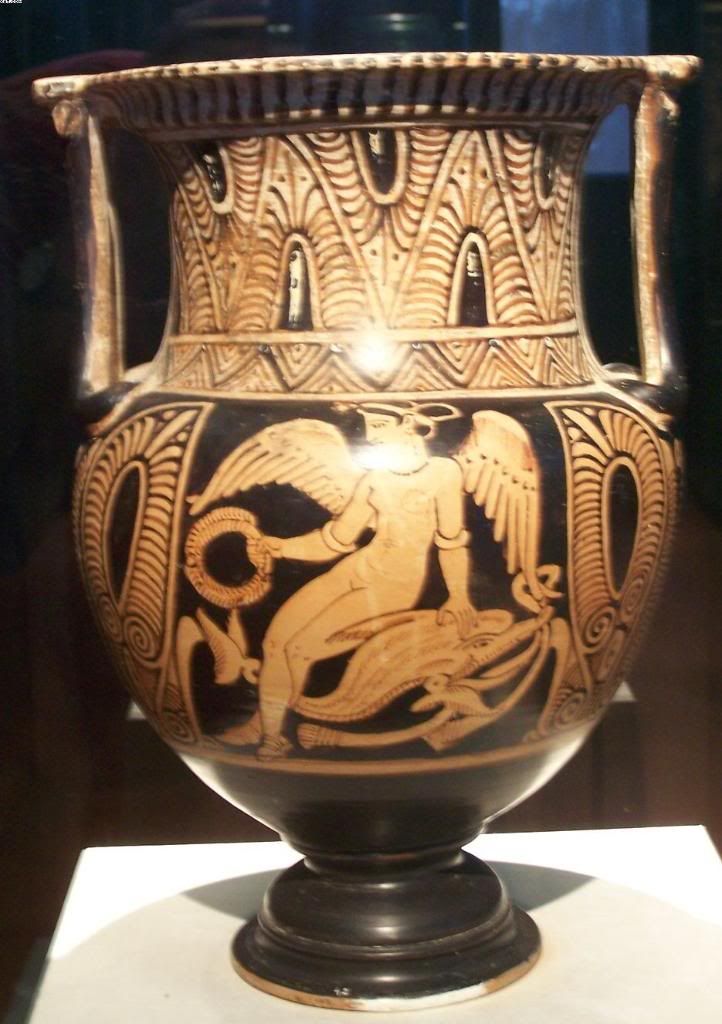 New findings from ancient tomb in Italy
UPI - August 5, 2010
ROME, Aug. 5 (UPI) -- A royal tomb in an Etruscan necropolis in central Italy has yielded fresh archaeological finds during a summer dig, researchers say.
Tarquinia, one of the richest Etruscan sites in the Lazio region of Italy, is home to dozens of tombs, but researchers were only recently given permission to excavate the "Queen's Tomb" in detail, ANSA reported.
Dating to the mid-seventh century B.C., the crypt is thought to have been a royal burial site although no remains have ever been found.
Researchers uncovering the crypt say they are finding images and decorations found in other contemporary cultures, suggesting the ancient city had much wider links with the outside world than previously thought.
Archaeologists believe the royal tomb was created by a team of foreign architects and craftsmen, strong evidence of a solid network of ties and trade with other civilizations, they said.
The necropolis of Tarquinia contains 6,000 graves cut into the rock but has won worldwide fame for its painted tombs.
Nearly 200 crypts at the site are decorated with frescos in the early Etruscan and Greek style.
Considered one of the most important galleries of ancient art, the Tarquinia necropolis has been on UNESCO's world heritage list since 2004.
.
Tarquinia, one of the richest Etruscan sites in the Lazio region of Italy, is home to dozens of tombs, but researchers were only recently given permission to excavate the "Queen's Tomb" in detail, ANSA reported.
Dating to the mid-seventh century B.C., the crypt is thought to have been a royal burial site although no remains have ever been found.
Researchers uncovering the crypt say they are finding images and decorations found in other contemporary cultures, suggesting the ancient city had much wider links with the outside world than previously thought.
Archaeologists believe the royal tomb was created by a team of foreign architects and craftsmen, strong evidence of a solid network of ties and trade with other civilizations, they said.
The necropolis of Tarquinia contains 6,000 graves cut into the rock but has won worldwide fame for its painted tombs.
Nearly 200 crypts at the site are decorated with frescos in the early Etruscan and Greek style.
Considered one of the most important galleries of ancient art, the Tarquinia necropolis has been on UNESCO's world heritage list since 2004.
Sunday, August 15, 2010
Ancient Etruria II: Civilization without empire
"In the eight century BC, time of westward expansion, Phoenicians going west, Greeks going west, founding colonies. When the Greeks sailed into Italy, they found something they didn't expect. An advanced civilization already there." --Professor Richard E. Prior, Ancient Historian, Furman University, South Carolina, from the documentary 'Rome: Power & Glory'
As has been stated here before, the perception is that Rome more-or-less came from the Greeks. The truth is a lot different. As the above quote reflects, the Etruscans were trendsetters on thier own. That doesn't mean that, in many ways, the Greeks weren't the forerunners of what later became Western civilization. However, in most areas of human endeavor, the Etruscans were the equal to the Greeks. They apparently were not looking to expand, as they already were in a virtual Garden of Eden. They were not sea faring people. They conducted a lot of land trading, with the north mostly, it appears.
After the Romans shattered the Etruscans, as the victors always do, they rewrote the history. Until fairly recently, the Etruscans didn't even exist in the history books. Now we know that the Romans took Etruscan technology and began to form their plan for an empire. They leveled the vast majority of what had been Etruscan.
[Music: 'Hazelwood' by Silver On The Tree]
.
Sunday, May 23, 2010
Ancient Cisalpine Gaul: More Celtic than we thought
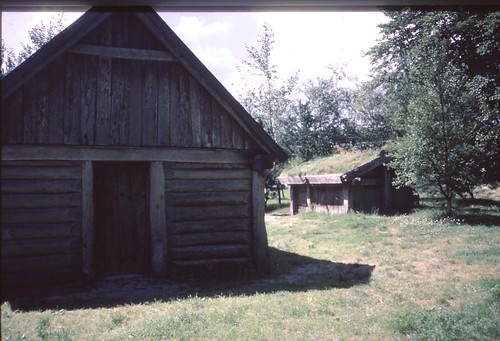
The evidence, as we dig though it, seems to suggest that while they can be traced back to upwards of ten thousand years, they weren't very widespread. It's highly unlikely then that there was every any significant fighting as the Celts migrated and settled in the largely underpopulated region.
The Eugenei who lived outside of what was their later stronghold in the northeast, probably were absorbed into the Celtic tribes. We encounter information all the time which challenges earlier beliefs, so this can and should be considered a historical work in progress. As of now it appears that the Celts were the, numerically-speaking, much more dominant culture. Even the Eugenei tribes who survived as a separate culture, did have at least some clear Celtic influence.
The Eugenei still are a reminder of the very ancient past, and as far as we know, the pure representatives of the human origin of the region. For anyone of "northern nations" descent, unfortunately, getting information in simple English text on these subjects (on both sides of the Atlantic) is like pulling teeth! I refer to the pre-Roman stock as "Celto-Alpine" people, rather than Gaulic or Celtic.
It's still somewhat of a mystery as to exactly where the Celts migrated into the Cisalpine region. They seemed to arrive in successive waves over a long period. The Cenomani tribe has the same name as the Cenomani of Gaul, although there is no definitive proof that they were once the same tribe. However, there is evidence that many or most arrived via Liguria; hence the name "Celto-Ligurian." Gaul's (France) geographic location would seem to validate this.
There is also evidence that some migrated early on from the Halstatt settlements of ancient south Germany. The "iceman," the famous archeological find of a preserved man in high Alpine ice in the 1990s, likely was among the first Celtic pioneers of the Cisalpine region. I recall that he lived between five and six thousand years ago. It should not be forgotten that there was also Celtic settlement in ancient Tuscany. What makes that a little different was that there did seem to be some skirmishing between Celts and Etruscans, although it didn't seem to be very long-lasting.
[1-27-11 ADDITION: It should be noted that Celtic migration into the Cisalpine region began at least by 3,000 years ago, and that in the fifth century there was another wave into the region. The first being pre-Roman, and the latter post-Roman. Also, the latter was also when the Celts first migrated into the British Isles; as well as into Denmark, Spain, and the Balkans. Some of those regions, like Spain, also had pre-Roman Celtic heritage.]
.
Tuesday, March 16, 2010
Etruscan video
Etruscans: Part 1
Etruscans: Part 2
"In the eight century BC, time of westward expansion, Phoenicians going west, Greeks going west, founding colonies. When the Greeks sailed into Italy, they found something they didn't expect. An advanced civilization already there." --Professor Richard E. Prior, Ancient Historian, Furman University, South Carolina, from the documentary 'Rome: Power & Glory'
As has been stated here before, the perception is that Rome more-or-less came from the Greeks. The truth is a lot different. As the above quote reflects, the Etruscans were trendsetters on thier own. That doesn't mean that, in many ways, the Greeks weren't the forerunners of what later became Western civilization. However, in most areas of human endeavor, the Etruscans were the equal to the Greeks. They apparently were not looking to expand, as they already were in a virtual Garden of Eden. They were not sea faring people. They conducted a lot of land trading, with the north mostly, it appears.
After the Romans shattered the Etruscans, as the victors always do, they rewrote the history. Until fairly recently, the Etruscans didn't even exist in the history books. Now we know that the Romans took Etruscan technology and began to form their plan for an empire. They leveled the vast majority of what had been Etruscan.
Subscribe to:
Posts (Atom)