
Showing posts with label Etruscans. Show all posts
Showing posts with label Etruscans. Show all posts
Thursday, February 7, 2019
What on Earth Happened to the Old Europeans? Pre-Indo-European History of Europe
What on Earth Happened to the Old Europeans? Pre-Indo-European History of Europe
Masaman
What happened to the Old European? Meaning the original people groups of Europe that inhabited the landmass before the arrival of the Indo-Europeans, a group which would later evolve into the vast majority of European nations we see today, from the Russians, Italians, Irish, Norwegians and Greeks.
Although precious little is known, there are clues left behind in the archaeology, genetics, linguistics and historical texts that have been passed down through the generations, which gives us a somewhat fuzzy picture of pre-historic Europe. Be sure to let me know your thoughts on the pre-Indo-European Europeans and let me know which culture you think is the most interesting. Thanks for watching!
Sources:
https://www.historyfiles.co.uk/KingListsEurope/GreecePelasgians.htm
http://www.sciencemag.org/news/2015/04/how-europeans-evolved-white-skin
http://humanphenotypes.net/PaleoSardinian.html
https://evolutionistx.wordpress.com/2015/10/30/genetic-history-of-the-finno-ugrics/
http://www.elupuu.org/index.php?id=52
https://www.ancient.eu/Etruscan_Civilization/
.


Saturday, May 30, 2015
Etruscan women, mythology, and the god Veltha
Etruscan Women
Tanguy de Thuret
Twenty-five hundred years ago, Etruscan women living in the Italian region of what is now called Tuscany were afforded a remarkably equal status with men.
An American Art Historian & journalist explains her passion about them & why they are still relevant in contemporary Italian society.
**************************************************
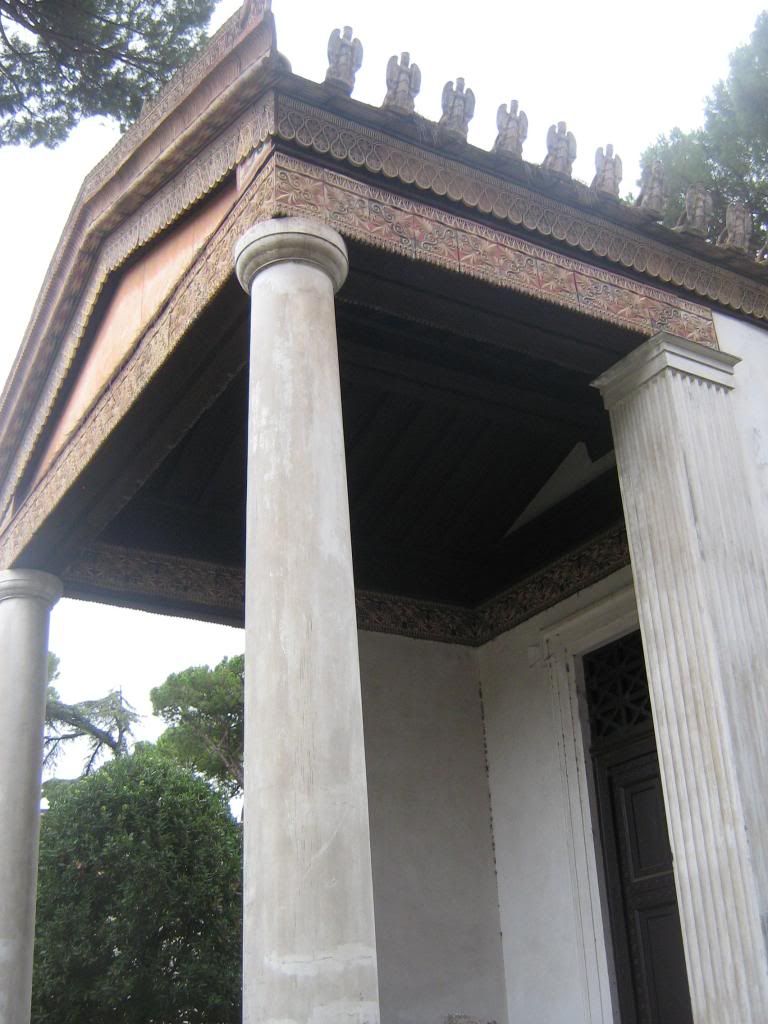
The Etruscan pantheon and its mythology appears to be as mysterious and alluring as any others of the ancient world, yet little is known of it. Part of the reason is that the Romans defeated the Etruscan civilization, destroyed their structures and culture, stole their technology, wiped out any memory of them, and fully replaced them. Only later did they resurrect some of the Etruscan deities under different names. Although apparently goddess-orientated, the supreme god of the Etruscans was a male deity called Voltumna (or Veltha).
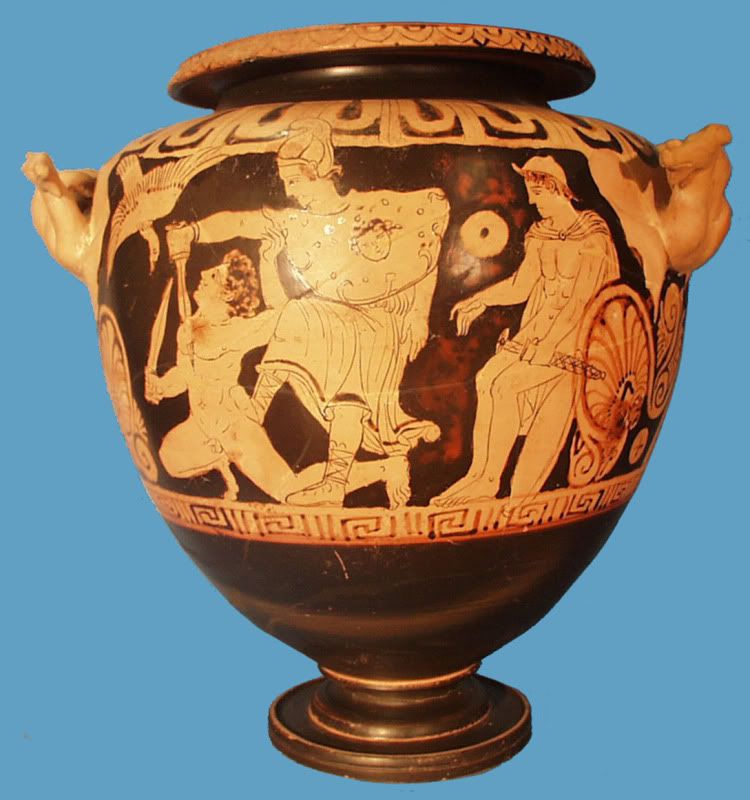
Re-imagining and re-imaging the Etruscan pantheon
 It's just like anything else, the Etruscan pantheon could be brought back
into our imagination if there was the imagery available. For example, the
imagery of Odin or Thor, Isis or Thoth, and Zeus or Poseidon, are known
the world over. They're probably more known by their images--their
dress and props, and the distinct cultural architecture amid the
landscap in the background--than they are for even their legends. The Etruscans don't have this in today's
world, partly because the Romans stole their thunder.
It's just like anything else, the Etruscan pantheon could be brought back
into our imagination if there was the imagery available. For example, the
imagery of Odin or Thor, Isis or Thoth, and Zeus or Poseidon, are known
the world over. They're probably more known by their images--their
dress and props, and the distinct cultural architecture amid the
landscap in the background--than they are for even their legends. The Etruscans don't have this in today's
world, partly because the Romans stole their thunder.This would be an interesting challenge for an artist, to do proper research and attempt to recreate this pantheon in art... for example, the god Veltha or the goddess Alpanu. Voltumna, or Veltha as I prefer, is easily the equal of Zeus, Isis, or Odin.
.
Tuesday, March 26, 2013
The Etruscans - Legacy of a Lost Civilization

The Etruscans - Legacy of a Lost Civilization (video)
The YouTube channel DeanDigitalVideo didn't allow embedding.
.
Thursday, April 5, 2012
Tuesday, September 27, 2011
Matrimonio Etrusco Celtico
Etruscan-Celtic Marriage
Reconstruction of a marriage between a Celtic nobleman and an Etruscan princess, in ancient Etruria or Cisalpine Gaul.
.
Thursday, December 16, 2010
Was there an Etruscan Book of the Dead?
In the 1998 movie entitled 'The Eighteenth Angel', the fictional plot revolved around something called "The Etruscan Book of the Dead." However, was this based on ancient reality? Certainly we know that there was the Egyptian "Book of the Dead." Google shows 703 results for an exact search for "Etruscan Book of the Dead," but still, the evidence seems to be lacking. We do know that the plot in 'The Eighteenth Angel' was at least partly based on fiction, as it portrayed the book as having something to do with Satan. Satan was a Christian concept, and would not have been present in ancient Etruria.
One possible answer may be hinted at in the book 'Marcus Aurelius: A Life' (McLynn; 2009). According to the book, the former Emperor of Rome enjoyed talking about local wines and the "Etruscan book of the dead" (in lower case). Therefore, this lowercase "book of the dead" possibly could be merely a nickname for the 'Etrusca Disciplina'. To quote Wikipedia's "Etruscan mythology" page: The Etruscan religion was a revealed one. Its scriptures were a corpus of Etruscan texts termed the Etrusca Disciplina.
According to the Romans, who had vanquished the Etruscans long before, "Etruria" was a dead culture. The early Romans had destroyed virtually everything Etruscan, including its spiritual traditions, therefore, the later generations of Romans would have looked back to the pre-Roman period in the region as mysterious. "The dead." Maybe someone out there could give us a little help here, but it appears that this explanation makes sense.
To quote the MysteriousEtruscans.com Etruscan Religion page:
The disciplina etrusca seems to have comprised three categories of books of fate. The first was that of the libri haruspicini, which dealt with divination from the livers of sacrificed animals; the second, the libri fulgurates, on the interpretation of thunder and lightning; the third, the libri rituales, which covered a variety of matters. They contained, as Festus says, "prescriptions concerning the founding of cities, the consecration of altars and temples, the inviolability of ramparts, the laws relating to city gates, the division into tribes, curiae and centuriae, the constitution and organization of armies, and all other things of this nature concerning war and peace.
Among the libri rituales were also three further categories: the libri fatales, on the division of time and the life-span of individuals and peoples; the libri Acherontici, on the world beyond the grave and the rituals for salvation; and finally, the ostentaria, which gave rules for interpreting signs and portents and laid down the propitiatory and expiatory acts needed to obviate disaster and to placate the gods.
The "Etrucan book of the dead" is probably just a nickname for the 'Disciplina Etrusca' and its "books of fate."
.

Tuesday, August 17, 2010
New findings from ancient tomb in Italy
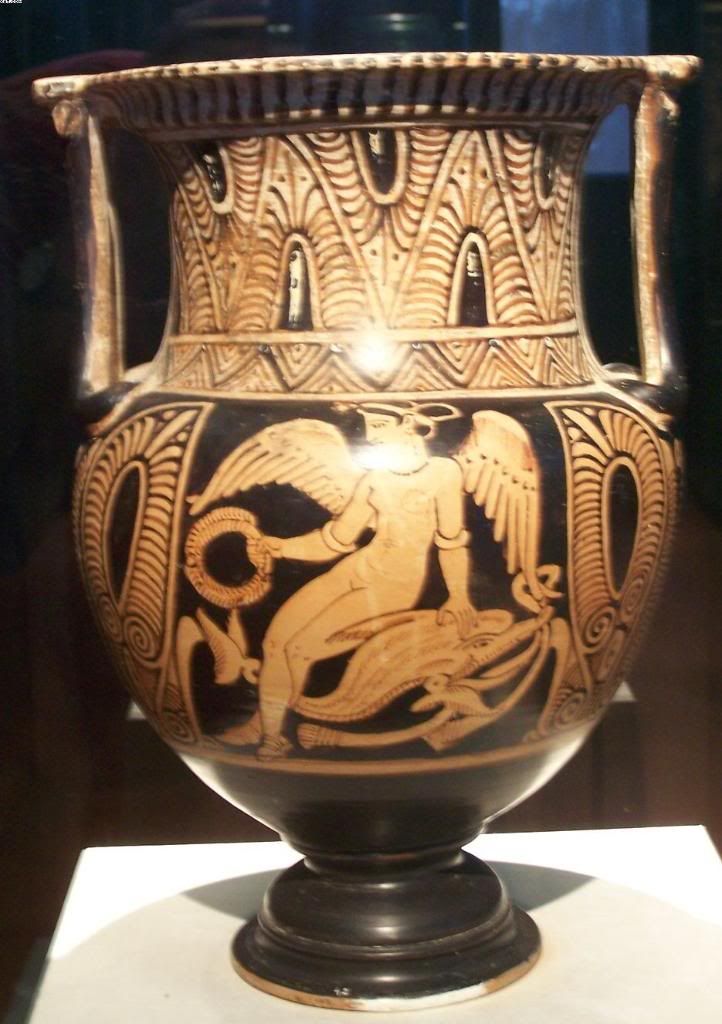 New findings from ancient tomb in Italy
UPI - August 5, 2010
ROME, Aug. 5 (UPI) -- A royal tomb in an Etruscan necropolis in central Italy has yielded fresh archaeological finds during a summer dig, researchers say.
Tarquinia, one of the richest Etruscan sites in the Lazio region of Italy, is home to dozens of tombs, but researchers were only recently given permission to excavate the "Queen's Tomb" in detail, ANSA reported.
Dating to the mid-seventh century B.C., the crypt is thought to have been a royal burial site although no remains have ever been found.
Researchers uncovering the crypt say they are finding images and decorations found in other contemporary cultures, suggesting the ancient city had much wider links with the outside world than previously thought.
Archaeologists believe the royal tomb was created by a team of foreign architects and craftsmen, strong evidence of a solid network of ties and trade with other civilizations, they said.
The necropolis of Tarquinia contains 6,000 graves cut into the rock but has won worldwide fame for its painted tombs.
Nearly 200 crypts at the site are decorated with frescos in the early Etruscan and Greek style.
Considered one of the most important galleries of ancient art, the Tarquinia necropolis has been on UNESCO's world heritage list since 2004.
.
Tarquinia, one of the richest Etruscan sites in the Lazio region of Italy, is home to dozens of tombs, but researchers were only recently given permission to excavate the "Queen's Tomb" in detail, ANSA reported.
Dating to the mid-seventh century B.C., the crypt is thought to have been a royal burial site although no remains have ever been found.
Researchers uncovering the crypt say they are finding images and decorations found in other contemporary cultures, suggesting the ancient city had much wider links with the outside world than previously thought.
Archaeologists believe the royal tomb was created by a team of foreign architects and craftsmen, strong evidence of a solid network of ties and trade with other civilizations, they said.
The necropolis of Tarquinia contains 6,000 graves cut into the rock but has won worldwide fame for its painted tombs.
Nearly 200 crypts at the site are decorated with frescos in the early Etruscan and Greek style.
Considered one of the most important galleries of ancient art, the Tarquinia necropolis has been on UNESCO's world heritage list since 2004.
Sunday, August 15, 2010
Ancient Etruria II: Civilization without empire
"In the eight century BC, time of westward expansion, Phoenicians going west, Greeks going west, founding colonies. When the Greeks sailed into Italy, they found something they didn't expect. An advanced civilization already there." --Professor Richard E. Prior, Ancient Historian, Furman University, South Carolina, from the documentary 'Rome: Power & Glory'
As has been stated here before, the perception is that Rome more-or-less came from the Greeks. The truth is a lot different. As the above quote reflects, the Etruscans were trendsetters on thier own. That doesn't mean that, in many ways, the Greeks weren't the forerunners of what later became Western civilization. However, in most areas of human endeavor, the Etruscans were the equal to the Greeks. They apparently were not looking to expand, as they already were in a virtual Garden of Eden. They were not sea faring people. They conducted a lot of land trading, with the north mostly, it appears.
After the Romans shattered the Etruscans, as the victors always do, they rewrote the history. Until fairly recently, the Etruscans didn't even exist in the history books. Now we know that the Romans took Etruscan technology and began to form their plan for an empire. They leveled the vast majority of what had been Etruscan.
[Music: 'Hazelwood' by Silver On The Tree]
.
Tuesday, March 16, 2010
Etruscan video
Etruscans: Part 1
Etruscans: Part 2
"In the eight century BC, time of westward expansion, Phoenicians going west, Greeks going west, founding colonies. When the Greeks sailed into Italy, they found something they didn't expect. An advanced civilization already there." --Professor Richard E. Prior, Ancient Historian, Furman University, South Carolina, from the documentary 'Rome: Power & Glory'
As has been stated here before, the perception is that Rome more-or-less came from the Greeks. The truth is a lot different. As the above quote reflects, the Etruscans were trendsetters on thier own. That doesn't mean that, in many ways, the Greeks weren't the forerunners of what later became Western civilization. However, in most areas of human endeavor, the Etruscans were the equal to the Greeks. They apparently were not looking to expand, as they already were in a virtual Garden of Eden. They were not sea faring people. They conducted a lot of land trading, with the north mostly, it appears.
After the Romans shattered the Etruscans, as the victors always do, they rewrote the history. Until fairly recently, the Etruscans didn't even exist in the history books. Now we know that the Romans took Etruscan technology and began to form their plan for an empire. They leveled the vast majority of what had been Etruscan.
Thursday, March 4, 2010
Knotwork and Runes: Part III

****************************************
From the "Celtic knot" webpage on Wikipedia:
"Examples of plaitwork (a woven, unbroken cord design) predate knot work designs in several cultures around the world, but the broken and reconnected plaitwork that is characteristic of true knot work began in Northern Italy and Southern Gaul and spread to Ireland by the 7th century."
--Sir Edward Sullivan - The Book of Kells (1986) Studio Editions Ltd. ISBN 1-85170-035-8***********************************************************************************************
There are innumerable sources, but I won't be redundant. As stated earlier, there was not a Druidic culture in Cisalpine Gaul; as there were no standard pentagrams or triple moons. To the best I can figure, the Cernic culture may have originated there, and those seeds were sewn so deep that they resisted Druidic influence. It's also possible that Cernism originated in the Hallstatt culture and then was migrated to the subalpine region (as well as othe regions).
.
Wednesday, March 3, 2010
Knotwork and Runes: Part II

[You would need to visit the above link in order to view the alphabet symbol comparisons]
A reader directed me to a wonderful website called "Omniglot, a guide to writing systems", which illustrates examples of various alphabets of the world. By examining some of these we can begin to see the influences which may have led to development of the Germanic/Norse rune alphabets. It is commonly thought that the Etruscan and Latin alphabets were sources, but as you will see below, there may have been others, also. All of the data that follows are from the information and graphics from the Omniglot website.
First, let's look at the major runic alphabets (called "futharks" based upon the first six symbols). There are many other variants, but the Elder, Anglo-Saxon, and Younger Futharks are the most well-known.
Runes were used to write many languages including, Gothic, German, Frisian, English, Danish, Swedish, Norwegian, Icelandic, Lithuanian, Russian, Hebrew and other Semitic languages (due to trade relations with the Khazars, a Semitic tribe of traders of the Silk Road).
The runes might be read from left to right or from right to left, even on the same artifact. Translation of runic inscriptions is therefore extremely difficult, and complicated by the fact that rune masters sometimes wrote cryptic puzzles or in secret script.
Elder Futhark
"The Elder Futhark is thought to be the oldest version of the runic alphabet, and was used in the parts of Europe which were home to Germanic peoples, including Scandinavia. Other versions probably developed from it. The names of the letters are shown in Common Germanic, the reconstructed ancestor of all Germanic languages."
Anglo-Saxon Futhore
"A number of extra letters were added to the runic alphabet to write Anglo-Saxon/Old English. Runes were probably bought to Britain in the 5th century by the Angles, Saxons, Jutes and Frisians (collectively known as the Anglo-Saxons), and were used until about the 11th century. Runic inscriptions are mostly found on jewelry, weapons, stones and other objects. Very few examples of runic writing on manuscripts have survived. " [The chart that follows is incomplete. There are additional A-S runes, which you can see here.]
Younger (or Scandinavian) Futhark
"This version of the runic alphabet was used sporadically in Scandinavia, in particular in Denmark and Sweden, until about the 17th century ." [There are variants of the Younger Futhark also, which you can see here.]The commonality of symbols of all of the following alphabets makes sense when one considers the migration of ancient peoples from the east to the west. The people and languages of northern Europe are considered "Indo-European" because of this migration. It's not unreasonable that customs, languages, alphabets, mythology, etc. share common origins. Staggering, isn't it!
Etruscan Alphabets
"The Etruscan alphabet is thought to have been developed from the Greek alphabet by Greek colonists in Italy. The earliest known inscription dates from the middle of the 6th century BC.
More than 10,000 Etruscan inscriptions have been found on tombstones, vases, statues, mirrors and jewelry. Fragments of a Etruscan book made of linen have also been found.
Most Etruscan inscriptions are written in horizontal lines from left to right, but some are boustrophedon (running alternately left to right then right to left).
Used to write: Etruscan, a language spoken by the Etruscans, who lived in Etruria (Tuscany and Umbria) between about the 8th century BC and the 1st century AD. Little is known about the Etruscans or their language."
Latin Alphabets
"The Old Italic alphabets developed from the west Greek alphabet, which came to Italy via the Greek colonies on Sicily and along the west coast of Italy. The Etruscans adapted the Greek alphabet to write Etruscan sometime during the 6th century BC, or possibly earlier. Most of the other alphabets used in Italy are thought to have derived from the Etruscan alphabet."[There are further examples, but mostly with images, so you would need to go the link above to compare for yourself.]
Tuesday, March 2, 2010
Runes and Knotwork: Part 1

The Celts actually originated in what today is basically southern Germany: The Hallstatt culture. From there, they spread far and wide. It's not entirely clear if it developed as more of an "ethnic group" or more of "a culture." Some accounts, from Roman and Greek historians, describe them as being very tall and light haired, while other accounts show them as not being particularly tall, and brunette. One thing is clear: There were people described as Celts living in Cisalpine Gaul long before there were people described as Celts living in the British Isles. There is also clear archeological evidence that clear Celtic artifacts were brought into the British Isles from Gaul (art, symbols, chariots, brass pottery, etc.).
In other words, the style came from Gaul, and to get back on subject: The current evidence shows that the knotwork symbols were Cisalpine Gaulic in origin. What are we trying to do? We're trying to get to the truth. I have discovered that there is no evidence of any Druidic culture in the Cisalpine region, so we have to keep moving toward the truth. Perhaps the people in that region were more inclined to maintain a more clearly defined Cernic spirituality, rather than a Druidic priesthood? Other than that, they shared so much in common with Gaul.
The evidence for an Etruscan origin of the runes is even stronger, as we will see. It's not entirely clear as to why the alphabet was adopted by Norse people rather than by Gauls, ancient Slavs, or others. Of course, there are some who would say that the runes are much more than an alphabet, but have magical powers. It is clear that the earliest Romans were more of a political movement than anything else. They demolished everything Etruscan to the point where they get the credit for technology and creativity that did not originate with them. The runes was one of the casualties of this movement. As I have stated before, and will again and again: There is incredible irony in that the flag of the Langobards had a Odal Rune in the middle of it. If we are not going to set the record straight about the runes and knotwork, then who is?
Sunday, September 6, 2009
From Mercury to Wotan

Was this true? Did the Romans and Greeks share a major god with the Germanic peoples, and perhaps others? If so, that would be a strong bond linking ancient Europe. It should also be noted that the Celts had an extensive mythology, and also we've begun to learn in recent years of the extensive "Slavic mythology" that existed. Staying with the original question, we might be able to start to answer some questions.
Greeks
Hermes is the Messenger of the gods in Greek mythology. An Olympian god, he is also the patron of boundaries and of the travelers who cross them, of shepherds and cowherds, of thieves and road travelers, of orators and wit, of literature and poets, of athletics, of weights and measures, of invention, of general commerce, and of the cunning of thieves and liars.
Romans
In Roman mythology, Mercury (associated with the Greek deity Hermes) was a messenger, and a god of trade, profit and commerce, the son of Maia Maiestas, also known as Ops, the Roman version of Rhea, and Jupiter.
Also according to Wikipedia: "Mercury did not appear among the numinous di indigetes of early Roman religion. Rather, he subsumed the earlier Dei Lucrii as Roman religion was syncretized with Greek religion during the time of the Roman Republic, starting around the 4th century BC. From the beginning, Mercury had essentially the same aspects as Hermes, wearing winged shoes talaria and a winged petasos, and carrying the caduceus, a herald's staff with two entwined snakes that was Apollo's gift to Hermes."
Etruscans
So, according to the above paragraph, Mercury entered the Roman religion some time after the founding of the Roman Republic. There was a break in time there. To answer that question, we again have to explore the Roman ruination of ancient Etruria. The Etruscans called the Greek god Hermes "Turms" (see chart). Well, isn't that interesting. The Etruscans worshipped this god long before Rome, and is it such a stretch to ponder as to whether or not the early Roman elite deliberately deconstructed an important Etruscan god? I have made the comparison of the Etruscans to the USA nation state, and the Romans to the Globalist American leadership. Both deconstructed much of what had been tradition in favor of internationalism.
Now we do not necessarily know if Hermes appeared in Greek mythology prior to Etruscan mythology, but we would have to assume Greece until proven otherwise. We do know that Etruria was not a colony of Greece, and was a strong nation right along with Greece, and that the "Greece then Rome" concept is largely untrue. By destroying the highly advanced Etruscan architecture, the Romans were indeed able to wipe ancient Etruria out of memory.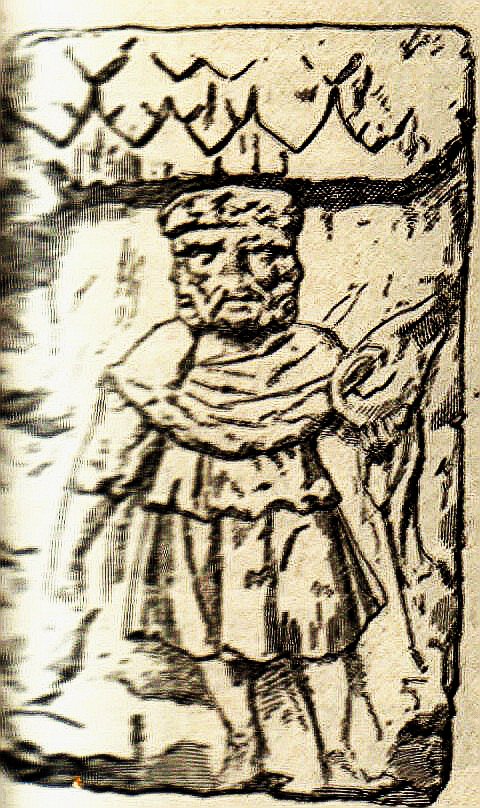
[Left: A three-headed image of a Celtic deity, interpreted as Mercury and now believed to represent Lugus]
When they described the gods of Celtic and Germanic tribes, rather than considering them separate deities, the Romans interpreted them as local manifestations or aspects of their own gods, a cultural trait called the interpretatio Romana. Mercury in particular was reported as becoming extremely popular among the nations the Roman Empire conquered; Julius Caesar wrote of Mercury being the most popular god in Britain and Gaul, regarded as the inventor of all the arts. This is probably because in the Roman syncretism, Mercury was equated with the Celtic god Lugus, and in this aspect was commonly accompanied by the Celtic goddess Rosmerta. Although Lugus may originally have been a deity of light or the sun (though this is disputed), similar to the Roman Apollo, his importance as a god of trade and commerce made him more comparable to Mercury, and Apollo was instead equated with the Celtic deity Belenus.
Romans associated Mercury with the Germanic god Wotan, by interpretatio Romana; 1st-century Roman writer Tacitus identifies the two as being the same, and describes him as the chief god of the Germanic peoples. Julius Caesar, in a section of his "Gallic Wars" describing the customs of the German tribes, wrote "The Germans most worship Mercury," apparently identifiyng Wotan with Mercury.
In Celtic areas, Mercury was sometimes portrayed with three heads or faces, and at Tongeren, Belgium, a statuette of Mercury with three phalli was found, with the extra two protruding from his head and replacing his nose; this was probably because the number 3 was considered magical, making such statues good luck and fertility charms. The Romans also made widespread use of small statues of Mercury, probably drawing from the ancient Greek tradition of hermae markers.
Lugus was a deity apparently worshipped widely in antiquity in the Celtic-speaking world. His name is rarely directly attested in inscriptions, but his importance can be inferred from placenames and ethnonyms, and his nature and attributes are deduced from the distinctive iconography of Gallo-Roman inscriptions to Mercury, who is widely believed to have been identified with Lugus, and from the quasi-mythological narratives involving his linguistic descendants, Irish Lugh and Welsh Lleu Llaw Gyffes.
"Gaulish Mercury"
Julius Caesar in his De Bello Gallico identified six gods worshipped in Gaul, by the usual conventions of interpretatio Romana giving the names of their nearest Roman equivalents rather than their Gaulish names. He said that "Mercury" was the god most revered in Gaul, describing him as patron of trade and commerce, protector of travellers, and the inventor of all the arts. The Irish god Lug bore the epithet samildánach (skilled in all arts), which has led to the widespread identification of Caesar's Mercury as Lugus. Mercury's importance is supported by the more than 400 inscriptions into him in Roman Gaul and Britain. Such a blanket identification is optimistic – Jan de Vries[8] demonstrates the unreliability of any one-to-one concordance in the interpretatio Romana – but the available parallels are worth considering.
Ancient Germanic Peoples
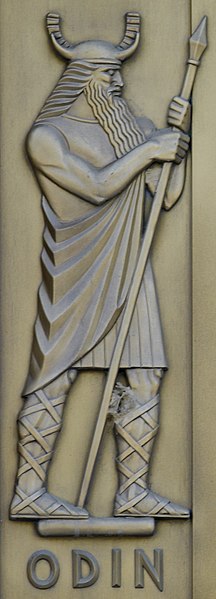
Odin is considered the chief god in Norse paganism and the ruler of Asgard. Homologous with the Anglo-Saxon Wōden and the Old High German Wotan, it is descended from Proto-Germanic *Wōđinaz or *Wōđanaz. The name Odin is generally accepted as the modern translation; although, in some cases, older translations of his name may be used or preferred. His name is related to ōðr, meaning "fury, excitation", besides "mind", or "poetry". His role, like many of the Norse gods, is complex. He is considered a principal member of the Aesir (Norse Pantheon) and is associated with wisdom, war, battle, and death, and also magic, poetry, prophecy, victory, and the hunt.
Parallels between Odin and Celtic Lugus have often been pointed out: both are intellectual gods, commanding magic and poetry. Both have ravens and a spear as their attributes, and both are one-eyed. Julius Caesar (de bello Gallico, 6.17.1) mentions Mercury as the chief god of Celtic religion. A likely context of the diffusion of elements of Celtic ritual into Germanic culture is that of the Chatti, who lived at the Celtic-Germanic boundary in Hesse during the final centuries before the Common Era.
It can be concluded that various mythological figures, from different cultures, were "associated" with a counterpart. This may have been partly due to political maneuvering by Romans and others, to pacify the population. To conjoin different cultures under a unified imperial state, in the same way that early Christians, rather than try to force the abolition of a pagan holiday, just co-opted it until it more-or-less disappeared.
Monday, June 29, 2009
The Legacy of the Etruscans
The Legacy of the Etruscans
Gary Biltcliffe Lecture
Gary Biltcliffe, Independent Researcher,presents the ancient Pelasgi and Etruscan connections with Britain, magnificent megalithic stonework, lost cities, and the city state society of archaic Europe.
"We keep on believing the teaching that the Greeks and above all the Romans are the peoples to whom the Western world owes its origins. All of this is considerably exaggerated and based on historical falsehoods. However, I have ascertained instead that it is the Etruscans, coming from the east, who are the true founders of our European culture." --Professor Graziano Baccolini, University of Bologna, 'Reflections on the Etruscan Civilization'
Sunday, February 15, 2009
"Etruscan Girl" song (by The Nays)
Thanks to our friend Eureka for sending this. Description from YouTube channel widecrossing (http://www.youtube.com/user/widecrossing): "A young man falls in love with a picture of an Etruscan flute girl in his Art History book leading to a fanciful song about the imaginary relationship he could have had, ironically the man meets a modern woman who fits the bill and they fall in love and live happily ever after. This song was written and performed by the NaYs, a band originating in Lincoln, Massachusetts. For a full quality mp3 version of this song visit thenays.com"
Monday, November 10, 2008
General consensus regarding Lombard invasion numbers

There seems to be some unscholarly dispute regarding just how many Lombards entered, invaded, and conquered Northern Italy in 568. Some would exaggerate the numbers, while others would trivialize them. I believe that the following quote gives us an idea of the general consensus among historians.
"Estimates of the number range between about fifty thousand and two hundred thousand adult males, so we may be talking about a population of four or five hundred thousand people altogether." --Professor Thomas Noble, Chairperson, Department of History, University of Notre Dame, on the Lombard invasion population numbers in 568 AD.
It doesn't even make that much difference to us, as the Etruscans and early Italic tribes (Ligurians, Venets, etc.) remain the heart, soul, and root stock of Northern Italy. The north was loosely united under one culture by the Etruscans, and centuries later, officially united under the Lombards. The two southern Lombard provinces were largely autonomous.
More and more, admittedly slowly, we are seeing a revisionism regarding the ancient Greeks as the undisputed founder of Western Civilization. All one has to do is compare the Greek and Etruscan dates and achievements to see that the evidence is contestable. I still think that Greece is the symbolic start of Western-European Civilization, in any case. Also, the Etruscans have an origin in the pre-Hellenic regions, which confuses the issue even more.
"We keep on believing the teaching that the Greeks and above all the Romans are the peoples to whom the Western world owes its origins. All of this is considerably exaggerated and based on historical falsehoods. However, I have ascertained instead that it is the Etruscans, coming from the East, who are the true founders of our European culture." --Professor Graziano Baccolini, University of Bologna, 'Reflections on the Etruscan Civilization'
Sunday, July 27, 2008
The Etruscan Runes to the Lombard Othala
 Websters dictionary describes Runes (or Rune Stones) as: "any of the characters of any of several alphabets used by the Germanic peoples from about the 3d to the 13th centuries"
According to the Serena Powers website: "Runes originated with the ancient Etruscans and Cast upwards throughout the Alpine regions to Northern Europe via the trade routes. The Germanic tribes took them and adapted them to their own needs and uses. The oldest and most widespread of the Germanic runes are the Elder Futhark or Common Germanic Runes. The word rune, which occurs in various forms in Germanic and Celtic languages, means "a mystery" or "holy secret" that is "whispered. Runes were traditionally carved into bone, wood or stone which accounts for their angular shape. The lack of curves made it easier to create the shapes in either hard wood or stone."
This further reinforces our cultural claim to the flag of the Kingdom of the Lombards (see above left) as truly a symbol of the Lombardian-Tuscan people. Our soul is Etruscan, but our cultural symbol is Lombard; and now we see that even our flag symbol has a partial Etruscan origin. To digress, you can see the red Othala in the middle of the black eagle.
Naturally the Lombards brought the Runes with them into the Po Valley. However, apparently, the Runes were just going back to where they had been originated in the first place. They may have been altered somewhat over the many centuries. It was a full millenium from the end of Etruscan civilization, to the time of the Lombard invasion.
Somewhat tied into this is the fact that the Lombards, although Arian Christian in faith when they arrived in the Po, had been Odinists for centuries. Arian (not Aryan in this definition) Christianity seems to have been a pagan-barbarian type of Christianity. The Lombard Queen, Theodelinda, converted the Lombards to Roman Christianity during her reign.
 There's so much history here that I wish I could go on further. We'll have to cover items in small bits and pieces for now. There's a lot on the web about the Runes. Below are a few links which are related to the subjects covered today:
Casting the Runes (SerenaPowers.com)
Odal Rune (Wikipedia)
Comunita Odinista (international)
Comunita Odinista - Vinland (North America)
Wednesday, June 18, 2008
Reflections on the Etruscan Civilization
 Reflections on the Etruscan Civilization
 By Graziano Baccolini
I can never succeed in understanding why Italians still fail to recognize the enormous contribution that the Etruscan civilization has made to our Western civilization. We keep on believing the teaching that the Greeks and above all the Romans are the peoples to whom the Western world owes its origins. All of this is considerably exaggerated and based on historical falsehoods. However, I have ascertained instead that it is the Etruscans, coming from the East, who are the true founders of our European culture, for both good and bad aspects. This truth continues to be understated and at times hindered by various Italian historians while it has been being recognized for numerous decades by the majority of the historians of the whole world. Etruscology is now a subject of enormous interest all over the world and a lot of falsehoods and commonly held beliefs are crumbling because they were used to discredit a people for appropriating of their worths. In the past centuries first the powerful and unculturated Rome has falsified its own origins and has ignored the legacy of the defeated Etruscan civilization, then the first Christian emperors have completed the work with their edicts. Subsequently on the ruins of the empire, the Pontifices of the new religion appropriated many ancient insignias of the Orient handed down to the Romans from Etruscan leaders and priests. For example the purple of the Lucumones became the colour of the cardinal, the Etruscan priest's Littus became the Pastoral one of the Bishops. The solemn ceremonies of the new religion are a reproduction of the Etruscan religious ceremonies. The ancient former Etruscan cities became the first Episcopal centers (Volterra, Vulci, Orvieto, etc).
The longest existing Etruscan text is a calendar containing 12 columns with the religious instructions for every day. Also the figurative Christian patrimony retraces the images found again in the Etruscan tombs. The winged figures of the Etruscans return in the Christian figures of the angels and Satan. On top of the ancient Etruscan temples has been built the new churches which very probably still conceal in many things their walls. It is strange that Etruscologists have not considered this yet. Then first Rome, then above all the priestly heirarchy of the new Roman religion snatched the symbols of the Etruscan civilization but denied the so-called pagan origin of it all. As always happens rather in the history and in the life, slandering the legitimate owners and accusing them of various inequities. Unfortunately our culture has inherited the worse of the Etruscan religion as for example, the concept of infallibility, seconded by the Christian religion.
However as also happens at times in life, the truth is reborn. From accumulated evidence, one succeeds in gathering that the truth is quite different. The great civilizing inheritance of the Etruscans was for centuries abandoned, earths once rich with produce became uncultivated, shops of artisans and artists became empty, their advanced knowledge of metallurgy and of hydraulics was forgotten and Etruscan creative individuality was oppressed, fortunately not entirely. After centuries of cultural regression (I probabably suspect due to the new religious Imperium) of hiding and of destruction of the sources of the Etruscan civilization there came the rebirth. In the ancient suburbs of the Appennines there remained the descendants of the Etruscans and the wonder contained in the tombs of their ancestors woke up again their native genome: the central part of the ancient world earth of the Etruscans, Tuscany, became the cradle of the Humanism and of the Renaissance. In these cities, Etruscans for long generations, characters such as Dante, Leonardo, Brunelleschi, Giotto, Bernini, Michelangelo etc were born, and above all so many unknown artisans and artists to which the growth of our Western civilization is owed.
Rereading these reflections I now understand, and perhaps you will also understand yourselves, because many Italian historians are reluctant to recognize these truths.
G. Baccolini Università di Bologna , Italy April 2001
See also a summary of my researches about the Sacred Etruscan Mount of Montovolo:
http://www.fci.unibo.it/~baccolin/summary.htm
***************************************************************************

My Opinion about the Origin of Etruscan Civilization
By Graziano Baccolini
Now, I wish to report my opinion about the origin of the Etruscan culture. This opinion, or new theory, is matured during my studies which have permitted to me to individualise, in the site of Montovolo, a probable Oracular Centre or Navel of the Etruscan world, hierto unknown to historians. In addition, this research has allowed to discover that the archaic symbols, till now underestimated, of the Oval Stone and of the Cross were fundamental symbols even in the Etruscan religion. I think that these new data will bring new light to the studies on the Etruscans and consistence to my hypothesis on their cultural origin.
Firstly, I think the mystery of this people is due, above all, to the fact that their literary sources, the writings of their contemporaries, as the Etruscan history in 20 volumes by emperor Tiberius Claudius, and their religious symbols were deliberately destroyed in the first centuries of Christianity to cancel, probably, something of very important for the survival of the "new" religion. The documents that show this destruction, as for example the edicts of Teodosio (391-392 d.c), exist, but till now many historians say, with euphemistic expression, that "unfortunately there are no traces of Etruscan literature or of historical accounts or they are disappeared !"
Therefore, when we speak about Etruscans we use the term of "mysterious people" whose origins are still an object of debate for many scholars and writers .On the other hand, surprisingly, many Etruscologists think it is irrelevant knowledge!
Nowadays, there are three different hypotheses that are presented in opposition among them. There is the hypothesis of the oriental origin firstly formulated by Herodotus and supported also by many other important ancient authors. Now, this theory is accepted by many non–italian historians . In opposition, there is the hypothesis, exposed firstly by Livio, of a northern origin whose the Reti and other populations like the Veneti could be the descendants. Now, this hypothesis is practically abandoned by the contemporary historians. Then the theory of autochthonous origin formulated firstly by Dionysius of Halicarnassus, the unique dissenting voice among the ancients, probably for ideological reason and about four centuries later Herodotus. This theory was in part reformulated1 by Massimo Pallottino in 1942. He wished to turn away from the question of the "origin" and instead discussed the "formative process of the Etruscan which can only take place on the territory of Etruria itself . "The mark received by earl, fresh , primitive, flexible soul of oldest Etruscan, influenced by great overseas cultures, was as great as to definitively draw spiritual trends and the structure of the nation".
I think that this Italian formative process postpones the problem of the pregnant "origin" of their culture that certainly cannot be formed in Etruria with only some commercial contacts with the east or with small groups of immigrants from east arrived in "remote pre-historic times". Besides, knowing when this theory was enunciated by the Pallottino, published in 1942 by Hoepli in an editorial collection dedicated to Mussolini, we may suppose some ideological motivations to choose this hypothesis to "underline glories and priority of ancient Italian civilization"2. Successively he become the founder of a "School" and his numerous assistants defended and defend still now his hypothesis which is the most followed by italian hystorians. However, reading a recent book of M. Torelli3, a hystorian of Pallottino’s School, I have found that Pallottino theory is evolving towards the orientalist theory. In fact Torelli say that probably "the arrive of omogeneous groups of not-numerous people with the same advanced cultural knowledge and the same language might have influenced the indigenous populations". But for Torelli this possible arrival is an "hystorical marginal fact".
Personally, I think that the above theories may be, more or less, corrected only if they are considered as a whole. In other words, the populations that have had a fundamental role for the Etruscan culture have been people with oriental origins and permeated of Anatholian and Mesopothamian culture. During the Bronze Age and for several centuries they arrived in Italy firstly from the North, probably going up the Danubio and subsequently the Po and the Reno (at that time called Spinete) crossing first the Adriatic sea, therefore subsequently more easily from the Tyrrhenian sea crossing the oriental Mediterraneum sea. Obviously their culture is further matured in that rich zone of Italy, to south of the Po subsequently called Etruria. If it is so, it is not justified to define indigenous this culture but its pregnant origin is oriental. In addition, I think that when we speak of the origin of the Etruschans it is more correct to speak of the origin of their advanced culture in contrast with the primitive culture of other italic peoples. On the other hand there is no evidence of a strong immigration as was happened for the Greeks in the South of Italy, but, probably, there will have been a gradual and constant migration of small groups of persons with very similar culture and probably all of anatholian -mesopothamian origin. Below I will propose the motivations and the circumstances of these small migrations.
Probably, these migrations beginned just at the end of the Bronze Age when there are very few indigenous inhabitants in Italy. However, the advanced knowledge of this immigrants in all the fields allowed them to become the dominant group. After some centuries at the beginning of the Iron Age this new culture was called Villanovians and it occupied part of the Padana lowland and of the Centre of Italy. Subsequently, with new and more substantial migrations of other peoples from the same oriental place and with similar language and arriving from south by sea, this culture defined Villanovian was transformed in that more evolved civilization so-called Etruscan. Then, the Villanovians already mark the beginning of Etruscan culture, as proved by the overlap of Villanovian area with the later extent of Etruscan inhabitation in the historical period.
In a simple manner, I think that, the development of the Etruscan nation and culture may be compared to the growth of our contemporary American nation and culture that all people know without doubts. The continuous arrival of European immigrants and the wealth of the place has allowed the American nation to become, after some centuries from the first European immigrants, a new cultural center and a new economic power. But now nobody would risk to define autochhonous our contemporary American culture neither that its formative process is occurred only on the American soul but everybody would recognise that its fundamental origin, also cultural, is European, even if, after some centuries, a difference will be noticed between Europeans and Americans that now already exists.
The Anatolian-Mesopotamian cultural origin of the Etruschans are confirmed by numerous series of advanced knowledges in different fields as metallurgical, hydraulic, building, artistic, religious ones and some affinities as the art of the divination, the jewellery and attire, the refined taste etc. For this when we visit an Etruscan museum it seems to us to be in a museum of oriental cultures. Their opulence and their refined taste in the choice of the joys of life had to be in contrast with the one of surrounding Italian peoples, but also with their contemporary Greeks that conducted a most modest standard of life. The structural resemblances between the Etruscan and Lemnian languages is in favour to an origin from Aegean-Anatolian area around 1000 B.C. Also the fundamental role that had the female figure in Etruscan culture connects them to archaic oriental matriarchal civilizations where the Big Goddess was venerated. This element differentiated them from other contemporary cultures where the male figure had supplanted that female relegating the woman to a subordinate role that only in our last century has regained its role. Remember to us that even Plato, in the Timeo, considered the woman a sub-human being, and this reveals what deep differences there were between Greek culture and the Etruscan one even if the Greeks have been also influenced, by the oriental Aegean culture.
In addition, as reported in my articles4 and web pages4, after the discovery of a probable Etruscan Oracular Centre on the top of the mountain of Montovolo, analysing several facts such as symbols, legends and toponimous, I have found unequivocal connections between this mountain and the Etruscan city of Marzabotto. These findings have permitted to me to realize that the Oval stones, set on Marzabotto’s Tombs as well as in other Etruscan Necropolises, were a very important religious symbol even for Etruscans. This symbol of the Oval stone, is another affinity with archaic oriental cultures. It should be noted that today these stones are considered by Etruscologists only simple cippi or Tomb signals! The other symbols found at Montovolo as a cross inscribed in a circle, a snake and two doves are often found in other ancient Oracular Centers as Delphi, Delos, Milethos, Metsamor, Tebe as well as many other oriental centres. These symbolism make evident the oriental origin of the Etruscans because such archaic symbols cannot be accepted by simple commercial exchanges. The Cross, often inscribed in a circle, that I have found at Montovolo and at Marzabotto like in a lot of other Etruscan findings is also a Villanovian symbol up to now underestimated and defined by many historians a simple ornamental motive. The equilateral cross was already used in ancient Sumerian carvings as indication of the Divinity. A so deep rootedness of these religious symbols in a whole people presupposes a distant origins in the time. The Oval stone can also bring back us to the Pelasgian myth of Eurinome that gave birth to the Primordial Egg after she was fertilized by Ofione, the snake, that immediately rolled up himself on the egg staying motionless up to when it was opened making go out the wonder of the universe.
Images of Oval stones with a snake rolled up are also depicted on mural frescos in Pompei, notoriously of Etruscan origin.
It is interesting to note that also now the Moslem pilgrim entering in the Ka’bha shrine, in Mecca, kisses the sacred Black stone which is of an oval shape about seven inches in diameter.
Now, it remains to explain the most important question! How and why these oriental immigrants with probable same culture, came continually in Etruria, forming after several centuries a rich and homogeneous people in a new earth? We know that the first European immigrants that reached America, finding in that place a rich country informed their European compatriots that they can also reach this rich earth. It is very probable that even, in archaic ages, there was a constant connection between several Sacred Centres of different and very distant regions. As I have explained in my preceding studies, such connection was possible using traveller pigeons that owed to be replaced, at least every one or two years, by others pigeons deriving from the interested regions. (See my page regarding the use of traveller pigeons5) . This periodically transport and reintegration of the pigeons had to be done by caravans and secretly. This necessity became the origin of the constant arrival of new groups of persons that were settled in that new rich region that will become the Etruria. Probably this easy and necessary connection between ancient Sacred Centres might give interesting explanations of others so- called ancient mysteries or mythological events.
Finally, after the reading of Giovanni Semerano’s books6, I have found a farther confirmation of the oriental origin of the Etruschan culture. In fact, after sixty years of studies this 90 years old philologist, Member of the Oriental Institute of Chicago, has demonstrated the Accadian and Sumerian origin of the Etruscan language and therefore also of the Latin and European languages. In such a way the theory of the Indo-European origin becomes a mere fable. His theories had been snubbed for years by the Italian Academy that had always ignored his contributions until just recently, when his book "The Origins of European Culture" was greeted with great interest by the philosophers Massimo Cacciari, Emanuele Severino and Umberto Galimberti. But many other academic historians ignores his discovery, because this is in great contrast with their acclaimed axiomatic theories.
References
1) Massimo Pallottino Etruscologia Hoepli, 2003, 110
2) See the article of Sergio Frau, Etruschi, cosi il fascismo ne cancellò le origini La Repubblica. maggio 2001 and also reported on the web: http://www.parcodiveio.it/_ita/articoli_02.htm
3) Mario Torelli, Storia degli Etruschi, Ed Laterza, 28, 2001.
4)Graziano Baccolini, Hera,16,61, 2001; Hera 41,76,2003 . This research is also reported on the web : http://www.fci.unibo.it/~baccolin/summary.htm
5) Regarding the use of traveller pigeons see my web page: http://members.xoom.virgilio.it/Farf/ipiccioviagg.html
5) Luciano De Cresenzo, I Grandi Miti Greci, Oscar Mondadori, 2003 pag. 247-8
6) Giovanni Semerano, L’infinito: un equivoco millenario, ed. Mondadori, 2001., Giovanni Semerano, Il popolo che sconfisse la morte ed Mondadori, 2003.
- Giovanni Semerano had to wait 90 years before receiving his first institutional acknowledgement for his important discoveries concerning ancient languages, in particular, the Etruscan language. In fact in Florence, July 2001, Semerano received the "Silver Plaque" by the Tuscany Regional assembly that the president Riccardo Nencini attributed to him for his hypothesis on the "mother of all languages" which for Semerano is the Acadian-Sumerian.
G. Baccolini Università di Bologna , Italy, September 2003
***************************************************************************
Reflections on the Etruscan Civilization
The Mysterious Etruscans
Etruscan Civilization [Wikipedia]
Etruscan Foundation
Although most people just assume that ancient Greece led directly to the ascendancy of Rome and ultimately to the foundations of Western Civilization, the Etruscan culture actually predates what was considered the timeline for Ancient Greece. It was latter influenced by "Magna Graecia" (Southern Italian Greek Culture), but I tend to agree with Mr. Baccolini.
Also, we use the flag of the Lombard Kingdom as the symbol of our culture (Etruscan-Italic-Celtic-Lombard) because they administered basically "Northern Italy" and had a flag to represent it. However, while our flag is Lombard, our soul is Etruscan. By "Etruscan," I mean Etruscan and other early Italic tribes from Rome northward (Volsci, Venets, Ligurians, Camunni, etc.).
If I've said it once, I've said it a million times. There's so much to study yet. I think this article, however, is a big step in understanding our origin.
Subscribe to:
Posts (Atom)