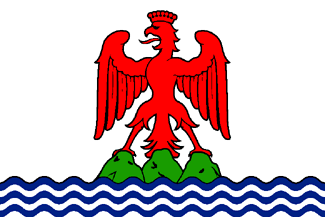
Ligury Region - Italy
Liguria borders France to the west, Piedmont to the north, and
Emilia-Romagna and Tuscany to the east. It lies on the Ligurian Sea.
Liguria is a narrow strip of land, enclosed between the sea and the Alps
and the Apennines mountains, it is a winding arched extension from
Ventimiglia to La Spezia and is one of the smallest regions in Italy.
Its surface area is 5,416.03 square Kilometres, corresponding to 1.18%
of the whole national surface area, with the following subdivision:
3524.08 kilometres mountain (65% of the total) and 891.95 square
kilometres hill (35% of the total).
Its shape is that of a thin strip of land, from 7 to 35 km (4.35 to
21.75 mi) wide (respectively above Voltri and in the high mountain area
around Imperia), on average about 240 km (149.13 mi) long, lying in a
semicircle around the Ligurian Sea and with convexity facing north;
comprised between the sea and the watershed line of the Maritime Alps
and the northern Apennines, which at some points it crosses (for example
in the Savona and Genoa mountains). Some mountains rise above 2,000 m
(6,561.68 ft); the watershed line runs at an average altitude of about
1,000 metres (3,280.84 ft).
The continental shelf, which is very narrow, is so steep it goes
down almost immediately to considerable marine depths. The coastline is
315 km long. Except for the Portovenere and Portofino promontories, it
is generally not very jagged, and is often high. At the mouths of the
biggest watercourses there are small beaches, but there are no deep bays
and natural harbours except for those of Genoa and La Spezia.
The hydrographic system is made up of the short watercourses of a
torrential kind. In the coastal part the most important are the Roja (in
its lower course), the Nervia, and the Magra. On the inland side we
find some tributaries of the Po: the two branches of the Bormida, the
Scrivia and the Trebbia; there is not much water in these rivers, though
the quantity increases greatly in rainy periods.
The ring of hills, lying immediately beyond the coast, together with the
beneficial influence of the sea, account for the mild climate the whole
year round (with average winter temperatures of 7-10° and summer
temperatures of 23°-24°) which makes for a pleasant stay even in the
heart of winter.
Rainfall can be very abundant at times; mountains very close to the
coast create an orographic effect, so Genoa can see up to 2000 mm of
rain in a year; other areas instead show the normal values of the
Mediterranean area (500--800 mm). Despite the high population density,
woods cover half of the total area. Liguria's Natural Reserves cover 12%
of the entire Region, i.e. around 60,000 hectares of land, and they are
made up of one National Reserve, six large parks, two smaller parks and
three nature reserves.
History
Traces of Neanderthal Man were discovered in the region of Loano,
whereas in Ventimiglia, in the grotto of "Balzi Rossi", numerous remains
were found which recall those of Cro-Magnon Man. According to the
written sources we have about the settlements of the Ligurians
(Ligures), the presence of this people of Mediterranean origin dates
back to the first millennium B.C. on a vast territory including most of
north-western Italy. This people, divided into several tribes, numbered
less than two hundred thousand.
During the first Punic War, the ancient Ligurians were divided, some of
them siding with Carthage and a minority with Rome, whose allies
included the future Genoese. After the Roman conquest of the region, the
so-called X regio, named Liguria, was created in the reign of Emperor
Augustus, when Liguria was expanded from the coast to the banks of Po
River. The great Roman roads (Aurelia and Julia Augusta on the coast,
Postumia and Aemilia Scauri towards the inland) helped strengthen the
territorial unity and increase exchanges and trade. Important towns
developed on the coast, of which evidences are left in the ruins of
Albenga, Ventimiglia and Luni. Between the 4th and the 10th centuries
Liguria was dominated by the Byzantine, the Lombards of King Rothari
(about 641) and the Franks (about 774) and it was later invaded by the
Saracens and the Normans. In the 10th century,
once the danger of pirates decreased, the Ligurian territory was divided
into three marches: Obertenga (east), Arduinica (west) and Aleramica
(centre). In the 11th and 12th centuries the marches were split into
fees, and then with the strengthening of the bishops' power, the feudal
structure began to partially weaken. The main Ligurian towns, especially
on the coast, became city-states, over which Genoa soon extended its
rule. Inland, however, fees belonging to noble families survived for a
very long time.