Showing posts with label Genoa. Show all posts

Monday, March 13, 2023

Lepanto 1571: Shattering the Idea of Ottoman Invincibility

Lepanto 1571: Shattering the Idea of Ottoman Invincibility

SandRhoman History

262K subscribers

202,313 views -  February 19, 2023

#educational #battle #history

Thanks to Nord VPN for sponsoring this video. Check it out here:  https://nordvpn.com/sandrhoman It's risk free with Nord's  30-day-money-back-guarantee!

The battle of Lepanto 1571 was one of the greatest naval battles of the Mediterranean and the last one to be fought almost exclusively by rowing vessels. According to maritime historian Lawrence Mott a staggering amount of 70 to 90 percent of all war galleys in the basin participated in the fighting.  Lepanto was in some sense the naval counterpart of the 1683 siege of Vienna. Contemporaries and historians long saw it as a climactic battle between east and west and mythologized it as the battle in which a Christian fleet defeated the seemingly unstoppable Ottoman threat from the east. In this video were going to look at what exactly happened in the gulf of Patras and look critically at the impact the battle really had.

con't....

.

Sunday, July 24, 2016

'Oakland mourns the looming closure of 90 year old Genova deli'

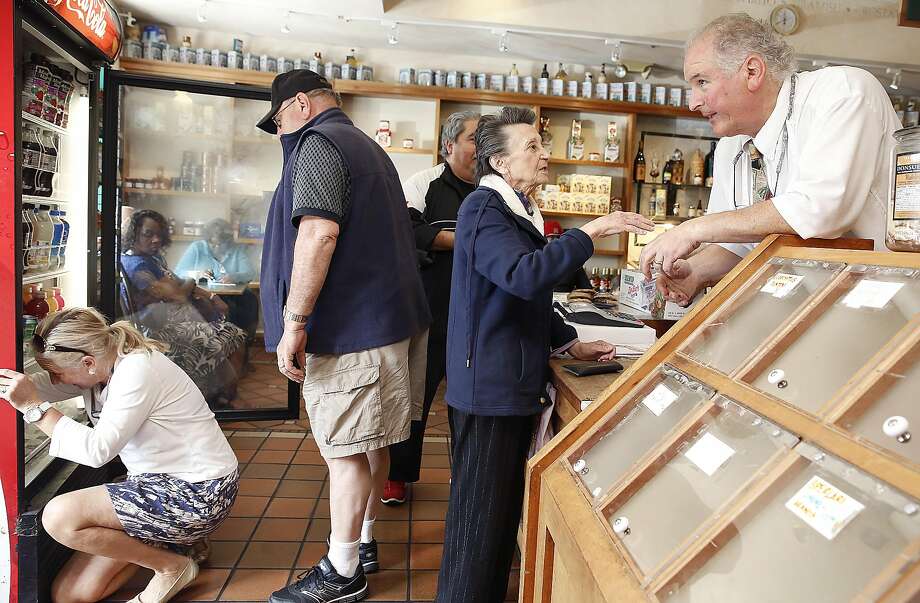
David DeVincenzi (right), son of Genova Deli owner Dominic DeVincenzi, helps customer Mrs. Gasparro, while his wife, Patti, kneels in front of a display case to help Joe Scodella (center), a deli customer since 1956.


'Oakland mourns the looming closure of 90 year old Genova deli'

Ethan Fletcher - San Francisco Chronicle - April 26, 2016

The vibe inside Genova Delicatessen on Monday afternoon had the feel of a living wake, with old friends gathering one last time to celebrate a loved one soon to pass.

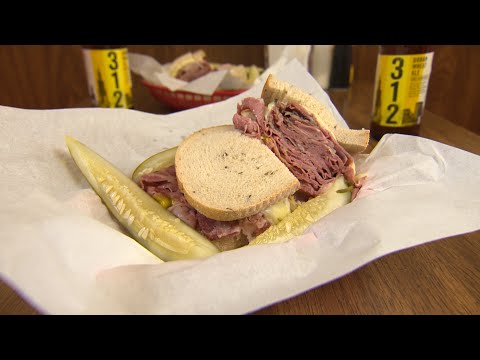
In this case, that loved one took the form of overstuffed Italian sandwiches, homemade meat ravioli and softball-size fried artichokes, all of which longtime customers were loading up on one last time before this immensely popular 90-year-old Oakland institution closes for good on Saturday.

While the announcement was officially made late last week, the closure had been threatened — and for many locals, dreaded — since January. That’s when news leaked that owner Dominic DeVincenzi was considering shutting down his family’s flagship Italian deli due in part to a rent dispute with the property owners of Temescal Plaza, where Genova has been located since 1996. (It’s been in Temescal since 1926.)

According to David DeVincenzi, son of Genova Deli owner Dominic DeVincenzi, the family is continuing to work on finding a new location in Oakland.

“We’re working on a couple of places,” DeVincenzi said. Where that might be exactly, however, DeVincenzi was unwilling to divulge.

The Temescal neighborhood’s reputation has soared in recent years as a foodie destination — home to the likes of Pizzaiolo, Burma Superstar and Bakesale Betty — and as a hot spot for house hunters priced out of San Francisco. But the crowd inside Genova, packed with everyone from families to firefighters, felt very old school.


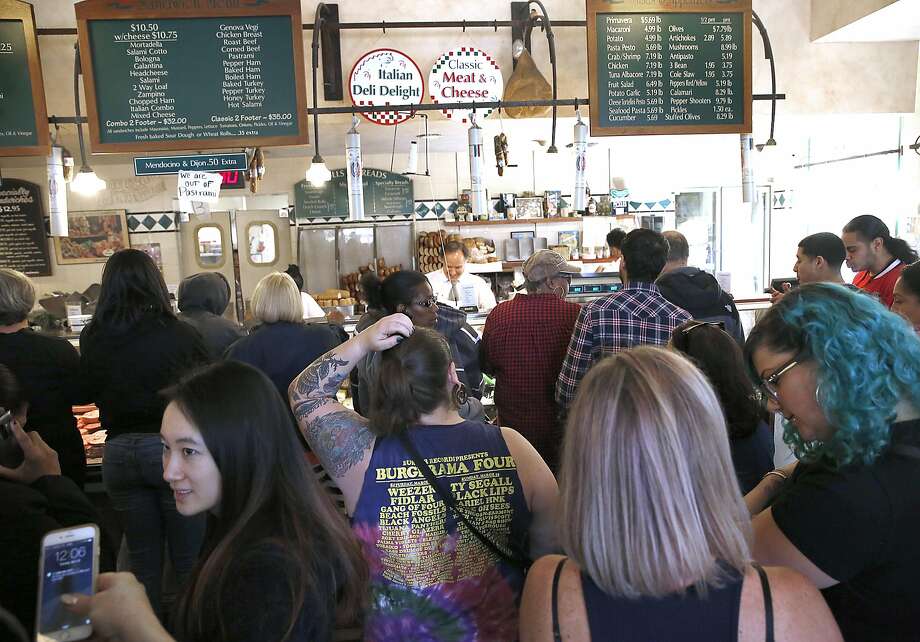
Customers pack Genova Delicatessen for their last orders and to say goodbye before it closes on Saturday after 90 years in Oakland.


Generations of patrons

Terry Barnes, 41, grew up around the corner and said he’d been coming to Genova since he was 4 years old, back in the days when it was located in a tiny Victorian on Telegraph Avenue, and lines would stretch out the door and down the block. He was waiting for his number to be called — which even at 3 in the afternoon was taking upward of an hour — to get one final Italian combo sandwich with extra dry salame and marinated cucumbers. “And a cannoli. Gotta have my cannoli,” Barnes added.

“My family, my mother and my grandmother and all my cousins, we all grew up on this,” he said. “My kids grew up on this, my kids’ friends and their cousins all grew up on this. Every girlfriend I ever had, I would take them here, and now I see all of them coming in with their kids. So it’s sad to see this happen because you would think this place would stick around.”

Genova’s factory and Napa store will remain open, and the property’s landlords have said they’re looking to keep the space as a deli. That seemed small consolation for many customers, nearly all of whom it seemed had been coming for decades and knew each other.

Another customer, Emmy Fearn, ordered three sandwiches — an Italian combo, a coppa and a pastrami. One was for her, one was for her husband getting treatment at a nearby hospital, and the third was for her husband’s doctor, who had promptly put in an order upon hearing the deli was closing. Like many, Fearn expressed shock that Genova was actually closing.

“At first I thought that it was just a play to get some leverage with the landlord,” Fearn said. “But now that it’s really happening, I think it’s horrible. I think it’s a terrible loss to the community.”


‘This is a real loss’

Inside, she ran into an old friend, Marge Gibson Haskell, a former Oakland city councilwoman who had worked with Dominic back in the 1980s to ensure that the deli remained in the neighborhood.

“Back then, there was hardly anything else around here, so you had to really hold on to what you had,” said Haskell while waiting for her Italian combo (light on the peppers). “That was really important for this neighborhood and to a large extent made it possible for everything else that came here afterwards. This is what started it all. … I think not keeping this here is a serious mistake.”

“This city has changed a lot over these last few years, some good, some bad,” said Haskell. “But this. This is a real loss.”

Similar sentiments were echoed by many inside Genova, where there was a palpable sense of unease among longtime locals at the speed with which the rapidly gentrifying city was changing and losing its ties to its past. And while it’s unclear to what extent any rent increase played in the store closing — Genova’s owners have cited the general cost of doing business in Oakland and not wanting to pass that on to the consumer as the main factor — there was plenty of blame to go around that something couldn’t be worked out.

“I understand you want to get fair market value and all that, but you can’t expect people to pay so much, especially in the restaurant industry where the margins are so thin,” said Lex Gopnik, loaded up with a big bag stuffed with Italian provisions. Gopnik said he has been coming to Genova since he moved to the East Bay in 1988. Genova has served as a touchstone for him, his wife and three kids, whether it was grabbing takeout to bring to an A’s game or as an easy dinner for a busy family of five.

“It’s indicative of what’s happening here in the East Bay and the Bay Area in general. I think they would have had to charge like $20 for a sandwich. So it’s sad to see them go, but I respect them for taking a stand and saying, ‘No, I don’t want to do that.’”


‘Things change’

Gopnik is more familiar with the industry than most. He’s been looking for space to open a Montreal-style deli in Oakland, but says news like this makes him reconsider whether he has a future in the city in which rising rents threaten the feasibility of the types of small, independently run businesses that make the place so attractive in the first place.

“I just don’t understand that mentality,” he says. “To me it seems so shortsighted.”

Brian McCabe, an Oakland native waiting for one last turkey sandwich on sourdough, took a more pragmatic view.

“I’ve been coming here for years, and it’s a special place,” he said. “It’s been around for so long, and there’s something comforting about that. But things change.”


Ethan Fletcher is a Bay Area freelance writer. Email: food@sfchronicle.com


*************************


Giovanni Beltramo, who opened a wholesale and
retail wine and spirits business in Menlo Park in
1882, in his vineyard. Photo courtesy Beltramo family.

'Menlo Park: Beltramo's closing after 134 years'

Melanie Wong - Chowhound - May 9, 2016

Whoa. Beltramo's ends 134 years in business this summer.

https://www.beltramos.com/

*************************

It would be worth it to click on the above link just to see the old photos, and there's a short interesting history. When Beltramo's opened, it was the El Camino trail with horses and carriages. The story of Beltramo's, the family originating from Piemonte, is everything our people have been about in northern California. I didn't realize that they were initially in the wine business. It was a truly great store. Why do I miss things most when they're no longer there...

'Beltramo's Wines and Spirits is closing its doors in Menlo Park' (history and old photos)

'Menlo Park's oldest business, Beltramo's, is a family tradition' (history)

.

Saturday, June 20, 2015

Olivia "Grandma" Rolleri - Part II

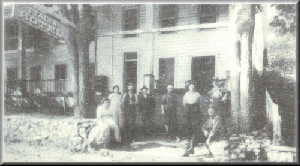
The Calaveras Hotel, circa 1890.
 
‘Grandma’ Rolleri: the Angel of Angels Camp

By Judy Georgiou - Calaveras Enterprise - June 11, 2013 


The story has all the key elements of a thrilling Wild West movie with John Wayne in the cast. It includes, as with so many Westerns, the lure of riches in the Gold Rush, a spark of true love, even the capture of a dangerous outlaw. But what kind of story would it be without a fearless hero in the leading role?

The twist in this tale is that our hero is a woman. Her name: Olivia Antonini Rolleri.

The Rolleri name is certainly not foreign to Calaveras County; in fact, it’s hard to find anyone who hasn’t heard it. Rusty Rolleri of Angels Camp, wife of the late Dick Rolleri, sat at her kitchen table, a small cardboard box balanced on her lap. She opened the flaps and pulled out an old, faded photograph: a porthole into a story that is as intrinsic to Angels Camp as the gold that runs in its hills.

The black-and-white photo is of Olivia Antonini, born Aug. 1, 1844, in San Antonia de Castiglione, a small village high in the hills above the Italian Riviera. When Olivia was 16, she traveled with her mother and sister to the California foothills. They joined her father who had preceded them to Sonora, working in the mines until he had saved enough money to send for them.

Shortly after Olivia arrived, she discovered her life was about to change again. Following a traditional Italian custom, her father had already chosen a young man for her to marry. Olivia shook her head. This was a new world; she had someone else in mind. A year later, she married the dashing Italian miner Gerolamo Rolleri, whose family had lived not far from hers in Italy, although they had never met before Sonora.


Over the next 27 years, Gerolamo mined, ran cattle and operated a ferry. With Olivia by his side, they ran a general store and raised a family. They had 13 children: five girls and eight boys, although two died in infancy.

The family was happy and prospering. In fact, in 1883 their eldest son, James Jr., brought fame to the Rolleri name by helping to capture the notorious gentleman bandit, Black Bart. James Jr. was presented with an engraved rifle by Wells Fargo for his bravery.

But the story took a turn in 1888; Gerolamo died from pneumonia, leaving Olivia with 10 children to care for. The youngest child was only 1.

Olivia knew she had to find a way to provide for her family. In 1889, she purchased a small hotel in downtown Angels Camp. Although Calaveras had lost half its population between 1850-1860, like most gold mining areas in California, Angels Camp was hardly a ghost town. Its gold mines, the basis of its economy, were still going strong.

“Running the hotel was a family operation,” explained Rusty. “The girls would sweep and make beds; the boys would scrub and run errands, and later run the cattle business. She counted on her children to help. That’s how it was back then.”

Rusty dusted off another small photo and smiled at the scene: The Hotel Calaveras in 1890, Olivia at the entrance, her sons and daughters on the upstairs porch, in front of the hotel and in the horse-drawn wagon. All the girls wore long dresses and aprons; the men suspenders and hats.

Through hard work, Olivia and her family transformed the Hotel Calaveras into a thriving enterprise. The saloon had bartenders in immaculate pearl-buttoned vests; local women sipped a discreet sherry in the private parlor after shopping. The dining room – complete with crisp white tablecloths, real napkins and fresh flowers – overflowed with regulars who enjoyed a sensational Italian feast prepared by well-trained Chinese cooks using Olivia’s recipes. “Drummers” (traveling salesmen) wrote orders on wooden desks in the parlor; single men who worked the gold mines called it home.

Olivia proved to be a born entrepreneur. Over the next 20 years she expanded, purchasing three buildings, increasing the hotel capacity to 50 rooms. The rooms weren’t grand, but they were as good as might be found anywhere in the Gold Country. Although the bedrooms didn’t have heat or private baths, each room had a bowl, a pitcher of water and clean beds. Before entering the dining room, miners could shower and change on the ground floor. Room and board fees were $25 a month in the early days, and it was all-you-can eat Italian style. Olivia would even pack as many as 75 lunch pails for miners every morning.


Amador County, California
In order to provide a supply of fresh meat for the restaurant, Grandma Rolleri purchased ranches, ran cattle, and opened a butcher shop. The fruit, vegetables, eggs, hens, milk and butter from the ranches went to her kitchen, where she baked bread, churned ice cream, and made fresh mayonnaise daily. On Sunday evenings, townspeople brought their 5-pound lard pails to the kitchen door to be filled with Grandma Rolleri’s fresh, hot ravioli for their own dinner tables.

Over time, the hotel became the center of life in Angels Camp and Olivia became affectionately known as “Grandma” Rolleri. “She was full of love,” Rusty said, “and love meant sharing.”

Grandma Rolleri was a generous humanitarian, befriending those less fortunate. If there was an empty bed or food in the kitchen, she simply couldn’t turn anyone away even if they couldn’t afford to pay. “She took everyone under her wing and everyone loved her,” Rusty added. “She was an inspiration. She never met anyone she didn’t like.”

“She always wore a long white apron with pockets. She put any tips she received in the pockets and gave them to the church for the poor. Dick, who lived in the hotel as a young boy, adored her,” Rusty recalled. “He remembered rocking with her on the second story porch that ran the length of the hotel. She’d talk to him in Italian. I’m not sure he even understood anything she said, but it didn’t matter. He loved her.”

Her reputation for kindness spread across Calaveras, California and even around the world. Her Chinese cooks returned home to retire and spread stories of the Italian woman who cared for them in a strange country.

On June 10, 1927, Grandma Rolleri died at the age of 83. She’s buried, alongside members of her family, in the Altaville family cemetery.

Between 1930-1945, a Madison Avenue company produced a radio and television anthology called “Death Valley Days,” featuring true stories of the American West. An episode that ran July 1, 1938, was titled “Grandma Rolleri.” The announcer asked the Old Ranger where Angels Camp got its name. He replied, “Well, there’s been angels that’s lived there… an’ my story tonight is about one of ’em.”

Rusty replaced the worn photos in the cardboard box and closed the flaps. “No one was ever turned away from Grandma’s door; color or creed meant nothing to her,” she said. “All people were her friends, and she was a friend to all people.”

Judy Georgiou is a freelance writer from West Point. She can be reached at jlgeorgiou@gmail.com.


.

Friday, June 19, 2015

Olivia "Grandma" Rolleri - Part I

Taken from AmadorGold.net:

In the rural settlements of the foothills, miners and single men often lived in boarding houses owned and operated by fellow Italians. Some of the well-known Italian boarding houses of the past were Calaveras Hotel in Angels Camp; Bisordi's Itala Hotel in Sonora; the Torino Hotel in Nevada City; the Trabucco Hotel in Mt. Bullion; the Colombo Hotel in San Andreas and the Europa Hotel in Sonora.

Olivia "Grandma" Rolleri came to Sonora from Genoa in 1860 at age 16. Left with 11 children after her husband died in 1884, she became a prominent businesswoman who established the Calaveras Hotel in 1887 and owned several cattle ranches and mining interests. The Calaveras Hotel contained more than 50 rooms, a butcher shop, saloon and barber shop under one roof. Sunday dinners were famous and people came from across the county for family homestyle dinners and to take home "ravioli," She operated the hotel for 40 years until 1927.


**************************************************

Taken from FindAGrave.com:

Olivia Elena Antonini Rolleri
Birth: Aug. 1, 1843, Italy
Death: Jun. 10, 1927
Angels Camp
Calaveras County
California, USA

Olivia Rolleri was a much beloved, early pioneer businesswoman of Calaveras & Tuolumne Counties. She had many nicknames: "Little Olivia"; "Little Oliviette" and "Grandma" Rolleri.

In the late 1850s, she and her mother and sister sailed from Genoa, Italy around Cape Horn to San Francisco and then made their way to Sonora to join Olivia's father who was working there. Soon after, she met and married Gerolamo Rolleri (aka Jerome & James.) They were involved in mining, farming, cattle ranching, operated a ferry and opened a general store.

When her husband died in 1888, Olivia was left with 10 children to care for. In 1889 she purchased a rooming house, one of the buildings on the Calaveras Hotel site. During the next 20 years, Mrs. Rolleri purchased three adjacent buildings that made up the Calaveras Hotel. Rooms were 25-50 cents.

The restaurant was known for it's outstanding food (especially her ravioli dinners) and became famous throughout the area. Dinners were "all you can eat" including dessert and all the wine you can drink for 25 cents.

The consummate entrepreneur, she purchased local ranches to grow fruit, vegetables, raise hogs and chickens, run cattle and opened a butcher shop. The children helped on the ranches and in the hotel.


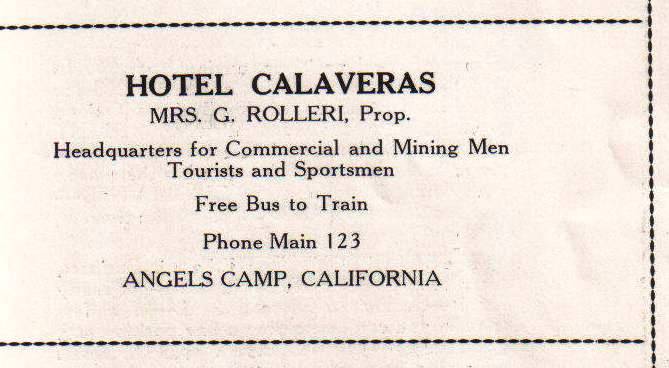
Advertisement in the 1923 Bret Harte yearbook.
Known as a generous humanitarian, she befriended those less fortunate. "Grandma" Rolleri held out a helping hand for those in need.

She died in Angels Camp on June 10, 1927.

A special thank you to Mozelle "Rusty" Rolleri who kindly verified the above information.
Burial:
Altaville Protestant Cemetery
Angels Camp
Calaveras County
California, USA
Plot: Sec B1 - Plot 79


************************************************** 

Rolleri Landscaping Products

Rolleri Vineyard

.

Sunday, May 17, 2015

John Cabot - The first European since the Vikings to explore the mainland of North America


John Cabot

John Cabot (Italian: Giovanni Caboto, Venetian: Zuan Chabotto; c. 1450 – c. 1500) was an Italian navigator and explorer whose 1497 discovery of parts of North America under the commission of Henry VII of England is commonly held to have been the first European exploration of the mainland of North America since the Norse Vikings' visits to Vinland in the eleventh century. To mark the Canadian site of a celebration of the 500th anniversary of Cabot's expedition, the Canadian and British governments accepted a widely held conclusion that the landing was at Cape Bonavista, Newfoundland.

.

Monday, February 2, 2015

'Italian Americans, California Italians' and a few random notes


'Italian Americans, California Italians' (UCLA YouTube channel)

From the video description:

This video records the beginning of a conference at UCLA titled "Italian Americans, California Italians." It was the first of its kind, made up of nearly a dozen scholarly presentations and discussions aiming to define "California Italians" within the more generic group of "Italian Americans." This opening, introductory statement to a full room was made by the Chairman of UCLA's Department of Italian, Professor Thomas Harrison.


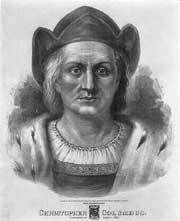
Columbus... born in Genoa

You may be aware that the origin of Columbus has been in some dispute due to a somewhat surprising lack of evidence of his early life in Genoa. However, it does appear that he was of Genoese ancestry.

"Yo nacio en Genoba" ("I was born in Genoa")
 

--Written in Christopher Columbus' Will; February 22, 1498


"La California"

The small town of La California, along the Tuscan coast, was founded by Leonetto Cipriani. Cipriani--who was Corsican--had spent many years traveling, especially in California and the west coast of the United States. He was influential, and was acquainted with the Count of Cavour, and was something of an ambassador for a unified Italy of which he very much wanted Corsica to be included. He wrote an account of his travels entitled 'California And Overland Diaries of Count Leonetto Cipriani From 1853 through 1871'. He co-founded the city of Belmont, California in San Mateo County.


Bargetto Winery (Santa Cruz Mountains)

I love the Santa Cruz Mountains. Any excuse to visit will not disappoint. It even resembles parts of the Cisalpine Alps or the Apennine Mountains. I have not visited this winery. Feel free to send a short or long review (camunlynx@hotmail.com) for posting.


Our History (from Bargetto.com website)

The Bargetto winemaking heritage began with brothers Phillip and John Bargetto who emigrated from Castelnuovo Don Bosco, a small town in the Piedmont region of northern Italy. They brought with them years of winegrowing experience when they established BARGETTO WINERY on the banks of Soquel Creek in California.

Phillip was the first to depart Italy in 1891 at the age of seventeen. In 1909 John joined his brother in San Francisco.
The original Bargetto family winery was located in San Francisco from 1910-1917. The name of this winery was South Montebello Vineyard and Wine Company. With Prohibition on the horizon the winery was closed and the brothers moved to Soquel in 1917.

Phillip and John purchased the present site of BARGETTO WINERY in 1918 and began making wine out of an old barn on the property. During Prohibition (1919-1933), the brothers continued to make wine for family and friends, while they continued to sell produce to local customers. They also grew apples at the family ranch in Soquel. When Prohibition ended in 1933, the brothers devoted more time to the wine business. They began a wine wholesale business, while they continued to sell produce wholesale.

Phillip Bargetto passed away in 1936 and John was left the sole owner of the business throughout the 1940s and 1950s. He continued to produce wine and sell wholesale and retail. He was joined by his sons Ralph and Lawrence during these years.


The Next Generation

The Bargetto Family winemaking heritage continued with John’s son Lawrence during the 1960s and 1970s. He introduced modern technology such as stainless steel fermentation, barrel aging, and added new Santa Cruz Mountains varietals such as Pinot Noir and Chardonnay. He also created the CHAUCER’S line of dessert-style wines.


Today

The third generation of Bargettos now direct the operation of the winery. BARGETTO WINERY represents the oldest continuous-operation winery in the Santa Cruz Mountains. Their pioneering spirit continued with the establishment of Bargetto Regan Estate Vineyards, near Corralitos, California in 1992. Here, cool-climate varietals like Chardonnay, Pinot Noir, and Pinot Grigio are carefully nurtured to produce BARGETTO WINERY’s estate wines. In keeping with the family heritage, the winery also incorporates northern Italian varietals from its Estate Vineyard into its flagship LA VITA wine.


Voynich manuscript
  
This work is in the form of a short book, filled with illustrations of plants, geometric shapes, and an unknown text. It appears very deep and scientific, but there has not yet been any way to read its secrets. The book is available for purchase, free in pdf form online, documentaries on YouTube, and lots of general information in a search.. so I won't bother with links. You may want to examine it and attempt to understand it. The best I could come up with is that the characters look a bit like ancient Indo-European Tocharian writing, and the illustrations remind me of Fibonacci patterns. Very strange.

From Wikipedia:

The Voynich manuscript is an illustrated codex hand-written in an unknown writing system. The vellum in the book pages has been carbon-dated to the early 15th century (1404–1438), and may have been composed in Northern Italy during the Italian Renaissance. The manuscript is named after Wilfrid Voynich, a Polish book dealer who purchased it in 1912.

The pages of the codex are vellum. Some of the pages are missing, but about 240 remain. The text is written from left to right, and most of the pages have illustrations or diagrams.

The Voynich manuscript has been studied by many professional and amateur cryptographers, including American and British codebreakers from both World War I and World War II. No one has yet succeeded in deciphering the text, and it has become a famous case in the history of cryptography. The mystery of the meaning and origin of the manuscript has excited the popular imagination, making the manuscript the subject of novels and speculation. None of the many hypotheses proposed over the last hundred years has yet been independently verified.

The Voynich manuscript was donated by Hans P. Kraus[6] to Yale University's Beinecke Rare Book and Manuscript Library in 1969, where it is catalogued under call number MS 408. A digitized high-resolution copy is also accessible freely at its website.


.

Sunday, February 3, 2013

The Tuscan Orient Expeditions: Part 1


[Introducing new contributor 'Etrusco-Umbro-Gallic'. He was trained in the sciences, and well versed in matters concerning the anthropology and history of N/C Italy and the Western World. Any questions or comments can be directed to him, or if you would like to e-mail him directly, please send them to camunlynx@live.com, and they will be forwarded to him. Thank you.]


 The Tuscan Orient Expeditions: Part 1


      Tuscany. No question about it, this is the Western Man’s Kosovo. It’s a microcosm of Western civilization, even surpassing Rome in importance. It is not just the home of Puccini, Of Michelangelo, of Dante, of Galileo, of Bocelli, but also of lesser known characters whose impact on the course of Western civilization was just as monumental. How about Francesco Redi,  Amerigo Vespucci,  Eugenio Barsanti and Felice Matteucci? Tuscany’s influence on the Western World is as immense as it is historically consistent in nearly all important aspects. This essay and its sequels will explore in a chronological manner the encounters, of both individual Tuscans and Tuscany as a whole, with the Orient, that is to say, the Islamic Mediterranean world. Such encounters are a recurring theme in Western history and, in many ways, define who we are as Westerners, as people of European descent.

      After the fall of Rome, Saracen armies went on to conquer the entire Eastern and Southern Mediterranean thanks to their zeal and unorthodox tactics as well as the plagues, political corruption and economic crises which hit the region hard. It was a dark time for Europe, indeed, with Saracen fleets prowling the sea unchecked, plundering settlements (even Rome was almost sacked once), stealing slaves and treasures in the process. According to the insightful, yet obscure and underappreciated historian Henri Pirenne, it were these events, rather than the invasions of the so-called barbarians (who were actually Romanized within century and never really constituted a majority in the former Roman empire anyway) that precipitated the so-called Dark Age.

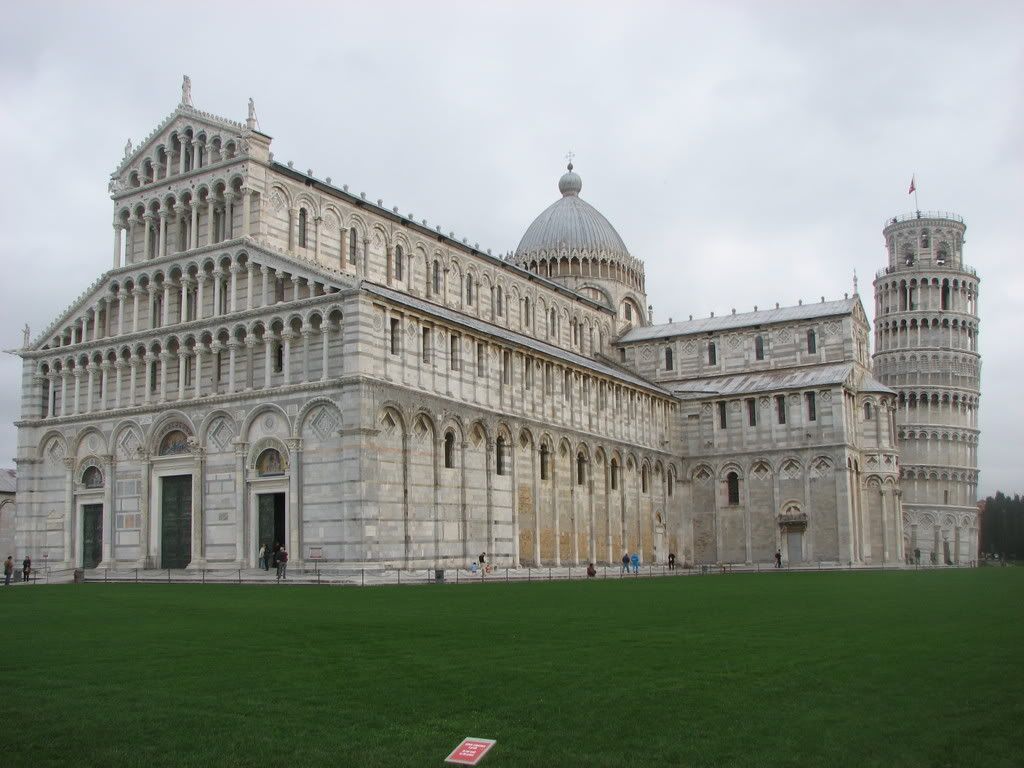
      Situated on the southern shores of Europe, it was only natural that, one way or another, Tuscany, too, was in the crosshairs. The Tuscan coast was repeatedly harassed by the Saracen pirate-marines and long stretches of it were abandoned. Such was not the case with Pisa, a former Roman municipium which was, by that time, the most important city in Tuscany. In the 9th century, spurred by constant Saracen attacks, Pisa began to expand its fleet. In 828, Pisan ships already made headway by taking the fight to the enemy, by assaulting the North African coast. In 871 they took part in the defense of Salerno, then a Lombard-rule principality in Southern Italy, from the Saracens.

      In 970, the Pisans were operating in Calabria, probably making war on its Muslim occupants in order to secure safe passage for their merchants through the Strait of Messina that separated Muslim Sicily from the peninsula. Pisan annals also record a Muslims naval attack on Pisa in 1004 and a Pisan victory over the Muslims off Reggio in 1005. The Muslim assault of 1004  may have originated in Spain, or it may have been a typical pirate raid. The Pisan attack of 1005 was likely a response, and perhaps a serious attempt to put an end to Muslim piracy, for which Reggio served as a perennial base. This victory greatly expanded Pisa’s maritime power.

      In 1011, an expedition from what is today southern Spain went on to wreck havoc on the Tyrrhenian coastline, clipping the Pisa region. The fleet most likely came from the Umayyad port of Denia, then ruled by the emir Mujahid, or Musetto, as he was called in Tuscan. By the time Musetto took power, the Emirate of Denia had established a foothold in the Balearic islands. An ambitious emir, Musetto decided to island-hop to Sardinia. As with most Saracen expeditions, it began with intensive coastal raids and the establishment of tactically important beachheads. The then-acting Pope John VIII was alarmed since Sardinia lay directly across the Tyrrhenian Sea from Rome and urged the Christian lay powers to expel the Saracens from the island. It was no trivial concern since Rome was nearly sacked by Saracen pirates in 846 (St. Peter’s basilica did end up being looted, though, since it was outside the walls). Well, Pisa and Genoa answered that call. Not many details are known, but what is known is that Musetto’s large scale attempt to invade the island in 1015 was thwarted.

      The persistent Musetto returned to Sardinia in 1016, however, intending a more thorough conquest of the island. After defeating the local Judges, as the local Sard rulers were called, Musetto immediately set about building cities using the local Sards for slave labour, which was the economic backbone of early and later Islamic caliphates. It was also that year that Musetto’s pirate-marines raided the Lunigiana, a picturesque area separating Tuscany and Liguria, in an in-your-face fashion. Once again, the wasp had awakened the boar. Once again, the pope called for an expedition and the combined Pisan-Genoese fleet scored---this time for good. With the Saracens expelled from the island, Pisans and Genoese began to bicker over the newly conquered territory, hence initiating their bitter rivalry which was to last unabated for two more centuries.

      Pisa’s fortunes continued to multiply and between 1030 and 1035, Pisa went on to defeat several rival towns in Sicily, conquer Carthage and sack Bona (now Annaba) in North Africa. In 1051–1052 the admiral Jacopo Ciurini conquered Corsica. During this time that Pisa’s rivalry with Genoa continued to grow.

      In 1085 Pope Gregory VII had granted suzerainty over the Balearic islands, off the coast of Iberia, to Pisa. Twenty-eight years later, in the fall of 1113 a Pisan fleet making an expedition to Majorca was put off course by a storm and ended up near the coast of Catalonia, which they initially mistook for the Balearics. The Pisans met with the Count of Barcelona and signed a treaty. Among other things, the treaty called for a military cooperation, the chief goal of which was to suppress Islamic piracy plaguing their coasts and to free Christian slaves. In 1113 Pisa and the Pope Paschal II set up, together with the count of Barcelona and other contingents from Provence and Italy (Genoese excluded), a war to free the Balearic Islands, which were at that time held by the Moors.  To make a long story short, the expedition was a success and the ruler of Majorca was brought in chains to Tuscany. Even though the Almoravids, the dynasty ruling much of Iberia at the time, soon reconquered the island, this was not really a major setback for Pisa. The booty taken helped the Pisans in their magnificent building program, especially its cathedral.  More importantly, Pisa still maintained its dominant military and mercantile role in the Western Mediterranean.

      It was also during this time that Pisa helped pave the way for the First Crusade, a long overdue, yet small-scale effort to roll back some of the conquests and stem the tide of Islamic attacks against the then Christian world. In 1087, prompted by a wave of pirate attacks on the Tyrrhenian coast orchestrated by the Zirid ruler of Mahdia (a city in present day Tunisia), the Pisans, augmented by the Genoese and Amalfitan forces, captured and plundered the city. The Muslim fleet stationed in the harbor was burned during the fighting. As in the Balearic campaign, Mahdia was soon reconquered but, once more, the ever resourceful Pisans used the money gained from plunder to further beautify and enrich their city. By burning the Muslim fleet, the Pisans helped secure the European Western Mediterranean coast which was to become a launchpad for Levant-bound Crusader fleets only 10 years later. Now, the Pisans did not simply initiate the First Crusade. In fact, they actually helped ensure its victorious outcome: the capture of Jerusalem in 1099. Some 120 Pisan ships took part in the First Crusade, no small number for the time.

      Through all of this, several important developments had taken place. By about 1100, thanks largely to the courage of Tuscan marines (along with those from Liguria, Provence, Catalonia, of course), Western Europeans were no longer afraid to go for a boat ride on their own beach. Well, the threat of Saracen piracy was still very much looming and would continue to do so until the French conquest of the Barbary Coast in the 1800s, but the bully’s nose was badly bloodied, so to speak. The pirates were no longer seen as an insurmountable obstacle, but as an inevitable inconvenience. Big difference. Additionally, since Pisa and the other maritime republics/states like Genoa had the ability to field powerful armed fleets, they could now escort their merchant navies safely to the bazaars of the Orient, and to, once again, obtain those now exotic goods, once commodities during the Roman era. Naturally, this wealth trickled down from the Arno Valley to the rest of the European continent over the decades and centuries that followed. 

      The Levant and North Africa were bustling hubs of intellectual activity in the Classical Era. To be fair, yes, a fair amount of that knowledge was preserved under the new Saracen overlords, but few original contributions were made by them to the major disciplines: medicine, philosophy, alchemy, and mathematics. Nevertheless, the region was a treasure trove of old manuscripts pertaining to those subjects and, by way of trade, Pisan travelers and merchants could now bring them back to the Occident. Perhaps the best such example is Leonardo Fibonacci, a forerunner of his fellow Tuscan namesake Leonardo Da Vinci, really. Leonardo was born in 1170 to a Pisan merchant operating in Algiers. As a young man, he was an avid traveler and had perused many mathematical manuscripts during that time. He was exposed to “Arabic” numerals (in quotes because they were actually developed in India and had reached the Mediterranean by way of conquest) and introduced the system to the Western world. He also developed a new notation of expressing fractions, similar to that used today. His name is most strongly associated with what is known as the Fibonacci sequence, where the first two numbers are 0 and 1, and each subsequent number is the sum of the previous two: 0, 1, 1, 2, 3, etc. Leonardo arrived at this sequence from a hypothetical situation involving an immortal rabbit population undergoing reproduction. Interestingly, the ratio of two sequential numbers of the Fibonacci sequence approaches the famous Golden Ratio the further along in the sequence that pair of numbers occurs. The Golden Ratio is commonly associated with art and, yes, has inspired many artists during the renaissance, but it has many applications in the financial market world, too. 


      Fibonacci may have been unique in his intellectual ability, but certainly not in his travels and not in bringing back the most valuable of all commodities, long denied but finally available to all Western Europeans thanks to the courage of his Tuscan countrymen: knowledge. And this knowledge was not destined to simply gather dust and be deemed blasphemic. In Europe, it was elaborated and expanded upon, criticized and corrected. Consequently, new knowledge was generated and systematically recorded and circulated, and this exponential process repeated itself many times over. Nothing like this has ever happened in all of mankind’s history and on no other continent. And here I am writing this on my laptop computer, itself a fruit of this process, much like the nearly microscopic components of its circuitry.

.

Wednesday, September 28, 2011

Liguria Region


Ligury Region - Italy

Liguria borders France to the west, Piedmont to the north, and Emilia-Romagna and Tuscany to the east. It lies on the Ligurian Sea. Liguria is a narrow strip of land, enclosed between the sea and the Alps and the Apennines mountains, it is a winding arched extension from Ventimiglia to La Spezia and is one of the smallest regions in Italy. Its surface area is 5,416.03 square Kilometres, corresponding to 1.18% of the whole national surface area, with the following subdivision: 3524.08 kilometres mountain (65% of the total) and 891.95 square kilometres hill (35% of the total).

Its shape is that of a thin strip of land, from 7 to 35 km (4.35 to 21.75 mi) wide (respectively above Voltri and in the high mountain area around Imperia), on average about 240 km (149.13 mi) long, lying in a semicircle around the Ligurian Sea and with convexity facing north; comprised between the sea and the watershed line of the Maritime Alps and the northern Apennines, which at some points it crosses (for example in the Savona and Genoa mountains). Some mountains rise above 2,000 m (6,561.68 ft); the watershed line runs at an average altitude of about 1,000 metres (3,280.84 ft).

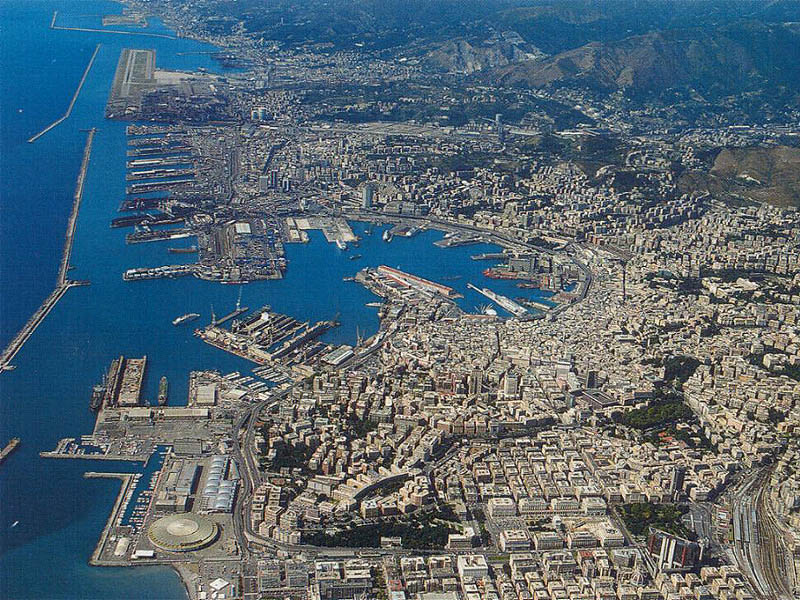
The continental shelf, which is very narrow, is so steep it goes down almost immediately to considerable marine depths. The coastline is 315 km long. Except for the Portovenere and Portofino promontories, it is generally not very jagged, and is often high. At the mouths of the biggest watercourses there are small beaches, but there are no deep bays and natural harbours except for those of Genoa and La Spezia.

The hydrographic system is made up of the short watercourses of a torrential kind. In the coastal part the most important are the Roja (in its lower course), the Nervia, and the Magra. On the inland side we find some tributaries of the Po: the two branches of the Bormida, the Scrivia and the Trebbia; there is not much water in these rivers, though the quantity increases greatly in rainy periods.

The ring of hills, lying immediately beyond the coast, together with the beneficial influence of the sea, account for the mild climate the whole year round (with average winter temperatures of 7-10° and summer temperatures of 23°-24°) which makes for a pleasant stay even in the heart of winter.

Rainfall can be very abundant at times; mountains very close to the coast create an orographic effect, so Genoa can see up to 2000 mm of rain in a year; other areas instead show the normal values of the Mediterranean area (500--800 mm). Despite the high population density, woods cover half of the total area. Liguria's Natural Reserves cover 12% of the entire Region, i.e. around 60,000 hectares of land, and they are made up of one National Reserve, six large parks, two smaller parks and three nature reserves.


History

Traces of Neanderthal Man were discovered in the region of Loano, whereas in Ventimiglia, in the grotto of "Balzi Rossi", numerous remains were found which recall those of Cro-Magnon Man. According to the written sources we have about the settlements of the Ligurians (Ligures), the presence of this people of Mediterranean origin dates back to the first millennium B.C. on a vast territory including most of north-western Italy. This people, divided into several tribes, numbered less than two hundred thousand.

During the first Punic War, the ancient Ligurians were divided, some of them siding with Carthage and a minority with Rome, whose allies included the future Genoese. After the Roman conquest of the region, the so-called X regio, named Liguria, was created in the reign of Emperor Augustus, when Liguria was expanded from the coast to the banks of Po River. The great Roman roads (Aurelia and Julia Augusta on the coast, Postumia and Aemilia Scauri towards the inland) helped strengthen the territorial unity and increase exchanges and trade. Important towns developed on the coast, of which evidences are left in the ruins of Albenga, Ventimiglia and Luni. Between the 4th and the 10th centuries Liguria was dominated by the Byzantine, the Lombards of King Rothari (about 641) and the Franks (about 774) and it was later invaded by the Saracens and the Normans. In the 10th century, once the danger of pirates decreased, the Ligurian territory was divided into three marches: Obertenga (east), Arduinica (west) and Aleramica (centre). In the 11th and 12th centuries the marches were split into fees, and then with the strengthening of the bishops' power, the feudal structure began to partially weaken. The main Ligurian towns, especially on the coast, became city-states, over which Genoa soon extended its rule. Inland, however, fees belonging to noble families survived for a very long time.

.

Monday, September 13, 2010

"Wine tasting in Genoa" ..... Nevada


Last year, while visiting South Lake Tahoo, I picked up a brochure entitled 'Wine Tasting in Genoa'. It was subtitled 'Nevada's First Settlement', and was referencing Tahoe Ridge Winery in Genoa, Nevada. The winery is fairly new, having been founded in 1990. The brochure shows that the town and winery are located twenty miles east of South Lake Tahoe. From the brochure: "Nestled in the picturesque town of Genoa, on the eastern slope of the great Sierra Nevada mountain range, lies the home of Tahoe Ridge Winery & Marketplace. Tahoe Ridge sources grapes from high quality growers who farm vineyards throughout Nevada and California."

The winery seems to have everything a large wine operation usually has, including entertainment events. Their events schedule shows that on September 5th, Victoria Vox performed there live; on September 18th, they will host an Annual Grape Stomp at their marketplace and bistro; and on October 17th, Beppe Gambetta, a musical artist from Genova, will perform there as well. From the website: "From Genova, Italy comes this smiling troubadour for his fourth appearance in the Carson Valley. Beppe’s diverse blend of styles range from romantic Italian ballads to traditional Americana and Bluegrass. His sense of humor accentuates his performances while his blazingly quick flatpicking style weaves multi-layered melodies that mesmerize the house."


From Wikipedia's Genoa, Nevada webpage:

"Genoa is an unincorporated township in Douglas County, Nevada, United States. Founded in in 1850, it was the first settlement in what became the Nevada Territory. It is situated within Carson Valley and is about 42 miles (68 km) south of Reno.

"Located within Utah Territory before the Nevada Territory was created in 1861, Genoa was first settled by Mormon pioneers. The settlement originated as a trading post called Mormon Station, which served as a respite for travelers on the California trail. Orson Hyde changed the name of the community to Genoa, after Genoa, Italy. The original Mormon settlers withdrew in 1857 when they were recalled by Brigham Young due to the Utah War.

"The community was the home to Nevada's first hotel, newspaper and court. Nevada's first newspaper, the Territorial Enterprise was founded in Genoa in 1858, but moved to Virginia City, Nevada in 1860. Another first for the state, the Genoa Bar, billed "Nevada's oldest thirst parlor," was patronized by Mark Twain, Teddy Roosevelt and Johnny Cash and was used in John Wayne and Clint Eastwood films. The village was also the set for the movie Misery, starring Kathy Bates. The village doubled in size with buildings added and then removed after the filming.

"Much of Genoa, including the original fort, station and hotel was destroyed in a fire in 1910, but replica of the fort was built in 1947. Every year since 1919 Genoa has held a festival called The Candy Dance, where candy, food and crafts are sold to support its town government. The Candy Dance is usually held during the final weekend of September. Many pioneers rest in the Genoa graveyard including Snowshoe Thompson, his wife and his son.

"A mile south of Genoa is David Walley's Resort, a famous natural hot springs and spa, now a mediocre resort. It was first built in 1862 and known as Walley's Hot Springs.

"Unlike the city of Genoa in Italy, the Nevada community's name is pronounced with the accent on the second syllable: juh-NO-uh.

"Genoa Historic District

"In 1975, the community was listed as a historic district on the National Register of Historic Places."


The town's website states about their town "Nevada's First Recorded Permanent Settlement." It was founded in 1851.


From the website's "Visit Genoa" page:

"Historic charm attracts visitors year-round

"Historic Genoa, Nevada, is nestled at the base of the eastern slope of the Sierra Nevada Range, just 25 minutes east of beautiful Lake Tahoe, and one hour south of Reno.

"It is home to Mormon Station Memorial State Park which commemorates the settlement of Nevada in 1851, when the first permanent trading post was established by a group of Mormon traders from Salt Lake City.

"Genoa’s natural beauty and historic charm still beckon travelers and local wildlife. It is not unusual to spot mule deer as they come down from the forested area on the west side of Genoa and cross local roads to graze on vegetation or fields along the Carson River Valley to the east of Genoa.

"The small town of approximately 250 residents and many local amenities and shops, welcomes visitors for a day trip or longer restful stay. Plan to learn about Genoa’s past with a visit to Mormon Station State Park Museum, Genoa Courthouse Museum, the Genoa Cemetery and the Hanging Tree. Stroll through a variety of shops, and be sure to make time for a leisurely lunch or dinner. Click HERE to download the Greater Genoa Business Association Walking Tour Map of town attractions, including shops, dining, drinking and lodging accommodations.

"Considering a stay in Genoa? There is much to do in the surrounding area including hiking, biking, golfing, flying, fishing and shopping, just to name a few. Click here to link to the Carson Valley Visitors Authority for more information about Genoa and the surrounding Carson Valley.

"Be sure to mark your calendar for the last weekend in September to visit the town’s annual Candy Dance Arts and Crafts Faire. Since 1919, the residents of Genoa have made the wonderful homemade candy sold during the weekend and complimented by a Saturday night dinner-dance. Over the years the event has evolved, and today the Genoa Candy Dance is well-known as one of the greatest craft fairs in Northern Nevada drawing artisans from all over the west who come to sell their wares."


There are more tourist links on this page for Carson County, but I think that I'll just leave it at that. The whole Tahoe area is a great place to explore.

.

Saturday, October 3, 2009

History of the Lemon

Lemon (from Wikipedia)

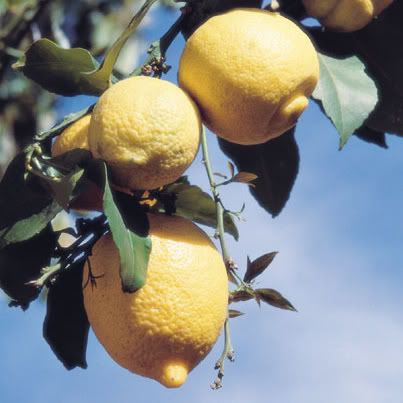
"The first real lemon cultivation in Europe began in Genoa in the middle of the fifteenth century. It was later introduced to the Americas in 1493 when Christopher Columbus brought lemon seeds to Hispaniola along his voyages."

The lemon is a small evergreen tree (Citrus limon) originally native to Asia, and is also the name of the tree's oval yellow fruit. The fruit is used for culinary and nonculinary purposes throughout the world – primarily for its juice, though the pulp and rind (zest) are also used, mainly in cooking and baking. Lemon juice is about 5% (approximately 0.3 mole per liter) citric acid, which gives lemons a tart taste, and a pH of 2 to 3. This makes lemon juice an inexpensive, readily available acid for use in educational science experiments. Because of the tart flavor, many lemon-flavored drinks and candies are available on the market, including lemonade.


History

The exact origin of the lemon has remained a mystery, though it is widely presumed that lemons first grew in India, northern Burma, and China. In South and South East Asia, it was known for its antiseptic properties and it was used as an antidote for various poisons. It was later introduced to Persia and then to Iraq and Egypt around AD 700. The lemon was first recorded in literature in a tenth century Arabic treatise on farming, and was also used as an ornamental plant in early Islamic gardens. It was distributed widely throughout the Arab world and the Mediterranean region between AD 1000 and AD 1150.

Lemons entered Europe (near southern Italy) no later than the first century AD, during the time of Ancient Rome. However, they were not widely cultivated. The first real lemon cultivation in Europe began in Genoa in the middle of the fifteenth century. It was later introduced to the Americas in 1493 when Christopher Columbus brought lemon seeds to Hispaniola along his voyages. Spanish conquest throughout the New World helped spread lemon seeds. It was mainly used as ornament and medicine. In 1700s and late 1800s, lemons were increasingly planted in Florida and California when lemons began to be used in cooking and flavoring.

In 1747, James Lind's experiments on seamen suffering from scurvy involved adding Vitamin C to their diets through lemon juice. The name lemon was originated from Arabic līmūn and Persian limun through Old Italian and Old French limone.

Sunday, June 14, 2009

Beyond the Sky: Genova to San Francisco 1850-1950


Beyond the Sky: Genova to San Francisco 1850-1950

Our first video

Being inherently more pioneer than immigrant, these people needed nobodys help. Leading a rugged underdeveloped society by example, former squalors were soon transformed into class family districts and thriving commercial centers.

Literally from each and every step, from land to sea, from slaughterhouse to dairy farm to field work to fishing net to bakery to stove, and through their own cuisine, they took the lead in simply feeding the hard working populations of California, decade after decade.

Former wilderness regions were soon dotted with roads, houses, ranches, farms, churches, vineyards, gardens, glass factories, blacksmith shops, schools, lumber mills, bakeries, building supply stores, food processing buildings, eateries, manufacturing plants, and symbols of artistic expression.

Looking from the vantage point of their departure location in Genoa, they truly created a paradise many thousands of miles away... beyond the sky!


Sunday, April 6, 2008

Tying Loose Ends: Pre-Risorgimento Immigration and other Revelations

This entry is to tie up some loose ends, so it won't necessarily follow a consistent pattern and will probably bounce all over the place. Personally, I have had many questions about the patterns of immigration from the Italian peninsula over time. One of them is regarding early immigration to San Francisco from one specific perimeter around Genoa, which includes the rest of Liguria, Northern Tuscany, and even extends to Italian Monaco and Nice, France (formerly "Nizza"), and including Corsica. Over the years, I have heard locals tell of ancestors from Monte Carlo, Nice, and Ajaccio. In fact, the majority of Italian immigrants to San Francisco were from this perimeter, which I dubbed "the Italian Riviera circle."

It appears that prior to Italian unification, emigration out of the peninsula was generally restricted to this area. That explains a whole lot. There were nineteenth century Genoese communities not only in San Francisco, but New Orleans, and to some extent New York, Chicago, Philadelphia, and other large cities. Also from Tuscany to a lesser extent. This immigration went from about 1850 to 1880. After 1880, it fizzed out (except for California), and was replaced by Southern Italians in much greater numbers. There were a few exceptions, like in St. Louis, where Milanese immigrants formed a neighborhood called "The Hill."

Later immigration from other parts of Northern Italy was to "the cone of South America" (Argentina, Uruguay, Chile, and Sao Paulo, Southern Brazil). That's part of a whole new study which I can't go into now. It is odd, however, that the Northern Italians ended up in Southern-South America and California and Southern Italians ended up in the much closer eastern USA and Canada. That's not any innate rule, as there were "Northerners" who settled in the eastern areas mentioned, as well as Northern Michigan and Western Pennsylvania. As to why those particular areas, is a question which we haven't answered yet. And, there were Southern Italians that migrated to Buenos Aires, Sao Paulo, etc.

One Italian pioneer in early California was Leonetto Cipriani, who went on to co-found the San Francisco area city of Belmont, as well as a whole slew of other things. A short look at Cipriani experience in Belmont is located in a blog entry entitled 'Pioneers of Belmont California' on the Rougeknights blog. Also, a book was published from his own personal journal, written all during his vast travels through the West, entitled 'California and Overland Diaries of Count Leonetto Cipriani from 1853 Through 1871'. Cipriani was from Corsica, from an aristocratic background, and believed in Italian unification, including Corsica. He worked with the Italian consulates here to achieve that end. He was the first Italian to settle (for a time) in San Mateo County. Later, when he lived in Tuscany, he founded another city which he named "La California." How many locals do we have here who knew that? That is something that we have to look at in future study.

I should also mention that prior to 1860, Sardinia was also open to emigration. I have no information at all about Sardinian immigration. There was one Sardinian family on the block that I grew up on, with the familiar surname ending (do, ddo, da, or dda). This whole revelation is a key to understanding why, for example, there is a huge Lombardian presence in Argentina, and virtually none in the USA. If you traveled to Buenos Aires, it would be like what it is for Sicilians in New York City or Calabrians in Chicago. There's a lot of study to do, but at least we can start to unravel some of these patterns. They aren't necessarily positive or negative, but we need to understand some of the reasons.

Our friend Marco in Tuscany.... in fact, IN "La California," has stated that he will send us some information about his city, which will be much appreciated. You can read part of our communication at the end of 'Pioneers of Belmont California'. I barely scratched the surface on the life of Leonetto Cipriani, so that's another area of interest that we need to look into. He was indeed the first known Italian settler in San Mateo County.


1-27-11 ADDITION: I wanted to add an item here, rather than make a new post. Leonetto Cipriani is an important part of our local history, whether or not we agree with his politics. Just the foundation of "La California" alone should make that a fact. The following text is from the book 'Peninsula Portrait: An Illustrated History of San Mateo County' (Postel; 1988), under the section "The Italians":

“Perhaps the first Italian to live in San Mateo County was Leonetto Cipriani. Cipriani was born on the island of Corsica in 1812 to an aristocratic family. As a young man he became involved in Italy’s quest for unification, but he tired of the struggle by 1850 and decided to find his fortune by joining the search for gold in California. With much cargo, including an entire prefabricated house, two servants, and two friends (Alessandro Garbi, an engineer, and Guiseppi Del Grande, a patriot), Cipriani left for California in late 1851. Just before he departed, Victor Emmanuel II, the king of Sardinia, appointed him the first Sardinian consul to California, a position of honor but without salary.

“After Cipriani arrived in San Francisco, his work as consul put him in contact with other pioneer Italians who were working to improve the status of recently arrived fellow countrymen. In fact, with Nicola Larco and Domenico Ghirardelli, he eventually organized the Societa Italiana di Mutua Benificenza, a mutual aid society that created the first Italian American hospital in San Francisco. The organization still exists. Its main charge is the operation of the Italian Cemetery in Colma.

“While his office as consul was a prestigious one, Cipriani desired to accumulate wealth while in California. He therefore resigned his position and set out with his companion, Garbi, on a rather ill-fated cross-country cattle drive and “scientific” expedition. After returning from the adventure, he purchased acreage that had once been a part of the Pulgas Rancho from S.M. Mezes, a law partner of Cipriani’s cousin, Ottavio Cipriani.

“At this site in what is now Belmont, Leonetto Cipriani built a fine home and landscaped it beautifully. Garbi came to live with him, and the two men were often to be found in the company of “society ladies” at a nearby hotel.

“Between 1855 and 1860 Cipriani made several trips to Italy and participated in the long-awaited unification of that nation. In 1864 he was declared a count when his old political ally, Victor Emmanuel II, became king of Italy. After hearing of this honor, Cipriani sold his estate and returned to Italy.

“Cipriani’s experience as an aristocrat was, of course, completely different from that of the Italian immigrants who followed. Like Cipriani, however, the first of these individuals came to California because of the Gold Rush. Most became discouraged and settled in the North Beach area of San Francisco. A few who had formerly been peasants came down the peninsula. Some took jobs as laborers on the farms of the Irish and German immigrants who preceded them. Others must have been struck by the apparent environmental similarities between their old country and the new. They purchased or leased land, and began growing vegetables the way their people had for generations.”

I didn’t photocopy the entire section at the library back when I got it some time ago, but I wanted to at least add the part about Cipriani. There is also a parallel with France and Corsica, with the former refusing to let go of the later like they did with Algeria and other regions. Corsicans are not French. Their language is not French. In fact, their language has been outlawed. Sound familiar? The section also goes on to discuss the connection with Genoa and an outline of the local history. We can look at that at another time using more thorough source material.

.