
Showing posts with label Ligurian. Show all posts
Showing posts with label Ligurian. Show all posts
Tuesday, November 6, 2012
"Veltha ruin" - Planting our flag
"Veltha ruin" - Planting our flag
Padanian American League flag
Voltumna (Veltha)
http://en.wikipedia.org/wiki/Voltumna
In Etruscan mythology, Voltumna or Veltha was the chthonic (earth) deity, who became the supreme god of the Etruscan pantheon, the deus Etruriae princeps, according to Varro. Voltumna's cult was centered in Volsini (modern-day Orvieto) a polis of the Etruscan Civilization of northwest Italy.
The bond of the twelve Etruscan populi was renewed annually at the sacred grove of Fanum Voltumnae, the sanctuary of Voltumnus sited near Volsinii (present day Bolsena), which was mentioned by Livy. At the Fanum Voltumnae ludi were held, the precise nature of which, whether athletic or artistic, is unknown.
Fanum Voltumnae
http://en.wikipedia.org/wiki/Fanum_Voltumnae
The Fanum Voltumnae, or shrine of Voltumna, was the chief sanctuary of the Etruscans: fanum means a sacred place, a much broader notion than a single temple. Numerous sources refer to a league of the "Twelve Peoples" (lucumonies) of Etruria, formed for religious purposes but evidently having some political functions. The Etruscan league of twelve city-states met annually at the Fanum, located in a place chosen as omphalos (sacred navel), the geographical and spiritual centre of the whole Etruscan nation. Each spring political and religious leaders from the cities would meet to discuss military campaigns and civic affairs and pray to their common gods. Chief amongst these was Voltumna (or Veltha), possibly state god of the Etruria.
Sacred grove
http://en.wikipedia.org/wiki/Sacred_grove
A sacred grove or sacred woods are any grove of trees of special religious importance to a particular culture. Sacred groves were most prominent in the Ancient Near East and prehistoric Europe, but feature in various cultures throughout the world.
[Music: Piano instrumental version of 'Battle Hymn of the Republic' by Allen Dale
http://www.youtube.com/user/allendale1962?feature=watch
Flute instrumental version of 'Brandy' by Blue Train
http://www.youtube.com/user/TwainsBlues?feature=watch
Piano instrumental version of 'Delta Dawn' by Allen Dale]
.


Friday, April 20, 2012
Top 100 Bay Area Restaurants 2012: Part 1 of 3

A few of the top Bay Area restaurants, according to the San Francisco Chronicle.
Corso Trattoria

1788 Shattuck Ave. (near Delaware)Berkeley
Tel. (510) 704-8003
Map | www.trattoriacorso.com
A chef change last year hasn't harmed the food coming out of
the compact kitchen of this Berkeley trattoria. Scott Eastman and Steve
Walker now share the kitchen duties, but you'll still find chicken
cooked in brown butter, a recipe owner Wendy Brucker perfected after
repeated visits to Trattoria Sostanza in Florence. The chefs also do a
smashing job on the bistecca alla Florentina, a grilled 24-ounce T-bone
that I'd put up against any steak house offering. There's also
exceptional pasta such as hand-cut tagliatelle with braised beef and
pork. With the close-together tables, the place feels like Italy. Sit at
the kitchen counter and you can witness your whole fish being grilled.
Specialties: Grilled whole branzino; trippa alla Florentina; pasta with braised beef and pork; chicken cooked in butter; Florentine steak; Amarena cherry sundae.
Specialties: Grilled whole branzino; trippa alla Florentina; pasta with braised beef and pork; chicken cooked in butter; Florentine steak; Amarena cherry sundae.
Hours
Lunch 11:30 a.m.-2:30 p.m. Monday-Friday; dinner 5-10 p.m. nightly, brunch 11:30 a.m.-2:30 p.m. weekends.Cuisines
- Italian
Features
- Corkage ($15)
- Credit Cards: All Major
- Full Bar
- High Chairs
- Parking: Paid Lot
- Parking: Street
- Bar Bites
- Lunch
- Seating (53 (plus seven at the counter)

Overall
Price

Noise

Food

Service
Ambience
 Make a Reservation with
When guests want to visit Sausalito, the place to send them
for lunch or dinner is this Italian restaurant overlooking the marina.
Diners can eat in the room facing the open kitchen, with a handsome
interior that features beautifully crafted terra cotta floors, marble
baseboards and mahogany arches. Or they can sit outside and enjoy the
almost-always nice weather. Peter McNee's cooking is even more
compelling than the interior. He ages prosciutto for 18 months, makes
burrata, cures bresaola and crafts pasta for his soulful dishes. The
wood-fired oven adds smoky nuances to lamb meatballs, roast chicken and
petrale sole, and the accompanying produce comes from the restaurant's
garden.
Specialties: Dungeness crab salad with Meyer lemon and grapefruit; house-made pasta; pizza; roasted whole petrale sole; grilled half chicken; meat loaf braised in tomato; lemon mousse.
Specialties: Dungeness crab salad with Meyer lemon and grapefruit; house-made pasta; pizza; roasted whole petrale sole; grilled half chicken; meat loaf braised in tomato; lemon mousse.
Hours
Breakfast, lunch and dinner until 10 p.m. Sunday-Thursday, until 11 p.m. Friday-Saturday.Cuisines
- Italian
Features
- Online Reservation
- Breakfast
- Credit Cards: Accepted
- Disabled Access
- Full Bar
- Outdoor Seating (In summer)
- With View
- Seating (130 (plus 20 outside))
- Reservations: Accepted
Overall
Price

Noise

Food
Service
Ambience

Perbacco
230 California St. (near Battery)
San Francisco
Tel. (415) 955-0663
Map | www.perbaccosf.com
Perbacco
230 California St. (near Battery)San Francisco
Tel. (415) 955-0663
Map | www.perbaccosf.com
Few sister restaurants are as in tune with each other as this
duo owned by chef Staffan Terje and front-of-the-house master Umberto
Gibin. They opened the upscale Perbacco, which draws inspiration from
Piedmont and Liguria, in 2006; two years ago, they opened Barbacco a few
doors away, featuring a more rustic Italian menu. Perbacco offers
multiple seating areas; at Barbacco, the feel is more casual and modern.
Don't pass up the pasta or salumi at either place. Barbacco, 220
California St., San Francisco; (415) 955-1919 . barbaccosf.com.
Specialties: Perbacco: Breadsticks; agnolotti dal plin; hazelnut cookies. Barbacco: lasagna Bolognese; bruschetta; braised chicken thighs.
Specialties: Perbacco: Breadsticks; agnolotti dal plin; hazelnut cookies. Barbacco: lasagna Bolognese; bruschetta; braised chicken thighs.
Hours
Lunch 11:30 a.m.-2:30 p.m. Mon.-Fri., dinner 5:30-10 p.m. Mon.-Thurs., until 11 p.m. Fri.-Sat.Cuisines
- Italian
Features
- Online Reservation
- Bar Menu
- Corkage ($20)
- Credit Cards: Accepted
- Disabled Access
- Full Bar
- High Chairs
- Parking: Difficult
- Parking: Paid Lot
- Parking: Street
- Parking: Valet ($10 (dinner))
- Seating (130 plus 40 at the bar)
Overall
Price
Noise

Food
Service

Ambience
.
.
Wednesday, September 28, 2011
Liguria Region
Ligury Region - Italy
Liguria borders France to the west, Piedmont to the north, and
Emilia-Romagna and Tuscany to the east. It lies on the Ligurian Sea.
Liguria is a narrow strip of land, enclosed between the sea and the Alps
and the Apennines mountains, it is a winding arched extension from
Ventimiglia to La Spezia and is one of the smallest regions in Italy.
Its surface area is 5,416.03 square Kilometres, corresponding to 1.18%
of the whole national surface area, with the following subdivision:
3524.08 kilometres mountain (65% of the total) and 891.95 square
kilometres hill (35% of the total).
Its shape is that of a thin strip of land, from 7 to 35 km (4.35 to
21.75 mi) wide (respectively above Voltri and in the high mountain area
around Imperia), on average about 240 km (149.13 mi) long, lying in a
semicircle around the Ligurian Sea and with convexity facing north;
comprised between the sea and the watershed line of the Maritime Alps
and the northern Apennines, which at some points it crosses (for example
in the Savona and Genoa mountains). Some mountains rise above 2,000 m
(6,561.68 ft); the watershed line runs at an average altitude of about
1,000 metres (3,280.84 ft).
The continental shelf, which is very narrow, is so steep it goes
down almost immediately to considerable marine depths. The coastline is
315 km long. Except for the Portovenere and Portofino promontories, it
is generally not very jagged, and is often high. At the mouths of the
biggest watercourses there are small beaches, but there are no deep bays
and natural harbours except for those of Genoa and La Spezia.
The hydrographic system is made up of the short watercourses of a
torrential kind. In the coastal part the most important are the Roja (in
its lower course), the Nervia, and the Magra. On the inland side we
find some tributaries of the Po: the two branches of the Bormida, the
Scrivia and the Trebbia; there is not much water in these rivers, though
the quantity increases greatly in rainy periods.
The ring of hills, lying immediately beyond the coast, together with the
beneficial influence of the sea, account for the mild climate the whole
year round (with average winter temperatures of 7-10° and summer
temperatures of 23°-24°) which makes for a pleasant stay even in the
heart of winter.
Rainfall can be very abundant at times; mountains very close to the
coast create an orographic effect, so Genoa can see up to 2000 mm of
rain in a year; other areas instead show the normal values of the
Mediterranean area (500--800 mm). Despite the high population density,
woods cover half of the total area. Liguria's Natural Reserves cover 12%
of the entire Region, i.e. around 60,000 hectares of land, and they are
made up of one National Reserve, six large parks, two smaller parks and
three nature reserves.
History
Traces of Neanderthal Man were discovered in the region of Loano,
whereas in Ventimiglia, in the grotto of "Balzi Rossi", numerous remains
were found which recall those of Cro-Magnon Man. According to the
written sources we have about the settlements of the Ligurians
(Ligures), the presence of this people of Mediterranean origin dates
back to the first millennium B.C. on a vast territory including most of
north-western Italy. This people, divided into several tribes, numbered
less than two hundred thousand.
During the first Punic War, the ancient Ligurians were divided, some of
them siding with Carthage and a minority with Rome, whose allies
included the future Genoese. After the Roman conquest of the region, the
so-called X regio, named Liguria, was created in the reign of Emperor
Augustus, when Liguria was expanded from the coast to the banks of Po
River. The great Roman roads (Aurelia and Julia Augusta on the coast,
Postumia and Aemilia Scauri towards the inland) helped strengthen the
territorial unity and increase exchanges and trade. Important towns
developed on the coast, of which evidences are left in the ruins of
Albenga, Ventimiglia and Luni. Between the 4th and the 10th centuries
Liguria was dominated by the Byzantine, the Lombards of King Rothari
(about 641) and the Franks (about 774) and it was later invaded by the
Saracens and the Normans. In the 10th century,
once the danger of pirates decreased, the Ligurian territory was divided
into three marches: Obertenga (east), Arduinica (west) and Aleramica
(centre). In the 11th and 12th centuries the marches were split into
fees, and then with the strengthening of the bishops' power, the feudal
structure began to partially weaken. The main Ligurian towns, especially
on the coast, became city-states, over which Genoa soon extended its
rule. Inland, however, fees belonging to noble families survived for a
very long time.
Monday, November 3, 2008
Nizza and Nizzardo Italians
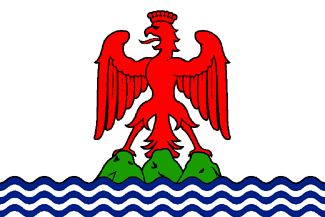
Like the canton of Ticino in Switzerland, the county of Nice, France, had belonged to the Italian speaking world. They were Ligurians in culture and dialect. Unlike Ticino, however, they were not allowed to maintain their language and culture. What is particularly amazing about this, is that one of the three founders of the modern Italian state, Giuseppe Garibaldi, was a Nizzardo! Yet still, the region was lost after the Risorgimento.
As mentioned previously, there is a local connection to the Nizzardi. While a large proportion of local Italians were/are Ligurians, there were also others from what we have coined "the Italian Riviera circle," which includes Ligurians, northern Tucans (Lucchesi), Corsicans, Nizzardians, and even once I met someone whose family had originated in Monte Carlo in Monaco. The term is an obvious play on "the Italian Riviera" coast.
Nice is a city in the county of Nice, which is one of six counties in the French province of Alpes-Côte d'Azur. From the Wikipedia entry for Nizzardo Italians: "Nizzardo Italians were the Italian- and Ligurian-speaking populations of the County of Nice (Nizza), who formed the majority of the county's population until the mid-19th century. The term was coined by Italian Irredentists who sought the unification of all Italian peoples within the Kingdom of Italy. During the Risorgimento, in 1860, the Savoy government allowed France to annexe the region of Nice from the Kingdom of Sardinia in exchange for French support of its quest to unify Italy. Consequently, the Nizzardo Italians were shunned from the Italian unification movement and the region has since become primarily French-speaking."
Nice may have originated when it was a Greek colony. It later became a Roman possession, and later was under Frankish rule. All throughout, it's soul seems to have remained, as it had always been, from the early Ligurian tribes. While we are on the subject, what is most facinating, is that the neighboring Languedoc region, along the the south French coast, until the latter nineteenth century, was mostly Greek speaking! Just like England, Germany, Italy, and even America; France had loved to stamp out any strong local culture within their boundaries. Any sovereignty or autonomy, apparently, was against their creed. Although Nizza should have remained part of Liguria, the Languedoc should have remained as a cherished local Greek speaking culture.
The following are related links from Wikipedia:
Nizzardo Italians
County of Nice
County of Languedoc
Subscribe to:
Posts (Atom)