Showing posts with label Genoese. Show all posts

Monday, March 13, 2023

Lepanto 1571: Shattering the Idea of Ottoman Invincibility

Lepanto 1571: Shattering the Idea of Ottoman Invincibility

SandRhoman History

262K subscribers

202,313 views -  February 19, 2023

#educational #battle #history

Thanks to Nord VPN for sponsoring this video. Check it out here:  https://nordvpn.com/sandrhoman It's risk free with Nord's  30-day-money-back-guarantee!

The battle of Lepanto 1571 was one of the greatest naval battles of the Mediterranean and the last one to be fought almost exclusively by rowing vessels. According to maritime historian Lawrence Mott a staggering amount of 70 to 90 percent of all war galleys in the basin participated in the fighting.  Lepanto was in some sense the naval counterpart of the 1683 siege of Vienna. Contemporaries and historians long saw it as a climactic battle between east and west and mythologized it as the battle in which a Christian fleet defeated the seemingly unstoppable Ottoman threat from the east. In this video were going to look at what exactly happened in the gulf of Patras and look critically at the impact the battle really had.

con't....

.

Friday, July 31, 2015

Tonight is a full "blue moon"


Blue Moon (Frank Sinatra - with Lyrics)

Sinatra Fan

Arranged by Nelson Riddle

For those that came here because of Fallout New Vegas... welcome and I invite you to visit my channel to hear music from the best there ever was. This song came from the Capitol LP "Sinatra's Swingin' Session" which is one of my favorite LP's from Frank's awesome collection. If you like this song, I'm sure you will totally enjoy several of the other cuts from this album. Thanks and Enjoy!
 

Music: "Blue Moon" by Frank Sinatra (Google Play • iTunes • AmazonMP3) 

.

Saturday, June 20, 2015

Olivia "Grandma" Rolleri - Part II

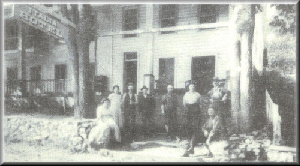
The Calaveras Hotel, circa 1890.
 
‘Grandma’ Rolleri: the Angel of Angels Camp

By Judy Georgiou - Calaveras Enterprise - June 11, 2013 


The story has all the key elements of a thrilling Wild West movie with John Wayne in the cast. It includes, as with so many Westerns, the lure of riches in the Gold Rush, a spark of true love, even the capture of a dangerous outlaw. But what kind of story would it be without a fearless hero in the leading role?

The twist in this tale is that our hero is a woman. Her name: Olivia Antonini Rolleri.

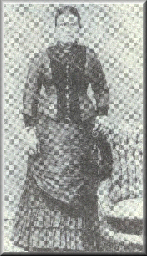
The Rolleri name is certainly not foreign to Calaveras County; in fact, it’s hard to find anyone who hasn’t heard it. Rusty Rolleri of Angels Camp, wife of the late Dick Rolleri, sat at her kitchen table, a small cardboard box balanced on her lap. She opened the flaps and pulled out an old, faded photograph: a porthole into a story that is as intrinsic to Angels Camp as the gold that runs in its hills.

The black-and-white photo is of Olivia Antonini, born Aug. 1, 1844, in San Antonia de Castiglione, a small village high in the hills above the Italian Riviera. When Olivia was 16, she traveled with her mother and sister to the California foothills. They joined her father who had preceded them to Sonora, working in the mines until he had saved enough money to send for them.

Shortly after Olivia arrived, she discovered her life was about to change again. Following a traditional Italian custom, her father had already chosen a young man for her to marry. Olivia shook her head. This was a new world; she had someone else in mind. A year later, she married the dashing Italian miner Gerolamo Rolleri, whose family had lived not far from hers in Italy, although they had never met before Sonora.


Over the next 27 years, Gerolamo mined, ran cattle and operated a ferry. With Olivia by his side, they ran a general store and raised a family. They had 13 children: five girls and eight boys, although two died in infancy.

The family was happy and prospering. In fact, in 1883 their eldest son, James Jr., brought fame to the Rolleri name by helping to capture the notorious gentleman bandit, Black Bart. James Jr. was presented with an engraved rifle by Wells Fargo for his bravery.

But the story took a turn in 1888; Gerolamo died from pneumonia, leaving Olivia with 10 children to care for. The youngest child was only 1.

Olivia knew she had to find a way to provide for her family. In 1889, she purchased a small hotel in downtown Angels Camp. Although Calaveras had lost half its population between 1850-1860, like most gold mining areas in California, Angels Camp was hardly a ghost town. Its gold mines, the basis of its economy, were still going strong.

“Running the hotel was a family operation,” explained Rusty. “The girls would sweep and make beds; the boys would scrub and run errands, and later run the cattle business. She counted on her children to help. That’s how it was back then.”

Rusty dusted off another small photo and smiled at the scene: The Hotel Calaveras in 1890, Olivia at the entrance, her sons and daughters on the upstairs porch, in front of the hotel and in the horse-drawn wagon. All the girls wore long dresses and aprons; the men suspenders and hats.

Through hard work, Olivia and her family transformed the Hotel Calaveras into a thriving enterprise. The saloon had bartenders in immaculate pearl-buttoned vests; local women sipped a discreet sherry in the private parlor after shopping. The dining room – complete with crisp white tablecloths, real napkins and fresh flowers – overflowed with regulars who enjoyed a sensational Italian feast prepared by well-trained Chinese cooks using Olivia’s recipes. “Drummers” (traveling salesmen) wrote orders on wooden desks in the parlor; single men who worked the gold mines called it home.

Olivia proved to be a born entrepreneur. Over the next 20 years she expanded, purchasing three buildings, increasing the hotel capacity to 50 rooms. The rooms weren’t grand, but they were as good as might be found anywhere in the Gold Country. Although the bedrooms didn’t have heat or private baths, each room had a bowl, a pitcher of water and clean beds. Before entering the dining room, miners could shower and change on the ground floor. Room and board fees were $25 a month in the early days, and it was all-you-can eat Italian style. Olivia would even pack as many as 75 lunch pails for miners every morning.


Amador County, California
In order to provide a supply of fresh meat for the restaurant, Grandma Rolleri purchased ranches, ran cattle, and opened a butcher shop. The fruit, vegetables, eggs, hens, milk and butter from the ranches went to her kitchen, where she baked bread, churned ice cream, and made fresh mayonnaise daily. On Sunday evenings, townspeople brought their 5-pound lard pails to the kitchen door to be filled with Grandma Rolleri’s fresh, hot ravioli for their own dinner tables.

Over time, the hotel became the center of life in Angels Camp and Olivia became affectionately known as “Grandma” Rolleri. “She was full of love,” Rusty said, “and love meant sharing.”

Grandma Rolleri was a generous humanitarian, befriending those less fortunate. If there was an empty bed or food in the kitchen, she simply couldn’t turn anyone away even if they couldn’t afford to pay. “She took everyone under her wing and everyone loved her,” Rusty added. “She was an inspiration. She never met anyone she didn’t like.”

“She always wore a long white apron with pockets. She put any tips she received in the pockets and gave them to the church for the poor. Dick, who lived in the hotel as a young boy, adored her,” Rusty recalled. “He remembered rocking with her on the second story porch that ran the length of the hotel. She’d talk to him in Italian. I’m not sure he even understood anything she said, but it didn’t matter. He loved her.”

Her reputation for kindness spread across Calaveras, California and even around the world. Her Chinese cooks returned home to retire and spread stories of the Italian woman who cared for them in a strange country.

On June 10, 1927, Grandma Rolleri died at the age of 83. She’s buried, alongside members of her family, in the Altaville family cemetery.

Between 1930-1945, a Madison Avenue company produced a radio and television anthology called “Death Valley Days,” featuring true stories of the American West. An episode that ran July 1, 1938, was titled “Grandma Rolleri.” The announcer asked the Old Ranger where Angels Camp got its name. He replied, “Well, there’s been angels that’s lived there… an’ my story tonight is about one of ’em.”

Rusty replaced the worn photos in the cardboard box and closed the flaps. “No one was ever turned away from Grandma’s door; color or creed meant nothing to her,” she said. “All people were her friends, and she was a friend to all people.”

Judy Georgiou is a freelance writer from West Point. She can be reached at jlgeorgiou@gmail.com.


.

Friday, June 19, 2015

Olivia "Grandma" Rolleri - Part I

Taken from AmadorGold.net:

In the rural settlements of the foothills, miners and single men often lived in boarding houses owned and operated by fellow Italians. Some of the well-known Italian boarding houses of the past were Calaveras Hotel in Angels Camp; Bisordi's Itala Hotel in Sonora; the Torino Hotel in Nevada City; the Trabucco Hotel in Mt. Bullion; the Colombo Hotel in San Andreas and the Europa Hotel in Sonora.

Olivia "Grandma" Rolleri came to Sonora from Genoa in 1860 at age 16. Left with 11 children after her husband died in 1884, she became a prominent businesswoman who established the Calaveras Hotel in 1887 and owned several cattle ranches and mining interests. The Calaveras Hotel contained more than 50 rooms, a butcher shop, saloon and barber shop under one roof. Sunday dinners were famous and people came from across the county for family homestyle dinners and to take home "ravioli," She operated the hotel for 40 years until 1927.


**************************************************

Taken from FindAGrave.com:

Olivia Elena Antonini Rolleri
Birth: Aug. 1, 1843, Italy
Death: Jun. 10, 1927
Angels Camp
Calaveras County
California, USA

Olivia Rolleri was a much beloved, early pioneer businesswoman of Calaveras & Tuolumne Counties. She had many nicknames: "Little Olivia"; "Little Oliviette" and "Grandma" Rolleri.

In the late 1850s, she and her mother and sister sailed from Genoa, Italy around Cape Horn to San Francisco and then made their way to Sonora to join Olivia's father who was working there. Soon after, she met and married Gerolamo Rolleri (aka Jerome & James.) They were involved in mining, farming, cattle ranching, operated a ferry and opened a general store.

When her husband died in 1888, Olivia was left with 10 children to care for. In 1889 she purchased a rooming house, one of the buildings on the Calaveras Hotel site. During the next 20 years, Mrs. Rolleri purchased three adjacent buildings that made up the Calaveras Hotel. Rooms were 25-50 cents.

The restaurant was known for it's outstanding food (especially her ravioli dinners) and became famous throughout the area. Dinners were "all you can eat" including dessert and all the wine you can drink for 25 cents.

The consummate entrepreneur, she purchased local ranches to grow fruit, vegetables, raise hogs and chickens, run cattle and opened a butcher shop. The children helped on the ranches and in the hotel.


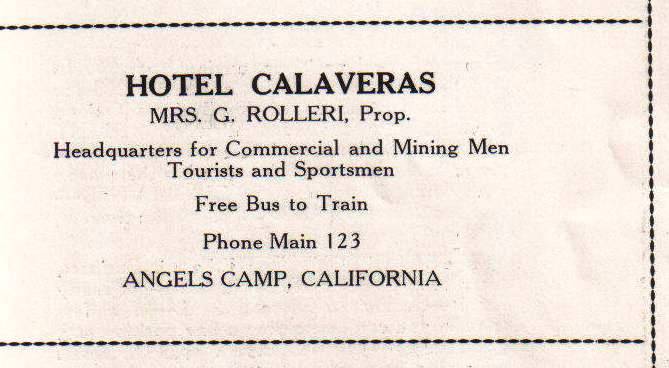
Advertisement in the 1923 Bret Harte yearbook.
Known as a generous humanitarian, she befriended those less fortunate. "Grandma" Rolleri held out a helping hand for those in need.

She died in Angels Camp on June 10, 1927.

A special thank you to Mozelle "Rusty" Rolleri who kindly verified the above information.
Burial:
Altaville Protestant Cemetery
Angels Camp
Calaveras County
California, USA
Plot: Sec B1 - Plot 79


************************************************** 

Rolleri Landscaping Products

Rolleri Vineyard

.

Tuesday, November 6, 2012

"Veltha ruin" - Planting our flag


"Veltha ruin" - Planting our flag

Padanian American League flag


Voltumna (Veltha)
http://en.wikipedia.org/wiki/Voltumna

In Etruscan mythology, Voltumna or Veltha was the chthonic (earth) deity, who became the supreme god of the Etruscan pantheon, the deus Etruriae princeps, according to Varro. Voltumna's cult was centered in Volsini (modern-day Orvieto) a polis of the Etruscan Civilization of northwest Italy.

The bond of the twelve Etruscan populi was renewed annually at the sacred grove of Fanum Voltumnae, the sanctuary of Voltumnus sited near Volsinii (present day Bolsena), which was mentioned by Livy. At the Fanum Voltumnae ludi were held, the precise nature of which, whether athletic or artistic, is unknown.


Fanum Voltumnae
http://en.wikipedia.org/wiki/Fanum_Voltumnae

The Fanum Voltumnae, or shrine of Voltumna, was the chief sanctuary of the Etruscans: fanum means a sacred place, a much broader notion than a single temple. Numerous sources refer to a league of the "Twelve Peoples" (lucumonies) of Etruria, formed for religious purposes but evidently having some political functions. The Etruscan league of twelve city-states met annually at the Fanum, located in a place chosen as omphalos (sacred navel), the geographical and spiritual centre of the whole Etruscan nation. Each spring political and religious leaders from the cities would meet to discuss military campaigns and civic affairs and pray to their common gods. Chief amongst these was Voltumna (or Veltha), possibly state god of the Etruria.


Sacred grove
http://en.wikipedia.org/wiki/Sacred_grove

A sacred grove or sacred woods are any grove of trees of special religious importance to a particular culture. Sacred groves were most prominent in the Ancient Near East and prehistoric Europe, but feature in various cultures throughout the world.


[Music: Piano instrumental version of 'Battle Hymn of the Republic' by Allen Dale
http://www.youtube.com/user/allendale1962?feature=watch

Flute instrumental version of 'Brandy' by Blue Train
http://www.youtube.com/user/TwainsBlues?feature=watch

Piano instrumental version of 'Delta Dawn' by Allen Dale]


.

Wednesday, September 28, 2011

Liguria Region


Ligury Region - Italy

Liguria borders France to the west, Piedmont to the north, and Emilia-Romagna and Tuscany to the east. It lies on the Ligurian Sea. Liguria is a narrow strip of land, enclosed between the sea and the Alps and the Apennines mountains, it is a winding arched extension from Ventimiglia to La Spezia and is one of the smallest regions in Italy. Its surface area is 5,416.03 square Kilometres, corresponding to 1.18% of the whole national surface area, with the following subdivision: 3524.08 kilometres mountain (65% of the total) and 891.95 square kilometres hill (35% of the total).

Its shape is that of a thin strip of land, from 7 to 35 km (4.35 to 21.75 mi) wide (respectively above Voltri and in the high mountain area around Imperia), on average about 240 km (149.13 mi) long, lying in a semicircle around the Ligurian Sea and with convexity facing north; comprised between the sea and the watershed line of the Maritime Alps and the northern Apennines, which at some points it crosses (for example in the Savona and Genoa mountains). Some mountains rise above 2,000 m (6,561.68 ft); the watershed line runs at an average altitude of about 1,000 metres (3,280.84 ft).

The continental shelf, which is very narrow, is so steep it goes down almost immediately to considerable marine depths. The coastline is 315 km long. Except for the Portovenere and Portofino promontories, it is generally not very jagged, and is often high. At the mouths of the biggest watercourses there are small beaches, but there are no deep bays and natural harbours except for those of Genoa and La Spezia.

The hydrographic system is made up of the short watercourses of a torrential kind. In the coastal part the most important are the Roja (in its lower course), the Nervia, and the Magra. On the inland side we find some tributaries of the Po: the two branches of the Bormida, the Scrivia and the Trebbia; there is not much water in these rivers, though the quantity increases greatly in rainy periods.

The ring of hills, lying immediately beyond the coast, together with the beneficial influence of the sea, account for the mild climate the whole year round (with average winter temperatures of 7-10° and summer temperatures of 23°-24°) which makes for a pleasant stay even in the heart of winter.

Rainfall can be very abundant at times; mountains very close to the coast create an orographic effect, so Genoa can see up to 2000 mm of rain in a year; other areas instead show the normal values of the Mediterranean area (500--800 mm). Despite the high population density, woods cover half of the total area. Liguria's Natural Reserves cover 12% of the entire Region, i.e. around 60,000 hectares of land, and they are made up of one National Reserve, six large parks, two smaller parks and three nature reserves.


History

Traces of Neanderthal Man were discovered in the region of Loano, whereas in Ventimiglia, in the grotto of "Balzi Rossi", numerous remains were found which recall those of Cro-Magnon Man. According to the written sources we have about the settlements of the Ligurians (Ligures), the presence of this people of Mediterranean origin dates back to the first millennium B.C. on a vast territory including most of north-western Italy. This people, divided into several tribes, numbered less than two hundred thousand.

During the first Punic War, the ancient Ligurians were divided, some of them siding with Carthage and a minority with Rome, whose allies included the future Genoese. After the Roman conquest of the region, the so-called X regio, named Liguria, was created in the reign of Emperor Augustus, when Liguria was expanded from the coast to the banks of Po River. The great Roman roads (Aurelia and Julia Augusta on the coast, Postumia and Aemilia Scauri towards the inland) helped strengthen the territorial unity and increase exchanges and trade. Important towns developed on the coast, of which evidences are left in the ruins of Albenga, Ventimiglia and Luni. Between the 4th and the 10th centuries Liguria was dominated by the Byzantine, the Lombards of King Rothari (about 641) and the Franks (about 774) and it was later invaded by the Saracens and the Normans. In the 10th century, once the danger of pirates decreased, the Ligurian territory was divided into three marches: Obertenga (east), Arduinica (west) and Aleramica (centre). In the 11th and 12th centuries the marches were split into fees, and then with the strengthening of the bishops' power, the feudal structure began to partially weaken. The main Ligurian towns, especially on the coast, became city-states, over which Genoa soon extended its rule. Inland, however, fees belonging to noble families survived for a very long time.

.

Sunday, June 14, 2009

Beyond the Sky: Genova to San Francisco 1850-1950


Beyond the Sky: Genova to San Francisco 1850-1950

Our first video

Being inherently more pioneer than immigrant, these people needed nobodys help. Leading a rugged underdeveloped society by example, former squalors were soon transformed into class family districts and thriving commercial centers.

Literally from each and every step, from land to sea, from slaughterhouse to dairy farm to field work to fishing net to bakery to stove, and through their own cuisine, they took the lead in simply feeding the hard working populations of California, decade after decade.

Former wilderness regions were soon dotted with roads, houses, ranches, farms, churches, vineyards, gardens, glass factories, blacksmith shops, schools, lumber mills, bakeries, building supply stores, food processing buildings, eateries, manufacturing plants, and symbols of artistic expression.

Looking from the vantage point of their departure location in Genoa, they truly created a paradise many thousands of miles away... beyond the sky!


Thursday, June 5, 2008

Northern Italians in the Gold Rush


This history of the Gold Rush was basically about immigrants from the Genoa area. I had used this one on an earlier website a few years ago, and I recall there was more of a writeup on Olivia "Grandma" Rolleri with an image. I don't recall if I saved that or not. Many of the locations here have been made into landmarks, so we will have to compile a list at some point.

**************************************************

The Italian Legacy in the Mother Lode

Introduction

Nearly 200 members of the Sacramento Italian Cultural Society and the Folsom Historical Society attended the opening reception for the exhibit "Nostra Storia" on January 28, 2000. This is a unique story about that wave of people from Italy, primarily from the area around Genoa in the region of Liguria, who settled in the foothills of the Mother Lode region of Northern California in the Mid-19th century. This is the first time that an exhibit has been created to tell the story of these enterprising people who contributed so much to the economic and cultural fabric of California. The history of the Italian Americans is often relegated to the margins of American and California history despite the fact that the Italians are the 5th largest ancestry group in America with more than 25 million Americans claiming to be of Italian decent. Some two million California's are of Italian decent, In fact, for much of California's history, the Italians have been the largest immigrant group in the State

This exhibit is part of the determination by us, this generation of Italians, to see that our story is told and included in the history of the nation so we to can snare in that history. It is well known that from the 1880's to the 1940's, the Italians were among the largest of the immigrant groups to settle in America. But less is known about the earlier wave of Italians from northern Italy who established their economic and cultural communities across the United States. It was in California that their communities and enterprises flourished the most. We have all benefited from their legacy. From our access to banking services to the food we eat, we are all indebted to these pioneers for the inheritance they have left us.

This story, like so many others about the Italians, would not have been told without the financial and intellectual resources devoted to this project by a committed Italian American institution in our community such as the Italian Cultural Society of Sacramento. It takes a large financial investment to put such an exhibit and a well organized team of Italian American scholars and activists that can make such a project a reality. This project, like so many others sponsored by the Society, is a reflection of the need for Italian American institutions like the Society to maintain our Italian community and speak for us when no one else well. That is why we work so hard at marshaling the resources of our community to support these goals.

This exhibit is our way of saying thank you to those who preceded us but it is also a way of showing out pride in our contributions to American life. This exhibit is also our way of connecting our past to our future as a community, a people. Without a knowledge of our past we have no memory upon which to build our future and the Italian American movement in the United States is about creating a future for us as we have helped create the past. Without a vibrant Italian American community we can no longer make such a contribution to American society.

This exhibit which will become a traveling exhibit, will join the Italian American World War II exhibit "Una Storia Segreta" and other exhibits being developed about the Italians in California agriculture, in the coastal fishing communities and in the urban centers and other regions of California. None of these exhibits has a home. One of the priority public policy goals of the statewide Italian American community is to establish a California Italian American Museum to house these and other exhibits under development. One of the primary goals of the "Italians in the Mother Lode project" is to establish a regional Italian American Museum in the Mother Lode where our story can be collected and displayed. The support and leadership of the Italian American community is vital to the success of these projects.

Arrival and Settlement


The story of the American West would be incomplete without telling the story of the Italian settlement of the west. This is especially true of California and the settlement of the Gold Country counties of the" Mother Lode" of Northern California. The Italians were one of the earliest and most important groups of people to settling the California foothills of the Sierra Nevada referred to as the "Mother Lode".The Italians settlement in the Mother Lode began with the Gold Rush. From the 1850s through the 1880s, Italian immigrants from Northern Italy, primarily from the area around Genoa in the region of Liguria, settled in large numbers in the Mother Lode counties of California's Gold Country.

The Italians came early in the states history. Lured by the promise of gold and land, the early Italian pioneers of California came to stay. Here they could use the traditional skills of their cultural heritage to develop the land and the region. The Italian immigrants established themselves in the mining, cattle ranching, lumbering, construction and stone masonry, fruit and vegetable market gardening, orchard, grocery, olive oil, railroading, mercantile, banking, restaurant, hotel and boardinghouse, and the vineyard and the wine industries of the California Gold Country. Their descendents still carry on the traditions brought to early California by the people from Italy. Seven Sisters Arriving From Genoa 1853Their heaviest settlement was in the southern Mother Lode and by 1870, 25 percent of the Italian population of California lived in the three foothill counties of Amador, Calaveras and Tuolumme. They were soon one of the largest immigrant groups in the Mother Lode. Most came from the same region of Italy and represented the distinctive chain migration of the Italians from the area around Genoa, especially from the province of Chiavari. Later waves of Italian immigrants from Liguria and other regions of Italy, such as the Venetians from the Veneto region also settled in the Gold Country and carried on the traditions brought by the early Italian pioneers. To this day, the Mother Lodes populated by many Italian Families that have their roots in the Gold Rush.

Gold Rush and Mining

Beginning with the Gold Rush of 1848, Italian miners played an important role in the mining industry of California. Attracted by the discovery gold, the early Italian gold miners left their legacy emblazoned in history on historic places with names like Italian Camp, Italian Diggings, Italian Bar and the Italian Bar Trail in Tuolumne County, the Italian Mine in Nevada City and Italian Bar on the American River in El Dorado County.

Between the 1860s and 1890s, numerous quartz and gravel mines along the mining belts of the Mother Lode were operated by Italian miners such as La Fortuna Mine, the Volponi, the Garabina, the Porto Fino , and the Bella Vista.

During the later deep mining period of the 19th and 20th century, Italian miners were recruited from Italy by the large mines to work the deep veins in both northern southern mines. By the turn of the century, the Italians were among the largest of the European immigrant groups in the mines.

The Italian Garden


Mother Lode residents, isolated from major population centers, were dependent on local market gardeners and ranchers for their foodstuffs. Many Italians, attracted by mining, turned to market gardening and farming to meet the demands of the local population for fruits, vegetables, meat and dairy products, grain and wine. By the 1860s, many Italians in the Mother Lode were operating these agricultural enterprises. By 1880, around 1200 commercial market gardens were being operated in California by an estimated 10,000 people from the region around Genoa, Italy, who dominated the industry. The picture to the left is a Italian Garden at Mokelumne Hill.

The Italian Gardens involved the entire Italian family. Women as well as men worked raising the vegetables. The plowing and cultivating was done with horses while the hoeing and cultivating of small plants was done by hand with a zappa, a short-handled Italian hoe.

Italian Gardens were operated throughout the Mother Lode. Some of the most prominent were the upper and lower "Italian Gardens" at Mokelume Hill. Another, The Italian "Pa-ta-ta" Ranch at Bald Mountain was started in 1862 as a cooperative garden by six young Italian miners. The ranch was referred to as "Little Genoa" because of the large number of Italian families that lived there and their use of the Genovese dialect.

Some of the other well-known Italian Gardens were the Volponi Gardens in Sonora, the Podesta Gardens in Columbia, The Gardella Gardens in Mokelumne Hill, the Sanguinetti Gardens in Vallecito, the Costa Gardens in Calaveritas, the Cavalero Gardens at Sonora and the Palemone Gardens in Tuolumne.

The Italians also played an important role in developing the early Olive Oil industry in the foothills. The Orsi family in Roseville was a major producer of olive oil until the mid 20th century. The rolling hills of the Gold Country, which resemble the Mediterranean hills of Liguria, are dotted with the remnants of the early Italian olive tree orchards and with new orchards reflecting the rebirth of this ancient tradition from Italy.

Stone Masons & Wood Cutters

Italians have worked in the Lumbering industry throughout the forested hills of the Mother Lode since the Gold Rush. They were heavily involved in logging and harvested timber off their ranches which delivered to the mines by horse team. Many of the Italian immigrants were woodcutters and the landscape was covered by the cabins of Italians woodcutters who split wood to make the charcoal used in the mining forges.

The Italian immigrants brought their skill in working with stone from Liguria, a rugged and mountainous land with an estimated 25,000 miles of terraced hillsides.

Crews of Italians skilled in rock work helped build the mountain roads carved out of the canyon walls of the western Sierra's from Nevada City to Yosemite. The old stone terraces on todays Gold Country ranches and along its roadsides are a reminder of this cultural tradition. The picture to the right is a Old Stone Mill, Liguria, Italy.


Ranching, an Italian-American Tradition


For the past 150 years, many Italian families have made their living off of cattle ranching in the Mother Lode foothills at the base of the Sierra Nevada Mountains. The early Italian immigrants became one of the main groups in the ranching industry of the Sierra foothills which are dotted with Italian family ranches to the present day.

Some of the oldest ranches in the Mother Lode were started by the early Italian pioneers, The Fregulia Ranch in Jackson was started in 1852 by Domenico Fregulia

from Genoa and is operated as a cattle ranch today by great-granddaughter Carolyn Fregulia and her three children. Giuseppe Rosasco came from Genoa in 1860 and by 1907, the Rosasco family owned seven ranches in Tuolumne County. To the right is the Old blacksmith shop on the Fregulia Ranch at Jackson, California dating from the 19th century.

The family still operates a 5,000 acre ranch near Sonora. The Cuneo ranch at Calaveritas was started in 1850 by immigrants from Genoa and is still operated by the Cuneo family as is the Sanguinetti Ranch and scores of other Italian family ranches in the region.

Italian Merchants

The history of the Mother Lode is also the history of the many Italian merchants that have operated businesses from the Gold Rush to the present. Some of the earliest merchants in the Gold Country were Italian Immigrants. Among the early Italian pioneers who established general stores were Luigi Costa in 1852 in Calaveritas; Louis Trabucco in 1850 in Hornitos; Joseph Arata in 1854 in Vallecito, Domenico Ghiradelli in 1855 in Hornitos, Agostino Chichizola in 1850 in Jackson; Frank Cuneo in 1857 in San Antonio Camp, Giuseppe Prince in 1857 in Altaville, Nicolas Pendola in 1859 in Angels Camp, John Peirano in 1854 in Angels Camp, Carlo Marre in 1858 in Jackson, Francesco Bruschi in 1854 in Coulterville, Andrew Olcese in 1861 in Mariposa, Enrico Bruno in 1857 in Butte City, Nicolas Quirolo in 1861 in Todds Valley, Bartolomeo Dughi in 1860 in Mountain Ranch and Gerolomo Tiscornia in 1868 in San Andreas. The Costa Store in Calaveritas has been restored by the Cuneo family as has the Chichizola Store at Jackson Gate. The Butte Store, operated by the Ginocchio family until 1926, is a State Historic Landmark.

One of the best examples of Italian architecture in the region is the Giuseppe Murer House in Folsom which was built by an enterprising immigrant who arrived in 1906 from the Veneto region of Italy. The Murer House is now a historic site and museum. The picture to the right is the Chichizola Store at Jackson Gate, Amador County, California.

Boarding Houses & Hotels


In the rural settlements of the foothills, miners and single men often lived in boarding houses owned and operated by fellow Italians. Some of the well-known Italian boarding houses of the past were Calaveras Hotel in Angels Camp; Bisordi's Itala Hotel in Sonora; the Torino Hotel in Nevada City; the Trabucco Hotel in Mt. Bullion; the Colombo Hotel in San Andreas and the Europa Hotel in Sonora.

Bisord's Italia HotelOlivia "Grandma" Rolleri came to Sonora from Genoa in 1860 at age 16. Left with 11 children after her husband died in 1884, she became a prominent businesswoman who established the Calaveras Hotel in 1887 and owned several cattle ranches and mining interests. The Calaveras Hotel contained more than 50 rooms, a butcher shop, saloon and barber shop under one roof. Sunday dinners were famous and people came from across the county for family homestyle dinners and to take home "ravioli," She operated the hotel for 40 years until 1927.

Italian Stone Ovens, a Unique Tradition

One of the cultural traditions brought to the Gold Country by the Italian immigrants was the tradition of baking in stone ovens. Many Italian families used outdoor stone ovens to bake bread, a vital part of Italian culture. Around 100 stone ovens have been identified in Calaveras, Amador and Tuolumne and dot the countryside where the Italians settled. "Victoria's Oven" was moved from the Ratto Ranch to the Calaveras Museum in 1994 where bread is once again baked fresh from this historic oven.

The oven to the left is from the Fregolia ranch.


Family & Community


The Italian immigrants to the Mother Lode established their own cultural communities wherever they settled. They had their own "Little Italy" communities such as at Jackson Gate and at Clinton in Amador County. To this day, Jackson Gate is the site of several Italian family restaurants and Clinton Road, is lined with Italian Ranches.

The Italian pioneers celebrated their pride in their Italian heritage by building "Bocce" courts, holding Columbus Day celebrations, and forming mutual benefit organizations.

There are a number of Italian organizations serving the Italians, in the Mother Lode. The Gold Country Italian American Club in Grass Valley plays bocce at the courts it has built in the local public park and the Italian Benevolent Society in Amador, organized in 1881, holds an annual "Italian Festa" at the " Italian Society Park " at Sutter Hill. The Society is 118, years old and made up of descendents of the early Italian immigrants to the Mother Lode.

Columbus Day Parade 1890Angelo Noce, an Italian immigrant to Clinton in 1858, is credited as the "Father of Columbus Day" in the United States for obtaining recognition of Columbus Day as a legal holiday by thirtyfive states. Native son, Andrew Caminetti, born in Jackson Gate in 1854 of Italian immigrant parents, was the first native-born California elected to the United States Congress.

From Italy to California

The early Italian settlement of the Mother Lode mining counties of northern California was part of the larger settlement of California by Italian people from the region of Liguria.

During the mid-19th century, Italian immigrants from the region of Liguria in Italy settled in the major cities of the United States and established Italian communities in places like New Orleans, Philadelphia, San Francisco, Chicago, Boston, and New York. The arrival of these "Genovesi" in California, beginning in the 1850's, coincided with the early development of the state. As a result, the Italians played a vital role in the creation of California.

It wasn't long before Italian fishermen had established themselves in fishing villages from Eureka to Benicia, Martinez, Pittsburg, San Francisco, Santa Cruz, San Diego and Monterey.

By the 1880's, California had become a leading fishery and its coastal waters were dominated by Italian fishermen and their graceful sailing "felucca's"

Across the state, the Italians also settled the states farmlands and played a prominent role in developing today's fruit, vegetable, and dairy industries. By the 1880's, Italians dominated the fruit and vegetable industry in the great Central Valleys of California. Italian immigrants also left their mark on the California food processing industry. Marco Fontana arrived in the United States in 1859 and along with another Ligurian, Antonio Cerruti, established a chain of canneries under the "Del Monte" label. Most of their workers were Italian and their cannery soon became the largest in the world.

Another enterprising Italian was Domenico Ghiradelli, who traveled through the gold mines in the 1850's, selling chocolates, and hard candies. He settled in San Francisco after the Gold Rush and founded the Ghiradelli chocolate empire, with Italian immigrant labor, at the site of the present Ghiradelli Square.

The California wine industry also owes much to the Italian founders of the industry. Italians have been planting vineyards and making wine in America since the early colonial days when Filippo Mazzei, planted vineyards with Thomas Jefferson. The founding of the Italian Swiss Colony, at Asti in 1881 as a cooperative of Italian immigrants from the wine growing regions of Italy promoted the widespread participation and success of the Italians in the California wine industry and the vineyards of the Napa, and Sonoma valleys.

One of the most inspiring of California's Italians was Amadeo Pietro Giannini who was born 1870 to immigrant Italian parents from Genoa. He started the first statewide system of branch banks in the nation by opening branches of his Bank of Italy, in the Italian neighborhoods, across the state. He later changed the name of his bank to Bank of America which became the largest bank in the world.

More than most people realize, the Italian Americans helped shape the cultural landscape of California and the modern West. The enterprise and success of these Italian pioneers is a unique legacy – one shared by all of us.

The Italian Legacy in the Mother Lode (Sacramento Italian Cultural Society)