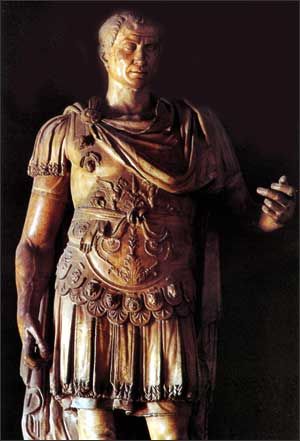
Spot where Julius Caesar was stabbed discovered [see image]
Concrete structure believed to mark location of Roman ruler's killing
By Stephanie Pappas - Senior writer - MSNBC - October 11, 2012
Archaeologists believe they have found the first physical evidence of the spot where Julius Caesar died, according to a new Spanish National Research Council report.
Caesar, the head of the Roman Republic, was stabbed to death by a group of rival Roman senators on March 15, 44 B.C., the Ides of March. The assassination is well-covered in classical texts, but until now, researchers had no archaeological evidence of the place where it happened.
Now, archaeologists have unearthed a concrete structure nearly 10 feet wide and 6.5 feet tall that may have been erected by Augustus, Julius Caesar's successor, to condemn the assassination. The structure is at the base of the Curia, or Theater, of Pompey, the spot where classical writers reported the stabbing took place.
"We always knew that Julius Caesar was killed in the Curia of Pompey on March 15th 44 B.C. because the classical texts pass on so, but so far no material evidence of this fact, so often depicted in historicist painting and cinema, had been recovered," Antonio Monterroso, a researcher at the Spanish National Research Council, said in a statement.
Classical texts also say that years after the assassination, the Curia was closed and turned into a memorial chapel for Caesar. The researchers are studying this building along with another monument in the same complex, the Portico of the Hundred Columns, or Hecatostylon; they are looking for links between the archaeology of the assassination and what has been portrayed in art.
"It is very attractive, in a civic and citizen sense, that thousands of people today take the bus and the tram right next to the place where Julius Caesar was stabbed 2,056 years ago," Monterroso said.
.
Showing posts with label archaeology. Show all posts
Thursday, October 25, 2012
Wednesday, March 4, 2009
Thousand-year-old Lombard warrior skeleton discovered
Thousand-year-old Lombard warrior skeleton discovered buried with horse in Italy
Italian archaeologists have discovered a perfectly preserved skeleton of a 1400-year-old Lombard warrior, buried with his horse.
By Malcolm Moore in Rome - London Telegraph - May 28, 2008
The skeleton, which was found in a park at Testona, near Turin, is of a 25-year-old Lombard who died of a fever. Unusually, his horse was buried alongside him.
"This is a very rare find," said Gabriella Pantò, the archaeologist leading the dig. "We have not seen many precedents in Italy. We have seen horses' heads buried with warriors, but this find shows the area is vitally important," she added.
The Lombards were a nomadic tribe of Germans who settled near the Danube and launched an attack on Italy in the sixth century.
Under the leadership of King Alboin, the Lombards stormed across the Alps in the spring of AD568 with an army of around 500,000.
Vicenza, Verona and Brescia were quickly conquered from the Byzantines, who were still suffering from battling the Goths. Lombardy was established across the whole of the north of the country, an empire which lasted for around 100 years.
The dig revealed a Lombard camp had settled at Testona, and the skeleton of a dog was also found nearby. The invaders had built an aqueduct and irrigation system and a series of small wooden huts, without any foundations.
The warrior was also buried with a treasure chest being x-rayed by archaeologists. In addition, a small bag held a pair of pincers, a bronze belt buckle and some armour.
He wore a ring on his left index finger and also had both a knife and a "scramasax", a short sword designed for close combat.
Article Link:
'Thousand-year-old Lombard warrior skeleton discovered buried with horse in Italy'
Subscribe to:
Posts (Atom)