Friday, February 16, 2018
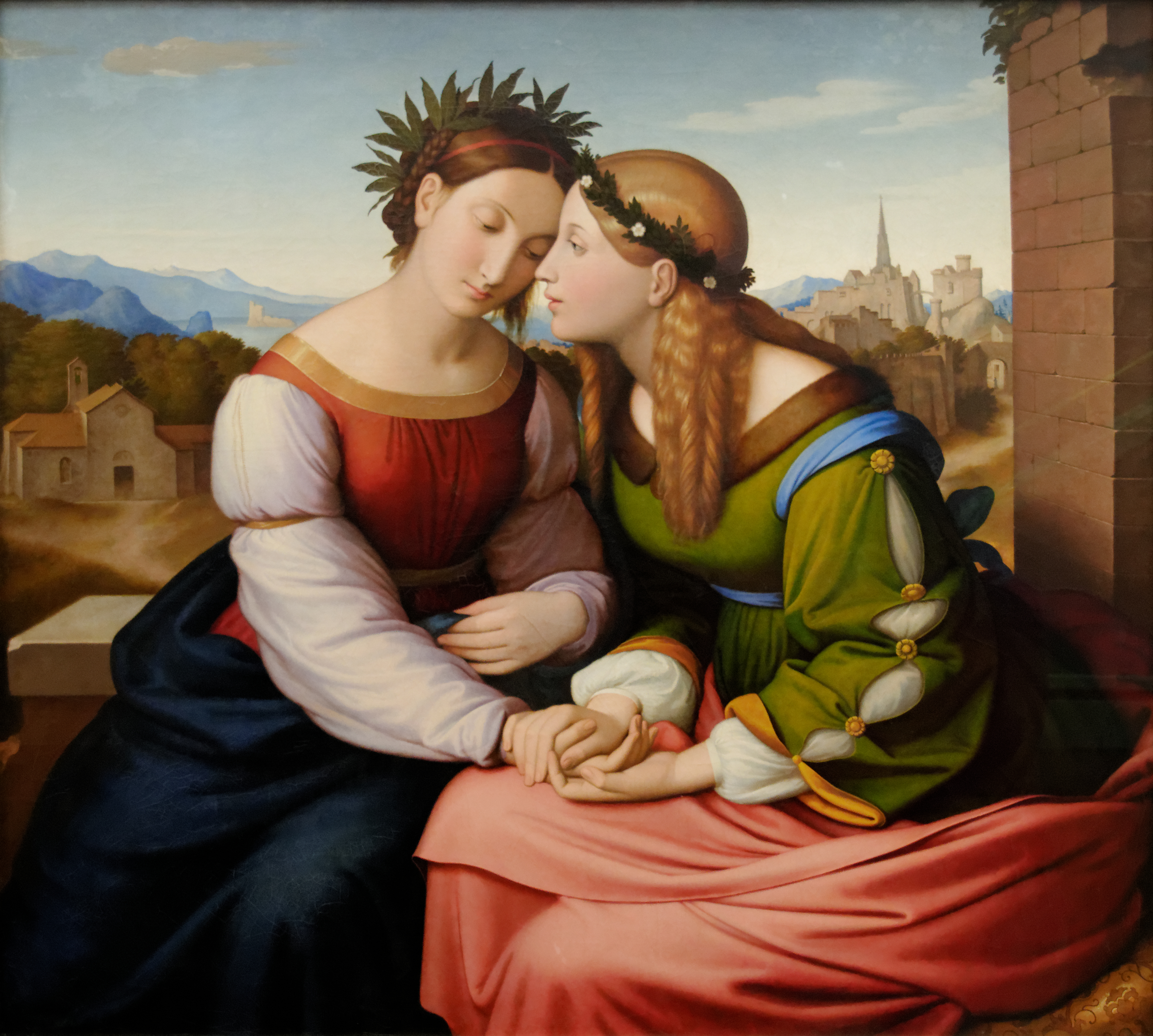
"Italia and Germania" (1828)
Reddit: "Italia and Germania"
Italia und Germania (1828) by Friedrich Overbeck. The two girls are personifications of the countries and symbolise their common heritage and friendship.
Here in Italy there's an adage:
Italians hold Germans in high regard, but don't love them; Germans love Italians but don't hold them in high regard.
Just pointing out the Italian landscape to the left and the German Gothic town to the right.
I love how , when you have pictures of German women in Art, there hair is often braided and Italian women have their hair tied with leaves.
well, the leaves are usually laurel leaves, the plant used in classical antiquity to crown athletes, writers, and so on. It just works as a reminder of our classical past
*************************
I like Germania and Austria more
[Not my comment, but I thought it made for an interesting concept in its own right]
*************************
Is it a coincidence that each one's clothes hint at the other's flag? The green-white-red color scheme was already in use in Italy at the time, not sure about Germany.
Both nations were struggling to create their own state at the time. If anything, it represents nationalism.
Friedrich Overbeck, the painter did want to express both heritage and friendship between these cultural spheres and their common wish for unity.
Italy and Germany have always been very similar (except culturally) in their history (divided politically, then unification, WWII...), and economically (east/west, north/south divide), well at least until not that long ago.
Nah, at that time Italy and Germany weren't countries, but a bunch of small loosely knit duchies, free cities, princedoms, republics, bishoprics and what not. That was also the time that nationalism and a national consciousness was being formed. So this picture, among other things, is supposed to be a fairly nationalistic one. So, if anything, EU is against nationalism and for a more supranational approach to things.
'Italy and Germany: A peaceful meeting of opposites'
Rosemarie Fruehauf - TheEpochTimes.com - December 5, 2010
It is a meeting of dark and bright, yin and yang, of introvert and extrovert. The harmony of this painting is so compelling because it shows a peaceful connection of opposites, a talk between two different realms and approaches toward life.
Leave everything aside—German stereotypes, Italian stereotypes, and the story of the Nazarene movement—and you are looking at a timeless painting about friendship.
.
The Nazarenes
The two ladies, Italia and Germania, in the painting by Johann Friedrich Overbeck, (1789–1869) represent two ideals of art: the art of the early Italian Renaissance as found in the young Raphael, and the German late-Middle Ages paintings like those of Albrecht Dürer. These were the ideals the painter Overbeck venerated and from which he drew his artistic inspiration.
The two girls can also be seen as symbolizing the church and the state. Overbeck and his artist friends of the Nazarene movement postulated that the partners of art should be the church and the state, a view that was regarded as old fashioned and reactionary in a time when art suddenly had to search for reasons to validate its existence.
The industrial revolution was dawning, and both the bourgeoisie and artists were growing ever more independent. In these days at the brink of the 19th century, Overbeck and some fellow students of the Academy of Vienna were dissatisfied with the lack of heart and soul in the prevalent Neoclassicism and with the conventional art education in the academy system.
In the meetings and discussions they held in a loose circle from 1808, they found their Christian ideals manifesting in the earlier European art. Four of them, including Overbeck, left the academy in 1810 and traveled to Rome. In Italy, they hoped to live a life in the way of the old, “true” artists. Making an impact in Rome. They called themselves the “Brotherhood of St. Luke” (St. Luke is the patron saint of painters) and after occupying the abandoned monastery of San Isidoro, conducted a quasi-monastic life, dedicated to praying and painting.
Soon they became known among their detractors as well as supporters by the quizzical nickname “Nazareni” (for their long-haired, biblical appearance) and were joined by other like-minded personalities. The greatest achievement of the group was the reviving of the old fresco technique that had almost been forgotten.
With two major commissions, the wall paintings of Casa Bartholdy and the Casino Massimo in Rome, they could establish an international reputation. By 1830, all the Nazarenes had returned to Germany, where many of them became acclaimed teachers and chairmen of art academies.
Overbeck, as the figurehead of the movement, rejected all offers and stayed in Rome, where he lived his dream until his death in 1869. Though admired by fans and followers, he was ridiculed by his more practical-minded contemporaries.
The Nazarenes were disillusioned over the rationalism of the enlightenment movement that had discredited itself in the terror of the French Revolution.
They preferred a society based on belief. That is why they saw the Middle Ages in a very positive light. With its simplicity and honesty, the Middle Ages became their favorite period of history.
“Italia und Germania” was especially seen as the Nazarenes’ programmatic painting, as it extols the two branches they considered to be the highest ideals of art—the early Italian Renaissance in the spiritual and introverted Madonna-like figure, together with the natural, yet proud German Middle Ages artistry represented by the blond girl.
The Nazarenes were the first art movement in a modern sense—a group of people who met to formulate an ideology of what art should be like and then worked for it. This painting exemplifies and convincingly broadcasts what they sought in art. The painting works perfectly in iconography, technique, and compositional style. Here, their dream and message is given a shape.
The Painting
The painting becomes more meaningful and beautiful the longer one looks at it. Its clear and simple coloring, supported by the stunningly smooth surface, which hardly shows a brush stroke, attracts one’s eyes naturally.
The girls are in the midst of an intimate talk. They seem to be very close, peacefully and lovingly connected. This comes mainly through the composition, as there are a lot of oval forms, which echo each other.
There is the big oval going from their shoulders to their arms and conjoined hands. There are also the ovals of the necklines that Overbeck made the same size, the similarities in the dresses, like the belts and white sleeves of their blouses as well as the floral wreaths corresponding to each other. The pink wrap that drapes the lower part of Germania’s body with its soft pleats frames and emphasizes this big oval dynamic of the setting.
It looks like a religious painting on first glance due to the strong triangular composition in which the two figures are rendered. This is what we have seen in countless saintly images, especially in the Raphael Madonna paintings. The two figures become like saints.
As in Renaissance art, Italia and Germania fill the well-balanced format, and the landscape becomes secondary. With its humble green and blues, it just illustrates a surrounding. Details tell us about the ladies’ identities: Italian architecture and the Mediterranean sea feature the background of Italia; a Gothic city and the Alps decorate Germania’s side.
Sacred Friendship
Their friendship is idealized and made sacred in the way Overbeck depicts the girls because of the harmony, dignity, and quietude of the composition. Their strongly idealized faces cannot count as portraits. Their skin is amazingly white, shimmering like porcelain. Yet this seems to be more than just a conceptual work, as it features a very natural and human conversation.
Although the two are connected, they are independent of each other; their eyes do not meet. They are conjoined by their hands, the compositional triangle shape, and multiple round forms. Each woman has her own personality and emotional quality that goes beyond the idealized portrayal. As a profile portrait, there is almost breezy cuteness in the way the blond Germania stretches her nose in the air. The blooming floral wreath comes across as extroverted and friendly. Its blooms are repeated as golden buttons on her sleeve. She leans toward the dark-haired one and holds both her hands around the others hand. She’s obviously talking to her. Some feel that she’s comforting her friend.
The image of the dark-haired Italia, with its classical three-quarter perspective and the red and blue garments she’s wearing, repeats countless Madonna portrayals. We perceive her to be introverted and almost melancholic as she holds one of her hands in front of her body as if protecting herself. She looks humbly down to the ground while her blond companion curiously looks into the landscape while talking.
The dark lady’s dress is in comparison much simpler; there are no ornaments on it. The laurel wreath she wears is the only thing that gives an idea of her Mediterranean origin and adds a little peculiarity to an otherwise perfect image of Mary.
The two become a symbol for the possible union of opposites and a peaceful dialogue of different temperaments.
.
Sunday, January 31, 2016
Mount Sibillini National Park
Nationalpark Monti Sibillini - Italien
TheWorldOfTravel DE
Sibillini Mountains
The Sibillini Mountains, or Sibylline Mountains (Italian: Monti Sibillini) are a mountain group in Italy, part of the central Apennines. Situated between eastern Umbria and the Marche, they are mostly composed of limestone rocks, formed in the Mesozoic and Cenozoic (100 to 50 million years ago) on the bottom of an extinct sea. The land emerged 20 million years ago. Most of the peaks are over 2,000 m (6,600 ft); the highest altitude is reached by Monte Vettore at 2,476 m (8,123 ft).
.
Monday, June 15, 2015
Documentary 'Barbarians' series - 'The Lombards'
The Lombards
georgeweatherby
At the end of the sixth century, he Roman Empire, rocked by relentless waves of violent barbarians -- Goths, Huns, Vandals -- civilization on the Italian penisula teeters on the brink of collapse. As famine, war, plague leave death devastation in their wake, out of north bursts the last of the barbarian hordes. Fiercely pagan, famous for their cruelty, the Lombards strike the final blow to the Roman Empire.
In 488 the Lombards are a small but particularly savage group of warriors on the move, surviving by viciously raiding other tribes Originating in Scandinavia and migrating south, into Roman regions, they eventually inhabit what became modern day Austria and Hungary At the turn of the 6th century only the eastern half of the empire remains, ruled by the Byzantine emperor from Constantinople.
Alboin, king of the Lombards, was celebrated as a man fitted for wars, with noble bearing and courage. The emperor Justinian recruited Alboin and the Vandals to aid in the reconquest of Italy which was controlled by the Goths. The Roman military leaders disgusted by the uncontrolled Lombard warriors, relegated them to a new homeland along the banks of the Danube River. In 568, the Lombards, well familiar with Italy from earlier days as Roman mercenaries, invade Rome, inviting Saxons, Bulgars and other barbarian tribes to join.
Much of our information regarding the Lombards is found in the 8th century chronicler Paul the Deacon's work, HISTORY OF THE LOMBARDS, translated by William Dudley Foulke, LL.D., edited with introduction by Edward Peters, University of Pennsylvania Press, Philadelphia, 1907
This History Channel documentary series, Barbarians 2, tells the fascinating stories of four of the most fabled groups of fighters in history, the Saxons, the Lombards, the Franks, the Vandals, tracing 1,000 years of conquest and adventure through inspired scholarship and some of the most extensive reenactments ever filmed.
.
Tuesday, July 15, 2014
Lionel Messi: One of the all-time soccer greats, an Argentine of Cisalpine ancestry
Lionel Messi (Wikipedia)
Lionel Andrés "Leo" Messi (born 24 June 1987) is an Argentine footballer who plays as a forward for Spanish club FC Barcelona and the Argentina national team. He serves as the captain of his country's national football team.
By the age of 21, Messi had received Ballon d'Or and FIFA World Player of the Year nominations. The following year, in 2009, he won his first Ballon d'Or and FIFA World Player of the Year awards. He followed this up by winning the inaugural FIFA Ballon d'Or in 2010, and then again in 2011 and 2012. He also won the 2010–11 UEFA Best Player in Europe Award. At the age of 24, Messi became Barcelona's all-time top scorer in all official club competitions. At age 25, Messi became the youngest player to score 200 goals in La Liga.
Commonly ranked as the best player in the world and rated by some in the sport as the greatest of all time, Messi is the first football player in history to win four FIFA/Ballons d'Or, all of which he won consecutively, as well as the first to win three European Golden Shoe awards. With Barcelona, Messi has won six La Ligas, two Copas del Rey, six Supercopas de España, three UEFA Champions Leagues, two UEFA Super Cups and two Club World Cups.
Messi is the first and only player to top-score in four consecutive Champions League campaigns, and also holds the record for the most hat-tricks scored in the competition. In March 2012, Messi made Champions League history by becoming the first player to score five goals in one match. He also matched José Altafini's record of 14 goals in a single Champions League season. Messi set the European record for most goals scored in a season during the 2011–12 season, with 73 goals. In the same season, he set the current goalscoring record in a single La Liga season, scoring 50 goals. Also in that season, Messi became the first player ever to score and assist in six different official competitions in one season.
| Messi with girlfriend Antonella Roccuzzo and son. |
On 16 February 2013, Messi scored his 300th Barcelona goal. On 30 March 2013, Messi scored in his 19th consecutive La Liga game, becoming the first footballer in history to net in consecutive matches against every team in a professional football league. He extended his record scoring streak to 21 consecutive league matches, and the run came to a halt only when he sustained a hamstring injury. In March 2014, with a hat-trick against Real Madrid, Messi became the player with the most goals and most hat-tricks in the history of El Clásico.
Messi helped Argentina win the 2005 FIFA U-20 World Cup, finishing as both the best player and the top scorer (with 6 goals). In 2006, he became the youngest Argentine to play and score in the FIFA World Cup, and won a runners-up medal at the Copa América in 2007, in which he was named young player of the tournament. In 2008, he won an Olympic Gold Medal with the Argentina Olympic football team. In 2013, SportsPro rated him the second-most marketable athlete in the world.[8] His playing style and stature have drawn comparisons to compatriot Diego Maradona, who himself declared Messi his "successor". In 2014, Messi led Argentina to the World Cup Final, winning four consecutive Man of the Match awards in the process. He won the Golden Ball award after being adjudged the best player of the tournament.
Don’t Cry for Messi, Argentina. This Germany Team Is One of the Best in Years.
.
Friday, May 31, 2013
Gallo-Italic languages
If you look at the "linguistic map of Italy," and then look at the nations of 1860 (or any map between the fall of Rome and the Risorgimento, or even the regions today), it always closely matches! There is always the "northern nations," the "Roman state," and the "southern nations." All separated by different languages with local dialects. As Americans, we have a hard time comprehending the way Europe was socio-geographically over the centuries. I could move to Montana, a thousand miles away, tomorrow and instantly become a Montanan. That's what we're used to. I could move From the Bay Area to Maine, and probably fit in better than I do here, even though I have no knowledge of the state. That would be like going from Ireland to Belarus. The cultural-geographical scale, up until very recently, was entirely different.
Within many Italian provinces, there exists even different native dialects (ex. Brescia). Sometimes there are even two different language families, and in parts of the Tri-Veneto area there are three different deep-rooted languages spoken (Italian, Venetian, and Ladin), and it was once four when the German-Cimbrian language was alive. [I would consider the South Tyrol to be a different dynamic since it was wrongly acquired after World War II.]
Gallo-Italic languages (Wikipedia)
The Gallo-Italian or Gallo-Italic languages constitute the majority of northern Italian languages. Among them are are Piedmontese, Lombard, Emiliano-Romagnolo and Ligurian, although there is some doubt about the position of the latter due to its retention of final /o/.
The Gallo-Italian languages have characteristics both of the Gallo-Romance languages to the northwest (including French and Occitan) and the Italo-Romance languages to the south (including standard Italian). Examples of the former are the loss of all final vowels other than -a; the occurrence of lenition; the development of original /kt/ to /jt/ (and often later to /tʃ/); and the development of front-rounded vowels (e.g. the change of /u/ to /y/). Examples of the latter are the use of vowel changes to indicate plurals, in place of /s/; the widespread occurrence of metaphony of stressed vowels, triggered by original final /i/; and the development in some areas of /tʃ/ instead of /ts/ as the result of palatalization of original /k/ before e and i. As a result, there is some debate over the proper grouping of the Gallo-Italian languages. Most commonly, they are grouped with the Gallo-Romance languages, but some Italian linguists prefer to group them with the Italo-Romance languages.
Geographic distribution
Traditionally spoken in Northern Italy, Southern Switzerland, San Marino and Monaco, most Gallo-Italian languages have given way in everyday use to Standardized Italian. The vast majority of current speakers are bilingual with Italian. These languages are still spoken by immigrants in countries with Italian immigrant communities. Ligurian is formalised in Monaco as Monegasque.
The Venetian language is usually considered to belong to a different dialect community, while some publications place it among the Gallo-Italian languages.
.
Wednesday, February 13, 2013
The Gauls and Langobards drank mead: Part 1
Mead (pron.: /ˈmiːd/; archaic and dialectal "medd"; from Old English "meodu" Ukrainian: Мед or Russian: Медовуха or Lithuanian: Midus), also called honey wine, is an alcoholic beverage that is produced by brewing a solution of honey and water. It may also be produced by brewing a solution of water and honey with grain mash, which is strained after fermentation. Depending on local traditions and specific recipes, it may be flavored with spices, fruit, or hops (which produce a bitter, beer-like flavor). The alcoholic content of mead may range from about 8% ABV to 18%. It may be still, carbonated or naturally sparkling, and it may be dry, semi-sweet or sweet.
Mead is known from many sources of ancient history throughout Europe, Africa and Asia, although archaeological evidence of it is ambiguous. Its origins are lost in prehistory. "It can be regarded as the ancestor of all fermented drinks," Maguelonne Toussaint-Samat has speculated, "antedating the cultivation of the soil."
Claude Lévi-Strauss makes a case for the invention of mead as a marker of the passage "from nature to culture." Mead has played an important role in the beliefs and mythology of some peoples. One such example is the Mead of Poetry, a mead of Norse mythology crafted from the blood of the wise being Kvasir which turns the drinker into a poet or scholar.
History
The earliest archaeological evidence for the production of mead dates to around 2000 BC. Pottery vessels containing a mixture of mead, rice and other fruits along with organic compounds of fermentation were found in Northern China. In Europe, it is first attested in residual samples found in the characteristic ceramics of the Bell Beaker Culture (ca. 2800 – 1800 BC).
The earliest surviving description of mead is in the hymns of the Rigveda, one of the sacred books of the historical Vedic religion and (later) Hinduism dated around 1700–1100 BC. During the Golden Age of Ancient Greece, mead was said to be the preferred drink. Aristotle (384–322 BC) discussed mead in his Meteorologica and elsewhere, while Pliny the Elder (AD 23–79) called mead militites in his Naturalis Historia and differentiated wine sweetened with honey or "honey-wine" from mead. The Spanish-Roman naturalist Columella gave a recipe for mead in De re rustica, about AD 60.
Take rainwater kept for several years, and mix a sextarius of this water with a pound of honey. For a weaker mead, mix a sextarius of water with nine ounces of honey. The whole is exposed to the sun for 40 days, and then left on a shelf near the fire. If you have no rain water, then boil spring water.
Etymology
The English word mead derives from the Old English meodu, from Proto-Germanic meduz, from Proto-Indo-European *médʰu (honey, fermented honey drink). Slavic med / miod , which means both "honey" and "mead", (Czech, Slovak, Serbian, Bosnian, Bulgarian, Croatian: med vs. medovina, Polish 'miód' pronounce [mju:t] - honey, mead) and Baltic medus "honey"/midus "mead", also derive from the same Proto-Indo-European root (cf. Welsh medd, Old Irish mid and Sanskrit madhu).
Festivals
Mazer Cup International Mead Competition and Tasting Event -- Sponsored by Gotmead.com, this event is held every year in March in Boulder, Colorado. It is the largest mead event in the world, with over 300 home meads and over 200 commercial meads in competition. There is a Friday tasting event with the gold medal winning commercial meads from the previous year, plus feature meads from around the world.
Real Ale Festival in Chicago, Illinois, includes categories for mead as well as cider and perry.
Woodbridge International Mead Festival - Sponsored by local residents, it claims to be the only mead festival east of the Mississippi. While few types of mead are available, all are home-brewed and go through a rigorous judging process.
In literature
Mead is featured in many Germanic myths and folktales such as Beowulf, as well as in other popular works that draw on these myths. Notable examples include books by Tolkien, George R. R. Martin and Neil Gaiman. It is often featured in books using a historical Germanic setting and in writings about the Viking era. Mead is mentioned many times in Neil Gaiman's 2001 novel, American Gods; it is referred to as the drink of the gods. Also, in the books of the Inheritance Cycle by Christopher Paolini, it is often drunk by Eragon Shadeslayer at feasts in honor of him. Mead is also referenced in The Kingkiller Chronicle novel series by Patrick Rothfuss. The protagonist Kvothe is known to drink metheglin. The non-existent "Greysdale Mead" is also drunk, although it is merely water.
[See above link for distribution, varieties, and local variants; see also Mead of poetry]
.
Tuesday, November 6, 2012
"Veltha ruin" - Planting our flag
Padanian American League flag
Voltumna (Veltha)
http://en.wikipedia.org/wiki/Voltumna
In Etruscan mythology, Voltumna or Veltha was the chthonic (earth) deity, who became the supreme god of the Etruscan pantheon, the deus Etruriae princeps, according to Varro. Voltumna's cult was centered in Volsini (modern-day Orvieto) a polis of the Etruscan Civilization of northwest Italy.
The bond of the twelve Etruscan populi was renewed annually at the sacred grove of Fanum Voltumnae, the sanctuary of Voltumnus sited near Volsinii (present day Bolsena), which was mentioned by Livy. At the Fanum Voltumnae ludi were held, the precise nature of which, whether athletic or artistic, is unknown.
Fanum Voltumnae
http://en.wikipedia.org/wiki/Fanum_Voltumnae
The Fanum Voltumnae, or shrine of Voltumna, was the chief sanctuary of the Etruscans: fanum means a sacred place, a much broader notion than a single temple. Numerous sources refer to a league of the "Twelve Peoples" (lucumonies) of Etruria, formed for religious purposes but evidently having some political functions. The Etruscan league of twelve city-states met annually at the Fanum, located in a place chosen as omphalos (sacred navel), the geographical and spiritual centre of the whole Etruscan nation. Each spring political and religious leaders from the cities would meet to discuss military campaigns and civic affairs and pray to their common gods. Chief amongst these was Voltumna (or Veltha), possibly state god of the Etruria.
Sacred grove
http://en.wikipedia.org/wiki/Sacred_grove
A sacred grove or sacred woods are any grove of trees of special religious importance to a particular culture. Sacred groves were most prominent in the Ancient Near East and prehistoric Europe, but feature in various cultures throughout the world.
[Music: Piano instrumental version of 'Battle Hymn of the Republic' by Allen Dale
http://www.youtube.com/user/allendale1962?feature=watch
Flute instrumental version of 'Brandy' by Blue Train
http://www.youtube.com/user/TwainsBlues?feature=watch
Piano instrumental version of 'Delta Dawn' by Allen Dale]
.
Saturday, February 19, 2011
World Padanian Nation II: World Cisalpine Kindred
World Padanian Nation: World Cisalpine Kindred
Mondo Nazione Padana: Mondo Affine Cisalpina
Mundo Nación Padano: Mundo Parientes Cisalpina
Monde Nation Padanien: Monde Apparenté Cisalpine
Mundo Nação Padano: Mundo Afim Cisalpina
Wereld Padaniaans Natie: Wereld Cisalpine Verwanten
[Music: 'Slow It Down' by Phantom Blue]
.
Thursday, January 27, 2011
Choosing an identifying name
Many times it's hard to find a proper word to use in casually identifying people, places, and things which are "northern nations." "Northern Italian" isn't necessarily all that accurate because that term suggests that there is a definite "Italian." The Italian Peninsula should be a regional term, like the British Isles or the Balkans. Try explaining to someone in Ireland that he's not Irish, but a "British Islander," or to people in the Balkans that they're all the same... "Balkonians!" Yet we are expected to accept the Italian-arrangement without question, despite clear evidence to the contrary. Even the Austrians didn't outlaw our language and culture.
Other terms tended to be too regional or focus on only one aspect of our history. "Subalpine" is a term, while interesting, refers more to a particular climate around the world. "Gallo-Tuscan" is okay, but is still too regionally specific for us. Of course, "Padanian," while in various forms, is a term that goes back centuries, is still identified as a very modern political term. Although we like "northern nations," it would be entirely lost upon people not of our ancestry, and it's not an adjective.
What it really boils down to is that "Padania" or "northern nations" are, to us, fine descriptive terms for a shared ancestry or a federation of former nations which are very similar; but it would still would draw criticism to throw around the Padanian name in everyday language. The best term for that, I believe, is "Cisalpine." The Romans called the land of our Gallic ancestors "Gallia Cisalpina" (Cisalpine Gaul), which meant "Gaul on this side of the Alps." Cisalpine, by itself, literally means "south of the Alps." Also, there were Celts in Tuscany and Umbria.
For our unique heritage--which is different than the much more historically unified cultures of countries like Germany, Spain, France, Poland, etc.--we require acceptable terminology. Therefore "Padania" is a good term for the modern-day Cisalpine Gaul, Etruria, or Langbard Kingdom. It should be a federation of very similar cultures from past nations, and a reference to a common heritage. However for everyday language, a less political and more regional term for description is needed: Cisalpine or Cisalpines.
.