Showing posts with label Pompeii. Show all posts

Sunday, September 27, 2015

'The Last Days of Pompeii' (1935) - movie review

The Last Days of Pompeii (1935 film)

The Last Days of Pompeii (1935) is an RKO Radio Pictures film starring Preston Foster and directed by Ernest B. Schoedsack and Merian C. Cooper, creators of the original King Kong. Although inspired by the novel of the same name by Edward Bulwer-Lytton, the film has virtually nothing to do with the book.

This film made good use of artificially generated backgrounds, not entirely unlike computer generated graphics used in films today. The opening scene in Pompeii, with this imagery and music which sounded a bit like the fight song of the University of Southern California, was adequately believable. Black and white films, even through the 50s and even 60s, leave just enough shadow that it somehow allows for a little bit to the imagination.

Preston Foster plays the role of Marcus, a poor honest blacksmith who--through a series of events--ends up as a first rate voluntary gladiator. His character is ambiguous throughout the film. He starts out as a noble-minded and hard-working craftsman; but though some tragic events and great loss, takes on the cold attitude that "money is what really counts." Still, he never quite sells out completely, and the good man underneath remains somewhat dormant. He shows a good heart in adopting the son, named Flavius, of a man he has slain in the arena.

After a profitable period as a gladiator, Marcus becomes a slave trader for a short time, then a seaman and adventurer... something like a soldier of fortune. There are a lot of small but important and prophetic items during a time that he travels with Flavius to the Roman colony of Judea that sets the stage for the rest of the film, but are too numerous to mention in this short review. Now as a man of some fame, he meets the Roman prefect of Judea, Pontious Pilate, and they become close friends after Marcus leads what seems to be an off-the-record raid on a band of Pilate's enemies in the countryside. Pontius Pilate is portrayed as a wise man of some conscience, who seems to feel some guilt for having condemned a particular man to crucifixion. That man, although never named in the movie, was Jesus. They split the loot and Marcus returns to Pompeii.

Although the movie was obscure about it, Marcus and Flavius visited an encampment where Jesus was speaking and was active. At at later point, mentioned only later in the film in reference, they observed
Jesus and others being crucified. Both seemed strongly affected by their encounter with Jesus. Marcus denied the experience outwardly, while the young Flavius never forgot it. Basically this fictional film, through the story of the characters, subtly ties together the destruction of Pompeii with the beginnings of Christianity. When the now wealthy and popular Marcus returns to Pompeii, he becomes the important "head of the arena"; I suppose something equivalent to maybe a former football star becoming a director of football operations. During this mid-point in the film, Mt. Vesuvius is depicted ominously smoldering in the background, with one character making reference to it briefly.

.

Spoiler alert beyond this point!

.

.

.

.

.

.


Pompeii ruins with Mt. Vesuvius in the background
After a major slave revolt and escape, the new prefect for the region was compelled to hunt them down. The penalty for this crime was death. Flavius, with this "Christian ideas," was secretly helping to hide these slaves and making arrangements to lead them to a safe island. When they were all captured, Marcus was pleased and began organizing some arena "games" for them as part of their consequence. After being told just before the games that his son was captured along with them, he naturally goes bananas and tries but fails to free him before the prefect discovers what has happened. Finally, Flavius and the others are put into the arena to fight while Marcus dramatically and unsuccessfully scrambles to do something.

During the chaos, Mt. Vesuvius erupts and there's a very powerful earthquake. Pompeii starts to crumble as lava pours down towards the city. Actually in the real event, it was a type of super-hot and toxic smoke vapor that did in Pompeii and its inhabitants; but perhaps this wasn't known in 1935. After initially breaking down emotionally, Marcus quickly recovers--like the Grinch who stole Christmas--and saves a jailer (and the jailer's young son) who earlier would not accept a bribe to release his own son. He then starts loading children onto boats in the harbor ahead of himself. Eventually he saves his son and finally explicitly risks his life standing up to the prefect and his soldiers who wanted to take a boat for themselves away from some children. Marcus is badly wounded by a spear, but his effort allows that last boat to sail to safety.

As this was happening, the city was finally crushed. The final scene shows Marcus dying amid the ruins as he sees the spirit of Jesus come before him... presumably to reward him for his selfless redeeming efforts. Quite an emotional ending for this old film. This film, as well as numerous other works, was inspired by the 1834 novel 'The Last Days of Pomeii', written by the English author Edward Bulwer-Lytton.

.

Saturday, November 29, 2014

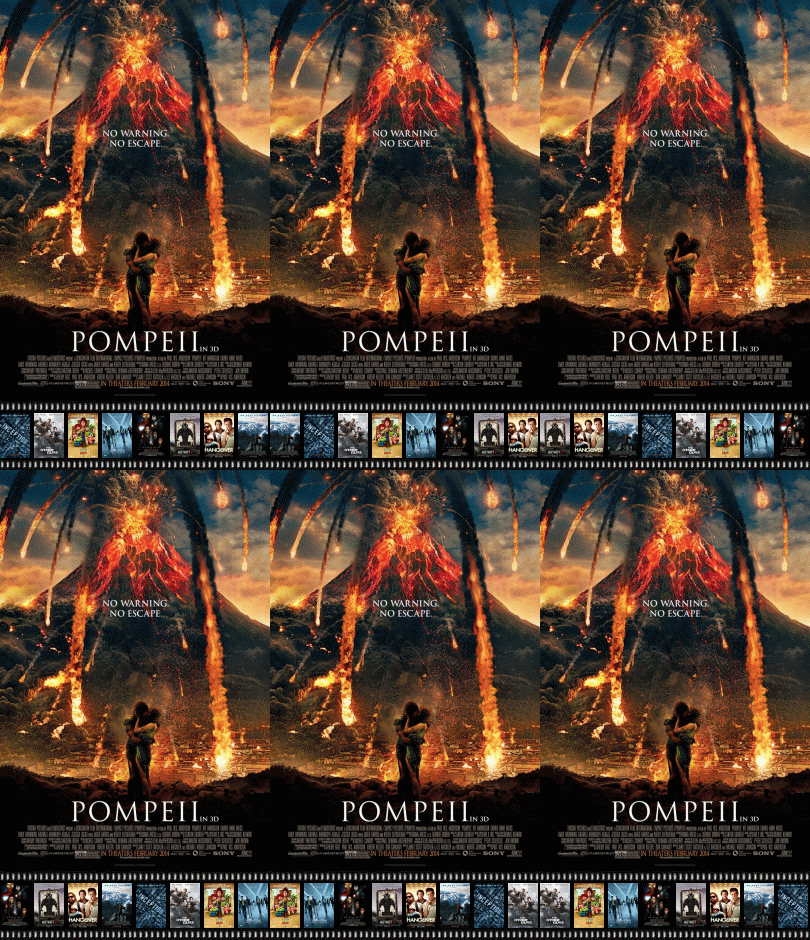
'Pompeii' (film) - movie review

'Pompeii' (film) [Wikipedia]

Pompeii (referred to in marketing as Pompeii in 3D) is a 2014 German-Canadian historical disaster film produced and directed by Paul W. S. Anderson. The film stars Kit Harington, Emily Browning, Carrie-Anne Moss, Adewale Akinnuoye-Agbaje, Jessica Lucas, Jared Harris, and Kiefer Sutherland. It premiered in France, Belgium, and Russia on February 19, 2014 and was released over the course of the next two days in many major territories, including the United States, Canada, India, and Australia.

*************************

'Pompeii' wasn't an "epic" movie, such as 'Spartacus', 'Braveheart', or 'Gladiator'. It was a good movie, and like 'Braveheart', it brought a historical event to life. Apparently, Pompeii was something of a resort city within the Roman Empire... located near modern Naples. It was a major city, and was perhaps more perceived as a "resort town" by Roman authorities.

It would not be giving away the movie to state the obvious... that Pompeii was located right near the foot of Mt. Vesuvius, which was an active volcano which destroyed the city in a horrific manner in 79 AD. Actually it wasn't the lava which destroyed the city and killed its inhabitants, but the real details are too gruesome to go into now. The plot of the movie was fictional.

The film opens with scenes of plaster casts of the victims of Pompeii as quotes on the destruction are made. The opening scene is from the Roman province of Britannia, where Celtic Britons lose in a revolt against the Roman army. The only survivor is a male child named Milo who becomes one of the two chief protagonists. He grows up to be a gladiator in Britannia, and naturally he has a desire for revenge against the Romans in a political and military sense. He is eventually taken to Pompeii to fight in the colosseum arena there, where he meets a princess named Cassia whose father is the city ruler Severus (Jared Harris). Severus' wife, Aurelia, is played by Carrie-Anne Moss. She has such a great character face.


The love affair between Milo (Kit Harington) and Cassia (Emily Browning) is the main plot around which the whole movie revolves. I thought Kiefer Sutherland played the best role, as far as character acting, in the role of Senator Corvus.. a powerful Senator from Rome who was forcing himself on the city's first family while pursuing Cassia for marriage. Naturally Corvus, a classic "bad guy," came into conflict with Milo. This was a very fast-paced film which fits events which would have unfolded over a year or two... into a few days.

The graphics of this movie were very good. Pompeii reminded me of what I perceive Etruscan cities to have looked. The beautiful imagery of the city against the mountains and countryside. During the opening scene in Pompeii.. it was during the "Festival of Vinalia"... a Roman harvest festival held in April and August. Later, the harbor of Pompeii was shown as spectacular and very advanced. Not surprisingly, the special effects of Mt. Vesuvius blowing looked like the end of the world. For the people of Pompeii, it was.

Milo's legitimate issue with Roman authority went along with what was portrayed as a bit of an autonomous feeling by the Pompeiians against Roman dominance over them. The Romans were clearly shown as the antagonists here. One interesting quote from Senator Corvus caught my ear... where he mentions the Roman deities Jupiter and Venus. Jupiter was the god of sky and lightening... symbolized by the eruption of Mt. Vesuvius; while Venus was the goddess of love, beauty, sex, fertility and prosperity... symbolized by Pompeii.

.