
Showing posts with label films. Show all posts
Showing posts with label films. Show all posts
Saturday, August 31, 2019
Sergio Leone Greatest Western Music of All Time (2018 Remastered 𝐇𝐃 Audio)
Sergio Leone Greatest Western Music of All Time (2018 Remastered 𝐇𝐃 Audio)
3,606,799 views
April 24, 2018
Ennio Morricone
Maestro Ennio Morricone and his timeless masterpieces.
NEW Video: Ennio Morricone “The Spaghetti Westerns Music”
https://www.youtube.com/watch?v=Q7tIqEgRwJY
#EnnioMorricone
#EnnioMorriconeMusic
#SpaghettiWesternMusic
Sergio Leone, one of the greatest movie directors of all time wonderfully soundtracked by his friend Maestro Ennio Morricone.
1. Watch Chimes 0:00
2. The Ecstasy of Gold - feat. Edda Dell'Orso 1:08
3. The Good, the Bad and the Ugly 4:28
4. A Fistful of Dollars - Main Theme 7:09
5. Once Upon a Time in the West - feat. Edda Dell'Orso 10:06
6. For a Few Dollars More 13:13
7. A Fistful of Dynamite - feat. Edda Dell'Orso 17:03
8. The Sundown 21:42
9. My Name is Nobody 23:00
10. The Wild Horde 26:08
11. Man with a Harmonica 28:49
12. A Fistful of Dollars - Prima 32:18
13. The Trio 34:07
14. The Strong 41:22
15. Farewell Cheyenne 43:46
16. Jill 46:24
17. My Fault? 48:10
18. Chapel Shootout 52:57
19. Good Luck, Jack 55:16
20. Chase
21. To el Paso
22. Cavalcata
23. Final Duel 1:00:19
24. The Bird's Tale 1:02:46
25. The Story of a Soldier 1:03:38
26. Father Ramirez 1:07:08
27. Two Against Five 1:10:46
28. Prison Break 1:18:08
29. My Name is Nobody - Version 2 1:20:50
30. A Dimly Little Room 1:29:40
Special thanks to Edgar ALEGRE (first comment below) for his kindness.
Sergio Leone Greatest Western Themes of All Time
iTunes http://hyperurl.co/SergioLeone_iTunes
Spotify http://hyperurl.co/SergioLeone_Spotify
Amazon http://hyperurl.co/SergioLeone_Amazon
Deezer http://hyperurl.co/SergioLeone_Deezer
http://vevo.ly/md8d6C
************
"Amazing. Ennio Morricone is 90-years-old and is still working for films today." -- Nick Jasper, YouTube user
"The best western music!!" -- Armando Ponce, YouTube user
"Ennio Morricone a legendery man!! Thanks for all Ennio!! Dont forget to make a statue in Rome for him. He deserves it!!" -- Dr3adKnight, YouTube user
************
YouTube to iPod converter >>> https://www.vidtomp3.com/
************
The Spaghetti Westerns Music - Greatest Western Themes of all Time 𝐇𝐃 Audio
1,403,770 views
November 21, 2018
Ennio Morricone
The Spaghetti Westerns Music – The Greatest Western Music of all time created and composed by Maestro Ennio Morricone. His acclaimed masterpieces all in one special collection.
More than 50 years ago Ennio Morricone revolutionized the concept of Cinema and Film Scores by giving a new and innovative chemistry between images and music. With his unique touch, Maestro created a new music genre, the “Spaghetti Western Music”, a legendary genre recognized worldwide and still inspiring generations.
#SpaghettiWestern
#SpaghettiWesternMusic
#EnnioMorricone
#ItalianWestern
1. Man with a Harmonica 00:00:10
2. The Good The Bad and The Ugly 00:03:40
3. The Ecstasy of Gold (feat. Edda dell'Orso) 00:06:22
4. A Fistful of Dollars - Main Theme 00:09:45
5. My Name is Nobody 00:12:44
6. Once Upon a Time in the West (feat. Edda dell'Orso) 00:15:55
7. A Fistful of Dynamite (feat. Edda dell'Orso) 00:19:06
8. A Fistful of Dollars - Version 2 00:23:43
9. Watch Chimes - Carillion's Theme 00:25:33
10. For a Few Dollars More 00:26:47
11. The Sundown 00:30:36
12. The Wild Horde 00:31:55
13. Face to Face - Titles 00:34:36
14. Chase 00:37:49
15. Tepepa viva la revolucion 00:40:17
16. Un monumento 00:45:51
17. L'arena 00:48:24
18. Canto a mia tierra 00:53:09
19. Libertà 00:56:24
20. Run Man Run - Titles 01:00:40
21. Father Ramirez 01:03:32
22. La messicana 01:06:12
23. The Trio (Extended Version) 01:08:53
24. La loro patria 01:16:07
25. Ricciolo 01:20:08
26. Rosita 01:22:36
27. To El Paso 01:24:59
28. Il Pinguino 01:25:53
.


Monday, September 18, 2017
'The Eagle' - movie review
The Eagle (2011 film)
The Eagle is a 2011 epic historical drama film set in Roman Britain directed by Kevin Macdonald, and starring Channing Tatum, Jamie Bell and Donald Sutherland. Adapted by Jeremy Brock from Rosemary Sutcliff's historical adventure novel The Eagle of the Ninth (1954), the film tells the story of a young Roman officer searching to recover the lost Roman eagle standard of his father's legion in the northern part of Great Britain. The story is based on the Ninth Spanish Legion's supposed disappearance in Britain.
The film was an Anglo-American co-production. It was released in the U.S. and Canada on February 11, 2011, and in the United Kingdom and Ireland on March 25, 2011.
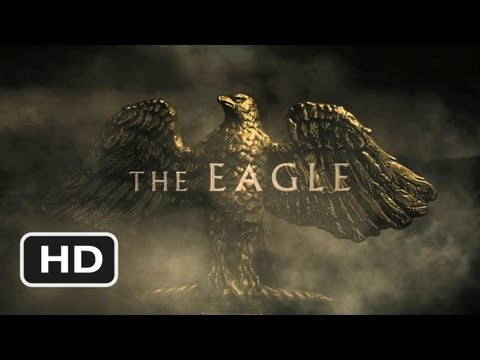 The Eagle is effectively a sequel to the film Centurion, written and directed by Neil Marshall, because Channing Tatum's character in The Eagle is Marcus Flavius Aquila, the son of Titus Flavius Virilus who led the Ninth Legion that was lost in the far north of Britannia, and who was therefore the same person as Dominic West's character Titus Flavius Virilus in Centurion: it continues the story of the disappearance of the Ninth Legion fighting the Picts in what is now northern Scotland, north of Hadrian's Wall by following the leader's son's search to solve the mystery of what happened to his father, and the Legion, and the golden eagle standard that they carried everywhere with them, and to restore his family's honor.
As a historical matter, the purported disappearance of the Ninth Legion in Northern Britain is a subject of debate and dispute (see Legio_IX_Hispana § Theories about the Ninth's disappearance for details.)
*************************
Partial spoiler alert! This review perhaps spoils the first 1/3 of the film....
 The premise of the entire movie was the desire of one man, Marcus Flavius Aquila, to put himself at great risk to recapture the lost honor of both the Roman Empire and that of his own family. Since we no longer live in an honor-bound society, this becomes something to really ponder. The symbol of this endeavor was the lost Roman golden eagle standard; a golden Roman eagle which was attached to a pole such as a national flag; a vexillum. Of course, since his own father commanded the 9th Legion, it was both patriotic and personal. The legion contained 5,000 soldiers, a great loss and embarrassment to the empire; similar to the great Roman defeat in the Teutoburg Forest about 130 years earlier.
The 9th Legion was to have disappeared in what was called Caledonia by the Romans, or what is now Scotland. The Picts were not Gaels, but usually thought of as being a Celtic people, although may have been a particular Atlanto-Mediterranean people. The strange sounding language used by the Picts in the film was not the lost and unknown Pictish language, but Scottish Gaelic. In any case, the tribes of Caledonia were so fierce that the Romans constructed a great fortified wall to seal them off, called Hadian's Wall.
The film opens with a Roman military unit traveling through Briton by boat via a river system with heavy foliage and trees. Suddenly a small herd of large steers splashed across in front of them, showing a certain backwardness to this society; although it was under Roman rule for about a century at that point. The boat carried Marcus who was to be the new commander of a certain Roman fortification and territory in northern Briton. As he arrives, there's a certain ominous feeling. There are still strong unconquered elements about them.
There were a few references to "the gods." Marcus prayed to one of the Roman gods, possibly Mithras, on a couple of occasions. He was a man on a mission. There were rumors of Druids about as well, although the Druids were thought to have been long ago defeated. Apparently, though not militaristic, the Druids had organized resistance to Rome in the past in both Briton and Gaul. Soon after assuming command, on a gloomy night, Marcus awoke with a feeling of danger. He got up and went along the outer walls, and heard a certain noise. They tried to figure out if it was a noise from cattle or not.
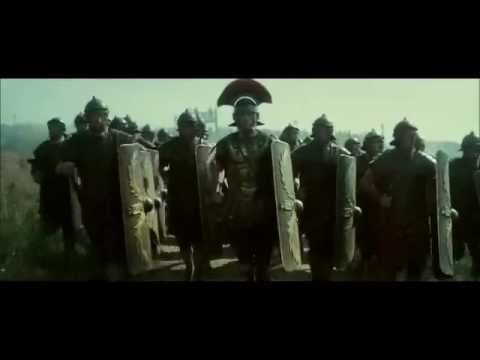 Marcus made a decision to waken all of the soldiers. They dressed and manned the walls, and waited. It could have ended up as a somewhat embarrassing error by the new commander. However, an army of Britons did attack, and the attack was repelled. For this, the young Marcus gained respect from all. The next morning, the army of Britons showed themselves beyond the walls again. As they started a ritual execution of two Roman soldiers, Marcus ordered a preemptive attack. Again, a great battle ensued.
As Marcus fought, visions of his father fighting some unknown enemy was shown; hinting at a psycho-spiritual connection with something which had occurred years earlier. Although the Romans were victorious, it came at a greater loss than the night prior. Marcus was seriously injured in the battle, and was soon taken away to a different part of Briton. I assume that he was relocated to a more southern location of which the Romans had a better grip on things. There he meets his uncle, who is in some form of command, and begins his rehabilitation. At this point there is a reference to an old Roman proverb, cited in the book 'The Eagle of the Ninth':
Eagle lost, honor lost;
Honor lost, all lost.
During some type of life-and-death battle "games," a young Briton named Esca is about to be put to death with the apparent approval of the crowd. Marcus rises and objects, successfully. Esca is allowed to live, and is given to Marcus as a slave. At one point Esca pulls a small dagger on Marcus and tells him that he hates him and everything he stands for; however, due to the fact that Marcus saved his life, swears eternal loyalty to him and puts the dagger down.
 When Marcus finally heals, he begins his quest to find the golden eagle beyond Hadrian's Wall. This is beyond Roman Briton, dark harsh highlands and weather, populated by savage tribes, the unknown, more dangerous than northern Briton, the top of the world. He sets out on horseback with only his slave Esca; and that's where the film really realizes it's aim.
There's a parallel to the movie 'Braveheart', however the film takes no pro or anti Roman slant. Much of the rest of the film is about redemption of Marcus, Esca, and others. Somewhat ironically, "Roman Briton" at a much later point became a new Roman Empire itself. I reviewed 'Centurion' (2010), of which 'The Eagle' was the sequel to, on the other blog... Centurion (movie review).
In ancient legends, the eagle was the symbol of oppression; perhaps more to the point... of a hording of power and knowledge. The serpent was the symbol of liberation and freedom; more to the point... of an opening up of forbidden knowledge and truth. However, it's also been challenged that the eagle is really the liberator and that it symbolizes safety and the rule of law... while the serpent is an anarchist.
.
Saturday, July 8, 2017
Opening battle scence from 'Gladiator' - A devastating fighting force
Gladiator- Opening Scene.avi
Michael M
*************************
I think this scene gives some glimpse of how effective the Roman army could be. There was the equivalent of howitzers and air strikes. Also, when we think of both thrusting and hacking swords, arrows, oil-fire bomb projectiles, and those big arrows that are fired from a cranked up mechanism... I mean, I'd rather just take a bullet! Lastly, the sheer bravery of all ancient warriors to engage in this type of wicked combat.
.
Monday, April 17, 2017
Franco Zeffirelli's 'Jesus of Nazareth' - 40 year anniversary
Jesus Of Nazareth (Full Movie) 1977
Repenttv
*************************
This was a big deal back in 1977... a time when there were five stations on the dial. It tied together the U.S., UK, and Italy in particular... something not likely to happen again given the massive planned changes in society. I was very young, but I remember everyone in the neighborhood seemed to have it on. As twilight and dimly lit windows arrived, that perfect moment in time, there was a certain unity and warmth to it.
When the first episode was broadcast in the United States, it was a major success. The New York Times reported it "swamped all competing programs on Sunday night", with overnight Nielsen ratings of 46% of the total audience in New York and 53% in Los Angeles. The miniseries as a whole received a Nielsen rating of 30.8 points, with each point representing approximately 712,000 television-owning homes, and an audience share of 50% nationwide, on both nights. The company calculated that Jesus attracted about 90 million viewers.
Jesus of Nazareth turned into a massive commercial success and one of the most widely marketed and best-known productions about Christ's life.
NBC rebroadcast the series in 1981 and four more times through 1990.
The mini-series is broadcast every Easter and Christmas in many countries...
 Jesus of Nazareth (miniseries)
Jesus of Nazareth (Italian: Gesù di Nazareth) is a 1977 British-Italian television miniseries directed by Franco Zeffirelli and co-written by Zeffirelli, Anthony Burgess, and Suso Cecchi d'Amico which dramatises the birth, life, ministry, crucifixion and resurrection of Jesus. It stars Robert Powell as Jesus. The miniseries features an all-star cast of famous American and European actors, including seven Academy Award winners: Anne Bancroft, Ernest Borgnine, Laurence Olivier, Christopher Plummer (subsequent winner), Anthony Quinn, Rod Steiger, and Peter Ustinov.
Extra-biblical traditions were used in the writing of the screenplay and some characters (such as Zerah) and situations were invented for the film for brevity or dramatic purposes. Notably, Jesus of Nazareth depicts Judas Iscariot as a well-intentioned man initially, but later as a dupe of Zerah who betrays Jesus largely as a result of Zerah's false platitudes and pretexts. However, in accordance with the Gospels, the film depicts Nicodemus and Joseph of Arimathea as sympathetic members of the Sanhedrin. Many of the miracles of Jesus, such as the changing of water into wine at the wedding at Cana, the transfiguration, and the calming of the storm are not depicted, although Jesus healing the blind man and the crippled woman on Sabbath, the feeding of the multitude, and the raising of Lazarus from the dead are presented here.
Jesus of Nazareth premiered on the Italian channel Rai 1 on 27 March 1977 and was first aired in the United Kingdom on the ITV Network on 3 April 1977. It is generally well-praised, but was not received without controversy.
.
Sunday, April 9, 2017
'Risen' (2016) - movie review
Risen Official Trailer 1 (2016) - Tom Felton Biblical Movie HD
Movieclips Film Festivals & Indie Films
RESURRECTION tells the epic New Testament story of the first forty days after the Resurrection of Jesus Christ through the eyes of an agnostic Roman Centurion charged by Pontius Pilot to investigate rumors of a risen Jewish Messiah and locate the missing deceased body of Jesus of Nazareth in order to subdue an imminent uprising in Jerusalem.
Risen (2016 film)
Risen is a 2016 American biblical drama film directed by Kevin Reynolds; it was conceived from a screenplay written by Reynolds and Paul Aiello. The film stars Joseph Fiennes, Tom Felton, Peter Firth, and Cliff Curtis, and details a Roman soldier's search for Jesus' body following his Resurrection. Columbia Pictures released the film to theaters nationwide in the United States on February 19, 2016.
*************************
 The film begins with the words "Judean Desert AD 33," and a revolt by Judeans against the Roman army. A rather gutty thing to do, as they were poorly armed. In the bigger picture, the Roman provincial prefect Pontius Pilate wanted things to settle down for a coming visit from the Emperor. In a separate early scene, the Crucifixion of "Yeshua" is shown, and the central character Clavius is introduced. He was a high ranking Roman military tribune; likely a fictional character. Roman and Hebrew leadership were portrayed as conspiring together against Yeshua's potential "Messiah" status after his death, and no doubt were doing so when he was alive as far as this movie's depiction.
Basically, the Hebrews appeared as what we would perceive as like Russian Jews; while the Romans appeared more-or-less accurately as being something of like "Alpine types." There is at least some evidence to suggest that the early Romans were more of a proto-European outfit... rising up against the more Mediterranean Etruscans. Our own Cisalpine culture led the way, in terms of the artistic portrayals of Jesus, centuries later. Needless to say, this movie is very relevant to our culture.
While this film doesn't have a particularly expensive or elaborate setting, it likely shows a more accurate Judea of 2,000 years ago. It shows the characters the way they were to have been, without overstating the point. It's an easy watch; rough without displaying too much overt violence.
*************************

.
.
.
.
.
Spoiler alert beyond this point!
.
.
.
.
.

The movie ends with Yeshua saying a few parting words as he walked towards the rising sun, and finally disappears into it. This at least suggests a connection with Horus, Egyptian mythology, and more ancient sun cult stories... and a symbolic tie-in with "the Sun," "the light of the world," or "our risen savior" (every morning). It's possible that this was a more subtle symbol. My guess is that the filmmakers displayed a clear tie-in with Horus. There was also the fish symbolism, which was not nearly as clear or dramatic as the sun symbology.
.
Friday, February 19, 2016
'Conquest of Paradise' by Vangelis
Conquest Of Paradise - Vangelis
New Age Music Corner
From the soundtrack of the 1992 film '!492: Conquest of Paradise'
.
Sunday, September 27, 2015
'The Last Days of Pompeii' (1935) - movie review

The Last Days of Pompeii (1935) is an RKO Radio Pictures film starring Preston Foster and directed by Ernest B. Schoedsack and Merian C. Cooper, creators of the original King Kong. Although inspired by the novel of the same name by Edward Bulwer-Lytton, the film has virtually nothing to do with the book.
This film made good use of artificially generated backgrounds, not entirely unlike computer generated graphics used in films today. The opening scene in Pompeii, with this imagery and music which sounded a bit like the fight song of the University of Southern California, was adequately believable. Black and white films, even through the 50s and even 60s, leave just enough shadow that it somehow allows for a little bit to the imagination.
Preston Foster plays the role of Marcus, a poor honest blacksmith who--through a series of events--ends up as a first rate voluntary gladiator. His character is ambiguous throughout the film. He starts out as a noble-minded and hard-working craftsman; but though some tragic events and great loss, takes on the cold attitude that "money is what really counts." Still, he never quite sells out completely, and the good man underneath remains somewhat dormant. He shows a good heart in adopting the son, named Flavius, of a man he has slain in the arena.
After a profitable period as a gladiator, Marcus becomes a slave trader for a short time, then a seaman and adventurer... something like a soldier of fortune. There are a lot of small but important and prophetic items during a time that he travels with Flavius to the Roman colony of Judea that sets the stage for the rest of the film, but are too numerous to mention in this short review. Now as a man of some fame, he meets the Roman prefect of Judea, Pontious Pilate, and they become close friends after Marcus leads what seems to be an off-the-record raid on a band of Pilate's enemies in the countryside. Pontius Pilate is portrayed as a wise man of some conscience, who seems to feel some guilt for having condemned a particular man to crucifixion. That man, although never named in the movie, was Jesus. They split the loot and Marcus returns to Pompeii.
Jesus and others being crucified. Both seemed strongly affected by their encounter with Jesus. Marcus denied the experience outwardly, while the young Flavius never forgot it. Basically this fictional film, through the story of the characters, subtly ties together the destruction of Pompeii with the beginnings of Christianity. When the now wealthy and popular Marcus returns to Pompeii, he becomes the important "head of the arena"; I suppose something equivalent to maybe a former football star becoming a director of football operations. During this mid-point in the film, Mt. Vesuvius is depicted ominously smoldering in the background, with one character making reference to it briefly.
.
Spoiler alert beyond this point!
.
.
.
.
.
.
 |
| Pompeii ruins with Mt. Vesuvius in the background |
During the chaos, Mt. Vesuvius erupts and there's a very powerful earthquake. Pompeii starts to crumble as lava pours down towards the city. Actually in the real event, it was a type of super-hot and toxic smoke vapor that did in Pompeii and its inhabitants; but perhaps this wasn't known in 1935. After initially breaking
 down emotionally, Marcus quickly recovers--like the Grinch who stole Christmas--and saves a jailer (and the jailer's young son) who earlier would not accept a bribe to release his own son. He then starts loading children onto boats in the harbor ahead of himself. Eventually he saves his son and finally explicitly risks his life standing up to the prefect and his soldiers who wanted to take a boat for themselves away from some children. Marcus is badly wounded by a spear, but his effort allows that last boat to sail to safety.
As this was happening, the city was finally crushed. The final scene shows Marcus dying amid the ruins as he sees the spirit of Jesus come before him... presumably to reward him for his selfless redeeming efforts. Quite an emotional ending for this old film. This film, as well as numerous other works, was inspired by the 1834 novel 'The Last Days of Pomeii', written by the English author Edward Bulwer-Lytton.
.
Saturday, November 29, 2014
'Pompeii' (film) - movie review
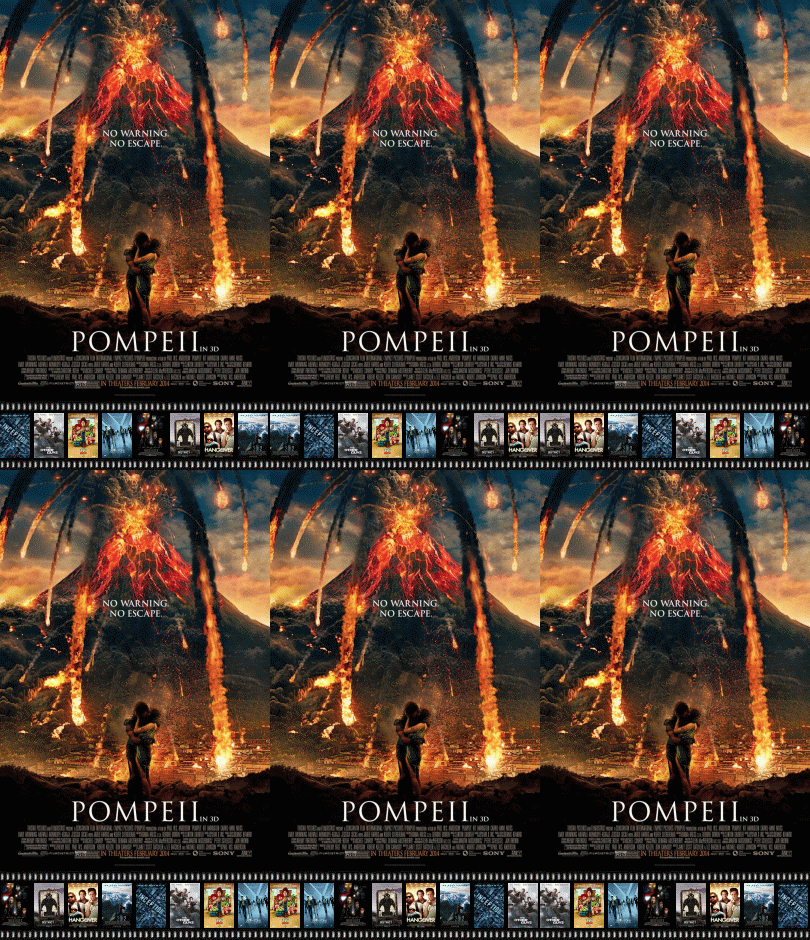
Pompeii (referred to in marketing as Pompeii in 3D) is a 2014 German-Canadian historical disaster film produced and directed by Paul W. S. Anderson. The film stars Kit Harington, Emily Browning, Carrie-Anne Moss, Adewale Akinnuoye-Agbaje, Jessica Lucas, Jared Harris, and Kiefer Sutherland. It premiered in France, Belgium, and Russia on February 19, 2014 and was released over the course of the next two days in many major territories, including the United States, Canada, India, and Australia.
*************************
'Pompeii' wasn't an "epic" movie, such as 'Spartacus', 'Braveheart', or 'Gladiator'. It was a good movie, and like 'Braveheart', it brought a historical event to life. Apparently, Pompeii was something of a resort city within the Roman Empire... located near modern Naples. It was a major city, and was perhaps more perceived as a "resort town" by Roman authorities.
It would not be giving away the movie to state the obvious... that Pompeii was located right near the foot of Mt. Vesuvius, which was an active volcano which destroyed the city in a horrific manner in 79 AD. Actually it wasn't the lava which destroyed the city and killed its inhabitants, but the real details are too gruesome to go into now. The plot of the movie was fictional.
The film opens with scenes of plaster casts of the victims of Pompeii as quotes on the destruction are made. The opening scene is from the Roman province of Britannia, where Celtic Britons lose in a revolt against the Roman army. The only survivor is a male child named Milo who becomes one of the two chief protagonists. He grows up to be a gladiator in Britannia, and naturally he has a desire for revenge against the Romans in a political and military sense. He is eventually taken to Pompeii to fight in the colosseum arena there, where he meets a princess named Cassia whose father is the city ruler Severus (Jared Harris). Severus' wife, Aurelia, is played by Carrie-Anne Moss. She has such a great character face.

The graphics of this movie were very good. Pompeii reminded me of what I perceive Etruscan cities to have looked. The beautiful imagery of the city against the mountains and countryside. During the opening scene in Pompeii.. it was during the "Festival of Vinalia"... a Roman harvest festival held in April and August. Later, the harbor of Pompeii was shown as spectacular and very advanced. Not surprisingly, the special effects of Mt. Vesuvius blowing looked like the end of the world. For the people of Pompeii, it was.
Milo's legitimate issue with Roman authority went along with what was portrayed as a bit of an autonomous feeling by the Pompeiians against Roman dominance over them. The Romans were clearly shown as the antagonists here. One interesting quote from Senator Corvus caught my ear... where he mentions the Roman deities Jupiter and Venus. Jupiter was the god of sky and lightening... symbolized by the eruption of Mt. Vesuvius; while Venus was the goddess of love, beauty, sex, fertility and prosperity... symbolized by Pompeii.
.
Subscribe to:
Posts (Atom)